MULE CROSSING: Why Mules Are Exceptional
 By Meredith Hodges
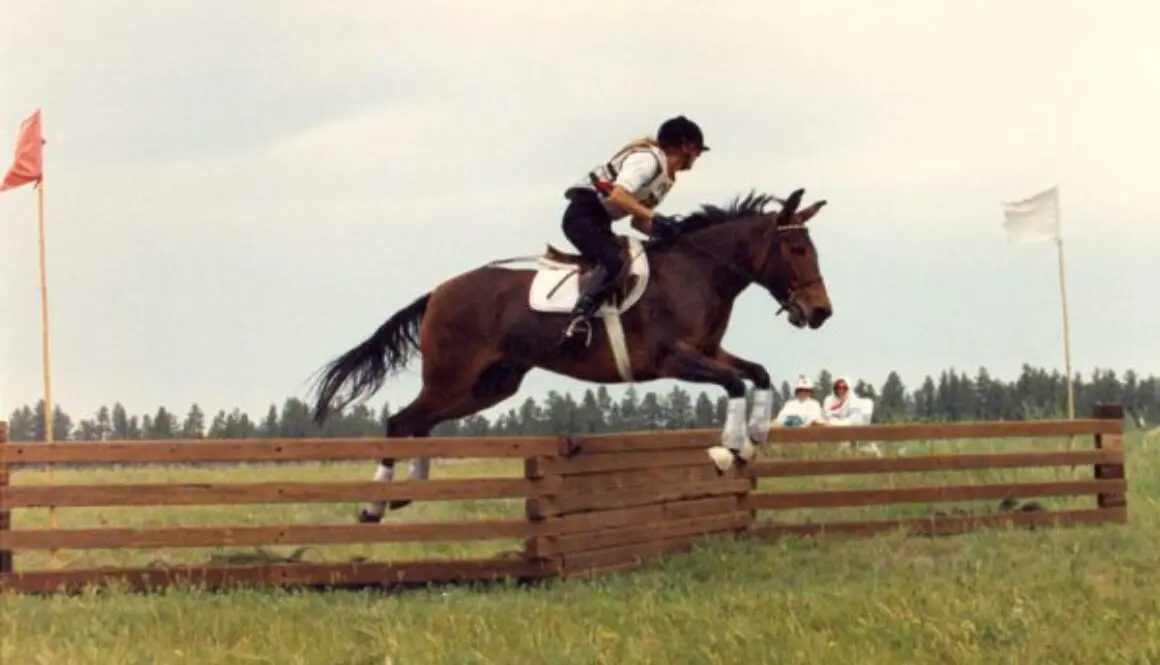
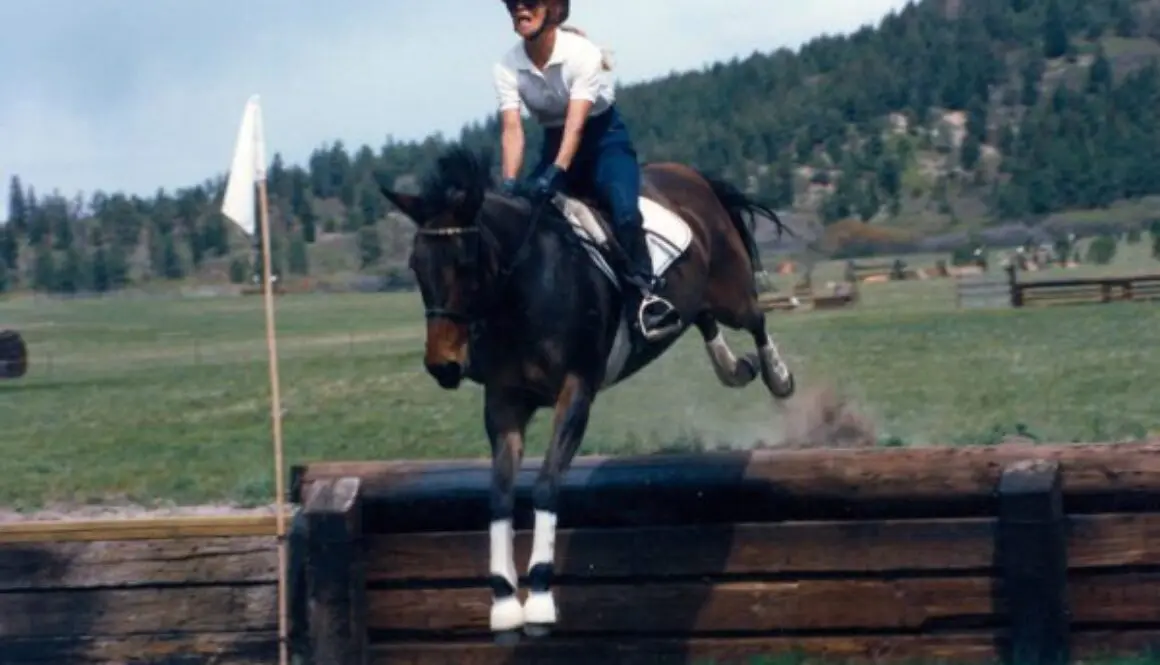
Across the United States and around the world, as mules are given more and more opportunities to perform in many diverse situations, they are exhibiting their exceptional beauty, athletic ability, endurance and intelligence. There are definite physical and psychological reasons for these outstanding abilities. It has been proven that the mule not only inherits the mare’s beauty, but is also more athletic than the mare out of which he came. The mule is an exceptional hybrid not only because he inherits these qualities from his dam, the mare, but he also inherits the best qualities from his sire, the jack who is responsible for his muscle structure, thickness of bone, strength and intelligence.
The muscle structure of a mule is noticeably different than that of a horse. His body is covered with masses of long, smooth muscle whereas the horse has more differentiated bulk muscle masses.


The most apparent example of this difference is seen in the chest of the mule. The horse’s chest has two distinct muscle groups, which creates a very distinctive line of separation in the middle of his chest. However, the mule’s  chest is composed of one wide muscle mass that resembles a turkey’s breast, which greatly enhances the mobility of the front quarters. Another example is found in the mule’s hindquarters, where the long, wide and smooth muscles enable the mule to kick forward, backwards and sideways—he can even scratch the top of his head with a hind foot if he wants to! Mules are also quite capable of climbing under, over and through most kinds of fencing. Restraints that are used with horses often do not work with mules because of their astounding ability to free themselves from annoying circumstances with their strong, quick and agile movements. Because the hindquarters of the horse possess bulkier muscle masses, the horse does not have this incredible range of motion. The difference in muscular structure is similar to that of a ballet dancer versus that of a weight lifter—the ballet dancer’s longer, smoother muscles are more conducive to elasticity and agility.
 In addition to this physical structure, which allows him more diverse range of movement, the mule also inherits from his sire (the donkey jack) the strength to tolerate prolonged and strenuous use of his muscles. One need only try to budge an unwilling donkey to realize his incredible strength! Donkeys traditionally possess an unbelievable vigor, and this vigor is passed on to the mule, adding to his superiority over the horse in strength and endurance. The donkey jack also contributes to the superior, tough hooves of the mule and a unique resistance to parasites and disease. Throughout their long history, the donkey’s natural ability to survive and thrive in habitats both desolate and unyielding guarantees that donkeys and their mule offspring are more sure-footed than other equines and masters of self-preservation.
Donkeys have long been referred to as “stubborn,” but this is a false and unjust perception. It is not stubbornness that causes an overloaded donkey to stop dead in his tracks to rest his body, but rather common sense and a strong desire for self-preservation. After all, would a sensible human being deliberately pack more than he could comfortably carry, and then continue a hike until he drops from heat and exhaustion? No. Would his refusal to do so be considered as being “stubborn?” Certainly not—it’s just common sense. The same common sense should be applied when understanding a mule or donkey’s behavior—and this holds true in any potentially dangerous situation a donkey may face. For example, when crossing a body of water, the donkey does not possess a human’s acute visual depth perception. Therefore, when he refuses to step into water that seems perfectly safe to us, it is because his depth perception is telling him to use caution and to take his time in evaluating the situation before he proceeds. His behavior is determined by the way he is asked to perform a task and by his concern for his welfare and safety.
 As a rule, donkeys are equipped with the innate intelligence to sense that humans are not always concerned with what is really best for them, yet they are still willing to gives us the opportunity to convince them otherwise. Donkeys also have a natural social attraction to humans and, when treated with patience, kindness and understanding, they learn to trust and obey. On the other hand, if they are treated with pain and abuse, they are not likely to comply and can become very dangerous to handle. Mules and donkeys have an honest way of responding to our demands, so if your mule or donkey is not complying with your request, you need to review the clarity of how you are communicating your desire and adjust your approach accordingly. The intelligence of the donkey is no accident.
When a male donkey, with his traits of superior intelligence, strength and muscle structure is bred to a female horse with a calm disposition, good conformation and athletic ability, the result is an exceptional and incredibly beautiful animal—the MULE!
All of us here at Lucky Three Ranch would like to wish longears everywhere and those who love them a very happy Mule Appreciation Day in the fall! October 26th has been popularly designated as National Mule Appreciation Day, but anyone who’s ever been lucky enough to nuzzle a muzzle knows that these magnificent, gentle, bright, honest, upbeat, funny, patient and loyal friends need our appreciation and guardianship not just once a year but every day. Let’s spread the word whenever we can—mules and donkeys are truly amazing!
To learn more about Meredith Hodges and her comprehensive all-breed equine training program, visit LuckyThreeRanch.com, MEREDITH HODGES PUBLIC FIGURE Facebook page, or call 1-800-816-7566. Check out her children’s website at JasperTheMule.com. Also, find Meredith on Pinterest, Instagram, MeWe, YouTube and Twitter.
Covered in TRAINING MULES & DONKEY: A LOGICAL APPROACH TO TRAINING, TRAINING WITHOUT RESISTANCE and EQUUS REVISITED at www.luckythreeranchstore.com
© 2013, 2016, 2024 Lucky Three Ranch, Inc. All Rights Reserved.


 Now that he is moving out well at the walk, you can teach him a reverse. As he is walking forward easily around the round pen, turn away from him, completely around, until you are in front of him. Step toward him, lay the whip ahead of him and give the command to “reverse.” Be aware of his space. Do not rush at him, or he may turn improperly. You want him to turn into the rail and resume the opposite direction. Give him plenty of time to make the turn and ask him to “walk on.” If he has difficulty, take a few steps forward and, with the whip, tap him gently on the shoulder to encourage him to turn. There is a purpose to turning away from him to turn him rather than just running ahead of him. By turning back the opposite way that he is traveling, you are establishing a new direction of travel, as well as giving him time to see that there will be a change in his movement. Most donkeys learn this very quickly.
 After his first lesson of trot, you can begin to integrate rein cues. During the second trot lesson, you will review all that he has learned up to the trot. Before you go to his trot lesson, you can attach your drivelines and ground-drive him through the walk and reverse while on the lines. He should have no trouble with you at his rear, since you have been lunging him from a close proximity from the beginning. Use your whip as you did for the turn on the haunches—at the shoulder for his turns, and at the gaskin to encourage him forward—but just touch him with it to remind him, don’t strike him. You want his movements to be smooth and correct, not abrupt. Pull as lightly as you can with a squeeze/release on the lines to encourage the turns, and make him move off more from your body language and the whip than you do with the lines. If he does well, stop, remove the lines, and send him back to the rail for his trot work—twice in each direction. (This means twice with trotting steps, not twice around the pen.) Then stop, reward him and tell him school’s out until the next time. Whether you come back tomorrow or a week later, rest assured that your donkey will be right where you left him in his training. They have an incredible memory!
 When he ground drives fairly well at the walk, you can mount him if he is a large enough donkey to ride. Mount him from both sides and dismount a few times at first. When he seems calm, you can stay aboard. Take a treat in your hand and encourage him to bend his head and neck around to each side to take the treat from your hand. At the same time, give short, light tugs on the rein on that side. This will encourage lightness in the bridle later on. Now he is ready to move with you aboard. It is best to use an assistant at this stage.
 steps. You can continue this lesson until he has completed one rotation of the round pen in each direction. Then stop him with “whoa” and ask him to go back a step or two. Give light pulls on both reins in a squeeze/release fashion to start, then, as he begins to move his feet backwards, alternate your pressure on the reins with the front foot that is forward. If he does not wish to back, your assistant can help with pressure to his chest as you did on the lead. Always end your riding or ground-driving lesson with a back, and don’t pull so hard on the reins that he resists by jutting his head out. Encourage him to stay light in the bridle. Then finish your lesson with lunging at the trot.
 By Meredith Hodges
 Take your donkey to the middle of the pen and ask him to “whoa.” Reward him for whoa, then step toward his shoulder—pulling his head toward you—tap him on the flank and stifle, and ask him to “move over.” Do not move your body unless you absolutely have to. You want him to keep his front end bent toward you, step under with his near hind leg, and begin to execute a turn on the forehand. This means his front legs will stay stationary while the hind legs move around them and away from you. You want your donkey to take only one step each time you tap him, so don’t get carried away and tap him too hard. We are laying the foundation for hindquarter control and it is easier to let him move slowly, one step at a time, in the beginning than it is to ask him to slow down from too many steps later on. Watch his hind legs to make sure he crosses in front of the offside hind, and stop and reward him after each tap and step. He will probably double in the barrel and move his front legs as well in the beginning. As long as he moves his hindquarters away from you, reward him and repeat. We can perfect his style as he learns what is expected. The first few times, ask only for one or two steps. When he has done this exercise on the near side (left), repeat them from the off side (right). During each session, you can ask for a few more steps in each direction.
 When he is doing the turn on the forehand fairly easily (it doesn’t have to be perfect), you can begin to teach him to move his shoulders away from you with a turn on the haunches. This is much more difficult, since donkeys love to “glue” their front feet to the ground. Take the side of his halter in your left hand, ask him for one step forward and push his face away from you as far as your arm will reach. Then, in the right hand with the end of the lead, tap him firmly on the shoulder and give the command, “Over.” If his hindquarters come around, leave your left hand on the halter and take your right hand and use your body weight to shove him over one step. Stop, praise and reward him for moving his shoulders (even if you had to do all the work). Now try again, tapping him with the end of the lead. If he still won’t move his shoulders, repeat as before. If he does not begin to try to move his shoulders after three tries, use a riding crop in your right hand and tap the shoulders sharply with it—only once! He will probably be so surprised that he will step over quickly. Be ready to reward him when he does. Then stop your lesson there. You can ask for two steps in each direction during the next session. If you try to do any more, you will encounter resistance and he will be unwilling to perform and may run off, so be patient and be ready to take all the time HE needs.
 Repeat these three exercises until he begins to move easily away when you ask. It may take three or four sessions. When he does comply easily, you can begin to teach him to lunge. Review these exercises every time you begin your training session. Then release the lead from the halter. Hold the lunge whip in your left hand and use your right hand to point to the right (the direction you wish him to go). Raise both your arms in unison and tell him to “walk on.” If he doesn’t move away, lower both arms and raise them again, repeating the command. If he still won’t move out, give the verbal command again and give him a firm tap on the gaskin, just below the tail and above the hock, then take a step back and wait for him to comply (donkeys need time to think). If he still won’t move, repeat this action until he does. Once he does start moving away, follow behind and to the side at a distance that he will tolerate. This distance will vary with the individual donkey.
 wander. When you are the correct distance, he will walk forward, although, in the beginning, he will hesitate after every step or two. Practice moving into him and away from him to get him to move. Try to stay out of his space and keep him moving forward after the initial tap of the whip. If he stops and doesn’t seem to want to move, strike the fence behind him once you have him on the rail. Try NOT to hit him if at all possible. Remember, donkeys freeze when they are confused or frightened and you will get nowhere with him at that point. He needs to learn, but he also needs to enjoy what he is doing. Don’t forget to reward him frequently, but be sure that you ask him to go further each time, or you may find yourself training him to walk only so many steps at a time. In the beginning, ask him to go in only one direction and change directions at each session. You can teach him to reverse and go forward later, once he has learned what you are asking.
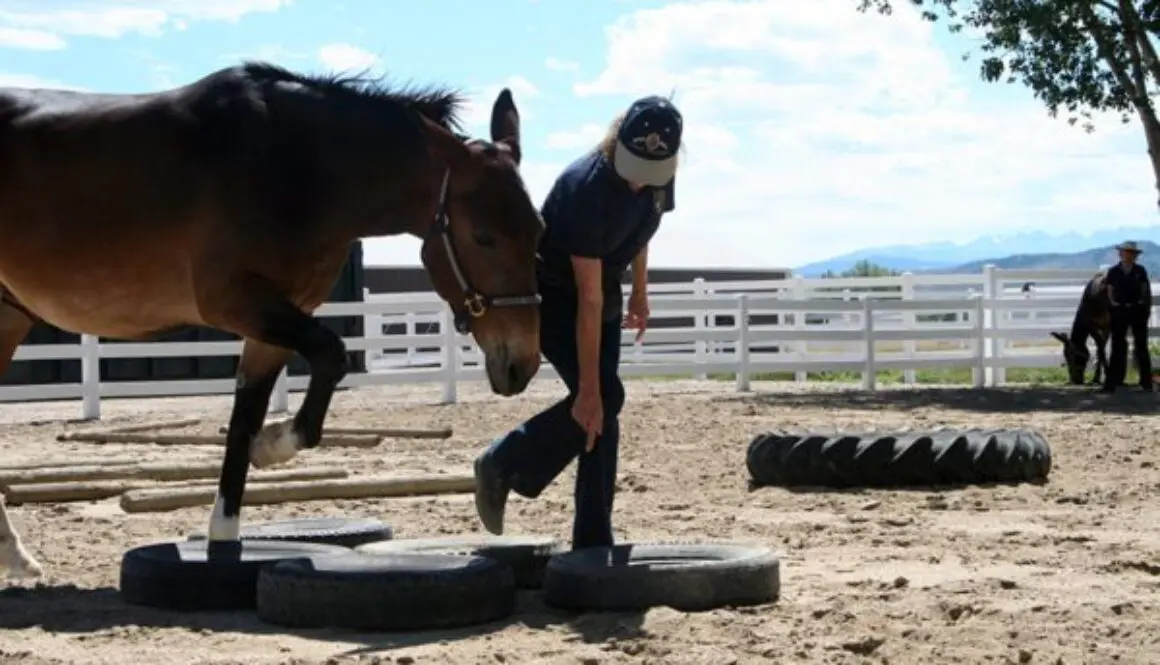
 You really don’t want to desensitize your animals to everything. Here is Webster’s Dictionary’s definition of the word “desensitize”:
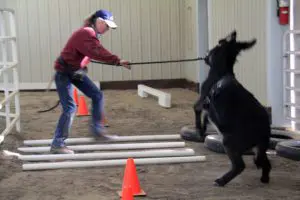 When incorrect, harsh or overly aggressive desensitizing techniques are used on equines, the handler is met with either a very strong flight reflex or a stand and fight reflex. In either case, an equine will either put up a fight and be deemed a rogue and, therefore, untrainable, or eventually just “give up” and succumb to the trainer’s wishes. This is a sad situation because the equine is not given the opportunity to make reasonable choices in his relationship with his trainer. The equine’s instinct to warm up to the person training him is hampered by his fear of more desensitization techniques. Thus, he becomes resigned to his work and is not fully engaged in the training process.
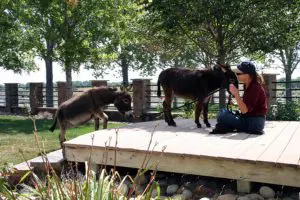 Often, trainers will put obstacles such as a trailer, tire or tarp in an equine’s pen in the hope of getting him used to it by making him live with it. But ask yourself this: How much rest would you get if someone put a blaring radio in your bedroom to desensitize you to noise? Equines have many of the same reactions to their personal space that we do, and they do much better when their place of rest is just that—a place of rest and comfort. And when lessons are approached in a considerate, respectful and rewarding way, an equine is more likely to approach them with an eager and positive attitude that facilitates better learning. It is always better to turn your equine’s fear into curiosity than it is to just assault his senses.
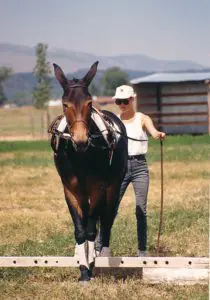 When doing obstacle training, it is better to allow your equine a gradual approach with small steps and great rewards for his honest effort than to whip and spur him through just to get to the other side. When his fear is converted to curiosity, the chance of his refusal to go forward is lessened and his trust in you as the trainer allows you to, eventually, ride through any obstacle at the slightest suggestion. This is because he trusts your judgment and has not been frightened, hurt or made uncomfortable during the training process. This is your equine developing sensitivity to your demands and learning to willingly comply so he can become a participating partner in each activity.
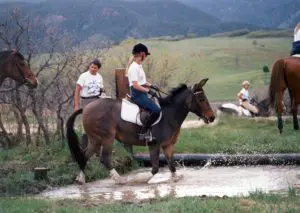 If you were asked to go on a 25-mile hike with a 50-pound pack on your back, how would you prepare in order to safely and successfully perform this task? You would break it down into small steps, working up to it by first running a short distance with a very light weight, and then gradually increasing the distance you run and the weight you carry, which may take as long as a couple of years of careful training and conditioning. But if you tried to prepare for this kind of grueling hike by simply walking around the block a few times for a couple of days, you’d wreck your muscles, compromise your health and probably fail—all because you attempted to do the task when you weren’t physically or mentally ready. And depending on how much you strained your body, you just might discover down the line that the damage is permanent and will worsen over the course of your life. I use this illustration to show that, just as with humans, when it comes to training and conditioning your equine, it’s always better to take it slowly—one step at a time. Your equine will learn to enjoy being a partner in your challenges and goals if you give him the time he needs to be able to do these activities comfortably and with success.
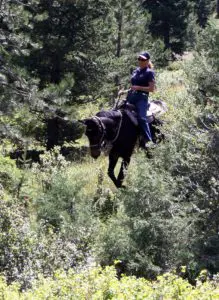 It is because I have trained my mules in this sensitized way that I once avoided going over a 100-foot drop up in the Rocky Mountains while on a trail ride. On that particular day, I was in front, riding my mule, Mae Bea C.T. with four horses behind us. When we came to a giant boulder semi-blocking the trail, I told the people on the horses to wait and rode ahead. I soon found that the trail had narrowed to an impassable two feet wide and a rockslide had wiped out the trail ahead completely! It was straight up 100 feet on one side of the trail and straight down 100 feet on the other side and there was no going forward. The horses behind me were still on the wider part of the trail on the other side of the boulder and were able turn around, so they were safe, but backing my mule around the boulder on that treacherous trail would be very dangerous. I thought we were stuck. At that point, my mule calmly looked back around at me as if to ask, “Well, Mom, what do we do now?” I thought for a minute and then shifted the weight in my seat toward my mule’s hindquarters. This movement from me allowed her to shift her weight to her hindquarters. Then, with pressure from my right leg, she lifted her shoulders, pivoted on her left hind foot and performed a 180-degree turn to the left on her haunches, and with her front feet in the air, she swept them across the open precipice of the cliff and turned us back around to face the wider (and safe) part of the trail. After completing the turn, she stopped again, looked back at me to see if everything was okay and waited for my cue to proceed back down. I believe, without a doubt, that my mule’s incredible and calm response to a life-threatening situation was the direct result of the sensitized training methods I used that created our unbreakable bond of trust.
 Training your donkey is not really much different than training horses and mules, although there are differences in instinct and attitude that will determine your approach in given situations. The mechanics and techniques, however, remain the same.
 When imprinting the foal, think of the kind of attitude you want to cultivate in him—do not come at him with the idea that he must accept you. This is a forceful and intrusive attitude and can foster resistance. Come at him with love, patience and kindness and these are the things he will learn. Give him respect and ask that he respect you and he will begin to learn about behavioral limitations. If he were in a herd, the adults would demand that he respect their space with well-placed discipline. You must learn to do the same without overdoing it. If he bites or kicks, a well-placed slap on the side of the mouth for biting and on the rump for kicking and a loud, “No!” will do the trick. Rewarding his good behaviors consistently will reinforce repetition of what you desire from him and will foster understanding between you and your donkey. This is the beginning of a long-lasting bond of friendship.
 Whether your donkey is a young foal or an older animal, begin with imprinting and do the steps in sequence. Learn how to properly put on the halter. Let him wear it for a while then take it off, as he could get it caught and injure himself if it is left on. When your donkey is not bothered by you putting on and taking off the halter, you can teach him to be tied. Put the halter on him and tie him to a safe post for one hour. Come by to see him every 10 or 15 minutes, untie him and ask him to “come.” If he does not take a step toward you, just retie him and leave. Come back in 10 minutes and try again. When he takes a step toward you, reward him with a treat and lots of praise. Stroke him on the neck and shoulder or on the poll between the ears, or scratch his chest or rump—whatever he finds most pleasing. Then try a few more steps. Don’t ask for any more steps each day than he is willing to give. Save them for the next time and soon he will lead easily. When he is leading easily, you can start taking walks around the farm and you can begin to introduce him to things he may find frightening. Lead him as close as he will go at your shoulder, then step toward the obstacle as close as the lead will allow and coax him to you. Offer a reward if necessary to entice him, and be sure to reward him when he comes forward. When he is confident about investigating “things” with you, you can progress to an obstacle course.
 At your first try going over logs, a bridge, tires, or other such obstacles, you may find your donkey reluctant to pick up his feet to negotiate an obstacle. He will probably try to go around it any way he can. Stand close to his head, holding him on a shorter lead, and ask him to “come.” If he moves only one foot over a log or tire or onto a bridge, stop, hold him there and give him a reward for his effort. Next, ask for the other foot and, if he is willing, let him walk over the obstacle, then reward him again. If he moves only one foot more, reward that, and proceed—slowly! You don’t want him to just run through it. You want him to come when you say “come” and to whoa when you say “whoa.” You are beginning to establish verbal communication with your donkey, so keep it simple and consistent. Do all obstacles the same way. Donkeys like to get crooked over obstacles. When he has learned to step through or over an obstacle but is not going straight, you can step directly in front of him, holding the halter on both sides, and ask for straightness as he negotiates the obstacle.
 Once he has learned to follow you over and around obstacles, he will be ready to begin the fundamentals of showmanship. Hold your lead in your left hand, keeping your right hand free and straight out in front of you. He should learn to lead with slack in the lead and to follow your shoulder. If he gets too close, you can use your right hand to push him back into position. Once you have begun showmanship training, ALWAYS lead him this way. Teach him to stand squarely on all fours every time he stops. You are not just teaching him to set up, but to carry his body in a balanced fashion so he will develop good posture and balance. When you want to teach him to trot on the lead, give the verbal command to “trot” and slowly move your own legs into a very slow trot. If he is difficult, do not go to the whip. Try to find something toward which he wants to trot. Above all, don’t get discouraged if he won’t trot the first few times, just slow back down and do something he already knows, then quit for the day and try again the next. Eventually, he WILL get it!
 Do the same exercises (outlined in DVD #1 of my
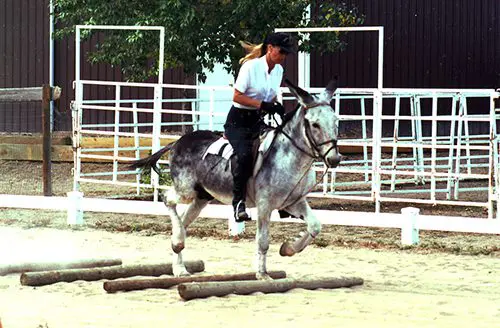 It is important that your donkey be in the best posture he can be in while he is performing at this stage of training. The way that he is moving with his body is the way his muscles and tendons will be strengthened and toned, and the way his bones will become permanently aligned. It is difficult for a rider to maintain this impeccable balance through every step and every stride. For this reason, you will use your “elbow pull” training aid to encourage your donkey’s good posture throughout training, once he has learned the right moves. Adjust your “elbow pull” so that, when tight, his poll can be raised about six inches above his withers. The “elbow pull” will help to maintain his proper frame and good balance without you having to fuss with anything. The “elbow pull” is most helpful during lateral movements, but it also helps him to maintain his balance through transitions and changes of direction. Get in the habit of using it all the time during intermediate training. When he is going well, staying in proper frame, light on the bit and responsive to your cues, and when the “elbow pull” is loose throughout all of his workouts—only then should you remove it. (Use of the “elbow pull” and instructions on how to make it are covered in my
  Now you need to teach your donkey to lengthen his trot. The elbow pull should have helped you to get a true trot out of your donkey. He will not be able to lengthen from a single-foot trot. Do not begin lengthening until the true trot is well established. When you wish to start schooling the lengthening, begin by asking him to lengthen on the long diagonal and corner-to-corner in your arena. Ask him to cover more ground going toward the center and as he approaches the corner, ask him to shorten his stride and collect the trot before the corner. Do not just ask for more speed. A lengthening is a more ground-covering walk, trot or canter, but maintains the same rhythm and cadence. In the beginning it will seem like there is very little difference between the working and lengthened gaits, but as he gets stronger and more agile, the difference will become more apparent.
 Next you will begin to regulate the canter. Place a pole perpendicular to the long side of your arena. Canter around the perimeter of the arena, coming down the long side and over the pole. Each time you approach the pole, about three strides out, start counting to your donkey, “One, two, three, pole.” This will accomplish several things. First, you will learn to gauge your distances and measure your donkey’s strides. Second, your donkey will learn to adjust his strides and they will become more balanced, rhythmic and cadenced. Next, he will become more obedient to your aids. Don’t forget to count out loud to your donkey every time you do this exercise. Remember, donkeys respond best to verbal commands. Do the canter pole several times in each direction, during each session that you work in the arena to help improve his canter.
 Whether you plan to jump or not, the next exercise is beneficial to your donkey’s body conditioning. It will help him to become agile and strong and he will be able to carry your weight a lot more efficiently. First set four cavalletti in your arena and have your donkey trot through them during several lessons. Then, set a cavalletti or cross rail jump in your arena with a ground rail one stride before and after. Begin each session with review and warm up with stretching—turns on the forehand and haunches on the lead; feeding treats from his back, bending his head to your knee on both sides; walking and trotting through the hour-glass pattern on the long rein; walking, trotting and cantering the perimeter of the arena on the long rein. Then you should do a collecting exercise. Ask him to collect on the short sides, and lengthen on the long sides at the walk and then do this at the trot. After the warm-up, stop and rest for three minutes. After the collection exercise, stop and rest for three minutes. He will be working in approximately 15-minute intervals with three-minute breaks in between. This is standard for mules, donkeys and horses.
 For the final segment of his workout, take him along the rail at the trot and come up over the cavalletti or cross rail jump. Two strides out from the ground rail (three strides from the cavalletti), start counting out loud, “One, two, three, JUMP!” Allow your donkey to trot after the cavalletti the first two times through, and the third time over ask him to canter away to the rail and down the long side of the arena. Then stop and reward him for his effort. Give him a brief rest and then repeat the exercise the same way three times with a brief rest after each canter pass. When he has done this pattern three times going in one direction, do the same thing three times going the other direction. If he is lazy, he may need encouragement from the crop, or you may need to wear BLUNT spurs. If he wants to run at the cavalletti, you will need to school him a little differently. You will need to walk to the ground rail, stop and back. Then turn away from the cavalletti, do a circle and approach again at the walk, stop and back. Circle again—at the trot this time—stop, back. Do this twice. The third time, let him trot and jump the cavalletti. After he jumps the cavalletti, a few strides out, ask him to stop and back. This is to help him to let YOU maintain control. It will also help him to maintain his balance and jump correctly, thus avoiding a mishap or fall.
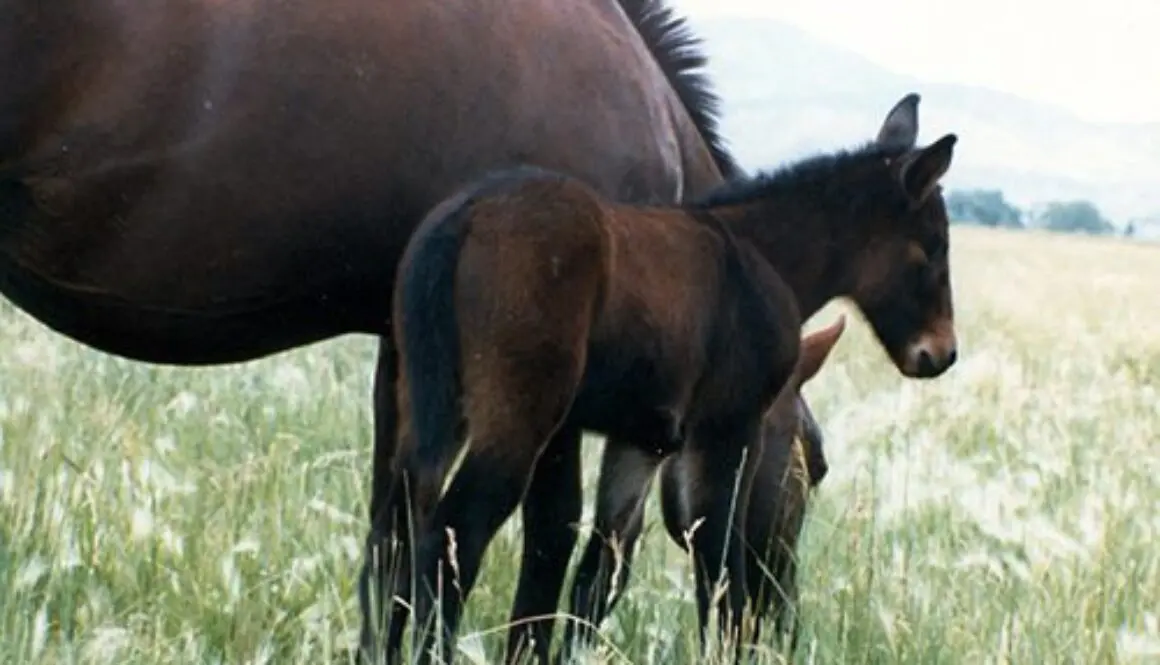
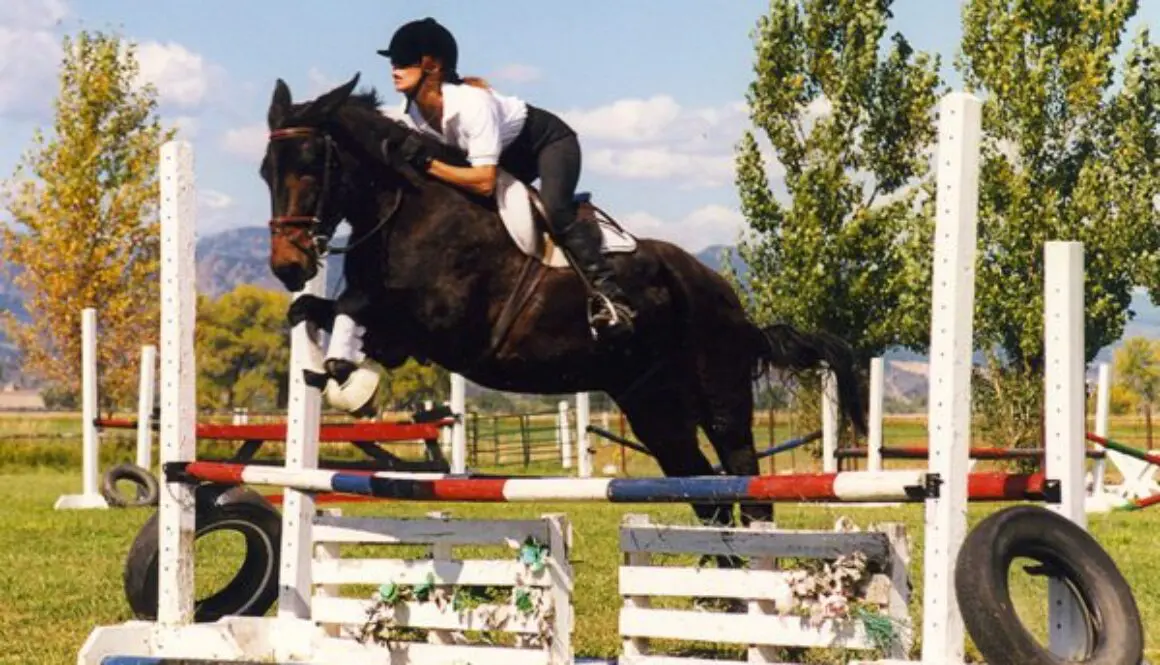

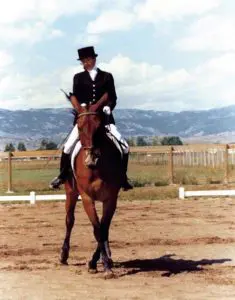 When proper attention is given to the development of balanced, postural core muscle strength from the very beginning, the equine develops strength symmetrically throughout his body as he grows. Muscles are stressed and relaxed at critical intervals, allowing for healthy mental, physical and emotional growth. When the equine feels good in his body, it clears his mind to concentrate on his performance. The result is an equine that is happy in his work and in his world.
 Dressage training has evolved from a useful tool to strengthen and balance a useful horse to just another name in Big Business. Today, equines are thought of as economic commodity, or a breeding investment, and are used in events such as Reining, Cutting, Stadium Jumping, Racing, Steeplechase, Eventing, Hunting, Dressage and just-for-pleasure riding. Monetary investment is high, and never was the old adage of “horse poor” more prevalent than now!
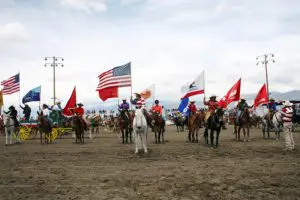 Owners can expect to spend thousands of dollars in a year for no more than a pleasure riding equine, and the cost increases with the status of the activities. The cost of supporting an equine provides economic success to a multitude of businesses such as feed stores, tack and equipment, truck and trailer sales, drug companies, motels, gas stations, county fairgrounds, breed registries, brand inspection, clothing stores, veterinarians, farriers, and the list goes on.
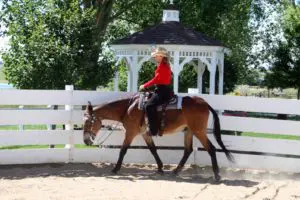 Breeding for bigger, better and faster equines, has given people the false idea that these horses perform almost solely from their heredity. This has changed how they are being trained and judged. Today, many equine competitions are no longer judged by an expert who really knows the definition of correct movement. We are inundated with terminology from the Masters that is most often misunderstood and distorted.
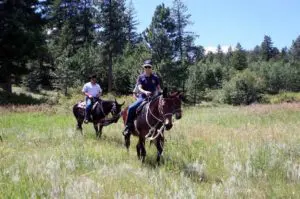 To those who are not schooled in Dressage, collection can mean a lot of things that are contrary to the actual definition, including the belief that it means to merely break at the poll and arc the head and neck. People also believe that an equine is on the bit if he arcs his head and neck and flexes at the poll. What this actually means is that the equine has taken contact with the bit, and can feel the hands of the rider through the reins, and respond lightly and obediently whether his head and neck are arched or not. Vertical flexion is the result of correct collection that involves the entire body of the equine, when the equine is flexible from head to tail with the hindquarters properly engaged. It is not the act of bringing the equine’s chin to his chest. Lateral flexion is when the equine bends his whole body through his rib cage to the arc of a circle, and is not just bending his head and neck to your knee.
 You would teach him to lunge on the lunge line in the Round Pen first with enough slack in the line so it drags on the ground as he circles. Keep a slightly open fist on the line and close your first as the outside front leg comes forward into suspension. He will feel this pressure and bring that front leg onto the circle instead of going straight forward with it. This is the cue you will use when lunging him on the line in the open arena.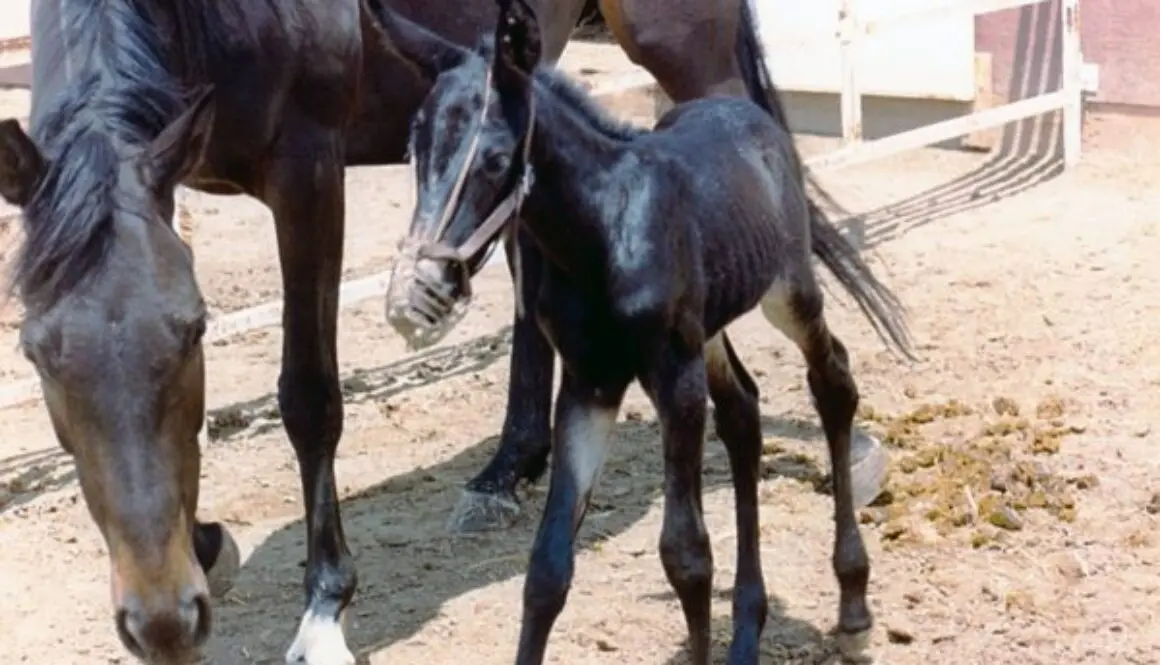



 Many veterinarians and farriers refuse to work on mules. Some are slaves to the old wives’ tales about mules being stubborn, ornery and dangerous, and some are subject to owners who cannot manage their own animals. The professionals that primarily studied with horses are more apt to be tolerant of a misbehaving horse than of a misbehaving mule. They have a better idea of what to expect and how to deal with it.
 upon their arrival; (2) the animals are not handled regularly or trained correctly and are difficult to treat; (3) owners use excitable disciplinary tactics while the professional is working on the animal, putting him in physical jeopardy; and (4) owners do not follow up on treatment instructions. True, these complaints apply to both horse and mule owners. To dispel old rumors about mules, it is important that all your equines are easily managed. The veterinarian or Farrier will not be as quick to forgive a mule. The mule foal learns his behavior from his dam. A calm and obedient mare makes for a calm and obedient foal.
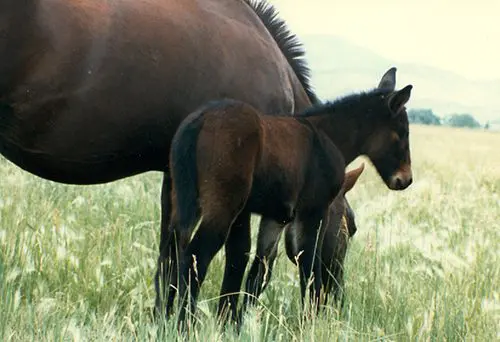 You are the one that interacts with the animal most often and should know the details that the vet could not possibly know. Good records are important for clear communication with your vet. With each visit, update him on your equine’s management & training status. Alert the vet as to any changes in the equine’s behavior or medical status. Ask questions and learn about what your vet is doing with each visit to increase your knowledge and understanding.
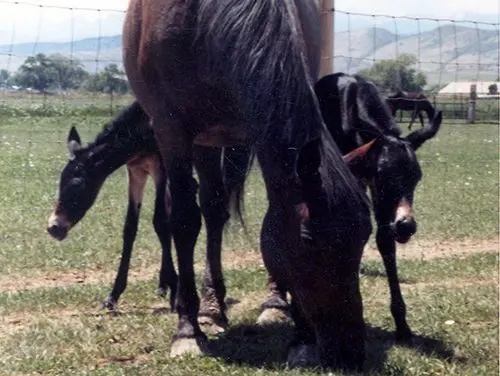 As in RH incompatibility in humans, if the foal’s blood type is the same as the mare’s blood type, there is no problem. If the foal’s blood type is different from the mare’s, antibodies may be created in the mare’s blood. That is when the problems begin. Mares should be tested for the possibility for an N.I. baby 1-3 weeks before foaling, but you can also test at 30 days before foaling, and again later closer to the time of foaling, to allow more preparation time. Consult your veterinarian well before the mare’s delivery date to make a plan for testing.
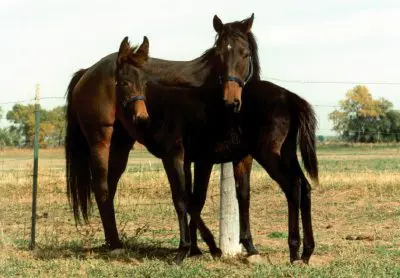 Decide on a foaling location. Decide about the birth location…at home, or remotely managed. If she is to be foaling at home, pick a large stall and run to allow for plenty of room and easy access to the mare and foal. It is helpful to install a camera for monitoring the mare since you must catch the foal before it suckles the mare. Keep the mare and foal inside a safe stall for the first 24-36 hours. The stall and run can be next to other animals fence provided there are no health risks. Having other equines near can help to keep the mare from feeling alone and anxious.
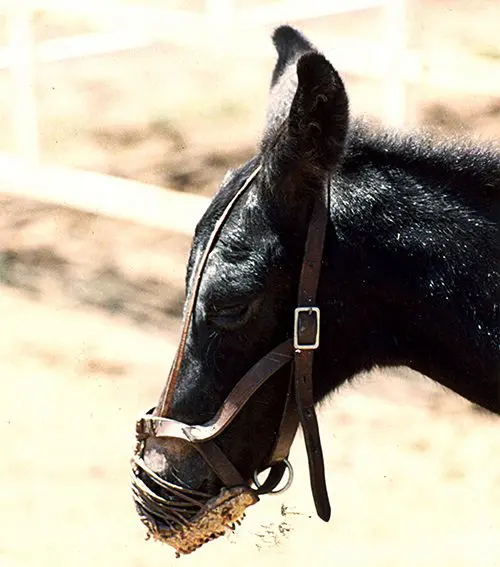 Be sure to have a muzzle on hand for the N.I. foal. Do not confuse a grazing muzzle with an N.I. muzzle. You can obtain an N.I. Foal Muzzle from:
 Be present for the birth of the foal, imprint, and muzzle the foal immediately. Tie the mare to a stout post in the stall next to the feeder (with about 3’ of slack), take the muzzle off of the foal, feed the foal replacement colostrum and after the predetermined amount of colostrum has been provided over the first few hours of life Milk out the mare every 2 hours. When you are bottle feeding the foal, position him at the mare’s flank. Putting him onto the mare to suckle later will then be easier. Have grass hay in the feeder to help keep the mare occupied while you work. Make sure the foal starts to receive the replacement colostrum as soon as it has a suckle reflex. Consult with your veterinarian about the amount to feed the foal at each feeding and how often to feed the foal.
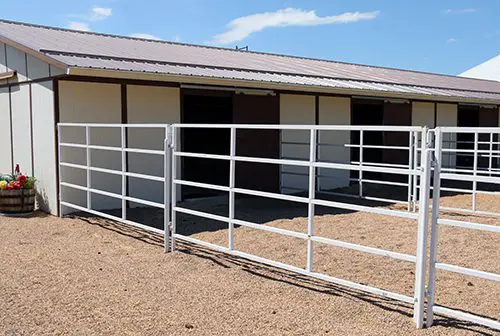 When the muzzle is removed, you can open the stall door and they can be turned into the run together (with the stall door remaining open). Keep them both separated from other animals until the foal is finally weaned. The foal should not be weaned until he is sixth months old. They should not be turned out with other animals to prevent the risk of injury to the foal. If there are other mares with foals, they are safe turnout mates.
 In Part 1 of Equine Behavior: Look Who’s Talking, we discussed the evolution of man’s self-discovery and how he applied this to his approach to equines. If we want to manage our equines in a healthy way and accomplish even the most basic performance with them, there is much to consider during the training process. In the not-so-distant past, the prevalent belief was that, if you had a reasonably large patch of grass with a fence around it, you could have a horse. We now know it takes much more than this!
 Born in Athens, Greece in 431 BC and referred to today as the original “Horse Whisperer,” Xenophon is considered to be the founder of military Horsemanship. He is credited with the beginning of structured, classical equine training over 1,000 years ago, when equines were trained with military defense in mind.1 The equine’s training was critical to the defense of his rider, and this meant that the animal had to be strong, healthy and obedient. Man discovered that when he paid attention to the mental and physical needs of the equine, he got a more willing and obedient response, and the result was a healthier and more protective companion than one that was forced into submission. Harnessing the defense mechanisms of the horse was not only awe-inspiring but effective.
 As man’s environment changed, he changed with it. However, when dealing with equines, he neglected to realize that he had changed the equine’s natural habitat forever and had begun a compression of space and freedom that would ultimately result in anxious and nervous behaviors in the equine. The equine’s negative response to this environment was most obvious when he was subjugated by man. Man misperceived the equine’s adverse behaviors as deliberate disobedience.
 The learned behaviors coming from other sources such as environment do not replace but, rather, become yet another integral part of the whole equine. It is easy to believe that if you reward good behavior it will be repeated, but not so easy to identify all good behaviors and reward them promptly. It is even more difficult to learn to identify bad behaviors, punish them accordingly and re-route behavior to the positive again. This requires the handler to move away from an observational post and become involved and engaged with the equine on a whole new level.
 The sum total of the effect an individual has on others is referred to as his “social stimulus value.” The social stimulus value of a human being takes into account his or her height, hair color, general physique, vitality and so forth. It includes distinctive behavior patterns such as habits and mannerisms. The sum total of the effect an individual equine has on other equines is referred to as his “status in the pecking order.” It also includes distinctive behavior patterns such as habits and mannerisms.
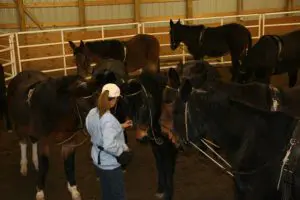 At first, it disturbed me when I could not turn my much older animals out with the adult male mules. I thought they should be able to get along, until I began to think of them in terms of rebellious teenagers who did not appreciate the sage advice of their elders. The “guidance” of the elder equines was not appreciated at all, so I separated the groups during turnout and later integrated them during training, after they had learned to be polite and considerate to the other equines.
 As they proceed through the training program, their expressions soften with acceptance. They then begin to show interest that ultimately results in an animal that is confident and trusting. You can see the soul emanating from their eyes and watch their overall carriage change to one of confidence and trust. These are simply behavioral manifestations of the equine’s introspection, or the way he perceives himself in his world. Change his world in a kind and understanding way and so will his perceptions change. The equine whose personality develops in a healthy way will exhibit more courage and less fear in the face of stressful situations and extreme weather conditions. The bond and trust in the handler is stronger than his sense of fear and you can see it in his face.
 Learning to be polite and considerate and giving pleasure with concrete reasons that are physical, mental and emotional in nature yield true health, and not just a perverse image. Be careful of arrogance. Arrogance stems from a masterful or Godlike approach, devoid of humility, that may elevate one’s ego, but invariably creates a “victim” equine instead of a willing and grateful partner and companion.


 What kind of equine handler are you? When interacting with your Longears or any equine, are you an observer or a participant? Are you fully aware of the reasons for your equine’s behaviors? Behavior in general is most often motivated by a stimulus that elicits a response, yet the early years of physiological development are most dependent on heredity. Heredity includes not only physical characteristics, but mental, emotional and instinctual behaviors as well. We are taught that if an equine’s knees are beginning to fuse, he is ready for training. Is the animal really ready for training just because his knees are beginning to fuse? Physical development is called maturation, and we often determine the equine’s capabilities by maturation alone, with no consideration for the whole animal.
 When the stallion signals danger, it is this mare that will lead the herd, while the stallion generally brings up the rear. During estrus, the mare cycles every 21 days during the warmer months of the year. The mare accepts the stallion for only seven days out of the 21-day cycle. The stallion may cover her several times during that period and will do the same with the other mares in the herd. Not all mares will accept the advances of the stallion at certain times and, because they are as different as people are in their genetic makeup, not all of them will become pregnant every time.
 A mule will pin its ears when it is concentrating very hard and when it is following you and wants attention. Mules and donkeys are basically very friendly and rarely lay their ears flat back in pure anger like a horse will. When they are angry, you will know it. Scratching in different areas will produce different results. If you scratch their jowls, for instance, they may perk their ears forward, but when you rub their forehead, they will lay their ears back. If you scratch the insides of the ears, some will like it and tilt the head sideways with quivering eyebrows while others will jerk away at your impolite intrusion.
 At first, Arabian horses were thought to be silly and difficult—not the ideal mount for the common man. Later, the intelligence of the Arabian was discovered and explained by saying that, because the Arabian’s eyes are set lower in the head and the forehead is broader than most other equines, there is more brain space in the skull. This is also true of most mules and, particularly, Arabian mules. Once man believed in the equine’s intelligence and had a scientific reason for it, training was modified and approached a little differently. Man was then able to learn even more about the horses he was training. It wasn’t long before man discovered that this didn’t always hold true and there had to be more to consider when assessing the whole human being and, consequently, the whole horse.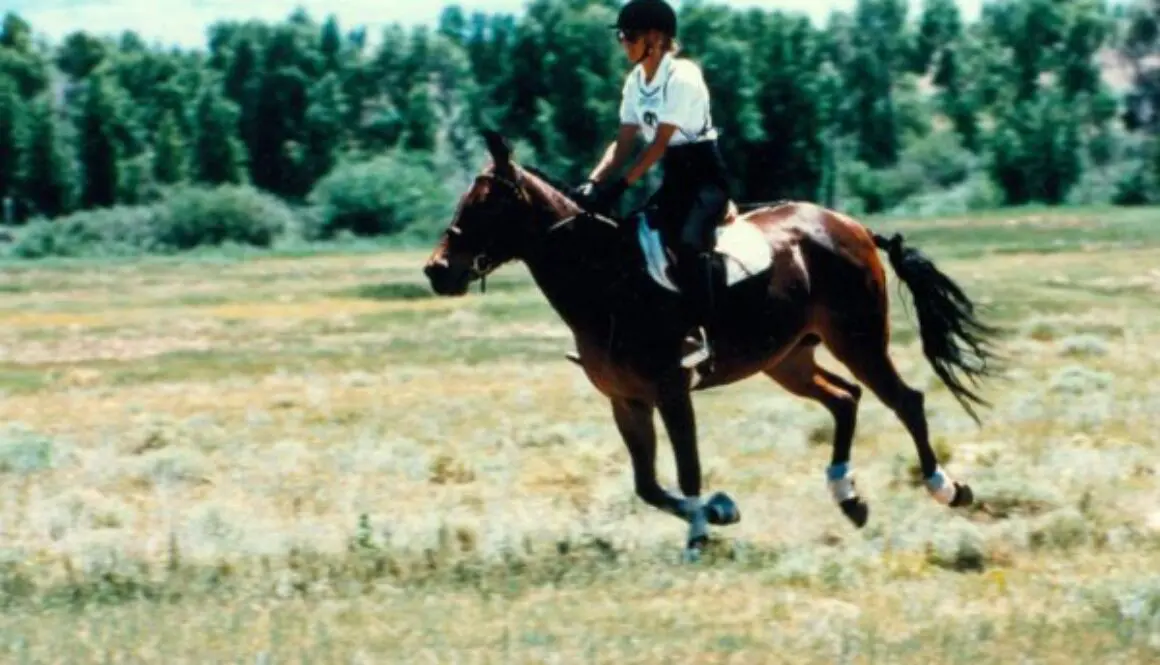
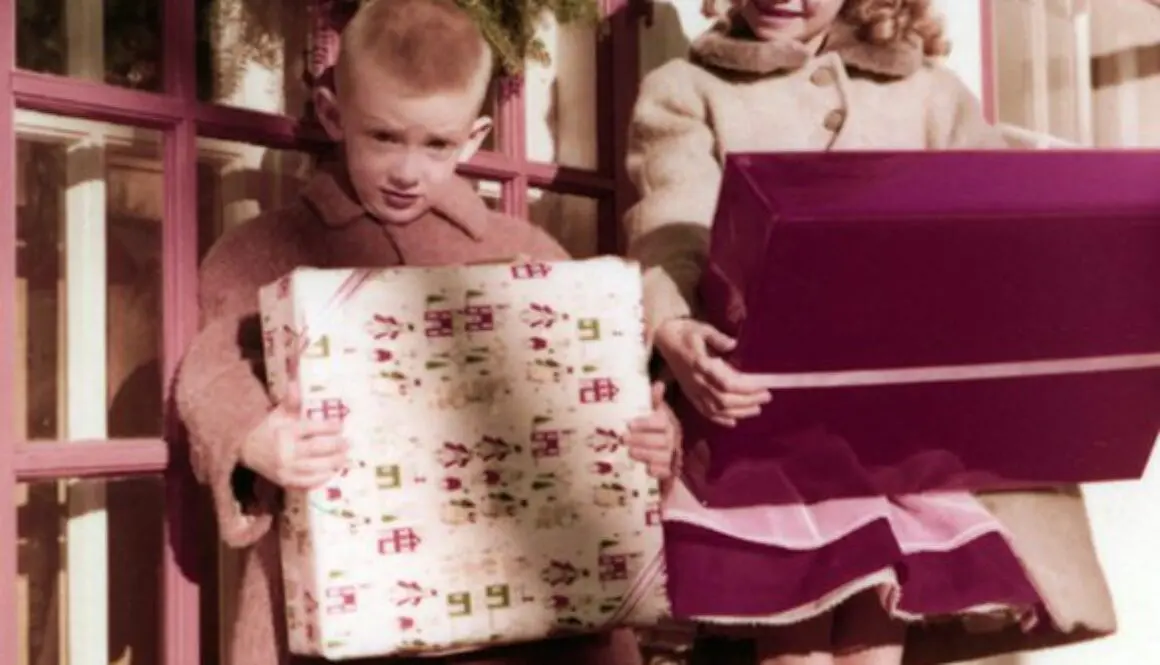
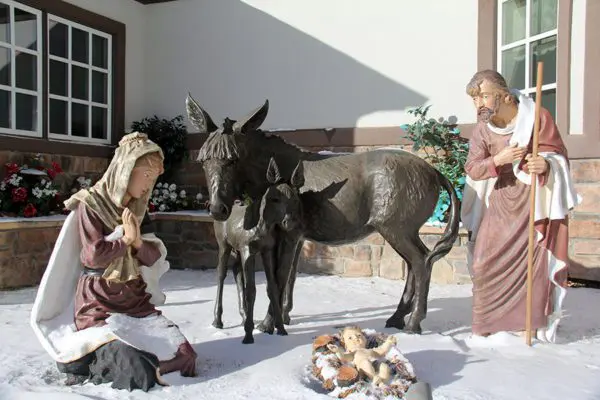 My favorite holiday of the year has always been Christmas! The sights, sounds and smells of Christmas transport me to a magical place for the whole month of December, and the excitement and joy of yesterday still ring true today. I cannot think of a more deserving holiday than one that celebrates the birth of Jesus Christ and promotes so much hope and serenity throughout the world, if only for a day. Christmas reminds us all that the spirit of sharing and giving is timeless and takes only a willing attitude and a little bit of creativity.
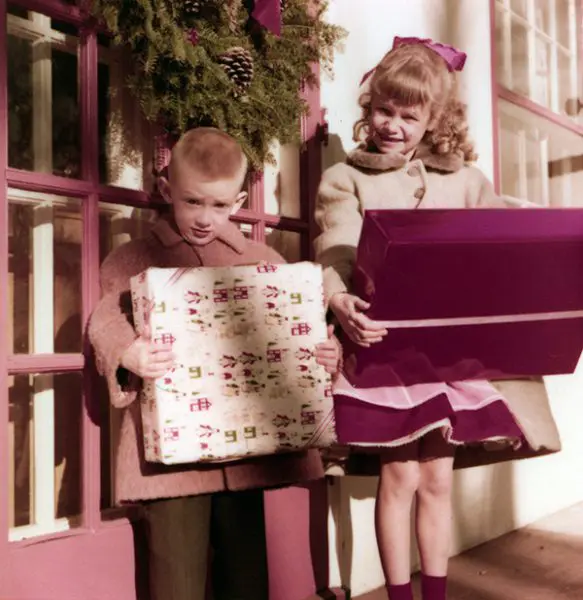 watched a 1955 film called On The Twelfth Day of Christmas. As you might guess, it was based on the old English song, “The Twelve Days of Christmas.” Every year, the film brought wild bursts of laughter, as we watched a proper Edwardian lady’s townhouse in England become filled to overflowing with gifts from her suitor. Not only did she get the gift designated for each day, but also the same gifts from prior days plus the new one. By Christmas, her little townhouse was filled with 12 partridges in pear trees, 22 turtle doves, 30 French hens, 36 calling birds, 25 gold rings, 30 geese a laying, 28 swans a swimming, 32 maids a milking, 27 ladies dancing, 30 Lords a leaping, 22 Pipers piping and 12 drummers drumming! Laughter filled our house daily from that day forward, all the way up to Christmas. Of course, as children, we were also reminded of the “naughty and nice” list.
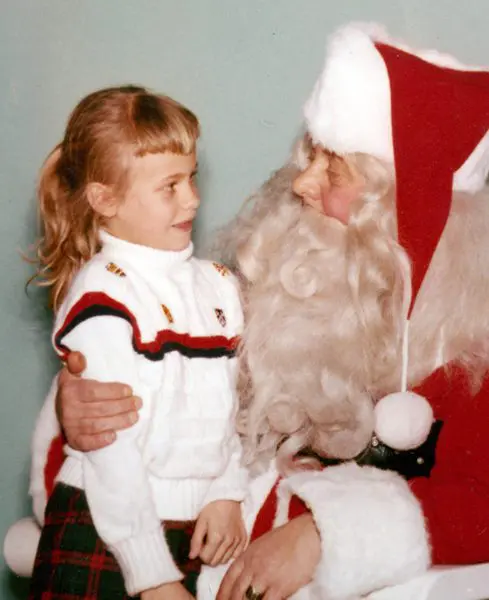 Christmas baking for days on end with my Grandma is a favorite memory. We got to bake great gifts for many friends and family members (and we all knew there would be time to exercise and take off the weight…LATER!). We children were wide-eyed and filled with wonder as we passed the evenings listening to our favorite Christmas carols and our elders’ stories of Christmases past. And we absolutely knew that Santa really could drive eight tiny reindeer across the sky, with Rudolph lighting the way with his red nose, bringing presents to little children all over the world. All of these experiences bonded our entire family together.
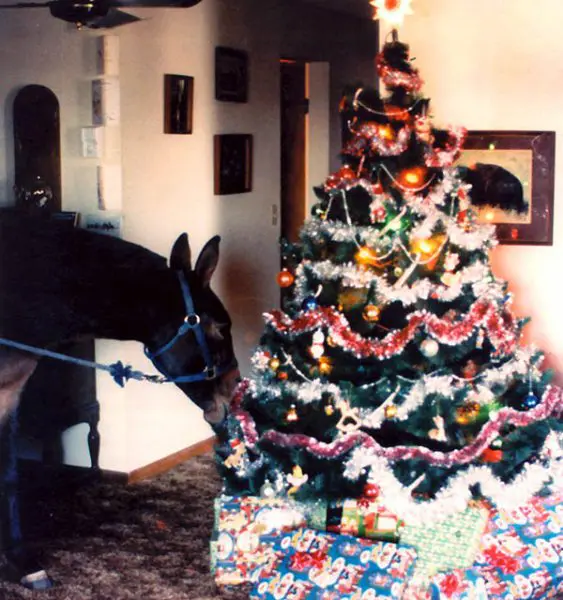 We kids always awoke extremely early on Christmas Day, bouncing down the stairs to see what Santa had left us. The cookies and milk were gone and the presents from Santa were under the tree, but we were not allowed to touch them until our parents and grandparents got up. That wait was excruciating, but it was oh so much fun when the adults finally got up! After opening presents, everyone had a light breakfast, because the early afternoon would bring our traditional Christmas dinner with friends and family. My mother made the most amazing spread of perfectly roasted turkey and stuffing, mashed potatoes and gravy, an incredible salad filled with everything you can think of from the garden, sweet potatoes and a lovely cranberry sauce. The meal was always topped off by my grandmother’s unique and decadent chocolate roll, a light chocolate cake with real whipped cream and homemade chocolate sauce on top.
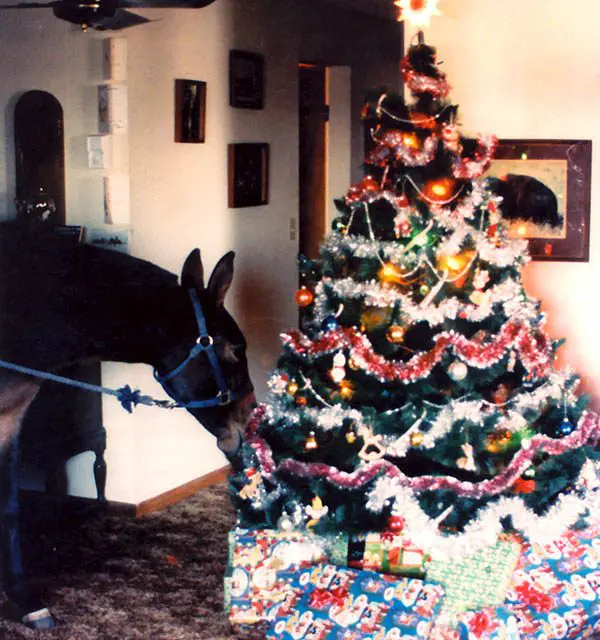
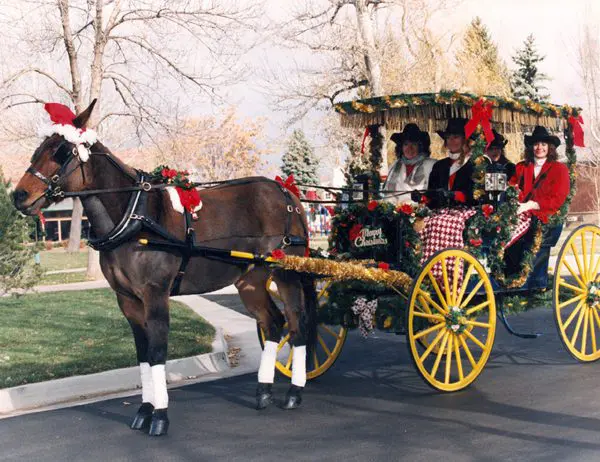 original farmhouse at Lucky Three Ranch, the old floors were sturdier than those in my present home, so the mules were actually allowed to help with the decorating of the Christmas tree!
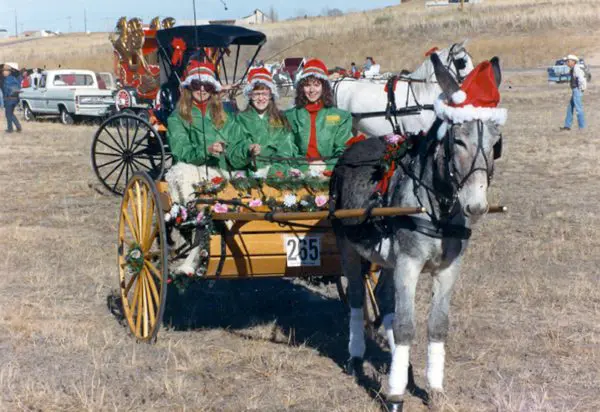 my mules, horses and donkeys became an integral part of each holiday season. My favorite tradition now is the time spent sharing a warm hug with each of my equines and giving them an extra measure of oats on that very special day that we call Christmas!