LTR Blog
Posts to share on the LTR blog
Lucky Three Ranch Impressions
(Page 48) Excerpted from: Touring Lucky Three Ranch with Meredith Hodges: Unexpected, Free-wheeling, Fun!
By Nell Wade
It’s not just a ranch—it’s an experience! Nestled on 127 sprawling acres that snuggle up to the edge of the gorgeous Rocky Mountain foothills, Lucky Three Ranch is the name that world-renown mule and donkey expert and equestrian star, Meredith Hodges, chose to christen what has become the heart and soul of her ongoing commitment to the preservation and welfare of mules and donkeys everywhere.
What strikes you first is her huge but inviting house. It’s a fairy castle built by someone who dreams like a child but thinks like an engineer. The front door flies open and out strides a tall, attractive and very vibrant woman. Her vivacious energy belies her age, and makes the statement that she is mistress of her domain but all friends are welcome and strangers can count on becoming friends. Meredith Hodges is off and running, multi-tasking like a house on fire with the same spirit and sense of adventure she attributes to her favorite creatures on earth.
The nearby barns erupt with a raucous chorus of honks, brays, chirps, snorts, and a bunch of other noises. These are the happy cheers of a bunch of kids who’ve been waiting for their mom to come out and play with them. These are Meredith’s mules!
As everyone piles into a very cute but surprisingly souped-up golf cart, Meredith takes the helm. The wind blows through your hair and you hang onto your hat as she drives around her huge property. Slowing the cart at the mule and donkey stalls, Meredith calls to each of her “kids” and out they come; some trotting, some sauntering, some prancing—but all full of tossing heads, inquisitive looks, sniffing nostrils and lots of of “mule talk.” A thrill runs down your spine as you respond in a very unexpected but wonderful way to this primal communication.
A trip to Lucky Three Ranch gives you a chance to savor the real meaning of “ranch lifestyle.” You’ll get to meet people who are so genuine and down-to-earth, you’ll want to hang out until you really have to go, as you wonder where the day went. Most of all, you’re going to discover why the Lucky Three Ranch experience is “all about the mules.” The fun and spontaneity generated by these people-loving creatures is something you’ll laugh about for a long time, and their intelligence and sensitivity will touch your heart. Witnessing these unique and amazing animals up close, you can’t help but feel that the fun and adventure of being around Meredith and her mules has just begun!
Get in Sync With Your Equine
(3-13-15) Lucky Three Vindicator and I are in perfect sync with each other and happy throughout all activities…even smiling for the camera and opening and closing gates! After training in multiple equine disciplines, I firmly believe that a well-adjusted and welltrained equine needs the same ideal attention that children need to help them prepare for adulthood. Ideal training involves not only Classical Dressage for physical development, Behavior Modification for character development and natural horsemanship for playful yet productive bonding, but also building core muscle strength in good posture to prepare them to carry a rider efficiently to prevent injury. Good posture is not automatically attained without a structured groundwork program that is both challenging AND fun…just like we structure for grades K-12! And nothing can replace the instillation of mutual respect and good manners in all living creatures! Learn more about our comprehensive training program at www.luckythreeranch.com.
Training the Jumping Donkey
(Page 45) Donkeys have been labeled stubborn for centuries, but with the right approach, they are every bit as trainable and tractable as horses, mules and ponies. Donkeys just demand more consideration and respect to really want to perform for you. If you want to jump any equine, it is not advisable to just go out and start jumping. As with any equine athlete, the animal first needs to have gone through extensive ground work that addresses core muscle strength in good equine posture using intensive leading lessons on flat ground and through obstacles, lunging, ground-driving and basic under saddle work. This takes a lot of patience, time and symmetrical body-building through postural core exercises that address core strength in the elements around the bones.
When he is finally able to sustain his own balance with adequate core strength, he should be worked over 6-inch ground rails and cavalletti to develop bulk muscle and strength in the hind quarters that will be used to propel him over the jumps. Working over raised cavalletti will increase the power from behind and will begin to add much more suspension to his gaits. Once the four raised cavalletti are easy for him, he can move to jumping single cavalletti with ground rails on both sides to help him sustain good posture throughout the jump.
Finally, he can begin gymnastics through a line of simple ground rails, cross rails, vertical jumps and an oxer appropriately spaced with all rails first just lying on the ground. Raise the jumps in 3-inch increments on each jump as the line becomes easy for him beginning with the first rail. It won’t be long before he can jump the whole gymnastic line and all jumps that have been gradually raised appropriately to more formidable heights.
To learn more details about jumping, look in the various sections under TRAINING on my website at www.luckythreeranch.com. Particular videos about jumping can be found under TRAINING/TRAINING TIPS (#98 through #108).
Shedding
(Page 62)
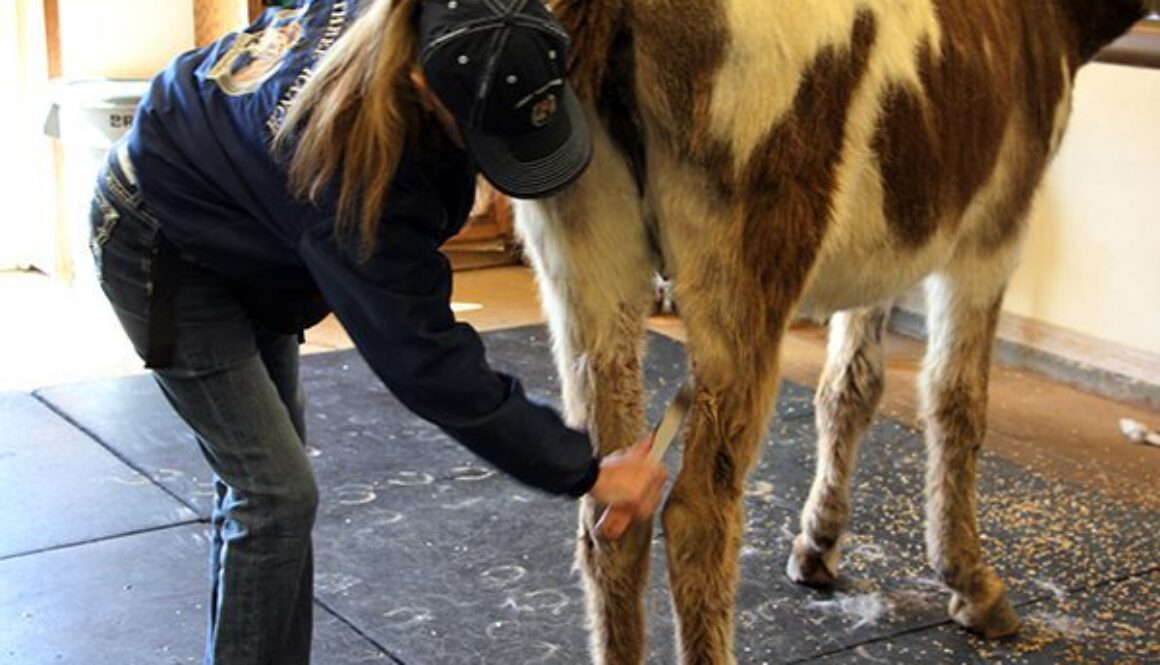
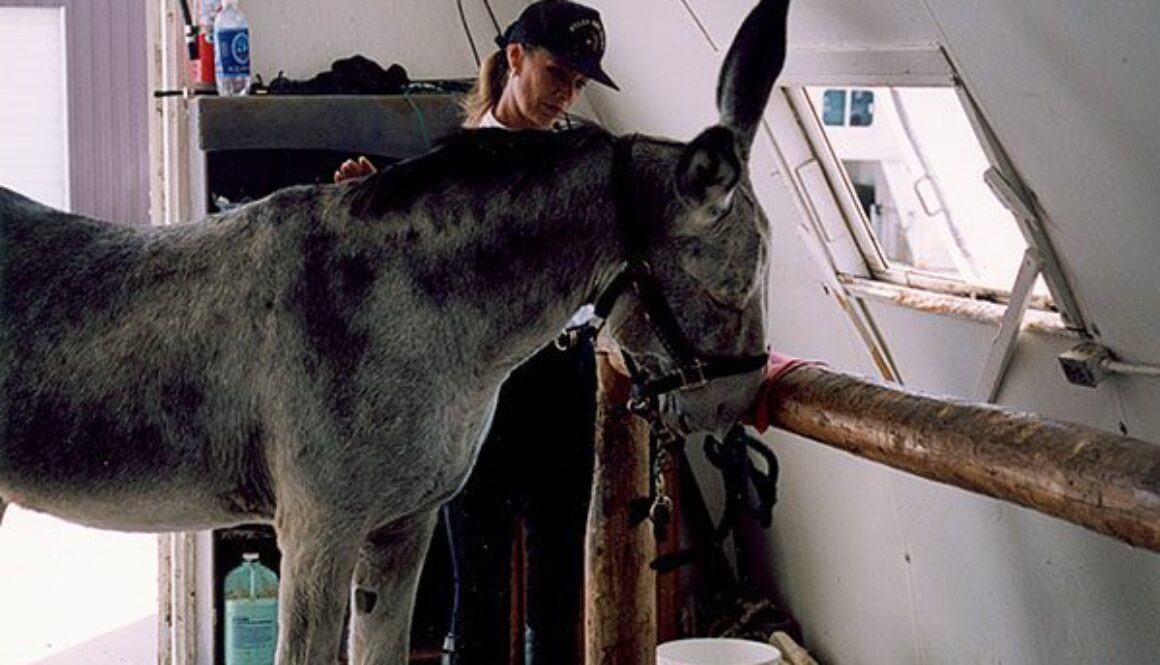
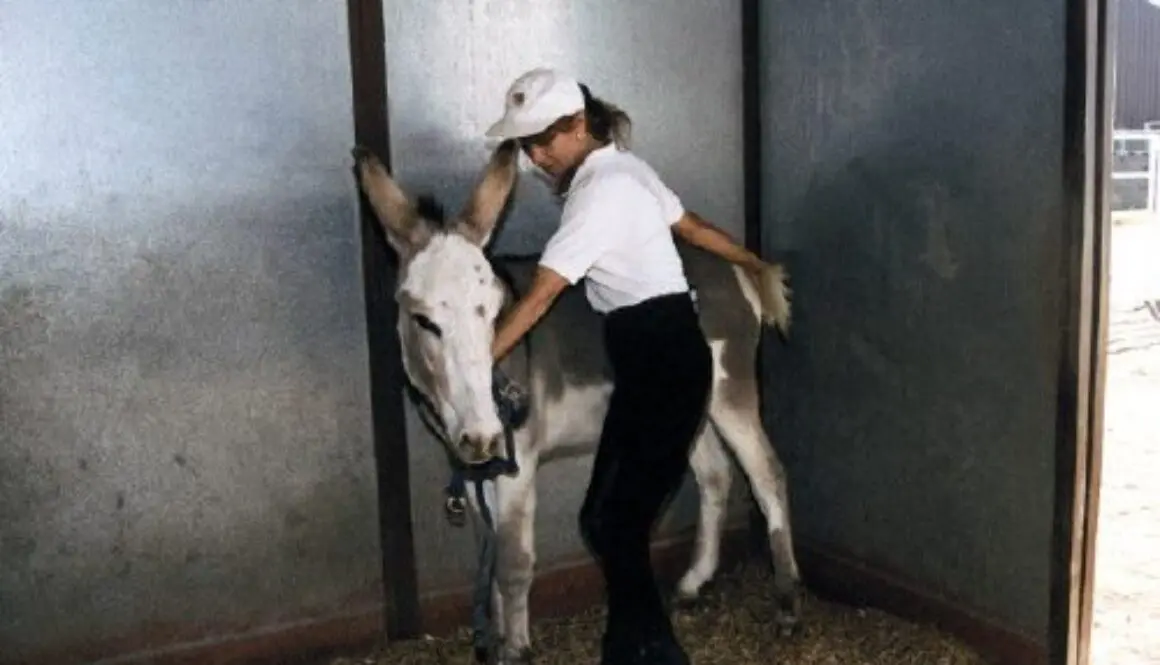
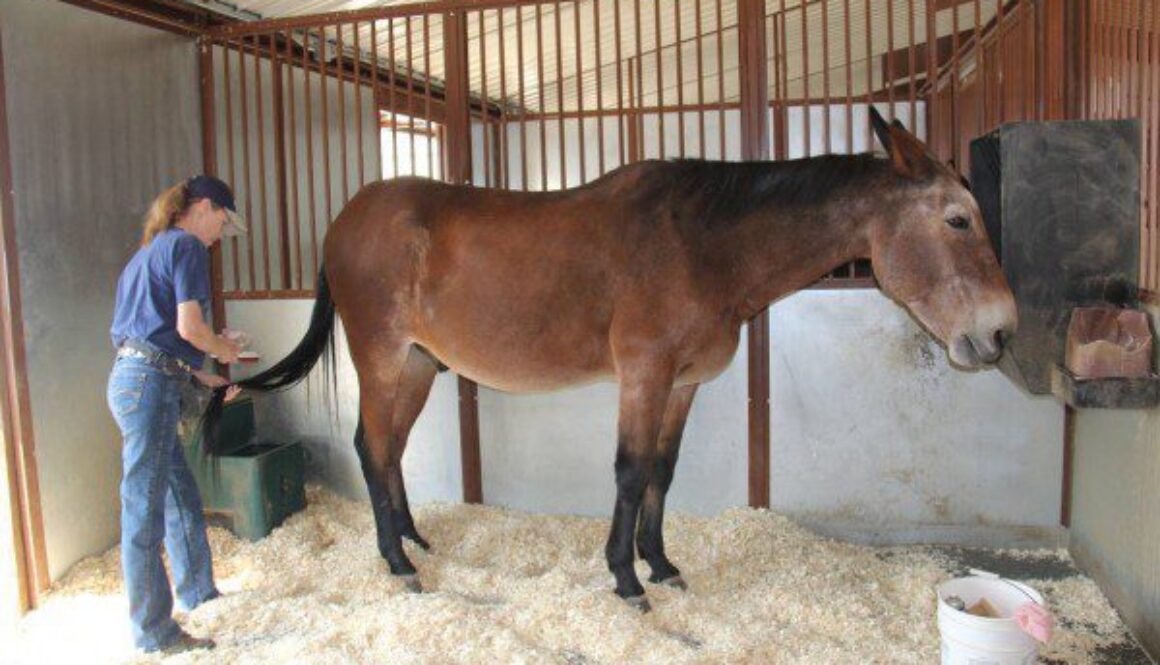
Finally, it’s spring and SHEDDING time again! In my experience it is better to start grooming your equine with a plastic multi-bristled, human hairbrush to get the dead undercoat off your equine than to use a shedding blade at first. The shedding blade cannot reach the shorter undercoat and can break off healthy hair shafts. The 20 hairbrush works particularly well on the thicker donkey hair coats that can easily get tangled. If you use the hairbrush first, you can come back over it lightly with the shedding blade and it will only remove the dead, longer hairs that are already loose. Doing it this way will pull the undercoat from the roots that are ready to let go and won’t cause breakage of healthy hair. After the hair brush and shedding blade, a quick once over with a damp (but not wet!) dandy brush, will remove the excess dust from the aerated coat. A sprinkle of Johnson’s baby oil in the mane and tail will soften the hair, make it easier to comb over, and will keep equines from chewing on each other’s manes and tails during mutual equine grooming and playtime. Learn a lot more under TRAINING and in our STORE for much more information about the management and training of your equine at www.luckythreeranch.com.
Happy Easter: Donkey’s Cross: The Legend
(Page 25)
The story is told that the donkey that had been Jesus’ mount on Palm Sunday, came to the hill of Calvary.
Seeing the tragic event taking place, he wished with all his heart that he had been able to carry the cross for Jesus, as he was the proper one to carry heavy burdens.
Ashamed of what was happening, the donkey turned his back on the sight, but would not leave for he wished to stay until all was over because of his love for Jesus.
In reward for the loyal and humble love of the little donkey, the Lord cast the shadow of the cross to fall across his back and left it there for the donkey to carry forever more as a sign that the love of God, no matter how humble, carries a reward for all us to see.
Published by The American Donkey & Mule Society

MULE TALK! PODCAST: The Risk of Neglecting Good Posture
The Risk of Neglecting Good Posture —
- We don’t usually pay close enough attention to our Good Posture and often take it for granted.
- Important for both two-legged humans and four-legged equines.
- We get used to working in Comfortable Environments and don’t realize the importance of how we are traveling until we are challenged with different situations.
- When we are in Good Posture and pay attention to it throughout all that we do, our daily tasks become Beneficial Postural Exercises.
- Core Elements are strengthened in an Ideal Balance and performance is enhanced.
- Soreness and Compromised Movement are no longer at risk.
And follow along. Read the transcript.
Learn more on Mule Talk podcast.
Take Off the Elbow Pull
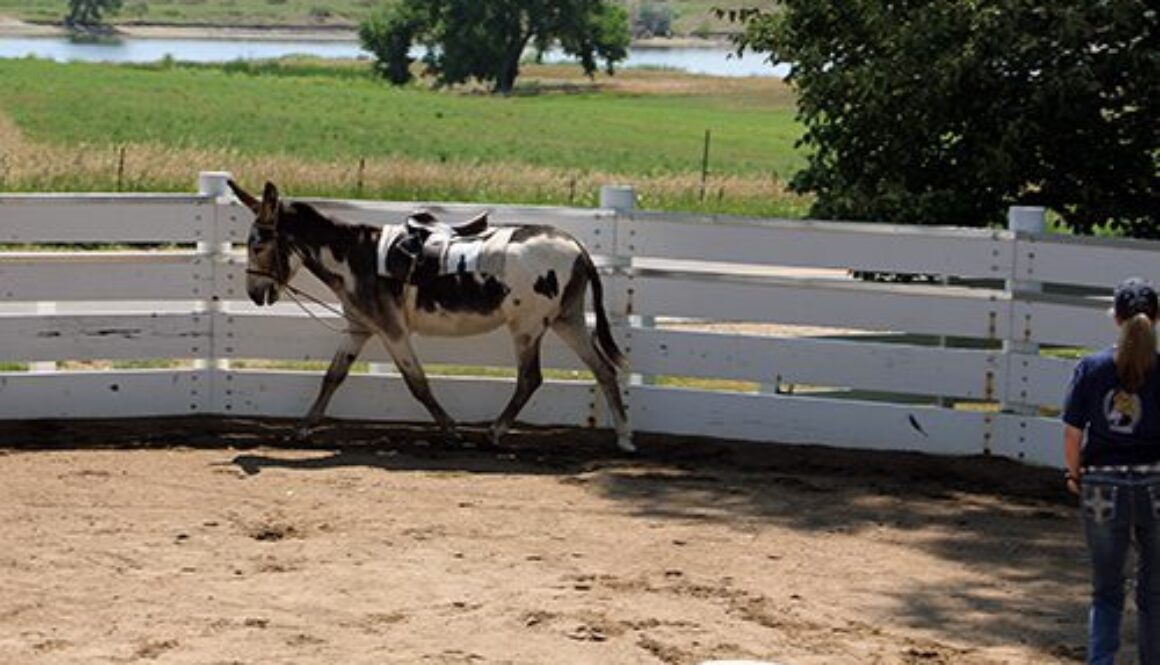
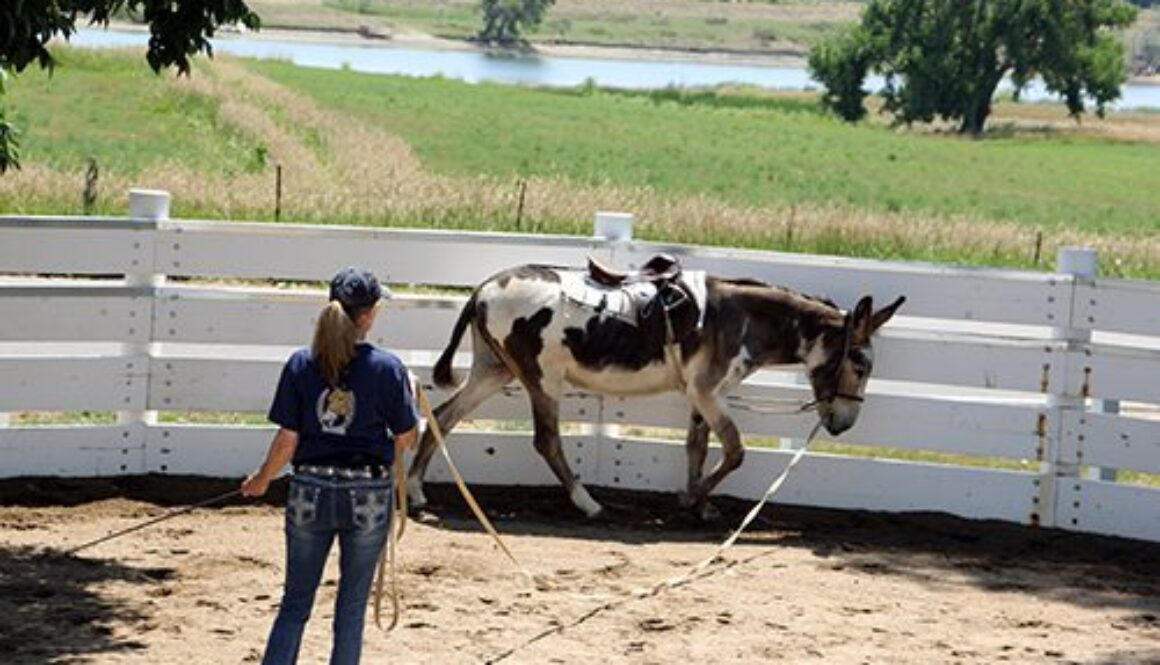
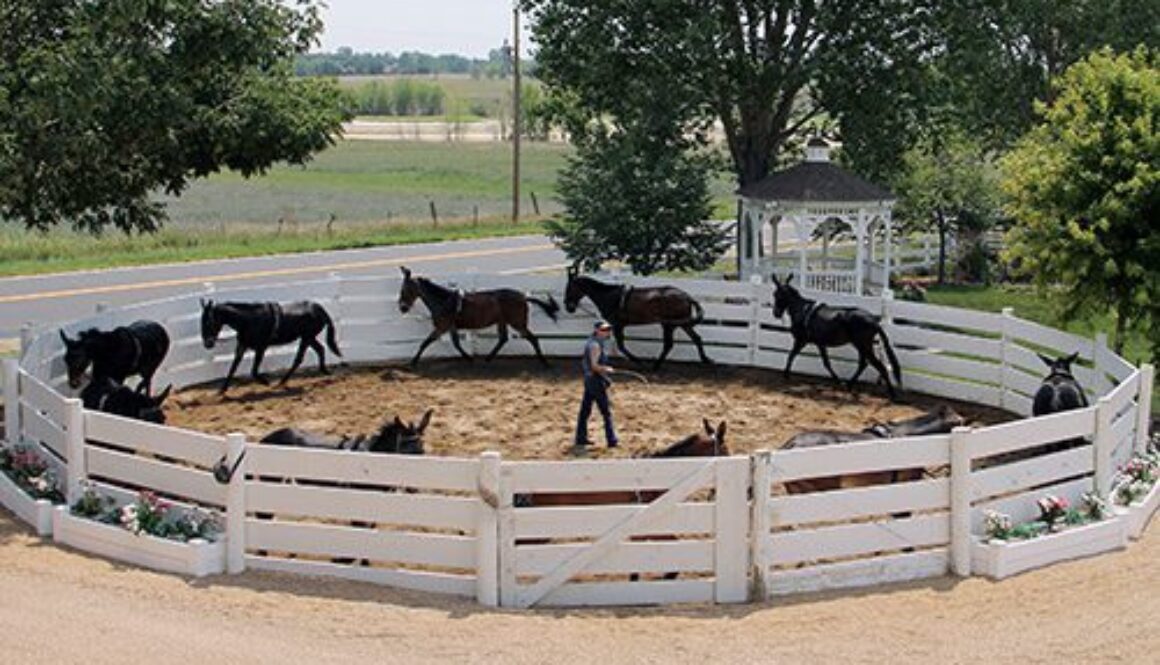
(Page 32) Many fans ask me what happens when you finally take off the “Elbow Pull?” Will the good posture go away? We use the “Elbow Pull” (photo #1) on equines that are two years and older during initial postural leading exercises first on the flat ground, then leading over and through obstacles (photo #5), during round pen lunging (photo #6) and ground driving (photo #7), and then for a year under saddle (photo #8). This helps their good equine posture to become natural and habitual through routine and consistent practice over a long period of time. Shown here is Lucky Three My April at twenty years old both with (photo #2), and without (photo #3), the “Elbow Pull” after only two weeks of tune-up work. Since she was young, April has had the benefit of leading and groundwork training for core strength in good posture prior to use with the “Elbow Pull” in the round pen. Also shown is Lucky Three Roll after only two years of rehab from a “collapsed posture” (photo #4). Lucky Three Roll was 18 years old when I got him, fully foundered with ring bone and side bones in three feet. The postural training rendered him sound enough at walk and trot to be lightly ridden until 2016. In early 2016, He got White Line Disease and it was his good postural balance that saved him. It allowed him to disperse his weight better over the other three feet and allowed his left hind foot to grow back. He became sound enough once again to be ridden for another full year and a half until he passed away in 2019 at the age of 27 years. Understand that the “Elbow Pull” is not designed to be used by itself as a simple restraint, but rather as an integral part of my postural training program. The restraint is NOT in the rider’s hands and is fully manipulated by the equine himself. It’s all about the equine’s self-carriage in good posture, unobstructed by human interaction. Learn much more under TRAINING on my website at www.luckythreeranch.com.
What is Good Equine Posture?
(Page 38) What is good equine posture and what does it look like? Good equine posture will be the same in principle for every equine. He should stand squarely at the halt with equal weight over all four feet directly underneath his body in a balanced position and his head should be raised in a natural position for his breed or type (neither too high nor too low). Each equine will be different in their individual makeup and their ability to stand correctly in good posture. When the base stance is square and balanced, the head, neck and tail will denote their breed, or type. When in motion, the equine in good posture will be balanced and symmetrical in his movement, stay erect with equal weight over all four feet and bend through the rib cage during arcs and side passes. The same animal can exhibit both good and bad posture depending on how repetitive and intensive his postural training has been. The most common indication of bad posture is a dropped hip and cocked foot when at rest. When in motion, an animal with bad posture will lean like a motorcycle during the side pass and around turns. Like a human being, the equine can practice good posture through constant repetition and with enough supportive exercise, good postural balance will become his habitual and rhythmic way of going. However, if he is allowed to “slouch” through too much inactivity, or only balanced in good posture once in a while, his development will be asymmetrical and compromised throughout his body and his habitual movement will be erratic.
Check out more about postural development in our EQUUS REVISITED manual/DVD combo at www.luckythreeranch.com in the STORE. Look in the various sections under TRAINING for much more helpful information or email me at meredith@luckythreeranch.com for even more details.
How to Make the Elbow Pull
(Page 31) Although the “Elbow Pull” is a very simple and straight forward device to help keep you equine in good posture, it is also a device that needs to be custom made to fit each individual equine. Equines that are approximately the same size in the front quarters will probably be able to use the same one. First, you need to obtain a package of 3/8″ twisted nylon rope. It is generally sold on the internet in 50′ spools, but is fairly inexpensive. Do not substitute any other kind of rope or leather reins, etc. as this will have a different weight and slippage around the bridle and will not have the same effect. Make sure that when you use the “Elbow Pull” that you place it OVER the crown piece on your bridle to prevent chafing and that you adjust it by first getting them to flex at the poll (by cupping your hand at the muzzle and rocking it forward and back or just offer some oats to get him to flex) and then push UP on his muzzle until he begins to push the nose out and hollow his back. This is not a device to “tie” their heads down. It should be adjusted just tight enough to prevent them from hollowing their neck and back, but still giving them full range of motion in every other direction (Up, down and to the sides).
You will also need two snaps that are narrow, yet fairly strong that can fit easily through the rings on your surcingle, or Western saddle. English saddle D-rings are generally too small and in this situation, we do not attach to them, but rather attach the “Elbow Pull” to itself after looping it through tied up stirrups. If you make the rope a bit longer for adjustment sake, you can loop it over the withers and attach it to the small D-rings on the opposite sides. The reason for twisted rope is so you can actually go through the D-rings and snap it into the twisted rope itself for a more exact setting. You would just untwist the rope at the setting point and snap into the middle of the rope so it won’t slide. With horses, you would just twist the rope over the back as shown so the snaps are a moot point until the horse learns to give to the “Elbow Pull” and can be hard tied.
Have the equine stand at the hitch rail with the snaffle bridle on. To get a measurement for how long a piece of rope you will need for his “Elbow Pull,” take a length of rope from the coil. From the near side (left side of your equine), feed the end of the rope from the inside to the outside of the snaffle bit ring, drape it over the poll of your equine and feed it from the outside of the snaffle bit ring to the inside on the off side (right) of your equine. Pull enough slack to go down through the front legs, behind the forearm, up and over the back such that it hangs 12 inches (or a bit more, but not less) over the spine. Then, go back to the near side on where you started and pull enough rope from the spool do the same thing on that side. When you have enough rope to loop over the spine on that side, you can cut the rope at 12 inches (or a bit more, but not less).
Once you have the proper length of rope for your equine, you will need to unravel 3″-4″ of one end of the rope and loop it through the ring on your first snap. Then you will braid the rope back into itself. First, pick the loose strand that is on top as you lay the rope across your hand, bend it around the end of the snap and feed it under a twist of the rope such that it creates a loop around the end of you snap and pull it snug. Then take the next loose strand (which would be the middle of the three strands) and feed it under the next twist down from the one you just did. Then do the same with the third loose strand under the third twist in the rope. Take all three strands in your hand, hold the rope so it doesn’t twist and pull all three strands snug. They should all line up.
Next, turn the rope over so you can see where the angled lines of the twisted rope begins again and feed the first strand under the first twist, the second under the second twist and the third under the third twist. Pull all three strands snug at the same time, turn the rope over, locate the first twist in the line and repeat until you have all 3″-4″ braided into the twisted rope. You will have some loose ends sticking out and nylon rope can slip, so you now need to take a lighter and burn all these ends until they are melted together and will not slip. Be sure that you burn them so they are smooth and without bumps or it will be difficult to feed the ends through the D-rings. Do the same with your second snap on the other end of the rope. Now, you have your own custom made “Elbow Pull!” If this is confusing, you can purchase our EQUUS REVISITED DVD which has a SPECIAL FEATURE that will show you how to do this at www.luckythreeranchstore.com
Core Muscle Strength Promotes Longevity
(Page 21) Do you know what your saddle is sitting on anatomically? The equine spine has fragile “spinous processes” that extend upward from the vertebrae like “fingers” that are covered only by the “Supraspinous ligament,” connective tissue and top line muscling that run the length of the top line from the “Nuchal ligament” and lamina that supports the neck. The equine spine is naturally designed to carry weight underneath and not necessarily on top. At 29 years old, AQHA stallion Kip Dee Beau exhibits the top line and core muscling that has given him greater strength, balance, health and longevity. See how the spine melds into the barrel on 32 year old, Large Standard donkey, Lucky Three Little Jack Horner, and 10 year old mini donkeys, Augie and Spuds. There will be no definition between the spine and barrel when there is adequate core muscle development. Even miniature mules and miniature horses can have this smooth appearance across the topline as with 17 year old mini mule, Lucky Three Francis. Without proper core strength exercises to strengthen the muscles that support the top line (and the weight of the rider) before actually riding, your equine could easily be put at risk and injured by something as simple as incorrect mounting and/or irregular exercise. Core strength exercises not only symmetrically develop the system of elements that support the spine, but they also enable the animal to perform efficiently in good posture, whether riding or driving. Have you ever experienced a “crick” in your neck, or back, and didn’t even know how it happened? Equines can experience these same kinds of issues. When their training does not address these core elements that support the skeletal frame, riding them can cause these kinds of problems. We cover how to develop the core in good equine balance in our EQUUS REVISITED Manual/DVD combo and in our TRAINING TIPS. We have even more detailed articles about our whole program under MULE CROSSING. Check out lots of helpful information to enhance your management and training program under TRAINING and in our STORE on my website at www.luckythreeranch.com. Please feel free to contact me at any time at meredith@luckythreeranch.com with any questions or concerns.
Side Reins vs. “Elbow Pull”
(Pg. 20, 9-26-16) When I first began training equines, I used “Side Reins” to help my Longears to collect their bodies for optimum use in the Round Pen after leading training for correct postural core strength in the Hourglass Pattern, but it didn’t take me long to realize that there were serious issues with the “Side Reins.” First, the “Side Reins” seemed to cause tension throughout the body instead of producing freedom of movement in good equine posture. “Side Reins” did produce flexion at the poll, but the hind quarters were only partially engaged and were still being somewhat “trailered” behind. The moderate stretch in the “Side Reins” invited my Longears to pull against them resulting in the saddle slipping forward even with the crupper snugly attached, causing the mule or donkey to raise his head instead of relaxing and “giving” at the poll with no tension. And, it did not allow for much freedom of motion. The “Elbow Pull” alleviates all of these issues and produces the freedom of movement in good equine posture that I sought. The “Elbow Pull” is NOT a “Tie Down” or “Draw Reins,” and does not produce the same reaction from the equine. Rather, it is a “POSTURAL AID” that helps them to keep their whole body in good posture during lessons with leading, lunging, ground driving and even riding. It allows the equine to raise his head above the withers with full freedom of movement. They can lower their head and neck all the way to the ground, and as far as they can reach from side to side. It only restricts them from raising their head so high that they hollow their neck and back. Breeds that like to carry their heads higher like Saddlebreds, Tennessee Walkers, Arabians, Thoroughbreds and other “high-headed” individuals can still be quite comfortable in this postural AID (or restraint). My equines gained postural balance with increased core strength in the elements that support the skeletal frame during the leading exercises, and showed increased range of motion with the “Elbow Pull.” They were better able to step well underneath their bodies with their hind quarters for increased impulsion and suspension. They learned to execute turns and pivots properly, staying in good posture through the turns while properly placing their hind quarter pivot foot.
They were better able to collect their bodies for a smooth and truly remarkable ride during more collected demands, such as the very slow Western Pleasure walk, trot and canter, and in the more collected gaits with the added impulsion and movements of Dressage. This freedom of movement has produced amazing versatility in my equines with minimal resistance and has created multiple Lucky Three Ranch champions in all kinds of equine activities, but you must do the correct postural leading exercises in the very beginning before putting the “Elbow Pull” to other uses for the best results. If your equine is over two years old, it is advisable to do the leading exercises in the Hourglass Pattern WITH the “Elbow PULL.” Animals under 2 years will not need this kind of restraint until later. Give your equine the athletic edge and make your training experience resistance free! Peruse our website at www.luckythreeranch.com and look in the various sections under TRAINING and in the STORE for reliable management and training information. How to make the “Elbow Pull” is covered in my EQUUS REVISITED DVD in the STORE. And, if you have any further questions or concerns, please feel free to email me at meredith@luckythreeranch.com and I will answer you PROMPTLY.
The Crimped Oats Reward
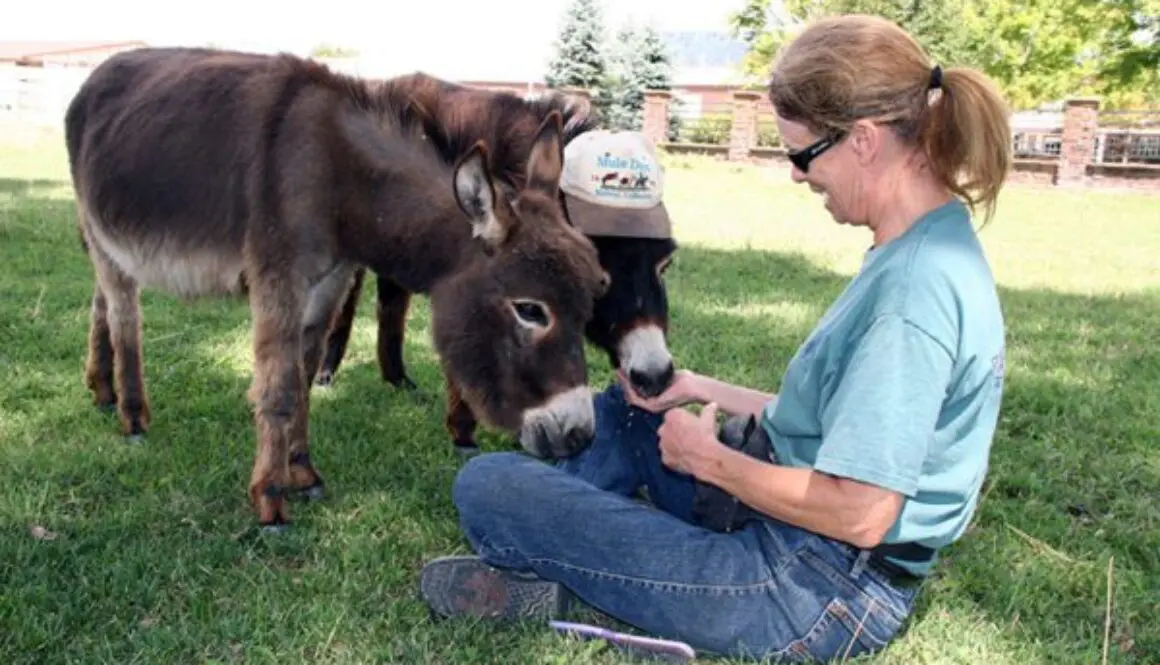
(page 58) Developing your equine’s physical health is of primary importance, but training should evolve into a balanced, posturally correct and habitual way of moving and behaving. When we do core strength exercises (as opposed to bulk muscle development), it is imperative that the animal learns self carriage, body awareness and discovers the ultimate comfort that can be obtained from being in good posture. Anything less would compromise symmetrical physical development around the skeleton at the deepest level, good postural performance and cooperative behavior. Using Behavior Modification with the crimped oats reward insures that bad behaviors can be replaced with polite behaviors and that repeated ways of moving in good posture will eventually become habitual…a new normal! The difference between our approach and Clicker Training is that your voice (instead of the clicker) provides a means of communication that works more intimately, consistently and effectively with your equine. By the same token, “Rewards” are not the same as “Treats,” and “Bribing” is not the same as “Coaxing.” Very few of us would be willing to work for a simple pat on the head and this is also true with equines. When “paid well” with the healthy crimped oats reward, equines are more apt to repeat good behaviors and in doing so, those behaviors become habitual. This more intimate communication develops a deep and mutual trust. And, contrary to popular belief, when presented correctly for tasks honestly attempted or completed, the equine that gets the crimped oats reward also gets a lot of practice in taking little things politely from your hand without biting your fingers! I LOVE to see people enjoying their equines as much as I enjoy mine! To learn about the correction for any aggressive behaviors, about Behavior Modification and about Rewards, Treats, Coaxing and Bribing, look on my website at www.luckythreeranch.com under TRAINING/MULE CROSSING/BEHAVIOR MODIFICATION (category). Watch our TRAINING TIPS, also posted under TRAINING on my website. Don’t miss our LUCKY THREE RANCH YouTube channel with lost more educational and entertaining videos! HAPPY TRAILS!
MULE CROSSING: Moving Beyond Prey Versus Predator
In the past, when equines ran free, they were unencumbered by human interaction and could build and condition their muscles naturally. Today, with increased population but reduced open lands, their activity is often restricted. It then becomes our responsibility to not only train them, but to prepare them physically to perform and keep them happy in their environment. This responsibility becomes even more important when we ask them to exert more energy than normal, in activities like long trail rides, endurance events, showing and equine-related work. Proper preparation for this modern-day lifestyle will help to minimize your equine’s stress, both physically and mentally. https://www.luckythreeranch.com/mule-crossing-moving-beyond-prey-vs-predator/
Reinsmanship
(Pg. 233, 4-22-15) Ground driving, whether single or double, is not just a driving-based activity. Whether you plan to drive or ride your equine, ground driving will help you to improve your Reinsmanship skills and the connection with your equine. Ground driving gives your equine the opportunity to learn direct rein cues that come from the corners of his lips with the snaffle bit (pull right, go right – pull left, go left) before actually riding or driving. During ground driving in the snaffle bridle, surcingle or lightweight saddle and my “Elbow Pull” (covered in my Equus Revisited DVD/Manual combo), his balance in good equine posture can be maintained throughout the exercises to develop symmetrical core strength around the skeletal frame. Bosals, side pulls and bitless bridles cannot affect good equine posture the same way. Walking in sync with your equine’s back legs will help you to establish rhythm with your equine to obtain a prompt response from him with the slightest of drive line (rein) cues. By the time you finally ride or drive your equine, he will know how to be light in the bridle. Your own body will be more flexible, in sync with your equine’s movement and relaxed from the ground driving exercises. Your seat will be more stable and your hands will be light and effective from this practice. You will be less awkward during those initial riding and driving lessons and better able to stay balanced and in control. The only real task that remains when your equine is finally mounted and ridden is to establish clarity in your seat and leg cues. When finally driving, your hands will then be ready to encourage your equine’s forward motion and responsiveness unobstructed from overcueing. This extra step in the training process avoids throwing too much at your equine all at once, keeps things logical and sequential and lessens the chance for confusion and resistance. Learn more in the various sections under TRAINING for FREE on my website at www.luckythreeranch.com or go to OUR STORE at www.luckythreeranchstore.com to purchase your own copies of our books and videos.
The Crimped Oats Reward
(Page 58) Developing your equine’s physical health is of primary importance, but training should evolve into a balanced, posturally correct and habitual way of moving and behaving. When we do core strength exercises (as opposed to bulk muscle development), it is imperative that the animal learns self carriage, body awareness and discovers the ultimate comfort that can be obtained from being in good posture. Anything less would compromise symmetrical physical development around the skeleton at the deepest level, good postural performance and cooperative behavior. Using Behavior Modification with the crimped oats reward insures that bad behaviors can be replaced with polite behaviors and that repeated ways of moving in good posture will eventually become habitual…a new normal! The difference between our approach and Clicker Training is that your voice (instead of the clicker) provides a means of communication that works more intimately, consistently and effectively with your equine. By the same token, “Rewards” are not the same as “Treats,” and “Bribing” is not the same as “Coaxing.” Very few of us would be willing to work for a simple pat on the head and this is also true with equines. When “paid well” with the healthy crimped oats reward, equines are more apt to repeat good behaviors and in doing so, those behaviors become habitual. This more intimate communication develops a deep and mutual trust. And, contrary to popular belief, when presented correctly for tasks honestly attempted or completed, the equine that gets the crimped oats reward also gets a lot of practice in taking little things politely from your hand withoutbiting your fingers! I LOVE to see people enjoying their equines as much as I enjoy mine! To learn about the correction for any aggressive behaviors, about Behavior Modification and about Rewards, Treats, Coaxing and Bribing, look on my website at www.luckythreeranch.com under TRAINING/MULE CROSSING/BEHAVIOR MODIFICATION (category). Watch our TRAINING TIPS, also posted under TRAINING on my website. Don’t miss our LUCKY THREE RANCH YouTube channel with lost more educational and entertaining videos! HAPPY TRAILS!
The “Elbow Pull”
(Page 29) THE “ELBOW PULL” The “Elbow Pull” is a self-correcting restraint for your equine that I developed to help the equine to maintain good posture in a balanced frame throughout his various lessons. Ordinarily, it is first used in our program after the young equine (2 years and under) graduates from the leading exercises (on the flat ground for postural balance and over obstacles to add coordination to the good posture while moving). If the equine is over two years old, I recommend doing all the leading exercises in the “Elbow Pull.” He will need to alter his unbalanced way of moving right from the beginning. Good posture is not inherent; it must be taught. Doing these leading exercises with this purpose in mind will prepare him to balance his body properly on a circle in the Round Ren. The “Elbow Pull” does not tie his head down and is completely self-corrected by the equine himself. It encourages him to stay erect in his body while bending through his rib cage, but prevents him from being able to hollow his neck and back when in more active motion. It gives him more responsibility for his self-carriage in good equine posture while you stand in the middle of the Round Pen when his head is no longer at your shoulder. It will help to keep him from leaning like a motorcycle on the circle and through turns so that the elements at the core that support the skeleton are developed symmetrically with no compromises. Its purpose is similar to the bar on the wall that a ballet dancer uses until they can sustain their own balance unassisted.
The leading lessons, both on flat ground and through obstacles, will strengthen his core in good equine posture, but the benefit of those exercises could be lost if he does not continue in good posture on the circle in the Round Pen where you are no longer right next to him to correct his posture. The “Elbow Pull” puts pressure on the poll, corners of the lips, behind the forearm and over the back when he begins to fall out of good posture. When the tension on the “Elbow Pull” is correctly adjusted, it will remain loose when he is taking complete responsibility for his own balance. When he raises his head and begins to go out of good posture, it will prevent him from hollowing his neck and back, gives him free range of motion in all other directions and still gives him something to lean against to sustain a reasonably good posture while briefly resting his muscles. Until your equine is strong enough in his core muscles to sustain his own balance consistently, he will move in and out of keeping the “Elbow Pull” loose.
When it is loose, there is no pressure at all. You will know his core is adequately strengthened when it remains loose throughout his entire Round Pen lunging lessons. Then he can graduate to ground driving lessons and his first riding lessons in the Round Pen and later in the open arena. Ride with the “Elbow Pull” when you introduce your added weight. When the “Elbow Pull” remains loose throughout the exercises, it is no longer needed. Your animal will then have a strong core and maintain his good equine posture without it. His habitual way of moving will have been changed and all he will need is turnout to practice his new-found ideal posture on his own. The “Elbow Pull” can be used with leading training exercises during the rehabilitation of older animals that have not had the benefit of this early experience.
Developing balance and strength in good equine posture results in numerous benefits for you and your equine from standing still when mounting to simultaneous flying lead changes and balanced sliding stops. This approach builds confidence in the equine and subdues the flight reflex making for a much safer ride. To enhance your skills, learn more about our comprehensive management and training program under TRAINING on our website at www.luckythreeranch.com.
Mother/Daughter Combined Training
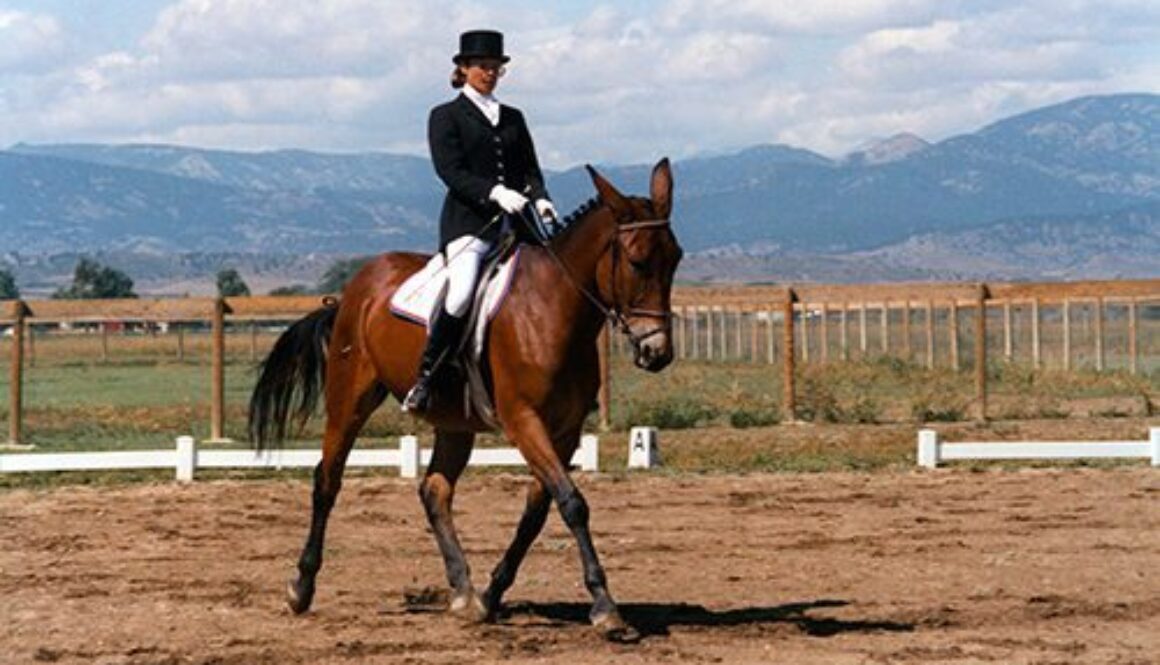
(Page 51) From the Lucky Three Ranch Archives…”Lucky Three Mae Bea C.T.” and I loved to train and compete with my daughter Dena and her gray Hanoverian, “Polacca’s Prince” in Combined Training over Dressage, Stadium and Cross Country jumping in the early nineties. “Bea” and I were graciously accepted into Dressage and C.T. schooling shows, and in the lower levels at official shows as long as we were polite, considerate and called management ahead of time to request permission to show. We simply wanted to show against seasoned equestrians to measure our own progress and not necessarily to win over horses. Attitude is everything and the show committees were always extremely cordial and helpful in our pursuit! Thank you to all those who were responsible for enabling us to reach our pinnacle of success even though I was mounted on a mule! “Bea” and I couldn’t have done it without you! It is so wonderful to see so many people who are out there exhibiting their mules and donkeys and showing the world just how versatile these hybrids can be. Keep up the great work! I’m behind you all the way!!! That was in 1993 and Longears have come a long way since then! Congratulations to all of you and the success you have achieved with your mules and donkeys! Your bravery in the face of challenges and risk is truly admirable! I am so proud to call you my fans and friends! Cheers to our EARS! Read more under TRAINING/MULE CROSSING/DRESSAGE & COMBINED TRAINING on my website at www.luckythreeranch.com.