MULE CROSSING: The Hourglass Pattern & The Elbow Pull
(A SELF-CORRECTING POSTURAL AID FOR EQUINES)
Concept Developed by Richard Shrake and Specific Design by Meredith Hodges (Trademarked & Published in TRAINING WITHOUT RESISTANCE 2003)
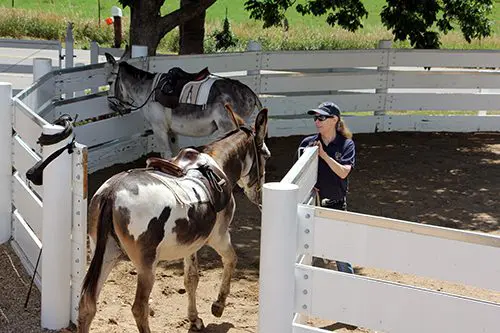
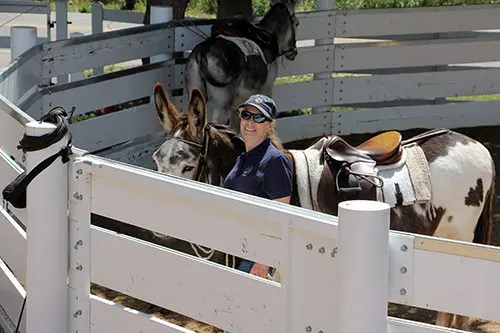
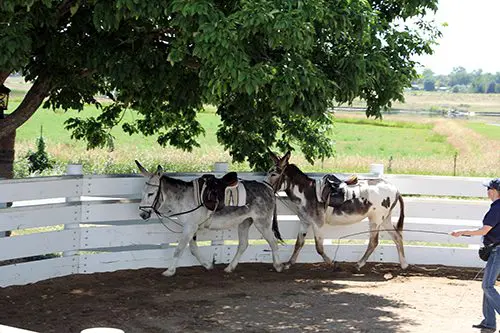
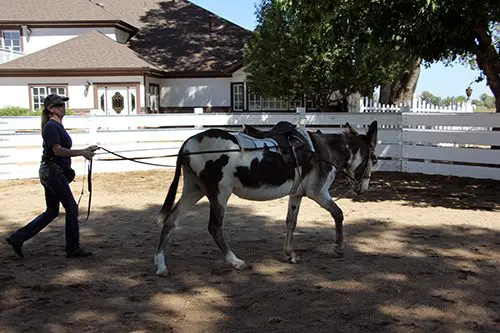
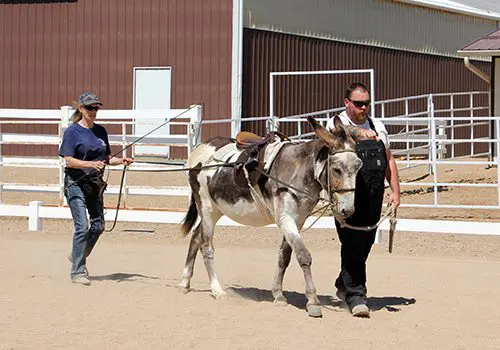
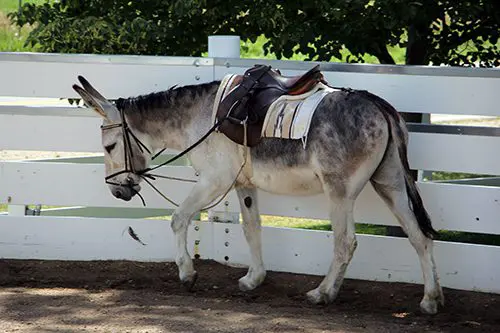
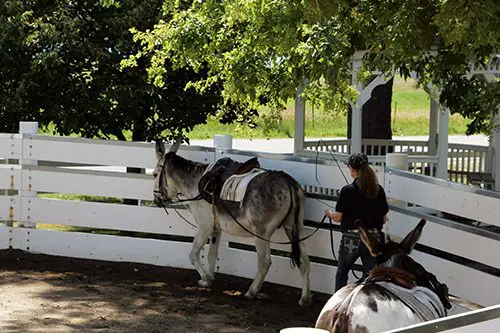
In my TRAINING MULES & DONKEYS DVD #2, in the TRAINING WITHOUT RESISTANCE manual (2003) and in the SPECIAL FEATURES of my EQUUS REVISITED DVD (2009), I talk about using a postural aid called the “Elbow Pull.” In the EQUUS REVISITED DVD, we teach you how to measure it for your individual equine and how to make it. If you have our video series, in DVD #2, in the TRAINING WITHOUT RESISTANCE manual (2003) and in the EQUUS REVISITED DVD (2009), we talk about using the “Elbow Pull.” We teach you how to measure it for your individual equine and how to make it. The “Elbow Pull” puts your animal into your equine's ideal posture. He will have full range of motion in every direction when it is adjusted correctly. He will just not be able to raise his head so high that he hollows his neck and back. He will be able to balance and adjust his body position, encourage the hind quarters to come underneath his body when he is walked, or driven forward. Allowing the equine take short steps, front and back, would let the back sag (swayback-Lordosis) and does not engage the abdominal muscles. The “Elbow Pull” encourages the equine to stretch his spine, round his back and neck upwards (not “hump” it!) and elevates the shoulders when he steps underneath his body. The elevation (or suspension) in the shoulders allows him to increase the “reach” in his front legs. I use the “Elbow Pull” for Leading Training, Ground Driving and when he is ready, Lunging in the Round Pen.
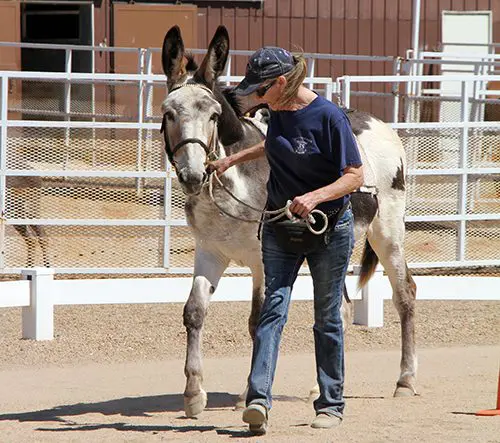
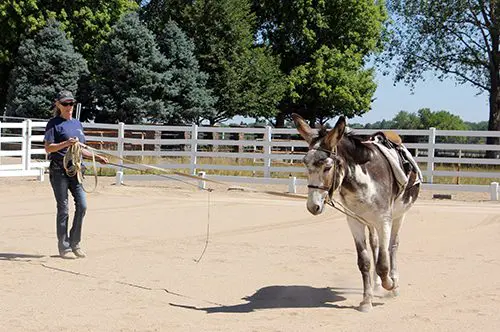
The Leading Training on flat ground through our HOURGLASS PATTERN positively affects his overall postural balance, and Leading through Obstacles adds coordination. You know that he is ready to go on to each stage of Leading Training on flat ground and then through obstacles) when you can throw the lead rope over his neck and do the exercises with verbal commands, hand signals and body language alone. This is building a new habitual way of traveling is all in preparation for Lunging correctly…keeping his body erect and in a symmetrical balance while he bends to the arc of the circle without leaning like a motorcycle. It will prevent muscle compromises throughout his body that could cause soreness. I continue to use the "Elbow Pull" with each new stage of training to help him maintain his good posture throughout the different tasks. It is a supportive device and when he has problems with his posture, it will become tight. He can "lean" against it for a few strides without going totally out of good posture which gives him relief from trying to hold his good posture, which is often difficult in the beginning. When he is again able to hold his good posture, the aid becomes loose all over. Even people have problems maintaining good posture without the reminder of a book on their head until it becomes more habitual.


None of us were born in good posture. It is something that must be taught. If we are allowed to “slouch” our posture, it WILL create soreness and physical problems over time, especially when we get much older. After Lunging in good posture for several months, the equine’s habitual way of going will be changed. He will begin to travel in good posture automatically. Changing habits takes a long time of repetitive behavior to evolve into a new habitual way of acting. As you teach you body through these stages to stay in sync with your equine’s steps, YOUR body becomes more in tune with his way of going and prepares you to be a better rider. This is all a matter or re-programming brain-muscle impulses. The equine will be Ground Driven in the “Elbow Pull” as he adjusts to learning rein cues, and when the weight of the rider is finally added, it is advisable to ride in the “Elbow Pull” until it remains loose all the time. When it does, you can be sure he is strong in his core balance and truly ready to support the rider in any kind of athletic pursuit. The equine learns to carry the rider on top of an upward arc in their spine with the abdominal muscles engaged. This is the same as teaching people to use their whole body correctly and lift with their legs and not their backs. These kinds of exercises make sure that the animal travels symmetrically, allowing the joints to work as they were designed to do (according to the laws of physics) with no compromises, and promotes optimum function of their internal organs.
With an equine that is over 2 years old and that has not had the benefit of developing core strength in good posture, it is advisable to first use the “Elbow Pull” during detailed and extensive Leading Lessons, both on the flat ground and later over obstacles. An equine under two years of age will not need the “Elbow Pull” support while working on his way of going since repetitive habits have not yet been fully established. Lunge the equine in the Round Pen for several months until the animal exhibits an erect posture and self-body carriage habitually. When you finally begin riding, you should use the “Elbow Pull” while you are riding our Hourglass Pattern under saddle as he adjusts to the added weight and new balance. When the “Elbow Pull” is adjusted correctly and the equine is in good posture, it will not put any pressure on the animal at all. When he is out of good posture, it puts pressure on the poll, the bit rings, behind the forearms and over the back. He will go back to his good posture as soon as he is able in order to release the pressure points.
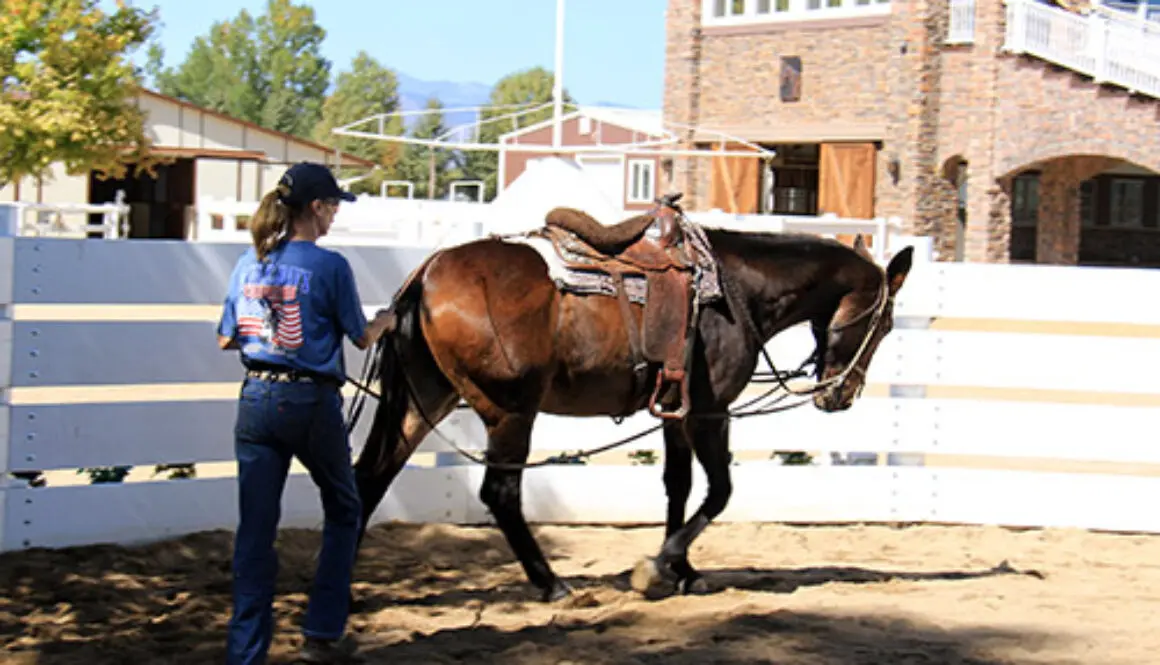
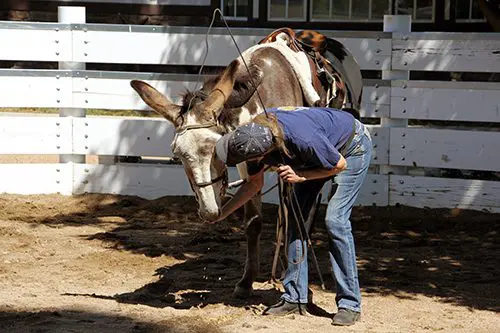
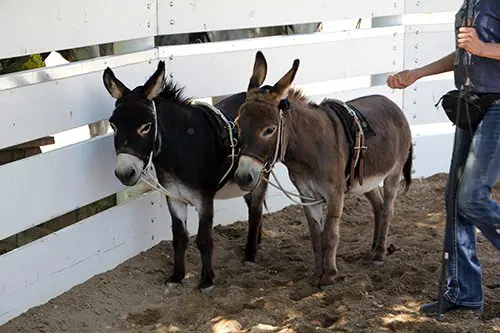
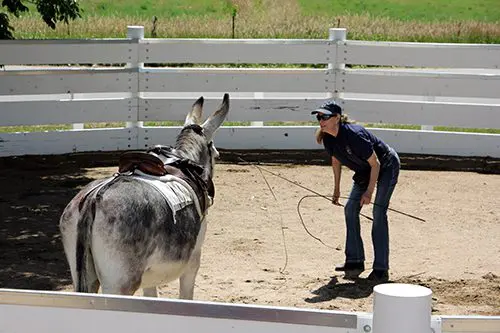
Place the “Elbow Pull” over the poll, through the snaffle bit rings, between the animal’s front legs and over the back, then snap the two ends to a surcingle D-ring or D-rings on the saddle you are using. It should be adjusted so he can only raise his head approximately 3-4 inches above the level of the withers (just before he hollows his neck and back. The “Elbow Pull” needs to be adjusted loosely enough so that he can relieve the pressure at the poll, bit rings, elbows and back without having to drop his head below the withers. When lunging, if the “Elbow Pull” is correctly adjusted and he still wants to carry his nose to the ground, encouraging him with the whip to speed him up a bit. This will encourage him to engage his hindquarters and raise his head into the correct position. The only way he can really go forward with his nose to the ground is if the hind quarters are not engaged. As soon as the hindquarters are engaged, he will have to raise his head to the correct position to maintain his balance. When being lead in the “Elbow Pull,” lowering the head is not a problem because you will have control of the lead rope attached a ring underneath his noseband (not attached to the bit!). Doing stretching-down exercises during leading training helps to stretch the spine and alleviate any soreness that could be developing with the new postural position. Breaking old habitual muscle positions can cause soreness to begin with, but as the better posture becomes more evolved, it also becomes much more comfortable (as it does in humans).
In the Round Pen, the “Elbow Pull” helps the animal learn to travel in good equine posture without the added weight of a rider first. In doing so, it increases his core strength and the ability for him to carry a more balanced posture of his own volition. The added weight of the rider under saddle will challenge the animal again to maintain this good posture. This will take further strengthening of the muscles. The “Elbow Pull” will keep the animal in the correct posture while carrying the rider, so he doesn’t ever build muscle out of balance and out of good equine posture. When you do this, you are changing old habitual movement into good equine posture and a balanced way of moving. This eventually (after two years) will become his habitual way of moving and playing, even during turnout.


Your equine should stay in the “Elbow Pull” when working for two years to make sure that the muscles are indeed conditioned around correct equine posture through correct repetition. This means that when your year of Lunging, then Ground Driving is over, and he begins to work with a rider or while being driven, you would still use the “Elbow Pull” to help him stay in good posture for another year with the added weight of the rider on his back. If driving your equine, you should also use it during the first two years in your driving arena to promote good equine driving posture and engagement of the hind quarters while pulling. This assures that the muscles are becoming correctly and symmetrically strong (supporting the skeleton), over a balanced and physically aligned frame.
The “Elbow Pull” postural aid does not pull their heads down. Rather, it gives them full range of motion (up, down, and sideways), but keeps them from raising their heads so high that they hollow their back and neck during initial training. It is a fully self-correcting restraint that gives them something to lean on when they are not yet strong enough in the core (elements that support the skeletal frame) to maintain their ideal balance. It encourages them to step well underneath their body, round their back upward from head to tail and puts the spine in an position to allow space between the vertebrae (and avoid “Kissing Spine”) and to prevent the rider from injuring their spine (according to the laws of physics). The “Elbow Pull” provides support much like a balance bar does for a beginning ballet dancer, and the principles of good posture are the same as with humans. Repetition and consistency during training can change habitual bad posture to habitual good posture over a long period of time, usually about two years. Good posture and correct movement can enhance longevity by as much as 5-10 years, enable internal organs to operate efficiently and prevent arthritis and other compromises that can create soreness in the body.
Making the “Elbow Pull”
Although the “Elbow Pull” is a very simple and straight forward device to help keep you equine in good posture, it is also a device that needs to be custom made to fit each individual equine. Equines that are approximately the same size in the front quarters will probably be able to use the same one. First, you need to obtain a package of 3/8″ twisted nylon rope. It is generally sold on the internet in 50′ spools, but is fairly inexpensive. Do not substitute any other kind of rope or leather reins, etc. as this will have a different weight and slippage around the bridle and will not have the same effect. Make sure that when you use the “Elbow Pull” that you place it OVER the crown piece on your bridle to prevent chafing and that you adjust it by first getting them to flex at the poll (by cupping your hand at the muzzle and rocking it forward and back or just offer some oats to get him to flex) and then push UP on his muzzle until he begins to push the nose out and hollow his back. This is not a device to “tie” their heads down. It should be adjusted just tight enough to prevent them from hollowing their neck and back, but still giving them full range of motion in every other direction (Up, down and to the sides).
You will also need two snaps that are narrow, yet fairly strong that can fit easily through the rings on your surcingle, or Western saddle. English saddle D-rings are generally too small and in this situation, we do not attach to them, but rather attach the “Elbow Pull” to itself after looping it through tied up stirrups. If you make the rope a bit longer for adjustment sake, you can loop it over the withers and attach it to the small D-rings on the opposite sides. The reason for twisted rope is so you can actually go through the D-rings and snap it into the twisted rope itself for a more exact setting. You would just untwist the rope at the setting point and snap into the middle of the rope so it won’t slide. With horses, you would just twist the rope over the back as shown so the snaps are a moot point until the horse learns to give to the “Elbow Pull” and can be hard tied.
Have the equine stand at the hitch rail with the snaffle bridle on. To get a measurement for how long a piece of rope you will need for his “Elbow Pull,” take a length of rope from the coil. From the near side (left side of your equine), feed the end of the rope from the inside to the outside of the snaffle bit ring, drape it over the poll of your equine and feed it from the outside of the snaffle bit ring to the inside on the off side (right) of your equine. Pull enough slack to go down through the front legs, behind the forearm, up and over the back such that it hangs 12 inches (or a bit more, but not less) over the spine. Then, go back to the near side on where you started and pull enough rope from the spool do the same thing on that side. When you have enough rope to loop over the spine on that side, you can cut the rope at 12 inches (or a bit more, but not less).


Once you have the proper length of rope for your equine, you will need to unravel 3″-4″ of one end of the rope and loop it through the ring on your first snap. Then you will braid the rope back into itself. First, pick the loose strand that is on top as you lay the rope across your hand, bend it around the end of the snap and feed it under a twist of the rope such that it creates a loop around the end of you snap and pull it snug. Then take the next loose strand (which would be the middle of the three strands) and feed it under the next twist down from the one you just did. Then do the same with the third loose strand under the third twist in the rope. Take all three strands in your hand, hold the rope so it doesn’t twist and pull all three strands snug. They should all line up.
Next, turn the rope over so you can see where the angled lines of the twisted rope begins again and feed the first strand under the first twist, the second under the second twist and the third under the third twist. Pull all three strands snug at the same time, turn the rope over, locate the first twist in the line and repeat until you have all 3″-4″ braided into the twisted rope. You will have some loose ends sticking out and nylon rope can slip, so you now need to take a lighter and burn all these ends until they are melted together and will not slip. Be sure that you burn them so they are smooth and without bumps or it will be difficult to feed the ends through the D-rings. Do the same with your second snap on the other end of the rope. Now, you have your own custom made “Elbow Pull!” If this is confusing, you can purchase our EQUUS REVISITED DVD which has a SPECIAL FEATURE that will show you how to do this at www.luckythreeranchstore.com.


THE HOURGLASS PATTERN
(Core Strength Leading Training)
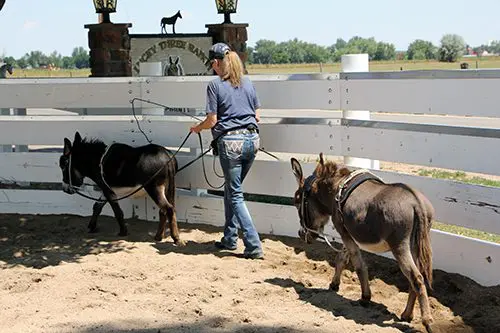
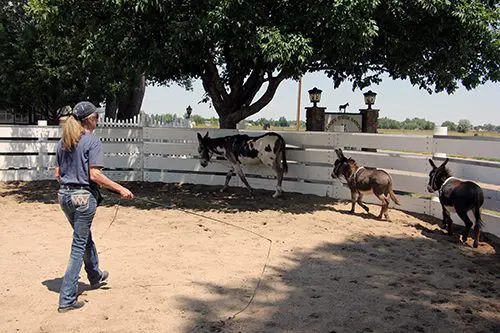
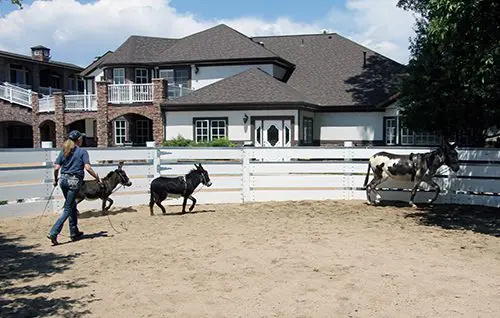
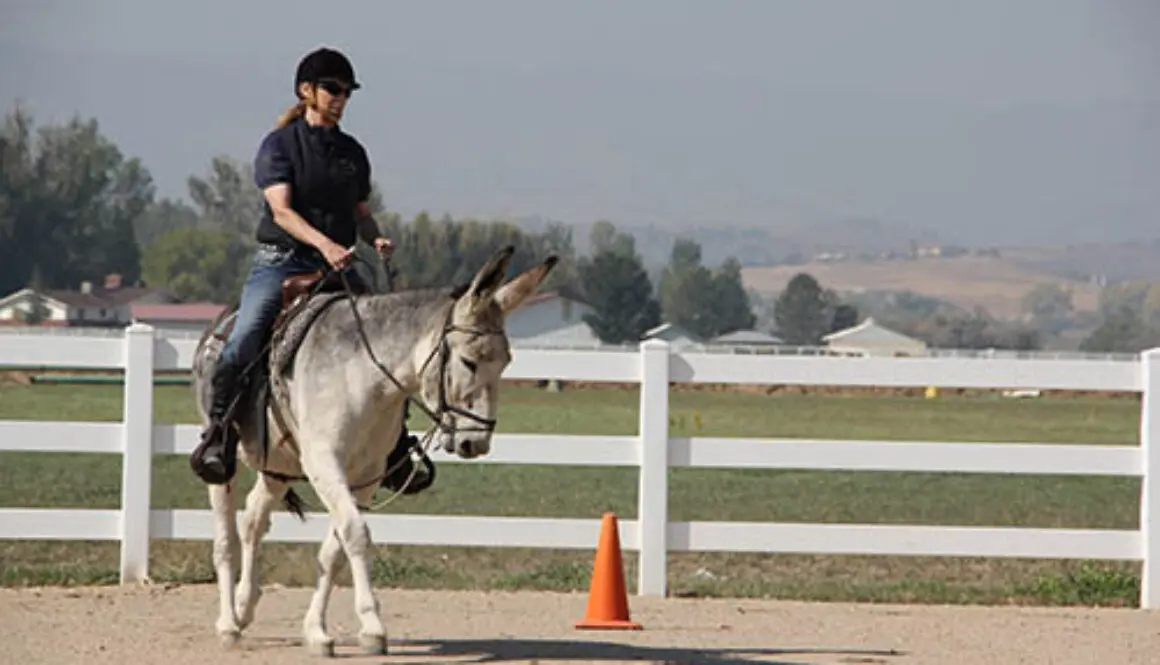
Tack up your animal in a surcingle (or lightweight saddle), a snaffle bridle with a drop noseband (with a ring underneath to attach to the lead rope) and our “Elbow Pull” self-correcting postural restraint. Adjust it so it is taut enough to keep his head from going so high that he inverts his neck and back, and not so tight that it pulls his head too low. Begin the “Hourglass Pattern” without doing circles at the cones. Lead your animal with the lead rope in your left hand from the left side with your equine’s head at your shoulder when tracking left, and lead your animal with the lead rope in your right hand with your equine’s head at your shoulder when tracking right. Point your left hand (or right hand) in the direction of travel and look where you are going. Say the animal’s name and give the command to “Walk on.” Then look down to see what leg he is leading with and match your steps with his. When you stop, say “And…Whoa” and stop with your feet together. Square him up with both hind legs together and then put both front legs together with equal weight over all four feet and reward from a fanny pack of oats around your waist. Stand quietly until he has finished chewing, change sides (and leading position) after every halt so you are always leading from the “inside” of the arc on which you are traveling, and give the command to “Walk on.” You can add circles at the cones and ground rails once he is consistently walking at your shoulder and prompt with the commands.


 Now that he is moving out well at the walk, you can teach him a reverse. As he is walking forward easily around the round pen, turn away from him, completely around, until you are in front of him. Step toward him, lay the whip ahead of him and give the command to “reverse.” Be aware of his space. Do not rush at him, or he may turn improperly. You want him to turn into the rail and resume the opposite direction. Give him plenty of time to make the turn and ask him to “walk on.” If he has difficulty, take a few steps forward and, with the whip, tap him gently on the shoulder to encourage him to turn. There is a purpose to turning away from him to turn him rather than just running ahead of him. By turning back the opposite way that he is traveling, you are establishing a new direction of travel, as well as giving him time to see that there will be a change in his movement. Most donkeys learn this very quickly.
 After his first lesson of trot, you can begin to integrate rein cues. During the second trot lesson, you will review all that he has learned up to the trot. Before you go to his trot lesson, you can attach your drivelines and ground-drive him through the walk and reverse while on the lines. He should have no trouble with you at his rear, since you have been lunging him from a close proximity from the beginning. Use your whip as you did for the turn on the haunches—at the shoulder for his turns, and at the gaskin to encourage him forward—but just touch him with it to remind him, don’t strike him. You want his movements to be smooth and correct, not abrupt. Pull as lightly as you can with a squeeze/release on the lines to encourage the turns, and make him move off more from your body language and the whip than you do with the lines. If he does well, stop, remove the lines, and send him back to the rail for his trot work—twice in each direction. (This means twice with trotting steps, not twice around the pen.) Then stop, reward him and tell him school’s out until the next time. Whether you come back tomorrow or a week later, rest assured that your donkey will be right where you left him in his training. They have an incredible memory!
 When he ground drives fairly well at the walk, you can mount him if he is a large enough donkey to ride. Mount him from both sides and dismount a few times at first. When he seems calm, you can stay aboard. Take a treat in your hand and encourage him to bend his head and neck around to each side to take the treat from your hand. At the same time, give short, light tugs on the rein on that side. This will encourage lightness in the bridle later on. Now he is ready to move with you aboard. It is best to use an assistant at this stage.
 steps. You can continue this lesson until he has completed one rotation of the round pen in each direction. Then stop him with “whoa” and ask him to go back a step or two. Give light pulls on both reins in a squeeze/release fashion to start, then, as he begins to move his feet backwards, alternate your pressure on the reins with the front foot that is forward. If he does not wish to back, your assistant can help with pressure to his chest as you did on the lead. Always end your riding or ground-driving lesson with a back, and don’t pull so hard on the reins that he resists by jutting his head out. Encourage him to stay light in the bridle. Then finish your lesson with lunging at the trot.
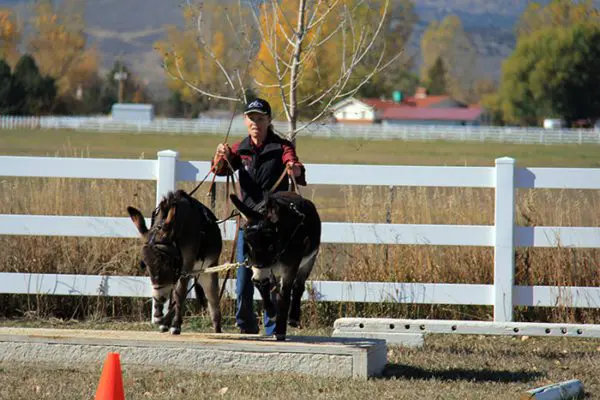 In Part 1 of Getting Down with Minis, you learned how to begin the relationship with your miniature equine in a positive and natural way that fosters good behavior and a solid relationship between you. You also learned the importance of getting down to your mini’s eye level so that he can make eye contact with you, which discourages striking, jumping on you and other bad behaviors that are common when working with miniature equines. In Part 2, I discussed how important it is to successfully complete the tasks in Part 1 before moving on to Part 2 and explained why it is advisable to work minis in groups, as they perform better when they are with their friends. You also learned how to train minis to go over and around various obstacles. Remember that all of this is to be done with no expectations that may overwhelm your mini—it is better if you maintain an attitude of fun and games. In Part 3, we got down to some serious groundwork training so your mini can be used for the purpose of driving and showing in hand. He learned to lunge and to be ground driven in the round pen and in the open arena through the hourglass pattern and if part of a team, how to do these things as a team. In Part 4, you worked on obstacle exercises on the drive lines to increase strength and coordination.
 Spend as many tire drag lessons as it takes in the round pen to be sure your mini is driving easily and smoothly before graduating him to the open arena with the tire. Just as you did with simple ground driving, once he is ready, let your mini drag the tire while ground driving him through two rotations of the hourglass pattern, and then cross the long diagonal and do two more rotations in the opposite direction. Make halts often so rewards can be dispensed for a job well done. Do not make any abrupt turns or try to add speed before you are completely competent with the lines and your mini is responding obediently. Ground driving is as much for you to learn good Reinsmanship as it is for your mini to learn to drive correctly. If training more than one mini, just tie whichever mini you’re not working with at the moment off to the side and have him wait his turn before ground driving the two as a team. The frequent halts with rewards will teach him to stay clam and remain still when asked.
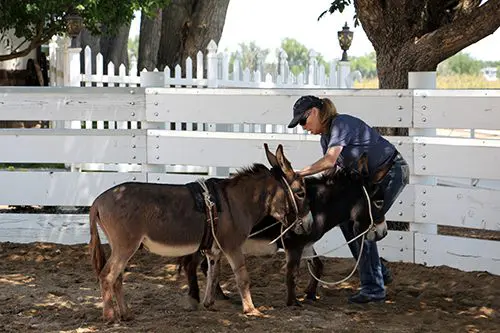
 Before actually hitching your mini to the vehicle, be sure to check all harness straps and make sure they are correctly adjusted. While you do this, you will also be teaching your mini (or minis if a team) to stand still in the cross ties, which will make hitching much easier. Checking all harness straps can be done anywhere that your fences or hitch rails are close enough together to accommodate the cross ties and still allow enough room for a single mini (or team) and the vehicle. During this lesson, all you need to do is put on and adjust the harness, hitch to your vehicle, have your mini (or team) stand quietly while being rewarded and then take everything back off. Before leading your mini(s) away from the vehicle, spend some time rewarding again for standing still and staying in position.
 your assistant to stand in front and to the side of your mini with a lead rope attached to a ring on the noseband (not the bit) of your mini’s harness bridle. When ground driving a team, you will need to use two assistants. Ask each assistant to stand on either side of the team. Once your mini is harnessed, and when you are seated in the vehicle and ready to go forward, ask your assistant to unsnap the cross ties and release your mini while your assistant stands at his head. Now ask your mini to “walk on.” Let him go just a few steps and then ask him to “Whoa.” If your mini does not stop promptly, your assistant can help by pulling back on the lead rope with a pull/release motion while, at the same time, you pull back on the drive lines with a pull/release motion. When he does stop, have your assistant give him his oats reward. Let your mini settle before asking him to back a couple of steps and halt again. Reward him for halting and end the lesson there. The object is to allow your mini enough time to understand what you are trying to teach him and respond accordingly so he can be rewarded without spending so much time that he gets bored and sucks you into a confrontation.
 When your mini is hitched to a vehicle, make a very large hourglass pattern to accommodate your vehicle. His familiarity with this pattern will help him to feel calm and gain confidence while being driven. Every time you end a lesson, keep your assistant at your mini’s head until your mini is fully unhitched from the vehicle. NOTE: Always remove the harness bridle last. Once he is unhitched, make your mini stand where he is while you come to him, then reward him and lead him away. This is how he will learn to wait for you and will not become antsy and uncontrollable. Routinely practicing good manners, setting up an environment for success and approaching your mini with a calm and deliberate attitude will all help him to become a quiet, safe and reliable driving animal.