
MULE CROSSING: Myths About Desensitization
By Meredith Hodges
 You really don’t want to desensitize your animals to everything. Here is Webster’s Dictionary’s definition of the word “desensitize”:
1) to make (a sensitized or hypersensitive individual) insensitive or non-reactive to a sensitizing agent.
Some people have the misconception that, in order to desensitize an animal, you have to make it numb to its surroundings and any stimulus it encounters. Not true! What you really want to do is sensitize your equine to different body language and cues from you, as the trainer. So “desensitization” does not mean achieving a total lack of sensitivity. Rather, it should be approached as a way of training your equine (in a way that is quiet and calm) to be less sensitive to certain objects or events that may be cause him to be fearful, so he can move forward with confidence and the right sensitivity toward the communication between the two of you.
 When incorrect, harsh or overly aggressive desensitizing techniques are used on equines, the handler is met with either a very strong flight reflex or a stand and fight reflex. In either case, an equine will either put up a fight and be deemed a rogue and, therefore, untrainable, or eventually just “give up” and succumb to the trainer’s wishes. This is a sad situation because the equine is not given the opportunity to make reasonable choices in his relationship with his trainer. The equine’s instinct to warm up to the person training him is hampered by his fear of more desensitization techniques. Thus, he becomes resigned to his work and is not fully engaged in the training process.
 Often, trainers will put obstacles such as a trailer, tire or tarp in an equine’s pen in the hope of getting him used to it by making him live with it. But ask yourself this: How much rest would you get if someone put a blaring radio in your bedroom to desensitize you to noise? Equines have many of the same reactions to their personal space that we do, and they do much better when their place of rest is just that—a place of rest and comfort. And when lessons are approached in a considerate, respectful and rewarding way, an equine is more likely to approach them with an eager and positive attitude that facilitates better learning. It is always better to turn your equine’s fear into curiosity than it is to just assault his senses.
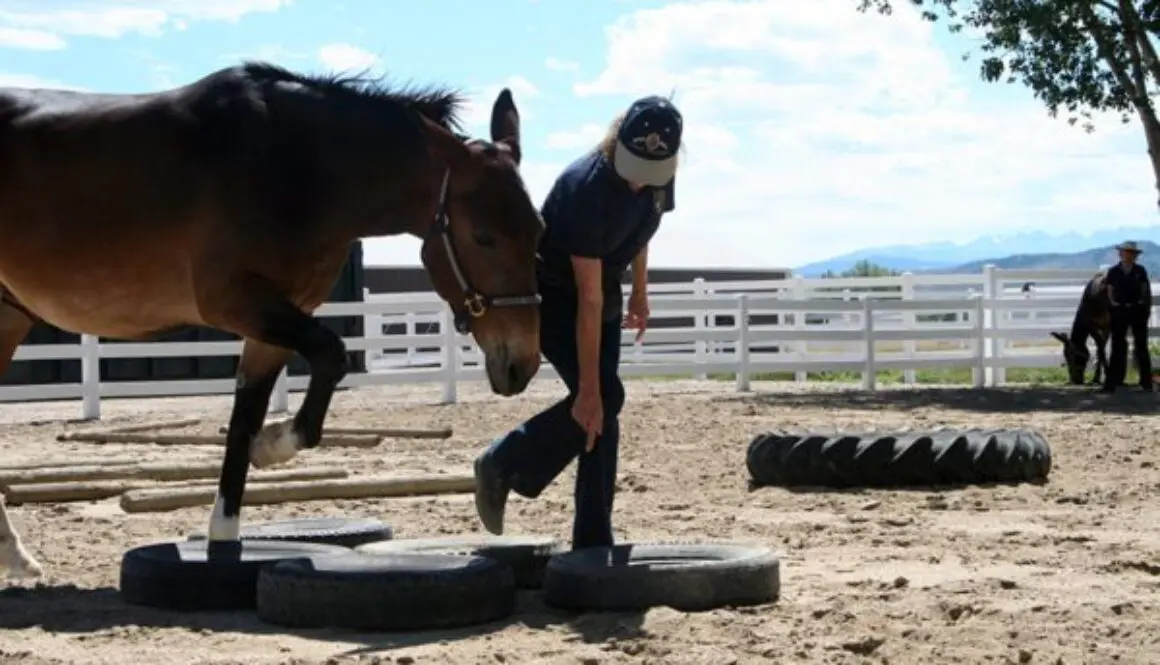
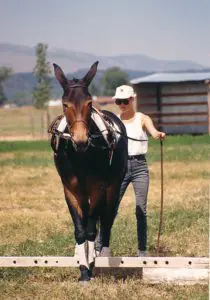 When doing obstacle training, it is better to allow your equine a gradual approach with small steps and great rewards for his honest effort than to whip and spur him through just to get to the other side. When his fear is converted to curiosity, the chance of his refusal to go forward is lessened and his trust in you as the trainer allows you to, eventually, ride through any obstacle at the slightest suggestion. This is because he trusts your judgment and has not been frightened, hurt or made uncomfortable during the training process. This is your equine developing sensitivity to your demands and learning to willingly comply so he can become a participating partner in each activity.
Some trainers believe that breaking down tasks for the equine into tiny steps is a waste of time and that giving a food reward prevents an equine from learning to respect the trainer, but I disagree. When you break tasks down into understandable steps in the beginning stages of training, you will eventually begin to get solid, reliable behavior from your equine. You will have to pay attention to a lot of little details at the beginning stages of training (and that can seem overwhelming at first), but if you take the time to pay attention to these small steps in the beginning stages and through the ground work and round pen work that will follow, when you finally do move on to riding under saddle the lessons will go much more quickly.
Each stage of training should become easier for you and your equine to master. For instance, it actually takes you less time to train in something like a side pass if you have done your groundwork training with the lead line and drive-line lateral training before you even get into the saddle. It also follows that the side pass will come more easily for your equine if he has first learned to move on an angle in the leg yield before having to move straight sideways. This is an example of taking things in small, logical steps, keeping your equine sensitive to his surroundings and tasks without fear. It also greatly lessens the chance for a fear or anxiety-driven blow up from your equine later on.
There is a physical as well as mental aspect to all of this technique. While you are training your equine to perform certain movements and negotiations over obstacles, his muscles, ligaments and tendons are all involved in his actions. When an equine is asked to do a movement for which his muscles have not first been properly conditioned, he will not only execute the motion incorrectly, but his premature attempt will undoubtedly compromise his muscles, ligaments and tendons. Even if he can adequately assimilate a requested movement while he is young, he could easily be creating problems in his body and joints that will cause him escalating problems as he ages.
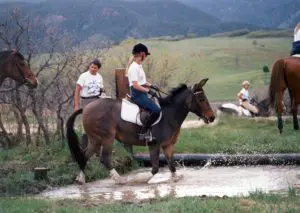 If you were asked to go on a 25-mile hike with a 50-pound pack on your back, how would you prepare in order to safely and successfully perform this task? You would break it down into small steps, working up to it by first running a short distance with a very light weight, and then gradually increasing the distance you run and the weight you carry, which may take as long as a couple of years of careful training and conditioning. But if you tried to prepare for this kind of grueling hike by simply walking around the block a few times for a couple of days, you’d wreck your muscles, compromise your health and probably fail—all because you attempted to do the task when you weren’t physically or mentally ready. And depending on how much you strained your body, you just might discover down the line that the damage is permanent and will worsen over the course of your life. I use this illustration to show that, just as with humans, when it comes to training and conditioning your equine, it’s always better to take it slowly—one step at a time. Your equine will learn to enjoy being a partner in your challenges and goals if you give him the time he needs to be able to do these activities comfortably and with success.
An equine that learns in this sensitized way can also make judgments that might even save your life when you might not be paying attention. This is because when your equine is calm and well rested, he actually seems to be able to anticipate consequences, making him more likely to stop and wait for your cue. The equine that is “forced” during training will most often become anxious about a challenging situation and will seldom stop and calmly alert you to a potential peril—and he most likely will not trust your judgment.
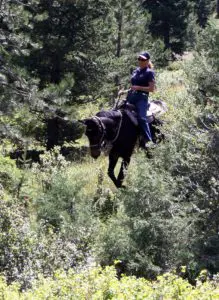 It is because I have trained my mules in this sensitized way that I once avoided going over a 100-foot drop up in the Rocky Mountains while on a trail ride. On that particular day, I was in front, riding my mule, Mae Bea C.T. with four horses behind us. When we came to a giant boulder semi-blocking the trail, I told the people on the horses to wait and rode ahead. I soon found that the trail had narrowed to an impassable two feet wide and a rockslide had wiped out the trail ahead completely! It was straight up 100 feet on one side of the trail and straight down 100 feet on the other side and there was no going forward. The horses behind me were still on the wider part of the trail on the other side of the boulder and were able turn around, so they were safe, but backing my mule around the boulder on that treacherous trail would be very dangerous. I thought we were stuck. At that point, my mule calmly looked back around at me as if to ask, “Well, Mom, what do we do now?” I thought for a minute and then shifted the weight in my seat toward my mule’s hindquarters. This movement from me allowed her to shift her weight to her hindquarters. Then, with pressure from my right leg, she lifted her shoulders, pivoted on her left hind foot and performed a 180-degree turn to the left on her haunches, and with her front feet in the air, she swept them across the open precipice of the cliff and turned us back around to face the wider (and safe) part of the trail. After completing the turn, she stopped again, looked back at me to see if everything was okay and waited for my cue to proceed back down. I believe, without a doubt, that my mule’s incredible and calm response to a life-threatening situation was the direct result of the sensitized training methods I used that created our unbreakable bond of trust.
To learn more about Meredith Hodges and her comprehensive all-breed equine training program, visit LuckyThreeRanch.com, MEREDITH HODGES PUBLIC FIGURE Facebook page, or call 1-800-816-7566. Check out her children’s website at JasperTheMule.com. Also, find Meredith on Pinterest, Instagram, MeWe, YouTube and Twitter.
Covered in TRAINING MULES & DONKEY: A LOGICAL APPROACH TO TRAINING, TRAINING WITHOUT RESISTANCE, TRAINING DVD #2 and EQUUS REVISITED at www.luckythreeranchstore.com.
© 2013, 2016, 2024 Lucky Three Ranch, Inc. All Rights Reserved.

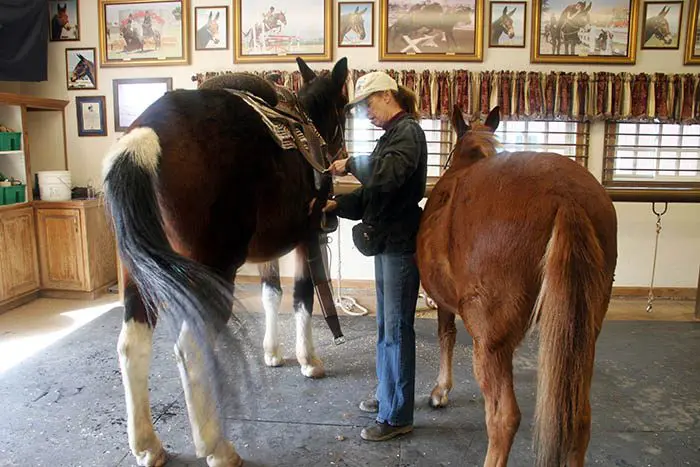 Once your equine has mastered tying and leading in the small pen, he can then move on to a designated work station where he will not only be groomed, but will also learn to accept tack in preparation for the round pen. This should be a place that has a good stout hitch rail and easy access to your tack and grooming equipment.
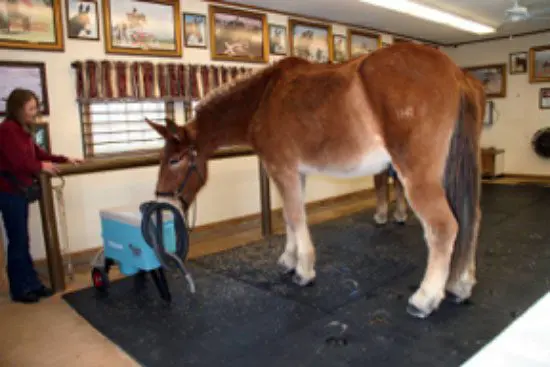 Keep an eye on the pressure you apply whenever using these various grooming tools. Different animals will have different sensitivity to these tools and will tolerate them better if they know you are not going to cause undue pressure or pain. Learn to brush the mane and tail starting at the bottom and working upward, and use a conditioner such as baby oil to keep from pulling or breaking the hair. (Baby oil will also keep other equines from chewing on the tail.) A shedding blade can be an uncomfortable grooming tool when used improperly. When using a shedding blade to remove mud around the head and ears and even on your animal’s body, be careful to minimize his discomfort by monitoring the pressure you apply to each area and working VERY slowly. When bathing him, be extra careful not to get water in his eyes or ears. These types of consideration for your equine’s comfort will help build his trust and confidence in you, and it will help make training easier and more enjoyable for both of you.
 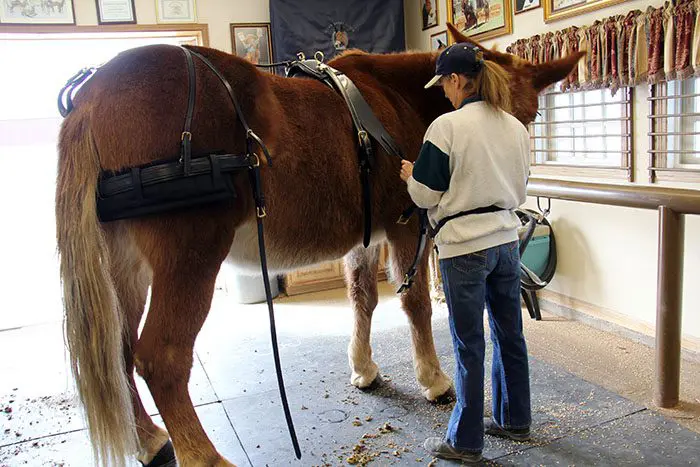 doing. If you are not sure about what tack to use when, go to the Lucky Three Ranch website for more detailed information, or ask the experts in your area. Make sure all tack and equipment fits your animal properly. If it doesn’t, it can cause adverse behaviors during training.
 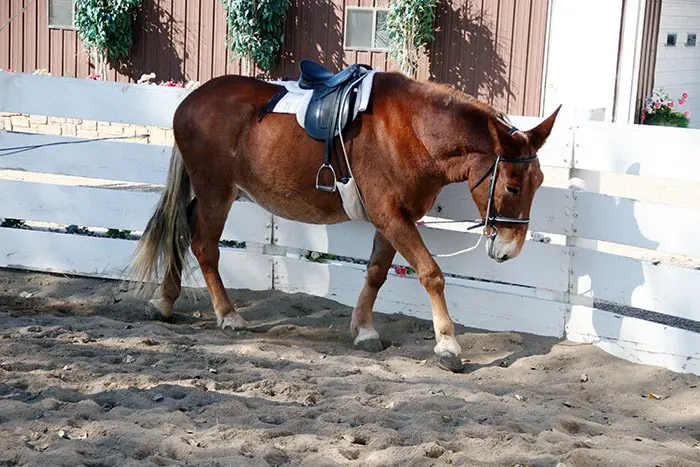 behavior you are seeing. Equines are very honest about their responses, and if they are not doing what you expect, it has to be in the way you are asking. Also, don’t hurry your equine. When asking for the walk, make sure that the walk is even in cadence, balanced and regular—not hurried. Only after your animal is correct in his execution of one gait, should you move on to the next gait. When first introduced to the Round Pen, it is not uncommon for an equine to begin work at the trot and then, as he becomes more comfortable with the new area, at the walk.
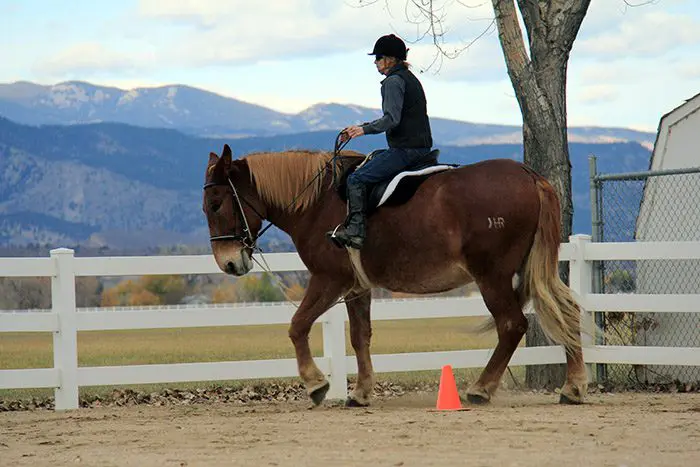 The arena is the place to really start focusing on forward motion and lateral exercises to further strengthen your equine, and it is the place to begin fine-tuning his balance, first during leading exercises, then Ground Driving and finally while he is carrying a rider. The Hourglass Pattern in the arena is also a good place for you to fine-tune your own riding skills, so that you learn to help your equine maintain good balance and cadence, on straight lines and while bending through the corners. In order for your equine to correctly go through the corners, you will be asking him to bend the muscles through his ribcage so he can remain upright and balanced. Equines are not motorcycles and should not lean around the corners. The power should always come from the hindquarters to keep the front end light, supple and responsive to cues. If his front end is heavy and sluggish, your equine is not adequately stepping underneath with his hind legs and will thus, lose forward impulsion and power and will not properly condition his muscles.
 By Meredith Hodges
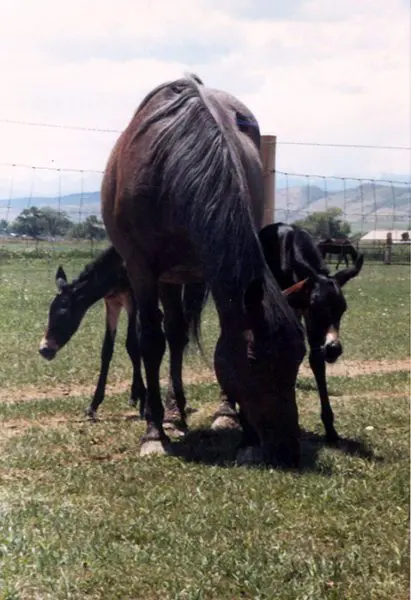 Mule foals are not too much different than human infants in their emotional needs. They require lots of attention, love, guidance and praise if they are to evolve into loving, cooperative and confident adults. In your efforts to get your young foal trained, bear in mind that he is still a child. If he is expected to fulfill too many adult responsibilities too quickly, he can become overwhelmed, frustrated and resistant. This is why it is important to allow your foal to have a childhood. You can turn this time into a learning experience by playing games with your foal that will help him to prepare for adulthood without imposing adult expectations on him when he is too young.
 The first component of developing a well-adjusted adult mule is to establish a routine that will give your mule foal a sense of security and trust in you. Having a definite feeding schedule can help a lot. If you take a few minutes each morning and evening to scratch and pet your foal while your foal’s dam is eating and after he has finished nursing, he will associate you with a very pleasurable experience. If his dam is busy eating, she will be less likely to think about running off with him. If your animals are on pasture, a short visit once or twice a day with a ration of oats and plenty of petting while paying special attention to the intensity of your touch on his body will accomplish the same thing.
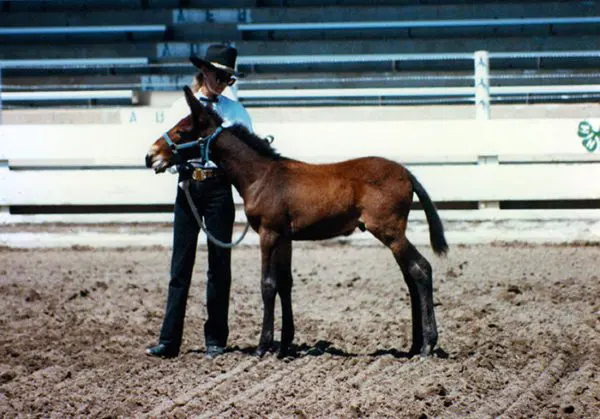 When your mule gets a little older and is ready to be halter broken, you can use your pleasurable status with him to your advantage. First, halter him and tie him to a fence with a safety knot (see DVD #1 n my Training Mules and Donkeys series). Leave him like this each day after breakfast for about half an hour, making sure to return to him every ten minutes. Each time you return, if he doesn’t become tense and struggle, untie him and ask him to follow you. If he refuses, just tie him up again and come back again ten minutes later and try again. If he comes with you, even if it is only one step the first time, take his halter off and play with him for a little while and then end the lesson. This will maintain your pleasurable status with your foal while he learns the things he will need to know as a young adult. In the next lesson you can ask for more steps before playing and ending the lesson
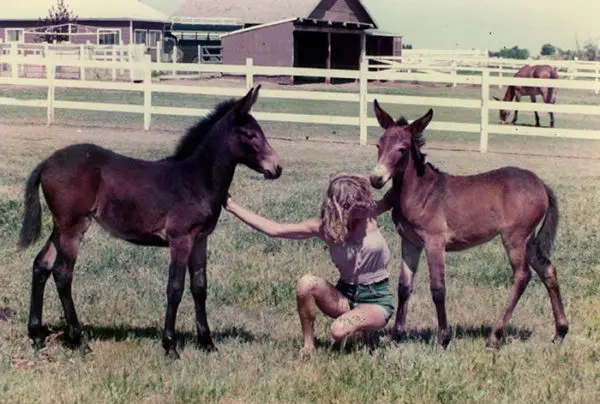 When handling your mule foal, always be sure to give him time to relax and accept a situation…and he probably will. Never get in a hurry and do not try to force anything—or your foal will be happy to oblige you with more resistance than you ever imagined possible! And remember, you can catch more flies with sugar than you can with vinegar, so go out there and have a good time with your little longeared pal. He’ll be glad to be your best friend if you learn how to be his best friend.
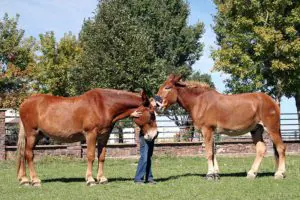 When I was growing up, my grandmother constantly reminded me of the importance of good manners. She would say, “You will never get anywhere of any consequence in this world without good manners!” And she would add, “Without good posture and proper dress, you won’t live long enough to enjoy it!” She made me read Emily Post’s Book of Etiquette from cover to cover. In retrospect, although reading the entire book was a real chore, the respect for good manners that she passed on to me has been an extremely valuable gem in my training experience with equines.
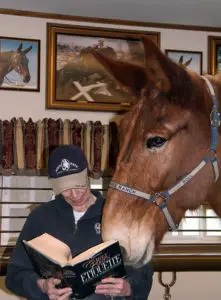 I think that the concept of combining equine training techniques with lessons in good manners is one that many people do not pay as much attention to these days as they probably should. Putting an equine in good posture with respect to his physical comfort is the most obvious form of good manners when communicating with your equine. When you apply the elements of good manners during the training process, you facilitate body and verbal language that equines really appreciate, and when you apply your own good manners and teach good manners to your equine from the very beginning of the training process, you can continue to move forward much more easily than if you do not incorporate good manners between you and your equine. When you run into resistance from your equine, take it as a red flag that you’re missing something in your communication with your animal and change your approach.
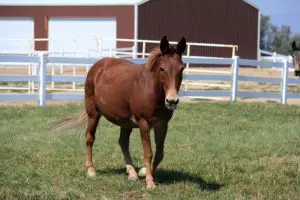 If your equine spends most of his time in the pasture, the good manners of promptness and reliability on your part are critical, as it is the only time you will have during the day to really spend time with him, and he’ll count on you to show up on time each day. What you’ll get out of being prompt at feeding times is a self-discipline that will carry over into everything that you do and will determine whether or not you are a reliable partner in the relationship with your equine. When you feed the oats mixture at night and none in the morning, it gives your equine a reason to come to you after breakfast when you offer oats to catch him, and gives him a reason to come back in off the pasture after being turned out for only a short time in the spring when pasture time needs to be limited. Doing something when it is convenient rather than considering the equine’s need for reliability in the trainer is a recipe for chaos and causes anxiety in both the equine and the trainer. However, having a predictable structure to your routine will allow both you and your equine to remain calm and clear in your communication with each other.
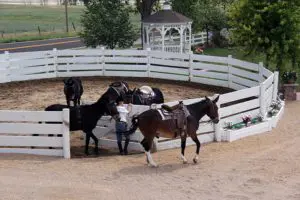 If you want your equine to come to you, rather than chasing him, simply stand at the gate or doorway and ask him to come to you, offering the oats reward when he does. If you are kind, patient and consistent, he will most likely always oblige you.
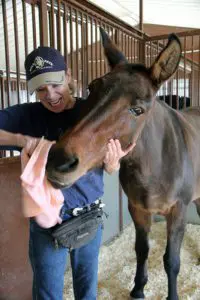 the others for standing back after you have rewarded the one you want for allowing you to halter him. This will also avoid anxiety in the one you are haltering, because he knows you will protect him and wave back the others who might otherwise crowd him or kick at him. The ones you wave back will learn that if they comply, a reward is coming.
 Being in good posture feels good to all of us and allows all the organs in the body to work correctly. When one is comfortable and amply prepared for physical activity, it is always more enjoyable. This is no different for equines. When you don’t consistently pay attention to your own good posture, neither will your equine pay attention to his. His movements will tend to be difficult and unpleasant, and the relationship between the two of you may begin to erode. But when your equine is encouraged to be in good posture during training, it feels good to him and, over time, will become his normal way of moving and resting. He will also be grateful for your kindness and consideration, and he will look forward to the activities he gets to do and the time he spends with you. When you pay attention to your own good posture right from the beginning of leading training and every time you work with your equine, he will be able to mirror your good posture. The result will be his own good posture, which will result in more comfort for him.
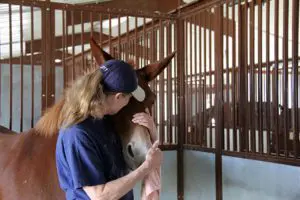 There will be times when it is necessary to employ negative reinforcement to stop bad behaviors that can escalate and become truly dangerous behaviors before they become persistent and uncontrollable. These corrections, which are covered in DVD #2 of my