By Meredith Hodges
 Your equine depends upon you for his safety and well-being. The best feed in the world won’t keep him in good health if you neglect other important areas such as vaccinations and worming. It’s up to you to create a program to prevent disease and control parasites. Here are some suggestions for a general health program:
1) Cleanliness is very important. Make sure feed boxes are clean and manure is removed from stalls and paddocks. Do not feed hay or grain on the floor or anywhere it may become contaminated with manure. Similarly, small, heavily used pastures tend to build up a heavy parasite load. Pastures should be rotated and harrowed as frequently as possible to break the life cycle of the parasites.
2) Internal parasites are the most common danger to the health and well-being of your mule, and you must be prepared to wage a constant battle to control these worms. Follow your vet’s advice to set up a parasite-prevention and control program through regular worming. The drugs that are available today are very effective in removing parasites and breaking the cycle of re-infection. At Lucky Three Ranch, we worm every eight weeks in January, March, May, July and September with Ivermectin and then break the cycle and worm with Strongid in November. Don’t forget to watch out for bot eggs and remove them immediately.
3) Avoid letting your equine drink from public watering facilities. Use your own clean water buckets. Keep an eye out for anything that might injure your equine, and remove or repair it.
Proper treatment of diseases and injuries depends on two very important factors: correct diagnosis and knowledge of the proper treatment. Your job is to become familiar with equine diseases and their symptoms. In case of sickness or injury, know what to do for your animal before help arrives. Understand what simple treatments and remedies are safe to follow. Above all, know when to call a veterinarian.
4) There are many resources available to help you learn how to be better prepared including books, clinics and, especially, advice from an expert such as your own veterinarian or farrier.
Assemble your own equine first aid kit and, with the help of your veterinarian, learn the proper use of each item in the kit. Be prepared to handle the situation before the vet arrives.
When signs of infectious disease appear, isolate infected animals promptly and call your veterinarian right away.
5) Seek your vet’s recommendations for shots and immunizations, and faithfully follow an annual vaccination program. Make sure you keep good records of vaccinations and worming, and be sure to keep track of when they’re next due.
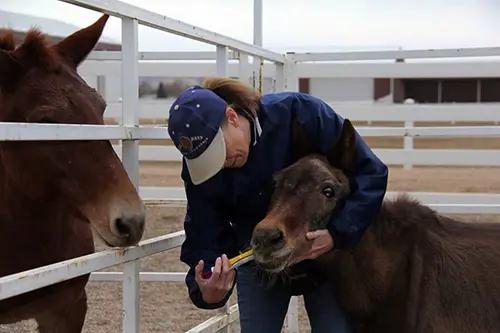
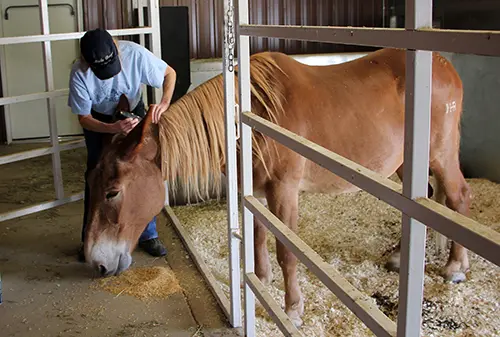
6) One of the best ways to monitor your equine’s health is by establishing a daily grooming routine. Not only will he be rewarded with a shiny coat, but you can watch for cuts and bruises and check the condition of the feet.
Basic grooming tools include a rubber currycomb to rough up the hair and bring dirt to the surface, a dandy brush to lift out the dirt, a body brush to smooth and shine, a hoof pick to clean the feet and a mane and tail comb and brush. A sweat scraper is handy to remove excess water during and after a bath, or sweat after a workout. A grooming cloth can be used to polish the coat and bring out the shine. In the springtime, a plastic multi-bristled hairbrush and shedding blade are also nice tools to have on-hand to remove dead hair, and a sponge can be used to clean muddy legs.
Begin your routine by using a hoof pick to clean the feet. Start with the near front foot, move to the near hind, then the off fore and off hind. If your young mule is skittish, work in whatever order he is comfortable. As he becomes accustomed to having his feet cleaned, you can do them in a consistent order. Clean from heel to toe and watch for infections like thrush and injuries from rocks or nails. This is also a good time to check his shoes. Mules should be shod (if working regularly on very hard surfaces), or trimmed, approximately every six to eight weeks according to use.
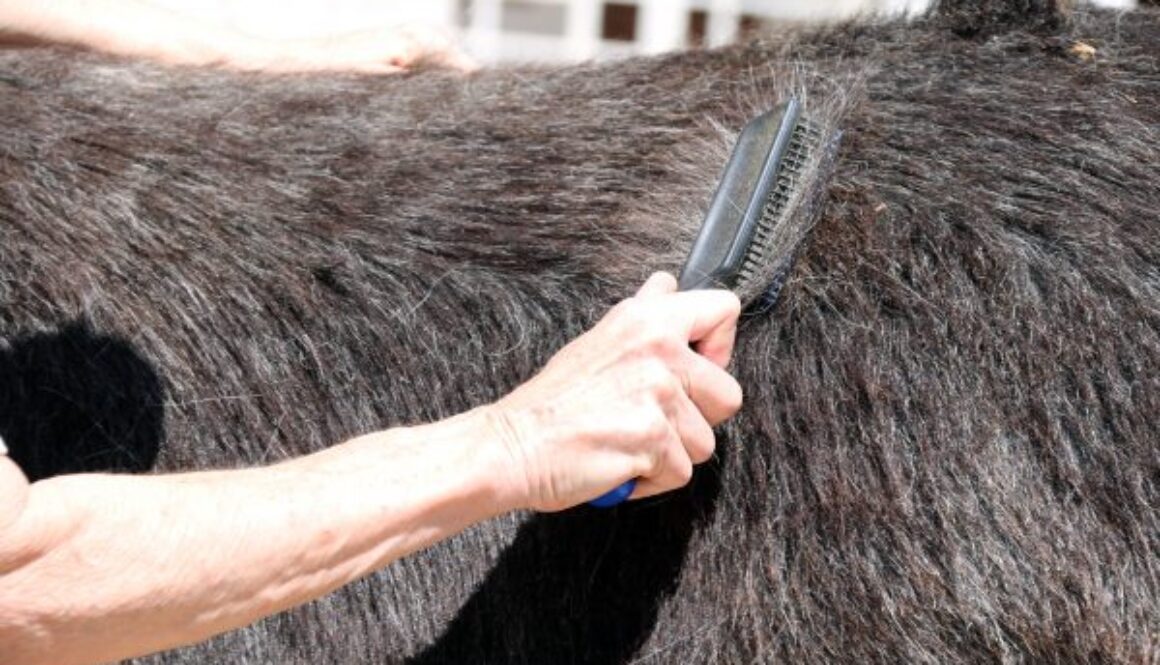
Next, begin to groom the body, starting on the left side at the head. Hold the currycomb in one hand, keeping the other hand on your animal to steady him. Gently curry in small circular strokes, working your way down and back, ending with the hind leg. Next brush vigorously, first with the hairbrush and then with the body brush. During springtime shedding, use your plastic bristle brush on the body to reach the dead hair in the undercoat before you use the shedding blade. Make sure that you apply only as much pressure as feels good to your equine (lighter pressure over bony areas). This should be an enjoyable experience for him.
After grooming the left side, move to the right side. Brush the head with a Dandy brush and use a multi-bristled human hairbrush on the mane and tail. By adding a little Johnson’s Baby oil to the mane and tail during grooming, you can train a mane to fall to one side and keep other equines from chewing on manes and tails. Finish with a soft body brush. Finally, use the grooming cloth to wipe around the ears, face, eyes, nose, lips, sheath (if it’s a male) and the dock of the tail.
While paying this much attention to your mule’s body, you will be sure to see anything abnormal such as an abscess, a cut, mites or insects, or a sore. Early discovery and treatment keep problems small.
Besides routine grooming, your equine’s longer hairs can be trimmed as often as needed. Clip the long hairs from the head, the outsides of the ears, on the jaw and around the fetlocks for a neat and clean appearance.
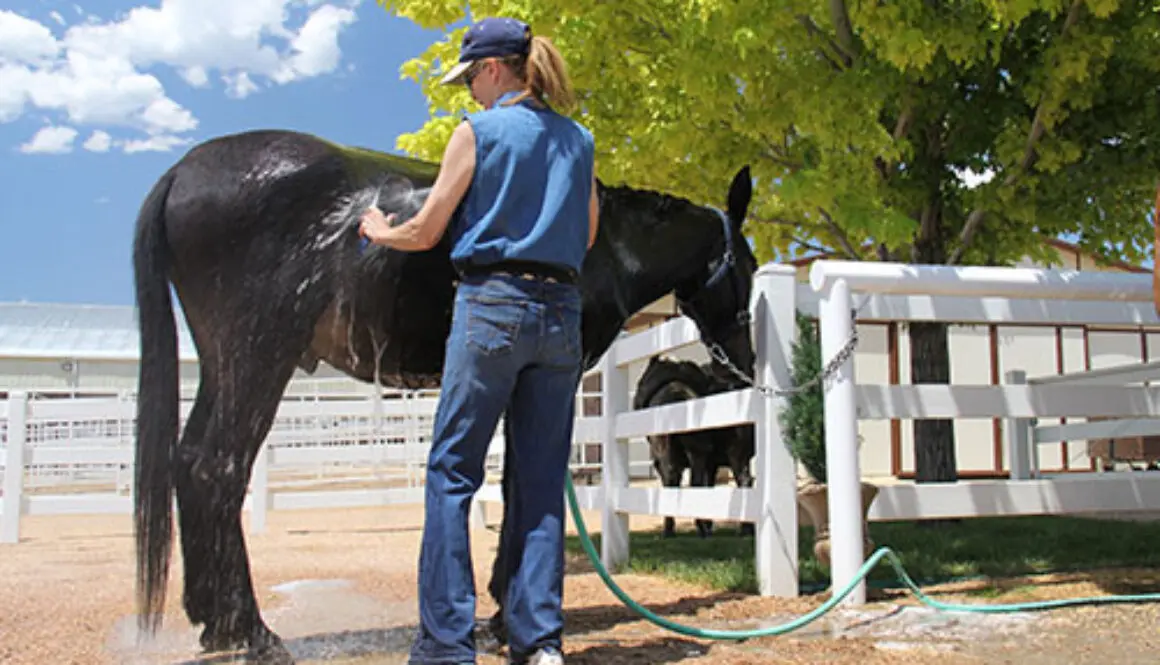
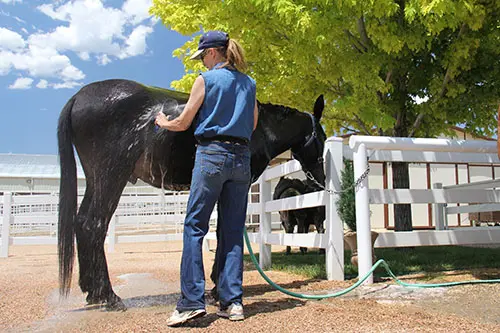
Mules and donkeys like to be dusty, but they also like to be clean. Bathing every so often will make your Longears look and feel better. All equines enjoy having all that itchy sweat rinsed off after a good workout. I don’t recommend bathing too often with soap because an equine’s skin is sensitive. Soap can irritate it as well as strip away the essential oils. Most of the time, a good rinse, while scraping the excess water off with a shedding blade, will maintain a clean, healthy coat. Of course it’s essential to have a spotless animal if you’re off to a show or parade.
Once your mule has been bathed and is spotlessly clean before the show, all you need to do to prepare him for your class is a quick once-over with a vacuum. Vacuum training is like anything else—take your time, be polite in your approach and make sure your mule understands that this strange, noisy monster is not going to hurt him. Soon he will learn to enjoy being groomed by the vacuum. The vacuum will also promote better circulation to the muscle tissue.
BODY CLIPPING
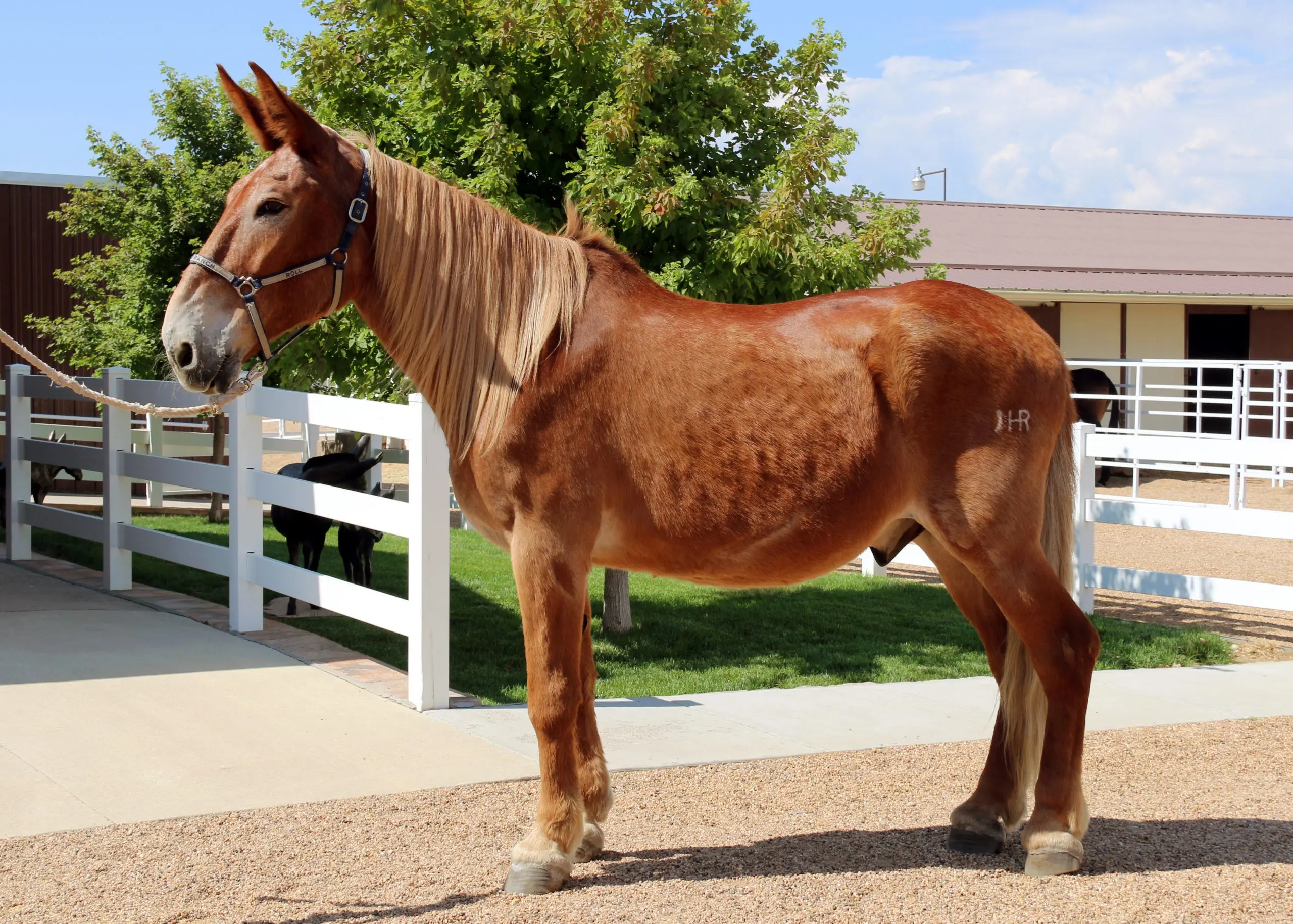
If you plan to show your mule, you might consider body clipping. If you clip in mid-April or May, you will expedite shedding and the hair that grows in will be more manageable than the heavy winter hair. Equines that are not going to be shown should be left with their natural hair coat, as it insulates them from both cold and heat, and protects them from invasive insects. Mules and donkeys shed more slowly than horses and are not usually fully shed out until late summer.
There’s a bonus to clipping a show mule or donkey—their hair won’t grow back as quickly as that of a horse. Just remember that clipped animals should be stabled and blanketed during cold weather. If you do blanket your mule, you must be ready to add or remove blankets and hoods as the weather changes each day. To keep the coat from growing back too quickly, it helps to have them under 16 hours of light (summertime light duration).
To body clip your mule, begin with a quick bath. Your clippers will last longer if your mule is clean. When he’s dry, use your rubber currycomb to bring any dirt and dead hair to the surface. Follow with a good brushing. If it’s too cold for a bath, use a vacuum to get him clean.
Begin clipping the legs and head, because these are usually the hardest areas to do. If he’s a little difficult, don’t hesitate to use the restraints you learned about in DVD #2. Use a twisted lead rope hobble to restrain the front legs, a scotch hobble for the rear legs, or a face tie for the head, but be sure to use them as described and don’t be punitive in your approach. Start with small clippers on the coronet band and fetlock, working your way up each leg.
Do the body last with large animal clippers. Clip against the lay of the hair. Start at the rear and work your way forward, clipping first one side and then the other. Pay special attention to the flanks, the mane and the fuzzy areas under the belly and around the forearms and buttocks.
If your mule has a nice mane, leave it and clip a bridle path. The length of the mane and the bridle path will depend on trends in the event you are participating in. For example, in English riding, manes are kept shorter to make braiding easier, but if your event is reining, keep the mane as long as possible. I like to grow the manes as long as possible (they help to keep flies and insects at bay), give crew cuts through the bridle path to the males and leave a foretop and bridle path on the females.
If you’re packing, you might want to shave or trim the mane short for the sake of simplicity. Many people shave the foretop and bridle path with a #10 blade, and then trim the rest of the mane to half an inch. You may trim the outside edges and backs of the ears, but leave the inside hair to prevent irritation from flies and bugs.
The tail is another area where there are many variations. I recommend applying Johnson’s Baby oil to the base during each grooming and letting the tail hair grow. This is a good idea if you compete in open events with horses. A second method is to shave the first two inches of the tail for a clean, well-groomed look (however, it does grow back even fuzzier!). A third variation is to “bell” the tail in three tiers. This looks best with a thick tail and is generally used for identification purposes by packers and the military, but is not recommended for normal grooming, as it is difficult to maintain.
Now you’re ready to trim the head. This will include trimming the bridle path, muzzle hairs, hair under the jaw, long hairs around the eyebrows and the backs and edges of the ears.
Lastly, remove chestnuts and ergots by soaking them with baby oil for about 30 minutes and peeling them off. If the ergots don’t peel off, you may cut them off with scissors or nippers.
Now you’ve got an equine that looks great! It will be easy to keep him looking good with a weekly trim that should include bridle path, ears, around the face and coronet bands.
BRAIDING FOR SHOW
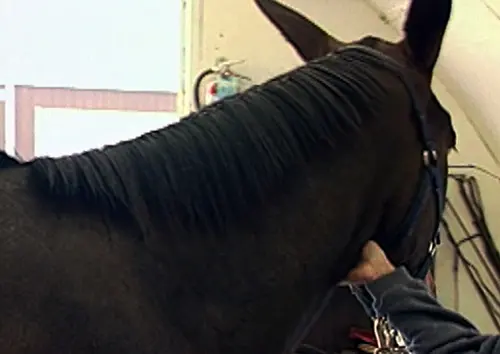
Depending on the event you plan to show in, treatment of the mane varies considerably. For Western pleasure, you may want to simply band the mane so it lies flat. The tiny rubber bands can be purchased in tack shops in colors to match your mule’s hair. Tradition dictates the braiding of the mane for hunters and English classes for a neat, clean appearance. A thick, heavy mane cannot be properly braided and must be thinned until all the hairs are about four to six inches long and lay flat on the neck. This is done by using a mane comb to pull out the long hairs from the underside of the mane. This can be a big job and it’s annoying to your equine, so limit mane pulling to a few minutes a day. Make sure the hair is the same length from poll to withers. Don’t even think about cutting it with scissors—it will just end up short but way too thick to braid.
You can spritz a little water and hair spray to make the hair easier to handle. The quickest way to secure the braids is by using tiny rubber bands. It’s also very easy to do and it’s great for one-day shows or quick changes between classes.
Sewing with thread or weaving yarn looks very professional and is more permanent, but it’s also more time consuming.
Once the braid is finished it should be folded once and fastened with either rubber bands or a piece of yarn or thread. It can also be rolled and tacked into place. How you finish your braid will depend upon the time you have and the look you want to achieve, as well as what looks good on your equine!
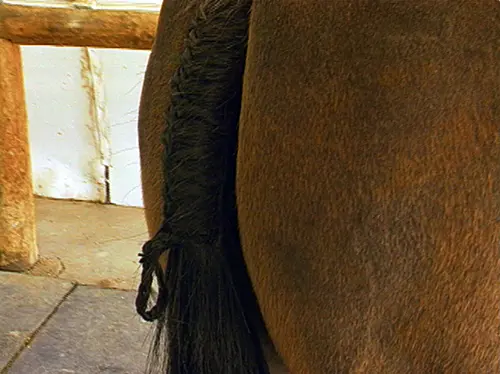
Braiding the tail begins with a clean, well-groomed tail. Even short hair can be braided if you use a lot of hair spray to make it sticky. Moisten all the hairs along the dock with a damp sponge and bring them forward. Take a section of hair from each side of the tail, as close to the top as possible, pulling the sections out from as far under as you can.
On a horse, you can pick up a third section from the middle of the tail, but on a mule’s thin tail, take the hair from the side. Cross it over one of the outer strands. Begin braiding with three strands down the center of the tail. With each twist of the braid, pick up a little more hair from either side or from the middle. Continue braiding until you reach the root of the tail, then don’t add any more hair, but braid until you reach the end.
Fasten the end of the braid with a tiny rubber band or a piece of yarn. Now fold the braid once and pull the end up into the braided root, tying it at the base with yarn or thread.
In showmanship and halter classes, it goes without saying that your equine must be groomed to perfection. This means that, for months prior to the show, you’ve given your equine a good brushing or vacuuming at least once a week. Brushing stimulates the skin and brings out the natural oils that make the coat shine. No amount of “shine in a can” will replace the natural luster of an equine that’s been brushed regularly.
To learn more about Meredith Hodges and her comprehensive all-breed equine training program, visit LuckyThreeRanch.com, MEREDITH HODGES PUBLIC FIGURE Facebook page, or call 1-800-816-7566. Check out her children’s website at JasperTheMule.com. Also, find Meredith on Pinterest, Instagram, MeWe, YouTube and Twitter.
Covered in TRAINING MULES & DONKEY: A LOGICAL APPROACH TO TRAINING, TRAINING
WITHOUT RESISTANCE, EQUUS REVISITED and A GUIDE TO RAISING & SHOWING MULES at www.luckythreeranchstore.com.
© 2013, 2016, 2024 Lucky Three Ranch, Inc. All Rights Reserved.

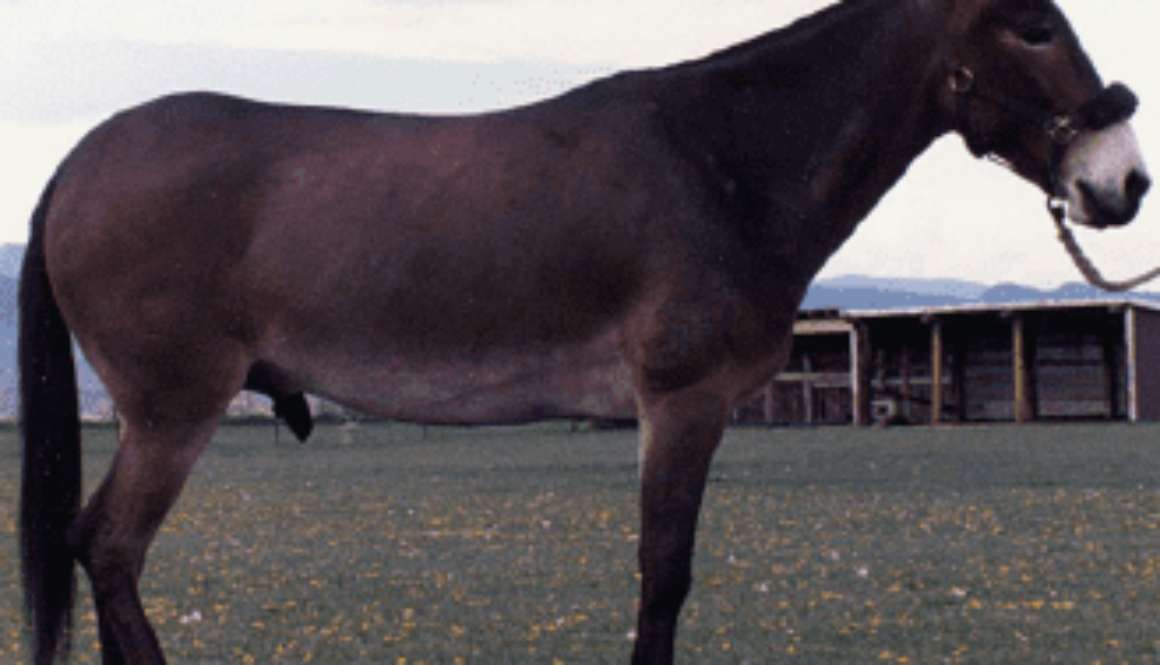
 Mule Lovers of Colorado showed True Grit and perseverance in their acceptance to put on a mule show at the Colorado Classic Horse Show held in Denver on April 26, 1986. Notice of the invitation to show mules at the Classic was given only a month in advance. Still, these undaunted mule lovers were able to band together and put on an impressive show, despite the short notice. Over 40 mules were exhibited, with the proceeds going to the Colorado Heart Association. The mules were shown in the elite company of Arabian and Appaloosa horses. At the beginning of the show, the skepticism of the horse people was fairly apparent, but it wasn’t too long before their skepticism turned to awe and admiration. The mules were not what they had expected. They were clean, shiny and extremely well mannered. Mules made many new friends that day!
 In the horse world in this country, one generally shows either English or Western, but the mule people have elected to open doors and accept many different riding styles in their shows via the Open Pleasure class. At the Colorado Classic, Sally McLean, astride her husband’s mule, Bucko exhibited the Australian mode of riding, complete with Australian clothing and tack. The man from Snowy River would have been proud and had he known mules a little better, he may have preferred using one in the film. His ride down the cliff would certainly have been more secure!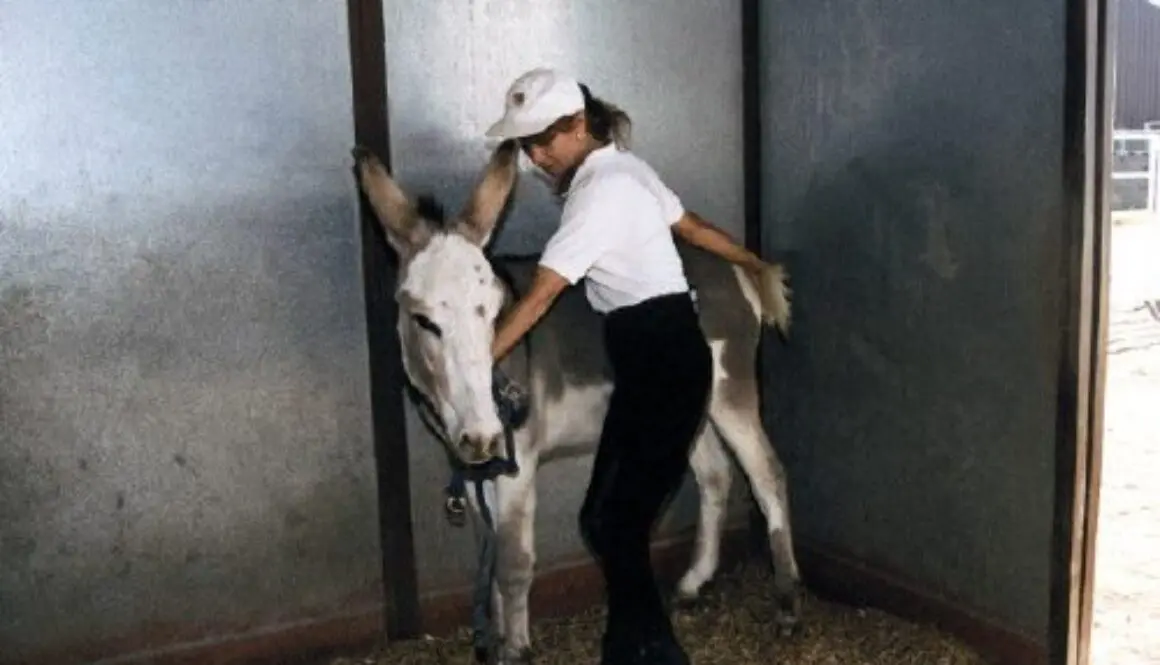
 There is probably nothing more infuriating than having a mule that you can’t easily catch whenever you would like. The young mule that has been introduced to the halter at an early age can pose a problem, just like the mule that has had no halter training at all. The reasons for their evasive behavior and the intensity of resistance are different, however. The mule that has been handled will periodically attempt to assert his dominance over you with a playful yet evasive attitude, while the mule that has not been handled will react out of fear and suspicion. You can deal with both of these mules in the same manner to produce positive results, but the one reacting fearfully could become aggressive and potentially dangerous because he feels a need to protect himself from you. The one that has been handled will seldom be as aggressive. He may kick at you, but he probably won’t touch you intentionally because he has learned that this is bad manners. Be careful, because the fearful and aggressive mule will most likely connect with his target.
 When a mule is being evasive, it is fairly obvious that his attention is not totally on you, and in order for him to be obedient, he must be attentive to you. If you have observed mares and foals, you have noticed the mare nuzzling, bumping and pushing her baby into obedience. As the foal matures, he learns the limits of his behavior from his dam, and sometimes she has to get pretty rough to get her point across. Once she does, however, the young mule learns to check his behavior with her at regular intervals. For instance, while curiously investigating, he will check the object, then his dam. His attention then returns to the object of his curiosity. It is this kind of attentiveness that you wish to cultivate in your mule. This can be accomplished with a relatively simple procedure. The only requirements in the game are patience and persistence.
 First, put your mule into a reasonably small pen, preferably with square corners because this will give you more of an edge. If you are right handed, hold your halter and lead in your left hand and approach the mule from the side, toward the point of his shoulder. Never approach from directly in front or from behind, because he cannot see you clearly and you may frighten him. When he does move away from you, you want him to track to the right if you are right handed. If you are left-handed, the situation is reversed. Upon your approach, mentally record the distance between you and your mule when he begins to move away. This is his space, or safety zone. You will use this distance to herd him into a corner and allow him to stop.
 When he does stop, he will be looking for a route of escape. He may push his head through the fence and lean, or he may just dash back and forth in the corner. Whatever he does, keep your distance and allow him to settle before moving to the next step. If you are in a round pen, a lot more back-and-forth walking (or running) will be required to get him to settle in one spot and is not advisable.
 neck. Then step to the left side of your mule, just in front of his shoulder. Adjust your arms so that you can hold his nose with your left thumb and slip the noseband over the nose. He will probably try to jerk away, but this position will give you the best leverage. If he does manage to get away, smack him on the rump with the soft cotton lead rope once more and repeat the entire procedure.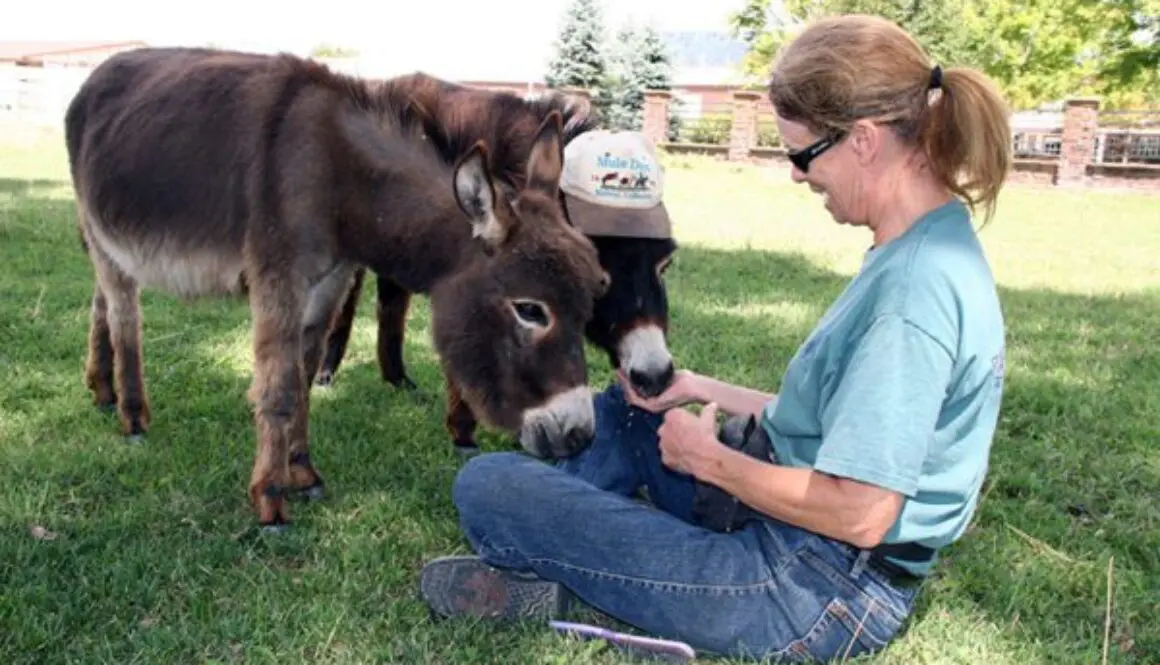
 Miniature horses, donkeys and mules all have one thing in common; everyone else is taller than they are! That makes eye contact with the trainer very difficult if not impossible for them. As the saying goes, the eyes are the window to the soul so it is understandable that they would become anxious if they are unable to look into a person’s eyes to decide whether they are friend or foe. I have five miniature equines: a mini horse named Mirage, a mini mule named Franklin, a mini molly mule named Francis, and two mini donkeys named Augie and Spuds. To help them all succeed and thrive, I’ve structured my training program for them based on the same one I use for all of my other equines, with one important modification. With safety always as my first priority, I work with my minis from a lower position whenever it’s safe to do so. That way, I can make eye contact with them, and I make certain they are always lavishly rewarded with an oats reward for their compliance. The results have been amazing! I’ve received total cooperation from them almost all of the time.
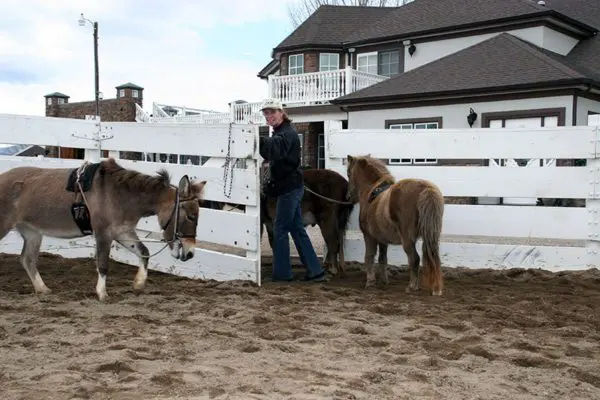 None of my minis were born at my ranch, so I knew that they would each first need to explore their surroundings a little at a time, and would also need ample time to get used to my staff and me. Mirage, the miniature horse, was my first mini. It wasn’t long after I acquired him that I acquired Franklin, the mini mule, who quickly became Mirage’s buddy. Since both Mirage and Franklin had previous training and because minis seem to accept training more willingly when done with a partner, we did all of Mirage’s and Franklin’s groundwork lessons together and, true to form, they learned very quickly because they were allowed to be together.
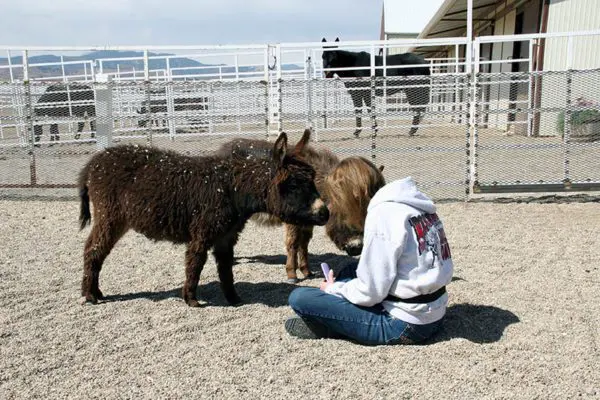 I think it is critically important that all equines have a space they can call their own—their personal oasis of comfort and privacy—so when I got my mini donkeys, Augie and Spuds, I decided that the first thing they would learn about was their living quarters or, as I like to call it, their “bedroom.”
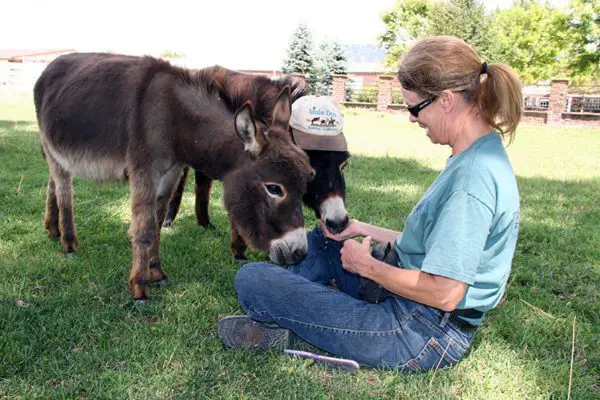 When your mini is comfortable with you coming into his pen and interacting with him, the next step is to ask him to go into a bigger turnout area, where you should repeat the same simple lessons. Now that your mini can be loose in a larger space, ask him to come to join you for another picnic. After a few times, bring a hairbrush with you (It’s the most efficient brush to use on donkey hair).
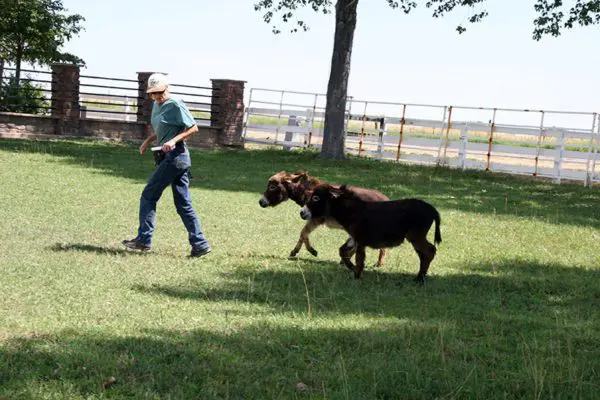 A halter doesn’t even come into play until after grooming in the pen is easily achieved and your mini will follow you to and from the pen without the halter. When it is time to introduce the halter, bring it with you into the pen for your picnic. Do the brushing and then show your mini the halter while you sit on the ground. When he sniffs the halter, he should be rewarded. Once he is unafraid of the halter, hold it on both sides of the noseband, feed your mini some oats, and then gently push the noseband of the halter over his nose and then take it off, rewarding him again. At this point you’ve got all kinds of oats in your lap and your mini’s got his head down, eating the oats, so when you put the noseband on again, just reach over his neck, grab the strap of his halter on the other side, bring it behind his ears and fasten it. If done correctly, this should not bother him. Then reward him with more oats, pet him as he complies and say, “Oh, how good is that?!” You can then take the halter off again and end the first lesson there.
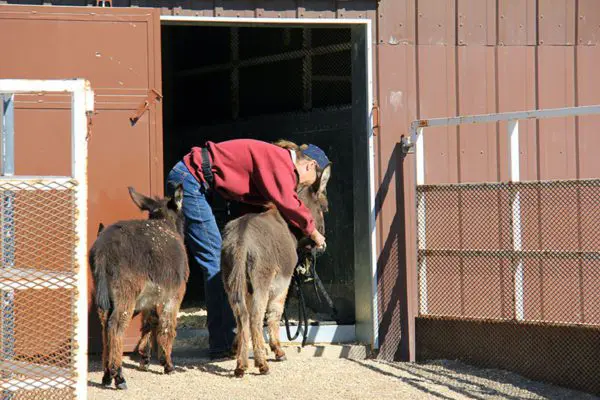 Once your mini is used to having his halter put on, let him graze while supervised in a larger pasture area with his halter on while he drags the lead rope behind him. When you want him to walk away from you, simply stand up and let him go off on his own. After a few minutes, approach him again, grab the end of his lead rope and sit down again. You can give a little tug, say his name and ask him to “Come.” He should come easily when you gently tug on his lead rope. This action makes him look at you and think, “Oh, my human is sitting down again, so I’m going to come over and get more oats!” As he comes toward you, take up the slack on his approach. Once he comes to you easily, you can stand up and ask him to come while you’re standing up and reward him for it. And that’s how to teach a mini to follow you.
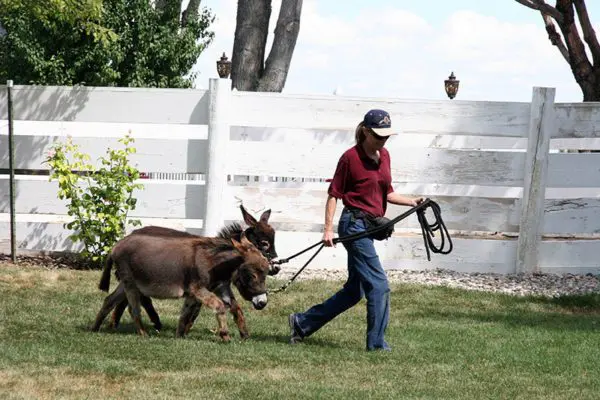 Breaking things down into little do-able steps seems like a long process in the beginning, but as your mini begins to understand the reasoning behind your approach, his reactions to tasks will become calmer, more automatic and more natural for him. When you allow your mini to learn to follow your lead without the halter in the beginning of each task, learning to follow you on the lead rope will be a lot easier for him, and when you finally move on to more specific tasks in training, he will oblige you much more willingly. In Part 2 of “Getting Down With Minis,” I will cover how to approach the tasks necessary for formal training.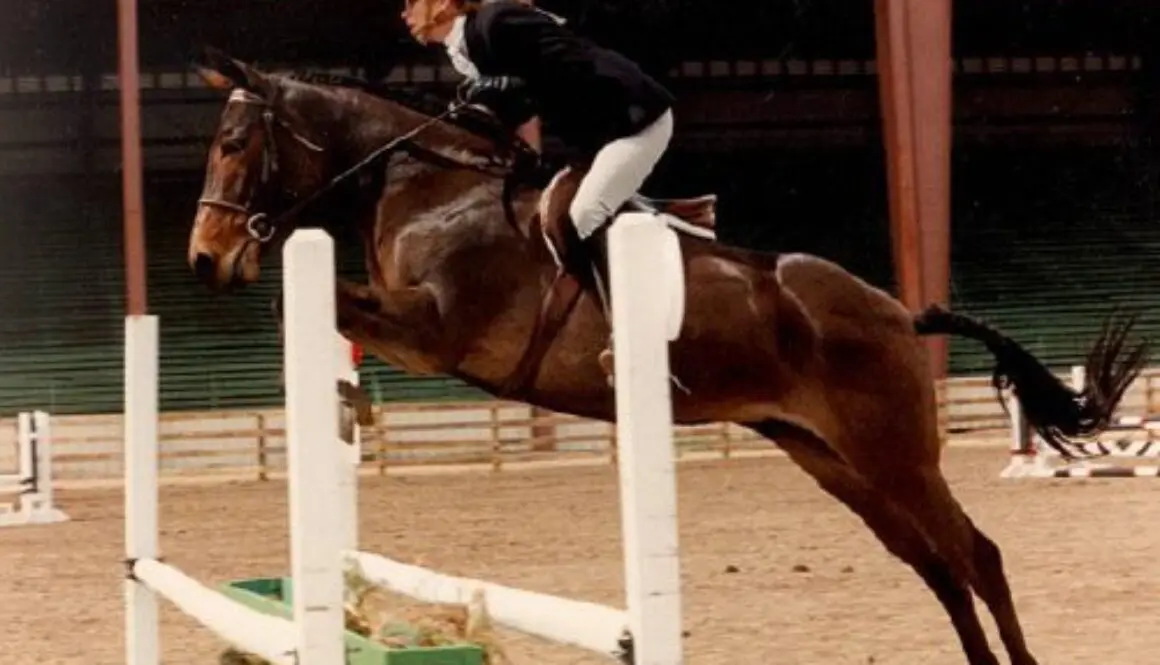
 First, this morning, we would like to present Meredith, riding her 16.2 hand Quarter Horse mule, Lucky Three Sundowner, exhibiting the discipline of Dressage through a First Level Test! Sundowner has recently taken the step up to First Level after spending 18 months at Training Level, learning to travel in a cadenced, rhythmic, and balanced fashion. At first glance, this pattern may look rather simple and many of you might think, “Oh, that’s simple!” But I challenge you to actually get out and try to do this. You will find, as is the case with many things… that it is not as easy as it looks. Many hours of training have gone into this animal in order to make this mule look as smooth, balanced, and rhythmic as he is. Though he is under the rider’s direct control, he must appear that he is doing of his own accord.
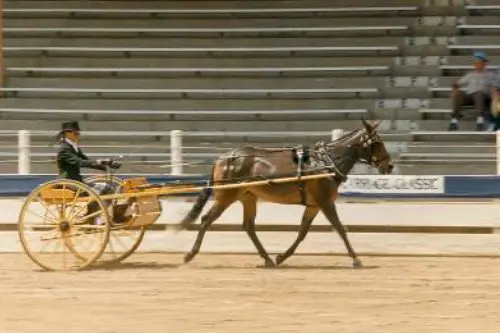 Next into the arena we have Meredith driving Lucky Three Mae Bea C.T., a 15 HH molly mule. Driving used to be a matter of necessity rather than pleasure. There was not much need to have the animal do much more than go forward at all three gaits, with the trot being most prevalent, and to back and turn. Mules today are being taught to drive with finesse through training in Dressage. Driving classes that are offered in the shows include Pleasure Driving, Obstacle Driving, Drive & Ride, and Cross Country. All of these classes require a good communication and understanding between mule and driver.
 and begins to learn submissiveness to the bit. By not throwing too many things at the animal all at once, we are allowed to work on these things in a natural progression that will facilitate an obedient, free-moving, and calm animal. As the training becomes the animal, the animal itself becomes a more dependable and pleasurable mount.
 drawings to acrylic painting to bronze sculpture, from commissioned work to originals, all revering the mule. She has also written a multitude of articles for such publications as The Brayer, a bimonthly publication put out by the American Donkey & Mule Society, Mules and More Magazine, Western Mule Magazine and the Bishop Mule Days program.
 Bonnie’s second contribution to the LOVELAND LONGEARS MUSEUM & SCULPTURE PARK at Lucky Three Ranch, titled “Friends,” was a depiction of the three main characters in the Jasper the Mule children’s series: Kylie, Moxie and Jasper. This sculpture was strategically placed at the entrance to the North Barn where the Champion Mules of the Lucky Three Ranch were housed. The people on our tours are always captivated, and smile broadly, when they spot these animated characters exhibited in bronze! Bonnie was my illustrator for the Jasper the Mule series, so we both did a book signing tour together for the launch of the first book that included: Nashville, Dallas (Children’s Hospital and several TV & Radio appearances, and book signings), National Finals Rodeo in Las Vegas and Los Angeles. Those were exciting times!
 Bonnie’s sense of humor is unique and infectious! Mules and More Magazinepublished her stories, mostly involving mules and their appearance in history with their human counterparts. They were always lively and entertaining! What is certain to end in disaster, usually takes you on a long journey that ultimately results in compromise and wide grins. Of course, this is what living with Longears is all about. Either you have a good sense of humor and enjoy the ride, or you DON’T. If you don’t, the joke’s on you! With each individual mule owner, the stories are different, but our introductions to Longears are basically the same. Most humans are not always ready for the pranks of their mules and donkeys! This is the source of Bonnie’s amazing sense of humor with her numerous cartoons and whimsical paintings. Bonnie did a classic painting just for me titled, “I Don’t Know…Maybe I’m Overorganized!” She sure knows me well! Even her way of spelling words adds to the charm of her work. For instance, “sure,” she spells “shure!” My mother once told me I should help her with her spelling. I told her that even Bonnie’s spelling was unique about Bonnie! It is all about “Artistic License!” Then my mother asked if she ever got dressed up when she went OUT? I replied, “Of course! She wears her WHITE overalls for those kinds of events! She DID get some pretty snazzy BLACK overalls from the Draft Horse Club for ‘Black Tie’ events!”
 of many works of art that we proudly display at the LOVELAND LONGEARS MUSEUM & SCULPTURE PARK at Lucky Three Ranch! As her biggest fan, my Bonnie Shields Gallery is quite extensive!
 This book will live on as one of her greatest accomplishments.
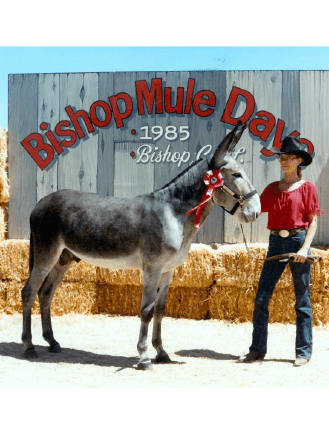
 Most of the world’s calendars begin with New Year’s, but a mule lover’s calendar begins and ends with Bishop Mule Days held in Bishop, California, over Memorial Day weekend each year. This year marked the 17th Annual Mule Days Celebration with over 600 mules participating in everything from the parade to packing to steer roping and jumping. But Bishop Mule Days is more than just a mule show. It is an annual rendezvous of mule lovers from all over the world. It is an opportunity for these people to come together, exchange ideas, demonstrate their talents and pay their respects to the one animal most responsible for the building of this great country of ours – the mule!
 Just as the mule has suffered great injustice to his character throughout the ages, so have his admirers and advocates. Stories and rumors have repeatedly portrayed the mule as an unattractive, stubborn creature, but modern day mule lovers have found that these rumors are simply not true. Fast breaking and gross impatience are probably the underlying reasons for such ignorant remarks. Mule lovers today are doing their level best to educate the general public about the true nature of the mule. The simple fact is that he’s generally better than the horse out of which he came, and much more personable!
 The hard work and dedication of the owners, Dr. Robert and Debbie Miller and trainer of “Jord Ass Jean” was also quite apparent; she exhibited the grace and agility of a truly fine animal. Congratulations on tying for World Champion Performance Mule! It was well earned. Not to be outdone by horseracing, mule-racing fans cheered the victory of Cajun Queen, owned by J.P. Rogers, as the World Champion Running Mule. She was indeed a queen! Demonstrating speed and skill, the World Champion Packer was awarded to Tony Holdridge of the Red’s Meadows Pack Outfit. He did it so smoothly! The best for the best – good mules need a good farrier and Lee Green was where it’s at! Congratulations to our World Champion Farrier! Is it that wonderfully loud shirt, or was it the mule? Congratulations to Johnny Enos and Poco Streak, the 1986 World Champion Working Mule!
 As more people are educated about mules, we see more participants in Bishop Mule Days. Ordinarily Bishop is a town of only 4000 people, but streets were lined with 50,000 spectators for the Mule Days Parade, the largest non-motorized parade in the world. In 1986, the parade consisted of 240 entries. Among those entries were real diehards such as the Vision Quest Wagon Train and Tindell Wagon Train. Both wagon trains travelled over 300 miles to take part in the Bishop Mule Days Celebration. The impressions they left along the way will probably go down in history. Once arrived, the young adults from Vision Quest gave us an extra-special treat with their multi-talented marching drill team. Our deepest thanks for their special contribution!
 Sunday afternoon, Wadi, an Appaloosa mule, was chosen for the part. Congratulations, Wadi! In addition, Dix Country Pictures will also be putting together a documentary about the Bishop Mule Days Celebration. With their enthusiastic help, we should be able to reach more people than ever in praise of mules! In addition to the actual mule show, special events and people are an important part of Bishop Mule Days. The Governor of California, George Deukmejian participated in the parade and later held a press conference. Ted Dawson, award-winning sportscaster for KABC-PV Los Angeles, was honored as Grand Marshall for the Bishop Mule Days Parade. Struck with “Mule Fever,” enthusiastic Ted also participated in many mule events, with his memorable performance being in the musical tires class. Surely, it is a time he will never forget…and neither will we! Semi-truck pulls, steer packing, large hitch demonstrations, and races with eight to ten mules per wagon were just a few of many special events enjoyed by spectators that year.
 All the way from Colorado, the Coors Belgian Hitch gave several impressive performances during the weekend show. Under the steady hand of Jim Hilgendorf, the Belgians exhibited an awesome display of power and grace. Monty Montana, 1978 Grand Marshall of the Mule Days Parade, returned to tantalize the crowd with his intricate rope tricks and trick riding, a wonderful contribution to Mule Days. Even the United States Armed Forces were represented at Bishop Mule Days – two were from the Mountain Warfare Training Center. Rumor has it that mules will still be replacing some modes of transportation in the more mountainous regions. The overall feeling is that mules would be more practical and economical for this type of use.
 Each year, before the Saturday and Sunday evening performances, a very special lady, Nita Vick makes her contribution to Bishop Mule Days. Affectionately known as “Sarge,” she takes rookie volunteers and shapes them into the Bishop Mule Days Drill Team. No one would know from the actual performances that this team had the absolute minimum practice time, only one hour of practice before the performance on Saturday and only one hour before practice on Sunday! Their performance “Under the Flags” is a sight to see!
 Mule Days is the most important American Association Show – it appeals to everyone in some way. Western cuisine, Western art shows and Western dances add to the overall picture of Bishop Mule Days. Fiddlers across America rosin up their bows for the Mule Days Fiddling Contest. As they wandered the grounds serenading the crowds, they were joined in harmony by singing donkeys and mules, and dancing exhibitions and spectators. A fun time was had by all! Bishop Mule Days is more than just a mule show. The area around Bishop is filled with mountain lakes and streams and offers backpacking and hiking, fishing, swimming and even skiing. Couple this with unique and spectacular entertainment and you have the opportunity for the time of your life! Memorial Day weekend is the beginning of the year for these maligned animals and the unique people who love them!


 By Meredith Hodges
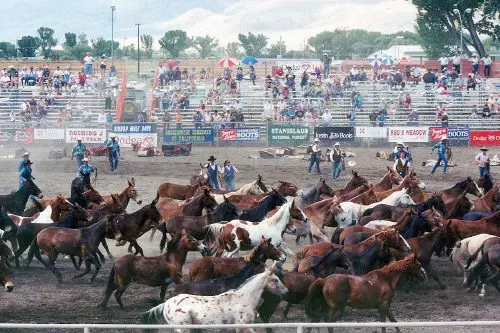
 Over 600 mules competed in more than 100 different events, including packing scrambles, English and Western classes and games, mule shoeing and comedy and specialty acts. As mules have progressed in their unique abilities, the art of Dressage has been added to the agenda. Lucky Three Sundowner of the Lucky Three Ranch in Loveland, Colorado, was invited to exhibit his grace and ability toward dance in an exhibition during the Sunday afternoon performance. He was the highest level Dressage mule to perform at Bishop this year. Lucky Three Mae Bea C.T. preceded the exhibition by winning the Mule Jumping class with no faults!
 During the Saturday and Sunday performances, Bobby Tanner and friends reenacted the old 20-mule team hitch exhibition with mules that had only been hitched together since the preceding Monday afternoon! Such skill and Mulemanship is a sight to see…for sure! Another skillful performance was demonstrated by the Bishop Mule Days Drill Team comprised of exhibitors who practiced only once before each performance over the weekend under the strict and skillful command of Nita Vick, fondly known as “Sarge.” Pack scrambles, chariot races and comedy packing kept the audience in suspense and stitches with their wild and crazy antics. Rodeo announcer Bob Tallman added still more fun and excitement to the weekend events with his outlandish quips and stories. Other highlights included the Country Western dances on Friday, Saturday and Sunday nights, preceded on Thursday night by hit songwriter Michael Martin Murphy, who captured the audiences with hit tunes from past, present, and future recording albums. Western artists, craftsmen and salesmen displayed their wares throughout the weekend with a wide variety of items and art from past to present day. Bishop merchants store windows were painted in celebration of “Mules” and mule memorabilia could be found everywhere!

 By Meredith Hodges
 Bishop Mule Days always has something for everyone. Mule lovers, their friends and family can enjoy fine Western cuisine, games, dancing and good conversation in addition to the show itself. The celebration is kicked off by three mule shows on Friday—there were over 90 different classes and events for competitors. They included: Pleasure classes, Reining classes, Trail, Musical Tires, Barrel Racing and Pole Bending. Also, Jumping, Cattle Penning, Steer Stopping, Team Roping, and a Balloon Bust. For the packers: Pack Train classes, Packing contests, Box Hitch and Diamond Hitch packing contests (pro and non-pro), Team Packing and the Team Packing Scramble, which you must see to believe!
 There was an Individual Packing Scramble for those wild and wooly mountain men or women who preferred to “go it light,” Western Saddle Races for those who wouldn’t be caught dead sitting on a postage stamp, and Forging and Hot Shoeing for our more artistic farriers. All these events and more were narrated by the “Man with the Magic Voice,” Bob Tallman from Reno, Nevada. He is one of many extra-special people who participated in this year’s Mule Days Celebration.
 the French archives as early as 1121. The breed has been protected by the French government and has remained pure for 300 years. Sonnette was one of only 60 Poitou donkeys in existence in 1985 and the only one of her kind in the United States. Her companion Savane was one of an estimated 150 Mulassiers in existence in 1985 and the only one of her kind in the United States. Mulassiers are a powerful draft horse used exclusively to breed with the Poitou ass to produce the Poitou mule, that has been extensively used in agriculture in France for hundreds of years. Seeing these two extremely rare animals was a very special treat indeed!
 The following is a list of points that I used in my pursuit for “Mule” acceptance into the national equestrian organizations such as the American Horse Show Association, The United States Dressage Federation, the United States Eventing Association and ultimately the United States Equestrian Federation (A.H.S.A. replacement).



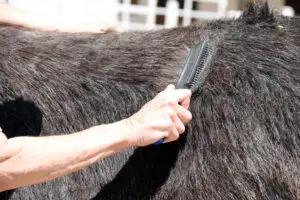 After grooming the left side, move to the right side. Brush the head with a Dandy brush and use a multi-bristled human hairbrush on the mane and tail. By adding a little Johnson’s Baby oil to the mane and tail during grooming, you can train a mane to fall to one side and keep other equines from chewing on manes and tails. Finish with a soft body brush. Finally, use the grooming cloth to wipe around the ears, face, eyes, nose, lips, sheath (if it’s a male) and the dock of the tail.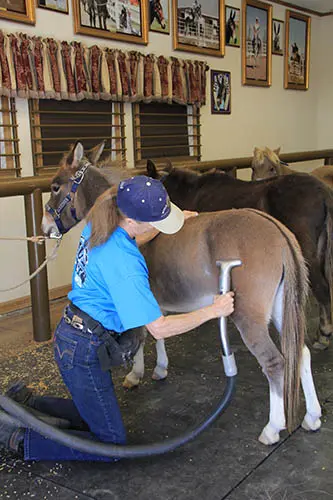

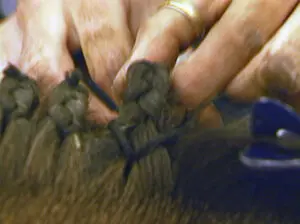 You can spritz a little water and hair spray to make the hair easier to handle. The quickest way to secure the braids is by using tiny rubber bands. It’s also very easy to do and it’s great for one-day shows or quick changes between classes.

 By Meredith Hodges
 In order to remain an integral part of the A.H.S.A, once we were accepted, we are expected to meet certain criteria. First, our breed organization must have been incorporated in the United States a minimum of five years. Since the American Donkey & Mule Society was founded in 1967, we had already met these criteria.
 records on stock for the purpose of a traceable ancestry and to monitor the accomplishments of our athletic champions. Obviously, registering animals improves the chances to help you monitor the health and well being of your animal. A traceable ancestry gives us the opportunity to explore and examine the strengths and weaknesses of our breeding programs and other related research. Monitoring the successful accomplishments of our champions allows us to set new goals and new challenges for our Longears and keeps them in a favorable light in the public eye. These things are all-important to the stability and growth of our industry. With a well-organized registry drive, we could, no doubt, meet this second criterion with no problem.
 The third criterion was, perhaps, the one that is gave us the biggest problem: “Competitions restricted to a breed or discipline must have been held in at least 20 events during the year immediately preceding an application for recognition either at A.H.S.A.-approved events or at events approved by the breed or discipline.” This alone, is not a problem, since we definitely hold at least 20 events a year that could stand the scrutiny of A.H.S.A. approval. To remain in the A.H.S.A. we must follow up by having “a minimum of 25% of the competitions restricted to a breed or discipline held at A.H.S.A. events annually.” We needed people and clubs to take responsibility for seeing that these competitions continue to survive and thrive in the corning years.
 In order to remain in the A.H.S.A., there are only 2 more requirements:
 However, it isn’t any more so than any other “new” experience. There are many benefits to be gained by joining, and the most important of all was the overall unification of the entire Equine Industry including all breeds and disciplines. Our world is composed of billions of people with many diversified interests. To see that each different interest has the best chance for growth and development, all of those with that particular interest should ban together in support for its very survival. Dissention and arguments within an industry are counter-productive. Those who wanted to see mules and donkeys accepted by the A.H.S.A. as a division were encouraged to write me letters, cards and even call me at the Lucky Three Ranch to let me know their feelings. We wanted to begin the organization for this action. I felt that if I did not receive any responses to this request, I could only assume that our industry was too young and immature for such an action at this time, and the action to join the A.H.S.A. would again be postponed. I pleaded people to PLEASE, for the sake of our growth, consider the options carefully before rejecting this proposal. It could have meant the success or failure of our entire Longears industry!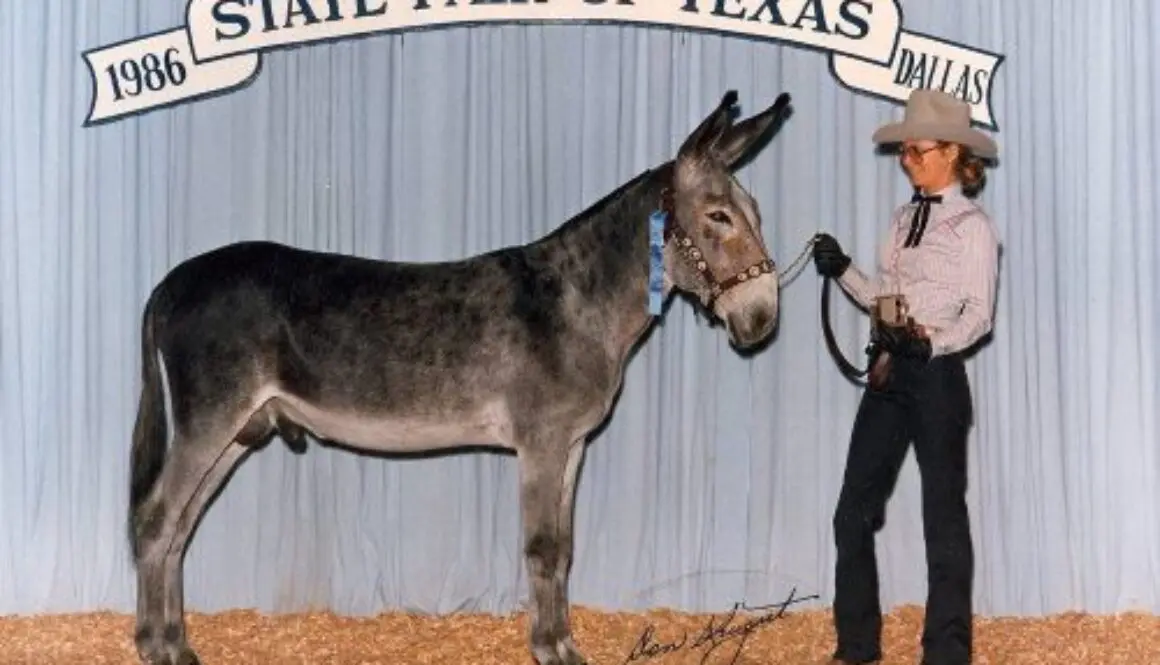
 By Meredith Hodges
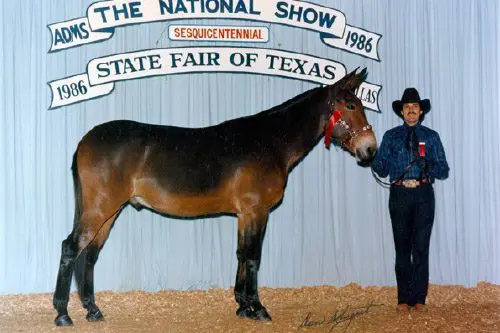 From Loveland, Colorado, it took two days to reach Dallas. The first night, Cliff Rich and Gary Marble were kind enough to arrange for accommodations for us and our Longears at the Equestrian Center in Canyon, just south of Amarillo. The following day, Cliff led us safely into Dallas for the show. Without his help, we would surely have been lost! At the show we were greeted cheerfully and enthusiastically by several A.D.M.S. members and friends whose hospitable contributions made our trip more than worthwhile. Our deepest thanks go to Cliff Rich, Katharine Bradley, Paul and Betsy Hutchins, Darlene Winters, Grady and Wanda Alexander, Jeb and Sue Wilson, Walter Nunn and Keith and Micki Woods. These folks went out of their way to make our experience a pleasant one.
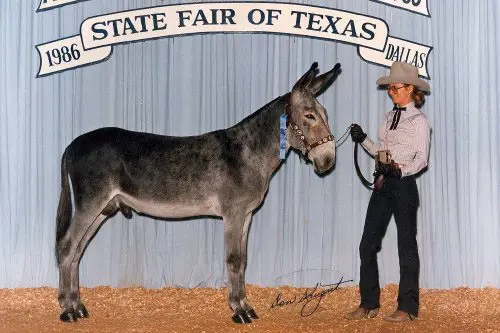 Besides the number of donkey classes made available, there were other things about this show that made it special. Exhibitors were encouraged to decorate their stall areas with photos and facts about mules, donkeys and their farms and ranches. This kind of enthusiasm made for an informative and interesting display for the spectators who strolled through the barn area, helping them to better understand just what was really going on at the show.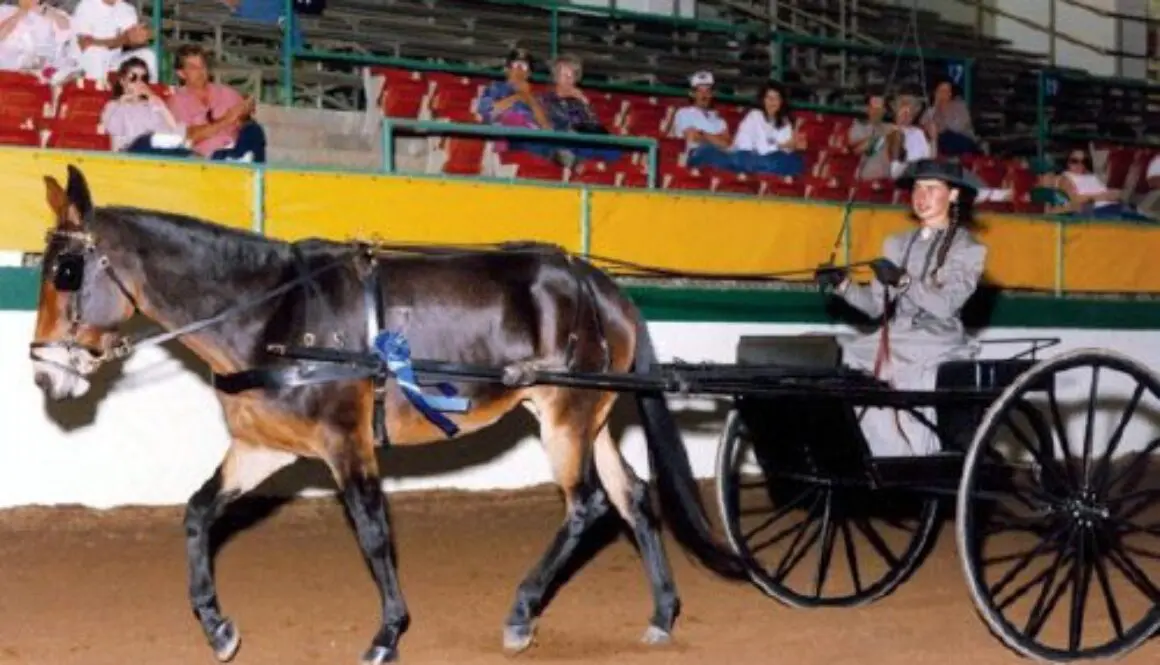
 The Donkey & Mule Society of the Carolinas is to be commended on a job well done in the organization and running of this show, with special thanks to Leslie Bruce and Jackie Sanders for their tireless dedication and support. Founders of the American Donkey & Mule Society, Paul and Betsy Hutchins from Denton, Texas, were thrilled with the success of the show while they too made their own personal contributions. Paul’s captivating and humorous comments throughout the show kept the audience perked, while Betsy spent the long hours manning the A.D.M.S. booth, taking new memberships and renewing old ones, selling longears products, and talking Longears with hundreds of eager spectators and exhibitors. Tennessee mule balladeer Marilyn Powell Greene’s melodic voice filled the air, musing on mules and setting an enchanting ambiance to the whole affair. Even I was compelled to travel all the way from Colorado to lend my support to this special Longears event… and I am really glad that I did! I was particularly thrilled that I was able to bring with me my apprentice mule and donkey trainer/breeder, Ruth Elkins, a representative of the British Mule Society! We both had a wonderful time!
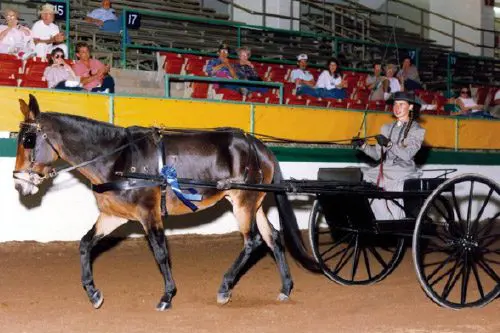 Of particular interest were the driving classes: Single Hitch, Youth Hitch, Multiple, and Parade Hitches, Pleasure Driving, Reinsmanship, Races, and Obstacle classes. There were teams of all different sizes and colors, in beautiful harness, pulling a variety of carts and carriages. Classes were held for both mules and donkeys. As we know, running mules in races of any kind is lucrative at best, but the mules that ran in the harness races at this show were really quite good. Even the donkeys did a respectable job, although there were a couple of them that gave us a chuckle with their deliberate unconcerned attitude during their driver’s enthusiastic “Yee-Hawing” and flailing arms!
 By Meredith Hodges
 Mules come in as many different sizes and colors as horses, donkeys and ponies. Donkey sizes range from miniatures that are 36″ and under to Mammoths that are 56″ and over. A mule is a miniature if he measures 50″ or less at the withers. Saddle mules come from a wide variety of the larger pony breeds, all light horse breeds and some draft horse breeds. They range in size from 50″ to 72″.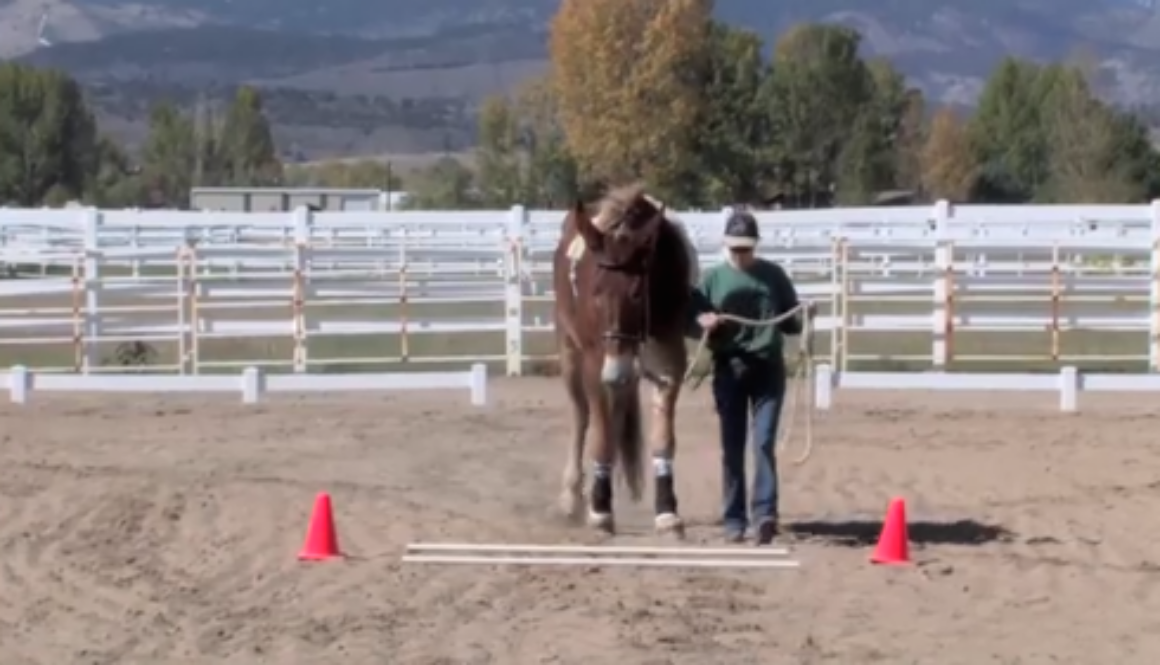
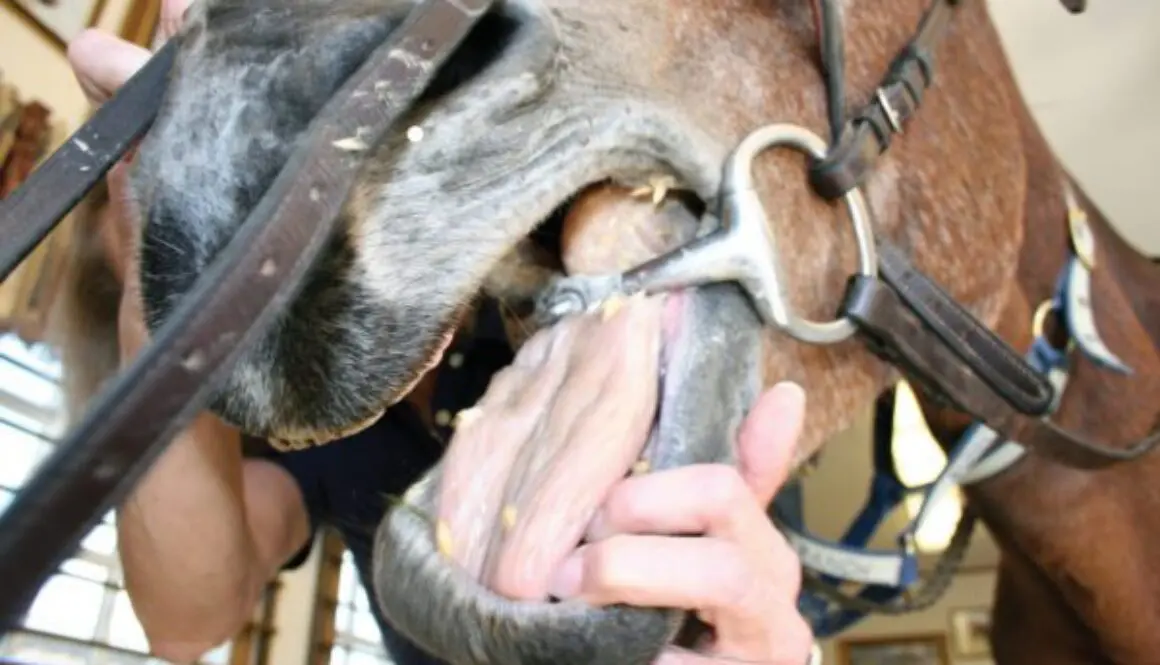
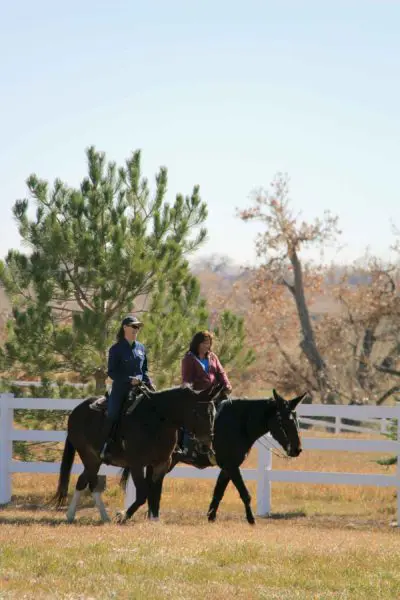 Over the past few decades, through trial and error, we equine owners and trainers have discovered that, when communicating with our equines, harsh bits are not really necessary. Rather, it is safer and more beneficial to use milder tack and equipment, to concentrate on learning correct body language and to give clear cues with our hands, seat and legs to elicit the desired response from our equines.
 When it comes to rider/equine communication, bitless and/or brideless techniques do not work as well as the simple, direct rein action of the snaffle bit in concert with your seat and legs.Many people are under the impression that having a bit in the mouth is painful for an equine, and the seeming “nutcracker” action of the snaffle bit when it is in your hands suggests that it might pinch your animal’s tongue when you pull on the reins. The mouthpiece of the snaffle bit actually “breaks” in the middle, allowing it to slide easily across the top of your equine’s tongue. It does not pinch his tongue, but it does put pressure on the corners of his mouth. The snaffle bit is correctly defined as a bit that promotes “direct rein action,” meaning that when you pull right, you go right and when you pull left, you go left. A snaffle bit does not have a shank. If it did have a shank, it would be considered a curb bit, regardless of how short the shank really is (as is the case with a Tom Thumb bit).
 Learning to go forward in the beginning of your equine’s training in a snaffle bridle is paramount to properly developing his body so he will learn to carry a rider in a strong and solid frame and in good equine posture. The forward training teaches him to stretch his head and neck forward, to step well underneath his body to propel himself forward, and to elongate his overall frame to keep the vertebrae in his back from becoming compressed and rigid. When he is moving correctly in a straight line, he will have more suspension and flexibility to his gait, and when he turns he will be able to bend easily through his rib cage.
 Although it would seem that a bitless bridle could achieve this same end, it has a different action on your equine’s head and neck, which inhibits proper bending through turns. The straight forward motion can be achieved with a bitless bridle. However, reins on a bosal (a type of braided rawhide noseband used with the hackamore-type headstall), bitless bridle reins, and other bitless configurations do not have the same lateral effect on the equine’s head and neck as does the snaffle bit. The equine’s head and neck form two sides of a triangle. The rope reins on a bosal, although lower on the nose of the equine than reins that come from the corners of the mouth, can cause the equine’s head to twist slightly sideways during the turn because, during any directional indication, the rawhide bosal around the nose twists through the rope reins which are both secured together underneath the jaw. The rope reins pull the underside of the bosal in the direction of the turn, but the nosepiece goes the opposite way and can cause your equine to improperly tilt his head through the turns. On bitless bridles, the reins are attached substantially higher than the corners of the equine’s mouth. When you pull on the reins attached higher on the equine’s jaw than where the bit would be as is the case with a halter or bitless bridle, the angle of pull is sharper and more abrupt, since the head side of the “triangle” is so much shorter than the length of the neck. It will cause the equine to try to turn his head too sharply from the poll, which can cause kinks and pain in his neck.
 To prove the point, try this experiment. Preferably using an untrained animal, take hold of the halter and gently but firmly pull on the halter in an attempt to make him bend his head and neck to the side. The higher position of the halter is like a bitless bridle and you will feel slight tension and resistance to this action before the animal finally complies. Next, gently insert two fingers into one corner of the equine’s mouth while standing at his shoulder and by squeezing and releasing your fingers, ask him to turn his head and neck to the side toward you. If done correctly, without yanking on him, he should give easily to your cue to submit and turn his head and neck. You will notice that he extends his head and neck slightly forward before turning it to the side.
 Now try this action on yourself. Stand in good posture and, without extending your neck, turn your head to the side. Do you feel the tension at the brainstem on the back of your neck? Now, stand in good posture, stretch your neck in an upward and forward arc and then look around the turn. Can you now feel the release from tension in the back of your neck? Your equine experiences the same feelings. The shorter angle of the side-pulls and bitless bridles will have a more abrupt pull and can cause some pain, while the longer angle coming from the snaffle bit at the corners of his mouth will allow a smoother and painless response. NOTE: Any bit can be painful to an animal when in the hands of an inexperienced rider who uses only the bit for control.
 The equine that has not had this kind of advanced training will possess neither genuinely good posture nor the knowledge of how to respond correctly in an abrupt and unpredictable situation. He will be more apt to be frightened and, as a result, may bolt and run, putting you and everyone around you at risk. However, the equine that is properly and conscientiously taught how to communicate through the snaffle bit will be a safer and more reliable animal to ride and to take into public places. He has learned to stop and wait for cues (communication through the bit) and is less likely to bolt and run if frightened because he understands and trusts the communication coming from his rider. He will now be more correct and solid in his good posture, yielding confidence in his attitude, and he will be a more reliable pleasure and show animal to ride.

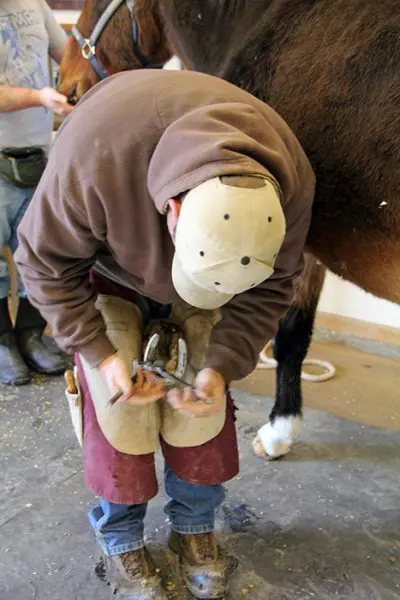 For better or worse, an equine inherits his hooves through his genes. If your mule has inherited good feet—black, oily-looking, and with good shape—then you are fortunate and hoof care and maintenance should be relatively simple. If he has inherited a softer or misshapen foot, you will need to discuss more specialized care with your farrier.
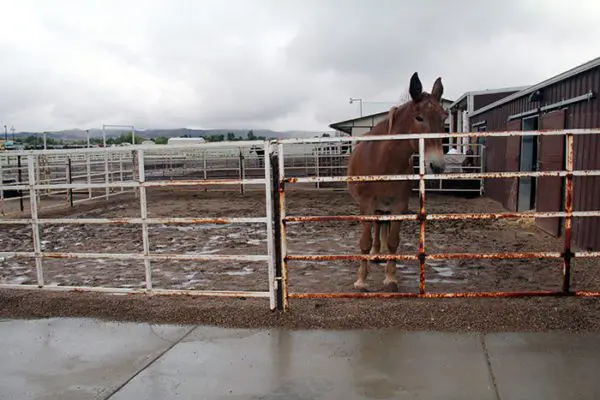 lubricate your mule’s hooves as needed with one of the commercial products available. But before you use an artificial hoof lubricant, first check with your farrier to make sure that it is actually needed. Many people use hoof products too frequently, which can cause hooves to become too soft. When this begins to happen, you will see horizontal rings appear around the hoof wall, and sometimes, vertical lines. Try not to let the hoof get to this point by using lubricants sparingly, but if you see that these rings are beginning to appear, immediately discontinue use of the lubricant and allow the hoof to harden. Then check with your vet to make sure it is not a founder condition. It does not take much to adequately soften the hooves of an animal with rock-hard feet. During the really dry seasons, lubricant application once a week is usually sufficient.
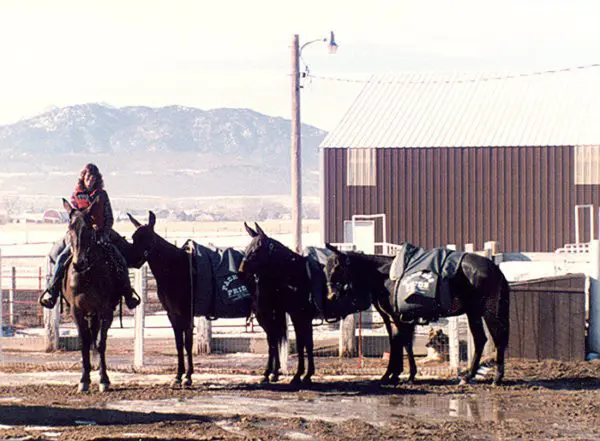 Assuming that your mule has a normal set of dark, healthy hooves, he will probably not need to be shod, as long as he is used strictly for pleasure or only sporadically. However, if you are going to use your mule on excessively rocky or hard ground, you might want to look into getting shoes for him. Mules that repetitively participate in more stressful and demanding activities (such as parades, showing and endurance events) should be shod to protect their feet and to keep them healthy. Prevention of bruising or cracking and maintenance of good foot and leg posture is critical to the equine athlete.
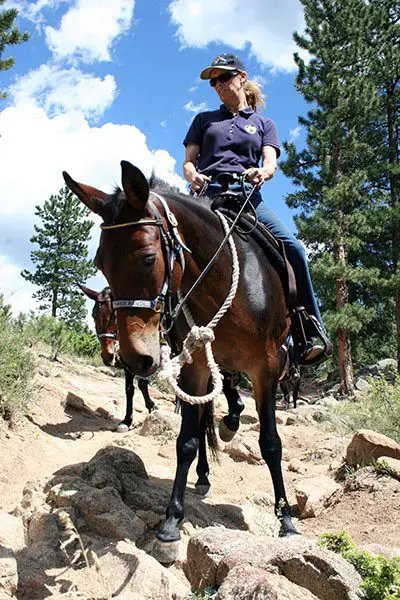 I believe that horses and mules, doing what they would naturally do alone—on terrain that is neither hard nor rocky—do not need to be shod. But mules that are asked to repetitively perform with a human on-board in varying surface situations should be fitted with the proper kind of shoes to help protect them from the additional weight and other demands that will be put upon their bodies. For example, my trail mules wear regular shoes on all four feet when they are being regularly used for trail riding and a variety of other activities, lessening the potential for injury. Then, when there is an occasional misstep on hard ground or rocks or when we trail-ride in the more challenging mountains, the shoes help to absorb some of the shock that would otherwise be absorbed by the hoof itself. It is my experience that young mules (and horses from two to four years of age) bear most of their weight on their front legs until their bodies are carefully and properly conditioned, and this is when you will see the most wear and tear on their feet. Because of this, my young mules that are just beginning saddle training wear regular shoes on the fronts only until their bodies are balanced and their activities clearly defined. Our broodstock, youngsters (under three
 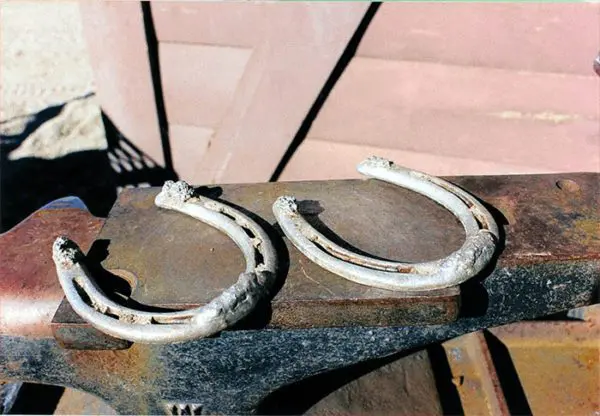 years of age) and equines that are not used under demanding conditions can go barefooted year-round, but they all still get regular trims every six to eight weeks.
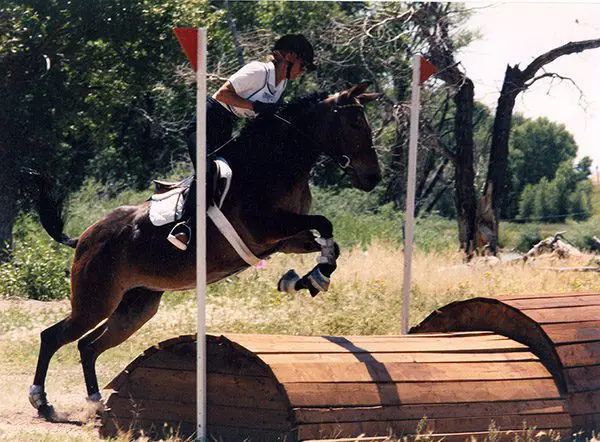 Granted, there are a lot of mules that may not need to be shod, but there are also many that do need shoes, so each individual mule’s feet must be evaluated on a case-by-case basis. Because of this fact, the generalizations that “mules don’t need to be shod” and “all equines should go barefoot” are not always correct. You must take into consideration how your particular mule’s genetics affect his hooves, what he will be used for and how harsh the demands put on him will be on his feet. These important factors will determine whether or not he needs shoes, and if he does need shoes, what kind of shoes will best suit him. And don’t forget to check your mule’s shoes on a regular basis to make sure that all is well and that his shoes are staying on tight, but most of all, that he is comfortable and happy.


