

MULE CROSSING: Hoof Differences in Horses, Donkeys and Mules
By Meredith Hodges
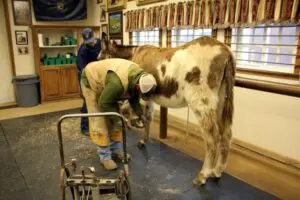
 The old saying, “No foot, no mule” is literally true, as it is in any nomadic animal. If the hooves are not trimmed and balanced properly, it will offset the balance of the equine’s entire body and can compromise longevity in the animal because his entire internal structure will be compromised. Most equines will need to be trimmed or shod every 6-8 weeks whether horse, mule or donkey.
Horse’s hooves in general are proportionately larger, rounder and more angled than that of the donkey or mule. The sole of the foot is flat on the ground promoting good circulation in the foot through the frog.
Regardless of the size of the animal, the hooves of the mule will be smaller and more upright than that of a horse of equal size, and should be well sprung and supported, not contracted. They should have a smooth appearance and look sleek and oily. No ribbing should be apparent and the frog should be well extended, healthy and make adequate contact with the ground for good circulation to the hooves. The shape of the mule or donkey foot is more oval and the bottom of the foot is slightly “cupped” which accounts for the surefootedness in the mule and donkey. When being trimmed, the mule should be left with more heel than the horse to maintain the often more upright position that complements the shoulders and hips. If the mule or donkey has a better slope to the shoulders, he might have an angle that is similar to the horse, but he will still grow more heel than the horse. The shape and condition of the hooves of the jack and the mare are both equally important when considering foot development in the mule.
Because donkey and mule hooves are different from a horse’s hoof in that they are more oblong, cupped in the sole, they need more heel left during a trim than the round, flat sole and low heels on a horse. There are, however, a few exceptions to the rule as there are in most generalizations. Most donkeys are relatively inactive and live on moderate ground, so they do grow out in that time period. Some donkeys, like my own Little Jack Horner, are much more active and will wear their feet down naturally.
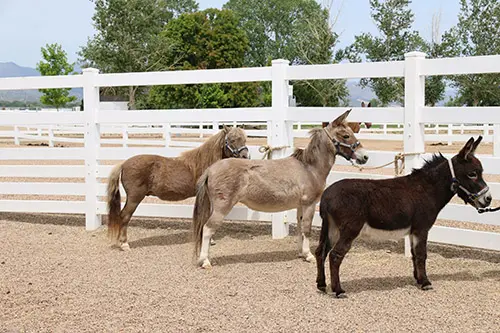
Miniature Horse

Miniature Mule

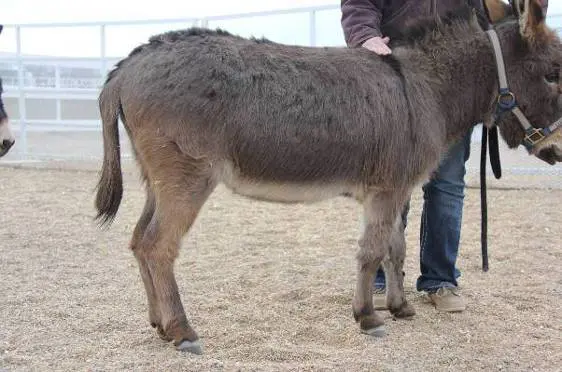
Miniature Donkey

Saddle Horse

Saddle Mule

Saddle Donkey

Draft Horse

Draft Mule

Mammoth Donkey

Of course, those that do not have the benefit of good training and conditioning would still wear unevenly and would still need to be trimmed, however, with the correct training and conditioning, they may wear evenly and may not need to be trimmed more than once a year! The same goes for those who would live in rough terrain. They may wear their feet down, but they would still need to be trimmed for balance. Those who are moving correctly may wear down evenly and would not require trims as often.
Failure to have your mule’s hooves regularly trimmed in order to maintain their balance and shape can result in an imbalance in your mule’s feet, which will then cause an imbalance throughout his entire body, inhibiting his performance. However, if trimming is done consistently, the risk of imbalance, accident or injury will be greatly reduced.
There are a lot of things to consider when trimming and shoeing all equines. If the animal is to have shoes, for instance, then they would need to maintain the flat surface of the sole for the shoes to fit properly. It is important that the equine have relief from shoes when they are not being ridden as much. We usually take any shoes off during the winter which keeps the heels from becoming contracted from wearing shoes and promotes good circulation to the foot as the frog can then make contact with the ground more consistently than it can with shoes. A good understanding of the anatomical differences among horses, mules and donkeys is essential for healthy hoof care.
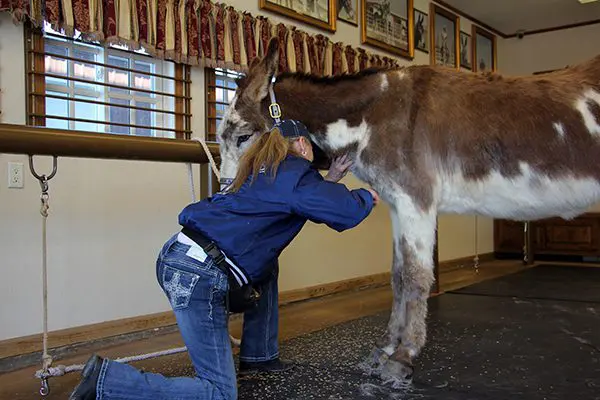
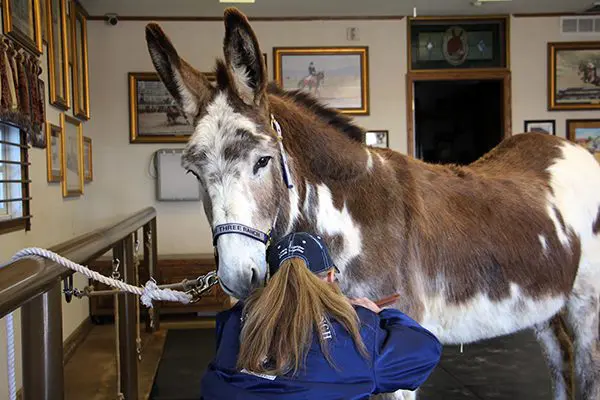
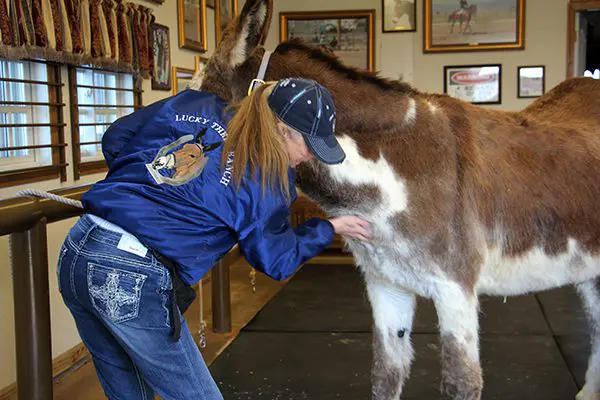
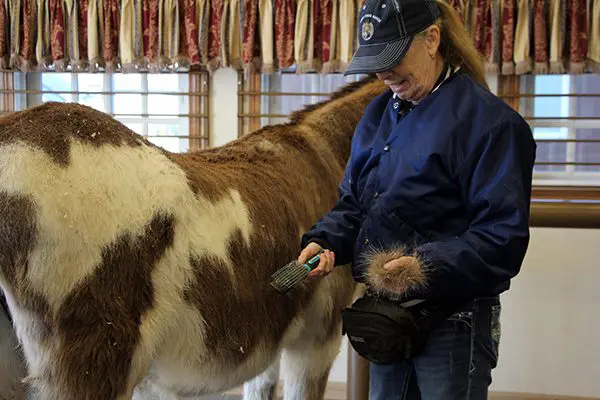
When your farrier is trimming your equine, he should take into account the angles of the shoulder, the forearm, the knees, the cannon bone, fetlock, pastern and the general angle to the entire body when at rest, not just trimming off the excess. This is an anatomical call and only people who are schooled and skilled in this profession should even attempt it or you could run the risk of injuring your animal.
It is commonly known that, when it comes to horses and mules, light-colored hooves are softer and more likely to break down under stress than are the darker, black hooves. Even though the black hoof is naturally harder than the light-colored hoof, if it does not contain sufficient moisture, it can become brittle and can chip away as destructively as can the lighter hoof. Whichever breed of equine you own and whatever the color of their feet, remember that good hoof care is essential for all domesticated equines.
For better or worse, an equine inherits his hooves through his genes. If your equine has inherited good feet—black, oily-looking, and with good shape—then you are fortunate and hoof care and maintenance should be relatively simple. If he has inherited a softer or misshapen foot, you will need to discuss more specialized care with your farrier. Beware of generalizations as they can often be misleading! Each animal should ultimately be assessed individually.
To learn more about Meredith Hodges and her comprehensive all-breed equine training program, visit LuckyThreeRanch.com, MEREDITH HODGES PUBLIC FIGURE Facebook page, or call 1-800-816-7566. Check out her children’s website at JasperTheMule.com. Also, find Meredith on Pinterest, Instagram, MeWe, YouTube and Twitter.
© 2016, 2019, 2021, 2022 Lucky Three Ranch, Inc. All Rights Reserved.

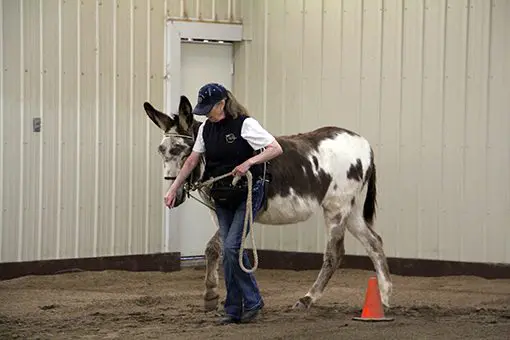


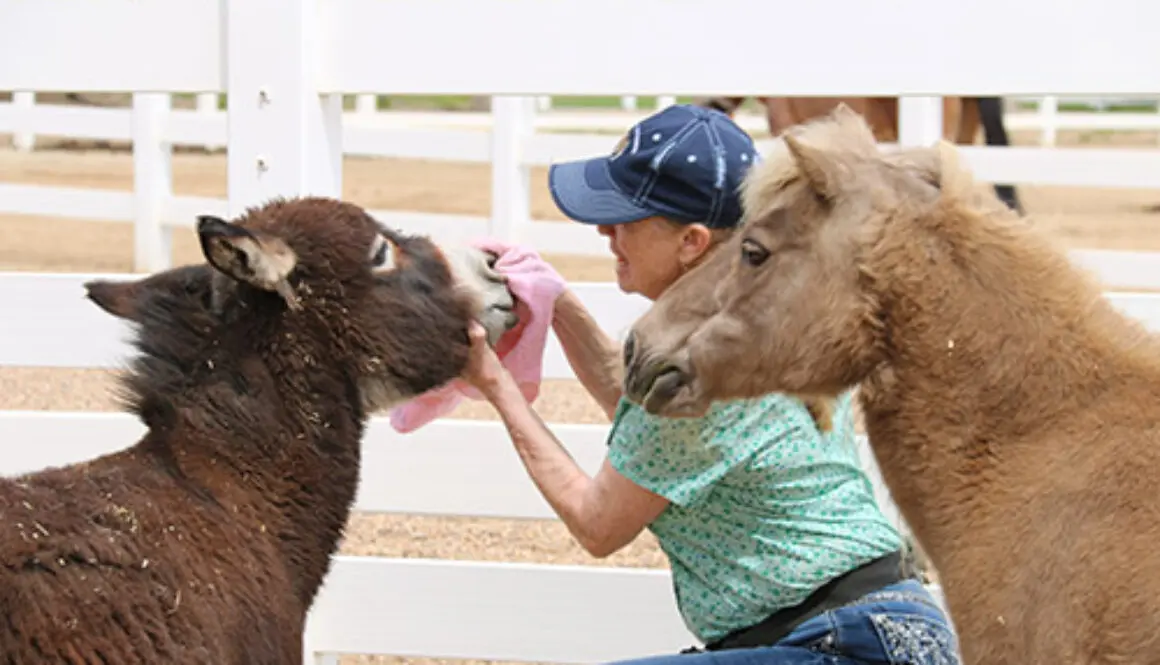


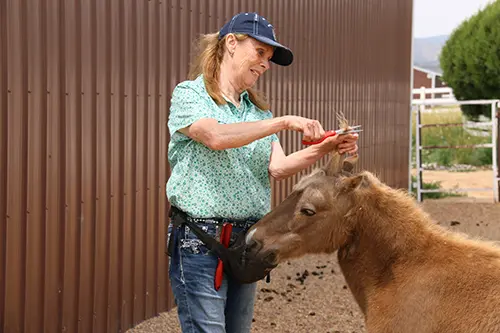




 Work with ground rails and cavalletti helps to build muscle, particularly in the hind quarters. This will help him to carry your weight more easily through lateral movements, stops and lengthening of the gaits. Proper preparation minimizes resistance and frustration. This will be apparent in how your animal carries his tail. Is it hanging in a relaxed fashion, or is he switching his tail periodically, or regularly? You might notice that after the initial introduction of lateral moves, your equine’s forward motion has become a little “shaky” again. It is now time to clarify the connection between forward motion and lateral motion with his increased understanding of your seat and legs (Not so much the reins as your connection to the bit needs to remain quiet!). By employing a few simple exercises, this can be a very simple process.
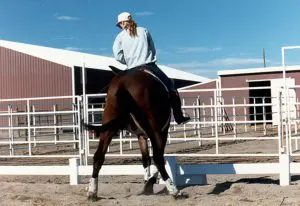 regular rhythm and cadence, proper flexion and bending through his rib cage. In rhythm, change your aids to a slight counter-bend and ask for a turn-on-the-forehand at the fence rail. Send his haunches around with pressure from your leg, well back on his barrel, until he is 180-degrees reversed. At the precise moment he is in the new position to go forward, in the opposite direction, release the pressure on your reins! Then send him forward again from your legs onto the new circle.
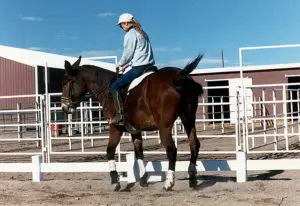 Complete the turn with a series of half-halts from your seat and a squeeze-release action with the reins. If you do this, your final release will come as a natural sequence to the turn and it will be executed in the rhythm and harmony of your equine’s movement. You can do this exercise at the walk, trot and canter, but be sure to slow down to a walk from the faster gaits in their natural sequence…canter, trot, walk and turn…trot, walk and turn. Do not be abrupt and skip the interim gaits.
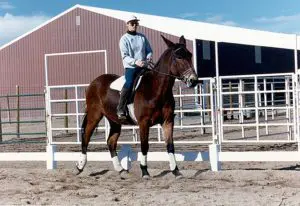 Be careful not to inhibit his forward motion. It is better that he does small circles to complete the turn at first than to fall back over his haunches and pivot on one hind foot. As in the turn-on-the-forehand, nudge his barrel on the opposite side, pushing his haunches into the turn with the squeeze-release action. Longears will tend to lean into a continuous pressure from your legs! Keep practicing this exercise, maintaining his body between your aids.
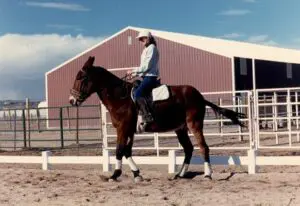 Once your equine gets his footwork figured out through these complicated movements, and has the opportunity to develop his body properly, you can begin to as for more speed and finesse on the turns, but this comes MUCH later! To attempt any more right now will most likely destroy his forward motion, cadence and rhythm. This will cause frustration and fatigue.
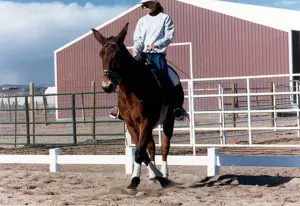 soon? Wouldn’t you rather have a long-lasting and pleasant relationship with a companion that is happy with his work?













 Although he is often confused with his sire, the donkey, the mule is the symbol of neither the Republicans nor the Democrats. During past political campaigns, certain Republicans actually declined to have their picture taken with a mule, because they were either ignorant of the difference between a mule and a donkey, or they were afraid that the mule would be mistaken for the Democratic Party’s symbol—the donkey.
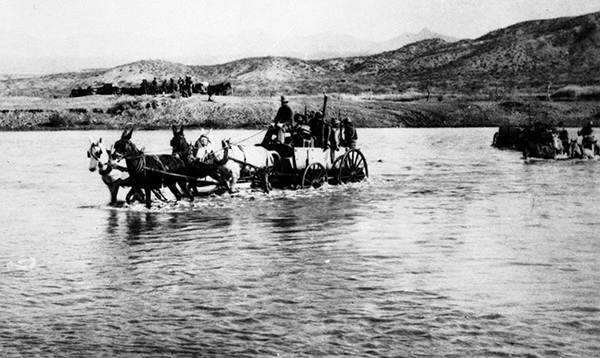
 Mule stories from the past are numerous in this great country of ours. The number of mules (and horses) in the U.S. peaked in 1919, at 26.5 million. The United States of America was quite literally built on the backs of its mules—they pulled supply wagons in the cities, forged west with the early settlers across the vast prairies, packed hunters’ gear in the mountains, plodded underground with the coal miners and plowed the Southern cotton fields. They have participated in war alongside our brave soldiers, and have found their place in the field of entertainment. They even helped with the excavation of the Pasadena Rose Bowl.
 After the onset of the Industrial Revolution, the number of mules in the U.S. declined, and in 1967, there were less than ten thousand. But happily, in recent years, renewed interest and public awareness have sparked a steady increase in the mule population.
 Obviously, I have one of the worst cases of “Mule Fever” ever suffered! But then, here I am—older, wiser and without any broken bones due to my association with mules. In fact, I can say my life was saved by one of my own mules. I was on my mule, Mae Bea C.T., leading a group of four trail riders on horses up a switchback in the Rocky Mountains, when the trail began to get very narrow. It was 100 feet straight up on the right and 100 feet straight down on the left! I could not see very far ahead because the two-foot trail wrapped around a huge boulder and blocked my forward vision. As I rounded the boulder, with the horses right on my rear, I was faced with a trail that disappeared into a wide landslide of small rocks. I couldn’t go forward and, with the horses directly behind on the wider part of the trail, I couldn’t back up. The horses could turn around where they were, but I couldn’t. I waited for the horses to get turned around, and then indicated to Mae Bea C.T. that I wanted a tight turn on the haunches. She sat her rear back on her haunches and swung her front legs over the 100-foot drop in a smooth and effortless 180-degree turn, facing next in exactly the opposite direction. She then stopped and waited for my next cue to lead the horses safely back down the trail. I shudder to think what could have happened had she been a nervous horse.
 Although the therapeutic value of the mule goes back as far as his own history, the idea of intentionally using mules for actual therapy did not come until much later. One of the most successful therapeutic stories involving mules is that of the Vision Quest Wagon Train. Vision Quest founder, Bob Burton, had a dream to use mules and the discipline and hard work of a real wagon train to help troubled kids. So, in 1976, the first Vision Quest Wagon Train was launched. In this life-changing program, 36 at-risk teens were required to spend one year traveling with six mule-powered wagon teams that went south in the winter and north in the summer. During the journey, the kids learned positive social skills and responsibility in caring for themselves and for their animals, with a solid success rate of 60 percent. (Mules really do make the best teachers!) Today, plans are being made on Facebook for a Vision Quest Wagon Train Reunion in 2012. Clips of the Vision Quest Wagon Train journeys can be seen on YouTube.





 By Meredith Hodges
 In 1967, concerned Paul and Betsy Hutchins founded the American Donkey & Mule Society, designed to spark the fires of interest in these longeared animals. The A.D.M.S. quarterly journal continues to remind the American public of all the extraordinary things that had been accomplished in history by donkeys and mules. They plowed the fields, pulled the covered wagons and worked in the coal mines. They pulled barges on the canals and packed munitions for the military. They built the Rose Bowl in Pasadena, California. Wild Bill Cody rode a mule named Mouse that put General Custer’s fancy Thoroughbred to shame over long distances and rough terrain. The crowned heads of Europe rode mules as a statement of class and Jesus rode into Jerusalem on the back of a small and humble donkey! Although the horse was revered and given the credit, mules and donkeys were always right there, too – strong, steady and humble!
 Thanks to Paul and Betsy Hutchins, we have been reminded of Longears’ great legacy and there are those, including myself, who would find a way to appreciate their efforts and would help to make donkeys and mules an important part of modern-day society.
 Mules and donkeys are becoming the equine of choice in many areas today. The California Sierra Nevada Pack Stations are populated with mules trained to take tourists on pack trips through the scenic mountain areas. The only equines safe enough to carry tourists down the steep rocky trails at the Grand Canyon and at Molokai are mules! Hunters are using mules as riding and pack animals due to their incredible strength, endurance and intelligent nature. They can handle rougher terrain and adverse weather conditions better than can the horse. Donkeys are finding new uses in guarding sheep from unwanted predators. Mules and donkeys are used in handicapped riding and driving programs, and molly mules are being used for embryo transplant. Third world countries are being educated in the care and feeding of their donkeys and mules to enhance economic growth. Mules and donkeys have even become viable 4-H projects for young people who enjoy the challenge. We are finding that there are actually very few things these longeared equines can’t do!
 Skeptic that I am I have always attempted to find the limitations of these incredible individuals. Here at the Lucky Three Ranch, we continually challenge our mules and donkeys with new and innovative tasks. They have continually met these challenges with success! With each new success, our mules and donkeys have brought many new and wonderful friends into our lives, making life full and very rewarding. To this day, I am still amazed when an animal has met his challenge and accomplished what I have asked. I suppose part of me would still like to believe that if they could have done all these things, then they would have already been done. But I can see now that that isn’t necessarily so. Need has a lot to do with it. No one ever NEEDED an upper level Dressage mule before! But I did!
 Since we have yet to find any serious limitations in these Longears’ ability, at the Lucky Three Ranch we concerned ourselves with documenting these three unique successes. Training Mules and Donkeys: A Logical Approach to Longears is a book documenting the training techniques we have used that led to the ultimate success of our mules and donkeys. It will was first released in May 1993 and was revised in 2013. As far as I know, it is the only book of its kind with training from foal to adulthood and has subsequently been supported by more books, DVDs and television shows and our extensive and comprehensive website at www.luckythreeranch.com. The intent is always to help mule and donkey enthusiasts to get the best from their animals and to avoid the common pitfalls that would sour an otherwise stimulating and rewarding experience with Longears. It just goes to show that MULES CAN DO, AND DONKEYS, TOO! Seeing IS believing and dreams really CAN come true!


