 By Meredith Hodges
Bea was the epitome of good manners and propriety, and is therefore allowed in the house! She has been known to help with the dusting, but she also enjoys a good game of cards or a hearty round of eight ball.
She has a little trouble with the pool cues, but her nose will sometimes suffice. She is a little leery, however. Chalk on one’s nose can be a little humiliating! Especially to a perfectionist!
Although Bea isn’t particularly fond of football, she does love the Broncos like any true Coloradoan. Nothing was more exciting than when the Broncos won the Super Bowl!
The owner of the Embassy Suites hotel in Fort Collins, Colorado made a bet with one of his employees that the Green Bay Packers would win the Super Bowl that year. If he was right, the employee would have to sit outside the hotel for a whole day on a toilet seat in his boxers. If the Broncos won, the owner would have to paint his face orange and blue and ride a mule all the way around the hotel. Well, guess who won and, guess who the mule was?! Yes, it was our own Lucky Three MaeBea C.T.!
Bea, dressed to the nines in Bronco gear and sporting a Bronco flag, carried the humbled Green Bay Packer fan and hotel owner proudly around the hotel while reporters scrambled asking questions and taking pictures. Later that day, she was on the five o’clock news in all her glory!
Bea was a natural born movie star! The cast always loved to work with her because she was always so willing and cooperative. A day of shooting can be quite exhausting, but Bea never was one that needed more than one or two takes. You told her what to do and she just did it. She put her heart and soul into everything she did and her expressions and actions were always appropriate. She helped me to produce three hardbound books, three manuals, eleven training videos and three documentaries and over fifty half-hour programs for television. Our website is now loaded with Training Tips, Video On Demand and access to our YouTube Channel, Facebook and Twitter posts, all based on the knowledge that I gleaned from this unique and amazing partner.
Although they never finished the movie, DIX Country Pictures chose Beaas Wadi’s understudy from hundreds of applicants.
She did a photo shoot in which she appears on the Colombian Relief poster with Juan Valdez! While we were shooting, it was hard to keep a straight face. Here we were in the middle of a grassy pasture, asking Beato put on her best sad face… without eating the grass! Of course, in true form, she did as we asked, but her facial expressions kept us in stitches!
In 1998, we did a shoot with the Discovery Channel and Bea can be seen as the mule in their production of “The Ultimate Horse.” What a gal!
Bishop Mule Days is always fun and exciting, but one of the things Bealiked the most was to be in the Bishop Mule Days Drill Team. She spent more than 10 years on the team and worked her way into the coveted leader position. Our drill instructor, “Sarge” was tough, but so was Bea!
One year, during drill team practice at the gallop with 30 other mules, we were doing the frightening “Crossfire” when her split-ear bridle came off and fell to her chest. I hollered at “Sarge,” but she wasn’t the least bit sympathetic and said, “Just keep going!” Well, Bea finished the entire drill without her bridle and never missed a lick!
Another time, Diane Hunter was riding her in the drill team when she got into some really deep dirt and tripped and fell right on top of Diane and the flag. I saw what happened and saw Diane pinned underneath Bea’s body. Everybody stopped cold and I hollered at Bea to stay still which she did. “Sarge” and I ran over to assess the situation and once we got to Diane and figured out that it was OK for the mule to get up, we told Bea to get up and she did…very carefully. “Sarge” turned to Diane and said, “You know, you owe your life to that mule. Any other mule would have got right up and probably would have kicked your head in!”
Everyone loves a parade and Bea was no exception! She competed in numerous costume classes and parades, but dressing up for the holidays was her favorite. She placed first in many a parade and had no problem with any theme you might want to try.
She loved to wear her Santa hat at Christmas time and she made a pretty scary wicked witch on Halloween!
Bea participated in the American Donkey & Mule Society entry in the 1988 Tournament of Roses Parade ridden by Gary Hodges in English attire along with her two stable mates, Lucky Three Sundowner ridden Dressage by me (Meredith Hodges) and Lucky Three Ciji ridden by Diane Hunter in Fox Hunting attire.
Bea may be a perfectionist, but she was certainly not a prude. She was always willing to try anything you might ask. At home, Bea worked hard checking fences, moving cattle and much more.
Early in the fall one year, two cowboys asked me if I wanted to help them move some cattle down from the high country and asked if I thought my mule could do it. I nodded confidently and we were off. We drove those cattle up and down the rocky terrain through thickly wooded trees, shrubs and bushes. We were headed up one hill behind the cattle and the two cowboys when we came upon a three foot diameter tree that had fallen across our path. The cattle dove into the underbrush on either side of the tree, the cowboys slid to an abrupt halt and Bea came right up the middle, jumped the tree and stayed on the heels of those cattle the entire way! No one was more surprised than those two cowboys, except maybe their horses!
The Northern Colorado Horse Trials cross-country phase was held at Lory State Park in Fort Collins, Colorado. Each year, our club is responsible for repairing and setting up new jumps on the course. The only hitch is that there are no motorized vehicles allowed in the park. We had dozens of heavy telephone poles to move in order to do our job. Of course, the event horses weren’t up to the job, but Bea certainly was! She pitched in and dragged those poles to their new locations and helped build and repair the jumps. Then, a couple of weeks later, she came back and competed to second place in the competition itself! Talk about versatility!
Bea loved to jump! It took Dressage to get her elevated in front enough to be proficient at jumping, but once we got her there, she cleared fences without batting an eyelash. She always took the jumps right over the center and never expended any more energy than necessary to clear the fence in beautiful form.
She competed in the Bishop Mule Days jumping classes for almost a decade coming in second only to the infamous pair, Lou Moore-Jacobsen and Empress Josephine. One year, she actually took first against Empress Josephine when she was penalized for clipping a rail in the last go round. Lou and Josephine knew from then on, they could not make even the smallest error against Bea or the competition would be lost.
Her shortened frame allowed her to make sharp turns and still clear the fences in timed classes where she would ordinarily be at a disadvantage against taller mules.
Everything Bea did with the bridle, she would do without the bridle and jumping was no exception. She did bridleless courses at home and in exhibition. In one exhibition, she did a Dressage and bridleless jumping exhibition to music performed by the Denver Symphony Orchestra as a tribute to our troops during Desert Storm.
Bea was the eternal perfectionist and only clipped two rails in her entire jumping career. She was horrified when it nicked her freshly polished hooves!
In 1986, Bea and I began lessons with instructor/trainer Melinda Weatherford in Dressage. The same year, I went to the United States Dressage Federation Convention and introduced them to the idea of allowing mules such as Bea to compete in dressage schooling shows and competitions. There were some discrepancies in the rules, but they finally decided to allow mules in lower levels at schooling shows with the discretion of the individual show committees. This was a major breakthrough for mules in equine society!
A few years later, she was instrumental in helping to get dressage classes added to Bishop Mule Days which has in more recent years become quite popular and a wonderful showcase to demonstrate how very well trained these mules can actually be.
She has shown dressage in all sorts of different disciplines: Dressage Shows, Dressage Schooling Shows, Two-Phase Combined Training Shows, Three-Phase Combined Training Shows and in Two-Phase Combined Driving Shows. Her scores were always high and she was always in the ribbons right from the start. The most remarkable thing about the training in Dressage was how it enhanced her driving skills so drastically that she won the first, second and the only two Two-Phase Driving Shows she had ever entered. People were always skeptical to start, and the first to applaud her performances after they saw her! The most prevalent comment during the ribbons ceremonies was, “My God! It’s a mule!”
For a decade, Bea was shown in numerous classes by my daughter, Dena Hodges from the age of six to sixteen. They showed together in Western Pleasure, English Pleasure, Driving, Mule Jumping, and Two-Phase Combined Training shows. They were always in the ribbons and most often first or second in their class.
In later years, she served as a mount for my two stepchildren (six years and ten years) on mountain trail rides, during lessons, and over jumps at the ranch. It was almost comical to see how carefully she would go over the 18” jumps with a child on her back so as not to unseat them!
When we were in Salt Lake City, Utah showing, my nieces and nephews who lived in Alpine came to see her and were thrilled to be able to take a ride around the fairgrounds with their cousin, my daughter, Dena on Bea. As usual, Bea was infinitely careful and protective of the children.
Bea was everyone’s favorite mule to ride. She carried amateur riders into the ribbons in numerous shows as well as being a schooling mule for students during riding lessons for all ages and abilities here at the Lucky Three Ranch.
Her kind and obedient manner made her a truly safe mount. She was always aware of her riders’ abilities and helped them any way she could to stay on board and ride effectively. With her help, as an instructor, I am more easily able to assess the ability of the students and thereby, better able to teach at appropriate levels. She was truly a remarkable individual!
Driving was always one of Bea’s strengths. I remember when I broke her to drive. I didn’t really know what I was doing. She took to the harness well, ground drove along side of the cart and didn’t seemed to be bothered by any of it, so within three days, I hitched her to the cart and proceeded to lead her out to the pasture where we would have more room. We were going around a 90-degree turn as I was leading her, hitched to the cart, when one of the wheels caught on the fence. She did a quick little scoot for a step or two which only caused the cart to flip over. She wound up with on of the shafts over her head and the other between her front legs. She stopped cold and allowed me to right the cart and get her untangled. Then we went out to the pasture and had our first drive with me in the cart with no further incidents. No big deal!
She was a driving star! She loved it and won nearly every driving class she ever entered. She competed in numerous driving related events. In breed shows, she competed in Pleasure Driving, Drive & Ride, Gambler’s Choice and Obstacle Driving. She went on to win at the only 2 Two-Phase Driving shows she’d ever entered, showing in Dressage Driving and the Cones Scurry (accumulated points) against…YES, horses again!
She schooled numerous students in driving and was so good with her verbal commands that if I let a student drive and they went dangerously to the left and I said, “Gee,” she would ignore the student and do what I asked to keep things safe. What a mule!
Bea was always so steady that she was the perfect Side Saddle mount. She competed in Side Saddle at numerous shows and won many of those classes. She competed in Side Saddle at the National Western Stock Show with several different riders, but always placed in the top three regardless of who was riding her.
Bea gave many exhibitions in Side Saddle at various fairs and events, always impressive to the people who were fortunate enough to be there.
In the 1990s, Bea was part of the Bishop Mule Days ladies’ Side Saddle Quadrille that showed in the parade and Grand Entry. She was ridden by a total stranger of limited ability and got her safely through the event. Beahad won herself yet another devoted fan!
In 1993, I rode her Side Saddle in the Inaugural parade in Washington D.C. It was a grueling 24 hours, standing around waiting to go in very cold weather and in the midst of more “mule eaters” than you could count. Bea seemed to take exception to the 50-foot Elvis Presley float, but otherwise handled the whole situation with her usual grace and dignity. Bea must have caught Clinton’s eye as she strolled elegantly past the viewing area because he turned away from the man he was speaking to and gave her a hearty thumbs up! We responded in kind and in her usual style, Bea smiled broadly!
Western Pleasure was fairly easy for Bea because her stride was so short, but when it came time to try her hand at English performance, this was a definite disadvantage. She had a rather short neck which made it difficult for collection, and her downhill build made it hard for her to lengthen her stride. But again, Bea gave her very best and cooperated when we lightly weighted her front legs to encourage some reach. In nine months, she had increased her length of stride by 18 inches!
She was on her way to a career in English events. We began enhancing her English performance with Dressage in 1986. She continued to improve, winning numerous English flat classes and always placing in the top five.
She competed against horses in a few Western classes and did well, but she really began to beat them consistently in the English classes. Mule shows alone could never offer Bea enough of a challenge, so competing against horses offered her the opportunity to push herself farther. And she did, to the disgust of many a horse person!
Bea was always an impeccable trail mule both in the show and on the trail. She did not always show in a lot of Trail classes because she showed so many other classes, but her technique was careful and deliberate. She would always wait for the cues from her rider and respond accordingly.
Trail experience for her was the simple enjoyment of many rides in the treacherous Rocky Mountains. I remember a specific time we went up a trail that was particularly narrow and steep. She was leading four people on horseback, when the trail disappeared into a rock slide. She was trapped on the narrowest part of the trail with four horses behind her. She couldn’t turn around and she couldn’t back up. After assessing the situation, I asked her to do a 180-degree turn on the haunches and swing her front legs over the 100-foot ledge to get turned around. She did as I asked and got us through that compromising situation with the finesse of a ballet dancer! The people on the horses were nothing short of amazed! When we went trail riding, or down the road, everyone wanted to ride Bea!
Bea began her show career as a Driving and Western Pleasure/Trail mule. She showed heavily in numerous Western classes over several years from 1984 to 1989 always placing in the top five.
She competed in numerous Western classes: Western Pleasure, Youth Western Pleasure, Trail, Western Riding, Reining, and a combination Trail/Reining class called Ranch Riding. She had several different riders over the years and was always willing to give her best for anyone who rode her.
Her accomplishments were so extensive that it would be impractical to list them all. In addition to showing Western, she did Western exhibitions at various local events and was the subject of many a newspaper or magazine article throughout her career.
Bea began her show career in Colorado in 1982 showing at halter as a two year old. She then showed successfully at Bishop Mule Days at Halter in 1985 and placed second in one of their largest halter classes for adult mules. The same year, she showed her expertise in Driving by placing first in the Mule Driving class. She continued to be competitive with world class competition in driving at Bishop taking firsts and seconds for numerous consecutive years in Mule Driving and Drive & Ride.
She then went on to show in Western Pleasure, English Pleasure, Hunter hack, Hunter Under Saddle, Jumping, and Side Saddle at Bishop and in other shows across the country, winning firsts and seconds in Mule Jumping and Side Saddle classes. Her smaller stature seemed to keep her out of the ribbons in the English flat classes, but her performance was always impeccable.
She continued to compete for more than a decade in Driving, Drive & Ride, Mule Jumping, always in the top 3 places. Although these were her strongest classes, Bea was always above average in any class in which she competed. Often, she would do 13 classes a day in various shows without complaint. What a trooper! She was inducted into the Bishop Mule Days Hall of Fame in 2006 and passed away at the age of 33 years in 2015. She was one of those truly MAGNIFICENT mules
To learn more about Meredith Hodges and her comprehensive all-breed equine training program, visit LuckyThreeRanch.com, MEREDITH HODGES PUBLIC FIGURE Facebook page, or call 1-800-816-7566. Check out her children’s website at JasperTheMule.com. Also, find Meredith on Pinterest, Instagram, MeWe, YouTube and Twitter.
Covered in TRAINING MULES & DONKEY: A LOGICAL APPROACH TO TRAINING, TRAINING WITHOUT RESISTANCE and EQUUS REVISITED at www.luckythreeranchstore.com.
© 2000, 2016, 2024 Lucky Three Ranch, Inc. All Rights Reserved.





 A horse can be dominated by man
 I was born LOVING horses in Minneapolis, Minnesota in 1950. I got a pair of chaps and a “bouncing” horse when I was six years old. My Grandmother was always teaching me about Good Posture and Good Manners. She once wanted to take me on a shopping trip to the local mall and requested that I put on one of my frilly dresses. She told me that all the little girls would be wearing them and I flatly refused! You don’t ride horses in frilly dresses! I was a Tom-Boy all the way through! I didn’t want to be a boy, I just wanted to be READY TO RIDE! So, my Grandmother conceded and let me wear my pants! When we got back, she said, “See, I told you all the pretty little girls would be wearing dresses. Now don’t you wish you had worn yours?” “Nope,” I replied and she just shrugged! I still wore my dresses to church!
 We moved to California in 1958 when I finally got my first horse, Duchess! I was still very much a Tom Boy now…cleaning stalls, doing chores on the ranch and riding my horse. In 1961, I even joined 4-H and got 4 Hereford cattle. Now I was a REAL Cowgirl!


 As we improved our skills, I had seven different mules to school, so I would not just practice one thing over and over. I practiced different disciplines on different days during the week. I never “drilled” on anything, but spent limited time teaching the things I had learned slowly, sequentially and logically. The mules really loved this approach, enjoyed the diversity of the lessons and learned quickly.
 Today, the concept of elegance has been greatly compromised by the fast pace of our progressive society. Few of us have neither the time nor the inclination to do what is necessary to cultivate this concept as a major part of our lives. Women today have far too many jobs and responsibilities with which to cope without worrying about being elegant,unless she lives in a densely populated urban area. There are just not a lot of places where a woman can practice being elegant. One of the places she can, however, is in the growing number of Side Saddle classes offered at many of the different Breed Shows across the country. The equestrian art of Side Saddle is currently being revitalized among the different breeds and one of the most enthusiastic groups is our own Longears lovers! But, elegance is not necessarily the only reason our Longears Ladies are riding aside. The lady equestrians of today like to get a more well-rounded education in the art of Horsemanship riding astride,and the perfection of their balanced seat when riding aside only enhances their existing abilities.
  Mules can be lovely, obedient and secure Side Saddle mounts when they are brought along correctly, as has been exhibited nationally by Crystal Ward and her mule, Final Legacy. I also fondly remember Ann Hathaway and her Dressage mule, Baby Huey, exhibiting Side Saddle in the Bishop Mule Days parade years ago. I judged the A.D.M.S. Nationals in Austin, Minnesota, and again, I witnessed a sprinkle of elegant Side Saddle riders on mules. In the state of Colorado, there was a surge of Longears Side Saddle riders beginning in 1983. The Side Saddle class for mules at the National Western Stock Show in Denver, Colorado previously had no less than 10 entries in its beginning in 1983, when the mule division was brought back after a long absence from the show.
 Generally speaking, people are quite impressed with the ladies who ride aside, and a common question often arises, “You sure look elegant, but how on earth can you stay on that way?!” We boldly reply, “Our mules teach us and WE LEARN…we are Lady Muleskinners!”
 This was demonstrated clearly at a Side Saddle clinic given by Patti Chadwick at the Bitterroot Mule Company in Bennett, Colorado on March 23rd of 1993. Six beginning Side Saddle riders of various equitation skills proved to be quite secure in their seats and no one had any real problems to speak of that day! All levels of riders were jumping cavalletti by the end of the clinic! So you see, it isn’t as insecure as one might be inclined to believe. And with an instructor like Patti Chadwick, it was a snap! The name of the game is “balance,” and whether riding aside on a horse, mule, pony or donkey, it is always a rewarding
  challenge to finally be able to master this art.
 English Side Saddle is probably the best one in which to learn, since the seat is better balanced over your animal. The Period Side Saddles are the worst, since most are built and balanced incorrectly for our contemporary riders and equines. The older Side Saddles were built to fit the smaller framed riders and larger animals of yesterday, they just don’t fit the conformation of the animals and the size of the ladies of today. Although most Side Saddles today are bought used, there are saddle companies that are making them again due to increased demand. If you buy a Side Saddle, make sure it fits your equine as well as yourself to assure the best ride. There are Vintage Side Saddles from different cultures. Just make sure the tack, equipment and equine match the accessories that you wear. Since Side Saddle is rather unique and there are not a lot of people showing in Side Saddle, the ladies have learned to accept the lax rules around the classes. If they are separated at all, it is usually split into WESTERN SIDE SADDLE and ENGLISH SIDE SADDLE classes.
 Fitting the Side Saddle to your body is relatively simple. While seated on a chair, measure along the bottom of your thigh from the back of your bent knee to just beyond your hips under your tailbone. The saddle is measured from pommel to cantle and should exceed your leg measurement by no less than two inches. You can ride in a Side Saddle that is a little too large, but not in one that is too small! Consider the width of your saddle to avoid excessive overhang on each side.

 Side Saddle equines that need a warm-up with a male groom will often use a rigged Two-Sided Side Saddles. He would want to ride aside like the lady would do, but he would need to alter his legs position to exercise the animal in a symmetrical and balanced way. Riding astride a Side Saddle is VERY uncomfortable!
 English Side Saddles are used with a Double Bridle or Pelham Bridles where the reins are carried in a balanced fashion on both sides. You should always have a straight line from your elbow to the bit.
 Place the Side Saddle in the middle of your equine’s back such that you are sitting over the equine’s center of gravity…same as regular saddles. Breast collars are optional (do not use breeching with a Side Saddle). Always keep in mind that your rigging keeps the saddle secure on the back of your equine, so the straps should all be snugly adjusted.


 Care & Reconditioning of Side Saddle & Tack:
 There was a surge of shows in 1994 featuring mules being ridden Side Saddle in Fox Hunting, Parades, Open Horse Show classes, and Mule Shows, and they have continued to grow nationally. Mules proved their worth as Side Saddle mounts, primarily on the East Coast, California and Colorado!
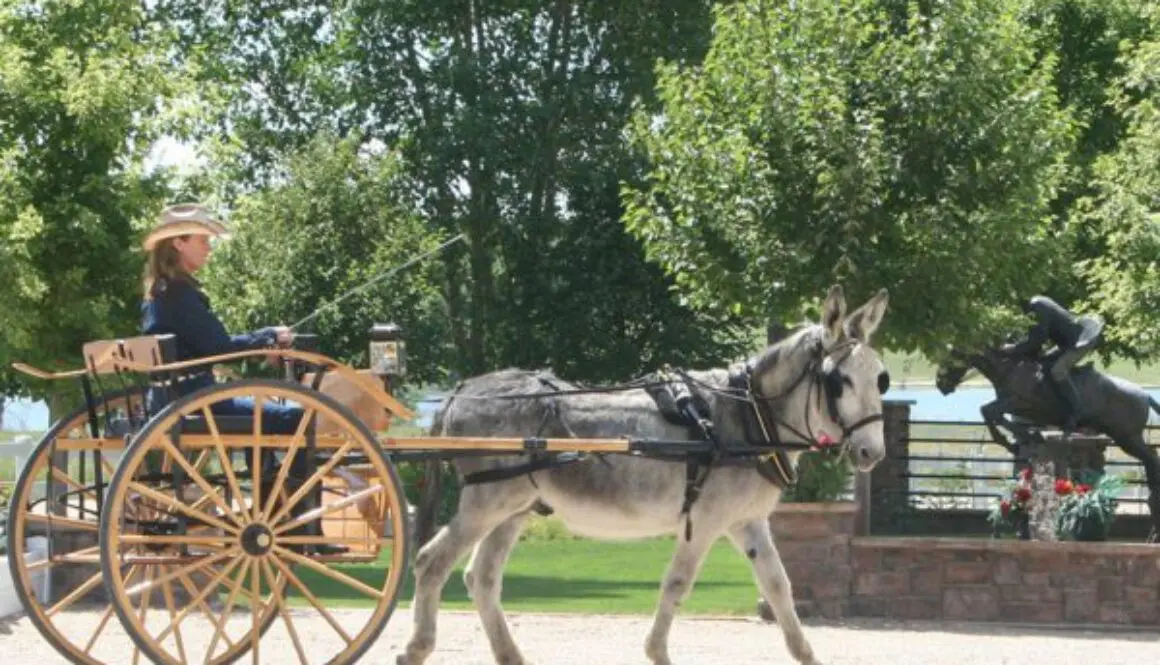
 With the introduction of the automobile came decreased interest in horse-drawn vehicles. Tractors replaced equine-driven vehicles in the fields. It seemed as if equines had been put out of a job! But, as with any change, this was only temporary. Modern society still has need of equine participation, especially from donkeys and mules. The well-schooled driving donkey or mule is much safer and more reliable than any horse. The reason for this is the donkey and mules’ natural sensibility and their positive response to verbal communication. Once they have learned the parameters of their job, if treated fairly, they will calmly and diligently go about their business, flicking their ears back and forth toward the driver, always listening for verbal reinforcement of their behavior. In a pinch, they can more often be prevented from “freaking out” with a few calm and reassuring words. Their strength and durability enables them to work longer and harder hours than can a horse and their variety of sizes and colors provides them as suitable driving animals for a number of driving-related activities.
 Most often we see driving animals in parades. Although it seems simple enough to drive down a parade route, there are a number of things to consider that can complicate the issue. Parade routes are lined with potential hazards and an overload of outside stimuli. Horses that become spooked have been known to bolt and actually run right through crowds of people. I have yet to hear of a donkey or mule that has done such a thing! Perhaps it is because the donkey or mule will not run into trouble if he can possibly avoid it. He will also be more likely to rely upon his driver for support and direction through the safest route. He will stop if in doubt of a situation when properly trained. Mules and donkeys are familiar with teamwork and will work as a team with their driver. The frightened horse just says, “Forget you!” and leaves!
 As the competitor improves, he may move into marathon driving, testing his skills across country and through obstacles (called hazards). The driver may use singles, or teams, depending on his personal preference. The American Driving Society has been more than generous, allowing mules and donkeys to compete in most of their events right along with the horses. For more fun-loving competitors, there are a lot of different driving games, gauged for the ability of the competitors. This allows even the most inexperienced driver some source of enjoyment from which he can derive a sense of accomplishment and excitement.
 Mules and donkeys are used in many tourist areas, pulling cabs and carriages of all varieties, taking tourists in a more leisurely fashion through the streets of history and tradition. Couples can romantically celebrate special moments in their relationships with a relaxing ride in a special cab or buggy. The sensible mule or donkey assures a safe and romantic memory that will stay with you for the rest of your life! We have used our mules to pull carriages for weddings and receptions, adding a touch of class and a little tradition to an otherwise fast-paced and chaotic world!
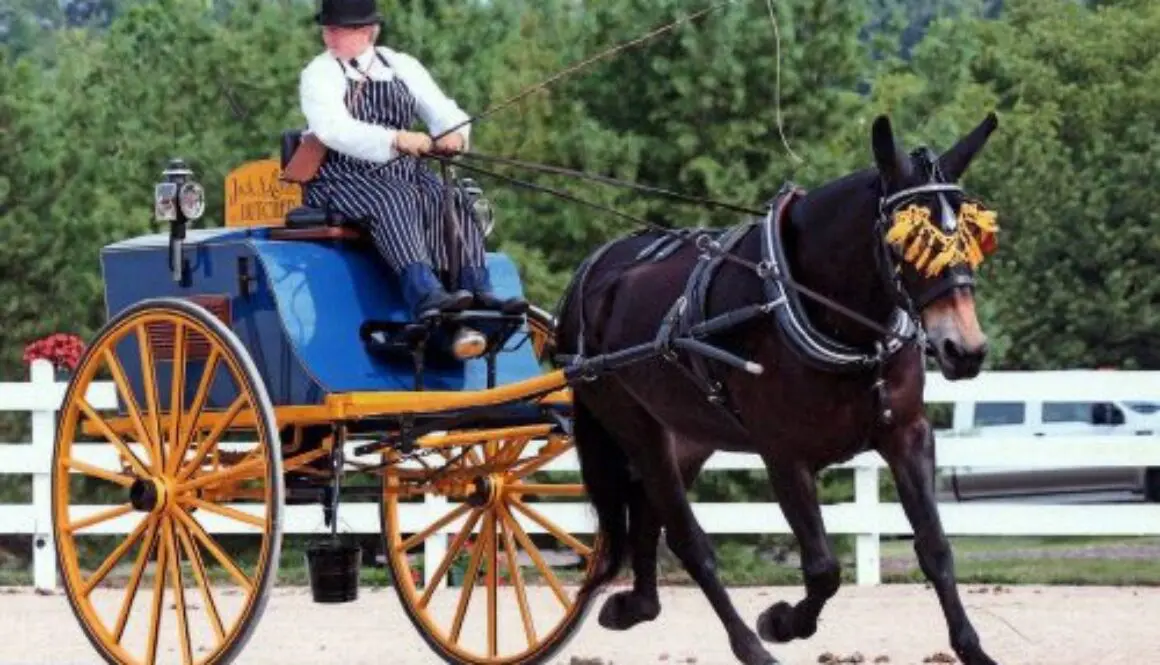
 When the mule was delivered, things didn’t seem right to Kathleen. This one was much too friendly and much easier to handle than the mule she had previously seen. She called the man who sold it to her and told him she had the wrong mule. He simply replied, “Oh, you noticed.” She made him pay for the return shipping and she finally got the mule she truly loved, who she named John Henry. And that was the beginning of a legacy!
 In early 2014, famed artist and wood carver, Dennis Page, asked my friend, Bonnie Shields (Tennessee mule artist and illustrator of my Jasper the Mule series), about a model for a “rocking mule” that he was going to carve out of wood. She suggested that he might want to model it after a ceramic sculpture she had done of John Henry, and he did just that. The wood-carved rocking mule of John Henry stands 48 inches tall and is just gorgeous! In fact, it is so beautiful that I bought it when it was finished.
 John Henry was one of a kind and is sorely missed, especially by Kathleen. But she is elated that her beloved mule and his legacy are being honored with his own exhibit here at Loveland Longears Museum and Sculpture Park in Loveland, Colorado. Kathleen and John Henry had a wonderful time together, touching so many lives and showing everyone just how extraordinary a mule can truly be. Thank you, John Henry for opening people’s minds to the superior versatility of the mule and for paving the way for so many other mules to follow in your footsteps toward extraordinary equine achievement!

 In Part 1 of this article, you learned how to begin your relationship with your miniature equine in a positive and natural way, and how “getting down” to their eye level so they can make eye contact with you discourages striking, jumping on you and other bad behaviors that are common when working with miniature equines. Be sure you have successfully completed the lessons in Part 1 before moving on to the lessons in Part 2 or training may not yield the desired positive results. Also, if possible, it is best to work minis in groups if they are used to being with other equines, as they perform better when they are with their “friends” and it doesn’t hurt to train their friends in the same way.
 in Part 1), but this time you will be in the work station and you will have a guest…the farrier. Before the farrier attempts to pick up the first foot, ask him to sit down beside your mini in front of the shoulder on the left side and offer a handful of oats as a way of introducing himself. Next, while you sit at your mini’s head and offer the oats reward for good behavior, have the farrier begin with the near side (left) front foot and work his way around from front to back, and then from back to front on the other side (right). While the farrier is working, talk calmly and encouragingly to your mini, and as long as he is doing what is asked of him, offer rewards generously. He should yield his feet easily, but if he does not don’t offer the reward until he complies.
 Don’t shove your mini when you want him to move over. Rather, give him some oats and use your index finger to tap or poke him on the side of his ribcage. If he doesn’t move over, use your whole hand to give him a slight push, always using a “push and release” movement, which is non-confrontational. You don’t want to keep steadily pushing up against him, because as soon as you give him anything to push against, he will and you could find yourself in a pushing match or, worse, a confrontation with him. As soon as he complies and moves, give him the oats reward and slide your body in next to him to help hold him in position for the farrier as he works with each foot. Don’t be afraid and always stay on the same side as the farrier. If the mini decides to make an abrupt move, he will try to slide around you because equines really don’t like stepping on, or running over, soft, squishy things like our bodies, so if your mini can get out of your way, he will. Even if he was to jump up in the air, he would more than likely jump over or around you, taking the path of least resistance. Trust your mini, stay calm and avoid becoming tense or exhibiting fear and things should go smoothly.
 This approach becomes particularly important when negotiating something like a dock or a bridge where you are not only dealing with an obstacle, but an obstacle that makes you substantially taller than you already appear to your mini. This is another instance when you can “get down” on your mini’s eye level the way you did in the pen and at the work station. Remember to do things in small steps. When you walk onto the surface of the dock or bridge or any other large, flat surface, leave enough room for your mini to come up. When you get to the end of the lead rope, take up the slack and then sit down and offer the reward. Then, once your mini has negotiated the obstacle, give him the oats reward and just have another picnic. If a companion equine is accompanying you, be sure to tie the companion animal in front of the obstacle so your mini can always see him. If you tie him behind, your mini will worry and want to go back instead of forward.
 When you are ready to step down off the dock or bridge, it would be unsafe to be lower than your mini, so at this point you should stand up, go to the end of the obstacle and ask him to come forward off the raised obstacle, making sure he has plenty of room to come off the obstacle without you having to move. Stand quietly and keep the lead rope taut as you verbally encourage him and invite him to come down off the bridge. As soon as he jumps down, ask for a halt and reward him for jumping down and stopping right in front of you. (He will learn to negotiate the obstacle more slowly with practice.) Once he has finished negotiating the obstacle and halted and is chewing on his reward, you can then proceed to the next obstacle. Having definite, purposeful and timely pauses will help alleviate anxiety and resistance in your mini.
 longer he must go without making eye contact with you, the greater the chance of resistance, but eye contact on his level will give him confidence in your judgment and will help to facilitate a real bond between you. If negotiating an obstacle such as a tractor tire or six tires, just extend the lead rope over the tire or tires, sit on that side, keep the rope taut and proceed as you did with the bridge obstacle.
 I call this technique “OATS.” (Observe, Approach, Touch and Sigh). It allows your mini time to observe each situation, then approach and touch the obstacle, finally giving a sigh as a signal that he is relaxed and not afraid. Always reward him for his efforts so he can begin to gain confidence and trust in you. By following the OATS technique you are turning your mini’s fear into curiosity, which will serve to keep him calm in future situations.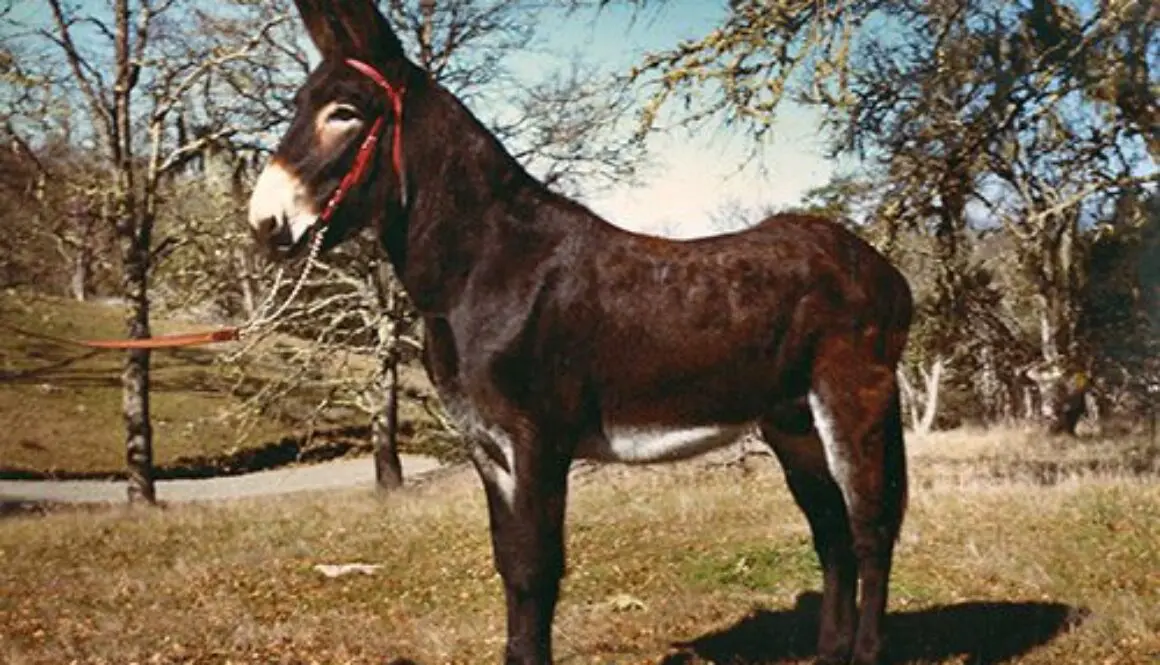
 When choosing a jack to breed to your mares and jennets, there are many important factors to consider. Conformation is the most obvious, but size, type, disposition and genetics are equally significant. As a direct result of the donkey’s evolution our choices in jacks are considerably limited these days. In the days when donkeys were widely used as beasts of burden, conformational soundness was an important consideration in their ability to do physical work. Today, the donkey is not as widely used in this manner, becoming more of an owner’s pleasure animal. In some cases, he is simply another pet. As a result, not much care has been taken to preserve his conformational integrity, thus limiting the availability of true breeding stock.
 Although the conformation of the ideal jack can only be approximated, you should always try to choose a jack that is as close to the ideal as possible for your breeding programs. (Perpetuating undesirable conformation traits will only compound future breeding problems.) The first conformational consideration is the jack’s overall balance and proportion. His torso should be well connected to the front and rear quarters, with plenty of width and depth from heart girth to the flank, which allows for maximum efficiency of the heart and lungs. The topline from the withers to the tail should be relatively straight, with only a gentle slope from the withers to the croup, and neither excessively long nor short-backed. A longish back is acceptable, provided there is not a lot of distance between the last rib and the point of the hip, as this causes weakness through the loins. The unusually short-backed jack does not have adequate lateral and vertical flexibility in his movement. A rigidly straight back is discouraged, as is a back that sags too drastically in the middle (except in the case of an aged animal).
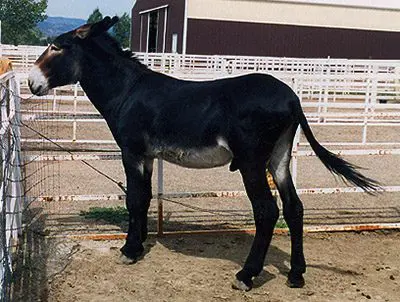 Proportionately, the jack should not be too narrow in the chest, through the rib cage and in the rear quarters—nor should he be too wide in these areas. These faults in proportion can interfere with his action, causing him to be “pin-toed” (splay-footed) or “pigeon-toed” (toed-in). The pin-toed jack will brush his knees and fetlocks together in deep footing, causing him to be a slow mover, or he may even cross his legs over one another, increasing the possibility of a fall.
 the animal’s body weight too far on the forehand, making turns and stops more difficult. It could also increase the possibility of falling. The croup should be smooth and round over the rump, with a tail set neither too high nor too low.
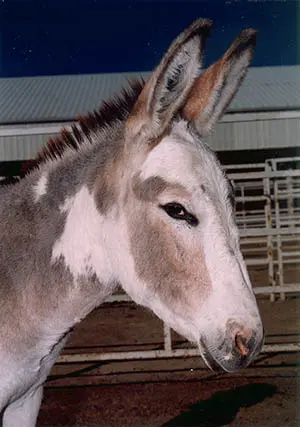 possible weakness in the hoof itself. If it is a cosmetic problem, it can often be managed successfully by adding one ounce a day of Mazola corn oil to the diet. If it is a genetic problem, a jack with hoof problems should be avoided when breeding and should probably be castrated.
 The basic conformation for the breeding jack should be the same regardless of size, although there are specific considerations with regard to type and use. The jack generally contributes more to the thickness of bone in his offspring, but not necessarily to their height. Therefore, when breeding for saddle mules and donkeys, the more refined-boned Standard or Large Standard jacks are preferred. On the other hand, when breeding for a draft mule or donkey, you would want to preserve more thickness of bone and use a stockier jack, such as a Large Standard or Mammoth. Use the same guidelines when breeding for miniatures; stocky begets stocky and refined begets refined. When breeding for saddle mules, you may want to keep the refinement, so you would use a Standard or Large Standard jack to breed to a saddle horse mare. However, if you wish to have a pack mule that is not overly tall, you might then want to breed a Mammoth jack to a saddle horse mare.
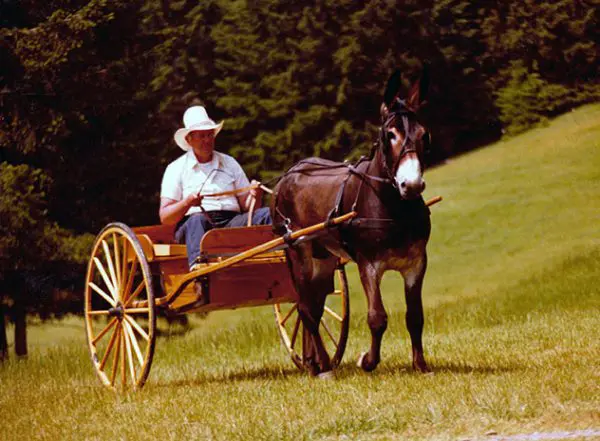 information, thereby giving us all a better understanding of Longears production. So, don’t be afraid to ask the breeder whatever questions you may have.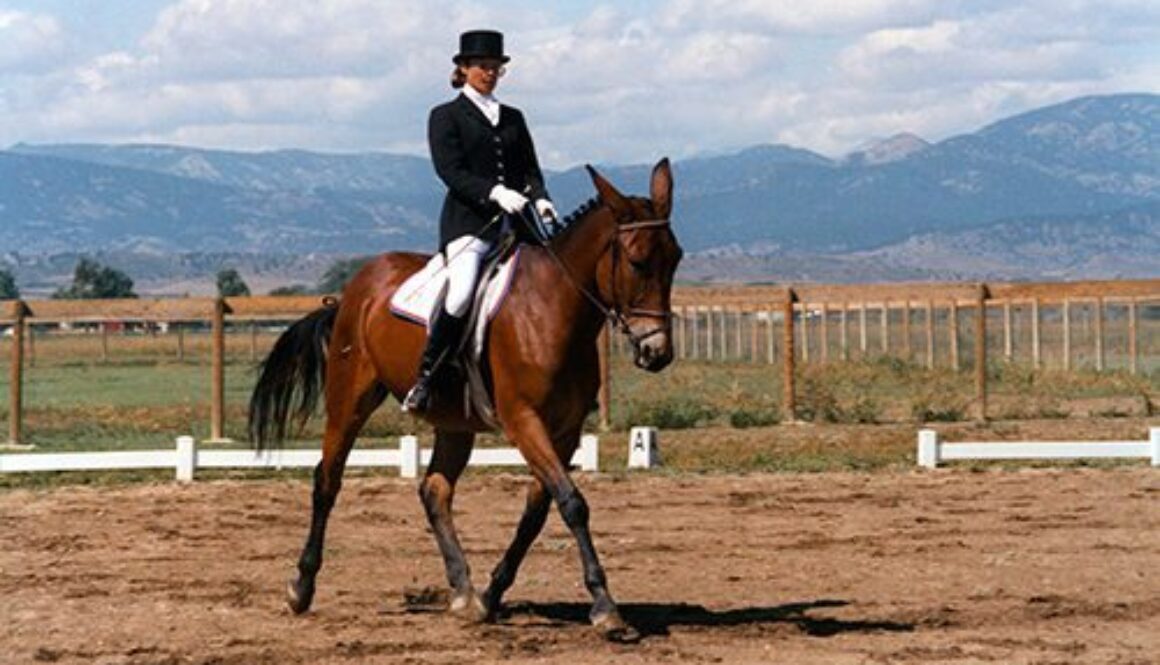


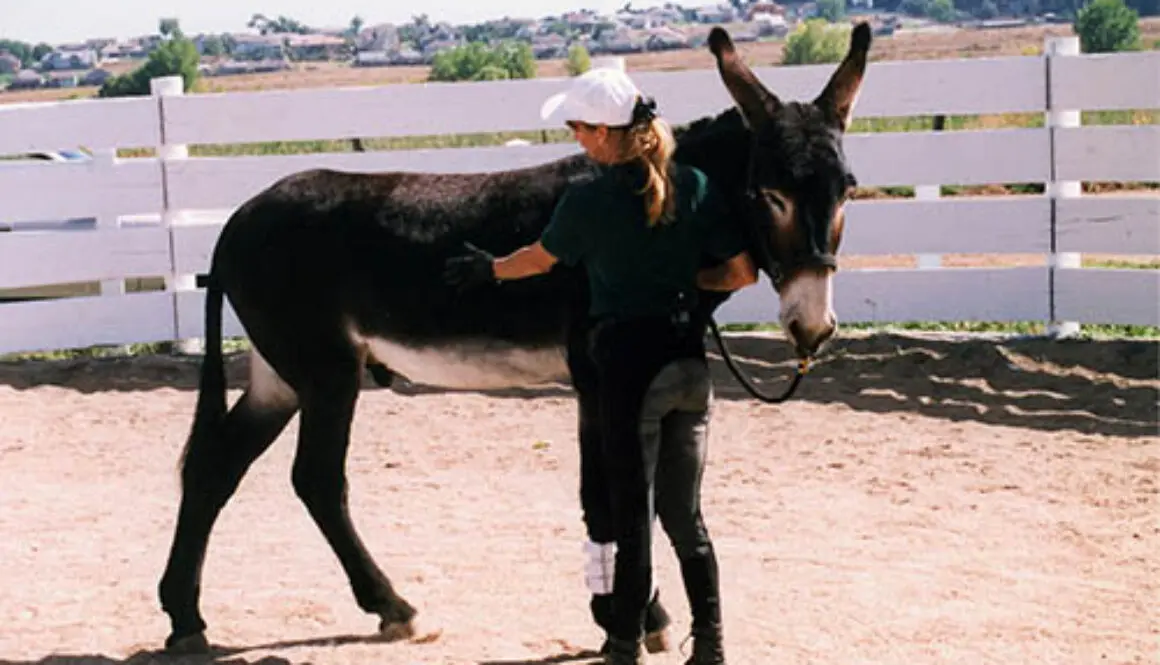
 By Meredith Hodges
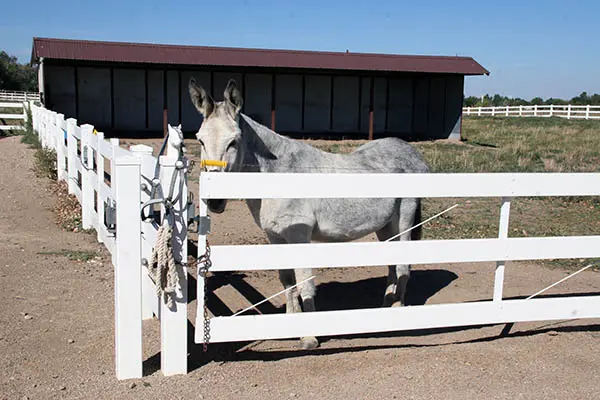 jack has a roomy area, free of refuse and debris, and adequately fenced. The fences should be high enough to discourage his leaning over the top and strong enough to bear his weight on impact. Also, they must be constructed so that there are no protrusions that could cause him injury. If females (or other animals) are present, the jack may run back and forth along the fence and catch his head on anything that is protruding. Hot wires along the inside of a weaker fence will often serve this purpose. However, a hot wire used alone is not sufficient. If your jack becomes frightened, he could run through an electric wire before he even knows that it is there. Giving him a clean, comfortable area where his limits are clearly defined will help him to be a calmer and more manageable animal.
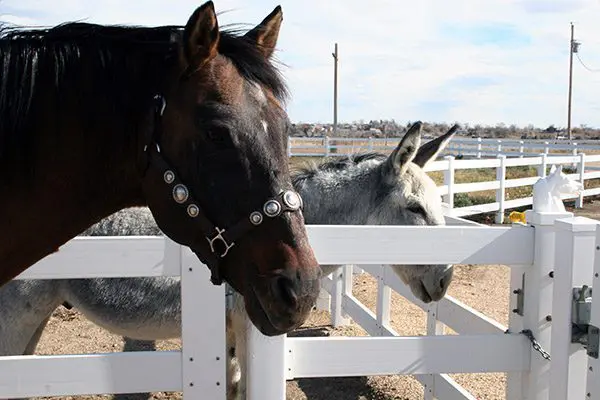 Many people opt to keep jacks in solitude, but this is not really good for them. Being a natural herd animal, they need social interaction. When they don’t have company nearby, jacks can become depressed (donkeys have actually been known to die from depression—they can stop eating and simply give up). To remedy this, jacks can be pastured or penned next to other animals, as long as the fencing is adequate between them. Of course, you also need to take into consideration the personality types of the animals involved, as well as being careful to make sure they are compatible. This can fulfill their need for companionship and keep them happy in confinement. As long as there are no cycling horse or donkey females around, jacks can be pastured next to mules of both genders. I had my own jack, Little Jack Horner, penned next to our teaser stallion for many years and they actually liked each other! We never had any trouble with them at all.
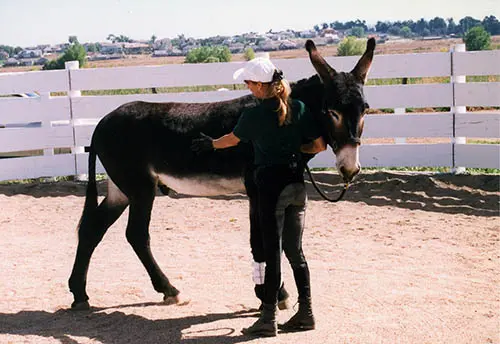 When he is flawless with his leading training, you can get him used to the bridle and a surcingle or lightweight saddle, and then move on to ground driving. Lunging is not as important, since most donkeys do not like to lunge. I suppose they don’t see much purpose in going around in a circle more than once to come back to the same place over and over again. Taking the time to properly train your donkey jack at halter and in the drivelines will enhance his obedience, and will make him more comfortable and relaxed. During the breeding process, it can even speed up his readiness.
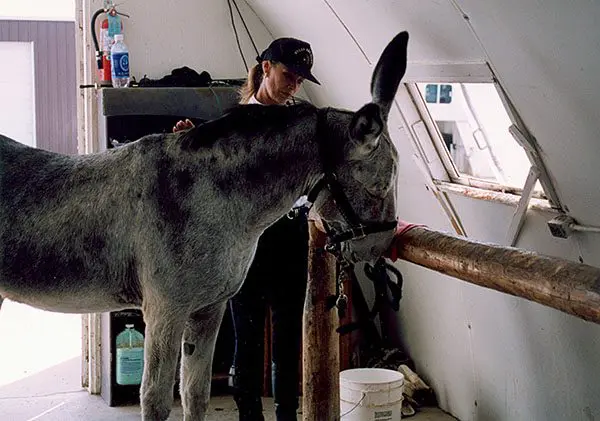 or out the door). If you are going to breed him, the mare should first be prepared. Next, once you are both out the door, ask him to whoa and square up all four feet. Then you can lead him to the breeding area, where you can then tie him to the hitch rail a little ways away from the waiting mare. By being consistent in your manner of going from the stall to the breeding area, the jack will learn not to be pushy and aggressive toward you.
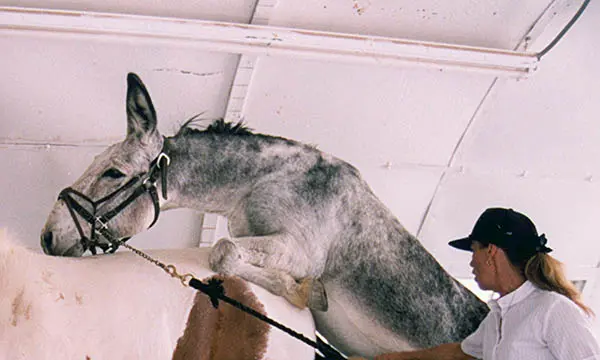 Just to be on the safe side with your jack while breeding, use either a muzzle or a dropped noseband (snugly fit low on his nose)—this will prevent biting injuries to you or to the mare. When he is finished, make him stand quietly behind the mare while you rinse him off. Allow him that last sniff to the mare’s behind, and then take him back to his stall (or pen), ask him to stand still while you remove the halter and then let him go. That last sniff appears to be an assertion of his act and of his manhood. If you try to lead him away before he sniffs, he might not come with you and he might become even more aggressive toward the mare. Remember to do things with your jack in a routine way, and always with safety in mind—this will allow him to relax and use the manners he has learned. NOTE: Women who are menstruating should never handle jacks or stallions during that particular time, since the scent can trigger aggressive and dangerous behaviors in these animals.
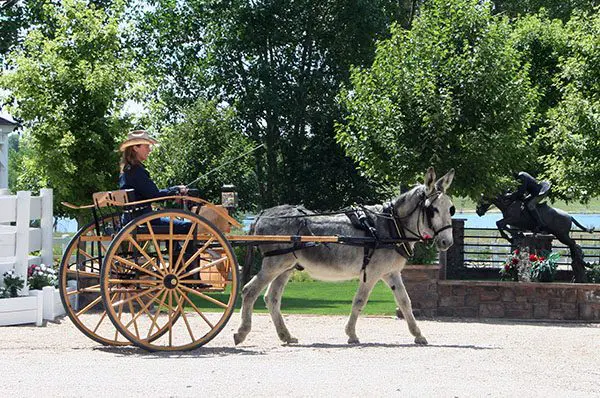 plenty of time and done your homework during his leading lessons, your jack will learn to be obedient on the lead shank, even during breeding.
 Because my equines reacted so well during training, I had no reason to believe that there was anything wrong with my approach until I began showing them. I started to experience resistant behaviors in my animals that I promptly attributed to simple disobedience. I had no reason to believe that I wasn’t being kind and patient until I met my dressage instructor, Melinda Weatherford. I soon learned that complaining about Sundowner’s negative response to his dressage lessons and blaming HIM was not going to yield any shortcuts to our success. The day she showed up with a big button on her lapel that said, “No Whining” was the end of my complaining and impatience, and the beginning of my becoming truly focused on the tasks at hand. I learned that riding through (and often repeating) mistakes did not pose any real solutions to our problems. I attended numerous clinics from all sorts of notable professionals and we improved slowly, but a lot of the problems were still present. Sundowner would still bolt and run when things got a bit awkward, but he eventually stopped bolting once I changed my attitude and approach, and when he was secure in his core strength in good equine posture.
 good unless I was careful about the way I used it. Body clipping was much more tolerable for them if I did the hard-to-get places first and saved the general body for last. Standing for long periods of time certainly did not yield a calm, compliant attitude when the more tedious places were left until last. After standing for an hour or more, the animal got antsy when I was trying to do more detailed work around the legs, head, flanks and ears after the body; so I changed the order. Generally speaking, I slowed my pace and eliminated any abrupt movements on my part to give the equine adequate time to assess what I would do next and approached each task very CAREFULLY. The results were amazing! I could now groom, clip bridle paths and fly spray everyone with no halters, even in their turnout areas as a herd. They were all beginning to really trust me.
 legs. The core of an equine is at the center of balance in the torso. Similar to bipeds, they need the energy to run freely along the hindquarters and down through the hind legs to create a solid foundation from which to allow the energy in front to rise into suspension to get the most efficient movement. When their weight is shifted too much onto the front end, their ability to carry a rider efficiently and correctly is compromised. To achieve correct energy flow and efficient movement, the animal’s internal supportive structures need to be conditioned in a symmetrical way around the skeletal frame. People can do this by learning to walk with a book on their head and with Pilates exercises, but how can we affect this same kind of conditioning in a quadruped?
 the routine and correctness in the execution of the exercises. Since this requires that you be in good posture as well, you will also reap the benefits from this regimen. Along with feeding correctly (explained on my website at www.luckythreeranch.com), these exercises will help equines to drop fat rolls and begin to develop the top line and abdominal strength in good posture. The spine will then be adequately supported to easily accept a rider. He will be better able to stand still as you pull on the saddle horn to mount.
 The task at the leading stage is not only to teach them to follow, but to have your equine follow with his head at your shoulder as you define straight lines and gradual arcs that will condition his body symmetrically on all sides of the skeletal frame. This planned course of action also begins to develop a secure bond between you. Mirror the steps of his front legs as you go through the all movements keeping your own body erect and in good posture. Always look in the direction of travel and ask him to square up with equal weight over all four feet every time he stops and reward him. This kind of leading training develops strength and balance in the equine body at the deepest level so strengthened muscles will hold the bones, tendons, ligaments and even cartilage in correct alignment. Equines that are not in correct equine posture will have issues involving organs, joints, hooves and soft tissue trauma. This is why it is so important to spend plenty of time perfecting your techniques every time you lead your equine.
 Loss of balance will cause stress, and even panic that can result in him pulling the lead rope, lunge line or reins under saddle right out of your hands and running off. This is not disobedience, just fear from a loss of balance and it should not be punished, just ignored and then calmly go back to work. The animal that has had core strength built through leading exercises, lunging on the circle and ground driving in the “Elbow Pull” before riding, will not exhibit these seemingly disobedient behaviors. Lunging will begin to develop hard muscle over the core muscles and internal supportive structures you have spent so many months strengthening during leading training exercises. It will further enhance your equine’s ability to perform and stay balanced in action, and play patterns in turnout will begin to change dramatically as this becomes his habitual way of going. Be sure to be consistent with verbal commands during all these beginning stages as they set the stage for better communication and exceptional performance later. Although you need to spend more time in his beginning training than you might want to, this will also add to your equine’s longevity and use-life by as much as 5-10 years. The equine athlete that has a foundation of core strength in good equine posture, whether used for pleasure or show, will be a much more capable and safe performer than one that has not, and he will always be grateful to YOU for his comfort.
 By Meredith Hodges
 owner would have to paint his face orange and blue and ride a mule all the way around the hotel. Well, guess who won and, guess who the mule was?! Yes, it was our own Lucky Three MaeBea C.T.!
 Although they never finished the movie, DIX Country Pictures chose Beaas Wadi’s understudy from hundreds of applicants.
 In 1998, we did a shoot with the Discovery Channel and Bea can be seen as the mule in their production of “The Ultimate Horse.” What a gal!
 Everyone loves a parade and Bea was no exception! She competed in numerous costume classes and parades, but dressing up for the holidays was her favorite. She placed first in many a parade and had no problem with any theme you might want to try.
 Bea may be a perfectionist, but she was certainly not a prude. She was always willing to try anything you might ask. At home, Bea worked hard checking fences, moving cattle and much more.
 shrubs and bushes. We were headed up one hill behind the cattle and the two cowboys when we came upon a three foot diameter tree that had fallen across our path. The cattle dove into the underbrush on either side of the tree, the cowboys slid to an abrupt halt and Bea came right up the middle, jumped the tree and stayed on the heels of those cattle the entire way! No one was more surprised than those two cowboys, except maybe their horses!
 there, she cleared fences without batting an eyelash. She always took the jumps right over the center and never expended any more energy than necessary to clear the fence in beautiful form.
 Her shortened frame allowed her to make sharp turns and still clear the fences in timed classes where she would ordinarily be at a disadvantage against taller mules.
 In 1986, Bea and I began lessons with instructor/trainer Melinda Weatherford in Dressage. The same year, I went to the United States Dressage Federation Convention and introduced them to the idea of allowing mules such as Bea to compete in dressage schooling shows and competitions. There were some discrepancies in the rules, but they finally decided to allow mules in lower levels at schooling shows with the discretion of the individual show committees. This was a major breakthrough for mules in equine society!
 She has shown dressage in all sorts of different disciplines: Dressage Shows, Dressage Schooling Shows, Two-Phase Combined Training Shows, Three-Phase Combined Training Shows and in Two-Phase Combined Driving Shows. Her scores were always high and she was always in the ribbons right from the start. The most remarkable thing about the training in Dressage was how it enhanced her driving skills so drastically that she won the first, second and the only two Two-Phase Driving Shows she had ever entered. People were always skeptical to start, and the first to applaud her performances after they saw her! The most prevalent comment during the ribbons ceremonies was, “My God! It’s a mule!”
 For a decade, Bea was shown in numerous classes by my daughter, Dena Hodges from the age of six to sixteen. They showed together in Western Pleasure, English Pleasure, Driving, Mule Jumping, and Two-Phase Combined Training shows. They were always in the ribbons and most often first or second in their class.
 Driving was always one of Bea’s strengths. I remember when I broke her to drive. I didn’t really know what I was doing. She took to the harness well, ground drove along side of the cart and didn’t seemed to be bothered by any of it, so within three days, I hitched her to the cart and proceeded to lead her out to the pasture where we would have more room. We were going around a 90-degree turn as I was leading her, hitched to the cart, when one of the wheels caught on the fence. She did a quick little scoot for a step or two which only caused the cart to flip over. She wound up with on of the shafts over her head and the other between her front legs. She stopped cold and allowed me to right the cart and get her untangled. Then we went out to the pasture and had our first drive with me in the cart with no further incidents. No big deal!
 Bea was always so steady that she was the perfect Side Saddle mount. She competed in Side Saddle at numerous shows and won many of those classes. She competed in Side Saddle at the National Western Stock Show with several different riders, but always placed in the top three regardless of who was riding her.
 In 1993, I rode her Side Saddle in the Inaugural parade in Washington D.C. It was a grueling 24 hours, standing around waiting to go in very cold weather and in the midst of more “mule eaters” than you could count. Bea seemed to take exception to the 50-foot Elvis Presley float, but otherwise handled the whole situation with her usual grace and dignity. Bea must have caught Clinton’s eye as she strolled elegantly past the viewing area because he turned away from the man he was speaking to and gave her a hearty thumbs up! We responded in kind and in her usual style, Bea smiled broadly!
 when we lightly weighted her front legs to encourage some reach. In nine months, she had increased her length of stride by 18 inches!
 the trail disappeared into a rock slide. She was trapped on the narrowest part of the trail with four horses behind her. She couldn’t turn around and she couldn’t back up. After assessing the situation, I asked her to do a 180-degree turn on the haunches and swing her front legs over the 100-foot ledge to get turned around. She did as I asked and got us through that compromising situation with the finesse of a ballet dancer! The people on the horses were nothing short of amazed! When we went trail riding, or down the road, everyone wanted to ride Bea!
 she did Western exhibitions at various local events and was the subject of many a newspaper or magazine article throughout her career.
 By Meredith Hodges

 chest is composed of one wide muscle mass that resembles a turkey’s breast, which greatly enhances the mobility of the front quarters. Another example is found in the mule’s hindquarters, where the long, wide and smooth muscles enable the mule to kick forward, backwards and sideways—he can even scratch the top of his head with a hind foot if he wants to! Mules are also quite capable of climbing under, over and through most kinds of fencing. Restraints that are used with horses often do not work with mules because of their astounding ability to free themselves from annoying circumstances with their strong, quick and agile movements. Because the hindquarters of the horse possess bulkier muscle masses, the horse does not have this incredible range of motion. The difference in muscular structure is similar to that of a ballet dancer versus that of a weight lifter—the ballet dancer’s longer, smoother muscles are more conducive to elasticity and agility.
 In addition to this physical structure, which allows him more diverse range of movement, the mule also inherits from his sire (the donkey jack) the strength to tolerate prolonged and strenuous use of his muscles. One need only try to budge an unwilling donkey to realize his incredible strength! Donkeys traditionally possess an unbelievable vigor, and this vigor is passed on to the mule, adding to his superiority over the horse in strength and endurance. The donkey jack also contributes to the superior, tough hooves of the mule and a unique resistance to parasites and disease. Throughout their long history, the donkey’s natural ability to survive and thrive in habitats both desolate and unyielding guarantees that donkeys and their mule offspring are more sure-footed than other equines and masters of self-preservation.
 As a rule, donkeys are equipped with the innate intelligence to sense that humans are not always concerned with what is really best for them, yet they are still willing to gives us the opportunity to convince them otherwise. Donkeys also have a natural social attraction to humans and, when treated with patience, kindness and understanding, they learn to trust and obey. On the other hand, if they are treated with pain and abuse, they are not likely to comply and can become very dangerous to handle. Mules and donkeys have an honest way of responding to our demands, so if your mule or donkey is not complying with your request, you need to review the clarity of how you are communicating your desire and adjust your approach accordingly. The intelligence of the donkey is no accident.

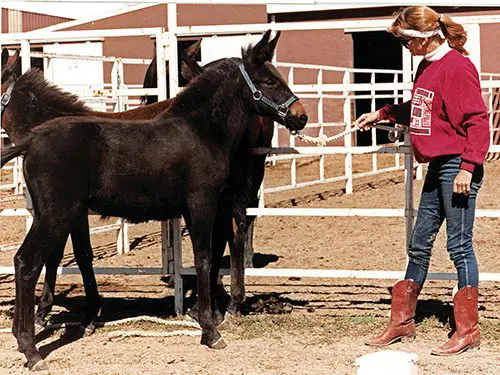 Many veterinarians and farriers refuse to work on mules. Some are slaves to the old wives’ tales about mules being stubborn, ornery and dangerous, and some are subject to owners who cannot manage their own animals. The professionals that primarily studied with horses are more apt to be tolerant of a misbehaving horse than of a misbehaving mule. They have a better idea of what to expect and how to deal with it.
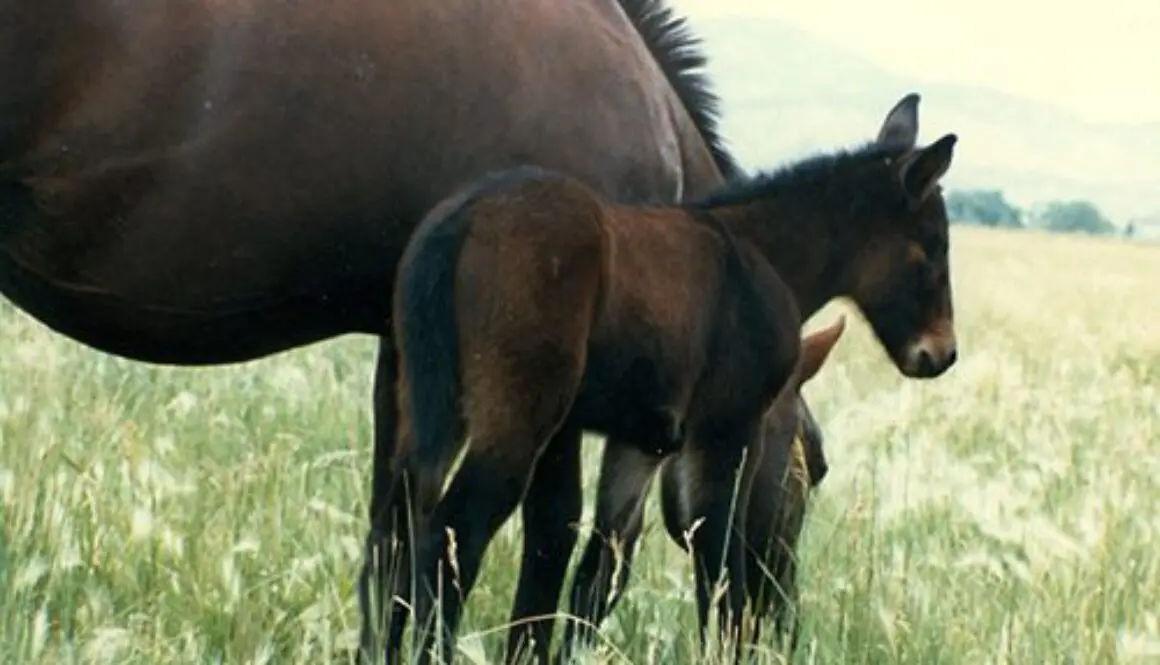
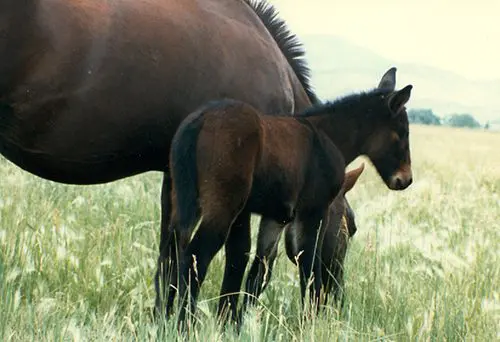
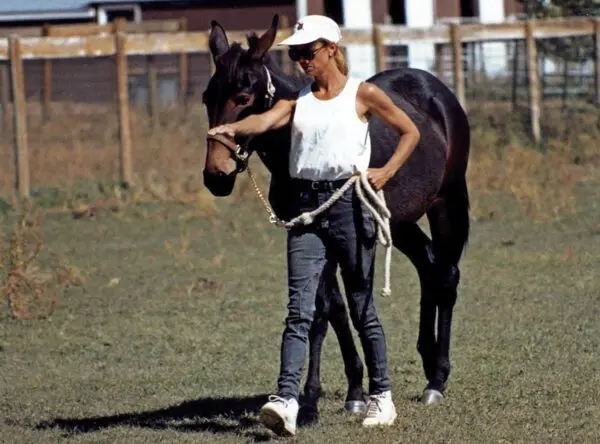 upon their arrival; (2) the animals are not handled regularly or trained correctly and are difficult to treat; (3) owners use excitable disciplinary tactics while the professional is working on the animal, putting him in physical jeopardy; and (4) owners do not follow up on treatment instructions. True, these complaints apply to both horse and mule owners. To dispel old rumors about mules, it is important that all your equines are easily managed. The veterinarian or Farrier will not be as quick to forgive a mule. The mule foal learns his behavior from his dam. A calm and obedient mare makes for a calm and obedient foal.
 You are the one that interacts with the animal most often and should know the details that the vet could not possibly know. Good records are important for clear communication with your vet. With each visit, update him on your equine’s management & training status. Alert the vet as to any changes in the equine’s behavior or medical status. Ask questions and learn about what your vet is doing with each visit to increase your knowledge and understanding.
 As in RH incompatibility in humans, if the foal’s blood type is the same as the mare’s blood type, there is no problem. If the foal’s blood type is different from the mare’s, antibodies may be created in the mare’s blood. That is when the problems begin. Mares should be tested for the possibility for an N.I. baby 1-3 weeks before foaling, but you can also test at 30 days before foaling, and again later closer to the time of foaling, to allow more preparation time. Consult your veterinarian well before the mare’s delivery date to make a plan for testing.
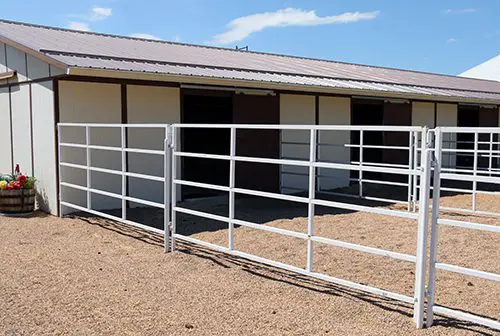
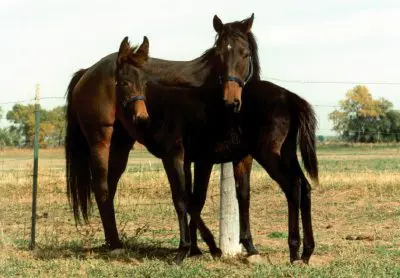 Decide on a foaling location. Decide about the birth location…at home, or remotely managed. If she is to be foaling at home, pick a large stall and run to allow for plenty of room and easy access to the mare and foal. It is helpful to install a camera for monitoring the mare since you must catch the foal before it suckles the mare. Keep the mare and foal inside a safe stall for the first 24-36 hours. The stall and run can be next to other animals fence provided there are no health risks. Having other equines near can help to keep the mare from feeling alone and anxious.
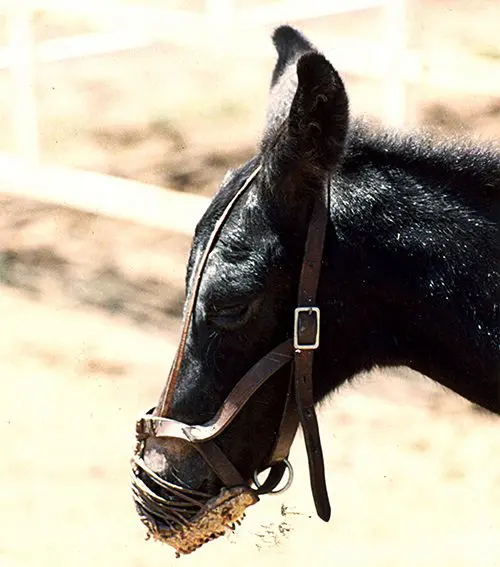 Be sure to have a muzzle on hand for the N.I. foal. Do not confuse a grazing muzzle with an N.I. muzzle. You can obtain an N.I. Foal Muzzle from:
 Be present for the birth of the foal, imprint, and muzzle the foal immediately. Tie the mare to a stout post in the stall next to the feeder (with about 3’ of slack), take the muzzle off of the foal, feed the foal replacement colostrum and after the predetermined amount of colostrum has been provided over the first few hours of life Milk out the mare every 2 hours. When you are bottle feeding the foal, position him at the mare’s flank. Putting him onto the mare to suckle later will then be easier. Have grass hay in the feeder to help keep the mare occupied while you work. Make sure the foal starts to receive the replacement colostrum as soon as it has a suckle reflex. Consult with your veterinarian about the amount to feed the foal at each feeding and how often to feed the foal.
 When the muzzle is removed, you can open the stall door and they can be turned into the run together (with the stall door remaining open). Keep them both separated from other animals until the foal is finally weaned. The foal should not be weaned until he is sixth months old. They should not be turned out with other animals to prevent the risk of injury to the foal. If there are other mares with foals, they are safe turnout mates.