By Meredith Hodges
 It is important to know the differences among rewards, treats, coaxing and bribing in order to correctly employ the reward system of training called Behavior Modification.
Rule Number One: Treats and bribery should never be used during training. However, the appropriate dispensing of rewards and coaxing will produce the correct behaviors.
In order to reward your equine correctly for performing tasks, it is important to know the difference between a reward and a treat, and between coaxing and bribing. Let’s begin with some basic definitions of these terms:
Reward: something desirable given for a completed task
Treat: an unexpected gift given simply because it will be enjoyed
Coax: to gently persuade without dispensing the reward
Bribe: to persuade the animal by indiscriminately dispensing treats
Remember to give your equine a reward only after a specific task you’ve asked for has been performed—or even an assimilation of that task, which means the taking of baby steps toward completing the task. The reward should be given immediately upon completion of the task and then your equine should be allowed time to enjoy his reward before moving on to the next task. If your equine is given a food reward for only good behaviors, he will be more likely to continue to repeat only those behaviors for which he is rewarded and you can begin to “shape” his behavior in a positive way.
Treats, on the other hand, are a food that your equine especially likes, which are given randomly and without purpose. Giving random treats during training can result in crossed signals and confusion in your animal. Treats such as peppermints and even “horse treats” are generally an inappropriate food source for equines and when dispensed too freely, have actually been known to cause equine health problems, so forego treats of any kind during the training process.
Coaxing and bribing can seem like the same thing, but they are not. Bribery suggests the actual dispensing of a reward before the task has been completed. Bribery is the indiscriminate dispensing of treats and is not the way to clearly communicate to your equine which is truly a positive behavior and which is not. Rewards and coaxing are often confused with bribery, but rewards are dispensed for a task only when it has been completed, and coaxing using the promise of a reward can often be used to help your equine to stop balking and attempt to perform the task you have requested. Then the reward is given only when he has completed the task.
As an example of coaxing, you can extend a handful of crimped oats to lure your equine closer to an obstacle, but he should not receive the handful of oats until he completes the required task or travels enough distance toward the obstacle to deserve a reward. If your equine just won’t come all the way to an obstacle, even to get a reward, you can modify the task by asking your equine to just come closer to the obstacle and then halt (but without backing up). Then the reward can be dispensed for the partial approach and halt, because these actions still qualify as an assimilation of the bigger task that is to be completed. If he backs away at all, he should not be rewarded and you will have to go back to the beginning of the task and try again.
A kind word or a pat on the head may be enjoyable for your equine, but it doesn’t necessarily insure that the desired behavior will be repeated. However, a food reward insures that desirable behaviors will be repeated, because food is a solid, tangible reward. The food reward will back up the petting, (the petting is something that you probably do all the time anyway). When you visit your equine, you most likely pat him on the nose or head and say hello, but there are no real demands for any particular task being asked of your equine—you and your equine are simply interacting. You’re getting him used to touch, discovering how he likes to be touched and learning about his responses, which is actually part of imprinting.
The problem with carrots, apples and other foods people use for treats is that they’re not something for which the equine will continue to work and are not healthy choices for your animal in large quantities. After a limited amount of time, equines can easily become satiated on most treats. It’s like a kid with a bunch of candy bars. Once they become full they don’t want any more candy and they’ll stop working for the treat. Many foods used as treats, when given too freely, may also cause your animal to become tense or hyperactive. However, it’s been my experience that an equine will continue to work for crimped oats as long as you dole them out. Crimped oats are healthy for the body and they don’t cause an equine to become tense and difficult to handle.
When you’re using rewards, always start with lavish rewards for all new behaviors. This means that, every time you teach something new, you’re going to give lavish rewards for even the slightest assimilation toward the correct behavior. For instance, if your foal is tied to the fence and upon your approach, he quits pulling, it’s time to try to walk away from the fence with him and see if he will follow you. In this first leading lesson, you’ll untie him and ask him to take a step toward you. If he does, lavishly reward that step toward you, wait for him to finish chewing his oats and then ask him to take another step forward and toward you. If he complies and takes another step forward, lavishly reward that step too. During the first lesson, you will be rewarding every single step he takes toward you. Remember to keep the lesson short (about 15 minutes) and ask for only as many steps as he willingly gives you.
Between lessons, let your equine have a day off in order to rest. When you return for the second lesson, tie him to the fence and review with him your last lesson from the very beginning. He should remember the previous lessons and be willing to follow you right away in order to be rewarded. If he seems willing to follow your lead, untie him and ask him to take a step forward just as he did before, but this time, instead of dispensing the food reward when he takes the first step forward, simply say, “Good boy” and ask him for a second step forward before you reward him with the oats. You will now be progressing from one step forward before you reward to two steps forward before you reward.
If he won’t take the second step forward, then give the reward for the first step, wait for him to finish chewing and ask again for two steps before rewarding him again. If he complies, you can then reward him every two steps during that lesson and quit after fifteen minutes. Give him another day between lessons and then proceed in the same manner, beginning with a review of the previous lesson, then a reward for the first step, and then for every two steps. During this lesson, you can now ask for three steps, and you can continue asking for three or more steps during this lesson, provided that he takes these steps willingly and then stops obediently on his own to receive his reward. You no longer need to count the steps as long as he is offering more steps between rewards each time. If, because of his enthusiasm, he begins to charge ahead, stop him and immediately reward him for halting. This will insure that he keeps his attention on you and the task at hand. This methodical, deliberate process is setting the stage for a positive and healthy working relationship with your equine.
This is how you begin with leading training, and also how you should proceed with all the new things that you will be teaching your equine. In the beginning of leading training, he gets rewarded for even an assimilation of what you’re asking. For example, when you get to negotiating obstacles, your goal may be to cross over a bridge, but when your equine sees the bridge ahead, he may stop or start backing up. At this point, allow him to back until he stops. Go back and repeat the steps you did prior to approaching the obstacle. Then, asking for only one step at a time, proceed as you did during his flatwork leading training toward the bridge, rewarding each step he takes. Tell him verbally how brave he is and continue to reward any steps he takes toward the obstacle before proceeding forward. Remember to stop at any interval where he becomes tense, ask for one more step to be rewarded, and then allow him to settle and refocus before asking any more from him.
Once he goes to the bridge without a problem, you no longer have to reward him all the way up to the bridge. Just reward him when he actually gets to the bridge. Next, step up onto the bridge and ask him to take a step up onto the bridge with his two front feet, which is another new task. If he puts one foot on the bridge or even tries to lift up a foot and put it on the bridge, make sure you reward that behavior. Once he has a foot firmly placed on the bridge, keep tension on the lead rope and ask for his other front foot to come up onto the bridge. If he places his second foot on the bridge, you can then reward him for having both front feet on the bridge. Next, you’re going to continue forward and just walk over the bridge to the other side, pause and reward. Then quit this lesson. In his next lesson, if needed, repeat the approach the same way if he starts to balk. If not, ask him to step both front feet up onto the bridge, stop, make sure he is standing squarely, and reward that behavior.
Now you no longer need to reward for one foot on the bridge. This is called “fading or phasing out” the reward for a previous behavior (one step), while introducing the new behavior of walking to the bridge, halting and then putting two front feet up on the bridge. Wait for a moment for him to chew his reward and then ask him to continue onto the bridge, stop and square up with four feet on the bridge and reward. If he does not comply and won’t stop on the bridge, just go back to the beginning, approach the bridge as described and try again until he stops to be rewarded with all four feet placed squarely on the bridge
Then you ask him, to place his two front feet on the ground while leaving his two back feet on the bridge. Then have him stop and square up to be rewarded. This is a difficult position and if he cannot succeed by the third attempt, you may have to step in front and aid in his balance, then reward him when he settles in this position.
The last step over the bridge is to bring the hind feet off the bridge, stop and square up one more time before he gets rewarded. This does two things. It causes your equine to be attentive to the number of steps you are asking and it puts him in good posture at each stage so that his body will develop properly. In future lessons, the steps in the approach to the bridge no longer need to be rewarded and as he becomes more attentive, he will learn to stop any time you ask and wait for your cue to proceed. After several months of this meticulous attention to these detailed steps, he will not necessarily need to be rewarded with the food reward each time—a pat on the neck and kind words of support should be sufficient. Rewards can then be given for whole “blocks” of steps when he successfully completes them.
Here is a question a lot of people ask: “This is fine while my animal and I are still working from the ground, but what happens when I finally get on to ride? Do I keep rewarding every new behavior when I ride?” The answer to that question is, “No, you don’t.” If you do your ground work correctly, it will address all the things that you’ll be doing while you’re riding before you actually even get on. Your equine has been lavishly rewarded for stopping when you pull on the reins and the drive lines, and he’s been rewarded for turning and backing and everything else he needs to learn before you actually get on him, so the only thing left to get used to would be exposure to your legs on his sides. He will soon learn that your legs push him in the direction of the turn you are indicating with your reins. For this action, he does not need to be rewarded.
In the natural progression of correct training—including during mounting training—your equine should also be getting rewarded when you’re first getting him used to your being on-board. Give him the oats reward for standing still while you attempt to mount (i.e., walking toward him, holding the left rein and reaching for the saddle horn), and then when you hang from each side of his body with a foot in the stirrup (first on one side and then on the other side), and, finally, from each side of his body while you sit on his back. When you ask him to turn his head to take the oats from your hand, you can be sure his attention will be on you because this action will force him to look at you in order to receive his oats. Then reward him again for standing still as you dismount. Consequently, by the time you actually get to the point of riding in an open arena, he’s been rewarded for having you on his back and for behaving well through all the exercises demanded from him during round pen training.
You may first want to lunge your equine when you move into the open arena. Lunge him on the lunge line and reward him during that part of your arena workout. When you are ready to mount in the open arena, have a few oats in your pockets to offer him when you mount on each side the first few times. This will ensure that his attention stays focused on you. Once he is used to being ridden, you will no longer have to reward him in the middle of riding lessons. If he does not keep his attention on his work in the open arena, this signifies that not enough time has been spent on the ground work and you should back up your training regimen to the point that he is maintaining attentiveness and performing correctly, even if it means going back to the round pen or leading work. If, in the ground work stages, you give plenty of food rewards in the correct manner, by the time you groom and tack up, your equine should have been sufficiently rewarded and will not require another reward until after your workout when you return to the work station and un-tack him. This is called delayed gratification. When you un-tack him and do your last minute grooming before putting him away, again be generous with the crimped oats and praise your equine for a job well done. Rewards are dispensed very specifically and pave the road to a solid foundation of trust and friendship.
To learn more about Meredith Hodges and her comprehensive all-breed equine training program, visit LuckyThreeRanch.com, MEREDITH HODGES PUBLIC FIGURE Facebook page, or call 1-800-816-7566. Check out her children’s website at JasperTheMule.com. Also, find Meredith on Pinterest, Instagram, MeWe, YouTube and Twitter.
© 2013, 2016, 2018, 2021, 2022 Lucky Three Ranch, Inc. All Rights Reserved.

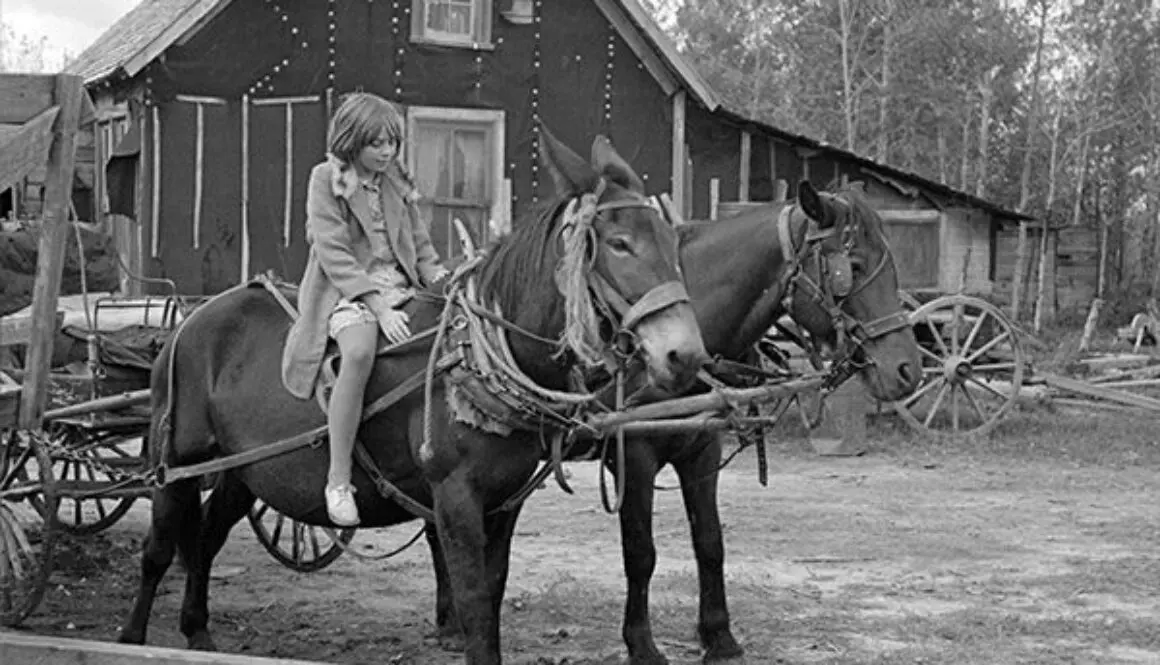
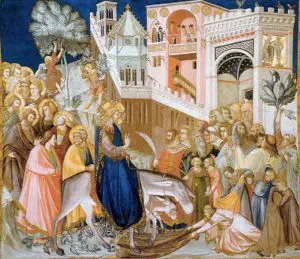 Long before the Founding Fathers drafted our constitution, the roots of America were as a religious nation under God. Today’s mule also has his roots in religion. The mule’s ancestor—the donkey—is mentioned in the Bible numerous times as an animal acknowledged by God and blessed by Jesus Christ. The donkey was even chosen to bring Mary and Joseph to Bethlehem and, later, as the mount Jesus himself used for his ride into the city of Jerusalem.
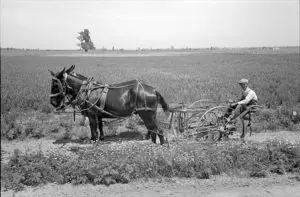 As early-nineteenth-century America continued to develop and its population grew, the American people came to depend more and more on self-sustaining agriculture. Because of the mule’s extraordinary ability to work long hours in sometimes harsh and unrelenting climates, his sure footedness which allowed them to cross terrain not accessible by any other means, and his resistance to parasites and disease, he became the prized gem of agriculture and remained so for the next hundred and fifty years.
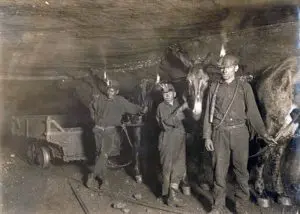 In 1882, the Harmony Borax Works opened with one big problem—how to get their product 165 miles across the treacherous Mojave Desert from Death Valley to the nearest railroad spur. The answer? Mules! “The borax wagons were built in Mojave at a cost of $900 each…When the two wagons were loaded with ore and a 500-gallon water tank was added, the total weight of the mule train was 73,200 pounds or 36 and a half tons. When the mules were added to the wagons, the caravan stretched over 100 feet. The Twenty Mule Teams hauled more than 20 million pounds of borax out of Death Valley between 1883 and 1889.” 1
 Because of their traits of strength, intelligence and loyalty, mules were a crucial part of our country’s greatest conflicts, from the Civil War through the Spanish American War, and in both World War I and World War II. A well-known tale from the Civil War states that, “In a battle at Chattanooga, a Union general’s teamsters became scared and deserted their mule teams. The mules stampeded at the sound of battle and broke from their wagons. They started toward the enemy with trace-chains rattling and wiffletrees snapping over tree stumps as they bolted pell-mell toward the bewildered Confederates. The enemy believed it to be an impetuous cavalry charge; the line broke and fled.” 3 During World War I, mules and horses were still the primary way that artillery was carried into battle. Although the 75mm Howitzers proved too heavy for most horses, it was a common sight to see the big guns strapped to the back of a sturdy mule.
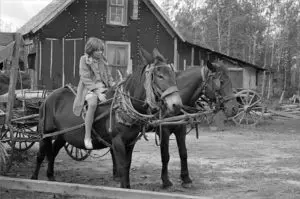 One of the world’s greatest natural wonders, the Grand Canyon, has been home to mules since the 1800s. First brought in by prospectors, it was soon realized that the tourists wanted a way down to the Canyon floor, and so began the Grand Canyon mule pack trips. Famous mule-riding visitors to the Grand Canyon have included Presidents Theodore Roosevelt and Howard Taft, famed naturalist John Muir and painter/sculptor Frederic Remington.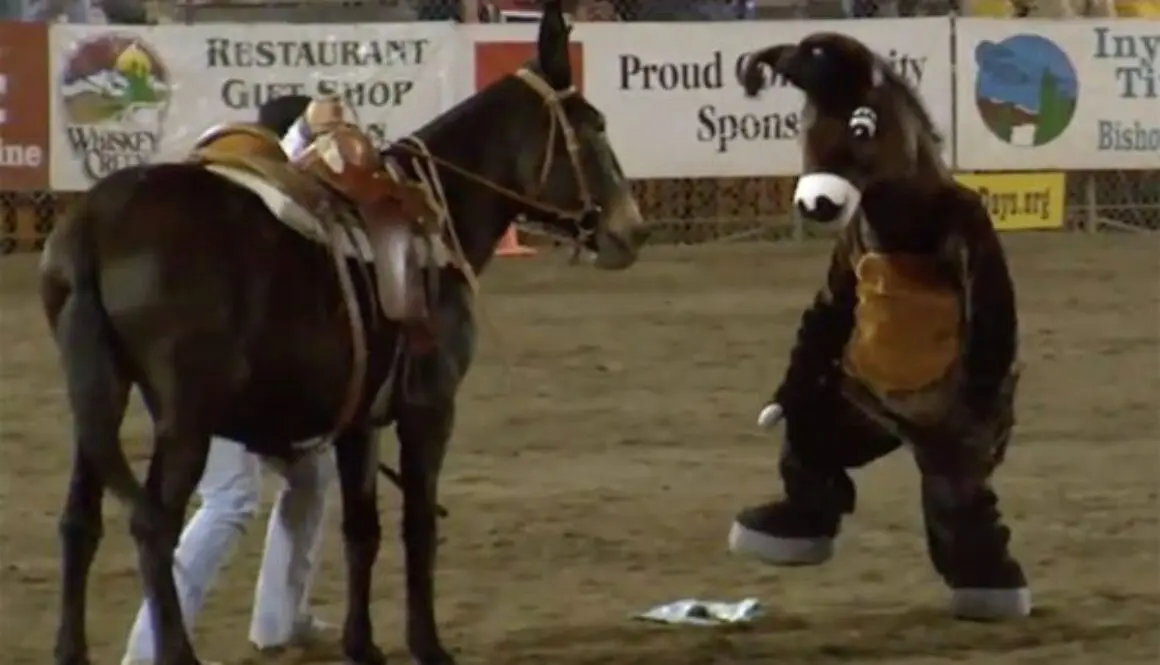

 The ideal mule should have a head that is slightly longer than that of a horse, but proportionate to the size of the mule’s body. The features should be prominent and give an overall pleasant appearance. The ears should have length and be nicely shaped, and the eyes should be large, soft and kind, reflecting the mule’s health and intelligence. The forehead should be broad, tapering to a small and delicate muzzle, with a shallow mouth and well-aligned teeth, and the nostrils should be wide to allow for adequate respiration while working. Both the mare and the jack are responsible for the shaping of these characteristics, but the jack has primary responsibility where the length of the ear and the mass of bone are concerned. A jack with a longer ear will, more often than not, throw a longer ear to the mule, while the shape of the ear is determined primarily by the mare. The attractive or unattractive head of the jack can emerge in the resulting mule, so be sure to carefully consider the head on the jack to be used for breeding to produce an attractive head on your mule offspring. Standard-sized jacks and Large Standard jacks most often have a more refined head, while the head of a Mammoth jack may be less refined and possess
  thicker bone, particularly around the eyes and jaw line. In the case of saddle mule production, massive bone on an otherwise attractive head can be very unattractive, so using the smaller jacks would be better for a more refined look in your saddle mule (which is also true for the rest of the mule’s body).

 The shoulders of the mule should be at a nearly 45-degree angle, with a broad collar surface. Most mares will have this angle, but donkeys have a tendency toward short, steep shoulders, so, to insure that the mule has good shoulders and hips, consider a jack with good length and a lower angle through the shoulders and hips.
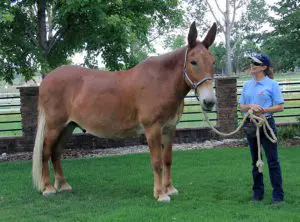 The chest of the mule should be deep and prominent, broad and well developed (it should resemble a turkey’s breast), with little or no line of separation (as is seen in a horse’s chest). Since jacks are generally narrower through the chest than are mares, the mare chosen for breeding should exhibit much width and depth through the chest to compensate for the lack of it in the jack.
 If a stockier mule is desired (as in the case of breeding for pack or draft mules), a stockier mare bred to a Mammoth jack will produce the desired thickness of bone in the legs of the mule. If a more refined Thoroughbred appearance is desired, the mare should be bred to a Standard or Large Standard jack in order to reduce the mass of the bone in the legs of the mule and retain refinement throughout the body. This does not affect the height of the mule, as the mare is primarily responsible for the mule’s height, while the jack is primarily responsible for the mule’s bone thickness. The forearm and stifle in the mule should be well developed and thickly covered with smooth muscle that tapers to the knee and hock in regular, well-defined lines. Again, these muscles should be thick and smooth, but not bulging, as in horses. The mare will compensate for the limited bulk muscling in the donkey jack, and the jack will contribute and maintain the smoothness of that additional bulk muscle in the mule.
 The coat and hair of the mule should be soft and shiny, covering pliable skin. The coat should be soft to the touch, denoting good skin health. Length and thickness of the coat are contributed by both jack and mare. Since donkeys have a typically thick coat of hair, a mare with a thinner coat will balance this thick hair coat in the mule, making him look sleeker and more horse-like than his donkey sire.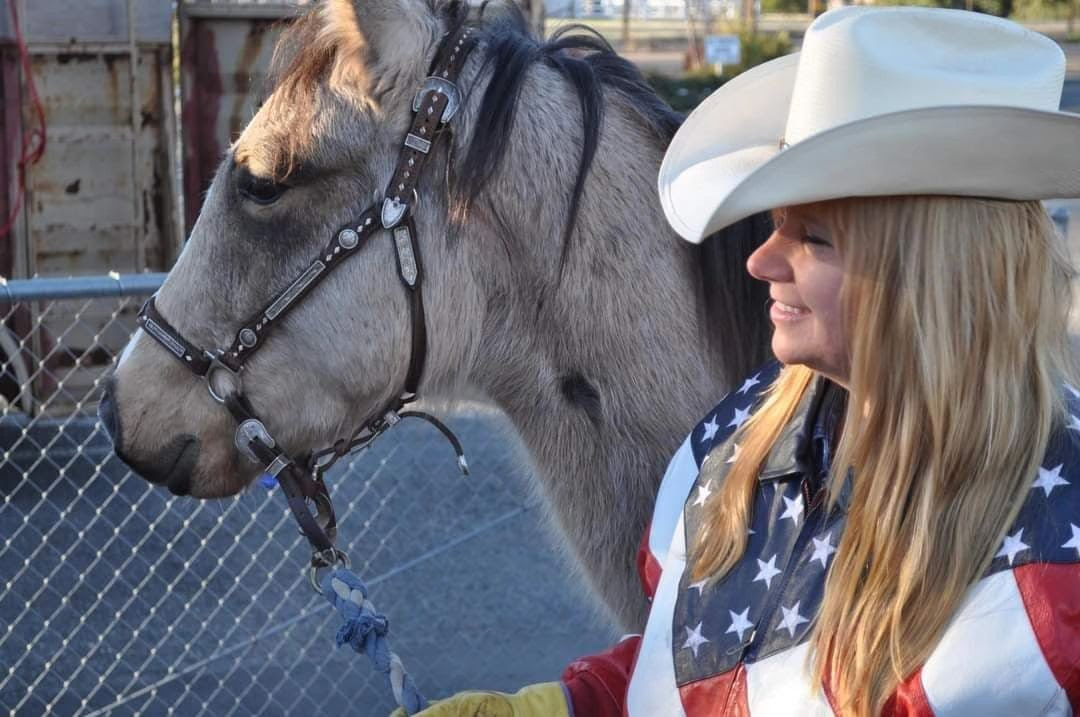


 Horse trainers have kept us in awe of their unique and significant talents for centuries, and now that their techniques are more public, many equine professionals will pooh-pooh those who attempt a “kinder” approach to training. Scientists who study the equine in motion—its nutrition, biomechanics, care and maintenance—have their own perceptions to offer as to what we can learn about equines. Because many of these studies and tests are done in the laboratory, scientists rarely have the opportunity to follow their subjects throughout a lifetime of activity, as well as having the opportunity to experience what it really means for you as a rider, to be in balance with your equine when you work together, whether you are leading, lunging, riding or driving. If they did, their findings would probably yield quite different results. With all this progressive scientific thought, it seems to me that common sense can often get lost in the shuffle and respect for the living creature’s physical, mental and emotional needs may not be met.
 degenerative breakdown. For instance, those who get in a hurry in Dressage and do not take a full year at each level in order to develop their equine’s body slowly and methodically may discover, several years later, that their animal has developed ringbone, side bones, arthritis or some other internal malady. These types of injuries and malformations are often not outwardly exhibited until it is too late to do anything about them.

 Tragically, many equines are suffering from abuse every day, while they are trying to please their owners and do what is asked of them. Their owners and trainers take shortcuts that compromise the equine’s health. It could be that these owners and trainers are trying to make choices with limited knowledge and really don’t know whom to believe. But ignorance is not a valid defense and sadly, the animal is the one that ends up suffering.
 The Lucky Three mules have always been worked in good posture, and spend only as much time on the hot walker as it takes for them to dry after a bath. They maintain their good posture while walking and rarely let the hot walker “pull” them into bad posture.
 Like many, I am of the belief that mechanical devices that force an equine into a rounded position do not necessarily put that equine in good posture. I would guess that many trainers think the “Elbow Pull” device that I use is guilty of developing this artificial posture. If that is their opinion, then they do not understand how it works. Rather than pulling the equine’s head down into a submissive position, when adjusted correctly, the “Elbow Pull” acts like a balance bar (like a ballet dancer would use) to help the equine to balance in good posture. It takes time to develop good posture. So, in the beginning, your equine can only sustain good posture for a certain number of measured steps, and then he must “lean” on the “Elbow Pull” in between these moments of sustaining his ideal balance on his own. The “Elbow Pull” simply prevents him from raising his head and neck so high that the neck becomes inverted and the back hollowed, but it does not actually pull his head down. The rope itself is very lightweight and puts virtually no weight on his head and neck at all. Note: Because horses react differently than mules and donkeys when hard-tied, a simple adjustment to allow the “Elbow Pull” to “slip” with a horse is necessary.
 By Meredith Hodges
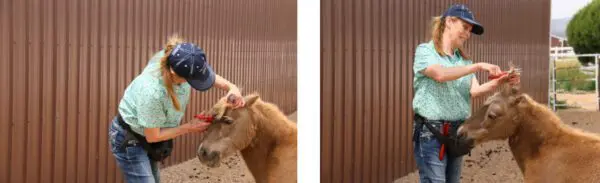
 Once the heavier coat is eliminated, a weekly grooming will keep his coat nicely maintained. Daily grooming before a show, or every other day, is even better. Each time you groom him before riding, check and clip as needed the muzzle hairs, around the eyes and ears, and around the coronet bands. Leave the hairs inside the ears to prevent irritation from bugs and flies, but trim the outside edges and backs of the ears. An ounce of corn oil in his feed daily will assure a healthy sheen in his coat on show day without the use of artificial highlighters. Trimming, or shoeing, your mule on a regular six-eight week schedule will assure that his feet will not need attending at the last minute. A routine vaccination, deworming, Coggins testing and a permanent brand inspection will make sure he is ready for transport to any show anywhere at any time. Then, all that remains to be done right before the show is minor clipping, bathing, and polishing hooves.
 Then, tack up your animal, checking each piece of equipment to make sure that it is in working order. Go ahead and practice the class. Then, as you unpack your mule, set the tack aside from the rest in your tack room for cleaning later. Do this for each animal in each class. Your animals will do better at the show if they get plenty of rest before the show, so it is wise to spend the day before the show cleaning your tack, clothes, and equipment. Before you begin to clean, load all the items into your trailer that are all ready to go without cleaning. Then, as you clean the remaining items, load them directly into the trailer as you finish them.
 can be left until morning, or last minute, provided that you put them in a highly visible spot with a list of what is to be put in attached. Do not try to rely on your memory, as it will be clouded by the excitement and anticipation of the show.
 If classes are spaced fairly close together and you are using more than one animal, it is wise to tack up the other animals ahead of time so they are ready to go. If you are using only one saddle for more than one animal, the other animals can still be bridled with the halter slipped over it, so they can be tied and waiting. Be sure to tie up the reins so they will not be chewed or stepped on. If you are using the same mule throughout the show, tacking and stripping should not be too time-consuming if your equipment is well organized.

 It is important to know the differences among rewards, treats, coaxing and bribing in order to correctly employ the reward system of training called Behavior Modification.
 Remember to give your equine a reward only after a specific task you’ve asked for has been performed—or even an assimilation of that task, which means the taking of baby steps toward completing the task. The reward should be given immediately upon completion of the task and then your equine should be allowed time to enjoy his reward before moving on to the next task. If your equine is given a food reward for only good behaviors, he will be more likely to continue to repeat only those behaviors for which he is rewarded and you can begin to “shape” his behavior in a positive way.
 As an example of coaxing, you can extend a handful of crimped oats to lure your equine closer to an obstacle, but he should not receive the handful of oats until he completes the required task or travels enough distance toward the obstacle to deserve a reward. If your equine just won’t come all the way to an obstacle, even to get a reward, you can modify the task by asking your equine to just come closer to the obstacle and then halt (but without backing up). Then the reward can be dispensed for the partial approach and halt, because these actions still qualify as an assimilation of the bigger task that is to be completed. If he backs away at all, he should not be rewarded and you will have to go back to the beginning of the task and try again.
 Between lessons, let your equine have a day off in order to rest. When you return for the second lesson, tie him to the fence and review with him your last lesson from the very beginning. He should remember the previous lessons and be willing to follow you right away in order to be rewarded. If he seems willing to follow your lead, untie him and ask him to take a step forward just as he did before, but this time, instead of dispensing the food reward when he takes the first step forward, simply say, “Good boy” and ask him for a second step forward before you reward him with the oats. You will now be progressing from one step forward before you reward to two steps forward before you reward.
 This is how you begin with leading training, and also how you should proceed with all the new things that you will be teaching your equine. In the beginning of leading training, he gets rewarded for even an assimilation of what you’re asking. For example, when you get to negotiating obstacles, your goal may be to cross over a bridge, but when your equine sees the bridge ahead, he may stop or start backing up. At this point, allow him to back until he stops. Go back and repeat the steps you did prior to approaching the obstacle. Then, asking for only one step at a time, proceed as you did during his flatwork leading training toward the bridge, rewarding each step he takes. Tell him verbally how brave he is and continue to reward any steps he takes toward the obstacle before proceeding forward. Remember to stop at any interval where he becomes tense, ask for one more step to be rewarded, and then allow him to settle and refocus before asking any more from him.
 Now you no longer need to reward for one foot on the bridge. This is called “fading or phasing out” the reward for a previous behavior (one step), while introducing the new behavior of walking to the bridge, halting and then putting two front feet up on the bridge. Wait for a moment for him to chew his reward and then ask him to continue onto the bridge, stop and square up with four feet on the bridge and reward. If he does not comply and won’t stop on the bridge, just go back to the beginning, approach the bridge as described and try again until he stops to be rewarded with all four feet placed squarely on the bridge
 The last step over the bridge is to bring the hind feet off the bridge, stop and square up one more time before he gets rewarded. This does two things. It causes your equine to be attentive to the number of steps you are asking and it puts him in good posture at each stage so that his body will develop properly. In future lessons, the steps in the approach to the bridge no longer need to be rewarded and as he becomes more attentive, he will learn to stop any time you ask and wait for your cue to proceed. After several months of this meticulous attention to these detailed steps, he will not necessarily need to be rewarded with the food reward each time—a pat on the neck and kind words of support should be sufficient. Rewards can then be given for whole “blocks” of steps when he successfully completes them.
 In the natural progression of correct training—including during mounting training—your equine should also be getting rewarded when you’re first getting him used to your being on-board. Give him the oats reward for standing still while you attempt to mount (i.e., walking toward him, holding the left rein and reaching for the saddle horn), and then when you hang from each side of his body with a foot in the stirrup (first on one side and then on the other side), and, finally, from each side of his body while you sit on his back. When you ask him to turn his head to take the oats from your hand, you can be sure his attention will be on you because this action will force him to look at you in order to receive his oats. Then reward him again for standing still as you dismount. Consequently, by the time you actually get to the point of riding in an open arena, he’s been rewarded for having you on his back and for behaving well through all the exercises demanded from him during round pen training.
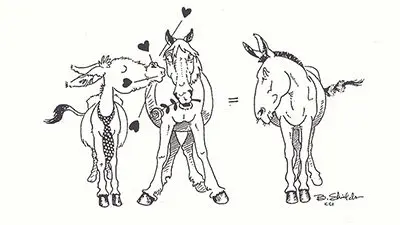 Many times I have been asked, “Is training a mule any different than training horses?”
 Showmanship training is not just for the showmanship class at a show. Perfecting your showmanship technique every time you have your equine on a lead line will command his attention to detail, build his confidence in you and insure that he is strengthening his muscles properly throughout his body at the most basic level.
 When you ask for a halt, stop with your feet balanced, your weight distributed equally over both legs and still facing forward. Give your equine a second or two to settle and then turn to face his shoulder. If his legs are already square, you can then give the crimped oats reward for stopping. If they are not square, take a moment to square up his legs and then give the reward. Praise him for standing quietly for a few seconds and allow him to settle. You can then face forward again, point in the direction of travel, give the command to “Walk on” and walk a few more steps before halting again. Add more steps each time before halting. Whenever you practice turning, always turn the equine away from you—never into you. To insure optimum balance, practice leading him through these exercises from BOTH sides.
 When executing a turn to the right, assume your leading position and then point in the direction of travel, asking your equine to take one step forward with the right front foot then cross the left front foot over the right to make the turn. Your own legs should execute the turn in sync with your equine’s front legs, giving him a good example to follow. Although you will rarely have an occasion to actually lead from the right side, be sure to practice from both sides to insure symmetrical muscle development. Dispense rewards, but only after he has completed what you have requested.
 Once he has learned to follow and to do the “moves,” you then need to help him fine-tune these moves, making them as steady, balanced and coordinated as possible. He should learn to walk, trot and back up in straight lines, to stop squarely and to execute smooth, properly arched turns. Remember that your equine will follow your lead, so always pay close attention to your good own posture and “way of going.” Equines and humans have corresponding body parts, so if you are stiff or off-balance in any part of your body, your animal will exhibit the same problem in his body.
 Maintain your own balance and rhythm, and ease into transitions from walk to trot and trot to walk smoothly and in rhythm and cadence—and so will your equine. Ask him to stand squarely each and every time he stops. Set up his back feet first by pushing on the lead rope with your hand directly under his chin in a diagonal motion toward the back foot that is forward. Push and release (in a diagonal motion only) the lead rope toward the forward foot as much as it takes to move it into line with the other back foot. Once the back feet are in line, set his front feet by pulling and releasing gently forward (again, in a diagonal motion only) to align the front legs.
 As your equine gains strength, you will notice that he now carries his body differently. He is more balanced, solid and steady, and is able to stop squarely at every “whoa,” regardless of the gait. As he frolics in the field, notice the dramatic change in his play patterns. He will be much less awkward.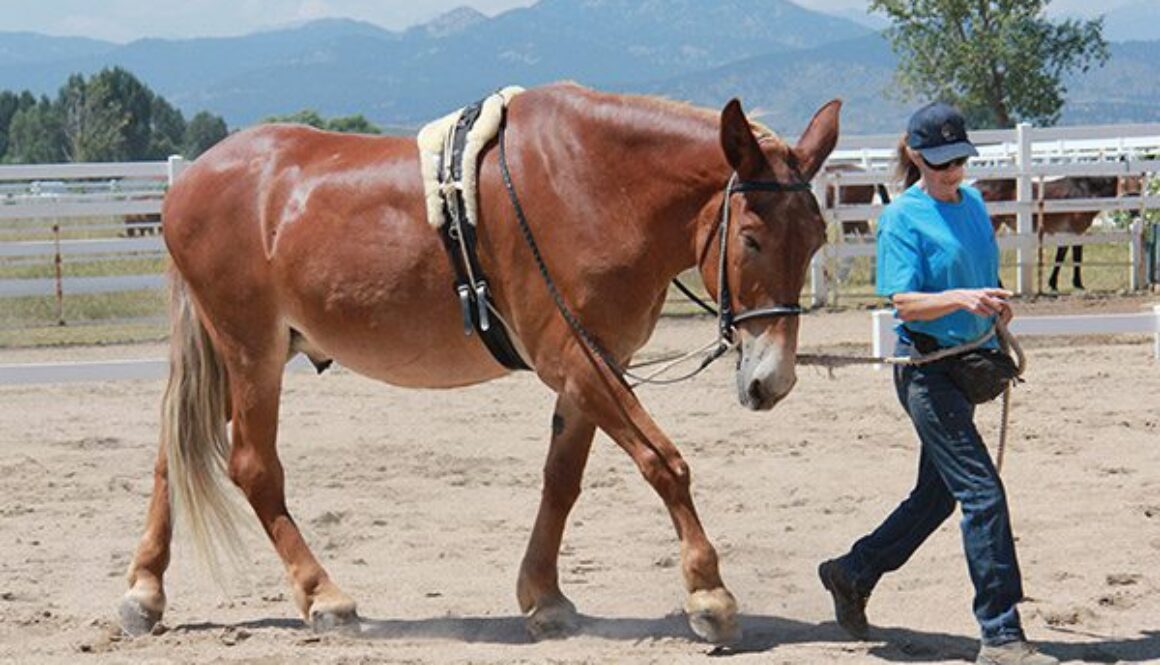


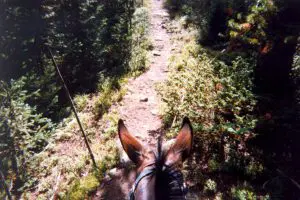
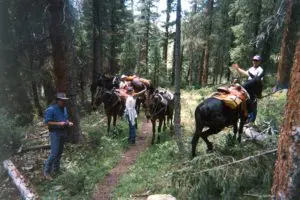

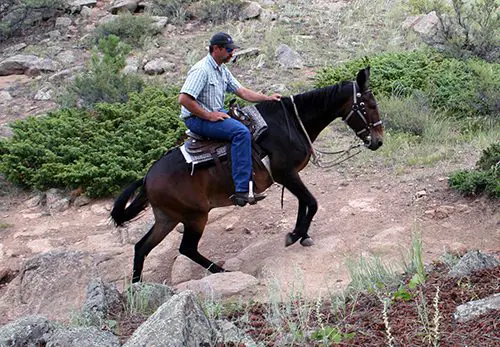 We are fortunate to be able to share our time with such intelligent, tough and durable equines as our beloved mules. But you should also remember to do your part in the relationship. Be patient and willing to take the time to allow your relationship to grow and for training to become solid before you indulge in the challenges that trail riding can present. Plan ahead and scout the locations where you desire to ride. With the growth of urban populations, open areas that welcomed riders in the past are not as numerous as they once were. Many areas now welcome hikers and even bicycles, but not equines. Find the designated trails and camp grounds that will accept equines when planning your treks.
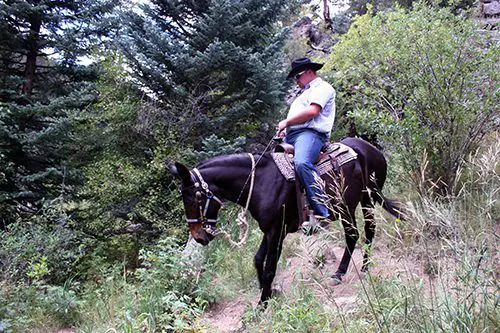 Even a ride that is planned to be short can turn into challenge if the weather changes suddenly, so be sure to plan for the worst case scenario. Tack up your equine in comfortable tack and equipment that fits like a glove. I like to ride with a crupper because it will hold the saddle in the correct placement when adjusted correctly and will allow for full range of movement, particularly behind when climbing uphill. If you use a breast collar, make sure it is loosely fitted so it does not pull your saddle forward and into the shoulder blades. Be sure to pack your saddle bags with the barest necessities for any ride far from home: Compass, water, rain gear, a Swiss Army knife, buck knife, hoof pick, lighter, fence pliers, Granola Bars or Trail Mix, a sleeping bag, a warm coat, Bear Spray and a First Aid Kit (at the very least Gauze, Vet Wrap and Neosporin).
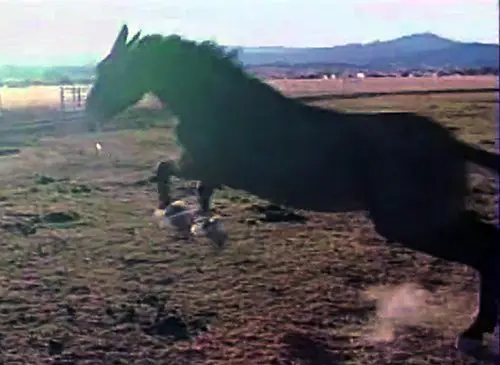 If planning an overnight trip, you will probably need a pack mule, or horse, to carry the extra food and additional necessities you will need like tents, blankets, sleeping bags, more food, extra clothes, High Lines and extra halters, and food for your equines. Lots of places will not allow your equines to graze in the parks, but some do. I do not like using picket lines where the equine is tied low with a halter, or with a rope around a foot. I do not like to use hobbles either (Mules can run off in hobbles with no trouble at all!). It is too easy for equines to get tangled up or injure themselves when they are restricted this way. They can get sprained tendons and ligaments, or severe rope burns that will leave them scarred for life. I prefer to bring their favorite horse “friend” along and tie the horse, and mules that tend to wander, to a High Line. Most of the mules can be allowed to run free and won’t leave your camp with the horse there, but do not leave halters on them. Again, they could become tangled up and injure themselves. If you have spent adequate time during training to build a solid relationship with your mules, they are much less likely to wander off and get lost. They will choose to stay near you.
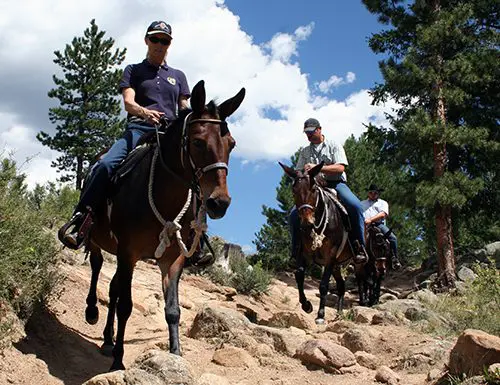 If you can, choose a place where you can establish a base and park your truck and trailer. You can then tie them on a High Line during the evening and put them back into the trailer for the night. This might be better if you are an area where there are a lot of large predators. Just don’t leave the truck and trailer windows open so a predator can get in. Stock trailers are the best for this purpose since they also have more room in them and are fully enclosed. Any food that could be attractive to predators should be mounted high in a tree, at least 50-100 yards away from your camp and your equines.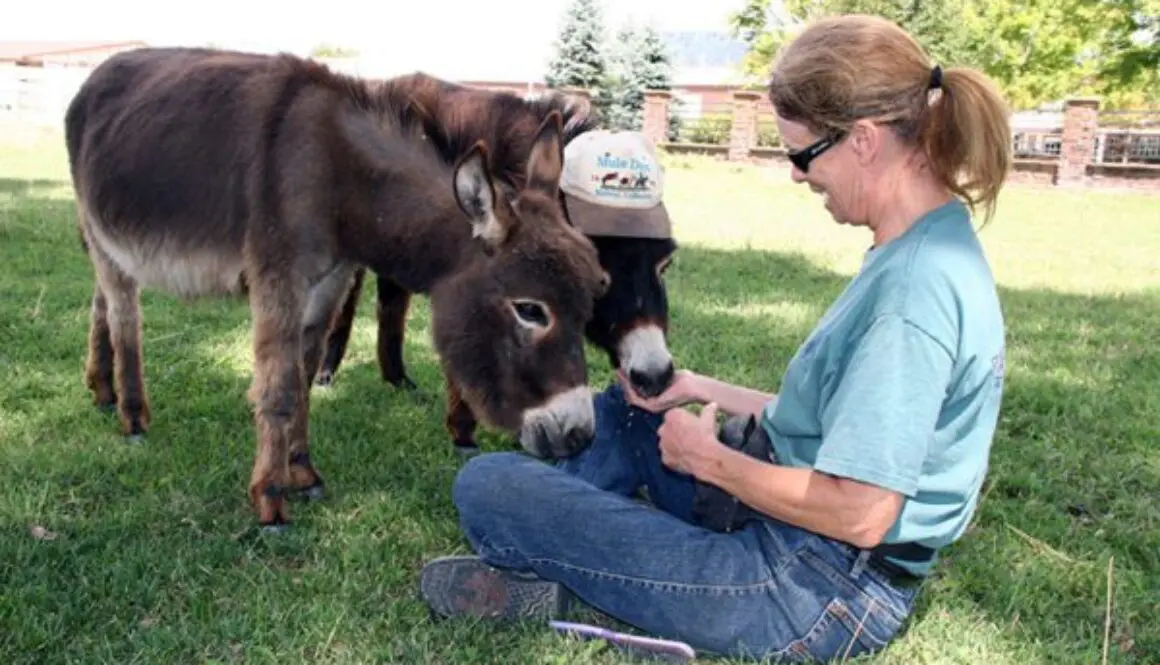
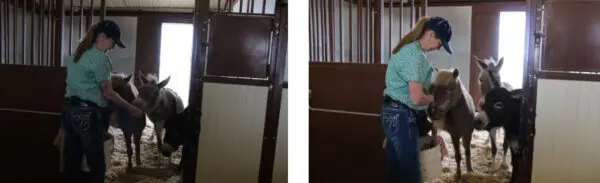
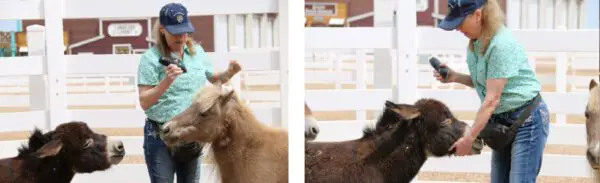
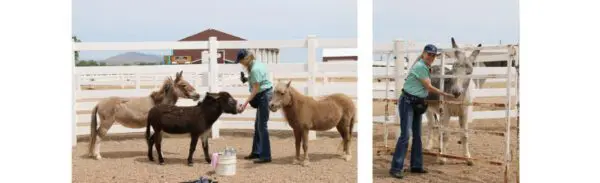
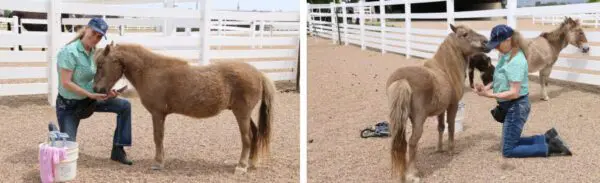
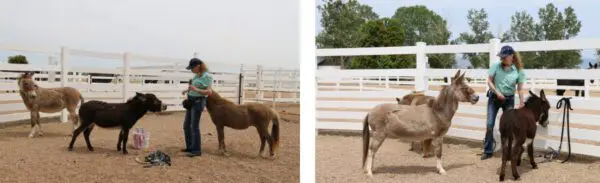
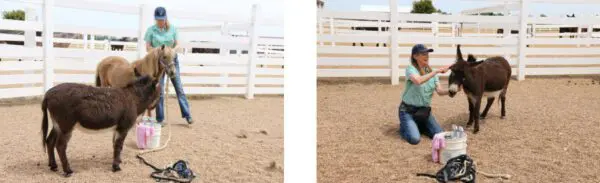
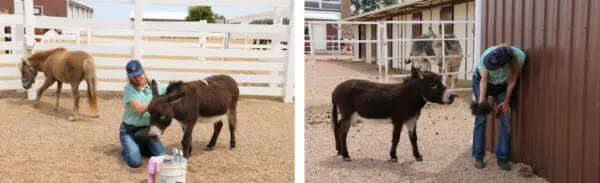
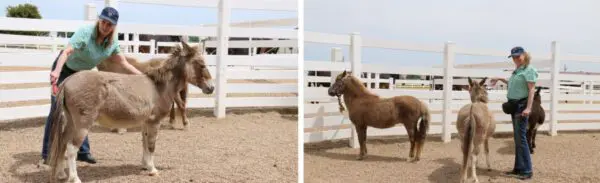
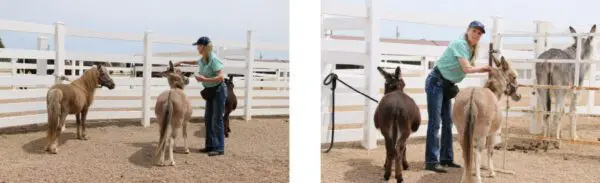
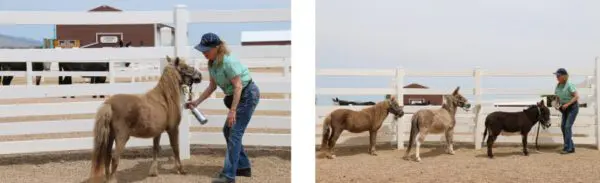
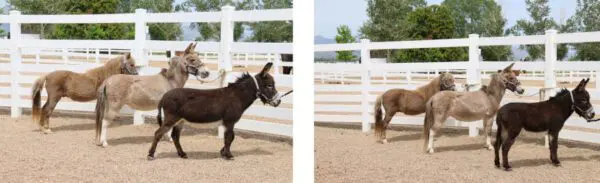
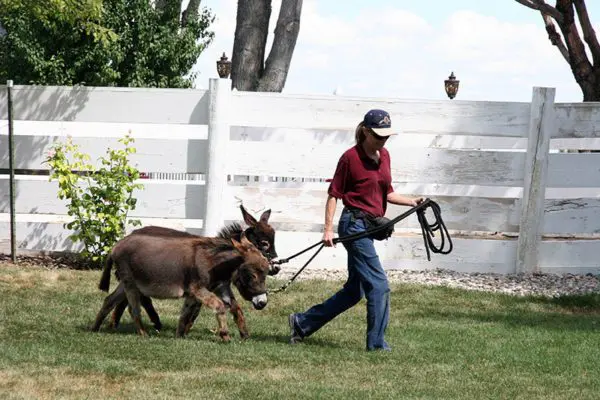
 Miniature horses, donkeys and mules all have one thing in common; everyone else is taller than they are! That makes eye contact with the trainer very difficult if not impossible for them. As the saying goes, the eyes are the window to the soul so it is understandable that they would become anxious if they are unable to look into a person’s eyes to decide whether they are friend or foe. I have five miniature equines: a mini horse named Mirage, a mini mule named Franklin, a mini molly mule named Francis, and two mini donkeys named Augie and Spuds. To help them all succeed and thrive, I’ve structured my training program for them based on the same one I use for all of my other equines, with one important modification. With safety always as my first priority, I work with my minis from a lower position whenever it’s safe to do so. That way, I can make eye contact with them, and I make certain they are always lavishly rewarded with an oats reward for their compliance. The results have been amazing! I’ve received total cooperation from them almost all of the time.
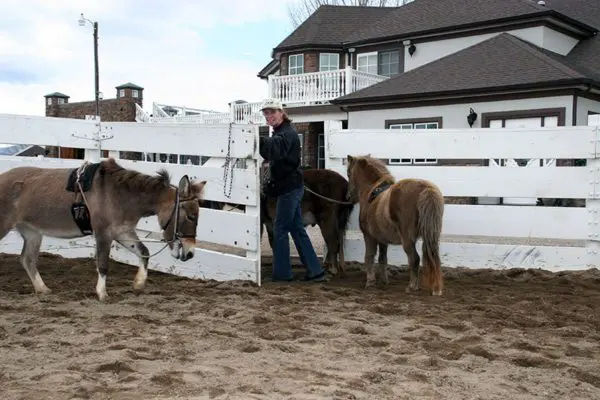 None of my minis were born at my ranch, so I knew that they would each first need to explore their surroundings a little at a time, and would also need ample time to get used to my staff and me. Mirage, the miniature horse, was my first mini. It wasn’t long after I acquired him that I acquired Franklin, the mini mule, who quickly became Mirage’s buddy. Since both Mirage and Franklin had previous training and because minis seem to accept training more willingly when done with a partner, we did all of Mirage’s and Franklin’s groundwork lessons together and, true to form, they learned very quickly because they were allowed to be together.
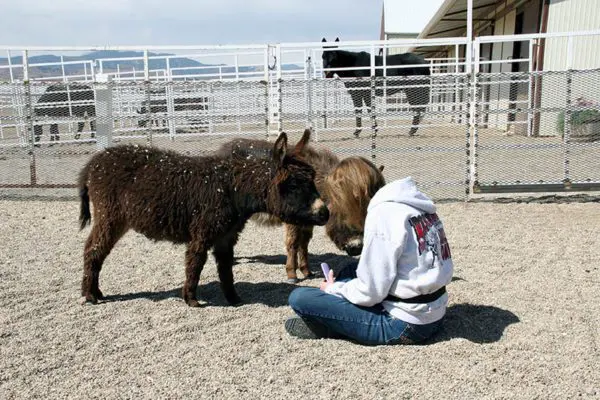 I think it is critically important that all equines have a space they can call their own—their personal oasis of comfort and privacy—so when I got my mini donkeys, Augie and Spuds, I decided that the first thing they would learn about was their living quarters or, as I like to call it, their “bedroom.”
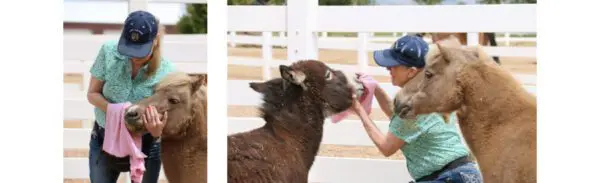
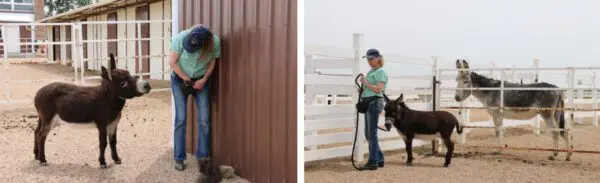
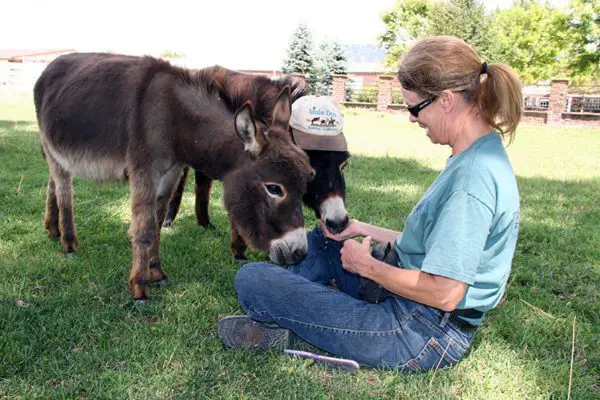 When your mini is comfortable with you coming into his pen and interacting with him, the next step is to ask him to go into a bigger turnout area, where you should repeat the same simple lessons. Now that your mini can be loose in a larger space, ask him to come to join you for another picnic. After a few times, bring a hairbrush with you (It’s the most efficient brush to use on donkey hair).
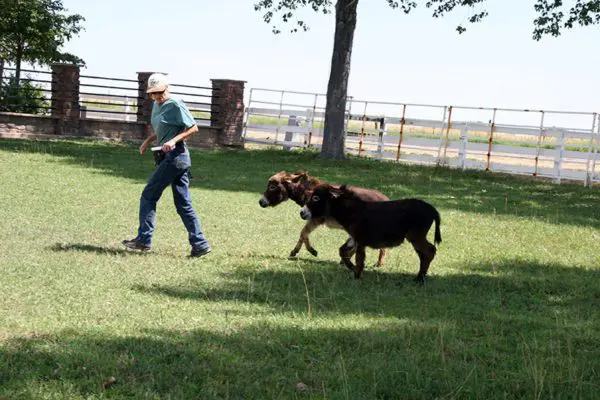 A halter doesn’t even come into play until after grooming in the pen is easily achieved and your mini will follow you to and from the pen without the halter. When it is time to introduce the halter, bring it with you into the pen for your picnic. Do the brushing and then show your mini the halter while you sit on the ground. When he sniffs the halter, he should be rewarded. Once he is unafraid of the halter, hold it on both sides of the noseband, feed your mini some oats, and then gently push the noseband of the halter over his nose and then take it off, rewarding him again. At this point you’ve got all kinds of oats in your lap and your mini’s got his head down, eating the oats, so when you put the noseband on again, just reach over his neck, grab the strap of his halter on the other side, bring it behind his ears and fasten it. If done correctly, this should not bother him. Then reward him with more oats, pet him as he complies and say, “Oh, how good is that?!” You can then take the halter off again and end the first lesson there.
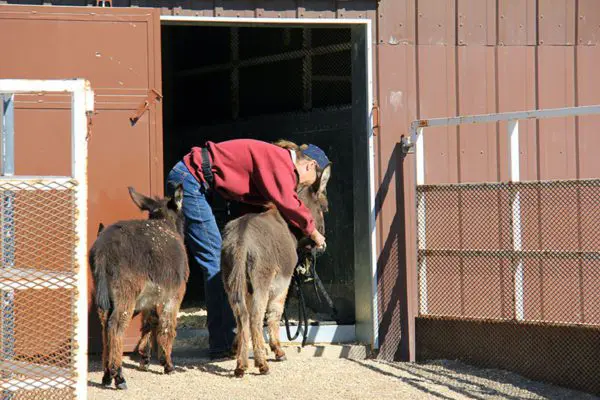 Once your mini is used to having his halter put on, let him graze while supervised in a larger pasture area with his halter on while he drags the lead rope behind him. When you want him to walk away from you, simply stand up and let him go off on his own. After a few minutes, approach him again, grab the end of his lead rope and sit down again. You can give a little tug, say his name and ask him to “Come.” He should come easily when you gently tug on his lead rope. This action makes him look at you and think, “Oh, my human is sitting down again, so I’m going to come over and get more oats!” As he comes toward you, take up the slack on his approach. Once he comes to you easily, you can stand up and ask him to come while you’re standing up and reward him for it. And that’s how to teach a mini to follow you.
 Breaking things down into little do-able steps seems like a long process in the beginning, but as your mini begins to understand the reasoning behind your approach, his reactions to tasks will become calmer, more automatic and more natural for him. When you allow your mini to learn to follow your lead without the halter in the beginning of each task, learning to follow you on the lead rope will be a lot easier for him, and when you finally move on to more specific tasks in training, he will oblige you much more willingly. In Part 2 of “Getting Down With Minis,” I will cover how to approach the tasks necessary for formal training.

 As your young equine grows and matures, he will realize that you do not wish to harm him. Next, he will develop a rather pushy attitude in an attempt to assert his own dominance (much like teenagers do with their parents), because he is now confident that this behavior is acceptable. When this occurs, reevaluate your reward system and save excessive praise for the new exercises as he learns them. Note, however, that a gentle push with his nose might only be a “request” for an additional reward and a polite “request” is quite acceptable in building a good relationship and good communication with your equine. Allow the learned behavior to be treated as the norm, and praise it more passively, yet still in an appreciative manner. This is the concept, from an emotional standpoint, of the delicate balance of give and take in a relationship. As in any good relationship, you must remain polite and considerate of your horse, mule or donkey. After all, “You can catch more flies with sugar than you can with vinegar.”
 Here is an example: I had a three-year-old mule that was learning to lunge without the benefit of the round pen. The problem was that he refused to go around me more than a couple of times without running off. I first needed to assess the situation by brainstorming all the probable reasons why he might keep doing such an annoying thing. Is he frightened? Is he bored? Is he mischievous? Has he been calm and accepting of most things until now? And, most important, is my own body language causing this to occur? Once I was willing to spend more time with regard to balance on the lead rope exercises and proceeded to the round pen to learn to balance on the circle, I soon discovered that developing good balance and posture was critical to a mule’s training. The reason my mule was pulling on the lunge line so hard was because he just could not balance his own body on a circle. Once I reviewed the leading exercises with him—keeping balance, posture and coordination in mind—and then went to the round pen to learn to balance on the circle, I noticed there was a lot less resistance to everything he was doing. I introduced the lunge line in the round pen and taught him how to circle with slack in the line. And, I realized that it was also important to time my pulls on the lunge line as his outside front leg was in suspension and coming forward. It didn’t make much difference in the round pen, but it was critical to his balance in the open arena so the front leg could be pulled onto the arc of the circle without throwing his whole body off balance. After learning that simple concept, lunging in the open arena on the lunge line was much easier and he did maintain the slack in the line while circling me.
 Like humans, all animals are unique, and like humans, each learns in his own way. Learn to be fair and flexible in your approach to problems. It is best to have a definite program that evolves in a logical and sequential manner that addresses your equine’s needs physically, mentally and emotionally. Be firm in your own convictions, but be sensitive to situations that can change, and be willing to make those changes as the occasion arises. This is what learning is all about for both you and your equine.
 Achieving balance and harmony with your equine requires more than just balancing and conditioning his body. As you begin to finish-train your equine, you should shift your awareness more toward your own body. Your equine should already be moving forward fairly steadily and in a longer frame, and basically be obedient to your aids. The objective of finish-training is to build the muscles in your own body, which will cause your aids to become more effective and clearly defined. This involves shedding old habits and building new ones, which takes a lot of time and should be approached with infinite patience. There are no shortcuts. In order to stabilize your hands and upper body, you need to establish a firm base in your seat and legs. Ideally, you should be able to drop a plumb line from your ear to your shoulder, down through your hips, through your heels and to the ground. To maintain this plumb line, work to make your joints and muscles in your body more supple and flexible by using them correctly. Don’t forget to always look where you are going to keep your head in line with the rest of your body.
 When you are fairly comfortable at the walk, you can add some variation at the trot. Begin at the posting trot on the rail. When your equine is going around in a fairly steady fashion, drop your reins on his neck and continue to post. As you post down the long side, keep your upper body erect and your pelvis rocking forward from your knee. Your knee should be bent so that your legs are positioned on the barrel of your animal. Raise your arms out in front of you, parallel to your shoulders. If your equine drifts away from the rail, you need to post with a little more weight in your outside stirrup. As you go around corners, be sure to turn your eyes a little to the outside of the circle to help maintain your position. As you approach the short side of the arena, bring your arms back, straight out from your shoulders, and keep your upper body erect. As you go through the corners, just rotate your arms and upper body slightly toward the outside of your circle. When you come to the next long side, once again bring your arms in front of and parallel to your shoulders, and repeat the exercise.