
Kyle Davidson
Posts by Kyle Davidson:

MULE CROSSING: Imprinting Beyond Birth
By Meredith Hodges
 Imprinting is defined as “rapid learning that occurs during a brief receptive period, typically soon after birth or hatching, and establishes a long-lasting behavioral response to a person or object as attachment to a parent or offspring.” 1 When we speak of “imprinting” in the scientific sense, it is a reference to the way the brain accepts input. The brain compartmentalizes impressions and images, and the animal reacts to the stimulus that the image produces. A collection of “imprints and images” produces memories. Imprinting training with a foal of any breed will give him a jump-start on his life with human beings.
Imprinting is more than getting your foal used to people. He’s going to spend the rest of his life with human beings, so he should get used to your touch, your voice, your smell and, especially, your handling of him. Handling your foal the minute he is born is a wonderful way to bond with him, and you will learn how he likes to be touched in order to produce a positive response. This early imprinting lays a foundation of trust for the training to follow.
Although it is commonly accepted that initial imprinting on the foal’s brain occurs only during a brief receptive period when initial contact is made during the first few days of life, it does provide a foundation on which to expand exposure to a human being through your foal’s five senses of touch, taste, smell, hearing and sight that leave impressions on the equine brain and will affect the way he interacts with a handler beyond what his dam may teach him. If the initial contact with humans leaves a positive impression, a foal will be more likely to be curious about humans than afraid of them. Because of this early contact, continuing imprinting then becomes an ongoing process that builds on the initial imprinting that is introduced at birth.
A calm, well-mannered mother helps produce a well-mannered foal, so if your mare or jennet is not easy to handle, she needs imprint training before the foal is born. Mares, and particularly jennets, can become very aggressive in defense of their offspring, so it is advisable to imprint even a mature mare or jennet so she will be safe to be around when she finally foals.
 When imprinting your foal, think about the kind of adult you want him to be. A foal is very similar to a human baby regarding emotional needs—both need attention, love, guidance and praise to become loving, cooperative adults. Start your relationship with a positive attitude and approach your foal with love, patience, kindness and respect. Be sure to set reasonable boundaries for his behavior through the way you touch him and speak to him, the facial expressions you use, and even how you smell when you are around him so he can learn to trust and respect you and be happy at the sight of you.
It doesn’t matter if your equine is a young foal or an older animal—he needs imprint training. It will set the stage for the way he relates to humans for the rest of his life. Imprinting stimulates all of his five senses: touch, hearing, taste, smell and sight. This leaves an indelible impression on your equine’s brain as to how you expect him to behave, which—over time and with repetition—becomes his new natural way of responding.
 The most important sensation to which you can expose your equine is touch. If your touch is gentle and considerate, it will feel good to him and he will be interested in your attention. When you run your fingers over his body, being careful not to press too hard on sensitive areas, he will experience pleasure and begin to look forward to your visits. Learning how your equine likes to be touched will also help things go more smoothly when you begin grooming him and tacking him up and during his training lessons, when he must learn to take his cues from your hands, legs and other aids. Even how you mount and sit down in the saddle—for instance, how your seat is placed on his back—denotes your consideration of him through touch. The wrong kind of touch, no matter how slight, can be a trigger for adverse behaviors. However, the right kind of touch—done correctly—produces pleasure in your equine and instills a willingness to perform in a positive way each time you interact with him.
 To begin imprinting training, run your hands all over your equine’s body and down his legs, and put your hands in his mouth and in his ears. His reactions will help you learn how he likes to be touched. Getting your equine used to touch in this way eventually evolves into exposing him to grooming and working with tack and equipment. You are continuing to build on the initial imprinting work, but now, when you are grooming, the grooming tools will become extensions of your hands, and when you introduce various tack and equipment like clippers, they will also become an extension of your hands. Allow your equine to use his sense of touch (usually with his nose) when introducing any new object. Work toward getting your equine’s response to your touch as highly sensitive as possible, so that he can use his own body language to communicate with you. NOTE: Many owners pat their equine on the top of the head with the flat of their hand as a sign of affection, without realizing that, as a rule, most equines don’t take kindly to people patting their foreheads or faces. A pat on the forehead works if you want to distract your equine, but save it for that purpose only. It is much better to show affection by stroking your equine (always in the direction in which his hair lies), in a soothing and reassuring manner.
 The tone of your voice is another important element of imprinting. If your general tone is soothing and encouraging, he is more likely to comply. Then, when he needs to be disciplined, the change in your tone of voice will convey your disapproval before you even have to touch him to make a correction—giving him the opportunity to straighten up before you actually need to apply the physical backup of negative reinforcement. If, no matter what the situation, you always speak in low tones, he will not be able to differentiate between what’s acceptable and what is not, but if you modulate your voice to clearly express what you want to convey, your equine will be much better able to understand and react appropriately.
Equines have an excellent sense of smell—for instance, they can smell danger from miles away. They can also smell people, and they are much more likely to warm up to a person who smells “good” to them. Smelling good to an equine has nothing to do with soaps or perfumes or deodorants. Oats and hay are smells that all equines immediately recognize and love, so if you dole out oats rewards correctly and you actively participate in the feeding and care of your equine, you will mostly smell like crimped oats throughout lessons, making you VERY attractive to your equine!
 The next sense to which you should appeal is your equine’s sense of taste (a no-brainer). When you dispense the oats reward for all of his new positive behaviors, he associates that wonderful taste with you and will follow you to the ends of the earth to get more oats.
When the equine’s five senses are truly pleased, the very sight of you will prompt the memories and impressions on his brain that you have instilled in him during imprinting. The impression you have left with him is positive, encouraging, kind, considerate and respectful, and his reactions to you will also be positive and willing.
As you begin your equine’s imprinting, make sure you include an equal measure of fun. As with children, if you make learning fun, it comes more easily. By encouraging your young foal or older equine’s enthusiasm for learning, you’ll cultivate and enhance your equine’s desire to please and to serve.
Imprinting training is truly an ongoing learning experience. When touching a newborn foal, keep in mind that the foal is coming out of the protected environment of the womb, where he’s had pressure from the amniotic fluid over his entire body. Suddenly, he’s born into an entirely foreign environment and, soon after, a human appears out of nowhere and begins touching him. Initially, this is like being tickled all over, so at this point, imprinting serves as a desensitization technique to human touch. Desensitization doesn’t mean you want your equine to become totally desensitized to you—just that you don’t want him to jump out of his skin every time you touch him. Always strive for a positive interaction between you and your equine.
Pay attention to the way your equine’s hair lays and stroke his coat in that direction only. There is more fatty tissue down the neck and over the back, so you can press a little harder when touching these areas. Going with the hair and using the flat of your hand, learn to gauge how much pressure you can apply to the fatty areas. Then, as you work your way down to where the fatty tissue becomes thinner, be sure to ease up on the pressure over the bony areas.
Always keep an eye on your equine and watch his face—he’ll let you know if he is experiencing pleasure or displeasure. If you observe wrinkling around his mouth, if his ears are laid back flat or if he stomps a foot, he is showing displeasure. A soft eye, a relaxed, contentedly chewing mouth and an absence of tension in his body denotes pleasure. So when you are engaged in training, pay special attention to your equine’s body language and adjust your own touch accordingly.
 Work on evolving your own body language as a natural and truly wonderful way to “talk” with your equine. You can also use verbal language, but body language should be your primary form of communication.
Making use of your equine’s five senses to expand the meaning and benefit of imprinting can really work in your favor and will leave an indelible impression on your equine’s brain that will engage his attention and expedite the learning process. The result will be a deep and meaningful relationship with your equine not just now, but for the rest of his life.
To learn more about Meredith Hodges and her comprehensive all-breed equine training program, visit LuckyThreeRanch.com, MEREDITH HODGES PUBLIC FIGURE Facebook page, or call 1-800-816-7566. Check out her children’s website at JasperTheMule.com. Also, find Meredith on Pinterest, Instagram, MeWe, YouTube and Twitter.
Covered in TRAINING MULES & DONKEY: A LOGICAL APPROACH TO TRAINING, TRAINING WITHOUT RESISTANCE, EQUUS REVISITED and A GUIDE TO RAISING & SHOWING MULES at www.luckythreeranchstore.com.
© 2013, 2016,2024 Lucky Three Ranch, Inc. All Rights Reserved.

MULE CROSSING: Fine-Tuning the Aids
TRAINING MULES AND DONKEYS
CHAPTER 28
Fine-Tuning the Aids
By Meredith Hodges
As you attempted the exercises in balance by riding without the aid of your reins, you probably discovered a lot more shifting of your own balance than you imagined. This nearly imperceptible shift of balance, however, can grossly affect the balance of your mule. Until now, I have always given you a visual point of reference by allowing you to glance down at the outside front leg. Now you will want to be more inwardly conscious of your own body position.
You need to repeat many of the old exercises to cultivate this kind of sensitivity. This time, close your eyes for brief periods to get the “feel” of each movement in your own body. Do not simply allow your mule to travel freely in any direction, because this  will not give you an accurate feeling for any specific task—you must plan your course of action. If, for instance, you set up your mule to bend through and impulse out of the corner, you can close your eyes for a few seconds down the long side and feel the balance that comes out of that corner when the movement is executed correctly. In this particular situation, once you’ve closed your eyes, you may notice that your animal is starting to leans lightly to the inside. A squeeze/release from your inside leg, sending your mule forward and into the outside rein, corrects the balance and keeps him going straight down the long side.
Your seat bones are closest to your body’s center of gravity, making them the best sensors for balance. “Feel” the weight shift from one seat bone to the other through turns and circles, and then even out as you ride straight lines and diagonals. You will soon discover that, in order to do a circle in better balance, you must have slightly more weight on the outside seat bone. This situates your weight over the outside hind leg, which is the impulsion leg. Putting the weight over the outside hind leg clears the mule’s shoulders, allowing freer movement in front. If you ride on your inside seat bone, the weight begins to fall to the inside of the circle and puts pressure on the shoulder, inhibiting the upright, forward balance and this will put your mule on the forehand instead of engaging the hind quarters.
Remember to plan your course of action and use your half-halts between changes of direction and transitions from one gait to another. You cannot expect your mule to maintain his balance when he is constantly being surprised with changes of direction or gait. Use your eyes correctly to enhance your balance and to help you more realistically plan your course. Teach yourself to be accurate with your eyes—look well ahead at all times and try to stay exactly on the lines and the arcs of your circles. When you plan a circle, look halfway around your circle so you can plan the arc more accurately, and then you can make the next half of the circle the same as the first half to complete your circle with minimal trouble. Keep your eyes on a visual horizontal line that runs parallel to the ground. Remember—you have two eyes, and any movement as slight as a tip of your head to one side or the other can affect the upright balance of your mule. Dropping your eyes to the ground shifts your mule’s balance forward and onto his shoulders, again interrupting his balance.
Do small circles, but only as small as your mule can handle without losing his balance. Once he can easily maintain his balance without interruption, you can begin to decrease the size of the circles. Keep movements planned and large. This will give your mule plenty of response time through planned movements and will allow you to ride and correct the balance with more ease. If, for some reason, your mule loses his balance, falls out or rushes, stop him by using even pressure on both reins, with a squeeze/release action. Back him up slowly and deliberately remembering to walk backward with your seat and legs, one step at a time, and then calmly go back and try to repeat the movement. If he makes the same mistake a second time, halt, back up and then walk through the area that is giving you the problem. Resume trotting or cantering when he complies. When you approach that area again, slow him down again, go through and resume your plan.
 If he “ducks out” with you and begins to run, keep your connection on the rein that he has pulled as best as you can, and try to stop him by pulling on both reins together with a light squeeze/release action. Try to verbally calm him, and when he finally stops, praise him for stopping. Then, turn him with the rein that he has just pulled out of your hand, and return him to the task. Do not try to pull him around with the other rein, because this will cause him to lose his balance and will frighten him even more. If he is praised for stopping, he will not be afraid to stop. If he’s punished for running, he may never want to stop.
The main goal is to cultivate a mule that is moving calmly between your two hands and your two legs and responsive to changes in your aids—to your seat, to your legs and to your hands. If you keep your eyes focused ahead and your hands and legs evenly balanced over your seat bones, you can strongly affect your mule’s vertical balance. Your correct and repetitive use of the aids will eventually allow your mule to become lighter in the bridle and more responsive. In addition, his muscles will begin to be properly conditioned. An animal that is restrained and forced will develop muscles incorrectly. In turn, this will cause him stiffness through many movements. Most commonly, you see a slight “U” in the base of the neck in front of the withers. This is caused by stiffness in the poll from riding from front to back, rather than from back to front. Actually, the stiffness will transmit to other parts of the body and can cause chronic soreness, but the most obvious signs show in the neck and poll. Incorrect development of the muscles will undoubtedly inhibit your mule’s best performance.
 I ride my equines diagonally through the aids to get the best lateral and vertical response. I want to maintain a good forward movement, which means that the impulsion must come from the hindquarters and from the push forward. Think of your hands and legs as four corners of a box that contains your mule. If you push forward on one side at a time from, say, left leg to your left hand, it leaves the other whole side of the animal unchecked, and he will proceed forward with a tendency to drift into the “open” side. This is why you have to ride alternately and diagonally from the left leg to the right hand and from the right leg to the left hand. It is why you ride from back to front, leg to hand, in a diagonal fashion—it pushes your mule from the outside leg forward into a straight and balanced inside rein, and from the supportive inside leg to the outside rein—he remains upright on the arcs and sufficiently bent. The wider the space between your legs and between your hands, the more lateral “play” you will feel in your mule. If you keep your hands close together and your legs snugly around his barrel, there is a lot less lateral “play” and a great deal more accuracy when doing your patterns. Think of your legs and hands creating a “train track” with rails between which your mule must move. The wider the space between your hands and legs, the more “snakier” his movements will become.
But what if he will not turn without you really pulling on the inside rein? He will turn if you do it correctly. Remember: It doesn’t matter how far you turn his head to the side. His head is not attached to the ground and he will only go where his legs go. You will be helpful to your mule and correct if you always try to keep his head and neck straight, in front of his shoulders. When you wish to turn, give a slight half-halt to slow for the turn. Be sure to support your mule with your legs as you do this—the inside leg should become stronger with each squeeze and give with each release. Keep your outside rein slightly checked back compared to your inside rein (which pulls and releases), and hold your hand in close to the withers on the outside. Do not check too hard or your mule will turn out instead of around the circle. Take your inside rein away from the withers a little to encourage the turn, but be careful not to take it any farther than necessary, because this will disconnect your mule’s hindquarters from his shoulders. As you repeatedly do this exercise, your mule will learn to bend his body through his rib cage, and not just his head and neck, to the arc of the circle. If necessary, you can counter bend his head and neck to move the shoulders onto the arc of the circle, but do not counter bend too much or you will get a turn instead.
The finer you tune your own aids, the lighter and more responsive your mule will become. To summarize: Plan your course of action; in the beginning, keep movements large and flowing; keep your eyes looking ahead; and keep your aids even and close in, employ the aids laterally, while being strong and encouraging from back to front, vertically. Do not be too concerned about where your mule’s nose is if his body is correct. As he becomes more confident, fit and relaxed, and as your aids become more correct, his head and neck will drop into the improved posture of their own accord. If you try to set the head and neck on the vertical before the body has been conditioned to balance and round, you will produce an animal with a hollow back and a lot of vertical and lateral stiffness. This will prevent him to correctly respond to your aids even if he wants to, because he will be physically unable to do so. It may take a little longer to correctly condition both your body and his, but the result is a sound, cooperative animal, possessing the mental and physical qualities necessary for the best performance upon your request. You may even experience the surprise of good posture, balance and strength in your own body, as well.
To learn more about Meredith Hodges and her comprehensive all-breed equine training program, visit LuckyThreeRanch.com, MEREDITH HODGES PUBLIC FIGURE Facebook page, or call 1-800-816-7566. Check out her children’s website at JasperTheMule.com. Also, find Meredith on Pinterest, Instagram, MeWe, YouTube and Twitter.
Covered in TRAINING MULES & DONKEY: A LOGICAL APPROACH TO TRAINING, TRAINING WITHOUT RESISTANCE, EQUUS REVISITED and A GUIDE TO RAISING & SHOWING MULES at www.luckythreeranchstore.com.
© 2024 Lucky Three Ranch, Inc. All rights reserved.

LTR Training Tip #47: Side Passing the T
Side passing the “T” is an advanced move, and a good challenge for testing your equine’s lateral abilities.
MULE TALK! PODCAST: Jasper The Mule
Jasper The Mule –
- How Jasper the mule was created and his purpose.
- Educating children about working with animals.
- Jasper books that are appropriate for children of all ages.
- Learn about Jasper going to Bishop Mule Days.
- Jasper the mule on tour and more!
And follow along. Read the transcript.
Learn more on Mule Talk podcast.

MULE CROSSING: Handling Your Mule’s Ears
By Meredith Hodges
Just how sensitive is a mule about having his ears touched? If a mule is handled often and properly, he should be no more sensitive about his ears than he is about any other part of his body. However, if he is rarely handled, mishandled or handled roughly, he can become quite sensitive about any part of his body and in particular, his ears. Bearing this in mind, take the time to desensitize your mule to touch and handling by paying attention to how he likes to be touched in any given area, and then by being polite about handling those more sensitive areas. This is an important part of any training program, both for general management and for safety purposes. This is the heart of imprinting.
The mule that has an aversion to having his ears handled poses a problem with management convenience, but more than that, he can be a safety hazard in many situations. Here are some examples of lack of desensitization causing inconvenience and possibly, a dangerous situation. Inconvenient: Your mule does not want his ears touched, so you have to disassemble his bridle each time you put it on him. Dangerous: Should you accidentally touch his ears while putting the bridle on him, he could possibly thrash his head around and knock you silly! Inconvenient: If you get into a difficult spot on a trail where you have to dismount and move quickly, you may be unable to take the reins over your mule’s head in order to safely lead him. Dangerous: While you try to get the reins over his head without touching his ears, your mule could inadvertently knock you down or lose his balance and fall down while trying to avoid you. The moral is this: If your mule is to be a completely safe riding animal, he must be appropriately desensitized all over his head and body—including his ears—and trust that you will not harm him.
 Desensitization should be humane and considerate—never abusive. When we say we want to desensitize an animal, it simply means that we want him to become accustomed to touch and handling all over his body, particularly in areas such as his head, legs and rear quarters, where he is apt to be the most sensitive. An animal that has not been politely desensitized will tend to react more violently to touch. When properly teaching your mule to become desensitized, your touch should be presented in a pleasurable way, so that your mule not only learns to tolerate it, but to actually enjoy it and look forward to it. An old-time method such as “sacking out” is a somewhat crude technique that is used to desensitize an animal by tying the mule in a corner where he cannot flee, and then flinging a tarp or large canvas all over his body, including the head. Often times, it creates more problems than it can solve because it is rarely done politely. A mule that has been “sacked” about the head can actually become more sensitive because this inconsiderate approach teaches him that humans cannot be trusted. He perceives that they will fling things over his head, blinding him and causing him anxiety for no apparent reason. The mule will stand still only because he cannot move, but if he is given the opportunity to flee or fight back, he will more than likely do so. Thus, the old “obstinate mule” myths are actually most often the result of some fault of the trainer, and not the mule. Sacking out more politely will eliminate these kinds of potential bad habits.
Desensitizing a mule that is sensitive about his ears is a long-term process. First, you must maintain a firm, quiet and tolerant attitude. Nothing your mule does should make you angry enough to lose your temper or your patience. Make sure your mule is tacked with a stout, non-breakable halter and rope. While stroking his nose in a polite and soothing manner, ask your mule to come forward, one step at a time, to a stout hitch rail. If he won’t come easily, just snub your lead on the hitch rail so he cannot go backwards, and keep coaxing him forward until he comes. Take up the slack with each step and then hold until he takes another step forward toward the hitch rail. Wait as long as it takes for him to gain confidence enough to come forward. Do not get into a pulling or pushing match with him—you will only create resistance in him and perpetuate avoidance behaviors—and he will win because he is stronger and he weighs more!
 When his nose is finally up to the rail, run your lead around the post and come through the noseband on his halter and around the post again. Then tie him off snugly, so that his nose is tied as closely as possible to the hitch rail, making sure there is no slack. Now begin softly stroking your mule’s nose, using gentle yet firm strokes. Next, work your way up his forehead, and finally toward his ears. NOTE: Remember to use soft, gentle yet firm strokes, going with the grain of the hair and never against it. Do not “pat” your mule—it’s too threatening.
Let the tips of your fingers find the base of your mule’s ear (away from the open side) and stroke upward, toward the tip. At this point, he will probably thrash his head back and forth to avoid your touch—just remain slow, deliberate, reassuring and gentle about your approach. When he has allowed you to stroke the ear, even if for only a couple of seconds, leave your hand resting on the ear and use your free hand to feed him an oats reward. Don’t take your hand away from the ear until he is chewing calmly and no longer worried about your hand on his ear. Do this with each ear no more than one or two times each session and then go to his shoulder and work your hand in a massaging fashion over his neck, toward his ears. While your thumb cradles an ear, let your fingers move over his poll. With your thumb, gently stroke upward on the back of his ear, while leaving the rest of your hand over his poll. If he jerks away, just keep going back to the same position of thumb cradling the ear and fingers moving over the poll.
 When he will tolerate this, you can then cradle the ear in your fingers and with your thumb, begin to gently rub upward on the inside of the edge of his ear. Do not go too deep into the ear at first. After he is calm with this, you can begin rubbing downward into the ear with your fingers, while cradling the ear in your opposite hand, being very careful not to go too deep. Watch his eyes and allow him to “tell” you how deep to go. If it feels good, his eyebrows will raise and flicker. If he doesn’t like it, he will simply jerk his head away and that is your cue to lighten up. Most mules love to have the insides of their ears rubbed, so find the areas inside your mule’s ear that actually give him pleasure. Each individual mule will be different.
 In the next step, you will be in the same position, but you will close your hand around your mule’s ear and hold it with just enough pressure that he cannot jerk your hand loose. Do not hold too tight, grab or pull the ear—just maintain a quiet, gentle hold on the ear and go with his movement. If he pulls away, just slightly tighten your grip on the ear until he stops pulling and then lighten your grip again. Tighten only when he pulls away, and then immediately release when he stops resisting—tighten and loosen your grip as needed, and be sure to follow his movement. He will soon learn that if he doesn’t fight it, there is no discomfort. Never tightly grip his ear and do not tighten your grip any more than you need to in order to hold onto the ear—you never want to induce pain. Once your mule is tolerant of you holding his ear in this fashion, you can introduce the clippers, should you desire, using the same guidelines of tightening gently yet firmly when he pulls and releasing when he submits. However, introduce the clippers only after he has completely accepted you holding his ears.

Introduce the bridle by holding your right hand flat on the poll between your mule’s ears, and by using your left hand to raise the crown piece over his nose and up to his forehead. Slide your right hand down his forehead a little to meet your left hand. When your hands meet, transfer the crown piece into your right hand, insert the bit with your left hand, and then raise the crown piece up to the base of his ears. Slowly transfer the crown strap back to your left hand. Gently cup the fingers of your right hand around the base of his right ear. Now bend the ear forward and under the crown piece and slide it over your hand (and the ear) into its position behind the ear. While keeping your palm firmly on your mule’s poll, slowly move to the left ear and repeat the same movements.
The bridle should now be in place and you can reward your mule. Do not put on and remove the bridle any more than once per session. Your mule needs to clearly know that this is not just some annoying past time you have discovered, but an act of necessity. He will soon learn that if he cooperates, it won’t take too long. Once the bridle is on, get right to the business at hand and forget the ears for a while.
 When you return with the difficult mule, tie him as before, stand directly in front of him (with the hitch rail between you) and gently remove the bridle with both hands lifting and sliding the crown piece over both of his ears simultaneously, so there is little pressure on his ears as it slides over them. If he still holds the bit in his mouth, hesitate for a minute when the bridle is off his ears and allow HIM to drop the bit. Removing the bridle this way will help to avoid chafing the ears and will avoid the bit hitting his teeth before you remove the bridle the rest of the way. Always removing the bridle in this fashion will encourage him to drop his head and will prevent bad habits such as pulling away or flinging his head.
 When your mule gets used to having his ears handled and being bridled while snubbed and haltered, you can then begin dropping the halter and loosely tying him while he is being bridled. Sometimes it takes a couple of weeks before you can drop the halter—this will vary depending on the individual mule, so just be patient. Your quiet, gentle perseverance will eventually win out and your mule’s ears will be desensitized and quite manageable. After you have mastered his outer ear and inner ear, you may find that your mule actually enjoys having his inner ear stroked or scratched, and bridling becomes easy. Integrating washing his face and cleaning his nostrils and ears during the grooming process should further help him to accept having his ears handled. Handling your mule’s ears can actually become a truly pleasurable experience for your Longears.
To learn more about Meredith Hodges and her comprehensive all-breed equine training program, visit LuckyThreeRanch.com, MEREDITH HODGES PUBLIC FIGURE Facebook page, or call 1-800-816-7566. Check out her children’s website at JasperTheMule.com. Also, find Meredith on Pinterest, Instagram, MeWe, YouTube and Twitter.
Covered in TRAINING MULES & DONKEY: A LOGICAL APPROACH TO TRAINING, TRAINING WITHOUT RESISTANCE, EQUUS REVISITED and A GUIDE TO RAISING & SHOWING MULES at www.luckythreeranchstore.com.
© 1992, 2003, 2012, 2016, 2024 Lucky Three Ranch, Inc. All Rights Reserved.

MULE CROSSING: Shoulder-In and Lengthening the Trot
By Meredith Hodges
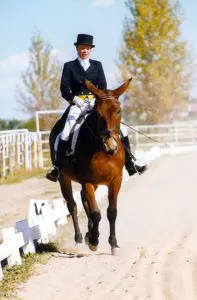 In order to perform the shoulder-in properly, it is important to understand its purpose. The shoulder-in causes the equine to engage his hindquarters so that they carry the bulk of his weight, giving him more freedom and suppleness in his shoulders and front quarters. A strong base must be established to carry this weight forward while the shoulders remain light and free to proceed forward while tracking laterally.
The shoulder-in is done on a straight line. Normally, an animal traveling in a straight line makes two tracks in the dirt behind him, because the front legs are positioned directly in front of the back legs. In the shoulder-in, the shoulders are positioned so that they cause a three-track pattern behind—the inside front foot makes one track, the outside front foot and the inside hind foot make one track, and the outside hind foot makes one track.
 Begin by walking your equine around the perimeter of the arena. When you reach the corner before the long side, make a ten-meter (30-foot) circle. As you close your circle at the start of the long side of the arena, maintain the bend that you had for the circle, using steady pressure on your inside rein. At the same time, nudge your equine with alternate leg pressure in synchronization with his hind legs as they each go forward. Squeeze your outside rein at the same time that you squeeze with your outside leg, and then release the outside rein. Ride the hindquarters straight forward from your seat and legs, as you offset the shoulders with your hands. Be careful that your inside rein is not so tight that your animal bends only his neck to the inside. As you squeeze with the outside aids, feel your equine rock his balance back to the hindquarters, giving you the sensation of pedaling backward on a bicycle. Simultaneously, you should feel the front quarters begin to lighten and become supple.
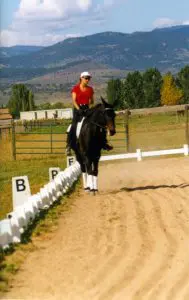 Take your time and don’t try too hard. Be content at first with two or three steps of shoulder-in and then straighten him down the long side of the arena. After a few accurate steps of shoulder-in, as he straightens his body, you will feel him surge forward with more energy. Collect and slow your equine’s gait through the short side of the arena and then repeat the exercise on the next long side. As your equine begins to understand the concept of rocking his balance to the hindquarters, the surge of energy that you feel when he straightens will become more and more powerful.
Much body strength and coordination is involved in this exercise and at first, you may feel like you are all thumbs. Time, patience and practice will bring about positive results, so stay with it. Over time, do this exercise at the walk, the trot and the canter, and do it the same way in both directions in the arena. Don’t forget to praise your animal for each correct step that he gives you.
The next exercise to enhance hindquarter engagement and lengthen the stride is quite simple, yet still a little tricky because lengthening your mule’s stride means covering more distance yet maintaining the same rhythm and cadence. It does not mean speed up, although that is what most equines will try to do. Track the perimeter of the arena again. This time, collect the trot on the short sides, and then urge your equine to lengthen his trot 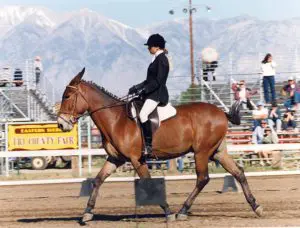 down the long sides. To add variation, ask him to lengthen across the diagonals (from corner to corner) as well. Your equine’s first impulse will probably be to shift his weight to the forehand and just speed up. For this reason, do not push him too hard too soon. At first, just ask for a little more energy—be aware that your rhythm and cadence will not be lost as his stride increases. He will just be spending more time in suspension. Keep the forehand light and free while you ride the hindquarters. Let your hand open slightly with the foreleg going forward on the same side, and close as the leg comes back. This will help you to determine how far you can let that stride go before the balance begins to shift forward. It will also allow you to check the balance with your hands before it begins to shift. If he has too much difficulty, you should go back and practice lengthening over ground rails again to gain more strength and coordination.
 As your equine gains strength in the hindquarters and is better able to carry your weight, his lengthened gaits will continue to improve until, perhaps a year or so later, he will be able to fully extend his stride at the walk, trot and canter. I caution you, however, that if your animal begins to rush, ask for less.
Another exercise that is helpful in lengthening the trot is to canter your equine around the arena, then cross half of your diagonal at the canter. Break to the posting trot and finish the diagonal. After the diagonal, sit the trot through the short side of the arena, pick up the canter on the long side again, and then cross the next available diagonal again and repeat the pattern. The drive that an equine gets from his hindquarters in the canter will carry through into the trot for the few strides on the diagonal and will create the true lengthening. This also holds true when teaching the lengthened walk (add trot work and back to walk) and the lengthened canter (add galloping and back to canter). This is your opportunity to tell your equine, “Yes, yes, this is what I want when I urge you on!”
Learning to ride from back to front (from the hindquarters forward) will greatly improve the harmony between you and your equine. Loss of balance seems to be the single most common cause of disobedience and problems with riding and driving animals. Carrying your weight and his in a properly balanced posture minimizes the chance for a loss of balance, and recovery from such a loss is much easier. Your equine will soon discover that your aids are indeed for his benefit as well as for your own, and he will become more accepting of them over time. As he becomes more balanced, you will find a world of different activities that you and your equine can do!
To learn more about Meredith Hodges and her comprehensive all-breed equine training program, visit LuckyThreeRanch.com, MEREDITH HODGES PUBLIC FIGURE Facebook page, or call 1-800-816-7566. Check out her children’s website at JasperTheMule.com. Also, find Meredith on Pinterest, Instagram, MeWe, YouTube and Twitter.
Covered in TRAINING MULES & DONKEY: A LOGICAL APPROACH TO TRAINING, TRAINING WITHOUT RESISTANCE, EQUUS REVISITED and A GUIDE TO RAISING & SHOWING MULES at www.luckythreeranchstore.com.
© 2016, 2017, 2024 Lucky Three Ranch, Inc. All Rights Reserved.
This article is an excerpt from the book, Training Mules and Donkeys by Meredith Hodges, 2013

MULE TALK! PODCAST: Selecting a Trainer
Selecting a Trainer –
- Where do you begin to look for a qualified trainer for your mule?
- Learn the smart way to interview a candidate to be your trainer.
- Viewing the training facility and having a conversation with the trainer.
- Take the time to read the contract and ask for clarification where needed.
- If you are unsure about the trainer, ask for references.
- After hiring a trainer, it is critical that you continually visit with your mule so he doesn’t feel as though he were stranded.
- Stay involved in the training process and work with your trainer.
- This and more on Mule Talk!
And follow along. Read the transcript.
Learn more on Mule Talk podcast.

MULE CROSSING: Leverage Versus Abuse
By Meredith Hodges
“Leverage” equipment refers to any restraining device or substance that is used to get an equine’s attention and obtain compliance, but many leverage practices often have the reverse effect and have the potential to cause  distress and pain. This includes harsh bits, chain leads, twitches, hobbles, stocks and even medications. There are times when our equines can really be a handful, so having a little leverage when needed can be a good thing. However, deciding which equipment to use and learning how to use leverage without it becoming abusive can be a bit daunting. There are so many different types of tack, equipment and restraints that it becomes difficult to determine which would be best to use on your equine to correct a particular problem, or if you really need to use anything at all. It may only be a case of needing to be clearer in your approach, in which case, leverage equipment may not be needed. It is important to make an informed decision when using any leverage equipment to be sure that what you are using is helpful and not abusive.
 One very common behavioral problem that seems to identify the need for more leverage is the mule that bolts and runs when on the lead rope. This seems like an obvious disobedience to the handler, and the first thing that comes to mind is to use a lead shank with a chain to gain control of the mule. Normal use for a lead shank is during a Showmanship class at a show and it should rarely be used in training unless the equine will be shown at halter and/or showmanship. And then, training with the lead shank should be done only after the animal is following well through all required movements while in his halter and on a lead rope.
Chains are severe and when not used properly, can damage the fragile bones in the underside of the jaw, and the cartilage and bone over the nose of the equine. If the chain is pulled while simply run under the jaw and attached to the ring on the opposite side, a quick jerk can bear down hard into the delicate mandible (jawbone). If the chain is run over the nose, when abrupt pressure is applied it can injure the nasal cartilage or the incisive bones. Because they occur internally, these injuries are often imperceptible to the human eye. The only thing you might see is broken skin, scabs or bumps that arise from repeated use. When properly fitted, the chain on a lead shank goes through the ring of the halter on the left side, threads under the chin and through the ring on the right side of the noseband, and is attached at the throatlatch ring on the right side. This keeps the halter balanced and the action of the chain less severe. When using the lead shank for leverage during training, it can work on some animals but others may decide to fight which can result in injuries such as fractures, causing more severe trauma to these areas. So it is best to avoid use of the lead shank until after completing leading training with the halter and lead rope. Even then, you should learn to use the lead shank properly with the least amount of pressure possible. Avoid using halters that are made with chains. Those types of halters should only be used when showing cattle and can do serious damage to equines.
If, after you’ve employed a kind, considerate and respectful approach along with a food reward, your equine is still being uncooperative, it may be appropriate to use equipment with more leverage such as the “Quick Twist,” but not necessarily chains. Chains do need to be used in some cases, such as with work harness (and most curb bits are now fitted with chains), but when not used correctly, these chains can be abusive. The chains on the pleasure driving harness should clear the legs and heels of the driving equine, and the chin chain on a curb bit should be adjusted so that it is twisted properly and lies flat against the animal’s jaw with an allowance of two fingers between the chain and the jaw, thereby minimizing any chance of injury. If you have a generally compliant equine, it is better to use a leather chin strap on your curb bit rather than a chain.
 If, after you’ve employed a kind, considerate and respectful approach along with a food reward, your equine is still being uncooperative, it may be appropriate to use equipment with more leverage such as the “Quick Twist,” but not necessarily chains. Chains do need to be used in some cases, such as with work harness (and most curb bits are now fitted with chains), but when not used correctly, these chains can be abusive. The chains on the pleasure driving harness should clear the legs and heels of the driving equine, and the chin chain on a curb bit should be adjusted so that it is twisted properly and lies flat against the animal’s jaw with an allowance of two fingers between the chain and the jaw, thereby minimizing any chance of injury. If you have a generally compliant equine, it is better to use a leather chin strap on your curb bit rather than a chain.
If you train for leading with a step-by-step program that incorporates a reward system during training, the mule is much less likely to bolt and pull the lead rope from your hands, and horses will not need any more leverage at all. This kind of training invites the equine to remain with you and he is rewarded lavishly when he does. If a horse spooks, you can usually stand still in balance, hang onto the lead rope and quickly regain his attention by staying calm and deliberate yourself.
Normally, mules learn to comply with the reward training. However, if a mule has been spooked, he may not care much about the reward in your fanny pack and you might have the need to use something with more leverage. In this case and in cases where a mule doesn’t always comply willingly, I use a new positioning of the lead rope called a “Quick Twist.”
 To employ the “Quick Twist” restraint, just take your lead rope and create a loop and feed it through the noseband of your nylon halter (rope halters are too loose and do not work) from back to front and then over the mule’s nose. When you pull on the rope, it will tighten around the end of the his nose below the incisive bones and over the cartilage, making breathing just a little difficult. Don’t keep pulling—just stand quietly and hold the tension snug. Let the equine come forward to you and slacken the rope himself by coming forward and allowing a free flow of air through his nostrils. Then, if the mule does not follow, just walk a step or two, creating tension on the rope, and then stand still again. When he does come forward, stop long enough to reward him with the oats reward before you proceed forward again. Keep the lead rope short and stand still in a balanced way so he cannot get ahead of you and jerk you off your feet. If you are standing still in a balanced position, it will be difficult for him to jerk the lead rope from your hand and leave.
Old-time twitches were made with a chain that could be twisted around the upper lip and used to distract the equine from shots, tube worming and the like, but the main focal point for the equine then becomes the equipment and not the task and, in the wrong hands, this piece of equipment can do a lot of damage to the equine’s sensitive upper lip. Most often, the equine can be more easily distracted by a simple rap on his forehead using your knuckles. Using a twitch at all can become a source of confrontation for many equines. If a twitch must be used, choose a more humane one that is made from aluminum and has a smooth surface. This will clamp down tight enough to hold, but not so tightly on the upper lip that it causes pain or even injury.
 Restraints should not be used as a means to control your animal except for a short period of time with the purpose of showing them a correct behavior. Restraints should be used as a support and not a controlling device. Restraints should be “phased out” as soon as possible.
I call this next restraint method the “Face Tie.” For the sake of safety, tie your mule to a good stout hitch rail. Then use our Face Tie technique (TMD DVD #2), running the lead rope around the hitch rail (or fence) and back through the noseband of the halter (nylon halters work best for this). Then come around a second time and loop it through the throatlatch part of the halter and around the hitch rail once more and tie it off. Take up the slack slowly as he gives and be ready to reward him with oats when he complies, then keep taking up the slack until his face is against the fence or hitch rail.
 Do not try to bully him into it or he will just pull back. This should be done while he is standing parallel to the hitch rail so that when you pull the rope tight, it pulls his head tightly sideways to the hitch rail. This will keep him from being able to swing his rear end around to block you. Reward him with oats and let him quiet down in this restraint before approaching with your shot. If he manages to keep you off the clear side, you can always go to the other side of the hitch rail and give him the shot from that side without fear of injury. You can do this along a stout fence provided the rails are sturdy. If you do this correctly, it will simply restrain him in a safe manner and keep you out of the line of fire. Each new time that you give shots, try to do it with the rope a little looser each time to fade out the restraint. They will usually just come to expect and go for their position along the hitch rail or fence and will lean into it like they do when you first gave the shots like this. He will soon learn to quiet down immediately when his face is being tied and at best will seem to be saying, “Dang, do we have to do this again?!” But, he will learn to comply.
 This is a humane restraint for mules and donkeys, but do not try this with a horse! This is a good restraint to use (and fade out) for any Longears that is difficult to worm, give shots, take blood, clip bridle paths and to use for those that are difficult to bridle. When using the Face Tie for bridling training (or clipping the bridle path), you will only need to go through the noseband and hitch rail (and not through the throatlatch unless you need to prevent them from turning into you). Just make sure when you put on the bridle that you “protect” their sensitive ears with your hands as it goes on and they will learn to trust you. Put the bridle on over the halter for the lessons until they don’t mind the bridling process.
If they lean away from you, you can just pull on the halter to bring the head back to you to finish bridling. Each time you use the “Face Tie” method,” see if you can leave it looser each time until they just stand for putting on the bridle while it is at its loosest. Then you will no longer have to use it.
Keep your lessons short, only 20-40 minutes (depending on how compliant they are) every other day and never two days in a row. They need a day off to ponder what they have learned and when they are allowed this break between lessons, they will come back the next time and do the tasks more easily. They usually leave because they perceive the lesson to be either too long or too difficult (and they would rather play!).
It is always better to not use the Scotch Hobble if you do not need to do it. If your donkey will pick up his feet for you, just give him the opportunity to “meet” your farrier by having him give him a handful of oats. Then see if he will yield his feet. If not, then you go ahead and pick up his foot with the farrier standing beside you, give him the reward for picking up his foot and then hand it off to the farrier while you back up and continue to feed him small handfuls of oats for compliance. Eventually, you should be able to step away and just have a bucket of oats in front of him to eat while the farrier is working on him (and take it away if he won’t comply). If he has a friend, it is always best to do donkeys in groups. They stay calmer that way. Try this FIRST!
 Your Longears will only need the kicking training covered in DVD #2 (Simple touch training with a driving whip) if he is resistant to having his hind legs worked with and even then, you should try picking them up with the scotch hobble rigging first. If he kicks with that, just hold the rope taut until he quits. Then, hold the foot off the ground for a couple of seconds and release it where the foot will touch the ground again. He just needs to know that when you pick up the hind foot, you will return it to him if he is good. During all of this, be sure to reward when he is standing still. If he complies easily about picking up his feet easily after trying to pick them up with the rope, you may not need to use the Scotch Hobble in it’s ultimate constraining position.
To employ the Scotch Hobble in its entirety, tie a Bowline knot loosely around the neck. Depending upon the size of the animal, the rope should be 16’-22’ long. Take the excess rope down to the pastern of the hind foot, loop it around the pastern, then back up through the loop around the neck, then back round the pastern a second time. Last, loop the rope around the ropes going from the pastern to the neck to capture them and tie off with a safety knot at the neck loop.
Only tie the Scotch hobble as tightly as is needed, and it is best to leave the toe touching the floor for balance. In some cases, you may have to tie the hind legs higher to prevent kicking on the off side, but be prepared to loosen the rope when the animal stops struggling with his balance. Remember that they can tire and not be able to continue to stand for long periods of time.
When taking the first wrap on the pastern of the hind leg, take the end of the rope well behind him and encourage him to step over it, keeping yourself out of kicking range. Then bring the rope along his side to the front and slip it through the loop around his neck. If he won’t let you go through the loop around his neck, you can just hold the rope taut around his pastern without putting it through the loop first and just allow him to settle before putting it through the loop. Just be very patient. When you get to this point, many animals will begin to kick. Just stand to the side, out of biting and kicking range, and keep the rope taut. Just hang onto it with both hands and stand quietly until he stops struggling. Allow your hands to follow a pull and release with the motion of his leg. If you allow your hands to move forward and back with the pulling of the rope and keep it taut, it won’t come off the pastern. Don’t try to hold his foot stationary at this point. You can easily step out of his way from this distance and position.
When he stops struggling, keep the rope the same tautness, walk to his head and give him a reward for standing still. Pet him and then proceed to go behind him again and take the second loop. Again, stand to the side if he begins to kick and wait for him to stop, allowing your hands to move back and forth with his kicking leg, maintaining the tautness in the rope. This is a give and release action that should not make him as mad as trying to hold the rope tight. Again, when he stops struggling, he is entitled to a reward.
If you do it this way, slowly and in small steps, you will not aggravate him as much and he will be more likely to comply. If you have been patient and meticulous while doing this procedure, tying the last knot around the neck rope should not be a problem, and you will not run the risk of him escaping from it.
Use a soft cotton twisted rope of the correct length measured to your animal for ease and to avoid chafing for the best results. It need not be traumatic if you proceed this way. Use the Scotch Hobble as needed, but each time, tie it as loosely as you are able and still have him stand still. For example, if you have had to raise the toe, don’t raise the toe and let it touch the floor. Next time, have the toe touch the floor with the ropes loosely tied. Next, take only one loop around the pastern, keep the rope fairly loose and tie to the rope around the neck. Lastly, just take the rope to  the hind foot, around the pastern and let it lay on the floor. Next time, you won’t have to use it at all. Your goal is to phase out the restraint entirely.
A lot of activity when trailer loading can cause the equine to become anxious and noncompliant and he becomes overstimulated. When having difficulty loading your equine, things will usually go better if you simply give him time to survey the situation.
Do not allow him to back away from the trailer. One step at a time while offering a food reward (and a food reward waiting inside the trailer), with frequent pauses and encouragement to move forward from behind with a tap of the whip, will usually accomplish the task without confrontation. Most equines will willingly follow you right into the trailer if prior obstacle training has been done properly and successfully. Leverage equipment such as butt ropes only refocus the equine’s attention on the equipment and will result in a confrontation.
 Hobbles are another form of leverage equipment and there are many different kinds of hobbles for different purposes. The hobbles that have chains on them should be avoided, as the equine can become entangled and the chains can do damage to their legs. Thin leather hobbles or coarse rope can chafe the hair right off the skin around the pastern and can cause severe abrasions that may never heal. Thick leather hobbles are best, as they will break when under extreme stress, releasing before damage to the equine is done. If so inclined, all mules and some horses can gallop in hobbles, so hobbles really aren’t all that effective for leverage. Tying onto a hyline (a rope suspended high between two trees that acts as a hitching line for overnighting equines in the mountains) is a better choice, and if the horses are tied, then the mules should not have to be tied or hobbled because they will generally stay with the horses. Personally, I only use hobbles in a controlled situation at the work station when body clipping my equine’s legs for show.
Sedation and tranquilizers are another form of leverage that is used all too often and, in some cases, can be very dangerous. Mules and donkeys may receive the correct dose, but they can be unaffected when they get over-stimulated, excited and confrontational. They can actually “pop out” of sedation if they get excited enough to release adrenaline in their bodies. In these cases, administering another dose of drugs can easily become an overdose and could result in death. Sedating an equine that is to be trimmed or shod can be dangerous for both the farrier and the equine because the animal is not able to stabilize his balance and his reactions are, for the most part, uncontrolled. The farrier may not have time to get out of the way and the animal could stumble into trouble.
Power tools can be of help to a veterinarian or an equine dentist when doing teeth. Old-fashioned rasps are safer than power tools, but they are clearly more of an aggravation to the equine. However, if power tools are to be used at all, they must be carefully monitored. When floating teeth, the equine dentist must be skilled in the use of his grinding tool and should do only what is necessary to remove sharp points on the equine’s teeth. Power tools can be a good thing when you are dealing with an equine’s mouth and jaw, as having their mouths held open for long periods of time is very tiring for them, so speed is essential, but accuracy and skill are also essential.
 I do not approve of using power tools on the equine’s hooves at all. In order for the equine’s body to be properly balanced in good posture, the hooves must first be properly balanced. Power tools cannot possibly shape the hoof with proper curvature in the sole, alignment of angles and equal balance over the hoof walls with appropriate pressure to the heels and frog.
This demands hands-on custom sculpting, as each foot on each equine will be different and all four feet need to be aligned with each individual’s legs and body in mind. The hooves are the basic foundation for the entire body, so they must be done correctly or everything else will be off. This is especially true with the tiny hooves of mini donkeys and mules. Minis can often be kept calm for trims simply by keeping things at their eye level and rewarding their good behavior with crimped oats.
There are things that may seem to allow for shortcuts through certain tasks, but when you are dealing with living creatures there really are no shortcuts. It is always better to take the necessary time to implement training techniques that allow your equine to learn and grow in a logical, step-by-step process that will not overwhelm him or bombard him with too much stimulus at any stage, so that he can become a comfortable and cooperative individual. If you use the correct methods right from the beginning, the need for excessive retraints (that can cause pain and even more resistance) will be greatly diminished and the long-term results will be undeniably better.
To learn more about Meredith Hodges and her comprehensive all-breed equine training program, visit LuckyThreeRanch.com, MEREDITH HODGES PUBLIC FIGURE Facebook page, or call 1-800-816-7566. Check out her children’s website at JasperTheMule.com. Also, find Meredith on Pinterest, Instagram, MeWe, YouTube and Twitter.
Covered in TRAINING MULES & DONKEY: A LOGICAL APPROACH TO TRAINING, TRAINING WITHOUT RESISTANCE, TRAINING DVD #2 andEQUUS REVISITED at www.luckythreeranchstore.com.
© 2013, 2016, 2024 Lucky Three Ranch, Inc. All Rights Reserved.

MULE CROSSING: Understanding Comprehensive Equine Training Skills
By Meredith Hodges
 You can often tell a horse what to do, but you have to ask a mule. Mules and donkeys are intelligent, sensitive and affectionate animals. Although they have been stereotyped as stubborn and difficult to control, members of the equine family can actually be quite responsive and compliant when they’re handled properly. Their intelligence, strength and natural athleticism make them well suited for virtually any equine activity or sport. With proper training and care, they bond closely with humans and make wonderful companions.
To work successfully with these bright, inquisitive animals is to understand the ways in which they differ from horses. Mules derive the best physical and psychological traits from both the horse and the donkey. Once you understand both the donkey half and the horse half, you’ll be well on your way to a successful relationship with your long-eared partner.
Redeeming Characteristics of Longears
The modern donkey is descended from the Nubian Wild Ass of North Africa.
Domesticated around 3,000 B.C. and has served man well ever since. Donkeys are surefooted, durable and have incredible strength for their size. They are very sociable animals and enjoy the company of their own kind, people and some other animals. They will most likely chase an animal that is smaller than them, so management must include careful consideration when they are in close proximity to smaller animals. Unlike horses, in the face of perceived danger, donkeys are inclined to freeze or hide rather than flee. However, mules being part horse and part donkey will either freeze or flee.
Mules inherit their instinct for self-preservation from the donkey, along with their innate intelligence and a number of unique physical traits. Mules may be either male or female and are primarily sterile. Horses have 64 chromosomes and donkeys have 62 chromosomes. The resulting offspring called a mule generally has 63 chromosomes, an uneven pairing, missing the conception pair. On occasion, some molly mules have conceived to jacks and stallions and have produced offspring as was the case in America with “Old Beck” and “Krause,” but this is rare. Typically, a mule foal will grow to the size of its dam, although he may be two inches taller or two inches shorter. Both mules and horses are very strong, but the mule has smoother muscling and more endurance and strength for its size. Mules also eat less, are less susceptible to parasites and disease, and will typically live longer than horses. “Hybrid vigor” gives mules some advantages over their equine cousins, but only proper management, care and training will enable them to reach their full potential.
Physical and Mental Conditioning
 Mules and donkeys will bond most closely with the person who trains them. Work with your equine one-on-one to build that critical bond of trust between the two of you. Remember that patience, kindness and consideration will determine the success or failure of your training program. Longears can be obedient and reliable when they feel you have their best interests at heart. If you treat them harshly, you’ll encounter resistance at every turn. Mules and donkeys have an incredibly strong sense of self-preservation and will not do anything that they perceive is dangerous to their health.
Ideally, you’ll have the opportunity to work with your mule or donkey from the time he is born. However, regardless of your animal’s age or ability, it is critical that you always begin your training with imprinting, carefully planned, adequate groundwork and work forward in a logical and sequential way that will naturally make sense and is doable for the equine at every stage. Be sure to work with a knowledgeable trainer and use a comprehensive training program such as I offer. Begin with the basics and don’t skip any steps. The training information included in my training and management program is geared toward mules and donkeys, but also pertains to all equines. Generally speaking, it’s best to add an extra measure of patience, creativity and good humor when you work with a donkey.
Like all children, a mule foal will take after his parents to some extent. Be careful when you select a mare for breeding. Be sure she possesses correct conformation and a nice, calm mare sets the example for a nice, calm baby. From the time of his birth, pay attention to the way you touch your foal and his mother to make them both comfortable with your presence. This is called “imprinting.” A good time to practice imprinting in the beginning is at feeding time. Pick up the foal’s feet while he is unrestrained and touch, scratch and stroke him all over to discover what he does and doesn’t like. Give him time to relax and get comfortable with you. Let him choose to be with you, and you’ll find that is where he will prefer to be.
 This is also a good time to introduce the concept of the “reward.” Offer his dam a reward of crimped oats when she comes to you. Your foal will see his mother’s acceptance and will learn to do the same. He is most likely already eating the oats with his dam if he readily accepts the oats. A consistent system of appropriate and prompt reward is a crucial part of your foal’s life-long resistance-free training program. Mules and donkeys will work harder for a pleasurable payoff and a handful of crimped oats serves the purpose best for equines.
At the beginning of training, you should offer rewards often, although only after a requested task is performed or assimilated. This will strengthen the bond between you and encourage good behavior. If your equine pulls away, don’t chase him. Simply let go of the rope, reins, drivelines, etc., and offer him oats when he returns to you. Your task is to be clear in your intent, fair in your expectations and prompt with rewards when tasks or assimilations are completed. When your animal understands which behaviors result in a reward, those behaviors will be repeated. This is called “Behavior Modification.”
 Mule foals are not much different than human babies when it comes to their need for attention, love, guidance and praise. Giving your foal plenty of time to be a “kid” will help him as he grows, and playtime can do double duty if you play games that give him a sense of security, set boundaries and build the trust between you.
Once your foal is comfortable with being handled, you should be able to halter him with little trouble. Feeding time is a good time to start. Teach your foal about the halter and leading while he is still young. You’ll be using halters and lead ropes with him all his life and carefully  planned leading exercises are critical to your equine’s core muscles development in good equine posture. The balance he attains will serve him well as his tasks become more difficult. This makes for a more pleasurable experience between you.
Tying your foal comes next and is comprised of a series of brief, methodical lessons. First, halter your foal with the mare tied nearby. Attach a thick cotton lead rope to his halter and tie him to a stout hitching post using a safety knot. Be sure to use a flat nylon webbed halter to avoid undue pressure points on his face and to prevent breakage. Approach him every 10 minutes and wait for him to slacken the rope before you release him. Keep lessons to no more than 30 minutes and repeat for as many days as necessary until he doesn’t pull back. Once he’s standing quietly, you can brush him with a soft brush and pick up his feet. He may struggle a bit at first, but as long as he isn’t hurting himself, he’ll be learning how to “stay cool.”
 When you can easily halter and tie your foal, and he ceases to pull back upon your approach, untie him and ask him to follow. If he refuses, just tie him up again, wait 10 minutes, untie him and ask him again. When he finally follows you for a few steps, praise and reward him, so he knows he’s doing well. There’s no need to jerk, pull hard or hit his rump. Keep your voice calm and use the simple command to “Walk on.” Be patient, work with him and reward him when he does what you ask.
When he walks when you say, “Walk” and stops when you say, “Whoa,” you’re ready to do more. Keep verbal commands VERY SIMPLE in the beginning. Always hold the lead rope in your left hand while standing on his left side (the “near side”), and point in the direction of travel with your right hand to keep him in proper position with his head at your shoulder. Look where you are going and match your steps with his front legs. Your foal should stop when you verbally say “Whoa” and he feels the resistance of a slight drag on the lead rope. Always stop with your feet together and he will learn to do the same. When he stops, ask him to square up such that he has equal weight over all four feet with the front and rear legs standing together. He should stand straight and still on a loose lead to receive his reward.
 Until now, you’ve kept your foal in a confined area such as a corral or paddock. Now you can move to a larger area, keeping in mind that this will affect his behavior. Use a calm reassuring voice to let him know that everything’s okay as you introduce him to simple obstacles. Use the lead rope to guide him through each obstacle. If he gets frightened, put yourself between the obstacle and your equine. Keep tension on the lead rope and give him plenty of time to investigate each new object. Encourage him to move forward by showing him the oats reward and then praise him with the reward when he touches the obstacle with his nose. We are trying to change his fear into curiosity. This is a time for positive interaction between the two of you. Take your foal with you often to discover new things together. Teach him to trust your judgment during training now and he will trust you always.
Once your animal will stand calmly when tied and willingly follows you over and around different obstacles, you can then introduce him to the trailer. If you’ve built a trusting relationship with him, he should load with little or no resistance. Never get in a hurry! It will only take longer. If he refuses to cooperate with a reward as an enticement, you might need to make use of a lunge line and whip used as described in my books and DVDs in conjunction with the reward.
Mules are typically about a year or more behind horses in their overall development. Even at two years of age, your mule is still growing and the cartilage in his joints is still soft and being shaped. He is a rambunctious youngster and not inclined to be easily restrained. Because the cartilage is soft, he’s more susceptible to physical and psychological injury at this stage, so proceed with caution—only the simplest of leading lessons is appropriate at this point.
Basics of Resistance-Free Training
 During these early lessons, some discipline may be required. If your youngster gets a little bold and jumps or nips at you or kicks, you must correct the behavior so it doesn’t become a bad habit. With the flat of your hand, give him a brisk slap on the side of mouth if he bites or on the rump if he kicks, and in a strong voice say, “No!” Then continue to play with him so he knows that everything is okay. When an older animal tries to bite you, slap him on the side of the mouth and very loudly say, “No!” and then raise your hand like a stop sign in front of his face. He will raise his head, begin to turn to the side and be ready to leave, or simply will back up. Immediately take a step toward him, tell him, “Good boy,” and reward him for giving you your space. Be consistent and use only the word “No” to correct him. Correcting kicking through training is covered in DVD #2 of my resistance-free training series, Training Mules and Donkeys.
It’s very important to understand that negative behaviors on your part, such as yelling and hitting, when used in isolation, don’t really work with any equine. Abusive behavior will shut the animal down, pushing him into a freeze response and severing the connection between you. If there is any opportunity to do so, he will simply leave you standing alone.
 In rare cases when negative reinforcement is required, always immediately follow the negative correction with positive verbal praise and a reward him when the he responds to the correction. He may test you again, but a raised hand and verbal, “No!” should curb the behavior. He should back off and wait for the reward. When being disciplined for aggressive behavior in the future, you should only have to raise your hand like a stop sign and say “No!” If the slap was done smartly the first time, he should automatically take a step back and wait for his reward.
Set the stage for success to encourage good behavior. Just as you’ve established a feeding schedule, also design a training routine. Equines will work better when they know what is expected. Set up a workstation where you start each lesson.
Each day that you train, always bring your animal to the designated work station. Tie him, then groom him and tack up. At the end of each lesson, return to the workstation to un-tack and groom.
 Ideally, you should have a round pen, arena and obstacle course to work in, but whatever facilities you have, be sure that the training and grooming areas are clean and safe. The familiarity will keep him calm and receptive.
Also get in the habit of covering everything your mule or donkey has previously learned before going on to something new. A quick review will boost his confidence and prepare him to go on to the next level.
Athletic Conditioning for Optimum Performance
 Training begins by building a positive relationship with your animal, establishing a consistent reward system, and maintaining a safe, comfortable environment. Another often-overlooked but critical component is the need to physically condition your equine, so he can safely do whatever you ask of him. This is probably the toughest part of training. Our inclination is to rush through the basics to get to the “fun stuff,” but without thorough athletic conditioning with balance and strength in good equine posture, your animal simply won’t have the physical capacity to properly do what you ask. On the contrary, he’ll be more prone to injury and more likely to develop behavioral problems.
The work to develop core muscles, tendons and ligaments in good equine posture doesn’t start in the round pen—it begins on the lead line. Showmanship work on the lead line helps to develop strength and balance on the flat ground, in a controlled situation. Leading over obstacles adds coordination to the strength and balance. Take plenty of time at each leading stage of training before moving your animal to the round pen to learn balance at all three gaits on the circle. It takes months to develop muscles.
 Physical loss of balance is the biggest problem in under-conditioned animals and the most common cause of bad behavior. When you design your training program to fully develop muscles, tendons and ligaments in good equine posture, your equine will feel good all over and be more willing to comply. Stretching is also important for the equine athlete—young or old. Make sure you incorporate appropriate passive and active stretches throughout your training program to protect your animal from injury. It takes years for an equine to grow and develop properly. Give him the benefit of patience, kindness, respect and proper care, and you’ll both reap the rewards.
Breeding and Training for Performance
When you think of mules and donkeys, activities such as driving, packing and trail riding probably come to mind. But these days, mules, in particular, perform in an amazing variety of events including Reining, roping, Pleasure classes, Endurance events, Hunter classes, Jumping and even Dressage and Combined Training. In fact, in 2004, the United States Equestrian Federation voted to allow mules into their Dressage Division with provisions.
Better breeding, better training and renewed interest bolstered the popularity of Longears as pets and performance animals in modern times. By selecting your mare carefully, you can help to determine your animal’s athletic potential. Choose the breed of mare that most closely exemplifies talent in the specific events that you desire. By choosing and adhering to a comprehensive, sequential training program, you can help your equine to reach his potential in a way that keeps him healthy and happy.
Regardless of how you plan to use your mule, basic Showmanship training lays the foundation for all future training. In Showmanship, your mule or donkey must learn to follow your shoulder at a walk and a trot, stand squarely and quietly, and do a turn-on-the-haunches. Each time you lead your mule, do it as if you were in a Showmanship class. The walk to and from the barn or pasture is THE place to start.
 After you and your mule master Showmanship, you can begin to vary your training routine. For example, you might practice showmanship one day, rest the next, work with obstacles the next day, rest for a day, go for a trail walk, rest and then add lunging and so on. Your mule needs time to think, so keep it fun for both of you. Keep your expectations reasonable and remember that short, frequent lessons (20-40 minutes) with a day’s rest in between are better than long, repetitive drills. Also, understand that disobedience is an honest response to YOU and what you’re asking. If you’re not getting the response you want, ask a different way.
Training for Saddle
 After you have built core strength in good equine posture on the lead rope, and after your equine has finally learned to stay erect while bending his body through the rib cage during turns as he walks at your shoulder, he is now ready to move on to the round pen for lessons in lunging on the large circle. This is where he will learn more complex verbal commands and where he will begin to develop bulk muscle, balance, rhythm and cadence through the walk, trot and canter on the circle.
Begin lunging your mule in the round pen first in the bridle, and then in the bridle and saddle for ten-minute intervals. Then add the “Elbow Pull” to put him in his proper postural frame to correctly develop his muscles. Follow your trainer’s instructions about body language as you practice at all three gaits and the reverse. When you and your mule have perfected your lunging technique, you’re ready for ground driving in the round pen.
 Ground driving builds your mule’s confidence and teaches him the fundamentals of riding without the stress of a rider. Here, the animal learns verbal and rein cues from the drive lines that set the stage for more advanced resistance-free training. You will begin to develop the synchronization of your own body with his by following the steps he takes with his back legs. Then when you ride, your seat will be more flexible and better able to follow the motion of your equine’s body. If your goal is to ride your Longears, keep in mind that these animals mature more slowly than horses. A Longears might not be physically or mentally ready to carry a rider until he’s four years old. When your equine is physically prepared, comfortable with the saddle and bridle, and proficient in lunging and ground driving, he will then be ready to ride.
You will need to give your animal plenty of time to adjust to new sensations and directions. Always wear a helmet and work with an assistant until you’re confident your equine can calmly walk, trot and lope with you on board, first in the round pen and then in the open arena. As your animal advances, remember to work on your own “Horsemanship” techniques and the accuracy of your aids – your hands, seat and legs.
Driving Training
 Driving your equine can be great fun, but driving is very different from riding and the details are paramount. Driving can be hazardous for you and your animal, not to mention whatever or whomever is in your path. Choose an appropriate prospect—one who will stay fairly calm in the face of new situations. If you’re inexperienced, be sure to work with a trainer before setting off on your own.
Of course, before you tack up, you’ll need to desensitize your animal to the sound and feel of the harness, blinders and other equipment. Take your time and follow your trainer’s instructions carefully. Be careful because too much desensitization can cause your equine to become bored and disinterested. Instead, use the introductory techniques you used in leading training and appeal to his natural curiosity and sense of adventure to bolster his confidence.
 Once he’s comfortable with the equipment, practice lunging and ground driving your equine in harness. Eventually, you can add a PVC pole to mimic the shaft, then a drag (such as an old tire) for weight, then a travois of two poles and a crosspiece. Clear verbal commands are positively essential here. Used in combination with the drive lines and a suitable driving whip, they will be your primary means of communication. Take your time and remember that each individual animal is different. Safety should always be your primary concern. The “fun stuff” will come in time.
Importance of Logical and Sequential Training
 This article is only an overview of my resistance-free training basics for all equines and especially for mules and donkeys. If you’re serious about working with any of these smart, strong and intelligent animals, you’ll need to invest in a complete training program. Any equine training program worth its salt will address not only the exercises and assimilations required for performance, but also the physical, mental and emotional well-being of the animal.
Even abused or neglected animals can be rehabilitated using resistance-free training methods that include slow and methodical body conditioning. With love and patience, mistreated animals can learn to trust again and injured animals can recover enough to thrive. Training an equine should be like making a friend—it’s something no one else can do for you, and the experience teaches you as much about yourself as it does about your animal. So, remember to keep it fun and enjoy the journey.
To learn more about Meredith Hodges and her comprehensive all-breed equine training program, visit LuckyThreeRanch.com or call 1-800-816-7566. Check out her children’s website at JasperTheMule.com. Also, find Meredith on Facebook, YouTube and Twitter.
© 2008, 2016, 2020 Lucky Three Ranch, Inc. All rights reserved.
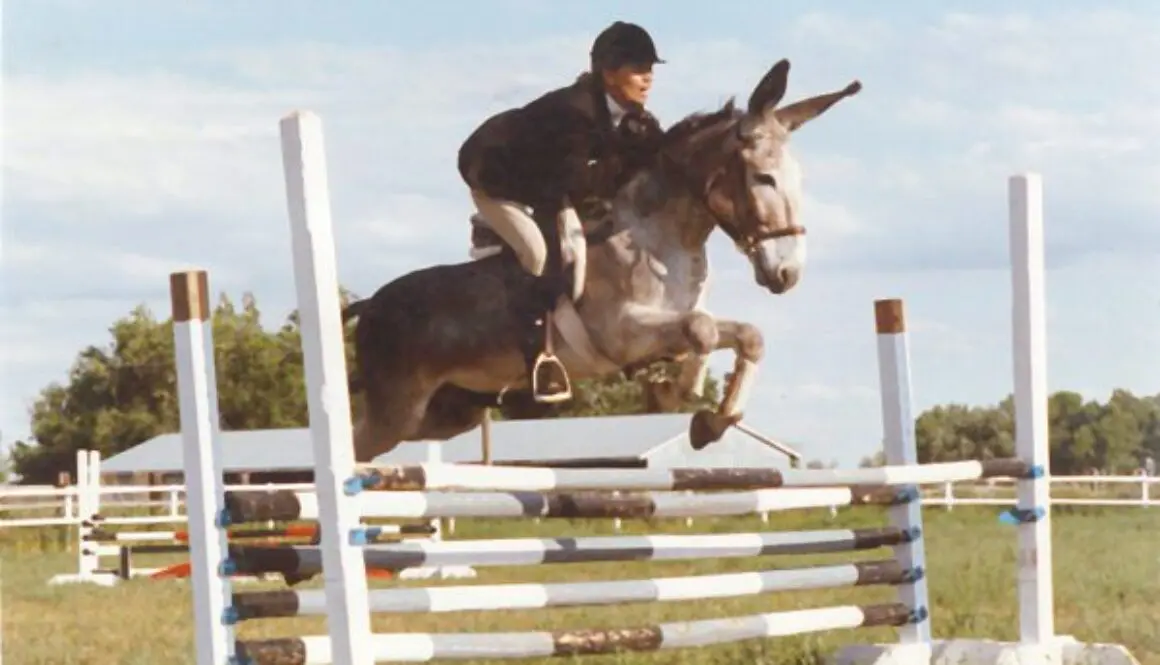
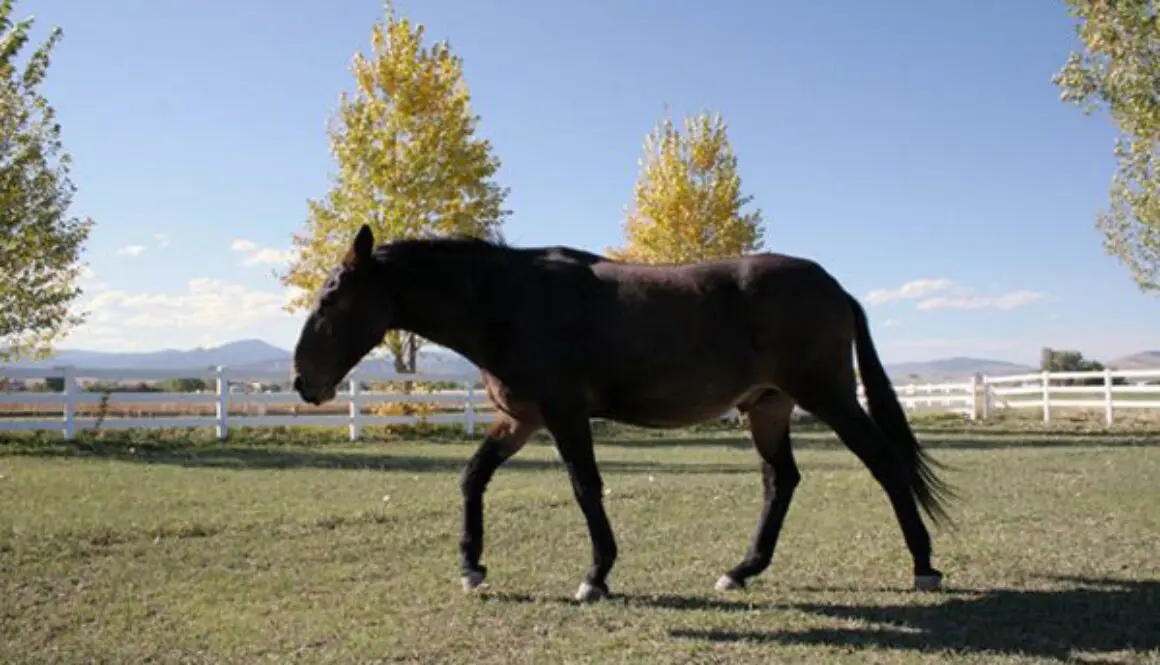
MULE CROSSING: Breeding Quality Mules
By Meredith Hodges

In the past, mares unsuitable for improved horse-breeding programs were the mares used for mule breeding. Looks and conformation were of little concern, since the animal that was produced had limited use for draft and farm work. In 1967, with the founding of the American Donkey & Mule Society, a new type of mule began to emerge—the American Saddle Mule—limited only by the imagination in his uses. As the mule’s popularity grew, so did the need for more carefully organized breeding programs to try to produce only the most superior mules in overall appearance and athletic ability.
In what I refer to as Phase I of our Lucky Three Ranch breeding program, my mother, Joyce Doty, successfully bred attractive, athletic and versatile mules at Windy Valley Mule Ranch in Healdsburg, California, between 1973 and 1979. They were bred for pleasure, work and show from 60 head of assorted breeds of mares. These mares included Arabians, Thoroughbreds, Tennessee Walkers, Morgans and Draft horses, but no Warmbloods.

We learned that the jacks would produce a stronger and more durable offspring, but that the heavy-boned Mammoth Jacks were not necessarily producing the most athletic—or the most attractive—saddle mule offspring. It seemed that the smaller, more refined Large Standard (48″ to 56″) and Standard Jacks (40.01″ to 48″) were better for the production of Saddle Mules. This led to Phase II of our breeding program.

Little Jack Horner, a Large Standard, was the last jack born at Windy Valley Ranch before its dispersal in 1979. In 1980 I brought him to my new Lucky Three Ranch in Colorado to become the sire supreme. My main focus was on the production of attractive, athletic, amiable and multiple-use saddle mules that would be suitable for the widest variety of uses. Beginning in 1982, Little Jack Hornerwas used with a number of different breeds of mares, including Quarter Horses, Appaloosas and a Half-Arab/Half-Quarter Crossbred. Over the next six years, as the offspring aged and matured, their abilities were quickly recognized. They excelled in all events at the shows and gave the Lucky Three its current reputation for breeding only the best.
In late 1985 I began taking a special interest in Dressage and Combined Training—the Breed shows no longer held a challenge for me. Our Quarter Horse, Appaloosa and Arabian mules competed against horses in Dressage and Combined Training and our mules were quite competitive. They were exceptional in their gaits, responsive, submissive and lovely to watch. Only two real major problems became apparent if we were to continue on this path: 1) The mules were a little too small (only14.2 to 15.3 HH) and, 2) the Quarter Horse influence caused them to be built slightly downhill, creating problems with overall balancing. It was time again to revise our breeding program.

Midnight Victory (or “Vicki,” as she was nick-named), a Trakehner cross, was born just before midnight on June 21, 1990. I had seen only one Trakehner-bred mule in my entire life, and it was the most elegant and refined mule I had ever seen, with conformation to spare. And now I had one!
Vicki was everything I have always bred for in a mule, exhibiting quality in her looks and her movement, and in and the kind of intelligence that is exalted by horsemen and women everywhere. She was the product of 17 years of selective breeding, which, in the case of the hybrid mule, can be a very lucrative and frustrating business. Frustrating because of people’s preconceived ideas about mules, because of the close attention that must be paid to selection of the right jacks and mares, and because of genetic considerations when breeding, such as Neonatal Isoerythrolisis (a condition that occurs when the mother’s blood is incompatible with her foal’s—similar to the RH negative factor that can occur in human mothers and babies).

Why a Trakehner cross? We spent years breeding donkeys before we finally got Little Jack Horner, a sire that predictably throws refined, attractive and athletic offspring, as well as producing some of the top halter mules in the country. Crossing him on Warmblood stock seemed like the natural thing to do next. We did need to be careful in choosing the type of Warmblood mare that would make the best match.

The Trakehner horse was carefully bred as a versatile and durable animal, with refinement and elegance in mind. Today, this horse plays an important role in the evolution of the mule from an ugly duckling into another beautiful swan in the American Horse Show ring.
After careful consideration of refinement and movement, we decided that the Trakehner would be the best cross. We feared that some of the other Warmblood breeds might produce too heavy an animal, something we had spent the last 17 years breeding out. In using caution and a careful breeding program, the Lucky Three Ranch was well on its way to producing the best in Sport Mules. Heartier and more athletic than their Thoroughbred and Trakehner dams, they were capable of performing in more versatile ways than were ever before imagined.
Phase III was the most exciting phase of the Lucky Three Ranch breeding program. The size and “downhill” problems had been solved, and the offspring made our dreams come true and their “presence” known. My deepest gratitude goes to all the conscientious people in the Thoroughbred and Trakehner industries for their special attention to selective breeding programs that have made it possible for us to produce such a lovely and remarkable hybrid.
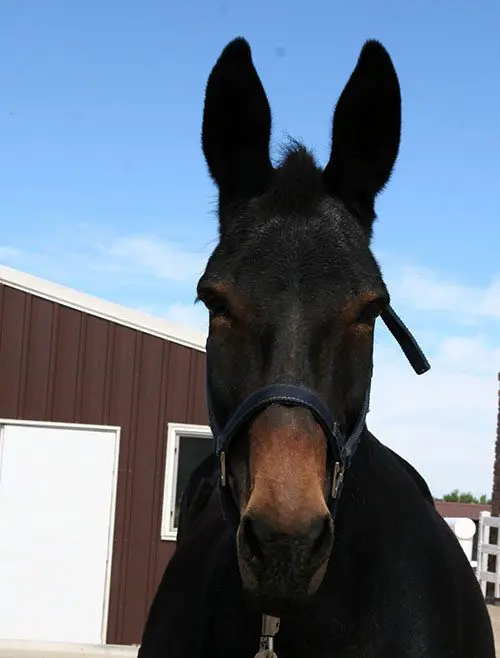 It’s hard to put your finger on it, but there’s just something a little more special about Vicki. She is way above average when it comes to mules and she definitely commandsyour attention. She embodies the spirit of free expression and an almost eerie reincarnation of a perfect dream…with long ears! Could this “presence” be something genetic, passed down through the ages of Trakehner (and possibly Arabian) breeding? It would seem so.
The mules of Lucky Three Ranch are living proof of what quality breeding produces. They are elegant, first-class animals that are easy keepers, inexpensive eaters and loyal, personable companions—you need only feast your eyes upon these mule offspring to be convinced!
To learn more about Meredith Hodges and her comprehensive all-breed equine training program, visit LuckyThreeRanch.com, MEREDITH HODGES PUBLIC FIGURE Facebook page, or call 1-800-816-7566. Check out her children’s website at JasperTheMule.com. Also, find Meredith on Pinterest, Instagram, MeWe, YouTube and Twitter.
Covered in TRAINING MULES & DONKEY: A LOGICAL APPROACH TO TRAINING, TRAINING WITHOUT RESISTANCE, EQUUS REVISITED and A GUIDE TO RAISING & SHOWING MULES at www.luckythreeranchstore.com
© 1990, 2011, 2016, 2019, 2020, 2022, 2024 Lucky Three Ranch, Inc. All Rights Reserved.

LTR Training Tip #14: Teaching Good Manners When Training
Meredith explains the lifelong benefits of teaching your equine to behave with good manners.
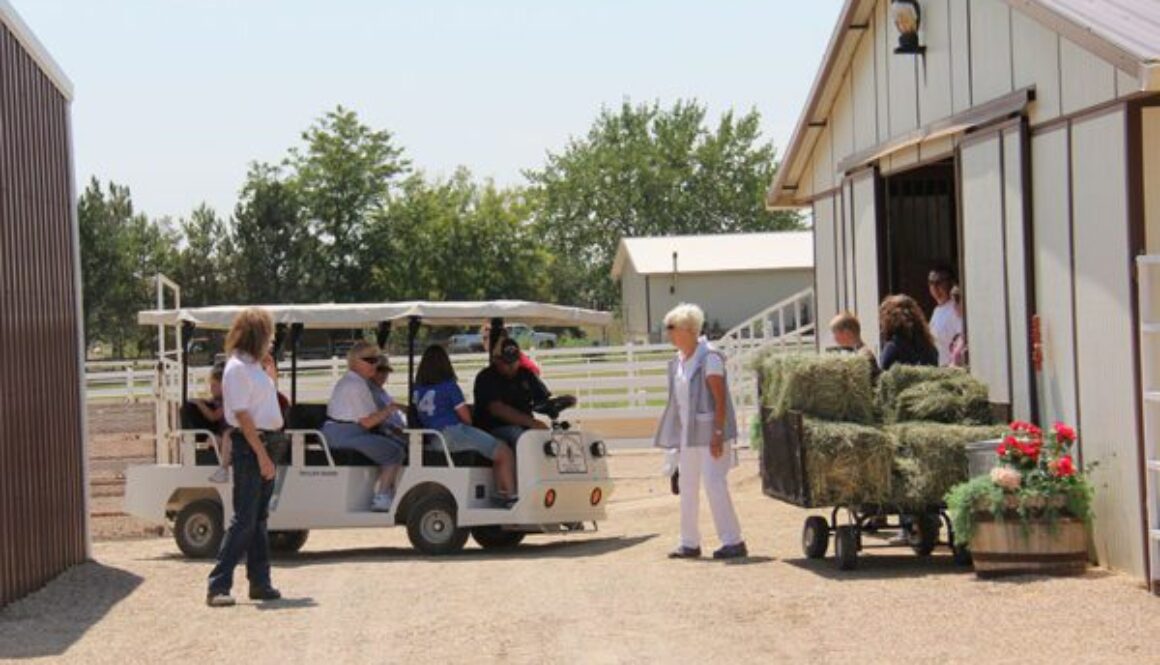
Lucky Three Ranch Impressions
(Page 48) Excerpted from: Touring Lucky Three Ranch with Meredith Hodges: Unexpected, Free-wheeling, Fun!
By Nell Wade
It’s not just a ranch—it’s an experience! Nestled on 127 sprawling acres that snuggle up to the edge of the gorgeous Rocky Mountain foothills, Lucky Three Ranch is the name that world-renown mule and donkey expert and equestrian star, Meredith Hodges, chose to christen what has become the heart and soul of her ongoing commitment to the preservation and welfare of mules and donkeys everywhere.
What strikes you first is her huge but inviting house. It’s a fairy castle built by someone who dreams like a child but thinks like an engineer. The front door flies open and out strides a tall, attractive and very vibrant woman. Her vivacious energy belies her age, and makes the statement that she is mistress of her domain but all friends are welcome and strangers can count on becoming friends. Meredith Hodges is off and running, multi-tasking like a house on fire with the same spirit and sense of adventure she attributes to her favorite creatures on earth.
The nearby barns erupt with a raucous chorus of honks, brays, chirps, snorts, and a bunch of other noises. These are the happy cheers of a bunch of kids who’ve been waiting for their mom to come out and play with them. These are Meredith’s mules!
As everyone piles into a very cute but surprisingly souped-up golf cart, Meredith takes the helm. The wind blows through your hair and you hang onto your hat as she drives around her huge property. Slowing the cart at the mule and donkey stalls, Meredith calls to each of her “kids” and out they come; some trotting, some sauntering, some prancing—but all full of tossing heads, inquisitive looks, sniffing nostrils and lots of of “mule talk.” A thrill runs down your spine as you respond in a very unexpected but wonderful way to this primal communication.
A trip to Lucky Three Ranch gives you a chance to savor the real meaning of “ranch lifestyle.” You’ll get to meet people who are so genuine and down-to-earth, you’ll want to hang out until you really have to go, as you wonder where the day went. Most of all, you’re going to discover why the Lucky Three Ranch experience is “all about the mules.” The fun and spontaneity generated by these people-loving creatures is something you’ll laugh about for a long time, and their intelligence and sensitivity will touch your heart. Witnessing these unique and amazing animals up close, you can’t help but feel that the fun and adventure of being around Meredith and her mules has just begun!

MULE CROSSING: Turns On the Forehand and Haunches
By Meredith Hodges
Proper conditioning of the young equine through a carefully sequenced program of gymnastic exercises is essential to the proper development of his mind and body. Spending time cultivating a smooth, fluid forward motion, with regular rhythm and cadence, helps to develop his body properly and enables him to perform difficult movements easily.
 Work with ground rails and cavalletti helps to build muscle, particularly in the hind quarters. This will help him to carry your weight more easily through lateral movements, stops and lengthening of the gaits. Proper preparation minimizes resistance and frustration. This will be apparent in how your animal carries his tail. Is it hanging in a relaxed fashion, or is he switching his tail periodically, or regularly? You might notice that after the initial introduction of lateral moves, your equine’s forward motion has become a little “shaky” again. It is now time to clarify the connection between forward motion and lateral motion with his increased understanding of your seat and legs (Not so much the reins as your connection to the bit needs to remain quiet!). By employing a few simple exercises, this can be a very simple process.
Ask your equine to walk a 20-meter circle (approximately 60 feet), while maintaining  regular rhythm and cadence, proper flexion and bending through his rib cage. In rhythm, change your aids to a slight counter-bend and ask for a turn-on-the-forehand at the fence rail. Send his haunches around with pressure from your leg, well back on his barrel, until he is 180-degrees reversed. At the precise moment he is in the new position to go forward, in the opposite direction, release the pressure on your reins! Then send him forward again from your legs onto the new circle.
You will find that you must hold him back just a little with the reins during the turn to keep his weight on the hind quarters throughout the turn, but still maintain a forward motion. It is critical that the release comes at the instant he has completed the 180-dregree turn. While executing the turn-on-the-forehand, do not hold back on the reins with steady pressure. Use a squeeze-release action with your hands.
 Complete the turn with a series of half-halts from your seat and a squeeze-release action with the reins. If you do this, your final release will come as a natural sequence to the turn and it will be executed in the rhythm and harmony of your equine’s movement. You can do this exercise at the walk, trot and canter, but be sure to slow down to a walk from the faster gaits in their natural sequence…canter, trot, walk and turn…trot, walk and turn. Do not be abrupt and skip the interim gaits.
Next your will begin to cultivate the turn-on-the-haunches. Your equine’s lateral work on the T-poles will have given him prior understanding of this movement. Again, walk him on a 20-meter circle. When you are ready to make the turn, stop along the fence, nudge him rhythmically and firmly with your outside leg. Hold him steady with your reins and keep your weight over his center of gravity in the middle of his barrel. Keep your inside leg passive and connected, but gently quiet.
Maintain contact with your outside rein so his head remains straight, and lead him into the new direction of the turn with a squeeze-release action on your inside rein. Back it up with a rhythmic squeeze-release action coming from your leg on the opposite side.  Be careful not to inhibit his forward motion. It is better that he does small circles to complete the turn at first than to fall back over his haunches and pivot on one hind foot. As in the turn-on-the-forehand, nudge his barrel on the opposite side, pushing his haunches into the turn with the squeeze-release action. Longears will tend to lean into a continuous pressure from your legs! Keep practicing this exercise, maintaining his body between your aids.
When he does well at the walk, you can move on to executing the move from the trot, and later the canter. Always slow down to the walk for the turn and go through all the gaits! Even if your equine makes a mistake, remember to praise him for his efforts and just keep going forward. If you do this, you will find him to be a much more willing partner and eventually, you will succeed with your goals.
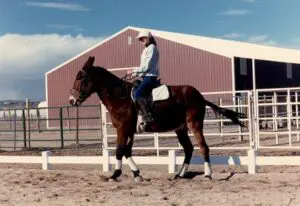 Once your equine gets his footwork figured out through these complicated movements, and has the opportunity to develop his body properly, you can begin to as for more speed and finesse on the turns, but this comes MUCH later! To attempt any more right now will most likely destroy his forward motion, cadence and rhythm. This will cause frustration and fatigue.
Working your mule along the fence line, will help him to keep his pivot foot planted throughout the turn and still stay balanced through his body. Abrupt turns cannot accomplish this with the finesse that he will need for optimum performance. This is an excellent exercise for improving the quality of the turn-on-the-haunches for Reining and cow work, but because of the sensitive nature of the animal and slow maturation, it can become too stressful and frustrating for a younger animal if attempted too early. The equine might even perform well for a couple of years after quicker training, but before long, he will sour on the movements. He will anticipate the moves in order to avoid soreness, and even begin to bolt. It’s better to take it slowly so it is easy for him. This will maintain your rapport and understanding in the relationship. Equines that are brought along slowly tend to live a lot longer and do not have serious issues with arthritis and other such problems. So, why get impatient and try to do too much too 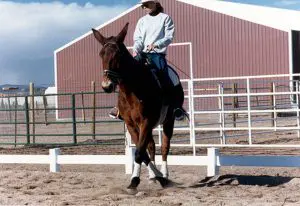 soon? Wouldn’t you rather have a long-lasting and pleasant relationship with a companion that is happy with his work?
Your equine does not need his crimped oats reward as often as he did in before his under-saddle training. Just be sure to be generous with your rewards BEFORE you ride and then again AFTER you ride, so he fully understands that he has done well. This will ensure that his good behaviors will be consistently repeated. When you lavishly praise your equine’s successes, stroke him gently and calmly when he makes mistakes, you will only solidify the bond between you!
To learn more about Meredith Hodges and her comprehensive all-breed equine training program, visit LuckyThreeRanch.com or call 1-800-816-7566. Check out her children’s website at JasperTheMule.com. Also, find Meredith on Facebook, YouTube, Pinterest, Instagram, MeWe and Twitter.
Covered in TRAINING MULES & DONKEY: A LOGICAL APPROACH TO TRAINING, TRAINING WITHOUT RESISTANCE, EQUUS REVISITED and A GUIDE TO RAISING & SHOWING MULES at www.luckythreeranchstore.com
© 1989, 1992, 2015, 2016, 2017, 2024 Lucky Three Ranch, Inc. All Rights Reserved.

Get in Sync With Your Equine
(3-13-15) Lucky Three Vindicator and I are in perfect sync with each other and happy throughout all activities…even smiling for the camera and opening and closing gates! After training in multiple equine disciplines, I firmly believe that a well-adjusted and welltrained equine needs the same ideal attention that children need to help them prepare for adulthood. Ideal training involves not only Classical Dressage for physical development, Behavior Modification for character development and natural horsemanship for playful yet productive bonding, but also building core muscle strength in good posture to prepare them to carry a rider efficiently to prevent injury. Good posture is not automatically attained without a structured groundwork program that is both challenging AND fun…just like we structure for grades K-12! And nothing can replace the instillation of mutual respect and good manners in all living creatures! Learn more about our comprehensive training program at www.luckythreeranch.com.

MULE CROSSING: Mule & Donkey Movies & TV Shows
By Meredith Hodges
- Does the Lucky Three Ranch participate in filming? Since my parents gave me a Brownie camera when I was five years old, I have been fascinated with taking pictures. They also gave me a diary after I learned to write. When I got older and began my interaction and training with mules in 1973, I always documented those interactions with my mules and donkeys in pursuit of learning the best way to manage and train them. I wanted to give them the best opportunity to exceed people’s expectations of them and dispel the old rumors. I kept diaries, wrote articles for international equestrian magazines from 1982 to present day, took photographs and video of every lesson, clinic and show to document their progress. I consolidated a group of articles in 1993 and published my first hardbound book, TRAINING MULES AND DONKEYS: A LOGICAL APPROACH TO LONGEARS.
- I worked with three different production companies from 1997-2017 producing my 10-tape video series (first in VHS and later upgraded to DVDs). By 2009, I had published two more hardbound books, A GUIDE TO RAISING & SHOWING MULES and DONKEY TRAINING, and another manual, EQUUS REVISITED with a matching DVD.
- From 2005-2007, I published five hardbound children’s books for a series for kids followed with corresponding DVDs and a coloring book. At the same time we did a lot of video short pieces such as TEACH YOUR MULES AMAZING THINGS and began the TRAINING TIPS series (67 TIPS).
- By 2017, I decided that the production companies were not doing justice to my brand considering their exorbitant costs. So, Lucky Three Productions, L.L.C. was born when my crew decided that we could probably do everything they were doing and could probably do it better…and we DID! We do EVERYTHING with two guys and three girls at the ranch working remotely with our graphics artist, two videographers, our JASPER Mascot & Social Media/Website person. Since then, we have flourished and produced eight documentaries, a total of 126 TRAINING TIPS, 31 LONGEARS MUSIC videos, 195 MULE CROSSINGarticles and 4 LONGEARS DIARY series that are all posted under TRAINING on my website at luckythreeranch.com . There is much more educational and fun LONGEARS things and biographical information to peruse.
- Instead of making every new project a singular production, and shooting for that only, we shoot photos and video of everything we do every day, keep diaries, log everything and then use the materials for multiple projects going forward, shortens the time need to do the various projects because there is very little shooting pieces that we need and significantly lowers the cost of production. This expands the use of everything we do from articles, to training tips, to advertising, to social media to new video projects and anything else we might dream up. If you can dream it, you can do it! You just need to learn how to be super-organized and efficient about the way that you work…and still continue the training with the equines as needed to add to our intellectual property library. As we all age and the ranch work changes, there are always new things to shoot and film.
- How do you select the animal(s) for the scenes? By temperament and disposition. All my equines are able to do whatever I ask for the filming that we do and for the people that will ride them. Ours is a complete training and exercise program that builds up their core balance and strength at the skeletal level for ultimate performance, and instills confidence & ability.
When working with the Longears, we do not set up the filming to get the perfect shots. We actually do everything at the time the equines are learning so people will know what to expect. This kind of training takes time and precision in communication with the animals to produce the results one would need for getting them to do anything and everything perfectly. And, it is a never-ending process! All the filming and documentation we do is to undeniably validate the integrity and quality of our management and training program. With this kind of foundation, the Longears training is impeccable and they are ready, willing and able for photos and filming.
- Training Mules & Donkeys is our brand and we now have our own production company, Lucky Three Productions, L.L.C., and self-published…
- 31 – Meredith Hodges Training Mules and Donkeys TV Shows – on RFD TV for 11 years
- 3 – Hardbound Training Books:
1) Training Mules & Donkeys: A Logical Approach to Training
2) A Guide to Raising & Showing Mules
3) Donkey Trainin
- 3 – Softbound Training Manuals (Produced in English, French, German & Spanish
1) Training Without Resistance (Corresponds with Videos #1 through #7)
2) Equine Management & Donkey Training (Corresponds with Videos #8 – #10)
3) Equus Revisited (Critique of Natural Horsemanship Principles)
4) Equus Revisited Extended Features (VOD Shorts & Equus Revisited DVD)
– The Equine’s Skeletal Structure – Developing Your Hands
– The Equine’s Skull – Choosing the Right Bit
 |
 |
– How to Make the Elbow Pull – The Elbow Pull for Good Posture
– Multiple Uses of the Elbow Pull – Building Coordination through Obstacles
– Obstacles under Saddle
- 11 – Training Videos that correspond with the manuals listed above
- Foal Training – Preparing for Performance: Driving


- Preparing for Performance: Groundwork


– Basic Foundation for Saddle – Intermediate Saddle Training
 |
 |
- Advanced Saddle Training – Jumping
 |
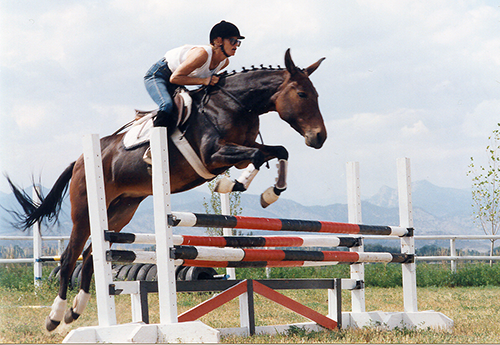 |
– Management, Fitting and Grooming – Donkey Training: Introduction and Basic Training
– Donkey Training: Saddle Training and Jumping
– Equus Revisited
 |
 |
- Give Your Equine the Athletic Edge (VOD)
- Teach Your Mules Amazing Things (Video Shorts)
- Housekeeping
- Chess Game – Classroom
- Magic Show – Paratroopers
- Trampoline
- Documentaries:


1) Lucky Three Ranch & the Road to Bishop 6) Making of the Jasper Carousel
2) The Bishop All-Stars 7) Lucky Three Hay Production
3) The Bishop Experience
4) Walk On: Exploring Therapeutic Riding
5) Rock and Roll: Diary of a Rescue
 |
 |
- Jasper the Mule Children’s Series


1) Jasper: The Story of a Mule (Book, Video & VOD)
2) Jasper: A Christmas Caper (Book, Video & VOD)
3) Jasper: A Precious Valentine (Book, Video & VOD)
4) Jasper: A Fabulous Fourth (Book, Video & VOD)
5) Jasper: A Turkey Tale (Book, Video & VOD)
6) Jasper: An April Mule’s Day (Book)
7) Jasper Goes to Bishop (Coloring Book, Video & VOD)
My lifetime mission has always been to prove that mules could do everything that horses could do in all kinds of recreational equestrian disciplines to further their use in modern America. As I learned more about Longears’ personalities and abilities, I began to develop my own unique training program, utilizing my observations and my background in Behavior Modification. Over the next ten years, guided by the resistance-free training techniques of Richard Shrake and merging the knowledge of many other trainers from multiple equestrian disciplines (such as Major Anders Lindgren of the Swedish Olympic Team in Dressage, Rick Noffsinger in Driving, Bruce Davidson, Denny Emerson and Jim Graham of the US Olympic Team in Combined Training, Steve Schwartzenberger and Al Dunning in Reining and some of the very best Western trainers like Tom Dorrance, Ray Hunt, Buck Branaman, John Lyons, Pat Parelli and Clinton Anderson) I used only the very best theories and techniques they had to offer. I combined them into a comprehensive management and training program that I called Training Mules and Donkeys.

My evolving techniques proved successful in showing my animals in both Horse and Mule Shows. In 1984 Lucky Three Sundowner became the World Champion Bridle Reined Mule at Bishop Mule Days in Bishop, California. He then became the World Champion 3rd level Dressage Mule in 1992, and again in 1993, while working at home at 4th Level Dressage.
 |
 |
During the 1970s and early 1980s, most competitive equestrian events were closed to mules and donkeys. In 1986 I lobbied the United States Dressage Federation (U.S.D.F.) Convention, wrote campaign letters, and held forums and discussions with various breed organizations in an effort to change the U.S.D.F. rules to include mules and donkeys in competition. Mules were eventually limited to schooling shows only, and not allowed at the upper levels in the U.S.D.F. shows that were governed by the A.H.S.A. I diligently worked with other mule enthusiasts to get mules accepted by the A.H.S.A. On January 18, 2004, mules were finally accepted by the A.H.S.A., now called the United States Equestrian Federation (U.S.E.F.). The rule was approved with consideration. Mules were now accepted in the Dressage Division of the U.S.E.F.
In 1990 my Sire-Supreme jack donkey, Little Jack Horner, jumped four feet in exhibition at Bishop Mule Days, winning a Special Award and making him the only formal jumping donkey in the world.

- HOLLYWOOD MULES & THEIR TRAINERS
The film titled Hollywood Horses focuses on the great Silver Screen Movie Horses from the old Hollywood movies, westerns, frontier epics, and the Trainers Cowboys, Wranglers and rental stables.
Information on Hollywood’s movie stable owner Fat Jones, and others including Glen Randall, Corky Randall, Tom Sweet, Ralph McCutcheon, Jack Lindell, Les Hilton, Kenny Lee, Denny Allen, Dave Richardson, and two women who ran a business together, Stevie Myers and Joan Edwards. Many have since passed away – and in several instances, their children, are running the remaining stables. Fat was in business until his death in 1963. Then it was sold to Dyke Johnson whom is NOT related to actor Ben Johnson. Ben also started out as a wrangler and was Fat’s son-in-law.
This is a tribute to the old horses and the popularity they enjoyed from the 1930’s to the 1960’s. The Californian local history of the San Fernando Valley where the rental stables were located and many films were shot. In the early days, before large trailers were used to haul the horses to their location, wranglers and cowboys would round them up herding them to the movie sets. The old western cattle driving technique met the modern world of motion picture making.

- What attributes are desired in film animals? They must be manageable, but they will also need to have attributes that are complementary to their roles in the script.
- How are the animals paid and who receives the payment? The animals are leased from various stables with their trainers that are in the business of making them available to Hollywood Producers. The stable receives payment for the loan of the animals.
- Are there rules regarding how often the animal(s) get a break and for how long? The animals would be governed by each State’s animal advocacy groups like PETA, ASPCA, Humane Society, etc.
- MULE AND DONKEY TRAINING FOR FILM
- Donkeys and horses are frequently used over mules in films because they are easier to train for specific roles.
- Mules are often found in the background of numerous films
- Mules have specific likes and dislikes when it comes to people so actors with an “attitude” could have problems with them.
- Horses frequently have more “starring” roles in films.
- Rumors about Longears supersede the reality of their true character and skill.
- Training horses for movie roles is a fascinating process that combines equine expertise, patience, and creativity, but much of the training used is “Old School.”
- Here are some key steps involved that are used primarily with horses. They don’t always work well with mules the way they execute the training. You MUST train mules the way that horses SHOULD be trained. That is probably why the mules don’t seem to have very many leading roles.
- Desensitization:
- Horses need to become comfortable with unusual sights, sounds, and props they’ll encounter on set. Trainers gradually introduce them to things like cameras, lights, costumes, and loud noises.
- Basic Obedience: Horses must respond to cues reliably. They learn commands like “walk,” “trot,” “canter,” and “stop.” Rein pressure, leg cues, and voice commands play a crucial role.
- Stunt Training: For action scenes, horses learn to perform specific movements, such as rearing, bucking, or falling. Stunt doubles may handle these challenging sequences.
- Trick Training: Horses can learn tricks like bowing, nodding, or lying down. These add flair to character interactions.
- Mounted Actors: Horses must adapt to different actors’ riding styles. They practice working with specific performers to build trust and coordination.
- Trail Exposure:
- Movie sets often involve outdoor locations. Horses train on trails, bridges, and uneven terrain.
- Crowd Scenes: Horses learn to remain calm amidst crowds, crew, and other animals.
- Transportation Training: Loading onto trailers or standing still during transport scenes is essential.
- Emotional Scenes: Horses can convey emotions. Trainers work on expressions like fear, curiosity, or relaxation.
- Safety Measures: Trainers prioritize safety, using protective gear and ensuring horses are comfortable.
- Remember, each horse has its own individual personality and learning pace. Patience, positive reinforcement, and understanding contribute to successful equine performances on the big screen!
- People might be surprised at the number of films where you can find mules and donkeys. Mostly, they were used as “stand-ins,” but as time passed and the old rumors became diluted, they claimed their place in the film industry. Here are some of the more popular movies that were produced with Longears starring roles, but there are even more where they are shown in a positive light.


- Any unusual moments on film that you would like to share?
When we were filming and doing the narration for Jasper: The Story of a Mule with Animator, Bill Melendez, our narrator, Lee Horsley and I went for a ride on my mules. He had a scar on his face, so I asked him about it. During a shoot, he was thrown to the ground when his horse tripped and fell. He was rushed to the hospital, treated for a broken nose and jaw, and then had to return to the set to finish his shoot right afterward. That was when I discovered how merciless Hollywood could be…it’s all about the money! I think Lee decided that day that he’d rather ride a mule!
 |
 |
- LONGEARS MOVIES. Mules may not have played a lot of starring roles, but they have always been “Stand-ins” in the background of historic movies and hold a very special place in people’s hearts that know them. Rumors have it that mules and donkeys are stubborn and not a pleasant animal to ride. Their history actually proves otherwsie. They have an incredible sense of self-preservation and will not be forced to put themselves at risk. When treated with a polite attitude and the right approach, there is no better equine as a companion…they wil keep you SAFE if you are willing to listen to them!
- OBJECTIVE BURMA! (Errol Flynn – Merrill’s Marauders – Parachute Mules into Burma 1945) Objective Burma is a gripping war drama film that was released in the year 1945. The movie stars the legendary actor Errol Flynn in the lead role, along with James Brown and William Prince. The film is directed by Raoul Walsh and is considered to be one of the best war movies of all time. The movie takes place during World War II in the year 1942. A group of American soldiers, led by Captain Nelson (Errol Flynn) are sent on a mission to destroy a Japanese radar station in Burma. The mission is considered to be one of the most dangerous military operations of the time and the soldiers have to face numerous obstacles along the way.
The film begins with the soldiers being dropped off by the Allied Forces near the Burmese border. They trek through the dense jungle, where they have to fight off various enemies and dangerous animals. Finally, they reach the location of the radar station and successfully destroy it.
However, things take a turn for the worse when a group of Japanese soldiers spot the Americans and decide to retaliate. In the ensuing battle, many of the American soldiers are killed or captured by the enemy forces. Captain Nelson, along with a handful of soldiers, manages to flee and seek refuge in the jungle.
The remaining soldiers are faced with the daunting task of trying to make their way back to their base, which is located hundreds of miles away. They have to navigate through the treacherous jungle, evade the enemy forces that are pursuing them, and survive without proper food and water.
As they journey deeper into the jungle, the soldiers come across a tribe of friendly Burmese people who agree to help them on their journey. Together, they face numerous challenges and obstacles, including hostile Japanese troops, natural disasters, and unpredictable terrain.
Throughout the movie, the soldiers are confronted with the brutal reality of war and are forced to rely on their training and instinct to survive. The performances of the lead actors, especially Errol Flynn, are remarkable and bring a sense of authenticity and credibility to the film.
In conclusion, Objective Burma is a timeless classic that captures the true essence of war. It showcases the bravery and courage of the soldiers who fought for their country, as well as the hardships and struggles they had to endure. The movie is a poignant reminder of the sacrifices made by those who fought in World War II, and it remains a must-watch for anyone interested in war movies.
- MULE TRAIN (Gene Autry 1950) The film was released on February 22, 1950, by Columbia Pictures. Prospectors have discovered a natural cement mine that yields material of astonishing durability. But greedy contractor Sam Brady enjoys a monopoly on the transportation of crushed rock, which is being used to build a local dam. U.S. Marshal Gene Autry, however, discovers that Brady has used this method before, and his dams always burst shortly after construction, flooding entire towns. Despite Brady’s power, Autry campaigns to have the new dam made of cement.
- FRANCIS THE TALKING MULE (Donald O’Connor 1950-56)
The book and film series focused on the exploits of Francis, an experienced Army mule, and Peter Stirling (played by Donald O’Connor), the young soldier whom he befriends. Francis then stays with Peter through civilian life and back in the military. In the original 1950 film, the mule identifies himself to the commanding general as “Francis…123rd Mule Detachment…[serial number] M52519.” With a plot device like the later series Mister Ed, Francis would usually talk only to Peter, thus causing problems for his nominal “master.”
As the titles indicated, each film had a different setting or gimmick, exposing the world-wise mule and the naive GI to race track excitement, the world of journalism, and many branches of the military, from West Point to the WACs to the Navy. The basic plots were fairly similar, however. Stirling, with the sage but sardonic advice of Francis (gleaned from overhearing generals plan strategy or from discussions with other equines), would triumph over his own incompetence. However, inevitably he would be forced to reveal that his adviser was a mule, and be subject to mental analysis (sometimes more than once per film) until the grand reveal, when Francis displayed his talent (usually either to individuals, or to a large group). Some of the Francis films had animated trailers.

Francis Goes to the Races (1951)

Francis Goes to West Point (1952)
Francis Covers the Big Town (1953)
Francis Joins the WACS (1954)
Francis in the Navy (1955)
Francis in the Haunted House (1956)
The mule who appeared on-screen was a female named Molly, selected because she was easy to handle. She was purchased from Ed Frazier in Drexel, Missouri. According to author Pauline Bartel, Universal Studio paid $350 for the animal but made millions from the film series. Mollywas trained by Les Hilton, an apprentice of Will Rogers; Hilton went on to train Bamboo Harvester, the horse that played Mister Ed. To create the impression that the mule was actually talking, Hilton used a thread fed into the animal’s mouth which would cause Molly to try to remove it by moving her lips, the same technique used for Mister Ed.
- DEATH VALLEY DAYS (Stanley Andrews as “The Old Ranger”, first host of Death Valley Days 1952-1970) Death Valley Days is one of the first anthology series to appear on television, featuring different characters and stories each episode.[5] The stories were based in fact, all within the legends and lore of California’s Death Valley. Style varied by episode, with some being drama and others comedy. Most were human-interest stories of miners and homesteaders in Death Valley, where borax was mined.As the series continued on the air, episodes began to focus on nearly any portion of the American West, not just the Death Valley country. Most episodes portrayed events in the late 19th century, the heyday of the “Old West”. Some, however, were set in much earlier times, especially the Spanish colonial era, and a few recounted stories from the early 20th century. Each of the 452 television episodes was introduced by a host. The longest running was “The Old Ranger,” a character played by veteran actor Stanley Andrews from 1952 to 1964. While the series followed the anthology format, with all new stories and characters in each episode, the series utilized many character actors over its 18-year run.
- GUNSMOKE (James Arness & Ken Curtis & Mule Ruth 1955-1975) Curtis remains best known for his role as Festus Haggen, the scruffy, cantankerous, and illiterate deputy in Gunsmoke. He joined the regular Gunsmoke cast in 1964, superseding the previous deputy, Chester Goode, played by Dennis Weaver. While Marshal Matt Dillon had a total of five deputies over two decades, Festus held the role the longest (11 years), in 304 episodes. Festus was patterned after “Cedar Jack” (Frederick Munden), a man from Curtis’ Las Animas childhood. Cedar Jack, who lived 15 miles south of town, made a living cutting cedar fence posts. Curtis observed many times that Jack came to Las Animas, where he would often end up drunk and in Curtis’ father’s jail. Festus’ character was known, in part, for the nasally, twangy, rural accent which Curtis developed for the role, but which did not reflect Curtis’ actual voice.
- LEGEND OF THE LOST (John Wayne 1957) Legend of the Lost is a 1957 Italian-American adventure film produced and directed by Henry Hathaway, shot in Technirama and Technicolor by Jack Cardiff, and starring John Wayne, Sophia Loren, and Rossano Brazzi. The location shooting for the film took place near Tripoli, Libya.In Timbuktu, experienced guide Joe January (John Wayne) reluctantly joins a Saharan treasure hunting expedition led by Paul Bonnard (Rossano Brazzi), a man obsessed with confirming his dead father’s claim to have found a lost city. Dita (Sophia Loren), a woman of dubious reputation, becomes infatuated with Paul and his willingness to overlook her past. She invites herself along, despite Joe’s protests. During the tough, dry ordeal, Joe and Dita become attracted to each other, raising tensions.Just as they run out of water, they stumble upon the ancient city and a well. There, they find three human skeletons, a woman and two men. It becomes evident that Paul’s father had found his woman in the arms of his guide, killed them and then himself. There is also no obvious treasure to be found. Paul’s faith in his father is shattered and he becomes drunk.However; they find the treasure after Joe deciphers the clues left by Paul’s father in his bible. They load it and prepare to leave in the morning. Paul makes an attempt to seduce Dita; she rejects him and he gets into a fight with Joe, who protects her. Joe and Dita wake up to find that Paul had sneaked away during the night, taking all the animals, supplies and treasure with him and leaving his companions to die.Joe and Dita pursue him on foot and eventually catch up. Paul is unconscious from dehydration. While Joe and Dita dig for desperately needed water, Paul regains consciousness. He buries the treasure and attacks Joe from behind with a knife. Dita shoots and kills Paul. When they spot a caravan approaching in the distance, Joe and Dita are saved.
- MR ED (1961-1966 The horse Bamboo Harvester portrayed Ed throughout the run. Ed’s stable mate, a quarter horse named Pumpkin, also served as Bamboo Harvester’s stunt double for the show. Pumpkin later appeared again in the television series Green Acres.Bamboo Harvester’s trainer was Les Hilton. To create the impression that Ed was having a conversation, Hilton initially used a thread technique he had employed for Lubin’s earlier Mule films; in time, though, this became unnecessary. As actor Alan Young recounted: “It was initially done by putting a piece of nylon thread in his mouth. But Ed actually learned to move his lips on cue when the trainer touched his hoof. In fact, he soon learned to do it when I stopped talking during a scene! Ed was very smart.”
- BRIGHTY OF THE GRAND CANYON (Joseph Cotten – January 1966) Based on the novel Brighty of the Grand Canyon by Marguerite Henry (New York, 1953).
- DINGUS MCGEE (Frank Sinatra, George Kennedy – Mules Pulling Stagecoach 1970) Hoke Birdsill rides into Yerkey’s Hole demanding the law take action because Dingus Magee has robbed him. Since no law exists, the mayor, Belle, who also runs the town’s bordello, sees to it that Hoke himself becomes the new sheriff. Dingus keeps getting away with his crimes, helped by Anna Hot Water, his young Indian companion, but when he tries to steal from Belle, he finds Hoke has beaten him to it. Hoke and his mule enjoy being on the other side of the law, so Dingus turns the tables, becoming sheriff to go after him. After being rivals for so long, Dingus and Hoke eventually team up, burning Belle’s brothel to the ground.
- TWO MULES FOR SISTER SARA (Clint Eastwood & Shirley Maclaine 1970) Just after the American Civil War, a former soldier named Hogan rides up on a naked woman about to be raped by bandits. He kills the bandits and discovers the woman is a nun, Sister Sara, who is raising money to assist Mexican revolutionaries fighting French occupying forces. When Sara requests that Hogan take her to the Mexican camp, he agrees, as he had previously arranged to help the revolutionaries attack the French garrison in exchange for half the garrison’s treasury.As the duo heads towards the camp, evading French troops all the while, Hogan is surprised that the nun swears and drinks whiskey. While on their way to destroy a French ammunition train, Hogan is shot at by Yaquis and seriously wounded with an arrow. Sara is able to tend to his wounds, and she is able to set the charges that Hogan detonates to destroy the train. Eventually the two reach Juarista commander Col. Beltran’s camp. Sara begs the local villagers for money needed to purchase dynamite for the assault on the garrison. In the lead-up to the attack, Sara reveals to Hogan that she is not a nun, but a prostitute posing as a nun because she is wanted by the French for her support of the revolutionaries. Although Hogan is shocked, the two team up to infiltrate the fort and let a squad of revolutionaries in through a trapdoor, while two other squads attack the gates and a fourth act as sharpshooters.Expecting the French army to be drunk for Bastille Day, they instead find that the train’s destruction has put the garrison on high alert. Hogan and Sara infiltrate the fortress by Hogan posing as a bounty hunter who has captured Sara and is turning her in for the reward. The ruse works, and Hogan and Sara engage the French commanding officers while the garrison’s gates are breached for the Mexican revolutionaries to swarm through. A battle ensues; the French are defeated, and the Mexicans capture the fort. As promised, Hogan receives half the riches. Now wealthy and with his job completed, Hogan sets off with Sara, with whom he has fallen in love, to open a gambling house in San Francisco.
- GUS (Don Knotts & Tim Conway 1976) Low-ranking football team The California Atoms are at a constant loss until they recruit a new player – a mule named Gus. It turns out that Gus is an amazing placekicker with a 100-yard field goal ability! Just as the Atoms begin to leave their losing streak in the dust, crooks attempt to kidnap their new star. Whether it’s a surefooted race to the goal posts or a riotous chase down the supermarket aisles, the action in this Disney favorite is sure to make your family cheer!
- MULE FEATHERS (Rory Calhoun & Don Knotts 1978) A preacher travels with a telepathic mule In this Western comedy, a sagebrush flim-flam man makes a career out of swindling naive settlers and pulling off the occasional train robbery.
- THE APPLE DUMPLING GANG (& RIDES AGAIN– Don Knotts, Tim Conway & a mule named Clarise1975) Set in the Wild West in the year 1879, a slick gambler named Russell Donovan (Bill Bixby) comes to the town of Quake City en-route to open a casino in New Orleans. In Quake City, Donovan meets his old associate, John Wintle. Wintle is leaving for San Francisco that night and asks Donovan to sign for valuables coming in on tomorrow’s stagecoach. Donovan accepts a down payment and promises to pick up the valuables. The next day, Donovan realizes he has been duped into taking care of three little orphans, Bobby, Clovis, and Celia Bradley. The stagecoach driver Magnolia “Dusty” Clydesdale (Susan Clark) explains that Wintle is in fact the children’s relative and their legal guardian. With him gone and Donovan promising to care for the “valuables”, they are now wards of Donovan. The town’s sheriff, barber, Justice of the Peace, and judge Homer McCoy (Harry Morgan) tells Donovan that he is legally obligated unless he can have someone else take custody of the children.
- THE POSTMAN (Kevin Costner 1997) In a post-apocalyptic world in 2013, an unnamed nomad wanders the scattered communities of the Utah flatlands, trading performances of long-forgotten Shakespearean plays for food and water. At one town, the nomad is forced at gunpoint into the ranks of the Holnists that killed his mule. This neo-feudalist militia, brand him on his shoulder with their symbol, a figure 8. The Holnists, under their leader, General Bethlehem, are the de facto authority in the area, collecting tribute and recruits from local towns. When the nomad escapes, he takes refuge in a long-deceased postman’s mail vehicle.With the postman’s uniform and mail bag, he arrives in the settlement of Pineview claiming to be from the newly-restored U.S. government. He convinces Pineview’s leader, Sheriff Briscoe, to let him in by showing a letter addressed to elderly villager Irene March. The postman inspires a teenager named Ford Lincoln Mercury, who asks to be sworn in as a member of the postal service and even helps him to reactivate the long abandoned post office in the town. When the postman leaves for the town of Benning, he carries a pile of mail left at the post office door by the townspeople.In a recitation of King Henry V’s speech prior to the siege of Harfleur, the postman rallies himself and his followers to war. The mounted carriers and Holnists meet across a field. Not wanting any more carnage, the postman instead challenges Bethlehem to a personal hand-to-hand duel, with their troops as witnesses, which is his privilege due to once having been a member of Bethlehem’s troops. The postman wins the fight but spares Bethlehem’s life to maintain morale.Thirty years later, the postman’s grown daughter Hope, accompanied by other public figures and servicemen (including postal workers), speaks at a ceremony unveiling a bronze statue by territorial waters in St. Rose, Oregon, in tribute to her father, who has recently died (1973–2043).
- MULE PEOPLE (Ted Faye – Gold Creek Productions 1997) People who appreciate mules are a unique breed of folks. In this video you’ll get to know some of them at Bishop Mule Days in Bishop, California. You’ll meet eleven-year-old Cameron Brooks along with trainers Cindy Powell and Jerry Villines whose mules, they all claim, can do anything a horse can do…only better. Hang onto your hats for a wild ride with Ron “Tash” Hudson. Then share in the poignant climatic moments as Mr. Jensen has to sell his pride and joy. His 20 well-trained mules, and all of his wagons. If you didn’t know any before, after watching this video, you’ll be glad you met these…Mule People.
- MULE FOR SALE (Ted Faye – Gold Creek Productions 2003) Join the fun and excitement of the world’s largest mule auction. Filmmaker Ted Faye takes you on a journey to Dickon, Tennessee where Dickie and Rufus Reese carry on a family tradition: The Reese Brothers Mule Auction. Find out why people buy mules, what they are used for and where the mules end up. We follow a mule from the time it is brought to the auction to the time it is sold. Discover the story of the mule and meet the people who buy and sell them. An intriguing look at the event that few have experienced first-hand.
- LONGEARS EVERYWHERE (Video Mike Kerson 2004) Bishop Mule Days with Jerry Tindell & Video Mike: Twitchell, Von (Actor), Shields, Bonnie (Actor), Kerson, Mike (Director) Format: DVD
- HOOVES AND ROSES (Video Mike Kerson 2006) Pasadena Tournament of Roses Parade
- LOVE THOSE LONGEARS (Video Mike Kerson 2006) Video Mike is passionate about equines – and all his love and respect for both the critters and their people shines through in this video. Every year Video Mike produces an action-packed Bishop Mule Days Highlights video, and each year he chooses some aspect of the week-long event for a more in-depth look.
- MULES ON SNOWSHOES (Video Mike Kerson 2006 ) Bill Balfrey’s family came to the remote Northern California town of Etna by covered wagon in the 1850’s. As Bill was growing up, he made friends with the Smith brothers, Bill and Ralph, who, in the early 1900’s, delivered the mail by mule train from Etna to Sawyers Bar and points down river. Come along with the two Bills, Ralph and others as they take us back to a time when tunnels had to be hand-dug through the 10-foot snowdrifts, the mules wore snowshoes, and the mail was delivered!
- CHASING THE RAINBOW: ADVENTURES OF THE DESERT PROSPECTORS (Ted Faye – Gold Creek Productions 2007) The last great Gold Rush in America played out in the deserts of Nevada and California. It began with those who roamed the barren hills seeking their fortune. Most traveled with their tools, some food, a blanket and a jackass. They were called single-blanket-jackass-prospectors. Most never made the fortune they sought, but many discovered something else: freedom and a kind of peace in the wilderness and every now and then, some wild times in the local towns. This the story o those who spent their lives “Chasing the Rainbow.”
- TOMMY AND THE COOL MULE (Grant Barker & Ice T 2009) Tommy Braxton’s father goes to war and never returns, forcing Tommy to become the man of the house and help support his mom and sister. Tommy makes a friend and finds a way to save his family’s farm when he meets Jackie-A – a talking mule. Against all odds, Tommy and Jackie-A triumph in a race over the other bullies and their horses in the country stock show, in a spectacular display of resolve and determination that caps off a winning family adventure!
- SEASONS: A YEAR IN THE LIFE OF A PACK STATION (Video Mike Kerson 2010) Follow the Virginia Lakes Pack Outfit through springtime preparations, competing at Bishop Mule Days, and on to the summer pack season. You’ll ride with guests, scientists, and government work parties into the spectacular Eastern Sierra Wilderness, and experience back country life at its finest. You’ll meet the people who work at the pack station, as well as the guests. Take a look behind the scenes as problems are solved, crises are met, and the crew lives the disappearing life of the back country. With the coming of autumn, the pack station gets ready for winter, and the cycle begins again.
- HITCH UP YOUR MULE & THE HIDDEN TRAIL (Ted Faye – Gold Creek Productions 2010) Hitch up your mules, mule-skinner Bobby Tanner of Bishop, California shows how to hitch up a 20-Mule Team. Bobby has revived the art of driving a long line of animals with a single rope called a jerk line, which is tied to a lead mule. The Hidden Trail is an expedition to the China Lakes Naval Air Weapons Station in the Mojave Desert to retrace the historic route of the Twenty Mule Team from Death Valley. Ruts from the original Twenty Mule Team can still be seen.
- BISHOP MULE DAYS (Video Mike Kerson 2011-2019) At 4000’ elevation, Bishop is nestled between two beautiful mountain ranges midway between Los Angeles, California and Reno, Nevada on U.S. Highway 395. Bishop is the center for recreational activity in the Eastern Sierra. In addition to the packing activities specific to the region, there are activities such as fishing, hiking, hunting, and fantastic sight-seeing of fall colors, mountains, creeks, and high desert. World class skiing is also available on nearby Mammoth Mountain in Mammoth Lakes, California.Mule Days is a six-day event that takes place each year Tuesday to Sunday the week before Memorial Day. Mule Days is held on the Tri-County Fairgrounds in Bishop, California. Our 14-show event begins with preliminaries on Tuesday through Thursday and features event finals, comic events and packing events Friday through Sunday. Video Mike Kerson has been filing this from 2011-2019.At 4000’ elevation, Bishop is nestled between two beautiful mountain ranges midway between Los Angeles, California and Reno, Nevada on U.S. Highway 395. Bishop is the center for recreational activity in the Eastern Sierra. In addition to the packing activities specific to the region, there are activities such as fishing, hiking, hunting, and fantastic sight-seeing of fall colors, mountains, creeks, and high desert. World class skiing is also available on nearby Mammoth Mountain in Mammoth Lakes, California.Mule Days is a six-day event that takes place each year Tuesday to Sunday the week before Memorial Day. Mule Days is held on the Tri-County Fairgrounds in Bishop, California. Our 14-show event begins with preliminaries on Tuesday through Thursday and features event finals, comic events and packing events Friday through Sunday.
- PALOUSE THRESHING BEE (Video Mike Kerson 2012) The Palouse Empire Threshing Association holds an old-fashioned wheat threshing bee in Colfax, Washington – the heart of the Palouse. Using only authentic, original equipment and raft animals, the public is treated to a day of living history, featuring the majesty of draft horses and mules.
- THE TWENTY MULE TEAM OF DEATH VALLEY (Ted Faye – Gold Creek Productions 2012) This program will show you how the Twenty Mule Team rose from a mundane means of transportation to become a national icon. Using spectacular, original color film, archival footage, photographs and reenactments, this documentary brings to life the Twenty Mule Team of Death Valley.
- HISTORY OF THE ARMY MULES (2013) Just outside of Fort Brag on a ranch in Lumber Bridge North Carolina there are two brothers mules unaware of how their lives are about to change forever. These animals the embodiment of strength hardiness and perseverance are about to embark on a journey that will lead them through the gates of the world’s Premier leader development institution. They are about to take their place in history as the new generation of mascots for the corps of cadets at the United States Military Academy at West Point. The tradition of mules as mascots for the Army dates back to 1899. Mules were an obvious choice. The mule reflects the long-standing usefulness of the animal in the United States Army, enabling soldiers to perform military operations, transporting guns, supplies and ammunition. Strong, hardy and durable, the mule is the perfect symbol for the corps of cadets. Not much was known about the official mules until 1936 when Mr. Jackson, named for Thomas J. Stonewall Jackson, arrived from Fort Royal, Virginia. Starting with him there have been 15 official mules: Poncho, Hannibal 1, K.C. MO, Trotter, Hannibal 2, Buckshot, Spartacus, Ranger I, Blackjack, Traveler and Trooper. At time this video was made, the members of the current and now retiring mule Corps are Raider, Ranger I and General Scott.We bid farewell and honor them for their service and now, as the Legacy continues, the two new mascots embark on their Journey several hundred miles north to West Point’s hallowed grounds just outside the greatest city in the world. They will be entering into a story of tradition where their presence represents inspiration, strength and steadfast perseverance They will help to reinforce the motto of duty, honor and country that continues to sustain the corps of cadets and the long gray line. Currently, those who have been added are: Ranger II, Stryker, Raider, Ranger III and Paladin.
- STORM RIDER is a 2013 American drama film written and directed by Craig Clyde and starring Kevin Sorbo, Kristy Swanson and C. Thomas Howell. It was filmed in Wallsburg, Utah.Cast:
Kevin Sorbo as Sam Fielding
Kristy Swanson as Jody Peterson
Danielle Chuchran as Dani Fielding
Jacob Buster as Jordan Fielding
Darien Willardson as Kevin Winslow
Sam Sorbo as Vanessa Fielding
Terence Goodman as Cameron Winslow
C. Thomas Howell as Mitch
Sarah Bernstein as Brooke
Jacque Grey as Marie Houghton
Amanda Swanson as Addy Jane
Joey Miyashima as Sheriff KikuchiEdwin L. Carpenter of The Dove Foundation gave it a positive review, writing that it “is well worth your time.” Tracy Moore of Common Sense Media gave the film two stars out of five.
- THE MULE (Clint Eastwood 2018) The Mule is a 2018 American crime drama film starring and directed by Clint Eastwood, who also produced with Dan Friedkin, Jessica Meier, Tim Moore, Kristina Rivera, and Bradley Thomas. The screenplay, written by Nick Schenk, is based on the 2014 The New York Times article “The Sinaloa Cartel’s 90-Year-Old Drug Mule” by Sam Dolnick, which recounts the story of Leo Sharp, a World War II veteran in his 80s who became a drug courier for the Sinaloa Cartel. Toby Keith contributed the theme song “Don’t Let the Old Man In”, which reached number 41 on Billboard’s Country Airplay chart and became Keith’s highest-charting single since “Drunk Americans” reached number 27 in early 2015.
- LOST SEA EXPEDITION (Bernie Harberts 2019) The true story of a lone 14-month wagon voyage across America. Filmed by Bernie Harberts, it is a tale of water and desert, loneliness and companionship. Lakota, Christian and secular beliefs about the origin of a land. Harberts, his mule and his lens capture the essence of the American West. The Lost Sea Expedition is the story of a solo mule wagon voyage across America. Because mule Polly and I (Bernie Harberts) traveled alone, without a film crew or chase vehicle, It took a lot of people and communities to turn the experience in to a series for Public Television. This is where we thank them. The credit list is ongoing. If you were part of the Lost Sea Expedition series and didn’t find yourself on the list (hey, some days I forgot to hook Polly’s traces chains too…) then drop us a line.
- TWO SINNERS AND A MULE (Cam Gigandet 2023) Two ladies of pleasure were kicked out of town and run across a Bounty Hunter shot to hell. After nursed back to health, the ladies decide he needs their help to track down, Gila Grimes, a ruthless, murdering bandit, for half of the bounty.
- Mules and donkeys are working their way into the hearts of many people in this new Industrial Age. Horses have been used for so many films for decades, but the unique character of mules and donkeys are drawing attention from everyone…everywhere!
To learn more about Meredith Hodges and her comprehensive all-breed equine training program, visit LuckyThreeRanch.com, MEREDITH HODGES PUBLIC FIGURE Facebook page, or call 1-800-816-7566. Check out her children’s website at JasperTheMule.com. Also, find Meredith on Pinterest, Instagram, MeWe, YouTube and Twitter.
© 2013, 2016, 2024 Lucky Three Ranch, Inc. All Rights Reserved.


