Kyle Davidson
Posts by Kyle Davidson:
MULE CROSSING: Selecting a Trainer
By Meredith Hodges
We have our animals professionally trained primarily to allow them to perform to the best of their ability, but once we have decided to put them into training we are faced with the dilemma of selecting a trainer. With mules, selection of the trainer is of the utmost importance due to his psychological makeup. Remember that your mule cannot learn from someone he doesn’t like, and mules do have their preferences!
So, where do you begin looking for a trainer? The best place to begin would probably be at a mule show – study the animals and see who is winning the performance classes. Talk with those owners if they do not do the training themselves. They will probably be able to put you in touch with someone who does. Other good sources for trainers are the various equine publications that are popular in your area. Trainers, as in any business, will usually post ads. If no trainers are listed as such, study the ranch ads and contact the ranch owners – they should be able to help.
Once you have accumulated a few names, call and make appointments to visit the various trainers. The interview with the trainer is as important to you as it is to him. You will have an opportunity to discuss finance, goals and general care. An appointment will also give you the chance to see his facility and allow you to draw your own conclusions before you make a commitment. There are many good horse trainers available today, but they are not necessarily qualified to train mules. The mule trainer must be a person of extraordinary patience and be well versed in technique… and just as a precaution, you might ask if he’s ever trained a donkey. The mule trainer must know how to appeal to the donkey half of the mule as well as the horse half of the mule to be successful.
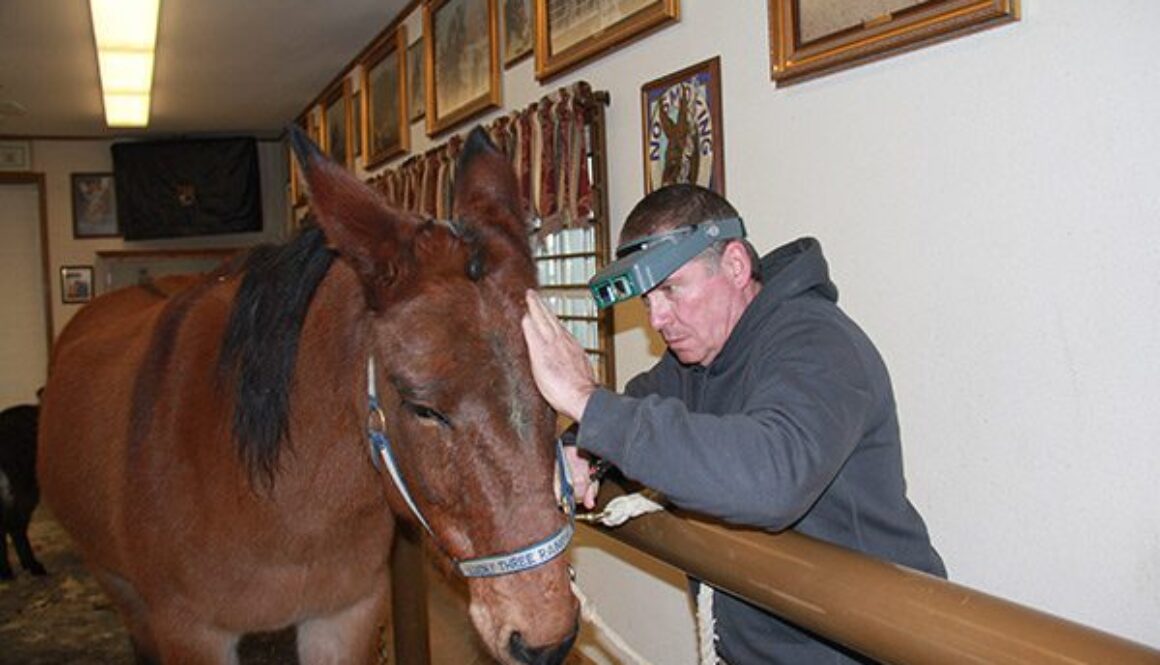
When you visit the trainer’s facility, there are several ways to get the information you require. First, pay attention to the general condition of the facility. Is it clean, free of debris with safe fencing? Check to see that water and mineral salt blocks are available to the stock. Does the trainer have a good working area available to him? In bad weather, an indoor arena is essential. If he does not have access to an indoor arena, he may not be able to work your mule as often as needed for a good sound training program. Next, check the general condition of his stock. Are they well fed? Are there any obtrusive scars or bruises on the animals, and what is the condition of their feet? Are they properly trimmed or shod? The condition of a trainer’s animals can tell you a lot about the trainer.
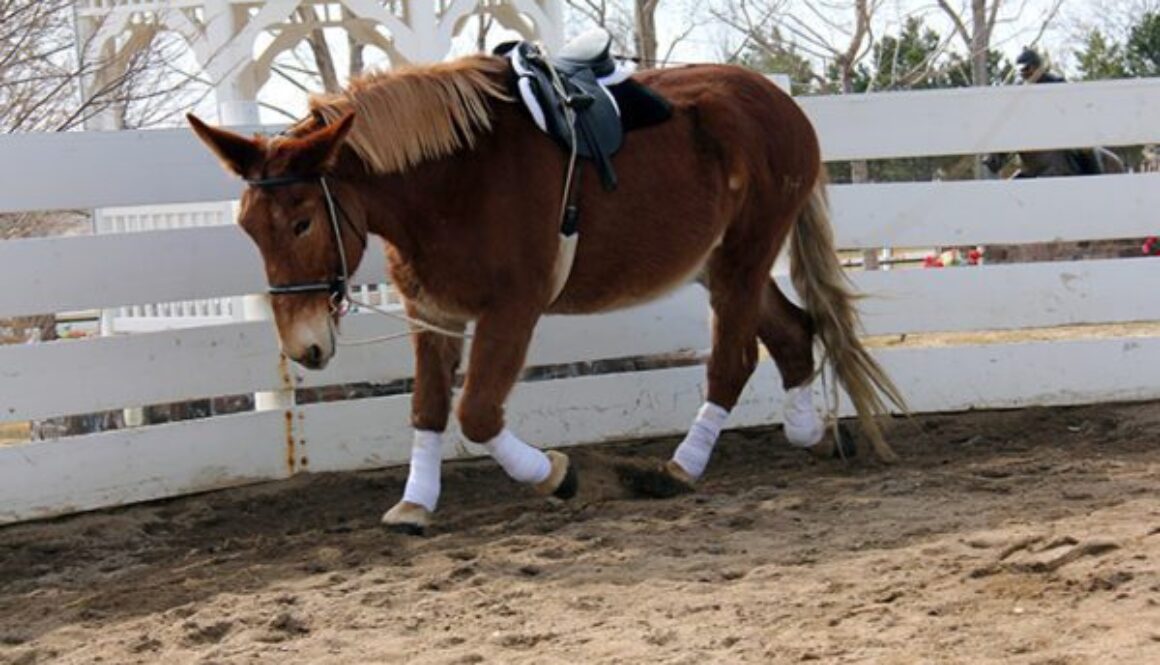
As a consideration to yourself and your mule, do not be afraid to ask the trainer if he will ride for you. You might want to mention the fact that you wish to see him ride at the time you make your appointment. The trainer can then be sure to allot the time necessary to ride for you. As he rides, watch the way he handles the animals. Are his hands light, yet firm? Does he ask for collection and cause the animal to travel smoothly and fluidly? Do his animals move away from leg pressure? Do the animals bend through their circles? Vertical flexion, impulsion, and lateral bend are all the elements of proper shape and any truly good trainer will know and practice these techniques. Beware of the person who claims to be a trainer, but only “rides” your animal. He could conceivably do immeasurable damage.
After touring the facility and watching the trainer at work, it is time for discussion. You have had a chance to determine the overall character of the trainer. If he is the least bit short-tempered or gruff, he is not trainer for your mule. If he seems patient and even-tempered, it is now time to discuss your goals and the way they will be financed. Be realistic about your expectations. An animal can be taught the basics in 60-90 days, but unless you are an experienced rider, the training cannot be maintained. Remember, training is primarily teaching the animal to respond to cues in a habitual manner and it takes time to build good habits. If you haven’t the finances for any more than 60-90 days and you are not experienced, ask the trainer if he would be willing to spend time in the last month, or so, teaching you how to ride your mule correctly. Any good trainer would insist that you do!
When you discuss your goals with the trainer, be concise and to the point. Ask him to clarify terms so that you understand exactly what he will be doing with your mule. Ask the trainer for a copy of the contract to take home with you and to study. To avoid any misunderstandings, ask the trainer about terms concerning the veterinarian, the horseshoer, hauling expenses, and any showing that you wish him to do. To clarify these responsibilities in advance will help to assure a good rapport with your prospective trainer.
If you are still unsure about a trainer after visiting his facility and talking with him, ask for references. While at home, you can check these references and go over the contract to see if he will, in fact, fit your needs.
Following these guidelines will enable you to locate the right trainer for your mule. Granted, it takes a little time to visit and discuss these things, but it is time well spent. The right trainer can produce a happy, healthy and well-mannered mule… but more than that, he can produce a satisfied owner!
To learn more about Meredith Hodges and her comprehensive all-breed equine training program, visit LuckyThreeRanch.com, MEREDITH HODGES PUBLIC FIGURE Facebook page, or call 1-800-816-7566. Check out her children’s website at JasperTheMule.com. Also, find Meredith on Pinterest, Instagram, MeWe, YouTube and Twitter.
Covered in TRAINING MULES & DONKEY: A LOGICAL APPROACH TO TRAINING, TRAINING WITHOUT RESISTANCE and EQUUS REVISITED at www.luckythreeranchstore.com.
© 1986, 1991, 2015, 2016, 2024 Lucky Three Ranch, Inc. All Rights Reserved.
MULE CROSSING: Letter from “Jasper” the Mule
By Meredith Hodges
Hi, Meredith!
My name is Jasper. I am a three-year-old, 15HH, bay Quarter Horse mule. I suppose, by people standards, I’m really nothing special, but I’m still me! I heard my owners talking about you the other day. They said that if anyone could help set me straight, it would be you. I didn’t know there was a problem! I always try to do what they want me to, but sometimes that can be hard to figure out! When I was just a foal, people used to come out to see me and my mother.
We were pastured on a couple of acres that surrounded an old shed where we used to get in out of the weather. My mother was content to graze and doze day after day – she wasn’t much on excitement. I used to love it when the people came and carried on about how cute I was. Then they would scratch and massage my fuzzy little body. They even got a little playful when I followed them around, romping, playing, and bumping them with my nose. “Oh, look how cute and friendly he is,” they’d say.
One day, when I was about six months old, the people came to play. I was feeling especially good that day and was glad to see some playmates coming to my pasture. Mom doesn’t really like to play much. I let them scratch and pet me for about 10 minutes, but then they started to leave! I didn’t want them to go, so I ran quickly behind one of the older men, nipped him on the butt playfully, and looped my forelegs over his shoulders. Wham! My whole head ached with the sting from that blow and I heard: “Get out of here, you brat!” I didn’t understand. They’d always liked to play before. “I guess we’ll have to start halter breaking this mule and teach him some manners!”
A few days went by before they came back. I was more cautious this time. I wanted to be scratched and loved, but I didn’t want to make them angry with me. Out of nowhere, they began trying to wrap this “thing” around my face! Didn’t even give me a chance to see or smell it! I felt trapped and scared to death! What were they going to do to me now?! Had I been worse than I had thought the other day? Did they want to kill me? I’d seen them whip and beat my mother one time when she wouldn’t go into that dark little room on wheels. She said it was best to do what they wanted, but that room was so small, she wasn’t sure she would fit, so she hesitated. “People don’t like it when you hesitate about doing what they ask, so try to perform quickly,” she said. My mother always helped me try to understand these humans and to appreciate the good things they have given us.
Suddenly, as soon as that “halter thing” was attached to my face, they tried to lead me away from my mother. That’s when I saw the little room on wheels parked along the pasture fence! I called to my mother to come… we were going for a ride! She took a couple of steps toward me when one of the two men shooed her off the other way. I was going alone with these two guys – but where?! Why?! I got scared! I pulled, kicked, bucked to get away, but nothing worked. They were both bigger than me and before long, I found myself locked in that little room on wheels… alone! I was frightened, but I was brave. The ride was short. When they finally opened the doors to let me out, I was an explosion of forced bravery. I came out of that trailer so fast I accidently knocked one of the men down. Whoops! Before I could show him how sorry I was, he jerked on my head and laced me about the head and neck with a long skinny stick that stung like a bee! Better stand still, I thought. Well, they didn’t like that either! They were pulling on my head and hitting me on the rear with that stinging stick! If I followed, it released the pressure from around my face and the man with the stick would stop, so I followed.
That was the first of my days in what they call training. They put me in a small house they called a stall. It had a small yard outside…large enough to walk around in, but not nearly enough room to romp and play. Whenever, the man came to take me out, I had hopes of finally getting a chance to stretch my legs and play a little, but every time I tried to play, he would only get angry with me and force me to stand still. Sometimes he would even tie me up and leave me alone for hours, which was worse than being in my stall! I tried to be good and do what he wanted, but there were always so many new things going on around me that I never really felt relaxed. Maybe, I wasn’t supposed to relax. Even the man who was training me seemed a little nervous and hesitant about how I would react. What was he nervous about? Why did he try to hide it? Is there something about all this that he wasn’t telling me? Will I get hurt?
The day they put the saddle on my back when I was two was only one of many confusing times. I didn’t really mind the saddle until they fastened the belt around my middle so tight that I could hardly breathe. I bucked and ran, trying to get it off. “He’s going to be a real tough one,” the man said to my owner. I’m not really sure what he meant. I learned pretty quickly that the bucking only caused more pain as the stirrups thumped against my sensitive body. It was better to move smoothly with that saddle on my back, for sure. It took me awhile to learn to stop and turn when they pulled on that bit in my mouth, but the worst part was trying to keep my balance through all of this! Didn’t they know that I was still very young and growing and not really all that strong despite my size? They would ride me until I was stiff and sore, and then put me back in that small area with no room to stretch and exercise. They gave me rest for days at a time, with no other exercise. It seemed like I was either overworked or over-rested! My muscles never really had a chance to become stronger. They rode me either too long, or not at all. Somehow, though, I managed to learn. I guess we all do, whether it’s the hard way, or not.
The reason that I am writing to you is to ask you to let mule owners know that we mules don’t mean to make mistakes. We love people! They know so many ways to have fun and they can be so pleasant and understanding when they want to be. I just wish that they didn’t think that we are deliberately trying to be bad. The only time I was ever “bad” is when I didn’t understand what they wanted. Even when I was stiff and sore and fed up… at least I tried!
I met Mae Bea C.T. (“Peepers” from Jasper Goes to Bishop) and Ciji at Bishop Mule Days this year. They said that they have a wonderful life – equally balanced with training, pasture time, just plain fun and a lot of consideration for their feelings. Ciji said you were really mad at her for refusing all the jumps in the Hunter Under Saddle class, but that you were fair. You made her do them in the Jumping Class, rode the English Pleasure class and then let her rest for the remainder of the show since you knew she was in heat and had cramps. Ciji admitted that she can sometimes be a little stubborn and unfair herself, so she tried to make up for it by doing her best in the English Pleasure Class, which brought her fourth place.
I wish my owners would be more fair with me. I’m only three years old, and they have already been riding me for a year! If they would only slow down and explain more carefully, maybe I wouldn’t make so many mistakes! Maybe if I had more play time, I wouldn’t get so impatient with their inability to explain… and if they would take time to learn to balance and control their own bodies, maybe they wouldn’t keep throwing me off balance when I am trying to comply. I really like my people and like most mules, I really want to please them. Bea and Ciji said you know how to speak “MULE.” Wish everybody did. It makes it easier to communicate when you speak the same language. Do you think you could teach more people to speak “MULE” so we can all enjoy our lives with our owners as much as your mules enjoy you? I hope so.
Sincerely yours,
JASPER
To learn more about Meredith Hodges and her comprehensive all-breed equine training program, visit LuckyThreeRanch.com, MEREDITH HODGES PUBLIC FIGURE Facebook page, or call 1-800-816-7566. Check out her children’s website at JasperTheMule.com. Also, find Meredith on Pinterest, Instagram, MeWe, YouTube and Twitter.
Covered in TRAINING MULES & DONKEY: A LOGICAL APPROACH TO TRAINING, TRAINING WITHOUT RESISTANCE, EQUUS REVISITED and A GUIDE TO RAISING & SHOWING MULES at www.luckythreeranchstore.com.
© 1990, 2016, 2024 Lucky Three Ranch, Inc. All Rights Reserved.
MULE CROSSING: Donkey Training, Part I0
By Meredith Hodges
It is important that your donkey be in the best posture he can be in while he is performing at this stage of training. The way that he is moving with his body is the way his muscles and tendons will be strengthened and toned, and the way his bones will become permanently aligned. It is difficult for a rider to maintain this impeccable balance through every step and every stride. For this reason, you will use your “elbow pull” training aid to encourage your donkey’s good posture throughout training, once he has learned the right moves. Adjust your “elbow pull” so that, when tight, his poll can be raised about six inches above his withers. The “elbow pull” will help to maintain his proper frame and good balance without you having to fuss with anything. The “elbow pull” is most helpful during lateral movements, but it also helps him to maintain his balance through transitions and changes of direction. Get in the habit of using it all the time during intermediate training. When he is going well, staying in proper frame, light on the bit and responsive to your cues, and when the “elbow pull” is loose throughout all of his workouts—only then should you remove it. (Use of the “elbow pull” and instructions on how to make it are covered in my Equus Revisited DVD.)
Now you need to teach your donkey to lengthen his trot. The elbow pull should have helped you to get a true trot out of your donkey. He will not be able to lengthen from a single-foot trot. Do not begin lengthening until the true trot is well established. When you wish to start schooling the lengthening, begin by asking him to lengthen on the long diagonal and corner-to-corner in your arena. Ask him to cover more ground going toward the center and as he approaches the corner, ask him to shorten his stride and collect the trot before the corner. Do not just ask for more speed. A lengthening is a more ground-covering walk, trot or canter, but maintains the same rhythm and cadence. In the beginning it will seem like there is very little difference between the working and lengthened gaits, but as he gets stronger and more agile, the difference will become more apparent.
You can use ground poles to help lengthen the trot. Begin with four ground poles spaced about two and a half to three and a half feet apart, depending on the size of your donkey. He should trot easily through, with one foot landing between each two poles. This is also essential for preliminary jumping to help his stride become cadenced and regular. Trot your donkey around the arena and come up over the poles. If he is too sluggish, you might have to encourage him with the crop. If he is too enthusiastic and wants to run through the poles, tripping and jumping all the way, just stop him before the poles and back him. Do this a couple of times, and then come back and allow him to go over the poles. This does a couple of things. First, he will expect to stop, so he will stay slow and listen to your aids. Second, by the time he does realize that you are going over the poles, it is too late for him to bolt and run and he will negotiate the poles correctly. When he is trotting over the poles calmly and correctly, you can begin to school the lengthening over them by spacing them farther apart at each session. Don’t add more than an inch at each session. If you do, he will not do it correctly.
Next you will begin to regulate the canter. Place a pole perpendicular to the long side of your arena. Canter around the perimeter of the arena, coming down the long side and over the pole. Each time you approach the pole, about three strides out, start counting to your donkey, “One, two, three, pole.” This will accomplish several things. First, you will learn to gauge your distances and measure your donkey’s strides. Second, your donkey will learn to adjust his strides and they will become more balanced, rhythmic and cadenced. Next, he will become more obedient to your aids. Don’t forget to count out loud to your donkey every time you do this exercise. Remember, donkeys respond best to verbal commands. Do the canter pole several times in each direction, during each session that you work in the arena to help improve his canter.
Whether you plan to jump or not, the next exercise is beneficial to your donkey’s body conditioning. It will help him to become agile and strong and he will be able to carry your weight a lot more efficiently. First set four cavalletti in your arena and have your donkey trot through them during several lessons. Then, set a cavalletti or cross rail jump in your arena with a ground rail one stride before and after. Begin each session with review and warm up with stretching—turns on the forehand and haunches on the lead; feeding treats from his back, bending his head to your knee on both sides; walking and trotting through the hour-glass pattern on the long rein; walking, trotting and cantering the perimeter of the arena on the long rein. Then you should do a collecting exercise. Ask him to collect on the short sides, and lengthen on the long sides at the walk and then do this at the trot. After the warm-up, stop and rest for three minutes. After the collection exercise, stop and rest for three minutes. He will be working in approximately 15-minute intervals with three-minute breaks in between. This is standard for mules, donkeys and horses.
For the final segment of his workout, take him along the rail at the trot and come up over the cavalletti or cross rail jump. Two strides out from the ground rail (three strides from the cavalletti), start counting out loud, “One, two, three, JUMP!” Allow your donkey to trot after the cavalletti the first two times through, and the third time over ask him to canter away to the rail and down the long side of the arena. Then stop and reward him for his effort. Give him a brief rest and then repeat the exercise the same way three times with a brief rest after each canter pass. When he has done this pattern three times going in one direction, do the same thing three times going the other direction. If he is lazy, he may need encouragement from the crop, or you may need to wear BLUNT spurs. If he wants to run at the cavalletti, you will need to school him a little differently. You will need to walk to the ground rail, stop and back. Then turn away from the cavalletti, do a circle and approach again at the walk, stop and back. Circle again—at the trot this time—stop, back. Do this twice. The third time, let him trot and jump the cavalletti. After he jumps the cavalletti, a few strides out, ask him to stop and back. This is to help him to let YOU maintain control. It will also help him to maintain his balance and jump correctly, thus avoiding a mishap or fall.
When he has done three sets over the cavalletti in one direction (two trot approaches and one canter), you should change directions and repeat the exercise. When he does this obediently, you may canter him to the cavalletti and away three times in each direction, but during each session, preface the canter with the trot work. If you were to go on to other kinds of jumps, you would approach them the same way. Your donkey needs to be strong to jump and should be schooled so he can jump from the trot or canter equally well. If he is built up slowly and becomes strong in a healthy way, there is no reason he shouldn’t be able to do this. Do not just trot around and jump or canter around and jump. This accomplishes nothing but risk to you and your donkey—it is both unsafe and unhealthy. End each workout by allowing your donkey to trot then walk on the long rein around the perimeter of the arena in both directions. If you school him properly, you and your donkey will have many enjoyable years together!
To learn more about Meredith Hodges and her comprehensive all-breed equine training program, visit LuckyThreeRanch.com, MEREDITH HODGES PUBLIC FIGURE Facebook page, or call 1-800-816-7566. Check out her children’s website at JasperTheMule.com. Also, find Meredith on Pinterest, Instagram, MeWe, YouTube and Twitter.
Covered in TRAINING MULES & DONKEY: A LOGICAL APPROACH TO TRAINING, TRAINING WITHOUT RESISTANCE and EQUUS REVISITED at www.luckythreeranchstore.com.
© 1999, 2016, 2024 Lucky Three Ranch, Inc. All rights reserved.
Take Off the Elbow Pull
(Page 32) Many fans ask me what happens when you finally take off the “Elbow Pull?” Will the good posture go away? We use the “Elbow Pull” (photo #1) on equines that are two years and older during initial postural leading exercises first on the flat ground, then leading over and through obstacles (photo #5), during round pen lunging (photo #6) and ground driving (photo #7), and then for a year under saddle (photo #8). This helps their good equine posture to become natural and habitual through routine and consistent practice over a long period of time. Shown here is Lucky Three My April at twenty years old both with (photo #2), and without (photo #3), the “Elbow Pull” after only two weeks of tune-up work. Since she was young, April has had the benefit of leading and groundwork training for core strength in good posture prior to use with the “Elbow Pull” in the round pen. Also shown is Lucky Three Roll after only two years of rehab from a “collapsed posture” (photo #4). Lucky Three Roll was 18 years old when I got him, fully foundered with ring bone and side bones in three feet. The postural training rendered him sound enough at walk and trot to be lightly ridden until 2016. In early 2016, He got White Line Disease and it was his good postural balance that saved him. It allowed him to disperse his weight better over the other three feet and allowed his left hind foot to grow back. He became sound enough once again to be ridden for another full year and a half until he passed away in 2019 at the age of 27 years. Understand that the “Elbow Pull” is not designed to be used by itself as a simple restraint, but rather as an integral part of my postural training program. The restraint is NOT in the rider’s hands and is fully manipulated by the equine himself. It’s all about the equine’s self-carriage in good posture, unobstructed by human interaction. Learn much more under TRAINING on my website at www.luckythreeranch.com.
MULE CROSSING: Donkey Training, Part 9
By Meredith Hodges
Perfecting Lateral Techniques
You have introduced your donkey to some lateral techniques both in the arena and over obstacles, and you are perhaps discovering that he is a lot better at some things than he is at others. You might find that he quits trying and goes through the bridle, going straight instead of laterally. You must understand that lateral work is very taxing for your donkey’s muscles and will tire him quickly. When he gets tired, he will “run through the bridle” and refuse to move laterally. This will usually happen at the trot, but rarely at the walk. If you find your donkey behaving in this manner, it is best to go to walk and perform only one correct lateral move, then end the lesson there and resume it on another day when he is rested. Lateral work should really be done only once or twice a week at most. There should be at least three days between lateral sessions.
This lesson will teach you some lateral exercises under saddle that will help your donkey be more responsive laterally. Up to this point, we have been schooling what is called leg yields, or lateral moves, on an angled track. We have begun movements to introduce the side-pass, which is a lateral move, only straight sideways. This is even more difficult for your donkey than the leg yields, since it requires a higher degree of crossing over from his legs. You may have found difficulty in negotiating the side-pass obstacles previously mentioned. First, check to make sure that the placement of your side-pass rail near the fence is correct. It should be about three quarters of your donkey’s length from the fence and lay parallel to the fence so that when he stands with his nose six inches from the fence, the ground rail lies directly under the middle of his barrel, equal distance from the front and rear legs. When you lay out the “T” poles, there must be room for him to swing his shoulders or haunches around to the next pole without touching them. If these steps are done correctly, it should minimize any problems. While ground-driving your donkey, your assistant can help steady him from the front. After some repetition, he should begin to comply easily.
In the beginning, when riding your donkey over these obstacles, your assistant can help to “show” your donkey what is expected, but then you are on your own. Using the next four exercises will help to clarify lateral moves to your donkey and make them easier for him to negotiate.
Begin on the rail and spiral down to a smaller circle in three revolutions. Then leg-yield back to the larger circle. The first you will do is the spiral, as described before, with just a few modifications. Begin at the trot on a large circle and spiral down gradually to a smaller circle. When your donkey is losing momentum, slow to the walk and spiral down to the smallest circle he is able to do. Keep him walking and begin to spiral back out, using your reins and legs to move him more sideways back onto the larger circle. Use your crop at his shoulder and hip to encourage
him to move more sideways at the walk. Do it this way a few times. Once he understands what is expected, you can pick up the trot as the circle becomes larger and yield at the trot to the largest circle. Each time he finishes the cycle, remember to reward him for his efforts. When he is performing well at the walk and trot, we can vary this pattern just a little more. Ask him to canter the larger circle while you begin to spiral down. At about the halfway point, ask him to slow to trot and finish the spiral as small as he can manage at the trot; then start spiraling back out to the larger circle. At the halfway point, pick up the canter and finish onto the largest circle. You can ask him to move laterally at the canter by cueing him as he is in suspension. In others words, when his front legs are out in front, he is on the ground and you would give the release on your reins and legs; when his front legs come back toward you, he is in suspension and you would pull back on the reins and squeeze with your legs. To get the sideways movement, you would pull back ever so slightly harder on the rein in the direction of travel, while maintaining the bend with a steady inside rein. This movement requires timing and coordination and will take a lot of practice, so don’t get discouraged. Just keep trying and you will soon get the right results.
The next exercise is to side-pass the donkey along the fence line. This is just like the ground pole by the fence, only without the pole. Walk along the rail and, as you come out of the corner on the short side, put your donkey at a 45-
degree angle to the rail with a partial turn on the forehand. Then ask him to maintain the angle all the way down the long side of the arena. Bend him away from the direction of travel. Keep the inside rein slightly shorter and steady, while giving tugs and releases on the outside rein and kicking him behind the girth on the inside. If he moves his shoulders and not his haunches, hold the front steady, move your leg way back on the inside and kick again, asking him to move his haunches over. Then he will probably move his haunches and not his shoulders, at which point you can keep the haunches steady by locking them between your two legs, well back behind the girth. Then you can move his front quarters sideways by holding the inside rein steady and shorter, pulling and releasing the outside rein in the direction of travel, while tapping him on the inside shoulder with the crop to encourage the movement. In the beginning, you may find yourself going down the rail first haunches, then shoulders, then haunches and so on, but if your persist, he will eventually get it. You need to be alert to when he does respond correctly and lighten your cues so he knows he is performing correctly. And of course, reward him often to let him know that he has done it correctly. Nothing works better than positive reinforcement!
The next exercise is to leg-yield your donkey from the corner of the arena to the center of the hourglass pattern. Do it just as you practiced it before—make a circle at the second cone and stop him, move his hindquarters parallel to the rail, then ask him to move sideways and forward to the center gate cones. When you arrive at the cone gate, straighten him, walk forward a couple of steps, then finish that side of the hourglass in a straight walk, then trot as he becomes more proficient. When you have completed half of the hourglass, you can go on to the next second cone on the short side of the arena and repeat the exercise. Just remember to stop and reward him for each half of the hourglass. As he learns, you can go longer between rewards. In the next exercise, you will go through the hourglass as usual, but when you reach the cone gates, you will circle around towards the rail, stop at the cone gates, move his hindquarters over and yield from center to corner. When he reaches the corner the first few times, stop and reward him then continue around to the center from the other side and repeat. As before, reward him for each completed move in the beginning. As he gets better, you can start rewarding him less often after completed successions. Always begin by walking until there are absolutely no problems, then he is ready for these exercises at the trot. Any time the trot goes awry, go back and school at the walk again. If he gets too strong with you, you may have to ask him to back a few steps before proceeding. Just make sure that if you ask him to back, you do it slowly, kindly and meticulously.
These exercises should help to improve your donkey’s negotiation of all kinds of different lateral movements and will greatly improve his side-passing ability. But remember, always take things slowly and build one thing upon another. Don’t do anything any faster than you can do it right. You are not only negotiating movements and obstacles; you are also conditioning your donkey’s muscles and tendons to perform properly and strengthening them while in motion. So you’d better do it correctly, or you could cause extreme soreness, crookedness and other side effects that will inhibit his performance and affect his overall health. Be kind to your donkey and he will reciprocate!
To learn more about Meredith Hodges and her comprehensive all-breed equine training program, visit LuckyThreeRanch.com, MEREDITH HODGES PUBLIC FIGURE Facebook page, or call 1-800-816-7566. Check out her children’s website at JasperTheMule.com. Also, find Meredith on Pinterest, Instagram, MeWe, YouTube and Twitter.
Covered in TRAINING MULES & DONKEY: A LOGICAL APPROACH TO TRAINING, TRAINING WITHOUT RESISTANCE and EQUUS REVISITED at www.luckythreeranchstore.com.
© 1999, 2016, 2024 Lucky Three Ranch, Inc. All rights reserved.
What is Good Equine Posture?
(Page 38) What is good equine posture and what does it look like? Good equine posture will be the same in principle for every equine. He should stand squarely at the halt with equal weight over all four feet directly underneath his body in a balanced position and his head should be raised in a natural position for his breed or type (neither too high nor too low). Each equine will be different in their individual makeup and their ability to stand correctly in good posture. When the base stance is square and balanced, the head, neck and tail will denote their breed, or type. When in motion, the equine in good posture will be balanced and symmetrical in his movement, stay erect with equal weight over all four feet and bend through the rib cage during arcs and side passes. The same animal can exhibit both good and bad posture depending on how repetitive and intensive his postural training has been. The most common indication of bad posture is a dropped hip and cocked foot when at rest. When in motion, an animal with bad posture will lean like a motorcycle during the side pass and around turns. Like a human being, the equine can practice good posture through constant repetition and with enough supportive exercise, good postural balance will become his habitual and rhythmic way of going. However, if he is allowed to “slouch” through too much inactivity, or only balanced in good posture once in a while, his development will be asymmetrical and compromised throughout his body and his habitual movement will be erratic.
Check out more about postural development in our EQUUS REVISITED manual/DVD combo at www.luckythreeranch.com in the STORE. Look in the various sections under TRAINING for much more helpful information or email me at meredith@luckythreeranch.com for even more details.
MULE TALK! PODCAST: Selecting a Trainer
Selecting a Trainer –
- Where do you begin to look for a qualified trainer for your mule?
- Learn the smart way to interview a candidate to be your trainer.
- Viewing the training facility and having a conversation with the trainer.
- Take the time to read the contract and ask for clarification where needed.
- If you are unsure about the trainer, ask for references.
- After hiring a trainer, it is critical that you continually visit with your mule so he doesn’t feel as though he were stranded.
- Stay involved in the training process and work with your trainer.
- This and more on Mule Talk!
And follow along. Read the transcript.
Learn more on Mule Talk podcast.
Chilly Pepper – 36.5 HOURS LEFT – Clock is ticking on 3 stallions and a Pregnant Mare!!
The following is from Chilly Pepper – Miracle Mustang:


FIVE MORE KIDS NEED HELP ASAP!
| I literally just got another 911 call for ANOTHER 5 more lives. I was told these kids were in a group of 10. The other 5 were sold to a kill buyer and have already shipped. |
Today we were given the chance to help out the remaining 3 very wild stallions and the Pregnant Mama. So not only 5 on Saturday, but ANOTHER 5 lives need IMMEDIATE HELP!
| I need to say YES in less than 37 hours. I have to commit by 9 a.m. on Friday morning. With a total of 10 new horses in one week, I need to order another load of hay, and the vet bill is going to be very big with the special needs mare we just got and to geld all the stallions. |
Everyone is always angry about having to pull them from the slaughter pens, and we have the chance to keep them home in Nevada. PLEASE, PLEASE, PLEASE do not let them down.
| I know I am wound right now. It is alot, but I need y’all to help me save them. |
I KNOW WE CAN DO THIS. The goal is $8000 so we can responsibly say YES, order another load of hay, feed all the new kids and get the needed medical done. This will also cover getting them delivered to Chilly Pepper, so that is also a big win.
These kids are young, so once they have some training we should be able to adopt them out. In the meantime, THEY NEED HELP NOW!!!
| Just wanted to make sure y’all knew they were safe even though the fund raising wasn’t completed. |
THANK YOU from all the critters!!
Please help and share far and wide.
| THANK YOU, MY CHILLY PEPPER FAMILY, FOR ALWAYS BEING THERE! YOU ROCK!!! |
| You can donate to Goldendale Veterinary – 509-773-0369 You can donate to Zimmerman Vet – 775-623-0981 |
|
|
|
|
|
|
|
|
|
|
|
|
|
|