

Kyle Davidson
Posts by Kyle Davidson:

MULE CROSSING: Donkeys: The “Sinking” Reflex
By Meredith Hodges
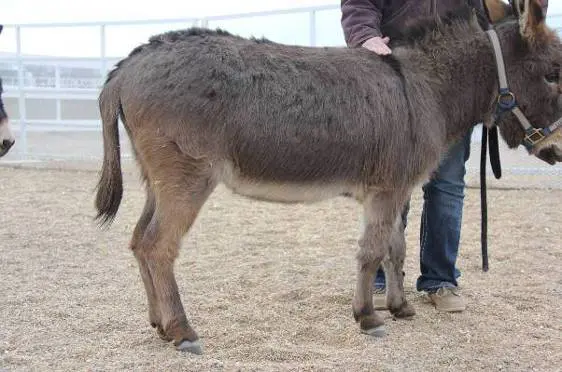
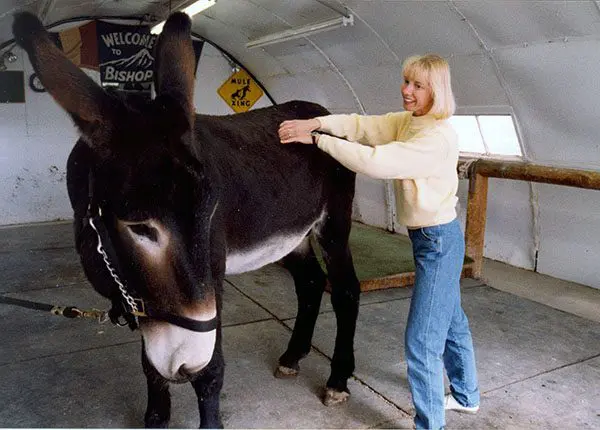
 Donkeys have a lot of behaviors that owners might find strange. One of these is dropping their spine, or “sinking,” when you put a hand on their back. Not all donkeys will do this, but many of them will, especially when they are young and or haven’t been handled routinely. I’ve personally had experience with donkeys sinking to the point that they’ll go down to the floor on their knees and bellies. You may also commonly recognize this behavior in cats and dogs.
In order to understand what’s happening, it is important to understand the intervertebral equine anatomy. “Intervertebral” refers to the opening between two jointed vertebrae for the passage of nerves to and from the spinal cord. When a foal is first born, their bones and cartilage are soft and flexible, and their nerves in these areas are hypersensitive — especially over the spine.

A foal that has not had the benefit of imprinting will be much more sensitive and generally reactive to touch than one that has been imprinted. Imprinting begins to desensitize nerve endings throughout the body wherever the animal is touched. However, the primary focus when imprinting is usually on the head, neck, ears, around the eyes, mouth, and down the legs, with only a passing swoop over the back and croup. Thus, the back does not get as much desensitization during imprinting and is largely ignored until grooming comes into the picture, and later, tack and equipment.
 As the foal ages, muscles begin to develop under and around the nerves thanks to ongoing exercise. When muscles get harder and toned, though still maintaining their elasticity, they put pressure on the nerves from the inside of the body. You will start to notice that the foal that used to “jump” out from under your touch is now increasingly tolerant, and his reactions are not as abrupt and overdone. Foals that are more active in their exercise tend to be less likely to sink their backs, as their hardened muscles have begun to desensitize the nerves to some extent. Softer, untoned muscles do not affect nerves in the same way, so less active foals will usually have a more drastic reaction to touch.
With the right kinds of controlled passive leading exercises, the foal’s body can grow properly, conditioning muscles symmetrically and allowing the body to develop balanced equine posture. This conditioning allows for efficient movement, maximum blood circulation, internal organs working as intended, joints bending correctly, and nerve impulses firing in an unobstructed and healthy manner. When the animal is not exercised with good postural balance in mind, his way of going can be compromised. Though his unbalanced movement may not be apparent to the untrained eye, it can still produce pinched nerves and pain. If you have an animal that sinks to your touch, it is up to you to determine whether the reaction is a case of sensitivity due to minimal touch, or a more serious case of pinched nerves.
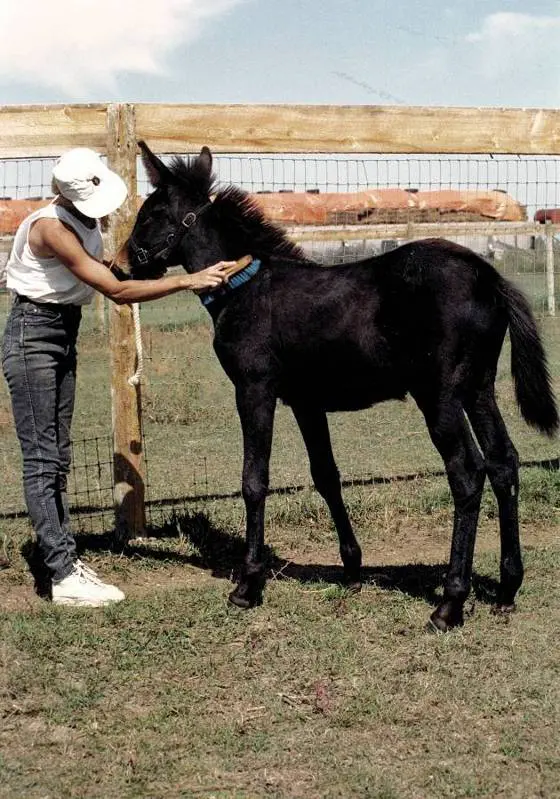 You can help desensitize your equine in a healthy way by continuing to imprint throughout the training process. Don’t just limit imprinting to a birth exercise, but pay attention to every phase and opportunity for touch. When grooming with the shedding blade for instance, pay special attention to the pressure over different places on your equine’s body. You can apply more pressure to fatty areas, but be sure to lighten up over the bony areas, as it can cause pain. Too much pressure over the spinal nerves will produce the sinking effect. When using your brushes over the body, be sure to use short flicks instead of long strokes. Short flicks induce more passive pressure over the nerves. This not only removes dirt more efficiently, but also provides more endurable pressure over the nerves that will eventually minimize your equine’s sensitivity. With these careful and detailed practices, the sinking effect will soon disappear.
These kinds of initial training practices will greatly enhance the training experience for both you and your equine. All behaviors, bad or good, arise from the way you do things with your animal, and you will only gain his trust when you make him feel good. When he feels good, his behavior will be good. Preparing him properly before asking him to carry tack and equipment, and later, a rider, will make the process much easier for him to accept, and will avoid the adverse behaviors and even painful or severe consequences that can develop without proper preparation. Be patient and always take the extra time to do the little things that will enhance your time together. It will be well worth the effort!
To learn more about Meredith Hodges and her comprehensive all-breed equine training program, visit LuckyThreeRanch.com, MEREDITH HODGES PUBLIC FIGURE Facebook page, or call 1-800-816-7566. Check out her children’s website at JasperTheMule.com. Also, find Meredith on Pinterest, Instagram, MeWe, YouTube and Twitter.
Covered in TRAINING MULES & DONKEY: A LOGICAL APPROACH TO TRAINING, TRAINING WITHOUT RESISTANCE, EQUUS REVISITED and A GUIDE TO RAISING & SHOWING MULES at www.luckythreeranchstore.com
© 2016, 2024 Lucky Three Ranch, Inc. All Rights Reserved.
Training the Jumping Donkey
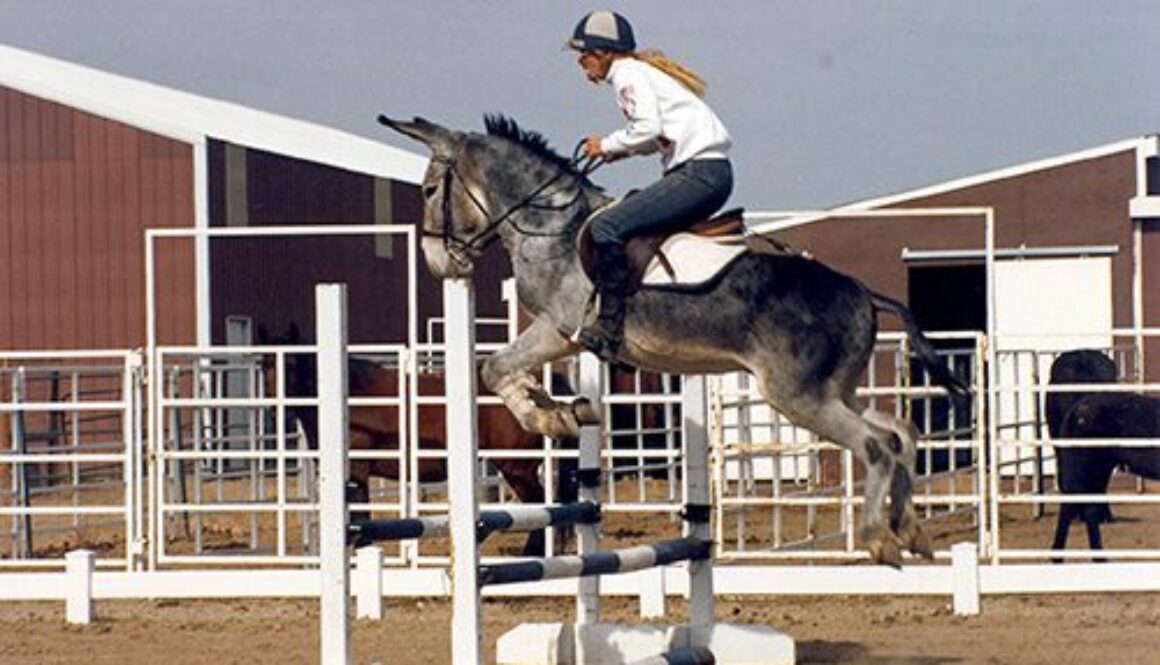
(Page 45) Donkeys have been labeled stubborn for centuries, but with the right approach, they are every bit as trainable and tractable as horses, mules and ponies. Donkeys just demand more consideration and respect to really want to perform for you. If you want to jump any equine, it is not advisable to just go out and start jumping. As with any equine athlete, the animal first needs to have gone through extensive ground work that addresses core muscle strength in good equine posture using intensive leading lessons on flat ground and through obstacles, lunging, ground-driving and basic under saddle work. This takes a lot of patience, time and symmetrical body-building through postural core exercises that address core strength in the elements around the bones.
When he is finally able to sustain his own balance with adequate core strength, he should be worked over 6-inch ground rails and cavalletti to develop bulk muscle and strength in the hind quarters that will be used to propel him over the jumps. Working over raised cavalletti will increase the power from behind and will begin to add much more suspension to his gaits. Once the four raised cavalletti are easy for him, he can move to jumping single cavalletti with ground rails on both sides to help him sustain good posture throughout the jump.
Finally, he can begin gymnastics through a line of simple ground rails, cross rails, vertical jumps and an oxer appropriately spaced with all rails first just lying on the ground. Raise the jumps in 3-inch increments on each jump as the line becomes easy for him beginning with the first rail. It won’t be long before he can jump the whole gymnastic line and all jumps that have been gradually raised appropriately to more formidable heights.
To learn more details about jumping, look in the various sections under TRAINING on my website at www.luckythreeranch.com. Particular videos about jumping can be found under TRAINING/TRAINING TIPS (#98 through #108).

MULE CROSSING: Donkey Training, Part 2
 By Meredith Hodges
If you have followed the steps outlined in Donkey Training, Part 1, your donkey should now—be easy to catch, let you put on his halter and lead, stand quietly while being groomed, allow you to pick up and clean his feet, follow you on the lead both over and around obstacles, load into a trailer, and follow your shoulder and your verbal commands. He should be happy and willing to be with you. This is a good time to let him watch other animals being worked, if possible. Donkeys and mules really can learn the purpose of their training when they see other equines being worked. When they are watching, you can almost hear them saying, “When is it going to be my turn?” They may actually be jealous of time spent with someone other than themselves. They’ll get to see other animals being tacked up in bridles and saddles and handling it well. When it is their turn to be saddled or bridled, they are not as afraid as they might have been if they had never watched.
Another good idea is to lead them around the area in which you will be working, so you can “inspect” it together. This allows them time to see if there is anything to which they may take exception before you start asking them to do anything. They will appreciate your consideration and be more willing to work for you. Don’t assume that, just because they were there the day before, they will remember that it was all right. Begin each new day with a brief walk around the schooling area. After all, things do have a way of changing from day to day, even if it is as slight as a new plant, or a stick, or anything that wasn’t there before. You may not remember things in such minute detail, but donkeys definitely do. This is one way you can minimize distraction and resistance during the actual training process.
Now you and your donkey will begin his training in a round pen, or a small pen that has been modified so that the corners are rounded. Take him into the round pen with only his halter and lead. The first thing he will need to learn is to move away from pressure. Donkeys naturally move into pressure and are terrific “crowders.” They always seem to want to be as close to you as possible. I would suspect that this is a defense tactic. Horses and mules have the initial natural instinct to flee when they think they are in danger. Donkeys are just the opposite and will freeze. If a donkey is attacked, he will move his body into the predator in hopes of knocking him to the ground, where he can then use his hooves and teeth for defense. It is important that you teach him right from the beginning that you are not a predator and that he must not move into you. If he does knock you down, it could be very dangerous, especially if he is a jack.
 Take your donkey to the middle of the pen and ask him to “whoa.” Reward him for whoa, then step toward his shoulder—pulling his head toward you—tap him on the flank and stifle, and ask him to “move over.” Do not move your body unless you absolutely have to. You want him to keep his front end bent toward you, step under with his near hind leg, and begin to execute a turn on the forehand. This means his front legs will stay stationary while the hind legs move around them and away from you. You want your donkey to take only one step each time you tap him, so don’t get carried away and tap him too hard. We are laying the foundation for hindquarter control and it is easier to let him move slowly, one step at a time, in the beginning than it is to ask him to slow down from too many steps later on. Watch his hind legs to make sure he crosses in front of the offside hind, and stop and reward him after each tap and step. He will probably double in the barrel and move his front legs as well in the beginning. As long as he moves his hindquarters away from you, reward him and repeat. We can perfect his style as he learns what is expected. The first few times, ask only for one or two steps. When he has done this exercise on the near side (left), repeat them from the off side (right). During each session, you can ask for a few more steps in each direction.
 When he is doing the turn on the forehand fairly easily (it doesn’t have to be perfect), you can begin to teach him to move his shoulders away from you with a turn on the haunches. This is much more difficult, since donkeys love to “glue” their front feet to the ground. Take the side of his halter in your left hand, ask him for one step forward and push his face away from you as far as your arm will reach. Then, in the right hand with the end of the lead, tap him firmly on the shoulder and give the command, “Over.” If his hindquarters come around, leave your left hand on the halter and take your right hand and use your body weight to shove him over one step. Stop, praise and reward him for moving his shoulders (even if you had to do all the work). Now try again, tapping him with the end of the lead. If he still won’t move his shoulders, repeat as before. If he does not begin to try to move his shoulders after three tries, use a riding crop in your right hand and tap the shoulders sharply with it—only once! He will probably be so surprised that he will step over quickly. Be ready to reward him when he does. Then stop your lesson there. You can ask for two steps in each direction during the next session. If you try to do any more, you will encounter resistance and he will be unwilling to perform and may run off, so be patient and be ready to take all the time HE needs.
Next, you will teach your donkey to back up. Hold the lead in your left hand, pull down and back, release, down and back, and release while you give the command, “Back.” If he doesn’t take a step back, use your right hand to push and release on the middle of his chest. It is most effective if you use only one finger, and you may have to push hard before you release to get the desired response. When he takes one step back, no matter how small the step is, reward him with a treat, praise him and stroke him on the shoulder, wither, or poll, or scratch his chest—whichever pleases him most. Do this exercise no more than three times, and then end your lesson. You can ask for a better response the next time.
 Repeat these three exercises until he begins to move easily away when you ask. It may take three or four sessions. When he does comply easily, you can begin to teach him to lunge. Review these exercises every time you begin your training session. Then release the lead from the halter. Hold the lunge whip in your left hand and use your right hand to point to the right (the direction you wish him to go). Raise both your arms in unison and tell him to “walk on.” If he doesn’t move away, lower both arms and raise them again, repeating the command. If he still won’t move out, give the verbal command again and give him a firm tap on the gaskin, just below the tail and above the hock, then take a step back and wait for him to comply (donkeys need time to think). If he still won’t move, repeat this action until he does. Once he does start moving away, follow behind and to the side at a distance that he will tolerate. This distance will vary with the individual donkey.
You can determine the distance you need to keep from your donkey to get the desired response by watching his reaction to you. When you are too close, he will stop and tuck his tail. If you are too far away, he will slow his gait and begin to  wander. When you are the correct distance, he will walk forward, although, in the beginning, he will hesitate after every step or two. Practice moving into him and away from him to get him to move. Try to stay out of his space and keep him moving forward after the initial tap of the whip. If he stops and doesn’t seem to want to move, strike the fence behind him once you have him on the rail. Try NOT to hit him if at all possible. Remember, donkeys freeze when they are confused or frightened and you will get nowhere with him at that point. He needs to learn, but he also needs to enjoy what he is doing. Don’t forget to reward him frequently, but be sure that you ask him to go further each time, or you may find yourself training him to walk only so many steps at a time. In the beginning, ask him to go in only one direction and change directions at each session. You can teach him to reverse and go forward later, once he has learned what you are asking.
When training your donkey, make sure you have plenty of time: You never want to get in a hurry. You want your time together to be a fun and enjoyable experience, with each of you learning about and from the other. Most of us today are on fast-forward but remember—your donkey is in slow-mo!
To learn more about Meredith Hodges and her comprehensive all-breed equine training program, visit LuckyThreeRanch.com, MEREDITH HODGES PUBLIC FIGURE Facebook page, or call 1-800-816-7566. Check out her children’s website at JasperTheMule.com. Also, find Meredith on Pinterest, Instagram, MeWe, YouTube and Twitter.
Covered in TRAINING MULES & DONKEY: A LOGICAL APPROACH TO TRAINING, TRAINING WITHOUT RESISTANCE and EQUUS REVISITED at www.luckythreeranchstore.com.
© 1999, 2016, 2024 Lucky Three Ranch, Inc. All rights reserved.

MULE CROSSING: Donkey Talk
By Meredith Hodges
Donkeys are indigenous to desert areas that are often extremely hot or extremely cold. They are tough, surefooted due to the unique shape of their hooves, resistant to parasites, and disease and can withstand wide variations in climate. They require very little to survive and actually prefer the wide variety of brush and weeds that occur naturally in the desert with one of their favorite foods being dandelions.
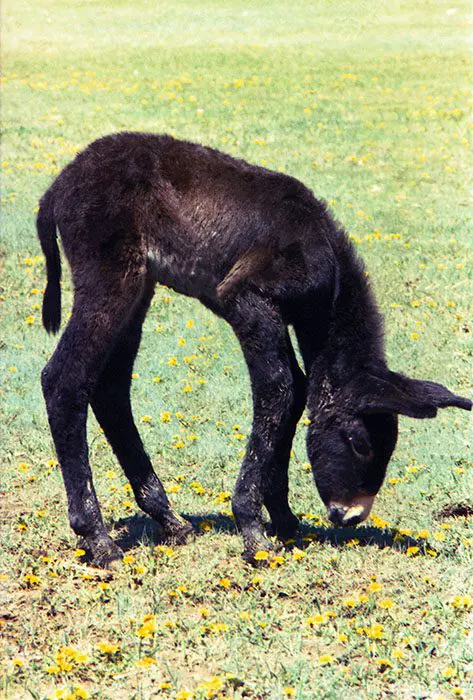
Donkeys possess an incredible hair coat that does not shed off completely like horses do in the summer months. In their first year, a young donkey will keep his thick hair coat throughout the summer and won’t lose most of the hair until August.

In August, he will not have the thick hair coat, but will retain some longer, wispy hair unlike the horse. This thick hair is meant to insulate the foal against extreme heat and cold until he is able to develop enough body fat to help regulate the temperature throughout his body. It will stay thick inside the ears and will protect the donkey foal from parasites, bugs and severe trauma.

In one short month, the young donkeys will begin to grow back their thicker, winter under-coat in September in preparation for the cold.

As the donkey ages into the prime of his life, he has a covering of body fat to help keep his temperature insulated and the thicker hair is no longer as long and shaggy. Of course, there are some breeds of donkeys that will grow more thick hair than others, but the shaggy hair as an adult is generally reserved for the French Poitou Donkeys.

As the donkey gets to be over 25 years of age, he will begin to grow thicker hair year round to compensate for his loss of body fat due to old age.


When we show our donkeys, we body clip them, but if this is done, it is imperative to blanket them if it gets too cold and provide a light sheet during the cool summer nights.
Understand that they now no longer have the PROTECTION of their unique hair coat. When traveling, donkeys will sit back in the trailer and can rub themselves raw during the ride, especially if they have been clipped. When unclipped, the hair coat will keep this kind of damage to a minimum.

If your donkey does get these kinds of sores, they can usually be healed fairly quickly with a daily application of Neosporin ointment (Photo below was taken one week later). Note that when you clip, there is also the consideration of sunburn.

If you clip your donkey for show and need to haul any distance at all, you should protect his precious rear end by using a blanket or sheet secured over the hind quarters. The best course of action is not to body clip your donkey at all if you do not show. Remember, he’s a desert animal and Mother Nature has already provided him the protection that he needs against the elements.


To learn more about Meredith Hodges and her comprehensive all-breed equine training program, visit LuckyThreeRanch.com, MEREDITH HODGES PUBLIC FIGURE Facebook page, or call 1-800-816-7566. Check out her children’s website at JasperTheMule.com. Also, find Meredith on Pinterest, Instagram, MeWe, YouTube and Twitter.
© 2017, 2018, 2021 Lucky Three Ranch, Inc. All Rights Reserved.
Shedding
(Page 62)
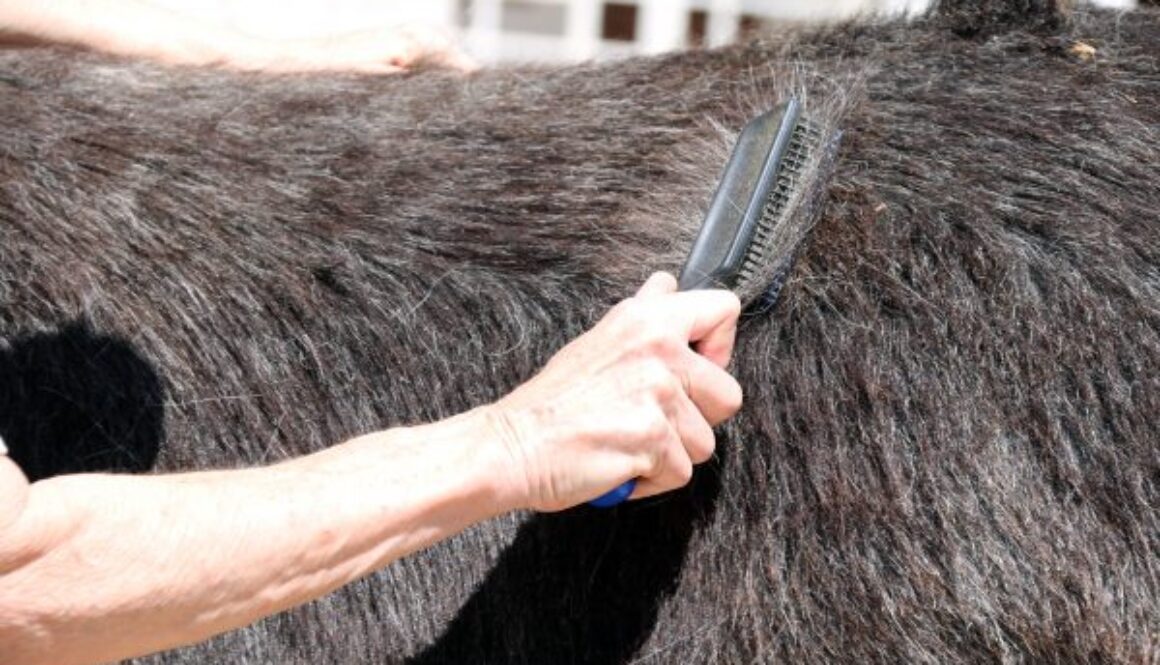
Finally, it’s spring and SHEDDING time again! In my experience it is better to start grooming your equine with a plastic multi-bristled, human hairbrush to get the dead undercoat off your equine than to use a shedding blade at first. The shedding blade cannot reach the shorter undercoat and can break off healthy hair shafts. The 20 hairbrush works particularly well on the thicker donkey hair coats that can easily get tangled. If you use the hairbrush first, you can come back over it lightly with the shedding blade and it will only remove the dead, longer hairs that are already loose. Doing it this way will pull the undercoat from the roots that are ready to let go and won’t cause breakage of healthy hair. After the hair brush and shedding blade, a quick once over with a damp (but not wet!) dandy brush, will remove the excess dust from the aerated coat. A sprinkle of Johnson’s baby oil in the mane and tail will soften the hair, make it easier to comb over, and will keep equines from chewing on each other’s manes and tails during mutual equine grooming and playtime. Learn a lot more under TRAINING and in our STORE for much more information about the management and training of your equine at www.luckythreeranch.com.

MULE CROSSING: Surge of Mule Shows
By Meredith Hodges
 I remember back in 1982 when summer came and we had to search high and low for shows in which we could compete with our mules! As they say, “You’ve come a long way, baby!” Mule shows are now so numerous that it is becoming very difficult to decide which ones to attend. Years ago, our mules were not necessarily welcome at horse competitions, and today that has changed as well – making our decisions about where to compete is even more complicated. It is truly amazing to see the tremendous growth in popularity of the mule over the past 30 to 40 years, but then I guess it was inevitable given all their redeeming qualities! It really isn’t that unusual that people would begin to prefer mules once they received accurate and truthful information about them. Granted, you have to be smarter than the mule in order to train one, but once you train one properly, you have a wonderful companion and a top competitor in the equine world. More and more, the criticism of mules has changed to general curiosity and a willingness to learn more about these unique animals. Many people have taken a great deal of time and effort to bring these animals into the public eye. To name them all would take volumes, but their work is certainly appreciated!
 As I said, there are many all-mule and donkey shows that you can attend in most states across the U.S. Most of them are held in conjunction with State Fairs. However, there are others that are promoted with horse and mule races as well. The American Donkey & Mule Society sponsors a National Mule and Donkey Show that floats from state to state. The 1992 A.D.M.S. Nationals were held in conjunction with the South Carolina State Fair. There were some truly lovely mules to see in our eastern United States.
 Breed shows are another place you will see mules today. In many places, you will see mules competing in their classes sandwiched between classes for anything from Draft Horses to Arabians and Saddlebreds. Many of these breed shows not only included a mule division, but allowed mules to compete in their Open Classes as well against the various horse breeds. In 1991, our own Lucky Three Mae Bea C.T. competed in an Open English Pleasure class of primarily Saddlebreds and American Show Horses to sixth place of 20 entries. It is nice to know that the judges were taking mules seriously, as well!
 The American Driving Society has been quite supportive itself! They encourage mules to participate in the many facets of driving that they offer, from pleasure, to fun events to actual marathon driving. In these shows, the mules are allowed to compete directly with the horses. Shows such as these tend to really test the knowledge and expertise of the trainer and the conditioning and response of the animals. Integrity in progressive learning is encouraged while stark competitiveness and politics take a back seat. This type of situation is much more appealing to the novice who wants to learn and improve his and his animal’s skills.
The United States Dressage Federation is another group that has encouraged mules to come and compete in their schooling shows, giving mules the opportunity to train and show with the best that Horsemanship has to offer. Showing was limited to non-A.H.S.A. (American Horse Show Association) shows, but nevertheless, quite adequate and beneficial for our mules. It is understandable that they should not compete with horses and riders that are competing for National and International Championships, and sometimes for Olympic recognition. It could offset the points system drastically should a mule compete, being ineligible for such events anyway. The A.H.S.A. has stated that these championships are horse competitions.
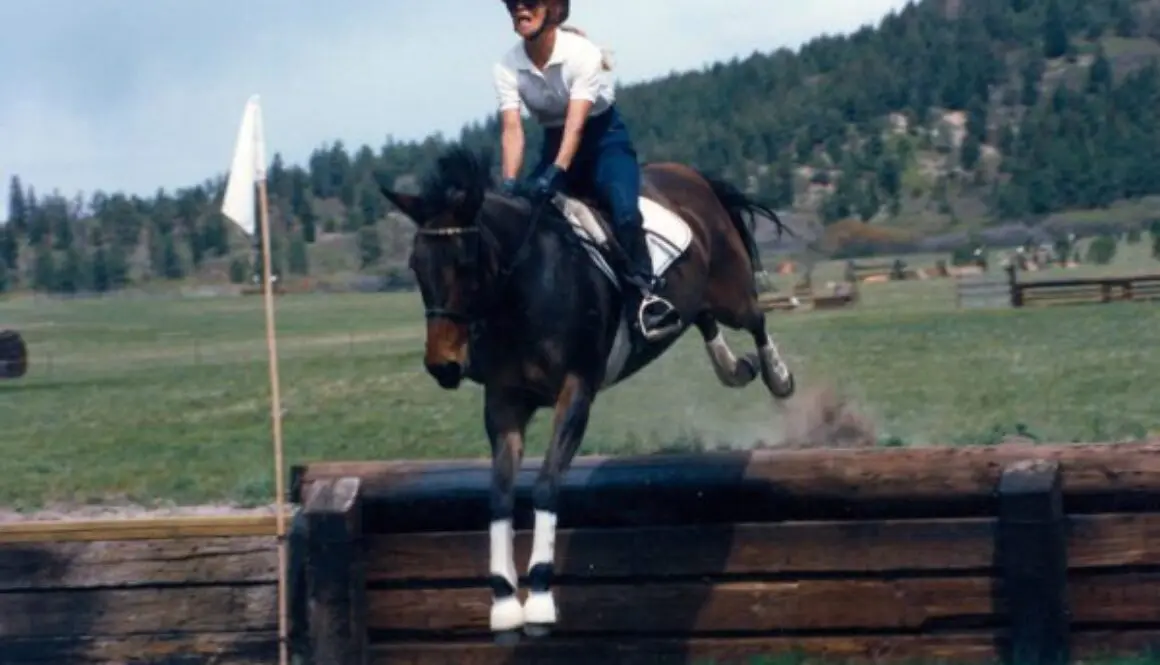
 The United States Combined Training Association left it up to each region to decide whether, or not, to allow mules to compete and some areas are more tolerant than others. Dressage and Combined Training offers the ultimate in fitness and conditioning of both animal and rider. Because it requires so much physical exertion and skill, everyone is accustomed to discussion on gross errors and wrecks with little or no embarrassment. This makes for a great learning environment with a lot of positive social interaction. We have had a lot of fun for three years competing with the Mountain States Combined Training Association and the Windy Wyoming Combined Training Association. They were a great group of folks from the organizers to the competitors. When Lucky Three Mae Bea C.T. came in second in 1992 in the Open Novice Division at the Abbe Ranch Horse Trials in Larkspur in June, organizer Susan Farmer presented our ribbon and warmly said, “We’re not prejudiced here! Congratulations!” I think it is more important to these folks to see that people enjoy the sport and more over, to continue to want to participate and learn. This makes for attainable long term goals, and even more… it makes for long term friendships.
 If you are not really the competitive type, but enjoy the simpler side of showing in gymkhana events and pleasure classes, there are a lot of small Open Shows that you can attend sponsored by various saddle clubs across the U.S. They will usually let the mules compete right along with the horses. Learning and having fun are again the key issues here.
The mule has been proving his worth now, more than ever in Competitive Trail Riding and Endurance Racing. When you talk about Competitive Trail Riding in Colorado, you have to give credit to Cee Wolf who really excelled with her mules in this area of equine athletics, even at 80 years of age! She is another lady who has done great promotional work for mules! I would like to thank the millions of people who have given of themselves, that mules might be seen for whom they really are… a truly wonderful companion and a magnificent athlete and performer!
To learn more about Meredith Hodges and her comprehensive all-breed equine training program, visit LuckyThreeRanch.com, MEREDITH HODGES PUBLIC FIGURE Facebook page, or call 1-800-816-7566. Check out her children’s website at JasperTheMule.com. Also, find Meredith on Pinterest, Instagram, MeWe, YouTube and Twitter.
Covered in TRAINING MULES & DONKEY: A LOGICAL APPROACH TO TRAINING, TRAINING WITHOUT RESISTANCE and EQUUS REVISITED at www.luckythreeranchstore.com.
© 2013, 2016, 2024 Lucky Three Ranch, Inc. All Rights Reserved.
MULE CROSSING: Neonatal Isoerythrolysis
By Meredith Hodges

“Neonatal isoerythrolysis (N.I.) is a condition in which the mare creates antibodies against the foal’s red blood cells, and then passes these antibodies to the foal via the colostrum. Once the foal absorbs these antibodies, they result in lysis* of the foal’s red blood cells within 24 to 36 hours after birth. This red blood cell destruction is widespread throughout the foal’s body and can lead to life-threatening anemia and/or jaundice. (This is similar to the human Rhesus, or Rh, factor, where a woman who is Rh-negative gives birth to her second or subsequent child that is Rh-positive, resulting in destruction of the newborn’s red blood cells.)”1
All legitimate mule breeders should be aware of this condition, especially because it can occur more often when breeding donkey jacks to mares than it does when breeding stallions to mares within the same species. If the hybrid foal’s blood type is the same as its mother’s, then there is no problem. However, when the jack and the mare have different blood types, and the foal possesses the jack’s blood type, there is potential for N.I. to occur.
 On the surface of the mare’s red cells are antigens that will stimulate the production of antibodies against incompatible red blood cells (R.B.C.s). There are basically two ways that these R.B.C.s can get into her system:
1) If the foal’s R.B.C.s enter the mare’s circulation via the placenta during pregnancy or during delivery.
2) If the mare obtains these incompatible cells during a blood transfusion.
If neither of these conditions occurs, the mare can carry, birth and nurse her foal with no problem. However, if the incompatible red cells do somehow get into her system, she will begin making antibodies against those cells that, in turn, will be passed into the foal’s system via the mare’s first milk, or colostrum.
“Signs of neonatal isoerythrolysis depend upon the rate and severity of red blood cell destruction. Affected foals are born healthy, and then typically develop signs within 24 to 36 hours. In severe cases, the signs of N.I. may be evident within 12 to 14 hours, whereas in mild cases, signs may not be present until three or four days of age. N.I. foals will develop progressive anemia, thus leading to depression, anorexia, collapse and death. These foals may also develop pale mucous membranes that later become yellow or jaundiced.”2
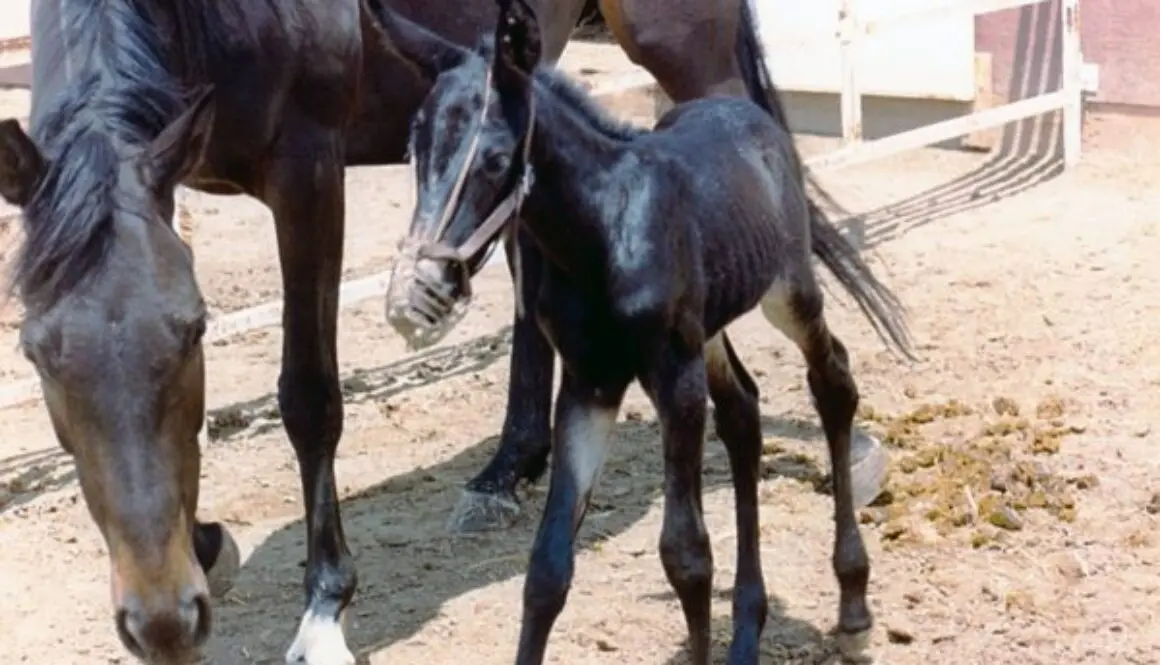
 The mare’s blood can be tested ahead of time to determine if she has a different blood type than the jack (or stallion), but a positive test result does not necessarily mean that N.I. will automatically occur, only that there is the possibility for occurrence. Blood samples from the mare and jack should be taken two to four weeks before the mare is due to foal to determine if she is producing antibodies against the foal’s red blood cells. If the blood test is positive, then precautions must be taken to save the foal at birth by making sure it is prevented from nursing its dam for the first 24 to 36 hours. The foal should be muzzled and bottle-fed colostrum from a mare that has not produced these same antibodies, and therefore is compatible with the foal. To be absolutely safe, the colostrum should be obtained and tested from a mare that has never had a mule foal.
For the best results in building the foal’s immune system, this “replacement” colostrum should be collected within the first six hours after birth. The mare being used does not need to be the same blood type as the foal, but her blood must not contain antibodies to the foal’s R.B.C.s. The quality of the colostrum will determine the amount fed to the foal. Immediately after birth, the foal should be given two to three feedings of colostrum within the first two hours, and then be given milk (for energy) for the first 24 to 36 hours after that. Goat’s milk is best for this purpose. After 24 to 36 hours, the foal should be able to be safely returned to its dam’s milk. If N.I. is present but is caught early enough, the foal can be transfused with blood and there is a chance that it may live, but this transfusion procedure has inherent risks and there are no guarantees of success.
Out of concern for future mule offspring, the Lucky Three Ranch—with the assistance of our veterinarian, Kent M. Knebel, D.V.M.; Colorado State University researcher, Josie Traub-Dargatz, D.V.M., M.S.; and Louisiana State University researcher, Jill McClure, D.V.M., M.S.—began thorough testing of Lucky Three Ranch stock in the early nineties, with particular attention paid to our breeding jack, Little Jack Horner. It was discovered by Dr. McClure that Little Jack Horner’s R.B.C.s were resulting in unidentifiable antibodies in many of the horse mares that carried his foals. The mares that were sampled had antibodies present, but Dr. McClure was unable to “type” the antibodies found in the mares.
 The next step was to immunize some research horses at L.S.U. using Little Jack Horner’s R.B.C.s. If they made antibodies, Dr. McClure would have a more readily available source of antibodies for further research. She also took samples from some burros from another L.S.U. project and discovered that they, too, had the same R.B.C. factor that occurred in Little Jack Horner, but the antibodies produced in the mares were still unidentified. There was already quite a bit of medical and scientific data on N.I. that could help in the prevention of this potentially fatal condition. However, this discovery of new antibodies stimulated by the jack and produced by the mare proved that there was still a lot more that needed to be learned. All of Little Jack Horner’s tests showed him to be of a compatible blood type to the mares if he was a stallion of the same species, and yet these unknown antibodies were being produced. Perhaps future research will hold the answer to this puzzle.
A debt of gratitude is owed to veterinarians like Dr. Kent Knebel, who take time out of their busy schedules to collect samples for this research, and to dedicated researchers like Dr. Josie Traub-Dargatz and Dr. Jill McClure, who continue with this important research that benefits our mule industry and its future generations. Their ongoing research will continue to have a significant impact on mule breeding programs, not just here in the United States, but all over the world.
Research on N.I. has been done over the years on Thoroughbred horses, and statistics indicate that 20 percent have incompatibilities between dam and sire, yet only one percent of foals develop N.I. The incidence in mule breeding suggests that the rate is higher. The University of California at Davis has a laboratory set up to do this initial N.I. testing on mares. Consult with your veterinarian about contacting any facilities for information on how to collect and ship samples for N.I. testing, and for resources that can help in the process.
To learn more about Meredith Hodges and her comprehensive all-breed equine training program, visit LuckyThreeRanch.com, MEREDITH HODGES PUBLIC FIGURE Facebook page, or call 1-800-816-7566. Check out her children’s website at JasperTheMule.com. Also, find Meredith on Pinterest, Instagram, MeWe, YouTube and Twitter.
Covered in TRAINING MULES & DONKEY: A LOGICAL APPROACH TO TRAINING, TRAINING WITHOUT RESISTANCE and A GUIDE TO RAISING & SHOWING MULES at www.luckythreeranchstore.com.
© 2013, 2016, 2024 Lucky Three Ranch, Inc. All Rights Reserved.
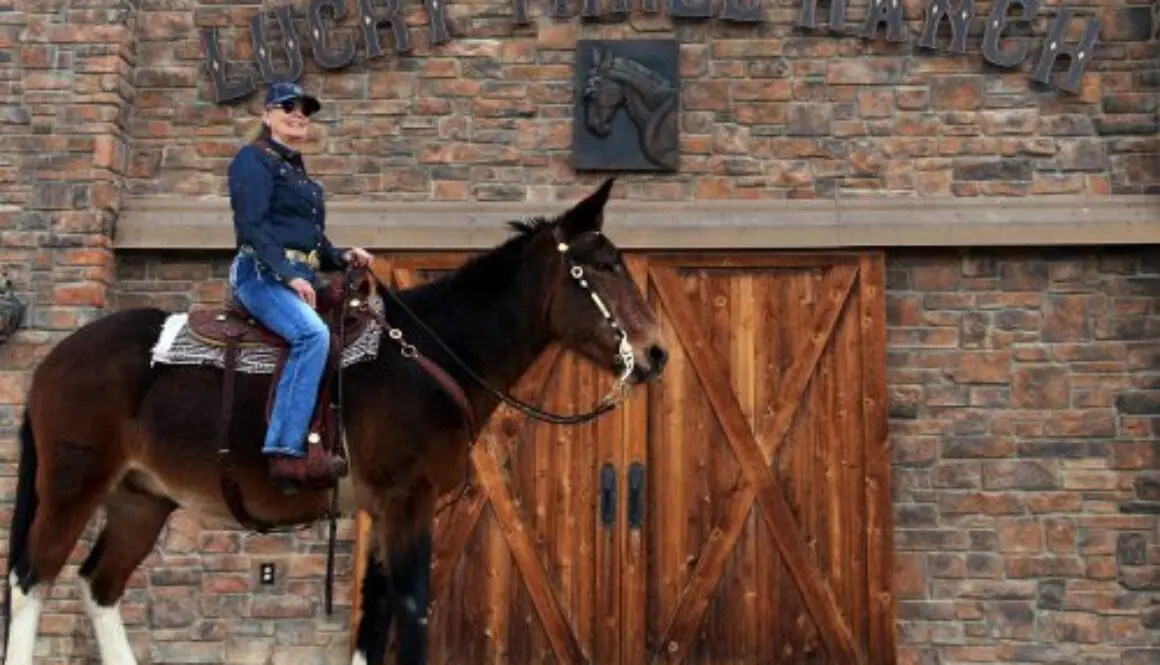
MULE CROSSING: Lucky Three Ranch – 45th Anniversary
By Meredith Hodges
It’s hard to believe that I have already spent 45 years in the business with not only mules and donkeys, but a vast array of equine related activities. I have always loved horses and began riding when I was only two years old. I was about as horsey as a girl could be and when not riding, it was still horse books, drawing horses and engaging in anything that remotely resembled a life with equines. At one point, I even designed a 100-stall barn and vowed to rescue every horse in our country that was being abused. Little did I know then, my 100-stall barn would be terribly inadequate.

I actually founded the Lucky Three Ranch in Loveland, Colorado in 1980 although I had many years with horses and six years with mules before then. I moved to Colorado with the intent of going to Colorado State University to get my veterinarian credentials, so I sought out places to live in Fort Collins. It was a fluke that a contract fell through and this tiny little 10-acre sheep ranch became available. I remember standing in the driveway, my vision crystal clear in my head, and told my mother, “This place HAS LOTS of possibilities.” She gave me a condescending nod and said, “It definitely has lots of possibilities.” I don’t think she had any idea of what was to come! But, after all, the vision was MINE!

Since, I began a journey that has led me from equine breeding and training for mules and donkeys, through showing, then judging and giving clinics. I developed the first ever equine training correspondence course with my videos. I revised them for television and was on numerous channels and RFD-TV for 11 years. After going off television, I adapted my award-winning TV Shows for VIDEO ON DEMAND from my website at www.luckythreeranch.com and expanded our presence on Social Media. I have written 3 hardbound books and 3 manuals on equine management and training that all complement each other. They overlap, but are not duplicated. There is a lot to learn and the learning never ends. The addition of the DVDs provided the most comprehensive management and training series ever to hit the equine industry. Since I have always documented EVERYTHING I learned, I produced numerous TELLY AWARD WINNING documentaries that are also in the VOD section of my website. I decided to go this route because of the lack of continuity in the management and training materials that I had to work with while I was growing up. I saw and personally experienced the therapeutic value of equines and became intimately involved with the HEARTS AND HORSES THERAPEUTIC RIDING CENTER (www.heartsandhorses.org) located just a few miles from my Lucky Three Ranch. The interaction with this program inspired me to write my children’s series of books and videos, and even a music CD, Jasper the Mule. I launched this fun and educational children’s series by writing a letter from a baby mule named JASPER to myself stating his concerns about training and his perception of trainers from the mule’s point of view.

The Lucky Three Ranch slowly became even more than the vision that had in my mind 45 years ago! My interest and influence in the equine community grew into something much more expansive than my original 100-stall barn. It grew into the LOVELAND LONGEARS MUSEUM & SCULPTURE PARK at LUCKY THREE RANCH! We opened the ranch to tours and each tour is a personalized clinic for those who attend. I can now reach hundreds of thousands of people worldwide and am now in a position to be able to teach them how to appreciate and enjoy their equines as much as I enjoy mine and share it in a multitude of different ways. It is so incredibly rewarding when I see happy animals with happy owners doing the things that they love together! This is the gift that I have been given in life by my Maker to share with others and their joy is my reward! Thank you to all of my friends and fans for your loyalty and support! I couldn’t have made 45 years without you and the magnificent equines that color my life! The ultimate gift for me is to be able to see all of you enjoying LONGEARS as much as I do, and to see you going forward to accomplish great things and become amazing ambassadors of the breed!


To learn more about Meredith Hodges and her comprehensive all-breed equine training program, visit LuckyThreeRanch.com, MEREDITH HODGES PUBLIC FIGURE Facebook page, or call 1-800-816-7566. Check out her children’s website at JasperTheMule.com. Also, find Meredith on Pinterest, Instagram, MeWe, YouTube and Twitter.
Covered in TRAINING MULES & DONKEY: A LOGICAL APPROACH TO TRAINING, TRAINING WITHOUT RESISTANCE, EQUUS REVISITED and A GUIDE TO RAISING & SHOWING MULES at www.luckythreeranchstore.com.
© 2015, 2016, 2025 Lucky Three Ranch, Inc. All Rights Reserved.

Happy Easter: Donkey’s Cross: The Legend
(Page 25)
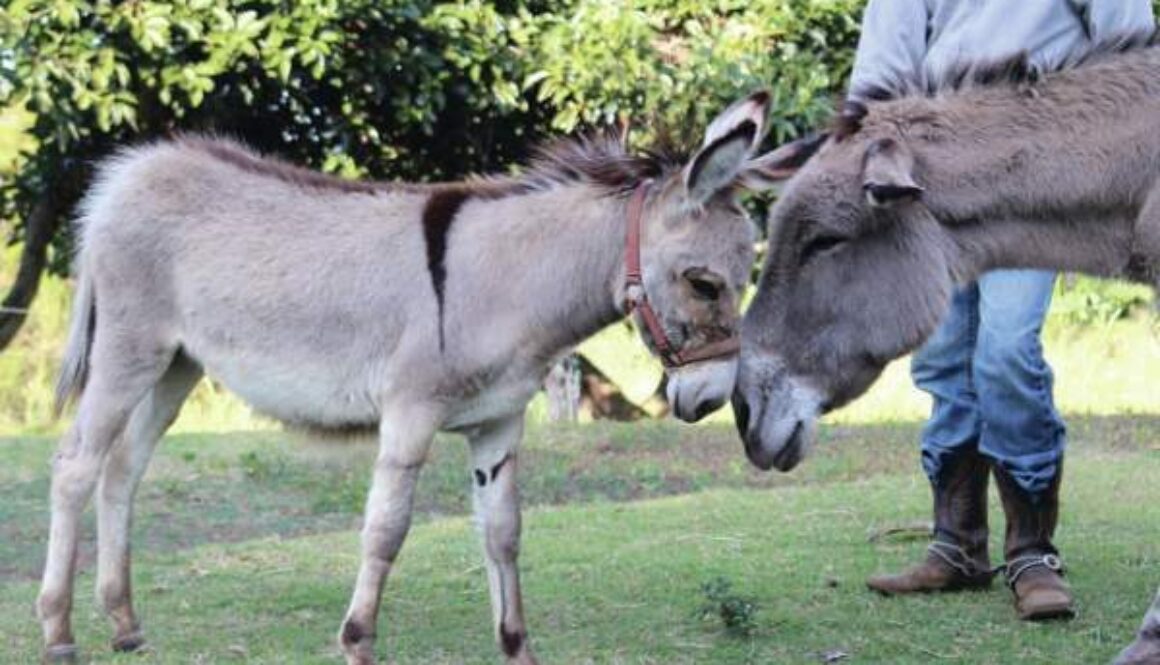
The story is told that the donkey that had been Jesus’ mount on Palm Sunday, came to the hill of Calvary.
Seeing the tragic event taking place, he wished with all his heart that he had been able to carry the cross for Jesus, as he was the proper one to carry heavy burdens.
Ashamed of what was happening, the donkey turned his back on the sight, but would not leave for he wished to stay until all was over because of his love for Jesus.
In reward for the loyal and humble love of the little donkey, the Lord cast the shadow of the cross to fall across his back and left it there for the donkey to carry forever more as a sign that the love of God, no matter how humble, carries a reward for all us to see.
Published by The American Donkey & Mule Society


MULE CROSSING: Looking Objectively at Your Equine
By Meredith Hodges
 Before most of us learn anything about horses, mules and donkeys, we tend to initially perceive them as large, strong and durable animals that can safely carry us anywhere we want to go and can participate in any number of equine events. This is essentially true. However, there can be a number of pitfalls along the way if you do not educate yourself and practice good maintenance, feeding and training practices.
Equines, like people, are comprised of living tissue, bones, muscles and tendons that can often experience improper growth and development, which can compromise their performance. This is why it is important to feed your equine’s living tissue, bones, muscles and tendons a healthy diet and exercise him in a way that builds these elements using natural and non-stressful techniques that will help your equine to strengthen properly in the right frame, or posture.
It is also important to make sure the tack you use fits well and is adjusted properly. An equine that is experiencing soreness from ill-fitting tack will be distracted from his best performance. Improve your own skills by taking care of your own body as you observe and condition your equine. The person who eats healthy food, exercises in good posture and improves his or her own general conditioning, coordination and Horsemanship skills will not be out of balance and will not compromise the equine’s ability to perform.
 Let’s take this one step at a time. First, make sure that your equine is stabled in a place where he has adequate shelter from the elements, plenty of room to exercise himself when you are not there, clean water and a good feeding schedule. When an equine is nervous or high strung, it can usually be attributed to this very elemental beginning. Many show horses are kept in 12-foot by 12-foot stalls with limited turnout during the day, usually only an hour or two. Think about this for a minute. The equine is a grazing animal and his natural health is enhanced by what he eats and the fact that he is moving with his head down most of every day of his life. The only time his head is truly raised is when he is on alert.
The equine that is stabled in a stall isn’t urged to have his head down for any more time than it takes to eat up the loose hay after his feedings. His body is forced to remain in a very small range of movement and he can become stiff and sore when asked to do things that require more flexibility in his work. When fed high protein feeds in this situation, he is not able to expend the energy to burn this feed, and it can manifest itself in nervous and anxious behavior. Therefore, it is critical to your equine’s health that he is not only fed the right kinds of feeds and supplements, but that he is able to expend this energy in a healthy way for his body to grow and develop properly.
 Muscles in the equine’s body, like our own, are structured in distinctive layers and are supported by ligaments and tendons. These muscles need to be strengthened in a specific order for optimum performance. Whether he is a foal or an older animal, his athletic conditioning needs this taken into consideration. The first exercises should be passive and easy to facilitate the strengthening of the core muscles closest to the bone. This is done with exercises on the lead line. It is not as important that he learns to negotiate obstacles on the lead line as it is how he negotiates the obstacles on the lead line.
On the approach to an obstacle, your equine needs to be relaxed and comfortable. It is your job as his trainer to show him how to do this. When you lead in good posture, walk straight lines and make smooth, gradual arcs and turns, you will encourage your equine to do the same. Using short pauses between changes of pace or direction will help your equine to stay calm and receptive to training.
 For instance, when approaching a bridge, walk with your equine’s head at your shoulder as if you were in a showmanship class. Stop at the foot of the bridge and encourage your equine to stretch his nose down and investigate the bridge in order to allay any fears he might have. When your animal has indicated he is not afraid by once again raising his head level with his withers, you can proceed. Face the bridge straight on, looking straight ahead and, while keeping his head at your shoulder, take the first step straight forward and onto the bridge, making sure he follows and places one front foot on the bridge itself. Next, ask him to place the other front foot onto the bridge, stop, square up his four feet (as in Showmanship) and reward. Continue forward in a straight line. Once all four of his feet are on the bridge, stop, square up and give him a reward. Then continue across the bridge maintaining your own good posture, hesitate at the last step, and then step off carefully, in good balance and with a coordinated effort. Ask him to place his two front feet on the ground while leaving the back feet on the bridge, stop, square up and reward. Your equine will learn to follow your lead and execute the task in the same balanced and coordinated manner and will be able to halt on command at any location.
In the beginning, your equine may be fearful and nervous about going over the bridge or any other obstacle. It is enough at this time that he gets over his fear and just crosses it, whether it is done with finesse or not. Once he is over the fear of crossing the obstacle, you can begin working on his ability to cross with finesse, balance and coordination. The longer you work on perfecting the negotiation of an obstacle in a balanced and coordinated way, the stronger the participating muscle groups will become and the more comfortable and automatic the movement will become until it develops into a habit.
The part you play in all of this is very important. You will discover that if you are not in balance and coordinated in the way you move with your equine, the less balanced and coordinated he will be. If you don’t walk straight, then neither will he. If you are not confident in your approach, then he won’t be either. Even something as simple as the tack you use will play a big part in your equine’s performance. If the halter is too small or too large, it can cause irregular pressure on your animal, preventing him from complying with your wishes. How you move your equine’s head with the halter and lead line can affect his performance. Pay attention to how hard you need to pull to get even the smallest response and be ready to release pressure immediately upon compliance. But again, when releasing pressure, just give him enough slack to release the pressure and not so much that you have a lot to take back later. This will help him keep his attention on you and the task at hand. Keep this minimal degree of pressure-and-release throughout his work. Even if he backs away from an obstacle, just give little tugs followed by a release to allow him to back and then encourage him to re-approach the obstacle by coming from another angle or by coaxing him with the promise of a reward upon his attempt. Another approach is to go to the end of the lead rope, keep the rope taut and invite him to come forward by revealing the oats reward he will get when he complies. Take up the slack as he approaches. Avoid resistance at all costs!
 Halters that are too loose allow too much lag time between the time you ask by giving a tug and the time the equine receives the message. This usually results in an over-reaction from your equine and then an over-reaction from you as you try to correct the mistake. A halter that is too tight can be a distraction because it can create sore spots—the equivalent to a headache and no one likes to perform with a headache! The lead line typically should be a length that you can easily handle and that will give your equine some room to move away, but that can be reorganized easily, usually about six to eight feet long.
No matter how careful you may be, there will always be times when your equine will experience some kind of soreness from playing too hard in the pasture or from kicking in a stall, to any number of daily hazards. How he is negotiating his obstacles and how he performs certain movements will give you clues to how he is feeling. Learn to watch every step your animal takes, how his feet are placed, how his body is moving and the look on his face as he performs a given task.
 This is when it can be beneficial to know the basics of equine massage therapy. There is a lot that you, as your equine’s trainer, can do without a professional equine masseuse, but you should always consult with a professional for lessons on how you can do your part. Make sure that the equine masseuse you decide to use is a person who knows equines and has at least 500 hours experience with equine massage therapy. Once you learn some massage techniques, you can often alleviate minor soreness exhibited by your equine. When your equine senses that your goal is to make him comfortable as well as successful in his work, he will be much more willing and able to comply.
The specifics of training techniques covered in this article can be found in the Equus Revisited manual and DVD.
To learn more about Meredith Hodges and her comprehensive all-breed equine training program, visit LuckyThreeRanch.com, MEREDITH HODGES PUBLIC FIGURE Facebook page, or call 1-800-816-7566. Check out her children’s website at JasperTheMule.com. Also, find Meredith on Pinterest, Instagram, MeWe, YouTube and Twitter.
Covered in TRAINING MULES & DONKEY: A LOGICAL APPROACH TO TRAINING, TRAINING WITHOUT RESISTANCE and EQUUS REVISITED at www.luckythreeranchstore.com.
© 2004, 2011, 2016, 2017, 2024 Lucky Three Ranch, Inc. All Rights Reserved.
MULE CROSSING: Myths About Desensitization
By Meredith Hodges
 You really don’t want to desensitize your animals to everything. Here is Webster’s Dictionary’s definition of the word “desensitize”:
1) to make (a sensitized or hypersensitive individual) insensitive or non-reactive to a sensitizing agent.
Some people have the misconception that, in order to desensitize an animal, you have to make it numb to its surroundings and any stimulus it encounters. Not true! What you really want to do is sensitize your equine to different body language and cues from you, as the trainer. So “desensitization” does not mean achieving a total lack of sensitivity. Rather, it should be approached as a way of training your equine (in a way that is quiet and calm) to be less sensitive to certain objects or events that may be cause him to be fearful, so he can move forward with confidence and the right sensitivity toward the communication between the two of you.
 When incorrect, harsh or overly aggressive desensitizing techniques are used on equines, the handler is met with either a very strong flight reflex or a stand and fight reflex. In either case, an equine will either put up a fight and be deemed a rogue and, therefore, untrainable, or eventually just “give up” and succumb to the trainer’s wishes. This is a sad situation because the equine is not given the opportunity to make reasonable choices in his relationship with his trainer. The equine’s instinct to warm up to the person training him is hampered by his fear of more desensitization techniques. Thus, he becomes resigned to his work and is not fully engaged in the training process.
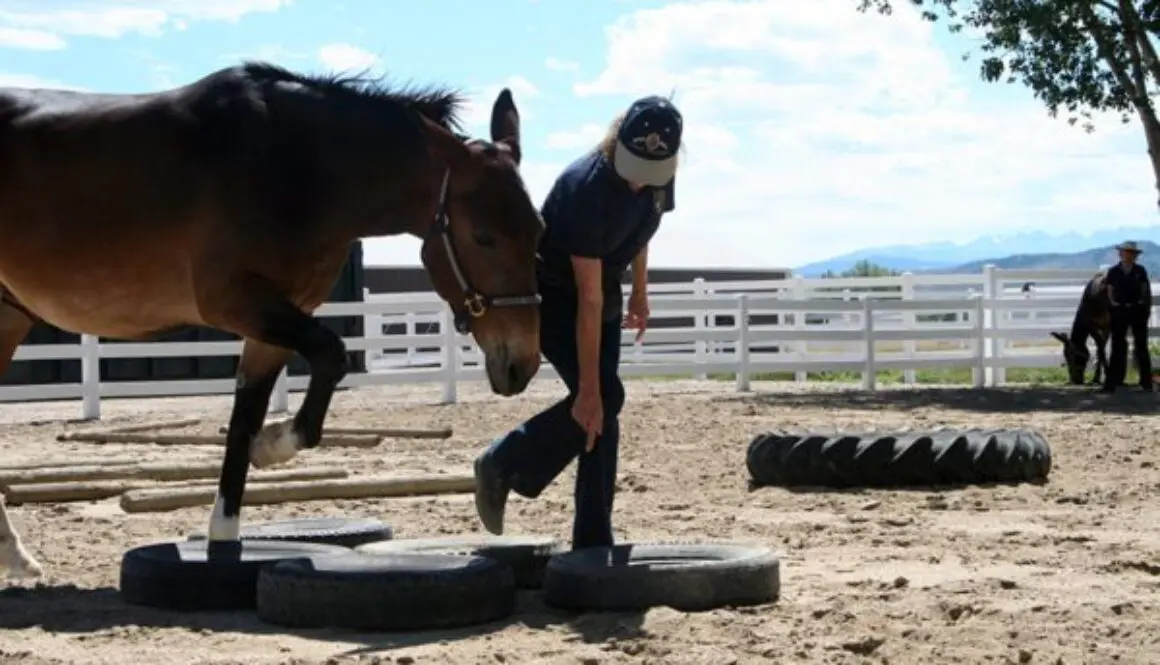
 Often, trainers will put obstacles such as a trailer, tire or tarp in an equine’s pen in the hope of getting him used to it by making him live with it. But ask yourself this: How much rest would you get if someone put a blaring radio in your bedroom to desensitize you to noise? Equines have many of the same reactions to their personal space that we do, and they do much better when their place of rest is just that—a place of rest and comfort. And when lessons are approached in a considerate, respectful and rewarding way, an equine is more likely to approach them with an eager and positive attitude that facilitates better learning. It is always better to turn your equine’s fear into curiosity than it is to just assault his senses.
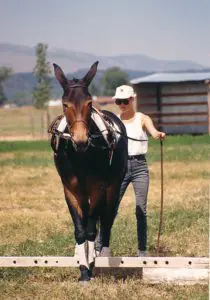 When doing obstacle training, it is better to allow your equine a gradual approach with small steps and great rewards for his honest effort than to whip and spur him through just to get to the other side. When his fear is converted to curiosity, the chance of his refusal to go forward is lessened and his trust in you as the trainer allows you to, eventually, ride through any obstacle at the slightest suggestion. This is because he trusts your judgment and has not been frightened, hurt or made uncomfortable during the training process. This is your equine developing sensitivity to your demands and learning to willingly comply so he can become a participating partner in each activity.
Some trainers believe that breaking down tasks for the equine into tiny steps is a waste of time and that giving a food reward prevents an equine from learning to respect the trainer, but I disagree. When you break tasks down into understandable steps in the beginning stages of training, you will eventually begin to get solid, reliable behavior from your equine. You will have to pay attention to a lot of little details at the beginning stages of training (and that can seem overwhelming at first), but if you take the time to pay attention to these small steps in the beginning stages and through the ground work and round pen work that will follow, when you finally do move on to riding under saddle the lessons will go much more quickly.
Each stage of training should become easier for you and your equine to master. For instance, it actually takes you less time to train in something like a side pass if you have done your groundwork training with the lead line and drive-line lateral training before you even get into the saddle. It also follows that the side pass will come more easily for your equine if he has first learned to move on an angle in the leg yield before having to move straight sideways. This is an example of taking things in small, logical steps, keeping your equine sensitive to his surroundings and tasks without fear. It also greatly lessens the chance for a fear or anxiety-driven blow up from your equine later on.
There is a physical as well as mental aspect to all of this technique. While you are training your equine to perform certain movements and negotiations over obstacles, his muscles, ligaments and tendons are all involved in his actions. When an equine is asked to do a movement for which his muscles have not first been properly conditioned, he will not only execute the motion incorrectly, but his premature attempt will undoubtedly compromise his muscles, ligaments and tendons. Even if he can adequately assimilate a requested movement while he is young, he could easily be creating problems in his body and joints that will cause him escalating problems as he ages.
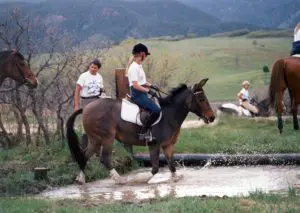 If you were asked to go on a 25-mile hike with a 50-pound pack on your back, how would you prepare in order to safely and successfully perform this task? You would break it down into small steps, working up to it by first running a short distance with a very light weight, and then gradually increasing the distance you run and the weight you carry, which may take as long as a couple of years of careful training and conditioning. But if you tried to prepare for this kind of grueling hike by simply walking around the block a few times for a couple of days, you’d wreck your muscles, compromise your health and probably fail—all because you attempted to do the task when you weren’t physically or mentally ready. And depending on how much you strained your body, you just might discover down the line that the damage is permanent and will worsen over the course of your life. I use this illustration to show that, just as with humans, when it comes to training and conditioning your equine, it’s always better to take it slowly—one step at a time. Your equine will learn to enjoy being a partner in your challenges and goals if you give him the time he needs to be able to do these activities comfortably and with success.
An equine that learns in this sensitized way can also make judgments that might even save your life when you might not be paying attention. This is because when your equine is calm and well rested, he actually seems to be able to anticipate consequences, making him more likely to stop and wait for your cue. The equine that is “forced” during training will most often become anxious about a challenging situation and will seldom stop and calmly alert you to a potential peril—and he most likely will not trust your judgment.
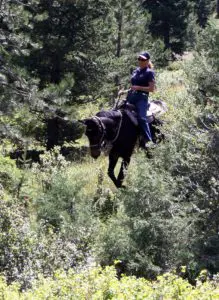 It is because I have trained my mules in this sensitized way that I once avoided going over a 100-foot drop up in the Rocky Mountains while on a trail ride. On that particular day, I was in front, riding my mule, Mae Bea C.T. with four horses behind us. When we came to a giant boulder semi-blocking the trail, I told the people on the horses to wait and rode ahead. I soon found that the trail had narrowed to an impassable two feet wide and a rockslide had wiped out the trail ahead completely! It was straight up 100 feet on one side of the trail and straight down 100 feet on the other side and there was no going forward. The horses behind me were still on the wider part of the trail on the other side of the boulder and were able turn around, so they were safe, but backing my mule around the boulder on that treacherous trail would be very dangerous. I thought we were stuck. At that point, my mule calmly looked back around at me as if to ask, “Well, Mom, what do we do now?” I thought for a minute and then shifted the weight in my seat toward my mule’s hindquarters. This movement from me allowed her to shift her weight to her hindquarters. Then, with pressure from my right leg, she lifted her shoulders, pivoted on her left hind foot and performed a 180-degree turn to the left on her haunches, and with her front feet in the air, she swept them across the open precipice of the cliff and turned us back around to face the wider (and safe) part of the trail. After completing the turn, she stopped again, looked back at me to see if everything was okay and waited for my cue to proceed back down. I believe, without a doubt, that my mule’s incredible and calm response to a life-threatening situation was the direct result of the sensitized training methods I used that created our unbreakable bond of trust.
To learn more about Meredith Hodges and her comprehensive all-breed equine training program, visit LuckyThreeRanch.com, MEREDITH HODGES PUBLIC FIGURE Facebook page, or call 1-800-816-7566. Check out her children’s website at JasperTheMule.com. Also, find Meredith on Pinterest, Instagram, MeWe, YouTube and Twitter.
Covered in TRAINING MULES & DONKEY: A LOGICAL APPROACH TO TRAINING, TRAINING WITHOUT RESISTANCE, TRAINING DVD #2 and EQUUS REVISITED at www.luckythreeranchstore.com.
© 2013, 2016, 2024 Lucky Three Ranch, Inc. All Rights Reserved.
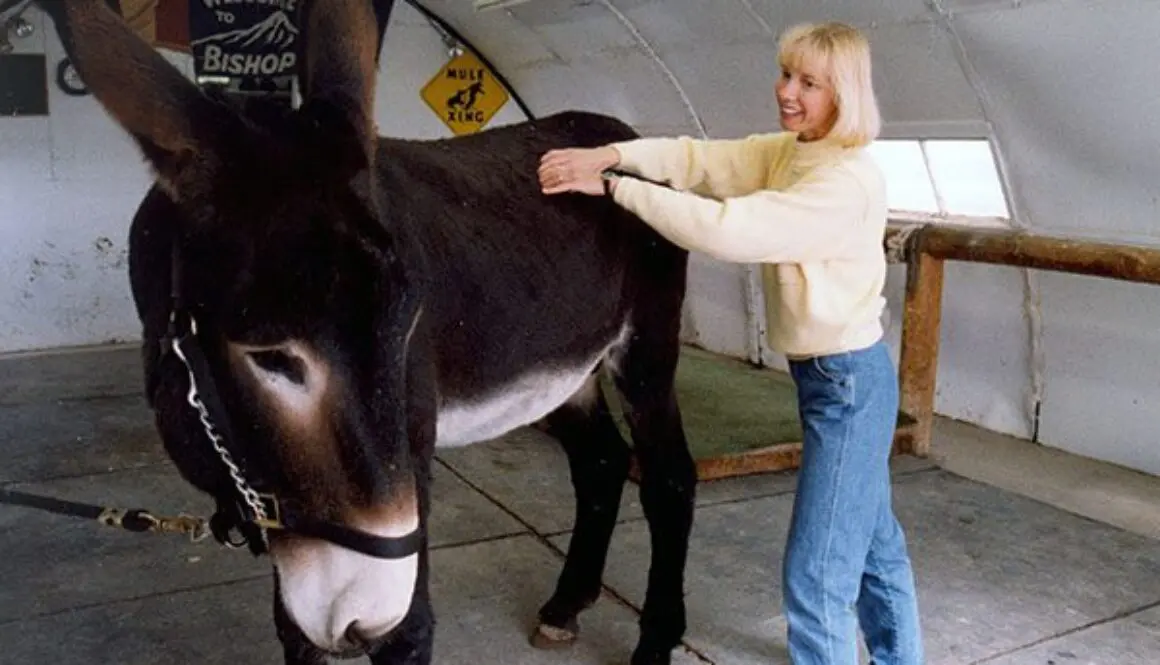
MULE CROSSING: Massage History & Contemporary Equine Use
By Joanne Lang & Meredith Hodges
 Massage History
Historically, massage is both ancient and worldwide. Native and folk cultures all over the world use massage for health and healing. There are highly developed forms of massage found in the writings of such primitive civilizations as Sumer, China, India, Greece and Rome. Arabic peoples in Turkey and the near east preserved the classical Greco-Roman culture during the Middle Ages and brought it back to Europe during the Renaissance. Greek gymnasia and Roman baths evolved into the Turkish bath, which includes a form of massage. Health clubs, workout facilities, swimming pools, steam rooms, whirlpools and massage rooms are all part of this legacy.
Pehr Henrich Ling (1776-1839) and Johann Mezger (1838-1909) were very instrumental in the development of today’s classical Western massage. Active and passive movements to treat medical conditions, commonly called Swedish Movement Cure, was developed by Ling in 19th-century 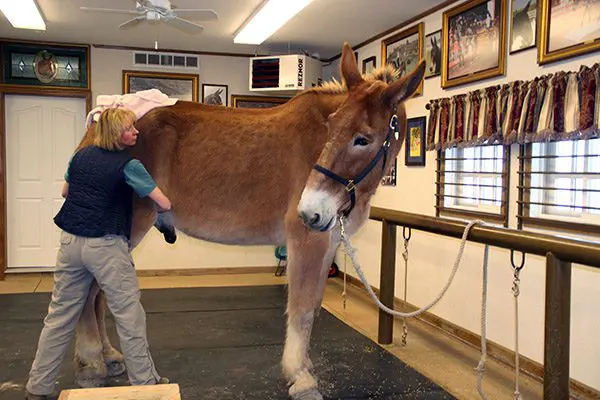 United States. Familiar French terms to describe four broad categories of massage (effleurage, petrissage, tapotement and frictions) were made popular by Johann Mezger. In the 20th century, their work was developed further by their students, and eventually found its way into regular medicine and the alternatives of health and healing. Swedish massage is a popular genre of classic Western massage. It includes Swedish movements, several forms of hydrotherapy, heat lamps, diathermy and colonic irrigation. Swedish massage is still offered at health clubs, some YMCAs, resorts and private clinics, although its heyday was between the 1920s and the 1940s.
Because of its use as a cover for prostitution in the 1950s, massage declined in popularity as a health practice for the more conservative general public. It also lost credibility as a therapeutic source within the medical profession at that time.
The 1960s brought about a revival of massage as a valuable health and healing method. The benefits of massage as a holistic health practice were revitalized by the counterculture and human potential movement. It is now used more often as an alternative or complementary healing process toward health and fitness.
Massage for Equines
Has your equine ever had any of the following problems? Sensitivity to the girth; restricted movement; continual scuffing of the hind legs; avoidance of leads; problems bending; lameness; inability to lock the knees; recurrent colic; loss of power or coordination; breeding difficulties when mounting or being mounted; constant tail swishing or an uneven top line? Has your equine ever had surgery, direct trauma or
resistance to training? Do you push your equine to the limit? If you answered yes to any of these, your animal will benefit from equine massage, a non-invasive type of therapy that, when administered properly, can address all of these problems and more.
 When we ride our animals daily and ask them for repeated movements in Jumping, Reining or Dressage, we demand a lot of their muscular and skeletal systems. This can shorten muscle fibers, restricting range of motion and putting undue stress on muscles and joints. Unforeseen problems can result such as lameness, arthritis, disk degeneration, or worse—a ruptured disk. These crippling dysfunctions do not always wait for the animal to age before they appear. Simple massage can prevent various injuries throughout your animal’s lifetime. Don’t wait for obvious injury to occur—preventive massage increases the length of the muscle fibers, taking pressure off the joints.
 When the muscles are allowed to contract and expand to their full length, they are able to absorb important nutrients that reduce fatigue. Massage also increases blood flow, which helps the body flush harmful toxins, such as lactic acid, that build up from normal use. Massage aids in reprogramming the nervous system to break patterns that can cause atrophy or knotted tissue. The following information is an introduction to some of the basic techniques of massage, which will enable you to identify areas of discomfort in your equine. It is not intended to replace the care of a licensed massage therapist or veterinarian. If you are unsure as to the severity of an injury, consult your vet!
Have you ever had a massage? Remember how good it felt? An increasing number of people in the United States and abroad are recognizing that animals also benefit from massage. At Lucky Three Ranch, I have found that therapeutic equine massage promotes relaxation and reduces stress. It also stimulates healing after an injury and provides significant relief from pain. Your equine may experience soreness when you ask him for some of the advanced moves in his training program. Massage can reduce muscle spasms, and greater joint flexibility and range of motion can be achieved through massage and stretching—resulting in increased ease and efficiency of movement.
 Palpate along the neck, beginning behind the ears and working your way back to the shoulder. Be sure to check the entire neck from poll to shoulder. Is one side more sensitive than the other? Ribs are a very sensitive area. Check each rib and between the ribs. If your donkey is nippy while being cinched or refuses to change leads, it could be from soreness in this area.
As you massage your equine, keep in mind how getting a massage should feel. Keep the pressure light over bony areas like the ribs, back and poll, whereas heavily muscled areas such as the neck and hips can endure more pressure. Always be aware of your animal’s reaction to pressure and respond accordingly. Watch his eyes and ears. As you work look for signs of sensitivity toward the affected area such as biting, raising and lowering the head, moving into or away from pressure, contraction of muscles from your pressure, tossing his head, swishing his tail, picking up his feet, changes in his breathing or wrinkles around his mouth. If there is sensitivity in the neck, the shoulders and upper back may also be involved. If there is soreness in the hips, the ribs and lower back may be involved.
 The neck is a good place to begin your massage, making small circles with your fingertips. Imagine your circles as eyes, searching out lumps and bumps under the skin that are knots in the muscle fibers. Start behind the ears and work your way back to the shoulders. If your animal is heavy in the bridle, if he tips his head to one side, or if he has difficulty bending through the neck, he is exhibiting stiffness in this area.
Next, massage the shoulders and between the front legs. Compare the two sides of the chest muscles. Is one side larger than the other? The shoulders work as shock absorbers and need their strength to pick up the front quarters when jumping. If there is soreness in these areas, your animal will have difficulty performing certain athletic movements.
 Ribs are a very sensitive area and can refer pain in many directions. Make sure to check each rib and the area in between them. Keep in mind that they span from the back to the belly; this is a large area of sensitivity due to the lack of muscle cover. Include the back when working on the ribs, using your fingertips to feel each vertebra and compare each side for symmetry. If you keep this area relaxed and flexible, your equine will bend more easily throughout his body.
Because muscling is thick in the hip area, you might want to use your fist to exert more pressure there. Using your fist, knead the muscles as if you were kneading dough. The animal will push into 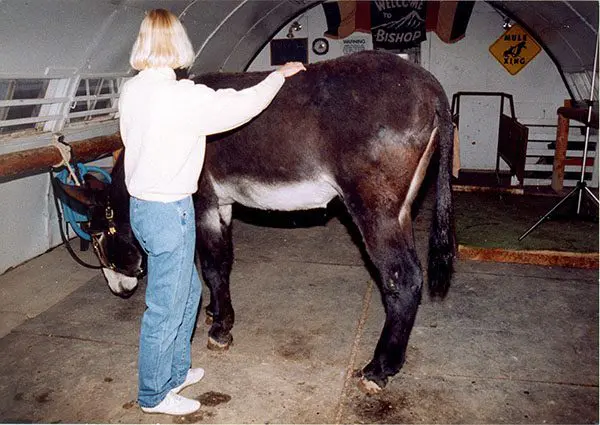 your hand to let you know that it feels good. If he moves away, he is telling you that you are exerting more pressure than he can comfortably endure, and you should go back to using your fingertips. When massaging the hips, the lower back and the last few ribs should be included. Soreness in this area can result from athletic movements like jumping, collection, sliding stops and rollbacks.
Passive range-of-motion exercises involve moving limbs and joints as they were naturally intended to move. Forcing motion can cause tearing of the muscles and a breakdown of the trust you are trying to achieve, so keep your movements gentle and easy. If you encounter resistance, just stop and try again. In order for you to do passive range-of-motion exercises, your animal must be able to trust you and “let go,” allowing you to manipulate his limbs without resistance. If you have an animal that resists, do only as much as he will allow. Over time, he may loosen up and allow you more control. If he doesn’t let go, don’t force the movements—it will foster more harm than good. Some animals are just intolerant.
When moving the limbs and joints, be sure to stay within your animal’s comfort zone. Be aware of the point at which your animal begins to resist and do not reach that point. As your equine begins to trust and understand, and as his muscles and joints loosen, he will afford you a wider range of motion.
 A raised head and perked ears may indicate sensitivity. He is asking for lighter pressure, so learn to pay attention to the things your animal tells you about his body. This animal is still concerned about the pressure. Sometimes you will assume that your pressure is so light it can do nothing, but less is best.
Now he is happy with the pressure. He has dropped his head and has taken a deep breath. This area can be very sensitive if you are doing rollbacks, sliding stops or collection.
 The front legs are a good place to begin your passive range-of-motion exercises. Be prepared to let go and get out of your animal’s way. Shake the limb under the animal and then move the limb forward and back, always being aware of his limitations. Each time you work with your animal, his range will increase.
Small circles are another technique for passive range of motion. The movement re-programs the nervous system, while building trust between you and your animal.
This is an advanced movement, and will take some practice and time to achieve the desired result. Passive range of motion should be done only within the animal’s tolerance, but time will increase his degree of tolerance.
 Massage therapy should never be harmful. For the sake of safety and comfort, do not attempt massage therapy for rashes, boils, open wounds, severe pain, high fevers, cancers, blood clots, severe rheumatoid arthritis, swollen glands, broken bones, direct trauma or if there is any chance of spreading a lymph or circulatory disease, such as blood poisoning. Avoid direct pressure on the trachea.
It is easiest to find sore spots and muscles when your animal is warmed up, so after a ride is a good time to do massage therapy and passive range-of-motion exercises. When performing massage therapy and passive range-of-motion exercises, you will also aid your equine in ridding his body of toxins that build up in muscle tissues and eventually cause stiffness, but you do not need to massage your animal’s entire body every time after you work. For example, if he is having difficulty with leads, you may want to massage only the ribs and mid-back.
 Each time you ride, take the time to quickly go over your animal and assess his sensitive areas: check his range of motion to detect stiffness in the joints. Paying this kind of attention to his body will enhance his athletic performance and provide him with a wonderfully relaxing reward. Stretching the front leg forward is a great movement to make sure that the girth is not pinching your equine after he is saddled. Give your equine the preventive care that he deserves to make your way to a mutually satisfying relationship.
To learn more about Meredith Hodges and her comprehensive all-breed equine training program, visit LuckyThreeRanch.com, MEREDITH HODGES PUBLIC FIGURE Facebook page, or call 1-800-816-7566. Check out her children’s website at JasperTheMule.com. Also, find Meredith on Pinterest, Instagram, MeWe, YouTube and Twitter.
Covered in TRAINING MULES & DONKEY: A LOGICAL APPROACH TO TRAINING, TRAINING WITHOUT RESISTANCE and EQUUS REVISITED at www.luckythreeranchstore.com.
© 2005, 2016, 2024 Lucky Three Ranch, Inc. All Rights Reserved.


MULE CROSSING: The Rein Back
By Meredith Hodges
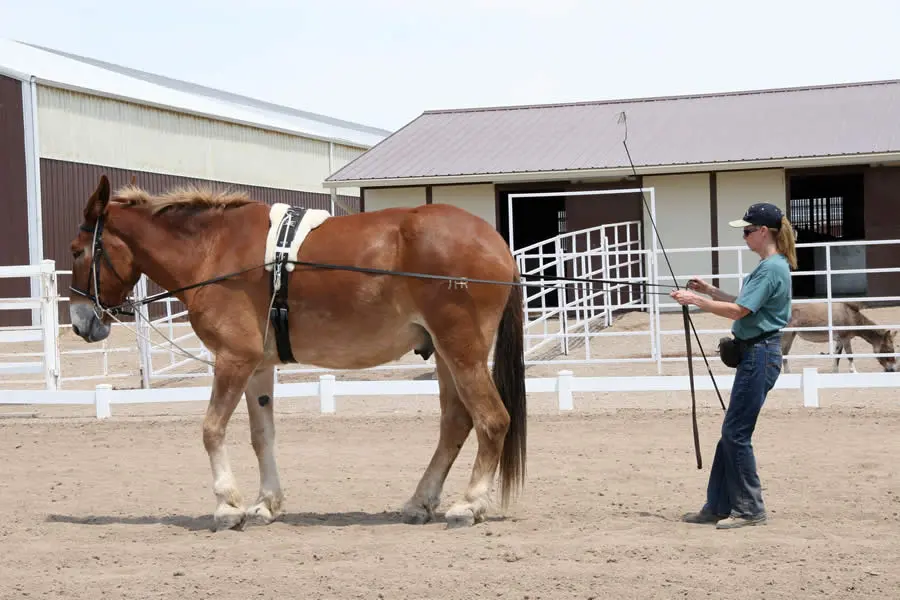 Many common horse training techniques used today work well on either horses or mules. However, being creative and using less technique with a more logical approach to training works better with donkeys. In the case of the “rein back,” the problems are universal. Some equines seem to “rein back” more easily than others. Similarities exist within the equine species regarding personality types, but there are also differences in environmental behavior during training. Horses that are resistant to backing either shake their heads violently from side to side or rear up and try to throw themselves over backwards. Resistant mules try to walk sideways or forward, and resistant donkeys are either stone statues or terrific “leaners.” All of these tendencies are an expression of discomfort in the equine and can pose serious problems for the trainer.
In order to get the best results, before teaching an equine to “rein back” you must understand the animal’s body mechanics and his mental attitude. The “rein back” is a reverse, two-beat, diagonal gait. When executing a straight “rein back,” the equine is unable to see what is directly behind him, but he can see peripherally on both sides. Because of the way the eyes are set in their head, mules can actually see all four feet when facing straight forward where a horse cannot. The depth perception of an equine is questionable at best, but when an equine must “rein back,” his vision is even more impaired because he can’t see directly behind him. This causes him to become tense because the equine must trust the trainer not to back his precious little rear into anything that might hurt him! If the trainer has been even a little abusive in the past, the equine will not be able to trust and will become resistant. On the other hand, if the animal has been brought along well and is being asked to “rein back” on the long lines, he may simply not want to “back over” the trainer. This could be perceived as disobedience when it is only consideration for the trainer.
In order to execute a straight and smooth “rein back,” the equine must be able to lower his head, round his back and step back and underneath himself easily with the power initiated from his hindquarters. If the rider has not prepared his equine for the “rein back” by allowing the animal to take one step forward first and round under his seat, the animal will be resistant. This is why one step forward before executing a “rein back” is essential. Otherwise, the equine may raise his head and hollow his back, making it very difficult, at best, to perform the “rein back.” If you have trouble visualizing this, get on your hands and knees and try it yourself to see how it feels, first with a hollowed back and then with an arched back.
Before you begin to “rein back,” take that extra couple of seconds to relax and prepare your animal. First, let him take one step forward. Then, alternately, squeeze your reins and ask him to lower his head a little (not too much at first). Keep your legs snugly hugging his barrel, and lift your seat ever so slightly by leaning forward just a little. Check over your shoulder to be sure that he won’t back into anything. Then, with corresponding rein and leg cues, squeeze and release alternately from side to side: first, right rein, right leg; then, left rein, left leg. By pulling first on one side and then the other, you actually allow him to see more directly behind, thus eliminating much of the apprehension that he feels when he cannot see. Pretend that you are pushing him backward with your legs, directly after giving a gentle tug on the corresponding rein. In the beginning, be satisfied with one or two steps, and don’t forget to praise him.
 Do this exercise in a two-beat fashion, with the squeeze/release action on the rein coming only a split second sooner than the corresponding leg. This prevents the hindquarters from resisting, and it is here where most resistance in backing originates. If you pull both reins at the same time, the hindquarters are not affected and this may cause considerable resistance. Animals that learn to “rein back” correctly will eventually learn to “rein back” on a mere tug of the reins and a shift of your body weight, but that is not the way to begin. Speed comes much later.
Horses and mules learn to “rein back” more easily than donkeys. As far as donkeys are concerned, why go backward when you can turn around to go forward? Because donkeys have a natural agility, this is not such a far-out way for them to think. However, if a donkey tried to turn around on a narrow trail with a rider aboard, his balance could be severely affected. Chances are, the donkey would make it, but the rider might not. The donkey needs to learn to “rein back” on command, because safety is of the utmost importance.
The simplest way to encourage your donkey to “rein back” is to ride or drive him into a three-sided tie stall, or anywhere that he has no way to escape but backward. Ask him to “rein back” with the cues outlined, and praise him for each step backward. If you are ground driving, just alternate long line pressure while you step backwards in unison with his back legs. Keep your squeeze/release action on the long lines minimal—pulling on your donkey’s mouth too much will only defeat your purpose. If your donkey is hitched to a vehicle, make sure that the weight of the cart or carriage that he has to push is not too heavy for him to manage. Adjust the breeching tightly enough so that your donkey can lean into it with his rear, and be sure that it is not so low that it will inhibit the motion of his upper hind legs.
 If you have checked all of these factors and your donkey still will not back out of the stall, ask someone to act as your assistant, and have them wave a fearful object (such as a brightly colored scarf or plastic bag) low and in front of your donkey. He should dip his head to focus on the object (arching his back) and begin to “rein back,” apply the proper squeeze/release cues and after a few steps, reward him. You have set up a situation in which you can predict that his reaction will be the correct one. Once he has done this a few times, he should begin to make the connection between your cues and his action. Always keep your cues gentle, but clear. Be prepared to immediately praise those first one or two steps, and don’t ask for too many steps too soon. Just as an animal is conditioned to perform any other maneuver, his body must also be conditioned to “rein back.” Doing a “rein back” without conditioning the muscles that will be used can cause injury. Taking it slowly and cautiously diminishes the chance for resistance. Work up your speed in the “rein back” only after your equine is backing straight and easily. When he has had time off, be sure to take the time to recondition those muscles before again asking for speed.
I can’t count the hours that I have spent sitting on-board my donkey, waiting for a foot to move, giving the cue to just one side over and over again. Patience is the key to success with any animal, but with donkeys, it’s a necessity. Be patient and deliberate with your training. Don’t get upset, and don’t try to be forceful. Remember, he has to move sometime. Even donkeys get bored standing in one place for too long!
To learn more about Meredith Hodges and her comprehensive all-breed equine training program, visit LuckyThreeRanch.com, MEREDITH HODGES PUBLIC FIGURE Facebook page, or call 1-800-816-7566. Check out her children’s website at JasperTheMule.com. Also, find Meredith on Pinterest, Instagram, MeWe, YouTube and Twitter.
Covered in TRAINING MULES & DONKEY: A LOGICAL APPROACH TO TRAINING, TRAINING WITHOUT RESISTANCE, EQUUS REVISITED and A GUIDE TO RAISING & SHOWING MULES at www.luckythreeranchstore.com.
© 2014, 2016, 2017, 2024 Lucky Three Ranch, Inc. All Rights Reserved.
This article is an excerpt from the book, Training Mules and Donkeys by Meredith Hodges, 2014

MULE TALK! PODCAST: Donkey Training, Part 3
Donkey Training, Part 3 –
-
When your donkey is doing well with the trot, time to learn to canter.
-
Use verbal commands with your donkey.
-
Training your donkey to move laterally.
-
Using the hourglass pattern in your training to improve posture and overall balance.
-
Using your elbow pull as a training aid.
-
Training your donkey at Cavalletti.
-
Training your donkey for jumping. And more!
And follow along. Read the transcript.
Learn more on Mule Talk podcast.
For more training info: www.LuckyThreeRanch.Com and click on the Training tab.
Mule Talk is an Every Cowgirl’s Dream production – www.EveryCowgirlsDream.Com
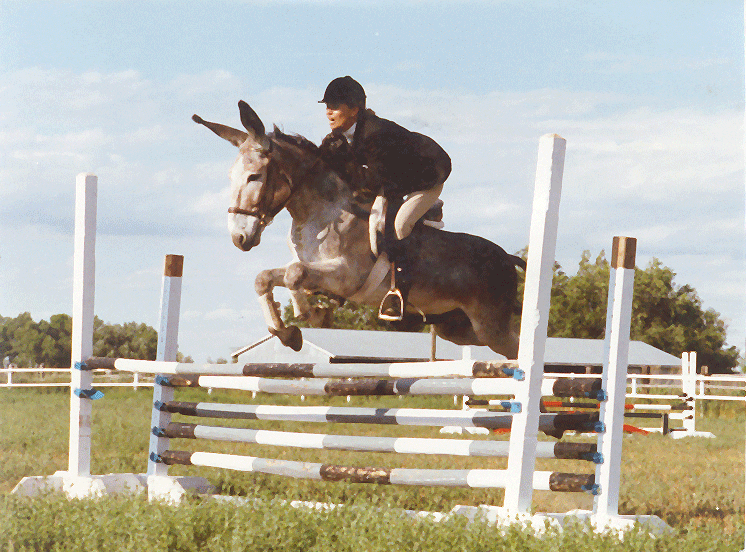
MULE CROSSING: Little Jack Horner
By Meredith Hodges
 Little Jack Horner , 13 HH Sire-Supreme of the Lucky Three Ranch in Loveland, Colorado, was the last jack born at the famed Windy Valley Ranch in Healdsburg, California owned by my mother, Joyce Doty. He was foaled June 11, 1980, by the renowned Windy Valley Adam (14.2 HH) and out of Windy Valley Maude (15 HH). His ancestry can be traced back to the original breeding stock of George Washington’s farm at Mount Vernon, Virginia.
 In 1984 and 1985, Little Jack Horner captured second place in the Bishop Mule Days World Show Halter class for Standard Jacks. His impeccable show record consists of first and second place standings at Halter in his home state of Colorado, and in 1986, he placed first at Halter in the American Donkey and Mule Society Registered Jacks class at the A.D.M.S. Nationals in Dallas, Texas.
In 1984, he made his debut in performance at the Colorado Classic Horse Show, placing first in Donkey Driving and Donkey Pleasure.  His willing disposition held him in good stead, placing him first in Donkey Pleasure and Donkey Driving at Bishop Mule Days in 1989. Little Jack Horner (by his own enthusiastic request via running the fence) was trained in Dressage and Jumping along with his numerous offspring mules. He reached Second Level Dressage over three years and jumped four feet in exhibition at Bishop Mule Days in 1991 where he received a Specialty Award for his efforts. At Bishop Mule Days in 1993, he placed first in Donkey Pleasure, Donkey Pole Bending and Donkey Keyhole.
 Although Dressage proved difficult (as it would be for any donkey), it helped to set the stage for his incredible athletic ability to jump. He soared over fences to 4’6” without a rider and worked up to 4’ with the rider on board. In keeping with traditional Dressage, Little Jack Horner worked on a Pas de Deux in Jumping with another Colorado Standard Jack, Blue Zebulon owned by Fran & Larry Howe of the Bitterroot Mule Company. Those who know the difficulty of working jacks together at all will appreciate their unique dispositions and good manners! Little Jack Horner proved himself to be not only a well-conformed breeding jack, but also a true athlete! He was inducted into the Bishop Mule Days Hall of Fame in May of 2014.
As a breeding jack, Little Jack Horner produced some of the finest saddle mules in the world. Consistently, his genetic makeup was responsible for extremely attractive heads, refined straight legs and good angles in the hip and shoulder of his offspring mules and donkeys. In addition,  these mules and donkeys reflected a smooth flowing topline, with depth of girth and a good length of neck for overall balance and beauty. Little Jack Horner’s mule and donkey offspring generally grew to the mare’s (or jennet’s) height or 2 inches taller despite L.J.’s own smaller size.
 Lucky Three Firestorm never lost a Halter class and was an all-around English Champion Arabian mule.
It didn’t seem to matter with what breed of mare or jennet he was bred. His superior qualities shone through in his offspring, giving the mules an appearance more like really nice looking horses (and donkeys!), only with longer ears!
 Not only did Little Jack Horner seem to improve on the characteristics of the mares with which he was bred, but also with the jennets as well. At Lucky Three Ranch, we endeavored to produce a Mammoth Donkey with these same refined characteristics as Mammoth’s typically have a lot of thick bone in the joints and in their faces which I wished to refine. Little Jack Horner sired two jennets, Lucky Three Pantera and Lucky Three Serendipity , who indeed retained his refinement within a much larger frame. Pantera , as a two-year-old gray jennet, stood at 14.3 hands and Serendipity as a yearling, stood 13 hands, the very same height as her sire. Pantera matured to 15.2 hands and Serendipity matured to 14 hands. When we bred the daughters back to Blue Zebulon from the Bitterroot Mule Company, the offspring jacks did indeed retain Little Jack Horner’s refinement with no unsightly boniness in the heads and joints. His offspring were most often taller than both the mare and sire . Little Jack Horner proved time and time again that the jack is indeed responsible for the shape and thickness of bone, and not necessarily for the overall height of the offspring.
 Be it donkey or mule, Little Jack Horner’s offspring always placed at the top of the Halter classes in the early shows and in the top five when they began competing in performance classes.
In January of 1989 at the National Western Stock Show in Denver, Colorado, Little Jack Horner and nine of his offspring, both mules and donkeys, made a clean sweep at the show and won everything in every class in which they were entered.
 Appaloosa mule, Lucky Three Ciji never lost a Halter class, placed in the top five in the Western Performance divisions at multiple shows across the country and was a Side Saddle Champion, and Reserve Champion the following year, against horses in the International Side Saddle Organization.
Appaloosa mule, Lucky Three Eclipse won the Bishop Mule Days Champion Warm-Up Hunter class in 2000. At the Lucky Three Ranch in 2017, we still have multiple Little Jack Horner offspring from various horse breeds  (Appaloosa, American Quarter Horse, Arabian, Thoroughbred and Paint) including one Warm Blood mule bred from a Trakehner mare that I acquired for the expressed purpose of doing Dressage due their their extraordinary movement. Little Jack Horner’s offspring here at the ranch are all healthy and are still being used for ranch work, even though most of them are well over twenty-five years of age, and some are thirty years and over.
When I said good night to Little Jack Horner one chilly fall evening on October 5, 2014, I noticed that he was unusually calm and serene. He stood motionless with a colorful rainbow arched over his pen showering him in a surrealistic light as the sun began to set behind the Rocky Mountains that he loved . Little Jack Horner passed  away quietly that night at the age of 34 years, but his legacy remains.
He set the bar exceptionally high for Longears everywhere and because he did, the interest in mules and donkeys has increased exponentially over the past 40 years. The old myths about donkeys and mules being stubborn and hard to work with are being laid to rest because of his efforts. What he taught me will go down in history to become my legacy as well. His story and that of his offspring needed to be told, so I documented everything I learned from them to pass on to future generations. I was very blessed to be the steward of such an extraordinary individual and to be able to go forward as the keeper of his children. He was a very special donkey for a very special time!
Little Jack Horner has left quite a legacy! It does my heart good to see how the quality of mule and donkeys has improved exponentially over the years with foundation sires such as Little Jack Horner and…
Black Bart , bred by Sybil Sewell from the famed Windy Ridge Farm in Canada and owned by Don and Irma Mode of Oregon. Mules, once bred from culled mares, are now being bred from the best! Through more careful donkey selection, they have also improved substantially in conformation and have thereby produced incredible breeding jacks and jennets for the future!
To learn more about Meredith Hodges and her comprehensive all-breed equine training program, visit LuckyThreeRanch.com, MEREDITH HODGES PUBLIC FIGURE Facebook page, or call 1-800-816-7566. Check out her children’s website at JasperTheMule.com. Also, find Meredith on Pinterest, Instagram, MeWe, YouTube and Twitter.
Covered in TRAINING MULES & DONKEY: A LOGICAL APPROACH TO TRAINING, TRAINING WITHOUT RESISTANCE andEQUUS REVISITED at www.luckythreeranchstore.com.
© 1988, 2016, 2024 Lucky Three Ranch, Inc. All Rights Reserved