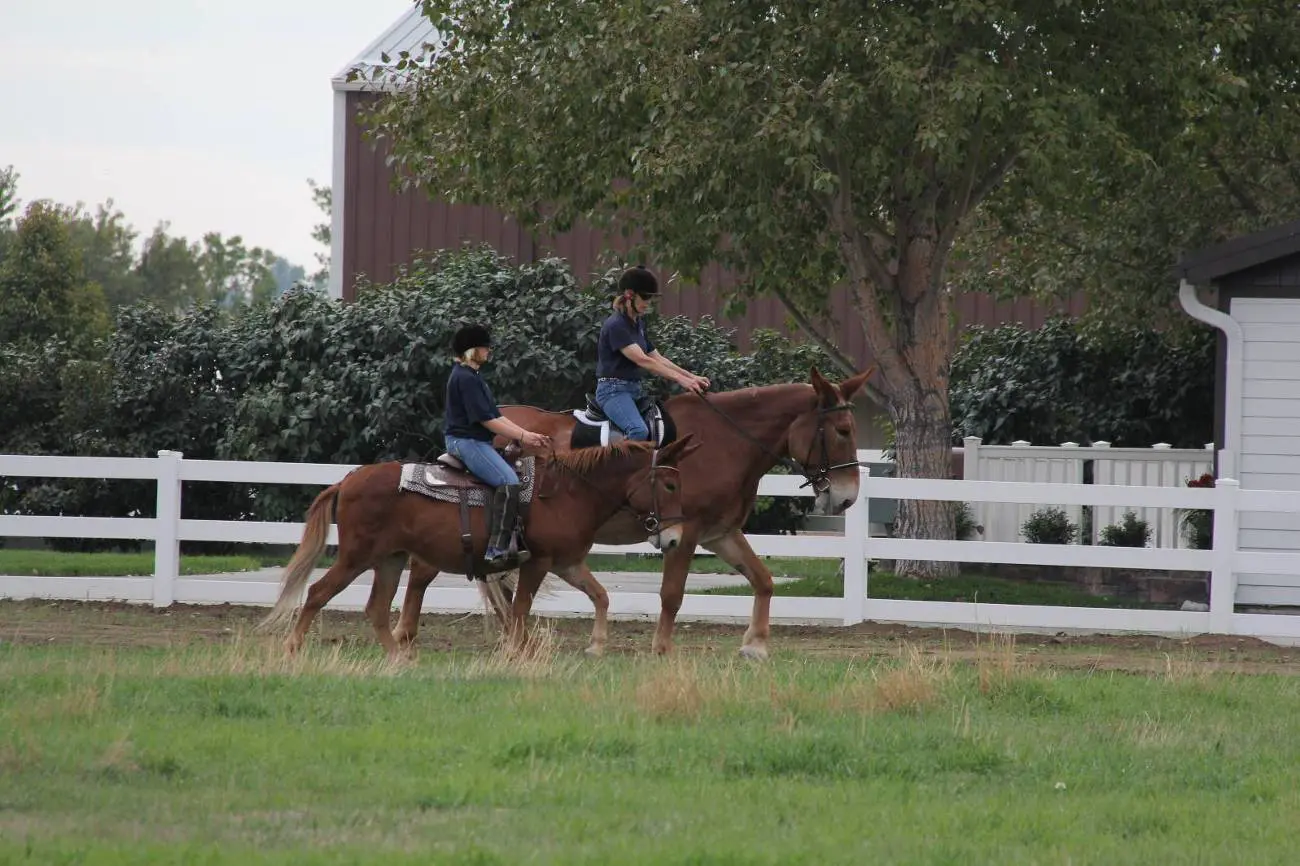
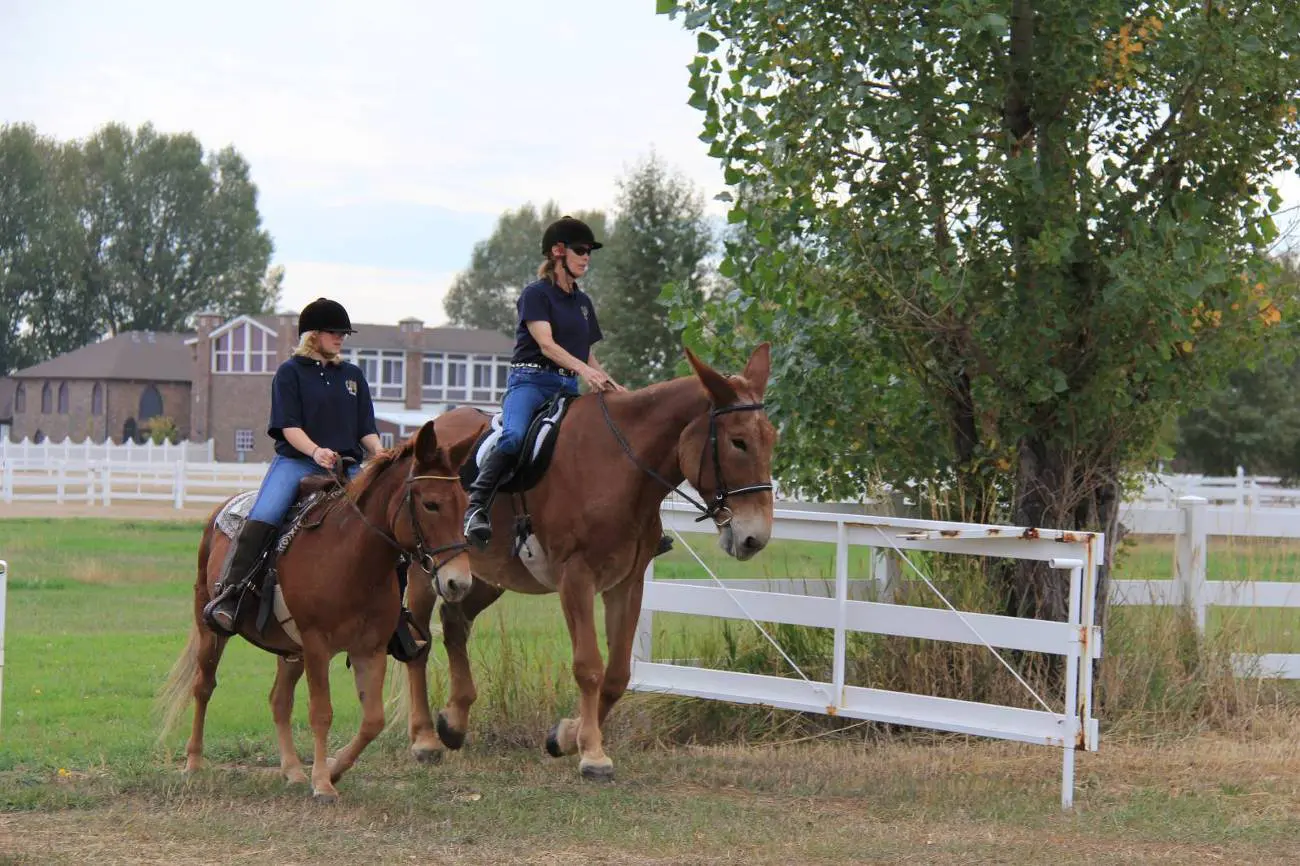
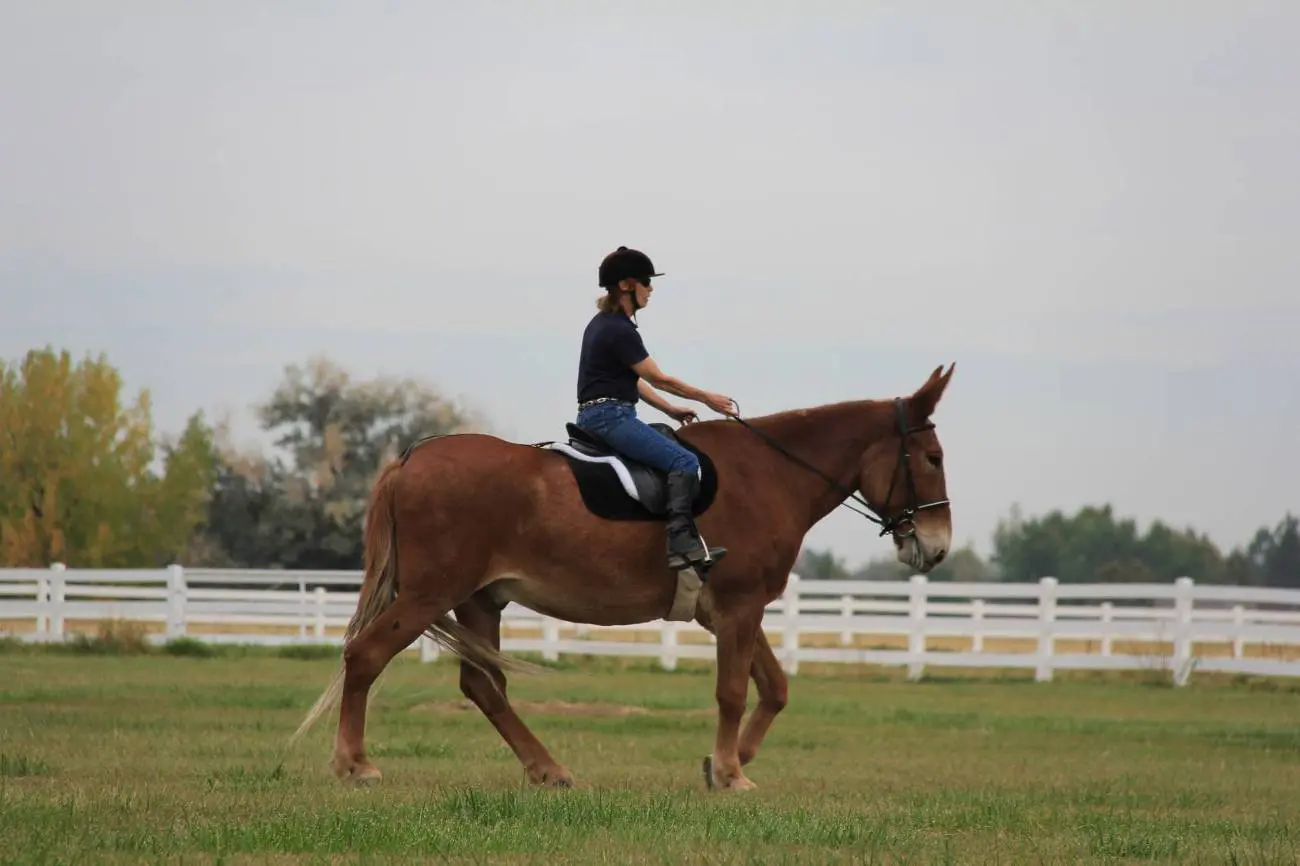
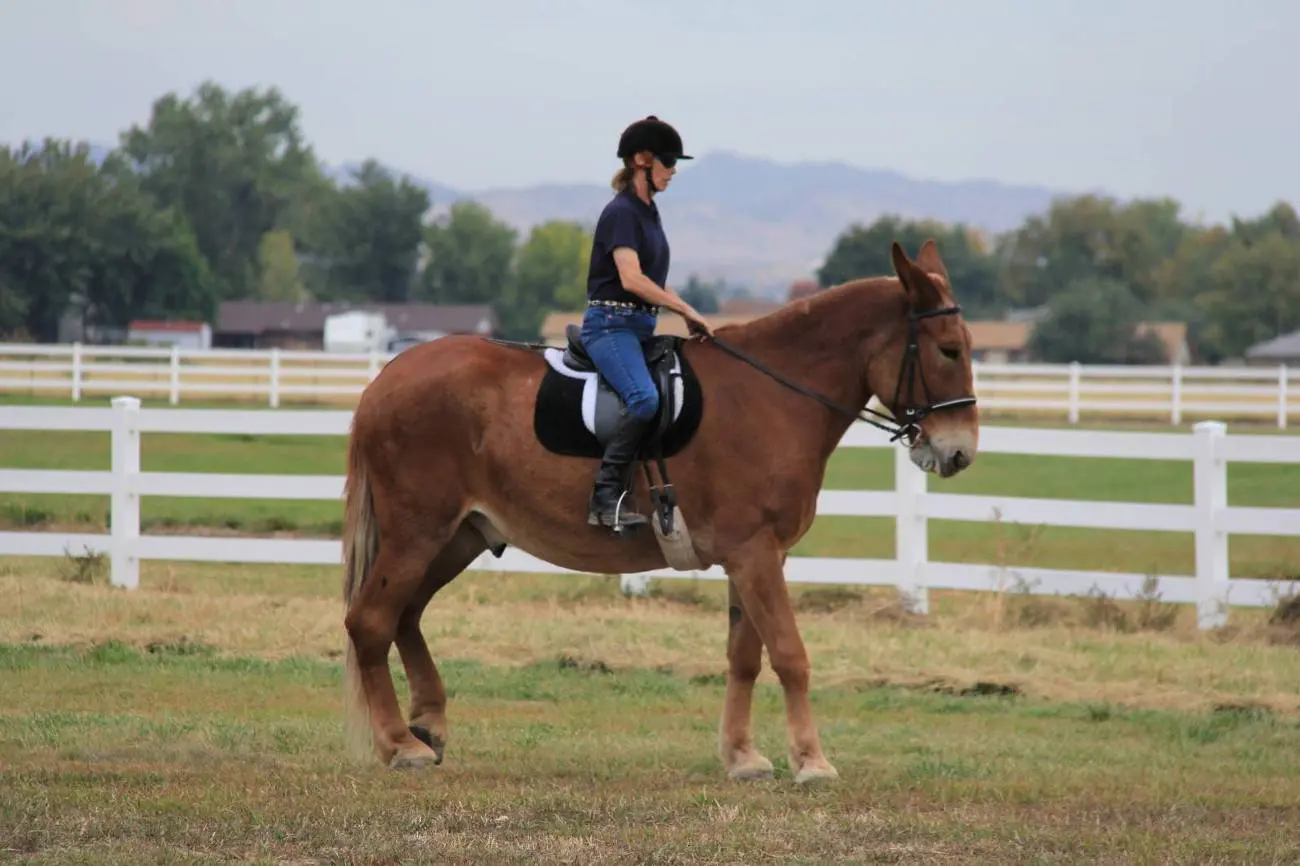
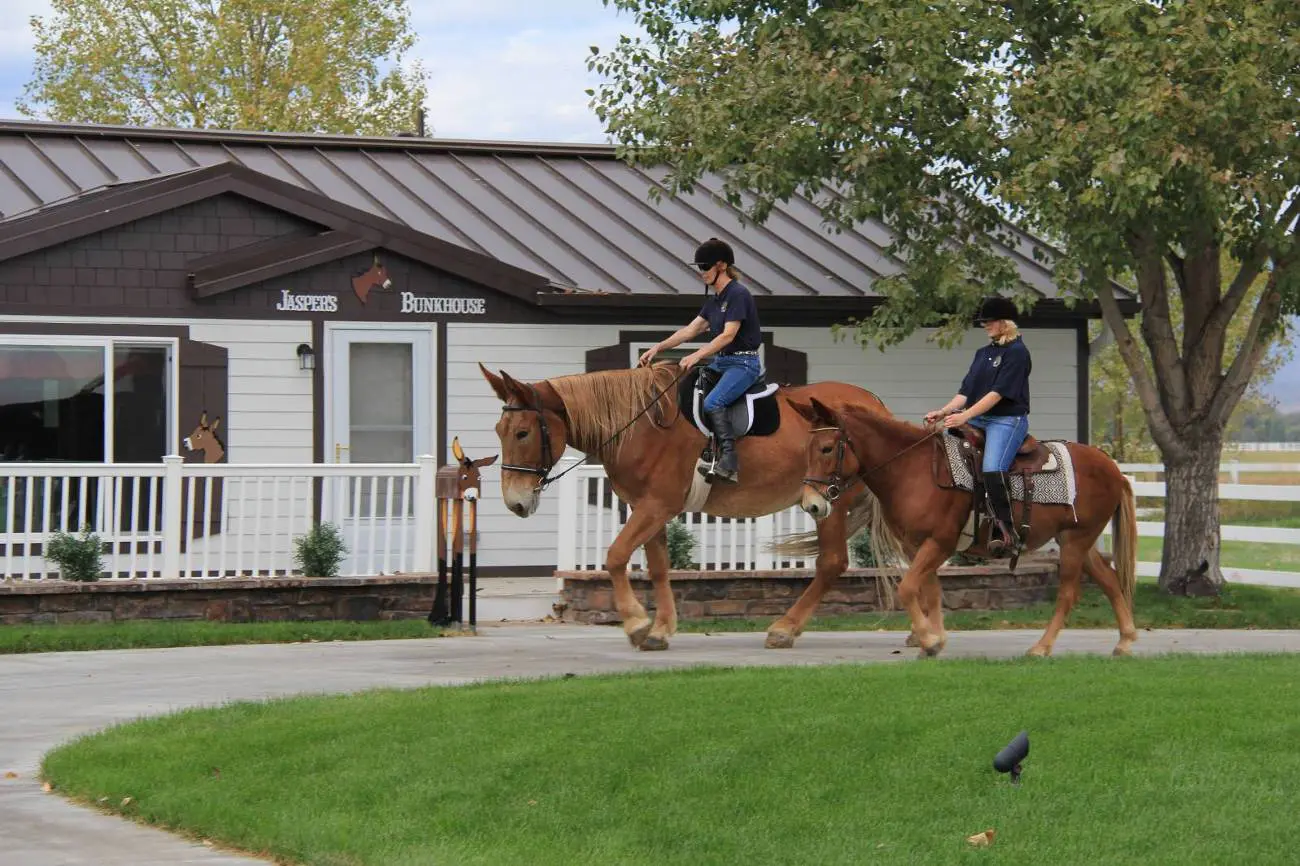
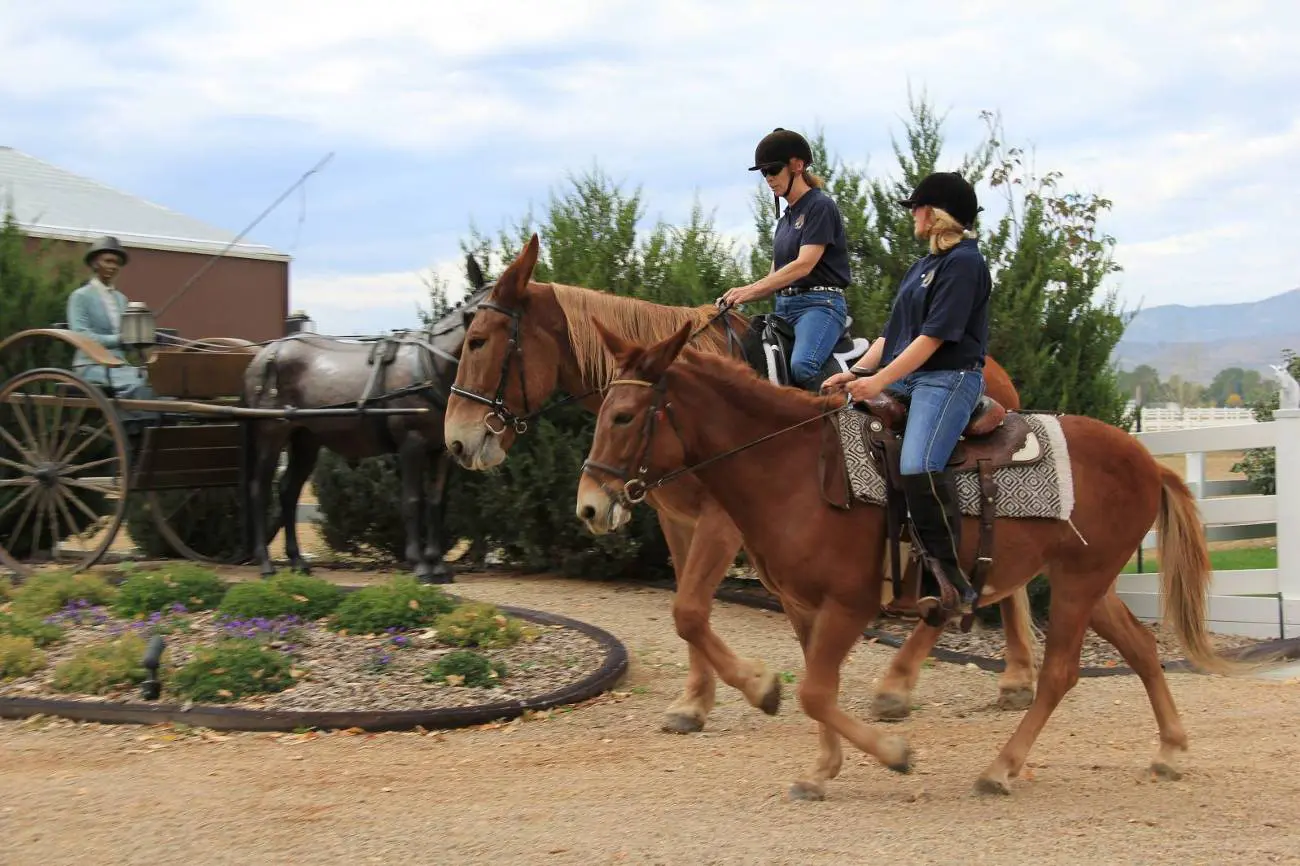
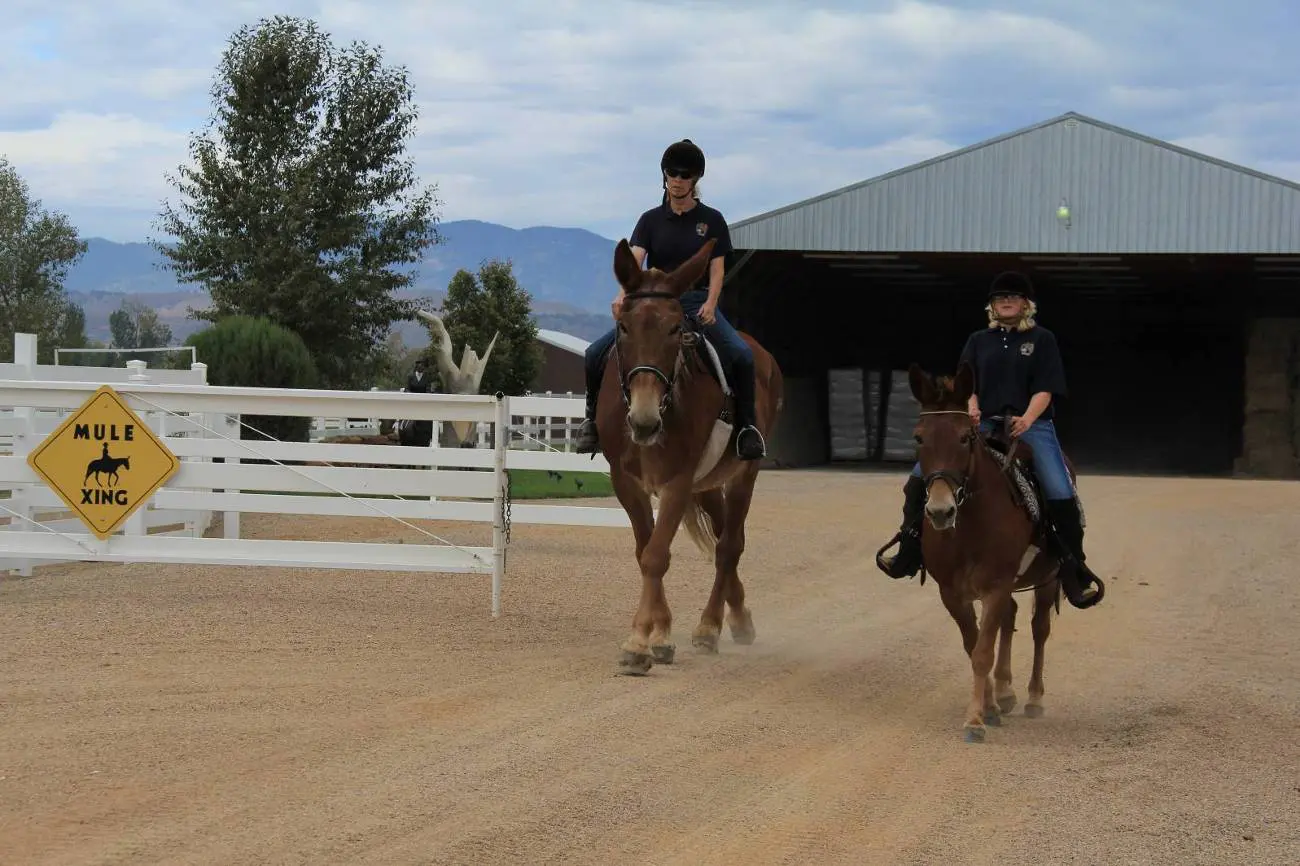
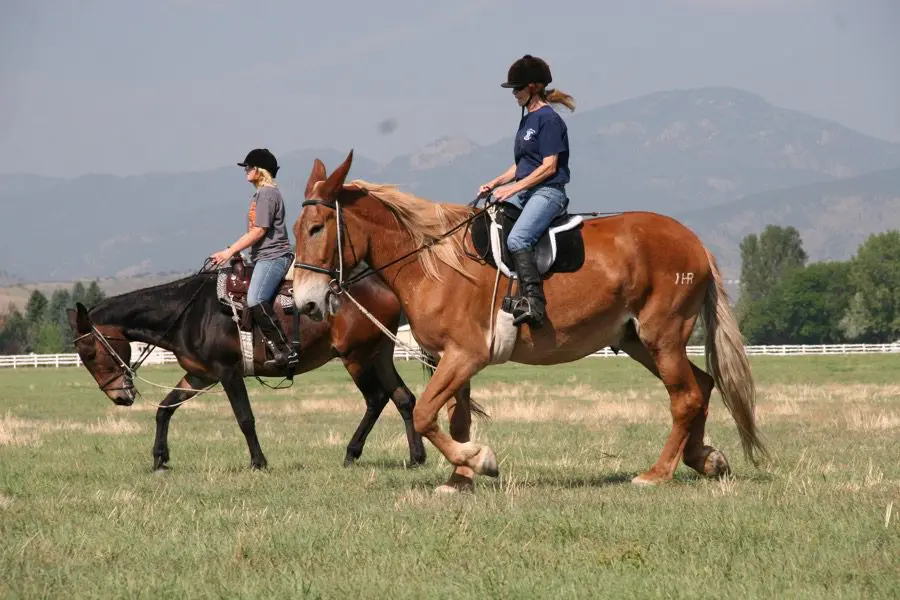
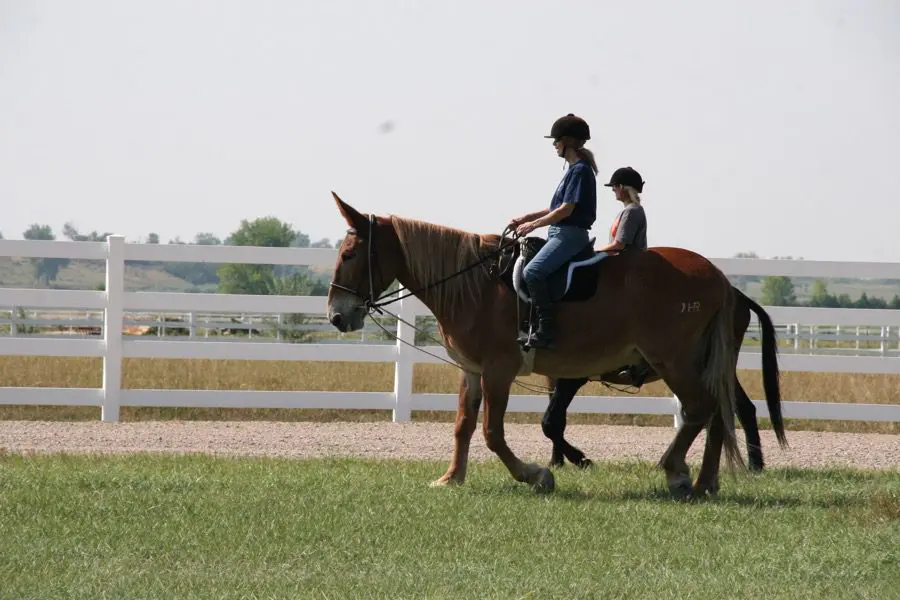
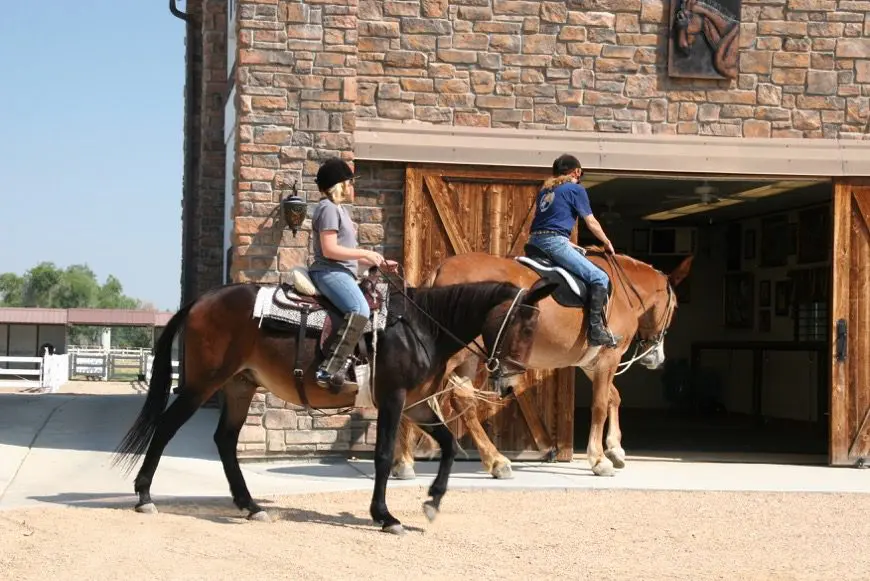
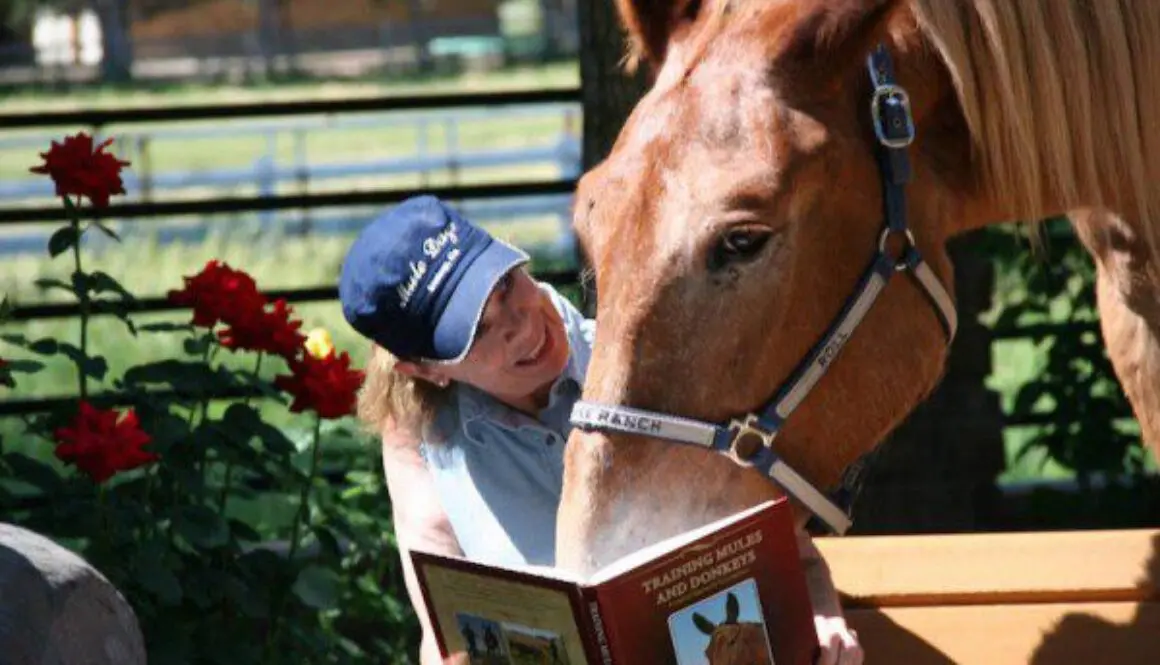
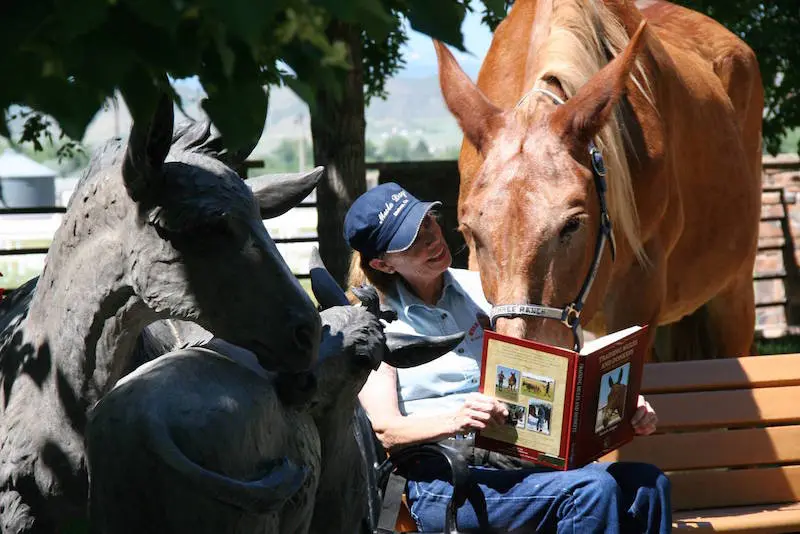
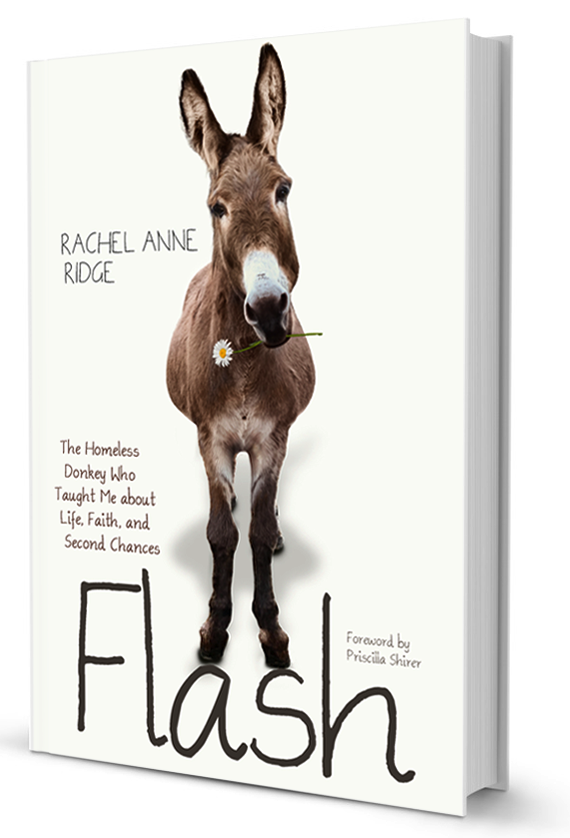
Meredith is pleased to have contributed an anecdote to the first edition of a new book series featuring humorous, equine-related stories called Horse Tales for the Funny Bone, Volume 1. The tales were collected by Bonnie Marlewski-Probert at Whitehall Publishing, who also put together the Horse Tales for the Soul series. Horse Tales for the Funny Bone features stories about all breeds, all styles of riding, and all age groups—60 in all. This book is sure to brighten your day and put a smile on your face, and makes the perfect gift for all the equine lovers in your life! Also, the book will be used to help fundraising efforts for therapeutic riding centers. Get your own copy of Horse Tales for the Funny Bone, Volume 1, here!
I have been called “the Mule Whisperer,” but I must admit that the mules have been whispering right back at me for over forty years now! Mules have taught me practically everything I know about training equines and for that, I am eternally grateful…and so are the people and their equines who learn from me! I am so proud of my fans and the successful accomplishments they’ve had with their equines! Thank you all for your kind updates and correspondence! Keep up the great work!
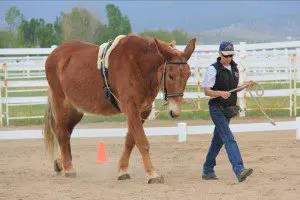
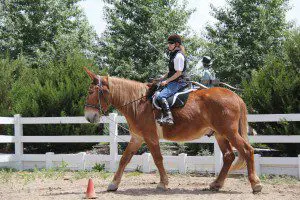
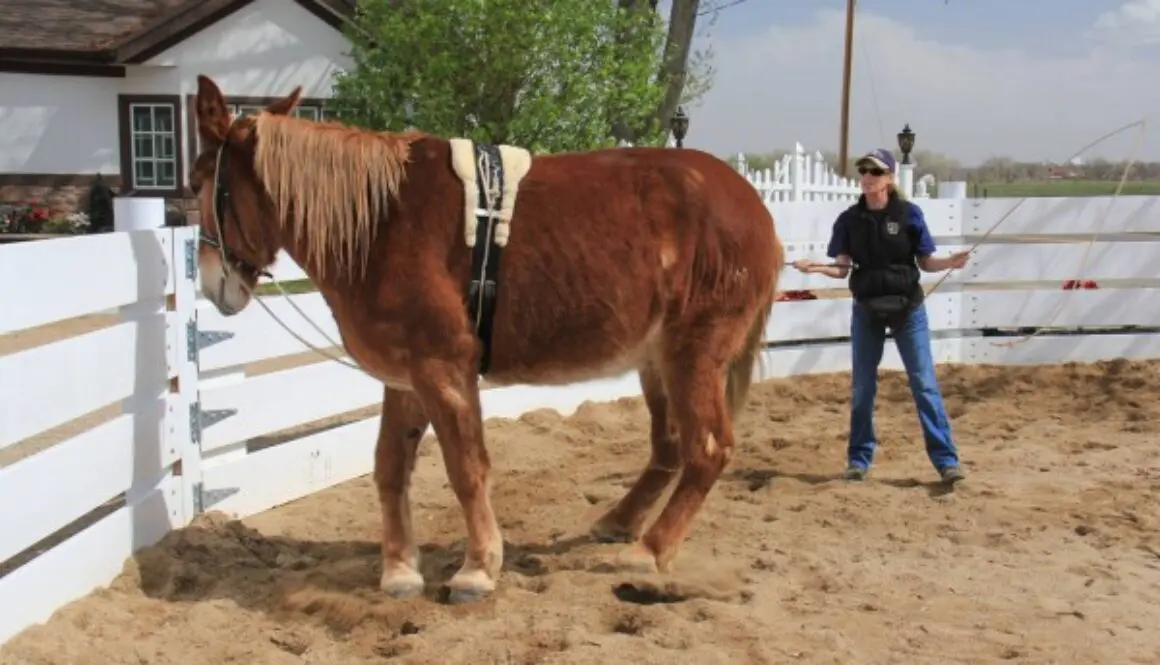
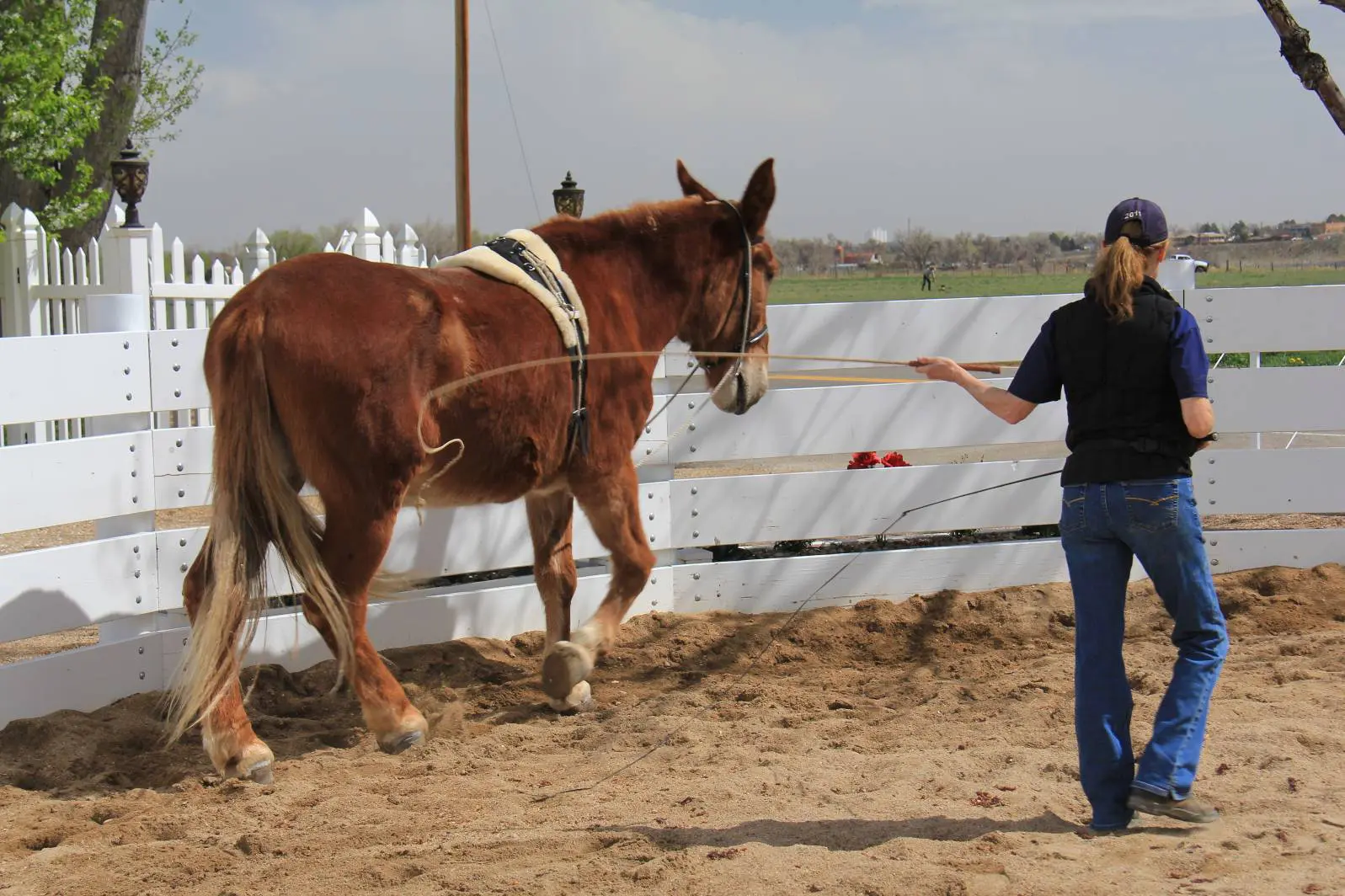
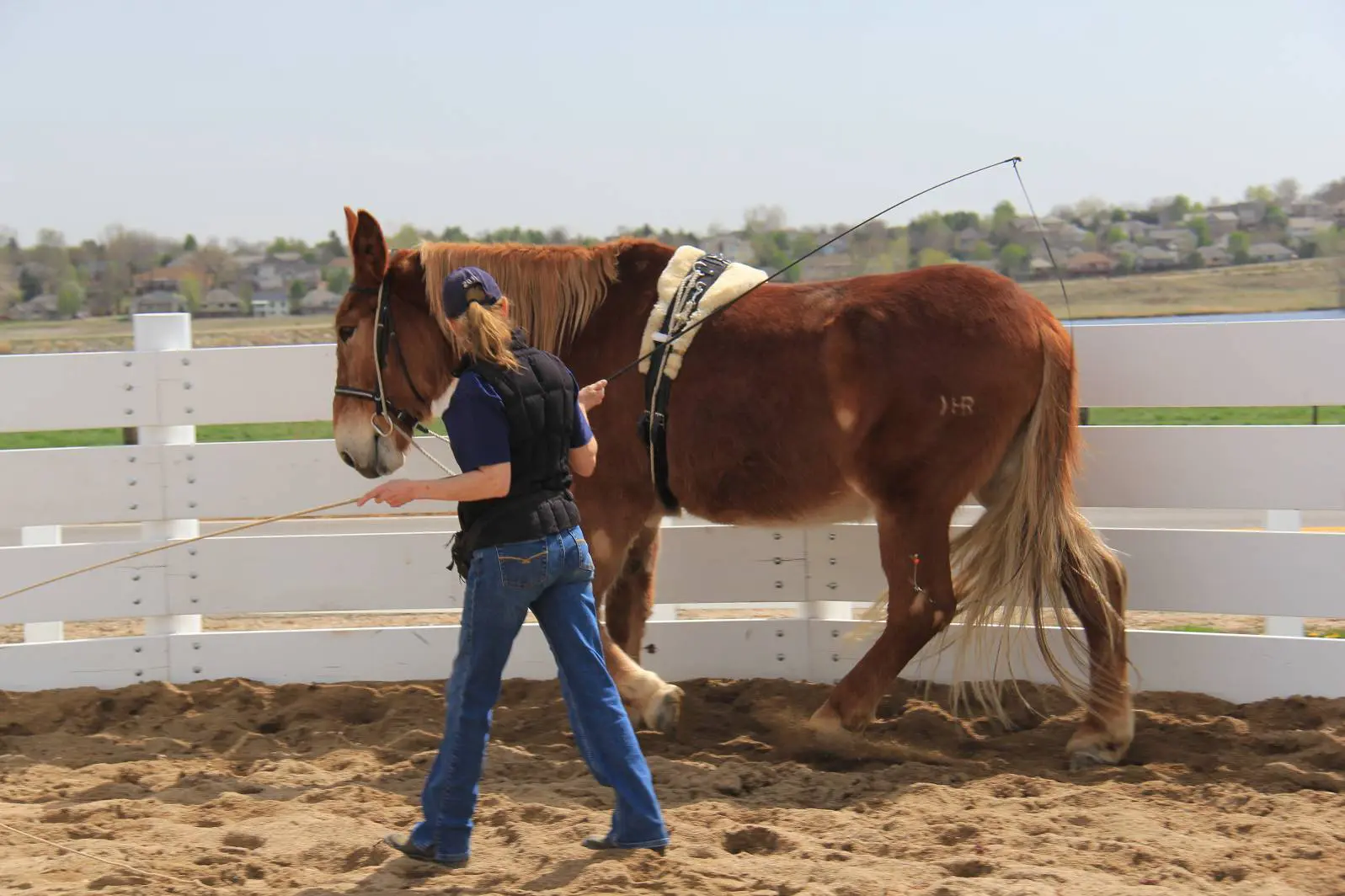
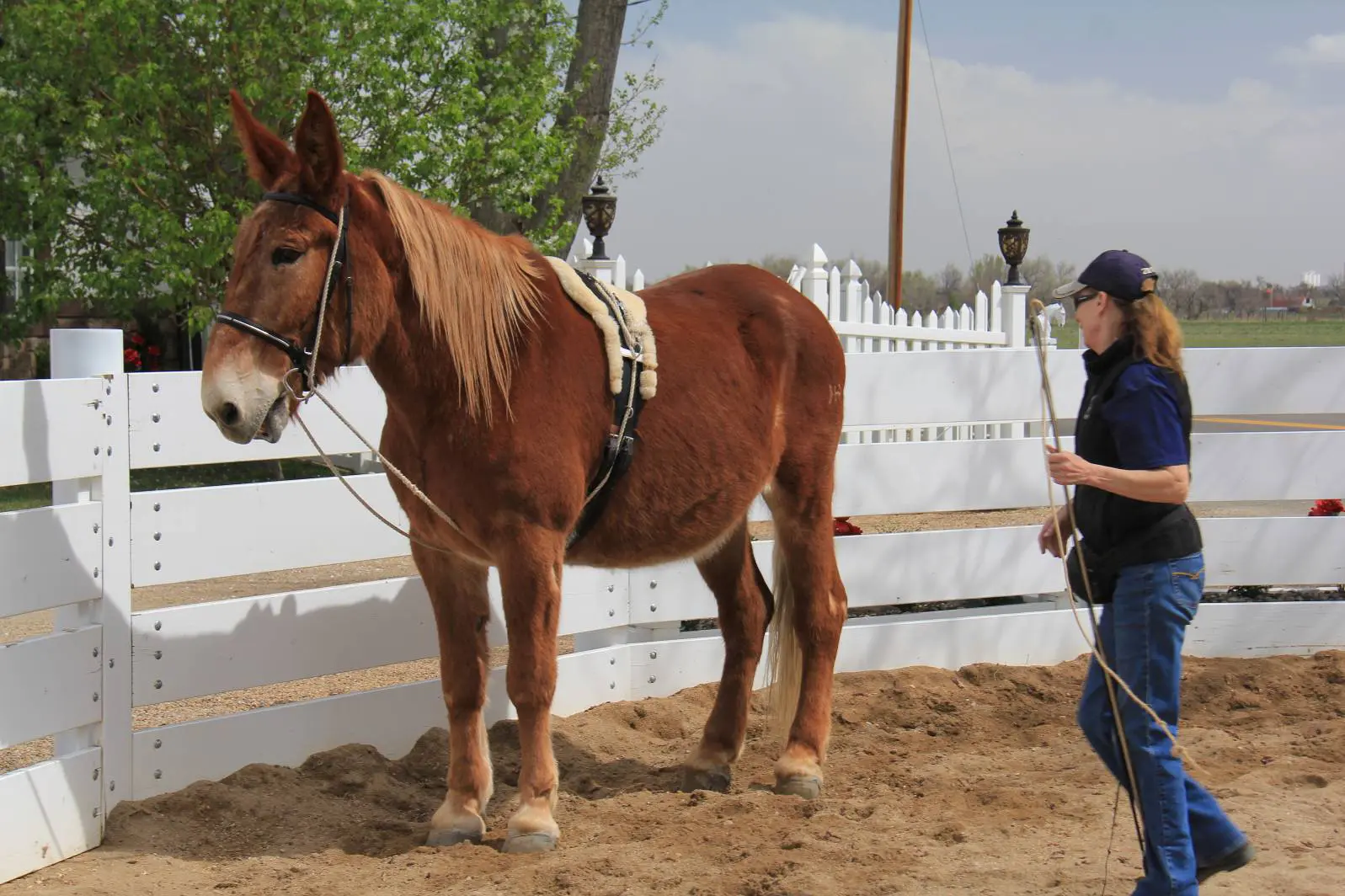
Roll had a really good leading workout today. He did do very well negotiating the gate.
Roll stayed in sync almost without a misstep during the whole lesson!
He did bend his body nicely through the rib cage around the cones.
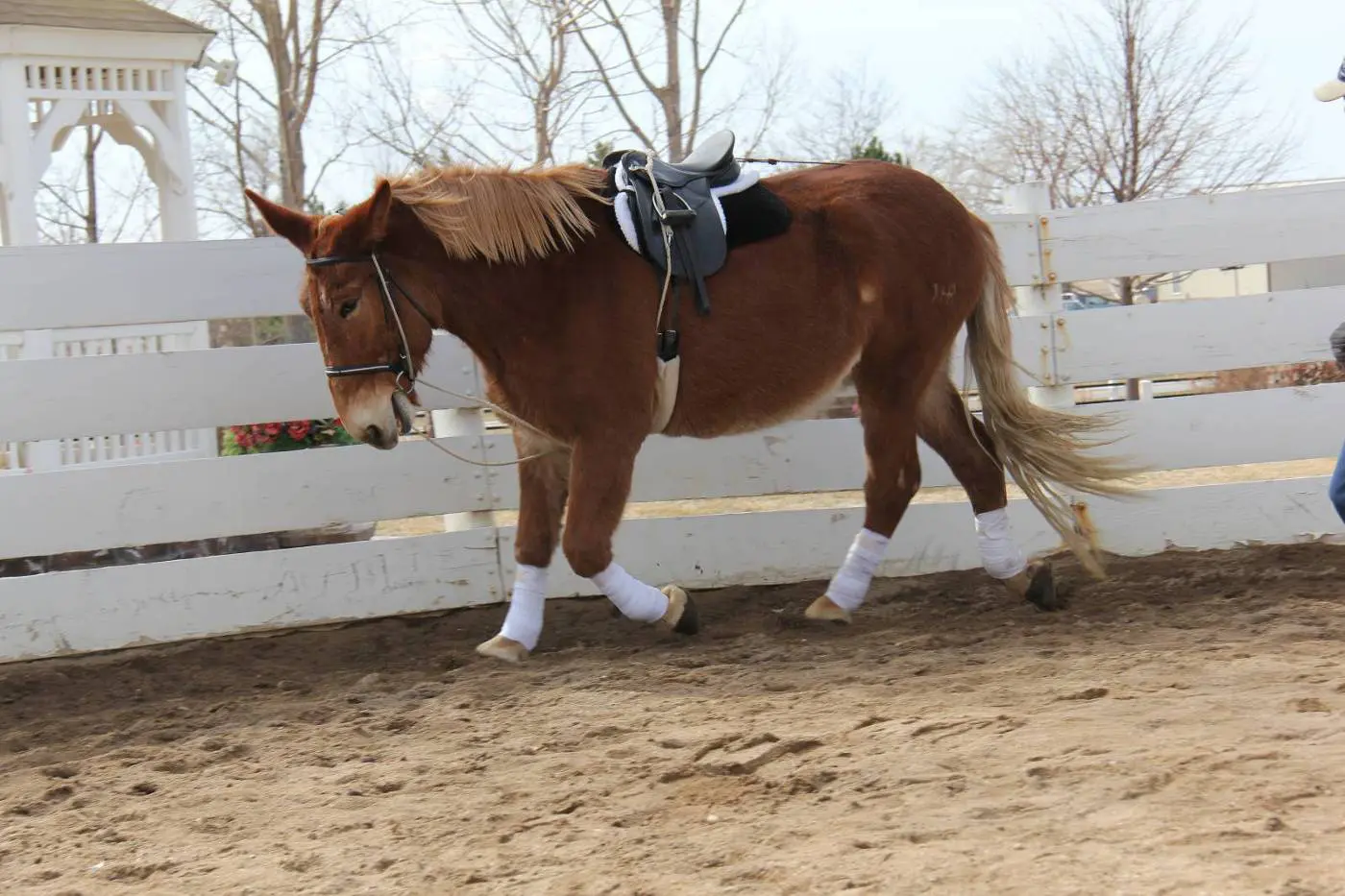
He did seem to have a little trouble aligning his back feet. He kept getting them a little closer to each other than he has in the past, but it will improve with practice.
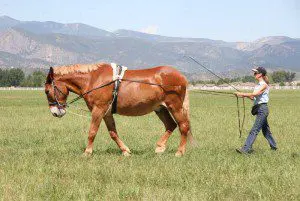
When I asked for more energy, he had it! A marked improvement from the beginning of his training!
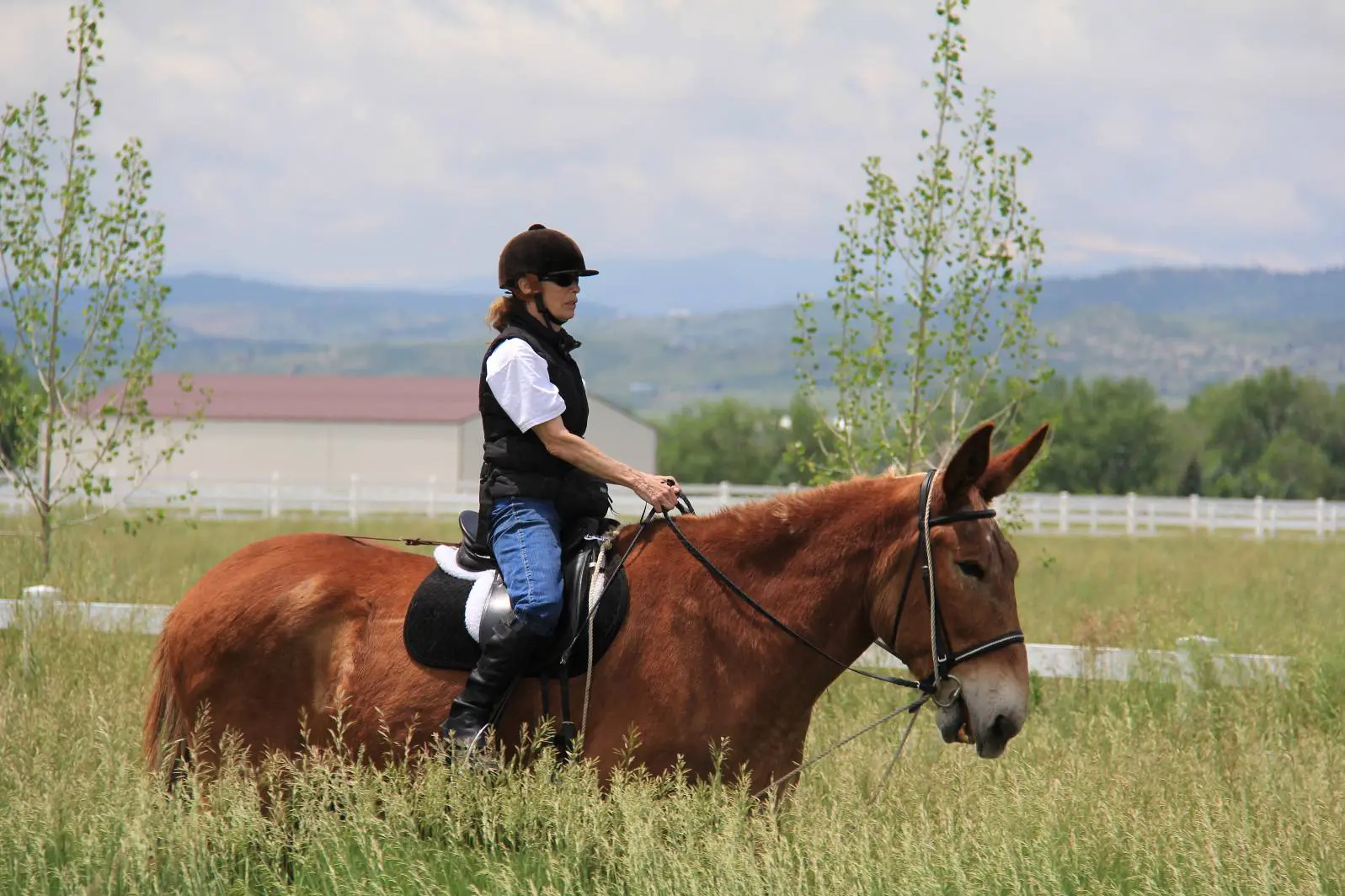
Roll is rounding across the top line and stepping well underneath with his hindquarters.
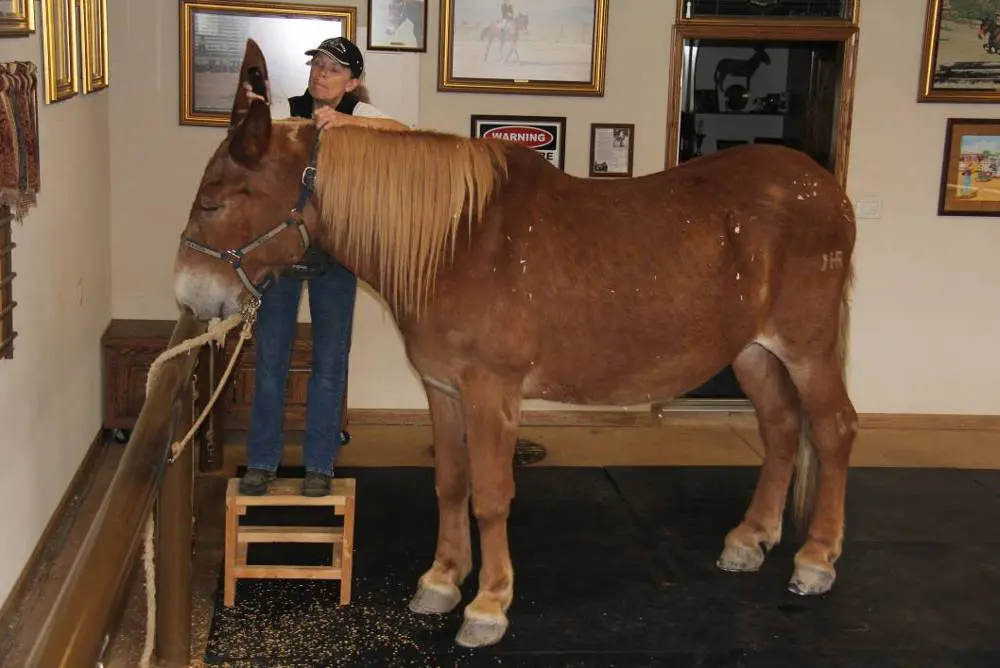
Roll gets more gorgeous every day! For a mule, his mane and tail are amazing!
A professional trainer, judge and animal inspector, Crystal Ward owned the Ass Pen Ranch in Placerville, California, where she raised and trained horse, mules and donkeys. The first year she came to Bishop Mule Days was in 1979. She happened to be coming through Bishop on vacation and it really intrigued her. She thought the mules were simply outstanding. Crystal had a show career with horses, but the following year she decided she had to own a mule. She showed up the next year with a horse trailer in tow, and at that point Bishop Mule Days was still offering an auction. She swiftly bought a mule at the auction and had been coming back ever since.
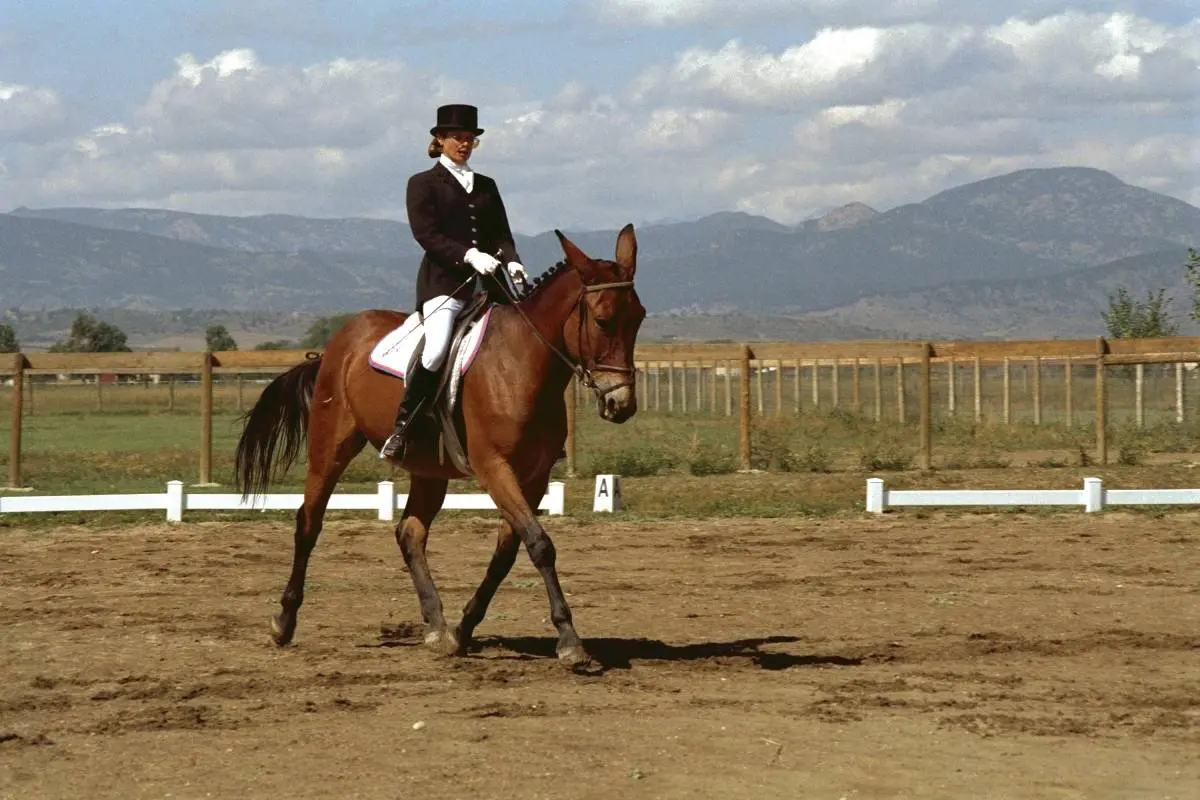
Her first mule was a wild little critter that didn’t make much progress. So the following year she bought a mule named Skeeter Sea from George Chamberlain, a dealer in mules in Los Alivos, California; the mule was previously owned by Slim Pickens. When Slim Pickens showed up as Grand Marshal in the Bishop Mule Days Parade, he told Crystal, “We used to own that mule.” She showed him with 55 mules in the class and won the Western Pleasure class that year. Although he was nice in the Western Pleasure classes, she couldn’t see owning this mule for the long term due to his generally bad manners. Later, she picked up a mule in Northern Montana and brought him back and started training him…his name was Final Legacy. He was a good honest mule and she kept him for the long haul.
Back in the early ‘80s, Crystal got really interested in riding side saddle, so she joined the International Side Saddle Organization and ultimately rode in the Presidential Inaugural Parade with Final Legacy in 1993, hauling him from California to Washington, DC, in the middle of January. He was a good honest mule and she loved him. She showed him in many classes at Bishop Mule Days over the years…from Western to English, dressage, driving and side saddle.
In more recent years Crystal switched to raising and showing donkeys. She had a variety of donkeys, from miniatures to mammoths. She fully understood that you have to take a different approach when training a donkey and produced training videos with Napa, California, videographer, Video Mike. She truly appreciated a good donkey: “Donkeys are like potato chips—you can’t have just one.”
In our interview in 2009, Crystal told me: “We call them [donkeys] ‘desert canaries,’ but that goes hand-in-hand with donkeys. They do like to talk and it can be loud, but you know I’ll still take a donkey any day. I live with the noise, but then again, I’ll have peacocks, barking dogs and roosters in my backyard. Donkeys are just one more noisy farm animal that I can certainly live with.”
For Crystal, it was always a matter of learning…English, Western, Side Saddle…the whole nine yards! She always performed to the best of her and her mule’s ability and she believed a lot of it was a matter of finding just the right mule!
Crystal enjoyed her interview for my documentary series, Those Magnificent Mules; she appeared in “The Bishop All Stars” episodes. (We have all of these episodes available to watch online.) She said: “We were showing back in the early ‘80s, beating the paths to Bishop Mule Days. The one thing I know about mule and donkey people is that it’s fun competing…nice rivalry. When you come out of a class, your fellow competitors will shake your hand and offer you a bit of encouragement. It’s like family when you show at a mule or donkey show. It’s something you always look forward to until the next time.”
You are so right, Crystal! You will remain in our hearts, forever a part of our longears family… we will miss you!
So what do you do together when it’s snowing outside? Roll looked like he was wearing SNOW boots when he first came into the tack barn. So, first we had to remove all of the icicles, but I had to be very careful because they don’t exactly come off easily. Roll let me know when I tugged too hard on the shedding blade and suggested that I warm them with my hand before I pulled! Good plan!
By the time I got to the back end, they had all melted!
We then decided to mess around with halters. Roll much prefers the fit and action of his nylon halter…and, it’s comfortable to wear!
The snugger fit allows him to feel the tug on the halter almost immediately and he can then comply promptly and without fear of reprisal. His ears indicate he is concentrating on stepping back with the slightest indication.
The fit and action on a rope halter is much different and it takes Roll a minute to figure out what I am asking. Note his questioning and confused look!
The halter puts uneven pressure across Roll’s face and he doesn’t seem to be confident about what to do…” Would you like me to stretch or just take a step forward?”
Because we have worked solely in the nylon halter except for the demonstration with the rope halter, he is happy to stand quietly and wait for me…no pain, no fear!
Even when we were interrupted by a loud noise, Roll remained engaged in his stretching activity. We both just turned our heads calmly to the side to see what it was!
…and then we resumed our stretching exercise in a sea of oats!
Making our way back to the paddock, Roll happily matched me stride for stride, staying in balance with good equine posture!
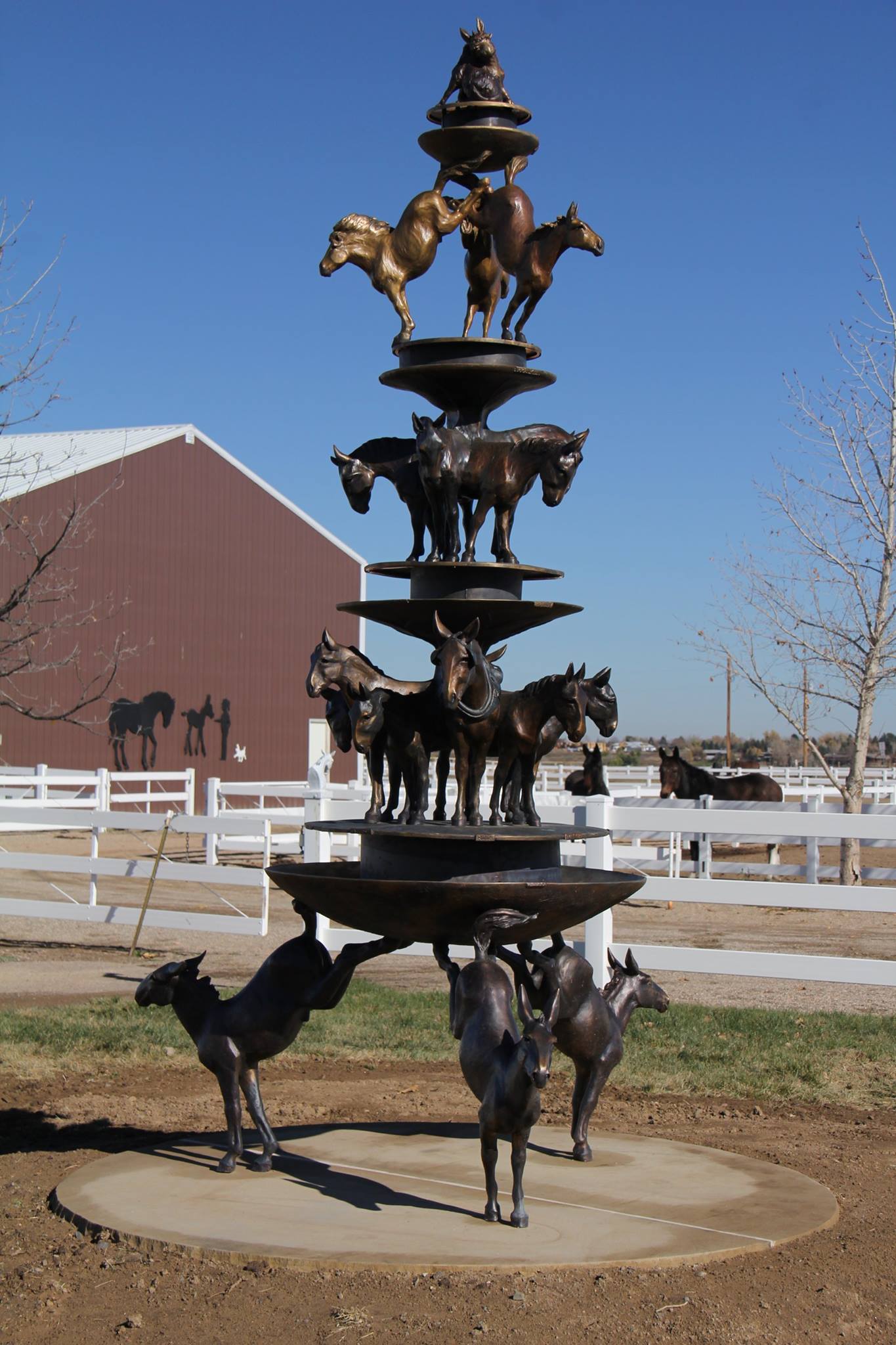
My good friend, Tennessee mule artist Bonnie Shields, recently introduced me to sculptor Dennis Page from the Rocking Horse Ranch in Riverton, Utah. Dennis is working on a hand-carved “rocking mule” that is modeled after Bonnie’s ceramic sculpture of Kathleen Conklin’s Champion Driving mule, John Henry. I am so impressed with Dennis’s work that I decided to purchase the wood-sculpted rocker. What an amazing addition it will be to the Loveland Longears Museum and Sculpture Park here at Lucky Three Ranch!
Kathleen Conklin sent me some really nice pictures, his Championship cooler with his name on it, his driving harness and John Henry’s championship ribbons from the finest pleasure driving in the United States – Walnut Hill Farm Driving Competition in Pittsford, New York. These will be on display here at our Loveland Longears Museum and Sculpture Park at Lucky Three Ranch. John Henry (1991-2011) and Kathleen Conklin competed at Walnut Hill for seven years in the Commercial carriage Division. They last showed there in 2010. John Henry died about three weeks before Walnut Hill. In the seven years they were there, John Henry was the only mule on the grounds and he had his own fan club of spectators who came to see him every year. He was Champion or Reserve Champion of the commercial Division six times showing under rated commercial driving judges from England! John Henry and Kathleen had a wonderful time together showing everyone just how great a mule can be…and he was TRULY A GREAT MULE!
Jasper the Mule stops by your TV screen once again this Christmas! Celebrate Christmas with Jasper and all his friends as Jasper: A Christmas Caper airs on Rural TV (Dishnet Channel 232) on Christmas Eve.
It’s the Christmas season and Jasper and his human family are in high spirits as they travel to visit far-away friends a few towns over. When Jasper and his pal, Moxie the dog, get out of the yard and wander down a strange alley, the two friends are headed straight for one big adventure!
Presents disappear, mysterious strangers appear and friends go missing. But junior detectives Jasper and Moxie are on the case. With the clock ticking, Jasper has to use his “mule smarts” to tackle this puzzle of a mystery and put the pieces together before the big parade. But will he solve the mystery in time?
Airing on Rural TV (Channel 232 on Dish Network or check your local listings).
Tuesday, December 24 at 7pm and 11pm ET (4pm and 8pm PT)
If you don’t get Rural TV or miss the airings, all Jasper episodes are also available for rental on demand.
Jasper the Mule returns to your TV screen this holiday season! Celebrate Thanksgiving with Jasper and all his friends as Jasper: A Turkey Tale airs on Rural TV (Dishnet Channel 232) this week.
As the gang prepares for the big Thanksgiving celebration, Jasper the Mule and his pal, Moxie the Dog, are hot on the trail of adventure! A mishap with a truckload of turkeys turns into a real live mystery, as the boys solve the case of “The Beady Eyes in the Bushes!”
When they make a new friend who is lost and alone, Jasper’s mule-y sense of loyalty kicks in and he is determined to help, no matter what. Will Jasper and Moxie save the day? Will their new friend find his “forever home?” All the fun and warmth of Thanksgiving come to life in Jasper: A Turkey Tale.
Airing on Rural TV (Channel 232 on Dish Network or check your local listings)
Monday, November 25 at 7pm ET
Wednesday, November 27 at 7pm and 11pm ET
If you don’t get Rural TV or miss the airings, all Jasper episodes are also available for rental on demand.
Our hearts go out to Connie Bartels for the loss of her beloved Homer, longtime friend and loyal companion. He will be missed.
“Sunday when we rode while I was taking his tack off I was talking to him telling him what a good boy he is and what a good ride we had. Then I hugged him tightly as I always do….he knew me, and he liked me a lot. To think that I will never ride him again is heart wrenching to me. He was my good friend and buddy…..and I would never find another Homer. I am very sad today, but I am thankful for the many years we were friends. Only mule people would understand this.”
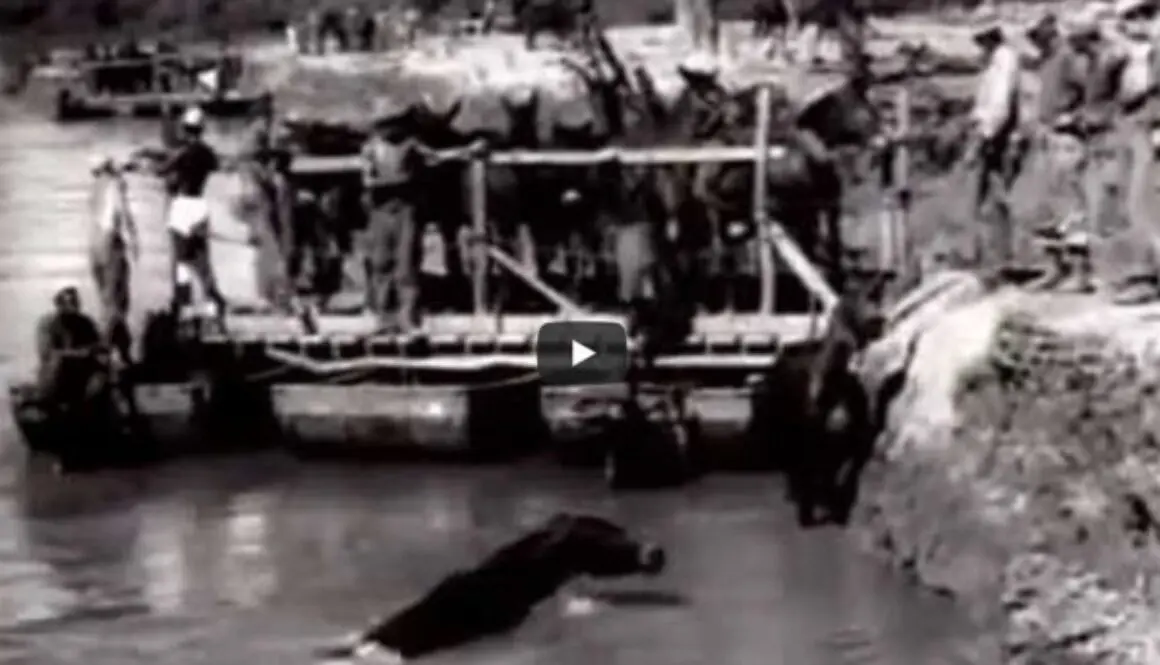
To celebrate the 100th anniversary of the Los Angeles Aqueduct, artist Lauren Bon, in collaboration with Metabolic Studio and the LA Department of Water and Power, is retracing the steps of the aqueduct’s original construction, from Owens Valley to LA–with a 100 mule pack train. Their journey started on October 18, and the convoy is expected to arrive at the Los Angeles Equestrian Center in Griffith Park on November 11, with stops along the way at the Lone Pine Rodeo Grounds, Jawbone Canyon, and the Hansen Dam.
The mules are being cared for by Jennifer and Lee Roeser, who run the McGee Pack Station in the Eastern Sierra range, and who received the “Most Honored Packers” award at Bishop Mule Days in 2010. They are utilizing one wrangler per 10-mule string, with about 35 people total on the support staff and 10 support vehicles to supply the mules with food, water, gear, and medical care.
The pack train will be passing through three counties and over 50 California communities before reaching their final destination. It’s appropriate that this project will be sharing and celebrating mules’ contributions to the country, especially in anticipation of Mule Appreciation Day on October 26.
For more information, check out the LA Times article about the project.
Roll continues to be a happy camper and always looks forward to any time he can spend with us outside of his pen and pasture areas. It has been several months since he has been worked because we have been busy with construction all summer, however, the core muscle, good posture training that he had for the past three years has drastically changed his overall health.
Because it has been so long in between workouts, I began his workout by walking him around the round pen five rotations before asking for trot. As he walked I made note of the way he was moving through his body. He was a little weak in strength, but still maintained a good rhythm and cadence to the walk with his feet landing only slightly behind his front footsteps. This was to be expected.
When he was asked to trot, he responded promptly and energetically and showed no signs of lameness even though he is still dealing with side bones on both sides of all four feet and ring bone, top and bottom in his hooves. It’s very encouraging at the age of twenty that he is sustaining good balance throughout his body such that he is not putting undue stress on those areas.
I was particularly surprised at how good his posture and balance was after so long with no work when he came to an almost perfect halt when asked to whoa.
When asked to reverse, he executed it with the finesse he had previously learned to do by first planting the pivot foot and then making a smooth turn against the fence and crossing the front legs over correctly.
He then walked in the opposite direction with regularity of cadence and rhythm and complete willingness to perform, though I could tell he was beginning to tire in the sandy ground.
When asked to trot, he responded promptly with good energy, but had to lean on the elbow pull a bit just as a ballet dancer would need to lean on a balance bar for exercises after being away from dancing for a while.
When asked to halt, again it was smooth, balanced and nearly perfect.
Roll was so proud of himself that I thought we should stop in front of the new construction for a photo op!
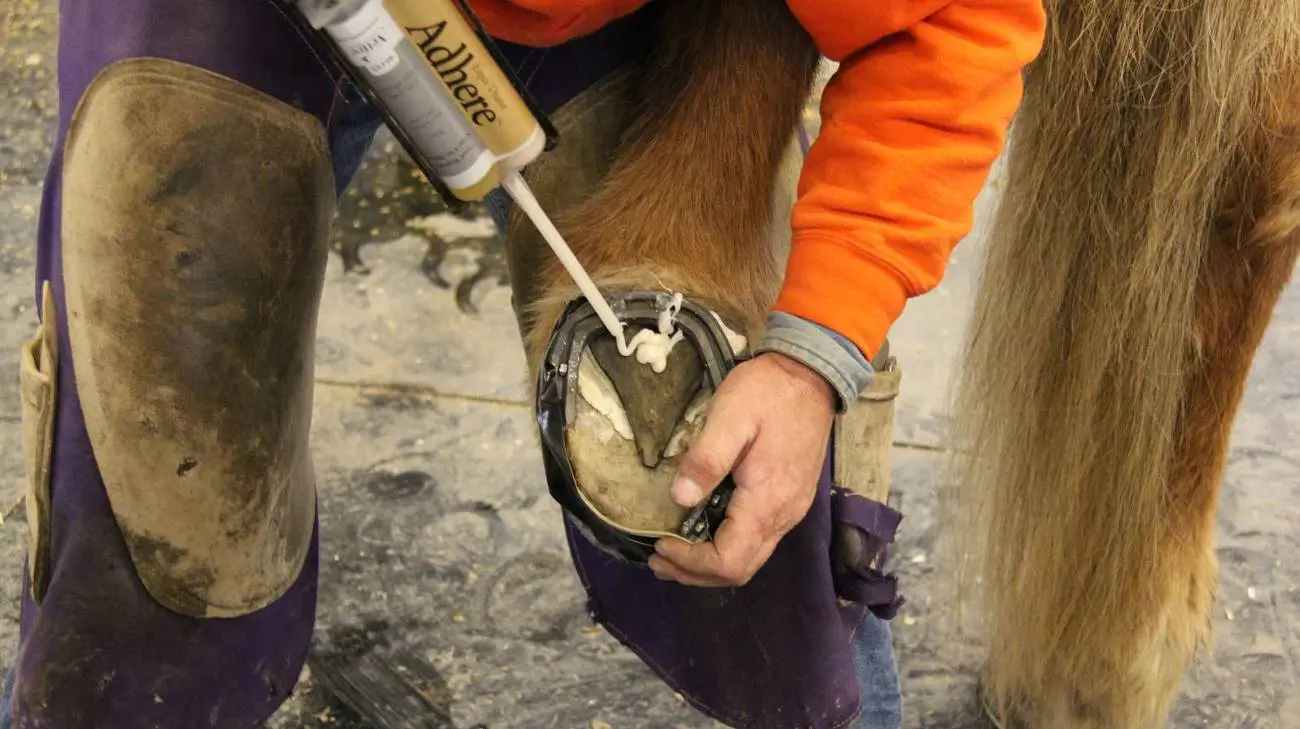
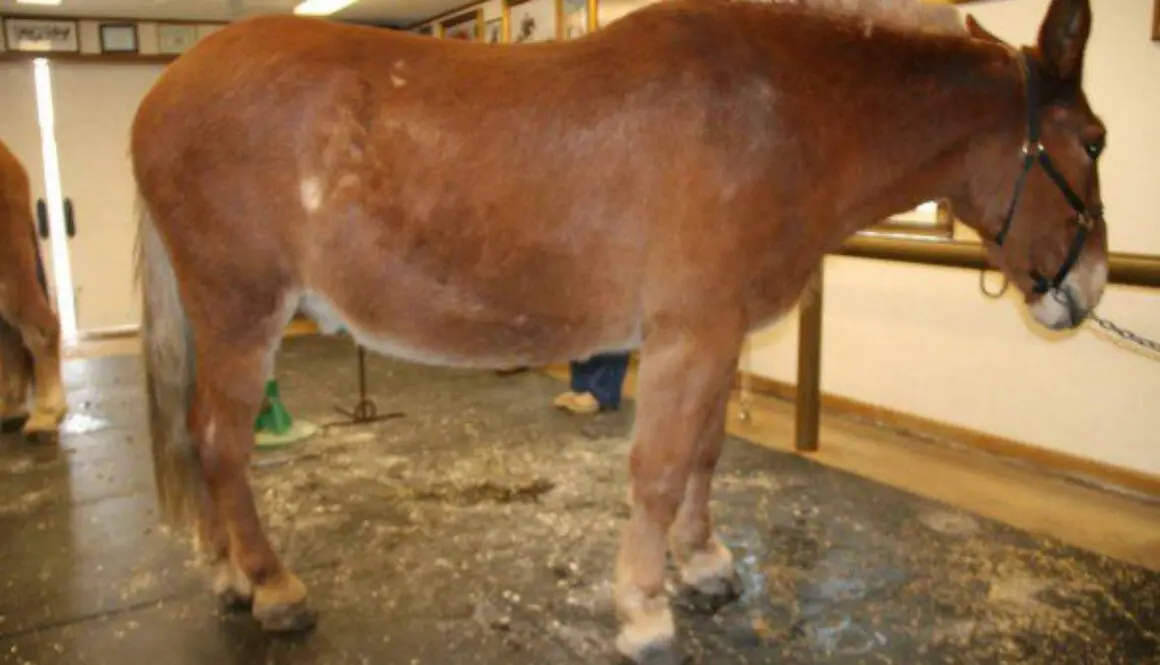
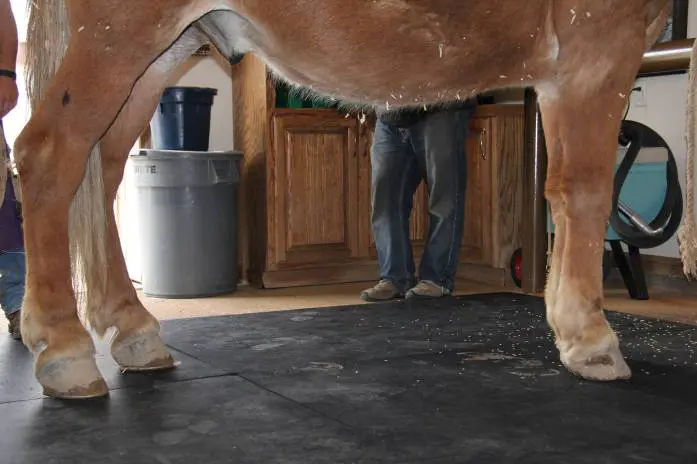
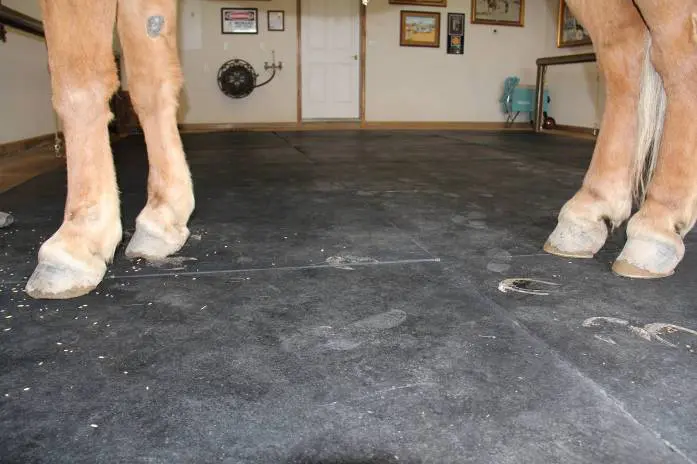
Dean the Shoeing Machine came by a few days later to reset Roll’s hind shoes. The shoes help him to sustain his balance and keep from wearing his toes on the hind feet. In addition, having the shoes has really helped to steady the right hind foot that used to twist when he moved.
Roll’s stretches have greatly improved as well. Where he used to have to twist his head sideways to look at me, he can now reach and keep his head straight while bending through his neck and shoulders. This is a really tough move!
Roll’s mane continues to grow long and soft with his weekly applications of Johnson’s Baby Oil that I used to soften and train his coarse mule hair to lay over like a horse’s mane. It would otherwise just keep growing straight up and fall on both sides in a rather unruly manner. That is why so many people roach the manes on mules! Roll is a beautiful boy at twenty years old and really loves being a Lucky Three mule!
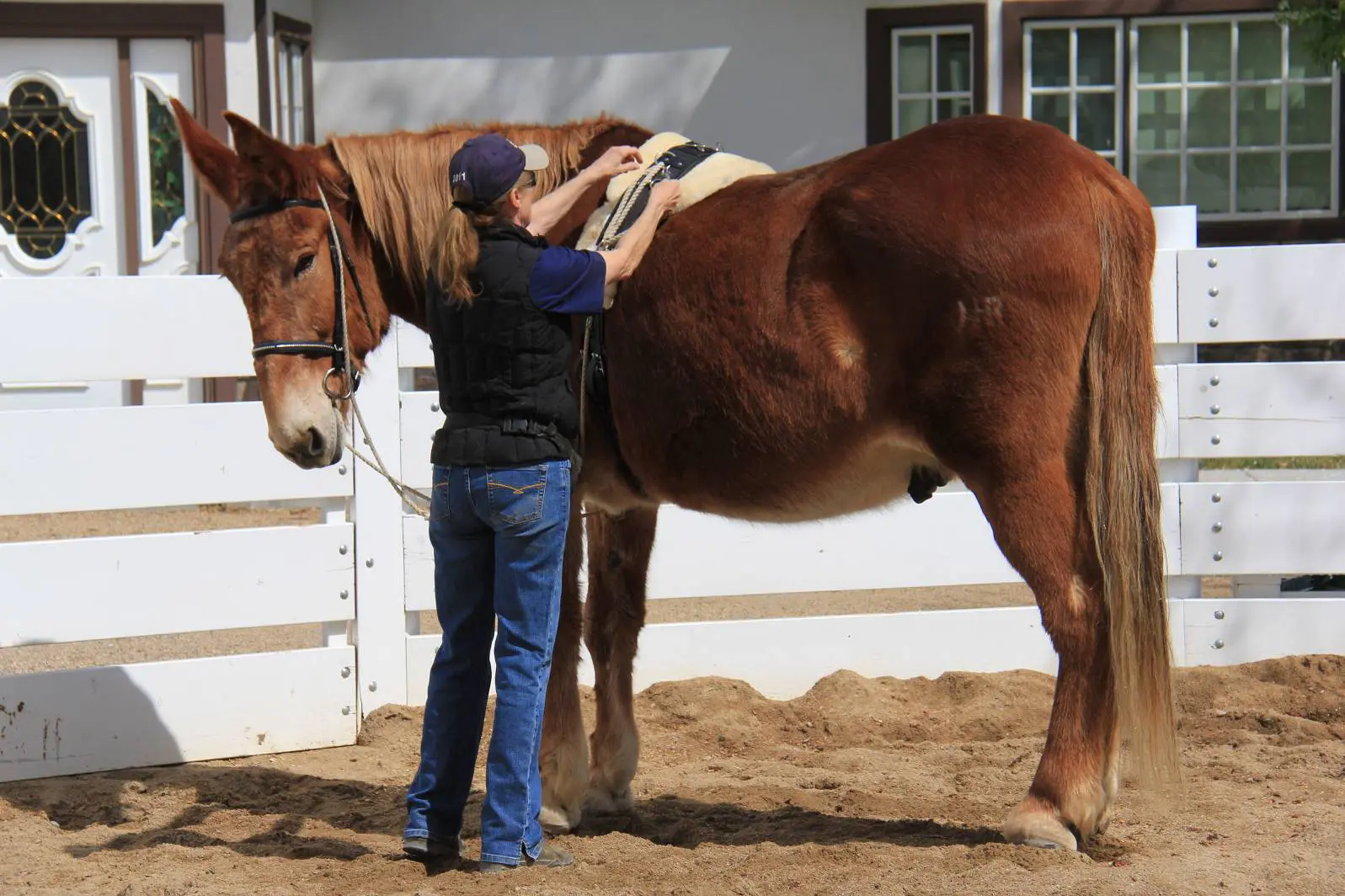
Roll had a very good day today. It has been awhile since his last workout and I wasn’t sure I was going to ride him, but I saddled him in case he looked like he would be able to handle it. Roll had a chiropractic adjustment on his right hip that helped the twisting right foot to be able to move in a more straight forward fashion. Equines, like us, can get locked up when we don’t move around enough and I suspect that is what happened with Roll’s hip.
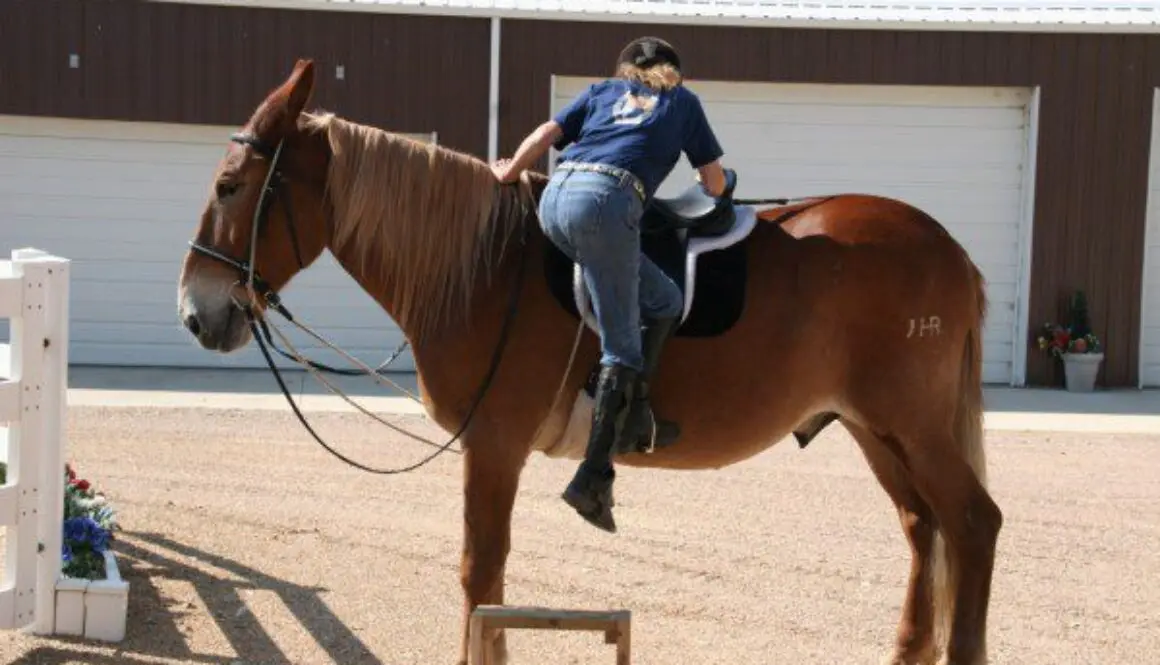
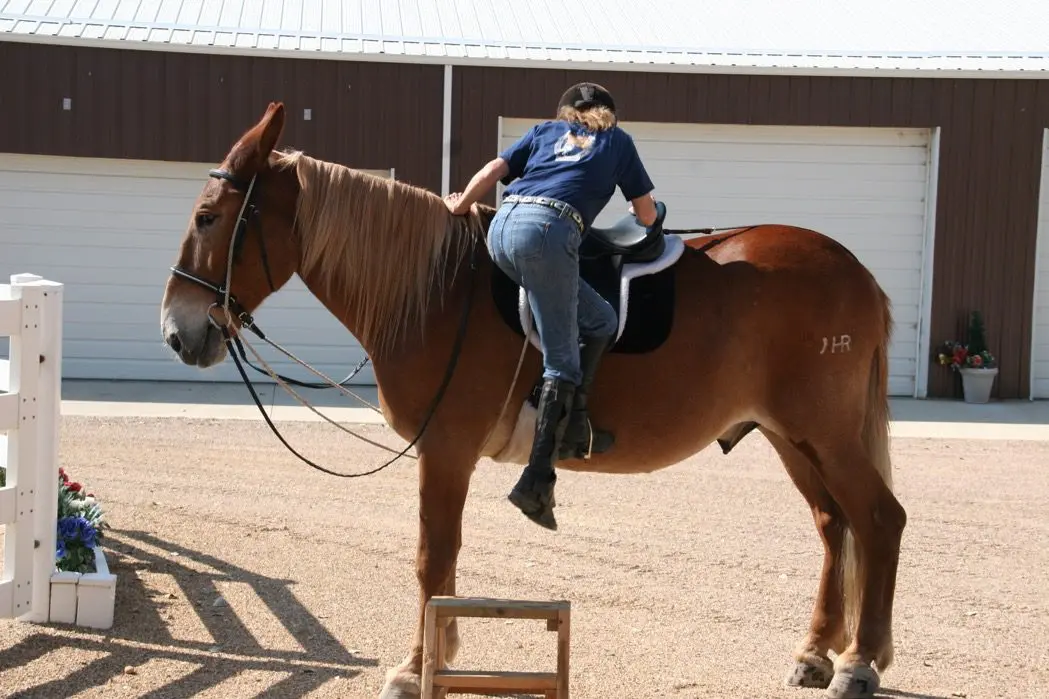
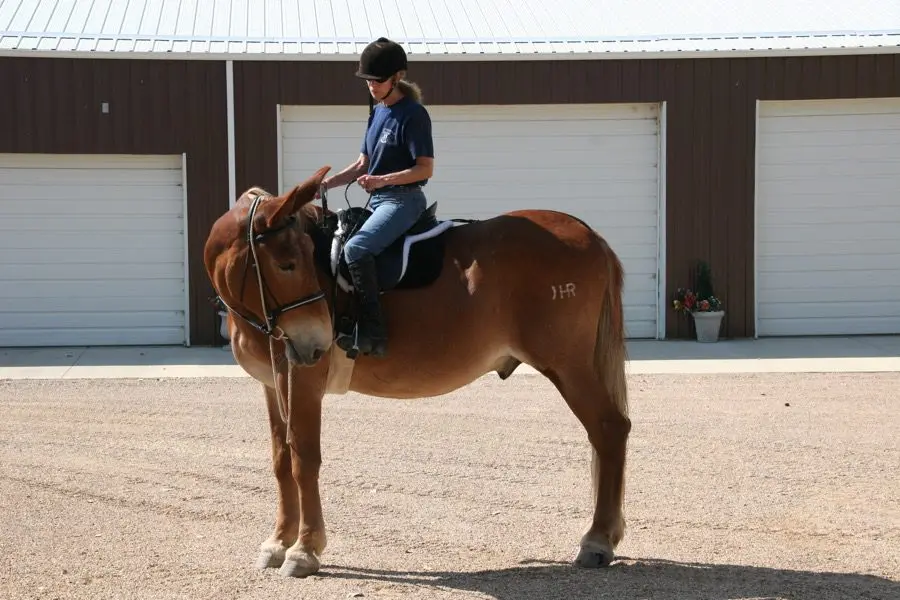
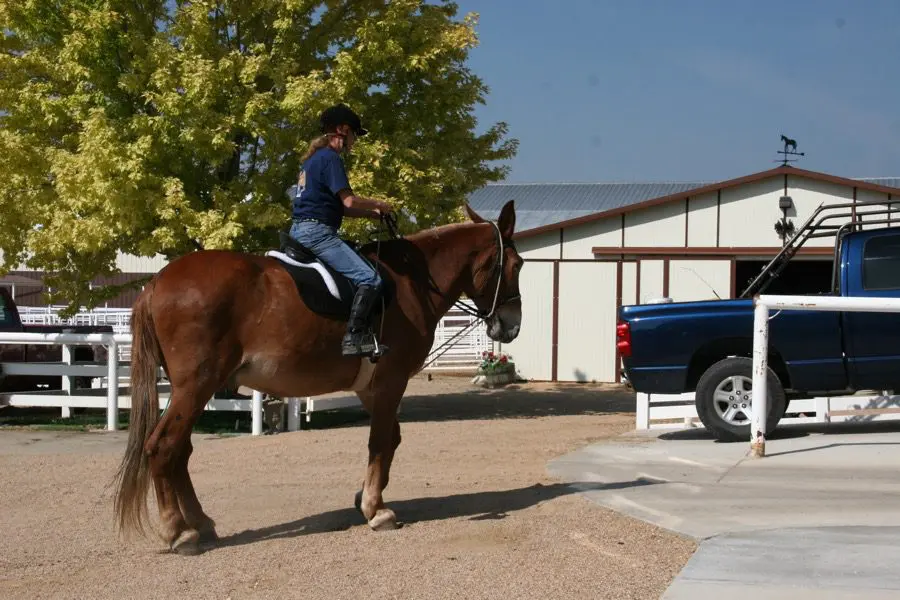
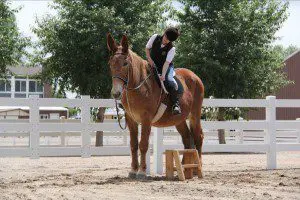
We went to the round pen and did 5 rotations of walk each direction and 8 rotations of trot each direction. Then I climbed on board with no help this time, Steve came in and removed the mounting block and we were off. Roll did fantastic. He was a little lazy, but very light in the bridle and very willing to do two rotations at walk each direction with an “S” turn through the middle for a change of direction with a rein back at the beginning and end of his workout. Since he had not worked in awhile, I left it up to him as to whether he felt like breaking into trot. He did not seem to want to do this with no cues from me, so I opted not to press him any further. He had already done much more than I expected that he would!
This is a special entry by Phil Yellott, owner of Romulus, who has been certified by the Guinness Book of World Records as the World’s Largest Donkey.
Cara and I wanted to get a couple of donkeys for guard animals. We saw a couple of mammoth donkeys on Craigslist, who were very skinny and underfed. We contacted the owner, and were able to negotiate a price so we could get them. We named them Romulus and Remus after the legendary founders of the Roman empire. Romulus is 9 years old, and his little brother Remus is 7.
The two brothers are very close, most of the time it is like having one donkey with eight feet! We love them very much. We have been working very hard to get them healthy. We contacted the American Donkey and Mule Society (ADMS) about whether they were registered, and were told that if they were as tall as we thought, that they might be a candidate for the world’s tallest donkey. After researching the record, we saw that Oklahoma Sam was 15.3, and it seemed like Romulus was a good bit taller than that.
At about 3:30 PM on Friday, February 8th, 2013 at 4C Stables, Dr. Valerie Jaffe, D.V.M., measured Romulus three times, each time finding his height to be 17 hands, or 68 inches tall. This is 172.72 centimeters in height.His brother Remus was also measured, and he was measured at 16.2 hands, 66” in height.
If you would like to have them at your event, please contact us. -Phil
Romulus’s information:
Size: 17 Hands (68 Inches, 172.72 CM)
Weight: about 1200 pounds
Age: 9
Breed: American Mammoth Jackstock
The tallest donkey living is Romulus, a 9-year-old American Mammoth Jackstock, who measured 17 hands (172.72 cm; 5 ft 8 in) tall on 8 February 2013, and is owned by Cara and Phil Yellott of Red Oak, Texas, USA.
Cara Barker Yellott and Phil Yellott
Proud owners of Romulus and Remus
3708 Ovilla Rd.
Red Oak, TX 75154
cara@cbyequestrian.com
phil@yellott.com Romulus’ Website Romulus’ Facebook
214-724-8527 (Cara)
903-399-6851 (Phil)
Roll has learned so much since he came to us in December of 2010 and he continues to learn more each and every day. When he first arrived, he was spooky and hid behind Rock almost all the time. Since, he has learned about how important good manners are and that he will always be treated with kindness and consideration being a part of the Lucky Three Ranch. Roll enjoys his studies of “Emily Post’s Book of Etiquette!”
Roll is not only healthy and strong at 20 years old, but his entire attitude has changed dramatically. He is calm, quiet, accepting and very careful about being around his human friends. He has been exposed to major construction and all kinds of new and potentially scary things, but he now trusts us and we trust him. Trust takes a long time to build and should not be taken for granted. Never get on your knees like this around your equine until you are absolutely sure of their good behavior and your solid relationship with them. As I said before, this takes a long time and the correct steps to reach this kind of intimate communication with your equine, but it is well worth the time invested.
Using baby oil in Roll’s mane and tail during weekly grooming has allowed his generally coarse mule mane to soften and grow long and beautiful. Mule manes are known for being really coarse and growing straight up and falling on both sides in no particular fashion. This is why they are generally roached and cut short. The fuzzy hairs at the top of his tail are now also sleek and smooth like a horse’s tail. Roll really likes looking like Fabio!
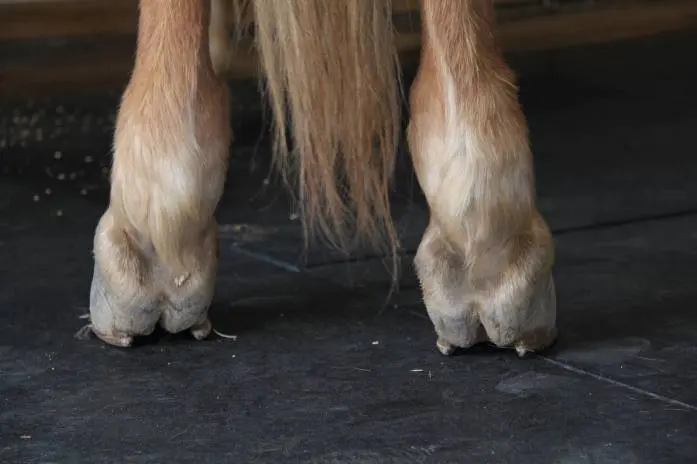
Roll really likes his farrier Dean Geesen. The founder, side bones and ring bone he experienced in all four feet has been under control since a year after he arrived and he continues to stay sound because of the strengthened core muscles and good posture training that he received routinely for 3 years.
Roll enjoys being a part of the Lucky Three Tours and loves to have his picture taken in the park with the statues! He makes quite an elegant statue himself and we couldn’t be more proud of him!
We were sorry to hear about longtime mule skinner Buddie Stockwell. We appreciate all the work that Buddy put into mules in Colorado with the Rocky Mountain Longears Association. Here is one of my favorite stories about Buddy.
In the fall of 1984, Loveland, Colorado muleskinner Buddie Stockwell and horseshoer Jerry Banks, along with a few friends, decided to make a hunting trip into the Rocky Mountains. Packing in, the weather was beautiful with warm temperatures, calm breeze, and nary a hint of what was to come. After setting up camp and tending to their horses and mules, the hunters went about the business of tracking elk. Hunting was good, but after a few days, one evening brought with it an unpredictable storm of incredible severity. The hunters awoke the following morning to find their camp buried in four feet or more of snow, and with no chance of the storm lifting.
Quickly, the hunters packed up what they could on the horses and mules; tents and a lot of gear had to be left behind since time was of the essence. As they left the campsite, snow deepened and the terrain underneath was steep, rocky, and treacherous. They had only gone a short distance when the snow became so deep, and the terrain so hazardous that the horses refused to go one step farther–the horses would not blaze the trail out! Anxiety was high and the hunters were fearful of never making if off the mountain.
In the face of great danger, Buddie asked his trusted mule, Goliath, to break trail for the others, and with slow, careful, deliberate steps, Goliath led them all safely down the mountain to their trucks and trailers, which were also buried in snow. In bitter cold, they freed the vehicles, loaded them up, and made their way back to the lowlands to safety. The storms on the mountain worsened, and it was spring before Jerry and Buddie could return for the rest of their gear–but both men and their friends were grateful to Goliath for leading them down the mountain to safety.
We are very excited to announce that our gorgeous revised edition of Training Mules & Donkeys has won the GOLD medal in the Pets & Animals category of the Independent Publisher Book Awards. We’re very proud of the work we’ve done on the book, and it’s great to see it being recognized. Many congratulations to our hardworking staff and to the longears that inspired the book!
Roll has been off for several months during the Christmas season and then during inclement weather throughout the winter and early spring. His physique has maintained its core muscle strength and his good posture continues to be strong. He has maintained this good posture and musculature over these five months on turnout alone. When an animal’s posture is truly changed and improved, he should reach a point where this becomes the norm and his way of standing and moving will reflect that. He no longer requires formal lessons to strengthen the muscles in good posture because he can now do it himself as long as he is given the room to move on a daily basis.
One of the most important things we did with Roll was to shoe his two hind feet. Back when he was first beginning the round pen work, I noticed he was twisting the rear feet, particularly on the right hind foot. He began wearing his hooves unevenly which was compromising his ability to balance in good posture consistently. We theorized that if we could keep the foot flat when it hit the ground with no give, he would be able to track forward without twisting.
This proved to be true and Roll has done well with frequent resets and new shoes at critical intervals. The founder he once had in his hooves is practically undetectable and his new-found health is exhilarating for him. He welcomes the farrier visits as it makes him feels good. This would not have been possible without the right kinds of exercises and shoes.
Roll stands stock still while he is being worked on and always seeks the four-square balanced position. He doesn’t ever have to lean on the farrier because his good posture and balance is so strong.
His feet are much improved and look fantastic compared to what we started with.
After his farrier work, Roll is asked to do some stretches after having to stand still for quite awhile. This feels good, too and he is happy to comply. First from side to side…
…and then to stretch downward.
All of these exercises allow him to learn to cope with a multitude of distractions and to handle them in a calm and thoughtful way, so that he learns to pay attention to all that is happening around him without becoming unduly nervous. All this helps to make him a comfortable, happy, reliable and a safe equine to be around!
This story comes from our friend, Luzma Osorio, of Criadero Villa Luz in Colombia. You may remember her previous posts about the mule mother on their ranch!
A Paso Fino Hinny
Very little has been written about Hinnies–most of the time it is unfavourable comments and myths due to lack of knowledge about them. Until now, very few people have bred Hinnies because of speculation about their size and behavior; they are said to be very small and difficult. Typically a breeder or a farmer may only have one Hinny and several mules; consequently his opinion is based on limited experience.
A Hinny is a domestic equine hybrid that is the offspring of a male horse and a female donkey. It is similar to the more common mule, which is the product of a female horse and a male donkey.
Most of the times Hinnies are the result of an accident, which is why they are less common than mules and there is a lack of information about them.
Moms-to-be
At our Stud Farm, Villa Luz, in Colombia, South America, we have been breeding mules and donkeys for more than fifteen years. There has been a big demand for our Paso Fino male donkeys (Jacks) to produce gaited mules through the years. But we were left with many female donkeys (Jennies), and nobody would buy them to produce mules even though they have the same good genetics and Paso Fino gait of their brothers. So we thought, let’s breed Hinnies–and the project began! This was twenty months ago.
Romero, the proud father
First we selected twelve of our beautiful female donkeys (Jennies), 13 hands height average, with good womb and physical conformation. Then we needed a horse, so we bought a three and a half year old Paso Fino stallion and called him Romero. He is 14 hands. But it wasn’t easy; he didn’t like the Jennies to start with. This is normal, as horses prefer mares and donkeys prefer Jennies. But with much patience and after three hours waiting, Romero finally went for his first Jenny. Now he loves his harem of twelve, four of which have given birth to beautiful Hinnies and six are pregnant! So we expect to have at least ten Hinnies at the end of this year.
Hinnies are thought to be smaller because female donkeys are, for the most part, smaller than mares, but like mules, Hinnies come in many size–it depends on the size of their dam and also the sire.
Female donkeys range from miniatures to Mammoth Jennies that may be over 15 hands at the withers. At Villa Luz farm the Jennies are 13 hands average and the horse stallion is 14 hands so we are expecting the Hinnies to grow around 14 hands in height.
There are now four baby hinnies.
We now have four Hinnies, two females and two males: Romance, Romancera, Ronaldo and Rosarito. They are seven, six, five and four months old respectively. Their mothers had good deliveries without any problems.
The pregnancy time differed a little; Romance was born after 12 months, Romancera after 12 months 21 days, Ronaldo after 11 months 19 days and Rosarito after 12 months and 23 days. The pregnancies of Jennies are normally longer than mares.
We do the imprinting process as soon as they are born; it allows us to mould their personality and make them friendly and well-trained adult Hinnies!
The babies are born with Paso Fino gait
It is said that Hinnies often have shorter ears, although they are still longer than those of horses, and more horse-like manes and tails than mules. Well, our Hinnies certainly have the ear shape of their sire–they are beautifully pointed at the top just like his, but bigger. Up until now the behavior and characteristics of our Hinnies don’t differ much from the mules, they are lovely animals. It is our goal to study Hinnies and help to understand them better.
The good news is, the Paso Fino gait has passed to the Hinnies! This gait is natural and we have seen it in our baby Hinnies shortly after birth! Paso Fino is a lateral gait, four beat footfall, which provides a constant, rhythmic cadence. The rider should not experience any bumping or jolting. They say you can carry a tray with a glass of champagne on a Paso Fino equine as they are so smooth!!
We don’t know if they got the Paso Fino gait from the sire or the dam because both have it, but we certainly will have Paso Fino Hinnies! Very smooth, intelligent and well behaved!
An article in the U.K.’s Daily Mail reports that one-third of recreational riders are too obese for their equines, putting the animals at risk for health problems including lameness and back pain, citing a study from the Journal of Veterinary Behavior.
This is a big issue for equine health, as an equine expected to carry a rider that is too heavy for him can cause both physical and behavioral problems. Rules like “the rider’s weight should be 10% of the equine’s” are often used as a general guideline, but are by no means absolute–there are many other factors to consider. Below, Meredith offers her advice in how to choose the correct equine for the rider.
The maximum weight a horse or mule can carry will depend on a lot of variables. Mules and donkeys can carry proportionately more weight than a horse of the same size, because of the unique muscle structure of the animal. However, you do need to be careful about making broad generalizations. Obviously, an equine that has not been conditioned properly will not be able to efficiently carry as much weight as one who has been conditioned properly, so it is all relative to the situation. Also, the rider with better balance and riding ability is going to be easier for the equine to carry than one who is not balanced regardless of the difference in actual weight. The size of the equine and the proportion of the equine to the rider will also affect balance and carrying ability.
The amount of weight an equine can comfortably carry or pull depends on many things, beginning with the animal’s overall fitness. If he is fit, he will be able to carry more than those who are not, but conformational abnormalities will also have an effect. If he has any deviations in his bone structure (i.e. crooked legs), it can compromise how he moves and put undue stress on certain areas depending on the defect. The easiest way to test for weight tolerance is to watch the way the animal moves. If he is halted and seems to be have difficulty moving, the weight is obviously too heavy. If he is unable to trot, or is resistant to trotting, the weight is too heavy. This would be the same in harness. If he cannot move freely, the load is too heavy. So, it’s not just a matter of how old he is, but rather how he is conformed and how fit he is at any given stage of training and the weight and ability of the rider that will dictate how much he can carry, or pull. Be careful about generalizations, because there are always hidden variables to be considered.
For instance, it is commonly believed that an equine should be able to carry 10% of his weight. But if a 2000 lb. animal is carrying the 200 pounds over a back that has not been physically developed correctly, it could be very difficult for him. If he possesses more strength over his topline and through the croup, then he may actually be able to carry more than 10% of his body weight. Any additional weight (as with saddle bags) also needs to be considered. If he is weak over the topline and in his back, then he shouldn’t be carrying even a 150 lb. person, much less anything behind the saddle. The weight does need to be placed and balanced over the bearing areas and the shoulder and hips do need to be kept clear for optimum movement. Anchoring the saddle with a crupper is always a good idea to keep loads from shifting and placement and security of the foundation tack to which you secure all these things needs to be assessed as well. When you add weight to the saddle, check to see if the girth you are using is adequate to keep the saddle in place without rubbing sores on your animal’s body.
We love seeing people with great relationships with their equines, and here’s a thrilling example of what training and teamwork can really accomplish. Ray Woodside and his mule, Willie, made a great showing in the Extreme Cowboy Race at the Washington State Horse Expo–check out the video below, and thanks to Jehnet for passing it along!