From the SWISS BULLETIN: The Mule as a Workhorse in Antiquity and the Early Middle Ages
By Elke Stadler
The history of mankind is closely connected with the use of the working force of animals. Animal power was of special importance in transport and traffic – before motorization it was the only available movable driving force, almost at any time and versatile. What people themselves could not wear or pull; oxen, mules, horses and donkeys carried or pulled. In the past, despite their essential importance for working life and the economy, the working animals were hardly noticed in literature.
The work of the animals was so natural to the people of that time that it was not considered necessary to describe their characteristics or the circumstances of their use for people in more detail. Thus, in historical scriptures, animals appear even rarer than slaves and farmhands; they stand at the end of the hierarchy of values and remain mutely. But there is much to be learned from the late antique veterinary writings about their living conditions. The “Mulomedicina Chironis” – the most significant surviving ancient scripture about medical treatment of equids – was used until the Middle Ages and, as copies prove, further into the late Gothic period.
Cattle and Horse
 At that time, cattle were the most important draft animals, less for meat production, and milk was also of little importance. Cattle were mainly used in agricultural traction work or heavy transports with wagons. Oxen were indispensable for long-distance transport. No person, no matter how much they preferred mules, camels or even elephants, could do without cattle. They were much less demanding of food and care than the sensitive horse, which was expensive to keep. The mule took a special position because of its outstanding qualities. Horses are hardly mentioned in the old writings as draft animals for heavier loads. Mostly, they were used for light wagons. Horses were the mount of the high-ranking men, both civilian and military, and also served as a pack animal.
The most important limitation of the horse’s work in the draft service was technical difficulties. The shoulders of the horse protrude only very little, thus, the use of a shoulder yoke becomes impossible; the animal must pull with a neck harness, or a yoke sitting very high at the neck. In this way, the draft-horses and mules are represented also on Roman reliefs. Larger loads were not possible since they strangled the breathing of the animal with this tension. So, the animal could only use a small part of its body weight for pulling. The collar was unknown in Antiquity and late Antiquity, it was used for the first time in the Middle Ages.
Mule Breeding
In ancient times the mule played a special role in transport and traffic. On the road, it is the most popular draft animal due to its optimal characteristics. Although it is weaker than an ox, it is much faster than the ox. At the same time, a mule requires less food and care than a horse. It is also easier to use because of its general calmness. Thus, mule breeding yielded more profit than the usual breeding of medium-value horses. Their value was even compared to that of noble racehorses.
High quality mares were used for breeding at the age of four to ten years, and donkey stallions between three and ten years. We can read that the Arcadian or Reatic donkey stallions should be preferably black or spotted, but not of grey color. Onagers, Asian wild donkeys, were also used for mating. Particularly appreciated were donkey stallions descended from a donkey that had been mated by an Onager. The wild nature was then broken and the begotten animal possessed the tameness of the mother as well as the dexterity of the Onager. The one-year old foal was separated from its mother and kept on rocky, mountainous terrain, so that it got hard hooves as a condition for profitable use in transport.
Use of Female and Male Mules
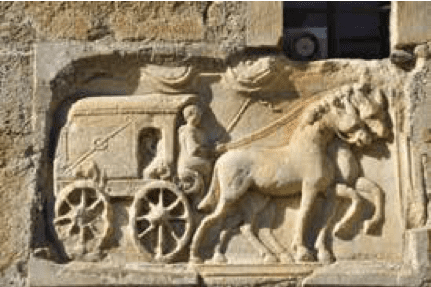 Female animals were used primarily for pulling wagons because of their agility, while male mules were used to carry loads. Various documents show this division for different purposes. Emperor Serverus Alexander gave his provincial leaders six female mules, two male mules and two horses. It is obvious that the female mules were intended for specific use as draft animals, the male mules as pack animals and the horses for mounts. The female mules were reserved for pulling which is evident from the fact that they were normally traded as a team. If one had a flaw, the seller had to take back both animals. It was especially popular when all the animals in front of a cart had the same color. The veterinarians gave recipes for dyeing the hair of the draft animals when it was not appropriate. To make white hair black, three ‘scripula’ (Roman unit of weight) cobbler’s blacks, four ‘scripula’ oleander’s juice and some goat fat are mixed, crushed and then applied. To make black hair white, a pound of wild cucumber root and twelve ‘scripula’ soda are crushed into powder, a cup of honey added, and then applied.
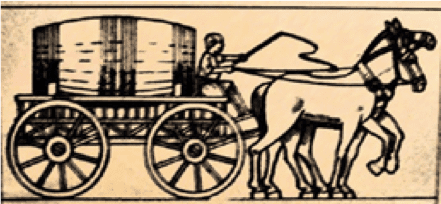 Most mules were not used as valuable draft animals in private passenger transport, but in public transport by rental car companies or by cargo. The provisions of Codex Theodosianus (late antiquity collection of laws) the ‘cursus publicus’, can give an approximate impression. Two car types are mentioned, the four-wheeled ‘raeda’ and the two-wheeled ‘birota’. The ‘raeda’ was fitted with eight mules in summer and ten in winter, 1000 pounds could be carried. When used by people, this corresponded to seven to eight passengers. For the ‘birota’ on the other hand, three mules and a maximum load of 200 pounds were prescribed, for a person’s use, this was two passengers.
Adventure by Road
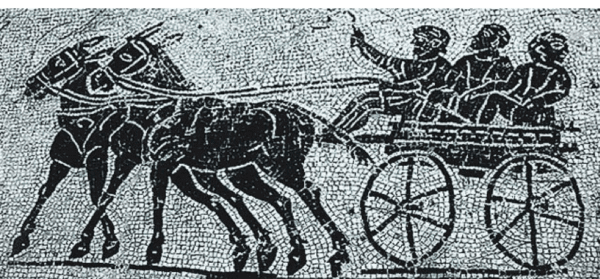
 The journey with such public transport was accompanied by wild screams, whip cracks from a drunken coachman and clouds of dust, reports a letter writer named Eustathios: A trip with mules that were boisterous by doing nothing and feeding too much he avoided – and prefered to walk.
Cross-country journeys were quite risky, as Roman poet Vergil describes, especially because of the daring overtaking maneuvers of competing truck owners. But sometimes a driver had to go under the yoke himself when a mule had got stuck in the mud of the soaked and crushed road. During overtaking maneuvers on the narrow country roads there was damage to the gravestones on the roadside, as an inscription proves. This also shows that mules were used in long-distance traffic to Gaul. Emperor Julian tells about the dangers on narrow Alpine roads, to which both passengers and draft animals were exposed, so does a rock inscription for remembering a road construction from the year 373 A.D.
In the Jungle of Cities
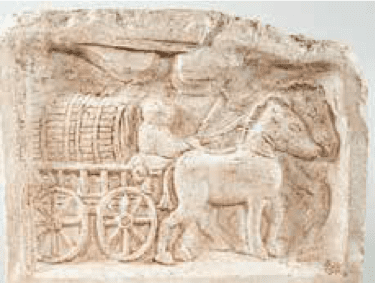
In the mostly narrow cities, the mule-drawn heavy wagon traffic caused great difficulties. Since the early imperial period, carriage traffic and riding in the city during the first ten hours after sunrise were therefore forbidden. Trips in connection with construction measures were permitted, and these were already enough to endanger the lives of pedestrians on the roads with their big wagons and high stacked loads.
A case story, described by a lawyer, shows what could have happened. Two mule-drawn ‘plaustra’ (load carts) drive up the Capitol slope in Rome. The mule leaders of the first one are pressing against the ‘plaustrum’ so that the mules could pull easier. However, the first carriage begins to roll back anyway, and the mule drivers jump out between the carriages. The first team then rolls onto the second, which now also rolls down backwards and crushes into a boy. The lawyer blames the leader of the first carriage for this accident, as he would be responsible for the overloading of the first carriage. Such incidents were as other sources show not uncommon.
Medical Care
This hard use of mules in driving is reflected in the treatment instructions of late antique veterinarians. The neck injuries caused by the yoke, which Pelagonius expressly refers only to mules, are of special importance. It was recommended that in order to prevent neck injuries of mules or to heal after damage has occurred, was to use an ointment made from fresh pig fat boiled with vinegar. For injuries of the neck and back of the mules, a remedy made of boiled wax, hot resin, verdigris and oil is used. Another remedy for neck treatment is described in this way; rotting chips from the middle of a fig tree are to be dried and burned to ashes in a clean place. This is sieved and then mixed in a mortar with wine, old oil and the protein of two eggs. To make the neck supple – this is the prerequisite for clamping it in the yoke – the neck is thoroughly washed with soap and then rubbed with a carefully beaten mixture of rainwater and protein. Mules were considered less valuable than horses or assessed to be more tolerant of injuries – such as an injury that is indicated by a crossed gait and an insecure step, where the animal trips over stones and a contracted hip.
A horse should be treated carefully and immediately to prevent major damage. However, if the suffering animal is a mule, it should first be stretched tighter in the yoke, so that sweat and pain will smash all pain. After work, it should be treated with the following remedy; twenty laurels are finely crushed with soda and heated with a handful of green rue, vinegar and laurel oil. Then they rubbed this on the center of the head between the ears, they also took a remedy-soaked piece of wool and laid it on this area. Another agent is made from barley flour and resin. These treatments are accompanied by the application of a general strengthening agent made from crushed crayfish, goat’s milk and oil.
Pack Mules
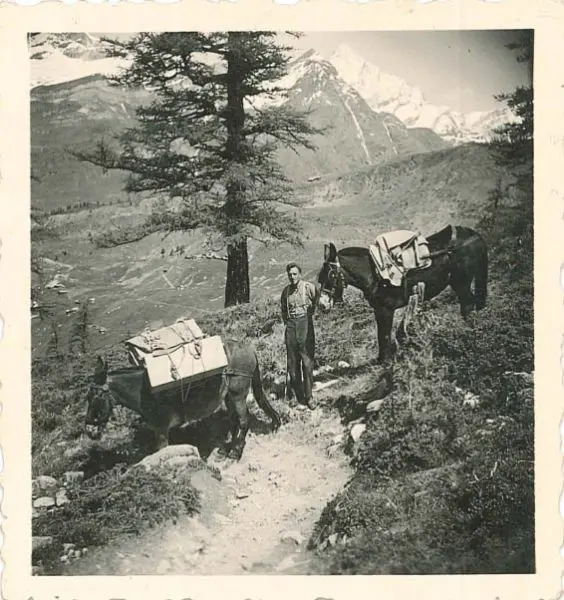
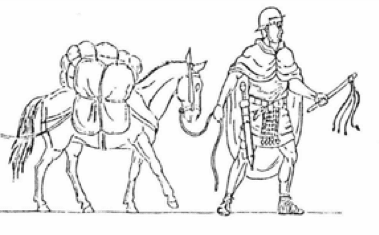 Male mules were used to carry less extensive loads in cities and agriculture because of their greater strength. The typical work was the transport of pole wood for plantations. Traders kept their mules directly in their shops. There is a case described in the Digests (scripts of ancient legal scholars) where a horse was led into a shop and was sniffing at the mule there. It kicked and broke the back of the horse’s leader. In the troop, each centurion had one such pack mule, which had to carry the heavier parts of the equipment on the marches.
Drudgery in the mills
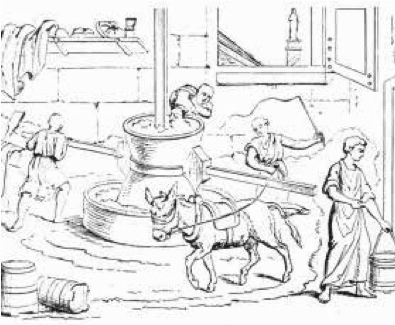 Mules were often used, as donkeys and horses were, to drive mills when they were no longer usable for other services. They were harnessed with a hard grass rope in front of the mill beam, the head was usually masked. They trotted in a furrow, always pushed by blows in the circle around. The bad condition of the animals corresponded to the gruelling work. In the “Methamorphoses”, Apuleius describes that the necks were swollen of wound rot, the nostrils were flaccid and dilated from coughing and dusty air. The body was disfigured by the constant blows and mange, the feet clumped by traveling permanently in a circle. These sufferings are also reflected in the veterinary writings, but the mill animals were certainly no longer treated.
Mounts
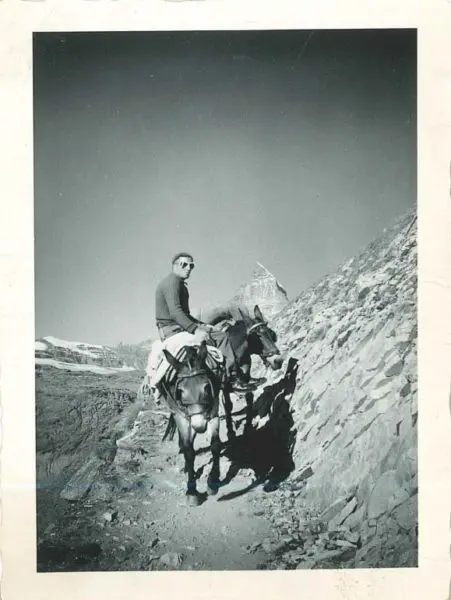
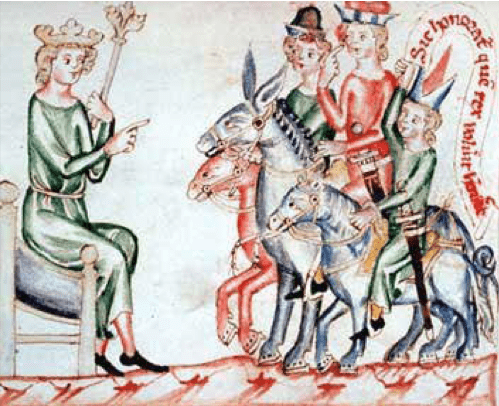 The mule was used rarely for riding in Antiquity, it was the simpler mount. Horace (poet) illustrates a simple but also free life in this way: He could bridle a mule at any time and head all the way to Taranto, even if the loins of the animal were rubbed sore by the heavy coat bag and the sides by the weight of the rider. The veterinarians list these specific injuries caused by riding, as well as, by loads being too heavy. The wounds are treated with ointments mixed from salt, wine, oil, raisin wine, pork fat and onions. In more severe cases, blood is taken from the veins of the groin area and mixed with salt, pork fat and oil. This is applied, and if necessary, plastered with ointment. For wounded skin caused by pressures, a dough-like mixture made of fine wheat flour, incense dust, egg yolk and vinegar is applied to the sore spots.
A special feature in those times were dwarf mules, called ‘mulae pumilae’, a curious luxury object of which the roman poet Martialis ironically states, that one often sits higher on the floor.
In the Middle Ages
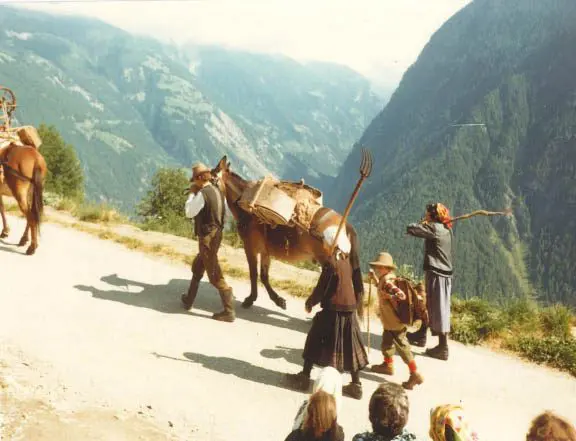
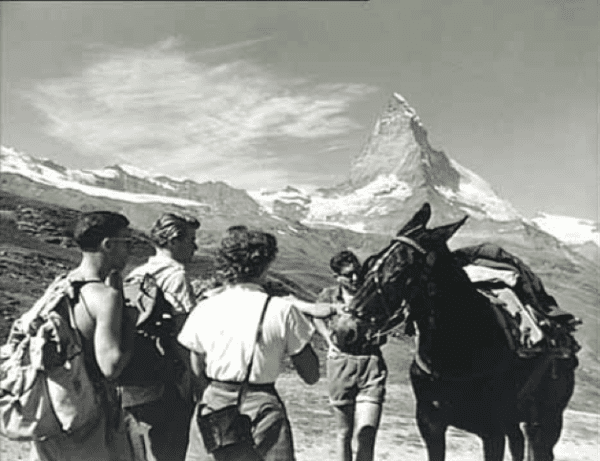
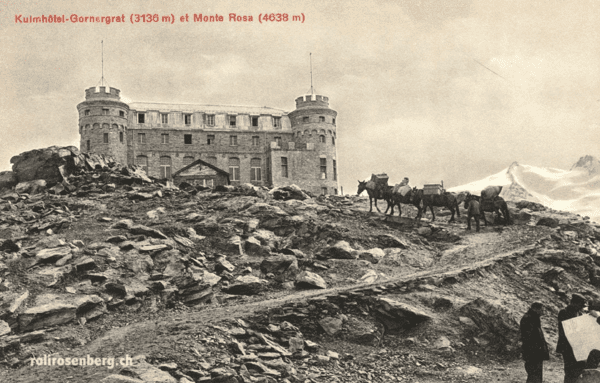
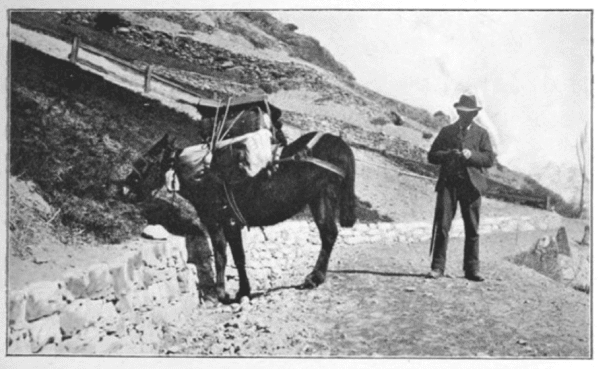
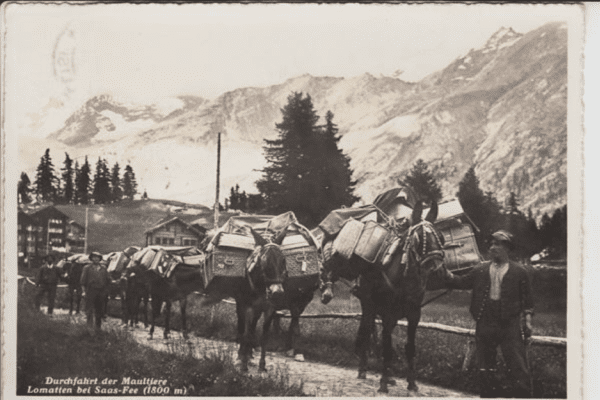
 Although mules were regarded by the church leaders as originating from an unnatural connection, and thus had a bad reputation, the mule nevertheless experienced a great appreciation in the early Middle Ages. Since Spanish mules are a noble gift, Emperor Charlemagne sent them to Caliph Harun Rashid. Mules and their Saracen guardians were bestowed by Robert Guiscard (Norman leader) to the Abbot of Montecassino. The mule is often mentioned as a mount of clergy. Gallus, for example, uses a mule for his journey to the Swabian ducal court. Also, for the journey of Goar (Priest, later holy spoken) to the royal court, a mule or a donkey is intended. Bishop Gregory of Tours, mentions mules among the farm animals of the monastery St. Martin, which were obviously riding animals. Because of the clergy’s preference for mules, the devil – as Notker (poet and scholar) tells us he turns into a mule to tempt the bishop to buy him, seduces him and kills him on the way out. A degree accordingly acts against the excessive dealing of clergy with mules. Of course, mules were often used as pack animals in the early Middle Ages, just like horses. Already Isidor from Sevilla (Archbishop) speaks about the ‘mulus sagmaria’ (Latin: pack mule) beside the ‘caballus sagmarius’ (packhorse). Some of the mules and horses with which the Irish bishop Marcus returned from his trip to Rome must have been pack animals as books, gold objects and robes are mentioned as transported goods. In the Vita Hludovici (anonymous biography of Louis the Pious) mules are also mentioned beside horses, working a mission as they transported ship parts through the woods. Mules are also considered a pack animal in custom regulations.
The existence of humans and the development of all processes, political and social, were marked by the importance of the working animals, not only in Antiquity and the Middle Ages, but also far into modern times. In the beginning it was mainly cattle that carried the workload. Over time there were shifts, the cattle were substantially relieved first in later Antiquity by the mule. Finally, in the Middle Ages the horse, caused by changes in animal technology – horseshoe fittings and collar – became more universally applicable. However, the donkey’s services remained to limited use.
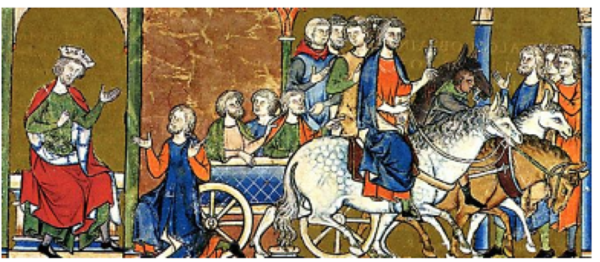
Excerpt from: “Animal laborans – Das Arbeitstier und sein Gebrauch im Transport und Verkehr in der späten Antike und im Mittelalter” (The work animals and its use in transport and traffic of late Antiquity and the early Middle Ages) in: L’uomo di fronte al mondo animale nell’ alto medioevo; Settimane di studio del centro italiano di studi sull’alto medievo XXXI, 1983, 2 vol., Spoleto 1985; vol.1, p.457-578 (essay monograph)
Picture references:
- Mule whith neck joke – http://wwwg.uni-klu.ac.at/archeo/alltag/10vieh.htm
- Carpentum, carriege for journey – https://commons.wikimedia.org/wiki/File:Maria_Saal_Dom_Grabbaurelief_Reisewagen_in_die_Unterwelt
- Plaustrum, wagon for load – https://www.artisanat.ch/reportages/578-histoire-des-voies-de-communication-et-moyens-de-transport-1ere-partie.html
- http://www.forumtraiani.de/lebhafte-roemische-strassen/
- Cisium, light carriage – http://www.ostia-antica.org/regio2/2/2-3.htm
- Roman soldier with mule – https://www.exfabrica-miniatura.de/Auxiliar-Infanterist-mit-Maultier
- Grain mill in Pompeji, ca. 200 v. Chr – http://www.voegeles-muehle.de/geschichte
- Mule, mounts in the Middle Ages – http://www.brandenburg1260.de/pferd-im-ma.htm
- Playing card 1440-1445 – https://www.pinterest.de/pin/94646029645701226/?lp=true
- Snippet: Absalon leaves David to plan a conspiracy, Maciejowski-Bible, 13. Century – http://www.stupor-mundi.info/2016/08/22/reisen-im-mittelalter/


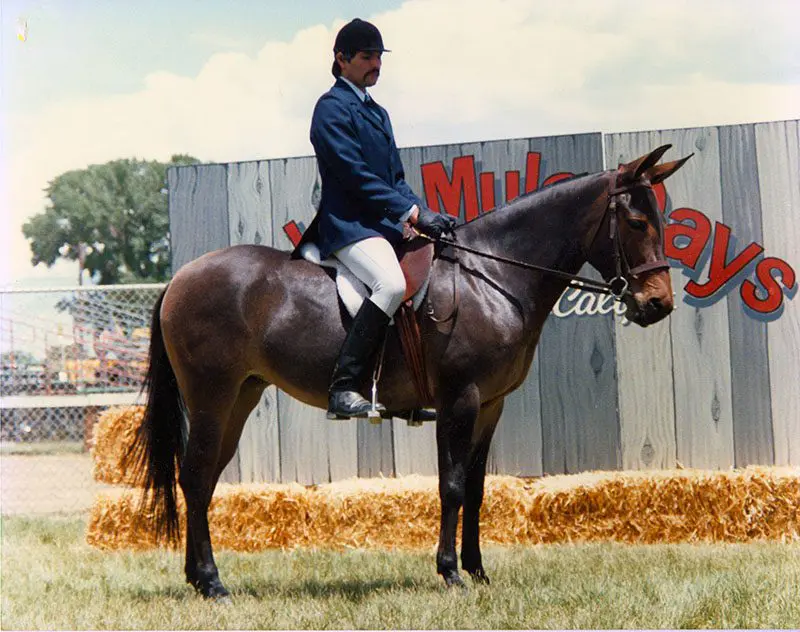 Today, we have more time to spend training our equines and cultivating our own riding skills. In most cases, the choice of tack is no longer of necessity, but of choice. Fashion, in any country, is supposed to be a statement of individuality and identity. The Western style of dress and tack suggests a hearty, rugged individual, surrounded by wide open spaces, using his equine as a partner for work. English attire paints a picture of dignity, reserve and concentrated skill. The Western image is a wonderfully romantic and picturesque way of seeing oneself, but it really doesn’t allow us the opportunity to improve our equestrian skills to the maximum. Western style riding is as limited as its uses. The smaller English saddle, made with a lot less leather, allows us to feel our equine’s body more closely (with the added stability of the stirrups) while we learn and exercise our bodies to become more harmonious with our mounts. As we can feel our equine more closely, so can he feel better the cues that we to give him. Thus, he can respond more accurately to our commands. However, most men don’t feel comfortable wearing “Sissy Pants” and riding in a “Sissy Saddle”—it just isn’t macho!
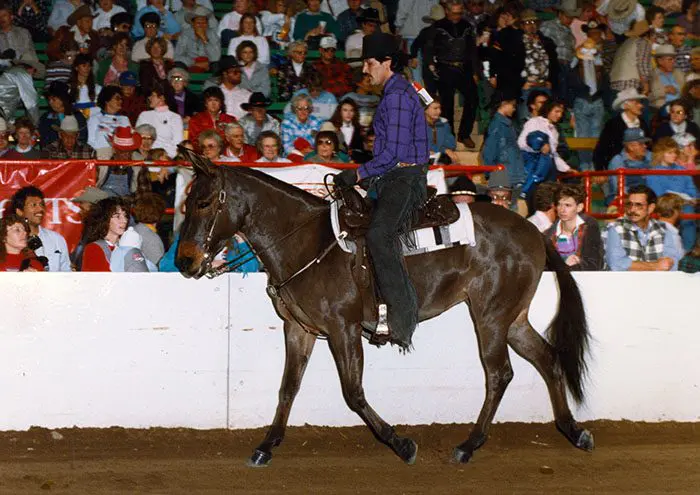 One Saturday morning, I finished a lesson with one of my students when Gary strolled into the indoor arena and announced that he was willing to give the English saddle a try, but that we would never get him into a pair of those “Sissy Pants!” “Fair enough,” I said, and brought my student’s horse around for him to ride. Getting on was a bit of a struggle, and exercises at the walk went really well, but as soon as the horse began to trot, Gary started bouncing. He was about to lose his balance, so he grabbed the rail to steady himself. The only problem was the rail stayed where it was and the horse kept going, leaving Gary dangling behind on the fence! I thought we would never stop laughing – he looked so ridiculous! Our macho man didn’t have the balance he thought he had!
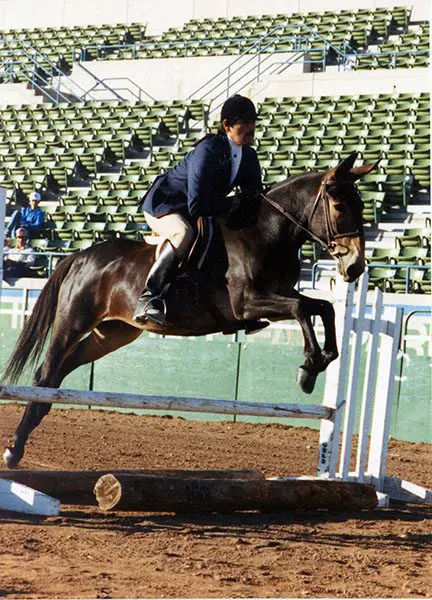 After a while Gary decided that English riding was, in fact, the best way to train. However, he still wasn’t too interested in “watching cement set” or doing Dressage tests. We decided after two years to start showing in Combined Training with the horses. We signed up for the second day of a two-phase show, not realizing that we would be asked to ride our Dressage tests the same day that we jumped. Two days before the show, Gary discovered that he would have to ride Training Level Test 1 at 9:00 A.M. the day of the show. We reviewed the test the day before the show, thinking that if all else failed I could read the test to him when he rode. Sunday morning, Gary was feeling tired, but confident. I took my place at “B” and prepared to read for him when the announcer explained that only United States Dressage Federation tests could have a reader, but not the same in Combined Training. Gary’s face turned ashen. I climbed back into the stands as he warmed up for his test… at the walk… lost in space! He stopped short below me and quietly said, “Meredith, will you please come here.” I ran down to see what the trouble was. “I can’t remember anything… I can’t do this!” he worried emphatically. I quickly explained the pattern. Gary’s first Dressage test ever in his first Combined Training show and he emerged in third place with a mule in the Elementary Division against 8 horses. Was he ever thrilled!


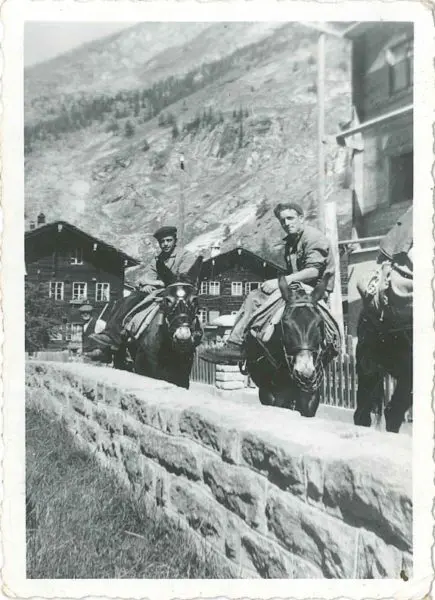
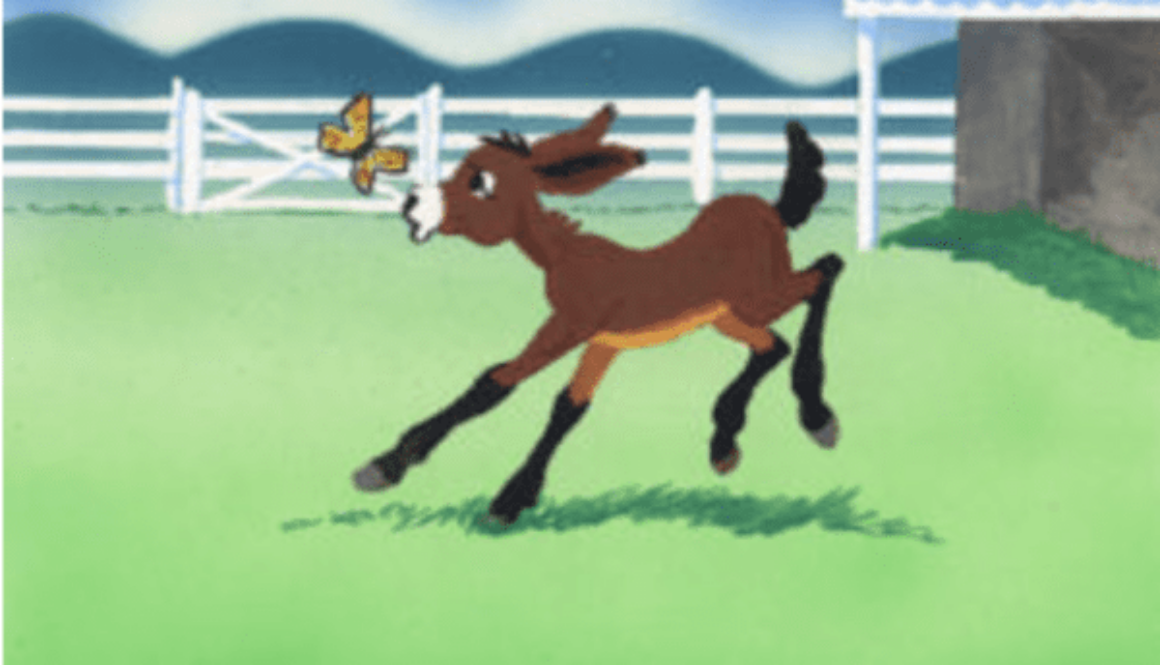
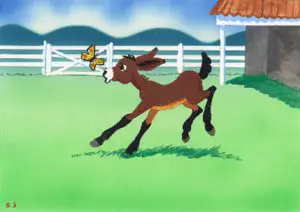 We were pastured on a couple of acres that surrounded an old shed where we used to get in out of the weather. My mother was content to graze and doze day after day – she wasn’t much on excitement. I used to love it when the people came and carried on about how cute I was. Then they would scratch and massage my fuzzy little body. They even got a little playful when I followed them around, romping, playing, and bumping them with my nose. “Oh, look how cute and friendly he is,” they’d say.
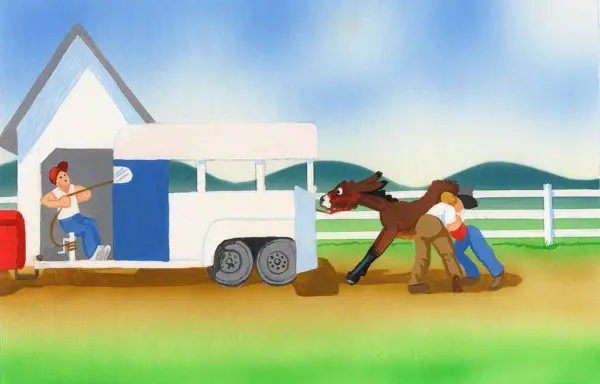 Suddenly, as soon as that “halter thing” was attached to my face, they tried to lead me away from my mother. That’s when I saw the little room on wheels parked along the pasture fence! I called to my mother to come… we were going for a ride! She took a couple of steps toward me when one of the two men shooed her off the other way. I was going alone with these two guys – but where?! Why?! I got scared! I pulled, kicked, bucked to get away, but nothing worked. They were both bigger than me and before long, I found myself locked in that little room on wheels… alone! I was frightened, but I was brave. The ride was short. When they finally opened the doors to let me out, I was an explosion of forced bravery. I came out of that trailer so fast I accidently knocked one of the men down. Whoops! Before I could show him how sorry I was, he jerked on my head and laced me about the head and neck with a long skinny stick that stung like a bee! Better stand still, I thought. Well, they didn’t like that either! They were pulling on my head and hitting me on the rear with that stinging stick! If I followed, it released the pressure from around my face and the man with the stick would stop, so I followed.
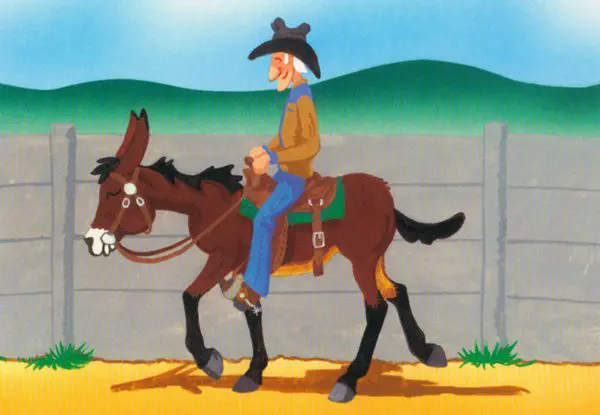 The day they put the saddle on my back when I was two was only one of many confusing times. I didn’t really mind the saddle until they fastened the belt around my middle so tight that I could hardly breathe. I bucked and ran, trying to get it off. “He’s going to be a real tough one,” the man said to my owner. I’m not really sure what he meant. I learned pretty quickly that the bucking only caused more pain as the stirrups thumped against my sensitive body. It was better to move smoothly with that saddle on my back, for sure. It took me awhile to learn to stop and turn when they pulled on that bit in my mouth, but the worst part was trying to keep my balance through all of this! Didn’t they know that I was still very young and growing and not really all that strong despite my size? They would ride me until I was stiff and sore, and then put me back in that small area with no room to stretch and exercise. They gave me rest for days at a time, with no other exercise. It seemed like I was either overworked or over-rested! My muscles never really had a chance to become stronger. They rode me either too long, or not at all. Somehow, though, I managed to learn. I guess we all do, whether it’s the hard way, or not.
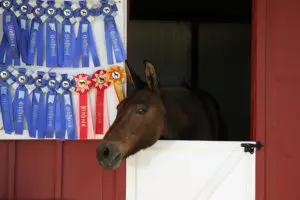 I met Mae Bea C.T. (“Peepers” from Jasper Goes to Bishop) and Ciji at Bishop Mule Days this year. They said that they have a wonderful life – equally balanced with training, pasture time, just plain fun and a lot of consideration for their feelings. Ciji said you were really mad at her for refusing all the jumps in the Hunter Under Saddle class, but that you were fair. You made her do them in the Jumping Class, rode the English Pleasure class and then let her rest for the remainder of the show since you knew she was in heat and had cramps. Ciji admitted that she can sometimes be a little stubborn and unfair herself, so she tried to make up for it by doing her best in the English Pleasure Class, which brought her fourth place.


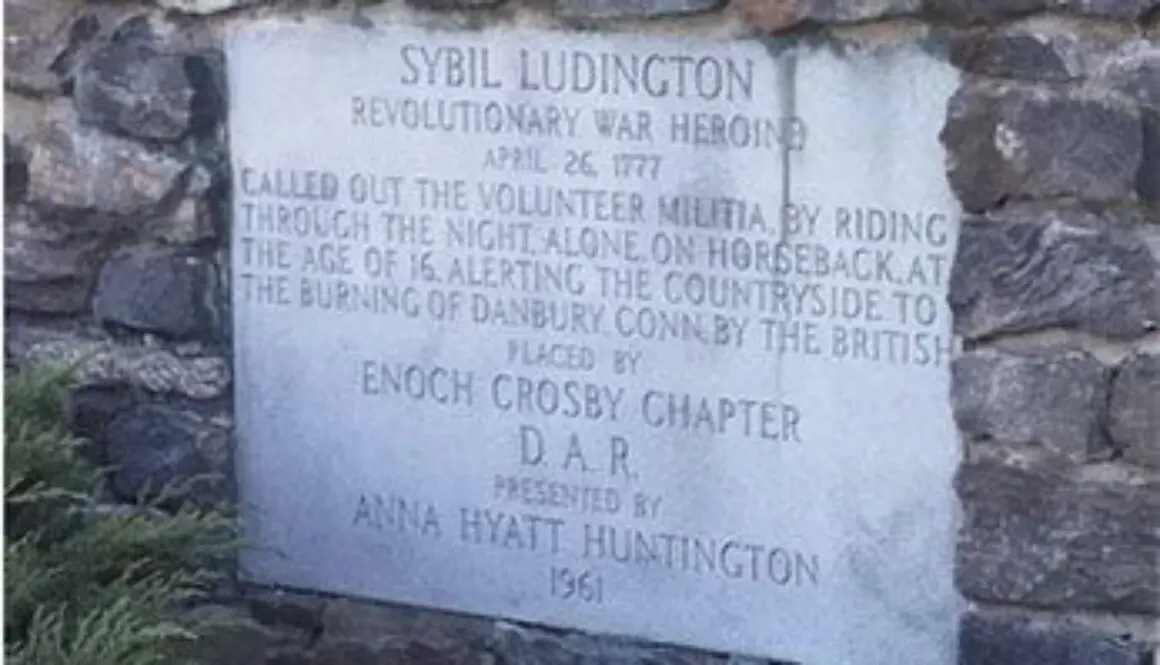
 Revere rode about 20 miles through what is now Somerville, Medford, and Arlington, Massachusetts, knocking on doors to raise people to defend Lexington. Another rider, William Dawes, was sent by another route to do the same thing. A third, Samuel Prescott, was also pressed into service. Only Prescott completed the night’s work and reached Concord; Revere was captured and Dawes was thrown from his horse while evading British soldiers, forcing him to walk back to Lexington.
 Sybil spent the night traveling down narrow dirt roads in the rain with nothing but a stick as protection. To add another element of danger, there were many British loyalists in the area and more than a few “