
MULE CROSSING: Multiple Facets of Longears Hybrid Vigor
By Meredith Hodges
“Hybrid vigor is the increase in certain characteristics like growth rate, size, fertility, yield etc. of a particular hybrid organism over its parents. Hybrid vigor is also known by some other names, including heterosis and inbreeding enhancement. Hybrid vigor occurs because the hybrid offspring’s traits are enhanced due to the mixing of genetic contributions of its parents.”
What are mules and hinnies?
The mule is a hybrid cross between a male donkey (jack) and a female horse (mare). Because the mule most often demonstrates the best traits from each parent, he possesses what we call hybrid vigor. The mule inherits from the donkey his incredible strength, intelligence, patience, perseverance, endurance and surefootedness from the jack and his equine beauty, athletic ability and speed from the horse.

The hinny is also called a mule. However, the hinny is the hybrid cross between a male horse (stallion) and a female donkey (jenny, or jennet). Mules and hinnies are very difficult to tell apart without a DNA test. A hinny generally resembles a horse more than it does an ass. It looks more like a horse with long ears and looks very much like a mule. The hinny has been used as a saddle animal from antiquity and is more difficult to produce than the mule, because the jennet does not conceive well with the stallion.
 The hinny is a somewhat slower and more meticulous mover than the mule, but a laid back mule can offer similar characteristics. The hinny inherits his way of going from the jennet as does the mule, which tends to be a little faster, more energetic and more agile—like his dam, the mare. The hinny, because of his meticulous way of going, is actually better in very steep, rocky terrain and, especially, in loose rock, and will not tire as quickly as a mule. Hinnies are the preferred equine in Mexico and Central America due to their diligence when working. Gaited hinnies are preferable in this kind of terrain where there is little opportunity to gallop because they have a smooth, more ground-covering gait and offer a smooth ride.
 The hooves of a hinny tend to be more donkey-like—narrow, oval and more upright—where the hooves of a mule will look more horse-like; a little rounder (although still oval), with slightly more angle than the donkey hoof, but not as flat, round and angled as the horse’s hoof. On both hinnies and mules, the hooves should be trimmed more upright and the heels should be left longer than the hooves of the horse.
The hinny will also eat a variety of different kinds of shrubs and bushes to sustain himself, where a mule will be more selective, again because of the influence of the mare. This makes the hinny more desirable to those people living in remote mountain areas with little vegetation.
Both the mule and the hinny have more endurance by far than the horse. They are more resistant to parasites and disease, require less feed for good health, have tougher hooves than the horse, and have an incredible sense of self preservation that keeps them safe, which is often mistaken for stubbornness. The horse has a flight reflex when startled and the donkey has a freeze reflex; mules and hinnies can exhibit both the freeze and flight reflexes, depending on their own unique personalities and the situation at hand.
Certain breeds of mares do not conceive as well with the jack as other breeds. When breeding for mules, since the jacks are generally smaller and of slighter build than a horse, mule foals are generally smaller than horse foals and the mare has very little problem foaling. When breeding for hinnies, one needs to be cautious, as the jennets are smaller and of a slighter build than mares. A large stallion could produce a foal that would be too large and difficult for the jennet to easily foal. This is the reason that breeding for mules is more popular than breeding for hinnies. Matching the size of the parents is much more important with hinnies. It is more difficult for a jennet to settle after being bred to a stallion than it is for a mare to settle after being bred by a jack, so breeding for hinnies can take significantly longer.
What are the physical characteristics of the Ass?

The ass has a distinctive bray, Long ears, a short upright and thin mane with hair only on the end of its tail. Mules tend to look more horse-like than donkeys. Asses and mules can come in a wide variety of colors. Their hooves are narrow and boxlike, unlike the oval shape of horse hooves. Their hooves are upstanding, and made for rock and mountain climbing. They are tough and elastic, non-chipping and can grow to long lengths when the animal is on soft ground and the hooves are left untrimmed. The ass has a long body with long, wiry muscles and a short, straight back. He lacks upstanding withers and is excellent for packing and weight bearing and his bone is dense and hard. Gestation is 12 months, whereas the gestation period for a horse is 11 months.
The ass usually has a white belly and muzzle, and circles around the eyes. His colors are much like that of a horse. They can  come in more colors than a horse, even an Appaloosa. Mule’s conformation falls somewhere in between that of the donkey and that of the horse. Mules inherit the best traits from both its sire and its dam. Mules get their athletic ability from the horse, while strength and intelligence come from the donkey. Mules today come in all shapes sizes and colors, from minis under 50 pounds to maxis over 1000 pounds, and in many different colors. Mules from Appaloosa mares produce wildly colored mules, much like their Appaloosa horse relatives, but with even wilder skewed colors. The Appaloosa color is produced by a complex of genes known as the Leopard Complex (Lp). Mares homozygous for the Lp gene bred to any color donkey will produce an Appaloosa colored mule.
What are the mental characteristics of the Ass?
The ass is highly intelligent, alert, curious and affectionate, when not worn down by bad conditions (i.e., cruel treatment, bad shelter, bad food and water or overwork). They are quick to learn. A well-trained mule is calm, tolerant, loyal, affectionate, obliging and patient and sensitive. Mules and donkeys might be mistaken as being stubborn when they’re actually afraid or confused. The ass has common sense and is not prone to panic or carelessness. He can readily recognize danger!
What kinds of hybrid equines are there?
The following are simple definitions for the horses, mules and donkeys we will discuss:
Stallion: male horse
Mare: female horse
Jack or Jackass: male donkey
Jennet or Jenny: female donkey
Horse mule, john mule: male mule
Mare mule, molly mule: female mule
Horse, Mule and Donkey Hybrids:
Mule: donkey father + horse mother
Hinny: horse father + donkey mother
Donkule, Jule: donkey father + mule mother
Hule: horse father + mule mother
Zebroids (Zebra Hybrids)
Zedonk, Zebrass, Zebronkey, Zonkey, Zebonkey, Zebradonk, Zebryde: zebra father + donkey mother
 Zorse, Golden Zebra, Zebra mule, Zebrule: zebra father + horse mother
Zony: zebra father + pony mother
Zetland: zebra father + Shetland pony mother
Zebret, Donkra: donkey father + zebra mother
Hebra, Horbra, Zebrinny: horse father + zebra mother
Although hybrids are typically sterile, two documented cases of fertility do exist. One was known as Old Beck from Texas A&M, bred first by stallion, Pat Murphy, and yielded the hule, Pat Murphy, Jr. She was bred a second time to a jack and produced the jule, or donkule Kate. The other was Krause, belonging to Arthur Silvester in Champion, Nebraska. She was bred to a jack twice and foaled first with Blue Moon, and then with White Lightning. More numerous cases have emerged with the new technology and better national and international communication.
Happy Hinnies
This story comes from our friend, Luzma Maria Osorio, of Criadero Villa Luz in Colombia.

At our Stud Farm, Villa Luz, in Colombia, South America, we have been breeding mules and donkeys for more than fifteen years. There has been a big demand for our Paso Fino male donkeys (Jacks) to produce gaited mules through the years. But we were left with many female donkeys (Jennies), and nobody would buy them to produce mules even though they have the same good genetics and Paso Fino gait of their brothers. So we thought, let’s breed Hinnies–and the project began!
It is said that Hinnies often have shorter ears, although they are still longer than those of horses, and more horse-like manes and tails than mules. Well, our Hinnies certainly have the ear shape of their sire–they are beautifully pointed at the top just like his, but bigger. Up until now the behavior and characteristics of our Hinnies don’t differ much from the mules, they are lovely animals. It is our goal to study Hinnies and help to understand them better.

The good news is, the Paso Fino gait has passed to the Hinnies! This gait is natural and we have seen it in our baby Hinnies shortly after birth! Paso Fino is a lateral gait, four beat footfall, which provides a constant, rhythmic cadence. The rider should not experience any bumping or jolting. They say you can carry a tray with a glass of champagne on a Paso Fino equine as they are so smooth!!
We don’t know if they got the Paso Fino gait from the sire or the dam because both have it, but we certainly will have Paso Fino Hinnies! Very smooth, intelligent and well behaved!
Mules are good mothers too!
They say Mules cannot give birth and are hostile to foals, but the mule Chucurena has proved completely the opposite. On 25 September 2011 she gave birth to a beautiful baby mule in Colombia South America and she is proving to be a great mother! This miracle was achieved thanks to the Embryo transplant technique. A three day old embryo was extracted from a mare and implanted in the mule’s womb to develop it. Embryo transplants are a complicated process that requires synchronizing the ovulating time in both females, in this instance it was carried out by the specialized Colombian Veterinarian Hector Mendez.
 The embryo was from a Paso Fino Mare called La Querencia and the Paso Fino Donkey Cosaco XVI de Villa Luz. The pregnancy was 11 months and the delivery was normal with no complications, the mule knew exactly what to do and behaved as an expert mother even if it was her first time! The baby is a female and it was called “La bien querida” (The much loved).
But that is not the end of the story, just 12 hours before the mule Chucurena gave birth, the egg donor mare also gave birth to another mule foal from the same donkey Cosaco XVI. Two foals born the same day, with the same dame and sire and they are not twins! Are you a bit confused? The explanation is easy: 18 days after the embryo was taken out of the mare, she had her cycle and was inseminated again and got pregnant, this time they left the embryo in, and another mule was born!
 Even if most mules are sterile, they have a maternal instinct, we had a case in our Farm where the mule La Rosa de Villa Luz, fell in love with a foal of a mare and tried to steal it, she kept very close to it for weeks, showing angry signs to the mare and a maternal attitude to the foal; when the mare and the foal were transferred to another pasture, the mule brayed for days. We have also been told of another case where an orphan foal was adopted by a mule and after two days the mule started producing milk!
Even though some mules have ovulation cycles, only 60 cases of mules giving birth have been documented in the last 500 years around the world. In 1976 in Colombia, South America a mule called Gaviota gave birth not only once but twice. First to a baby foal that looked like a horse and after 16 months, to a baby foal that looked like a mule, both fathered by the same horse called Arandu. There are no documented cases involving fertile male mules.As you can see mules never stop surprising us, they are lovely animals and there are still loads to learn about them!
Mules Producing Offspring
Most mules are sterile but, very rarely, they can reproduce. However, you are more likely to be struck by lightning than own a mule that is able to have a baby. Here are the stories of some of the mules who have had babies throughout history.There have been two documented cases in America where mules have conceived and given birth and even more in other parts of the world. Several female mules have produced offspring when mated with a purebred horse or donkey. Since 1527, there have been more than 60 documented cases of foals born to female mules around the world. There are no recorded cases of fertile mule stallions.
Since mules and hinnies have 63 chromosomes, and donkeys and horses have 62 and 64, respectively, the different structure and number usually prevents the chromosomes from pairing up properly and creating successful embryos. In most fertile mule mares, the mare passes on a complete set of her maternal genes (i.e., from her horse/pony mother) to the foal; a female mule bred to a horse will therefore produce a 100 percent horse foal.
One of the first historical accounts of a mule producing offspring comes from Herodotus’ The Histories: “There happened also a portent of another kind while he was still at Sardis,—a mule brought forth young and gave birth to a mule.” Such a thing was considered a very bad omen indeed (in fact,Herodotus considered it foreshadowing of Xerxes’ invasion …
A fertile mule would also disprove ancient theories of biology as determined by Aristotle and other Greek philosophers –an animal’s species is determined based on its ability to reproduce. So, a mule is not a separate species (like a horse or donkey). But what is the species of a mule’s offspring, then? Without the DNA pairs matching, the rest of meiosis does not happen, which means that there are no viable eggs or sperm. Besides the differences in DNA sequence, the mule also has a lonely horse chromosome. This extra chromosome, some research conjectures, might be another reason most mules are infertile.
Cornevin and Lesbre stated that in 1873 an Arab mule in Africa was bred to a stallion and produced female offspring. The parents and the offspring were sent to the Jardin d’Acclimatation in Paris. The mule produced a second female offspring sired by the same stallion and then two male offspring, one sired by a donkey and the other by a stallion. The female progeny were fertile, but their offspring were feeble and died at birth. Cossar Ewart recorded an Indian case in which a female mule gave birth to a male colt.
A comparable case is that of a fertile hinny (donkey mother, horse sire – the reverse of a mule) in China. Her offspring, named “Dragon Foal,” was sired by a donkey. Scientists expected a donkey foal if the mother had passed on her maternal chromosomes in the same way as a mule. However, Dragon Foal resembles a strange donkey with mule-like features. Her chromosomes and DNA tests confirm that she is a previously undocumented combination.
 In Morocco, a mare mule produced a male foal that was 75 percent donkey and 25 percent horse (i.e., she passed on a mixture of genes instead of passing on her maternal chromosomes in the expected way). Miracle mule ‘confirmed’ DNA tests have confirmed that a Moroccan mule did give birth to a foal. Veterinary experts say the foal’s father was a donkey and its mother a true mule. “The foal inherited a mixture of horse and donkey chromosomes via the mother’s ovum ”
Mule cases with offspring have been reported to be quite numerous in Morocco. Morocco’s mules are also used in the equine industry for embryo transplants. Pregnancy is rare, but can occasionally occur naturally, as well as through embryo transfer. A few mare mules have produced offspring when mated with a horse or donkey stallion.

Herodotus gives an account of such an event as an ill omen of Xerxes’ invasion of Greece in 480 BC: “There happened also a portent of another kind while he was still at Sardis—a mule brought forth young and gave birth to a mule” (Herodotus The Histories 7:57), and a mule’s giving birth was a frequently recorded portent in antiquity, although scientific writers also doubted whether it was really possible (see e.g. Aristotle, Historia animalium, 6.24; Varro, De re rustica, 2.1.28).
Between 1527 and 2002, approximately sixty such births were reported. In Morocco in early 2002 and Colorado in 2007, mare mules produced colts.] Blood and hair samples from the Colorado birth verified that the mother was indeed a mule and the foal was indeed her offspring.
In the 1920s, Old Beck, a mare mule {at Texas A&M), produced a mule daughter called Kit. When Old Beck was bred to a horse stallion she produced a horse son (i.e., the horse stallion sired horse foals). When bred to a donkey, she produced mule offspring. Old Beck was a mare mule owned by a farmer in East Texas. Mules are usually considered infertile, but Old Beck had been mated to a jack and produced a foal that was very clearly a mule, named Kit. When she was brought to Texas A&M in 1921, Old Beck was mated to a stallion and also produced a living colt, however this time a horse, named Pat Murphy, Jr. No other offspring were ever produced from subsequent matings. Kit never produced any offspring; however, Pat Murphy was a fertile sire. This story caught the attention of many, making Old Beck quite famous. #tbt #tamuansc
 In 1995, a group from the Federal University of Minas Gerais described a female mule that was pregnant for a seventh time, having previously produced two donkey sires, two foals with the typical 63 chromosomes of mules, and several horse stallions that had produced four foals. The three of the latter available for testing each bore 64 horse-like chromosomes. These foals phenotypically resembled horses, though they bore markings absent from the sire’s known lineages, and one had ears noticeably longer than those typical of her sire’s breed. The elder two horse-like foals had proved fertile at the time of publication, with their progeny being typical of horses.
The best documented fertile mule mare was “Krause,” who produced two male offspring when bred back to her own sire (biological father).
“Nebraska Mule Makes History”
They said it couldn’t be done but “Krause” did it! The young mule owned by the Arthur (Bill) Sylvester family, of Champion, Neb., foaled a healthy mule last July 6. The Sylvesters were as surprised as anyone.
Because of the extreme “once in a Blue Moon” odds under which such a phenomenon occurs, the Sylvesters named the new arrival Blue Moon. The birth of a mule results from the breeding of a mare horse with a male donkey (jack). Krause (Blue Moon’s mother) was produced on the Sylvester farm. Her mother is a Welsh mare pony named Annie, and her father a jack named Chester. Chester is a prolific jack who also is the father of the newborn mule Blue Moon. The Sylvesters permitted Chester to run with the mules because the females were thought to be infertile.
Because “everyone” knows that mules do not reproduce, you can imagine what Bill thought when he looked out in the pasture of mules to find what appeared to be a newborn colt. He told his son Kim they’d better head out to investigate. Sure enough, there was Krause, a two year old mule they had raised from birth, with a perfectly normal mule colt. The colorings and markings were almost identical to her mother.
When Blue Moon was born, the Sylvesters contacted Dr. Dave Johnsen, a local veterinarian, to have him vouch for the unusual birth. Within a short time, Dr. Kurt Benirschke, director of the Center for the Reproduction of Endangered Species at the San Diego Zoo, in California, was called to arrange for scientific testing and vertification. Dr. Johnsen was commissioned to take blood samples from Krause, the mother; Blue Moon, the foal; the grandmother, a Welsh pony mare (horse); and the father and grandfather, a jackass (male donkey). A horse is supposed to have 64 chromosomes, a donkey 62; and a mule 63.
 Blood samples and other “technical testing” have verified that Blue Moon is indeed the first scientifically verified mule colt foaled from a molly mule. In mid-August, the Sylvesters received word from Dr. Benirschke with the big news: Krause is a true molly mule with 63 chromosomes and her new son Blue Moon is also a mule with 63 chromosomes. The father and grandfather is a verified jackass with 62 chromosomes, and the grandmother a true female horse with 64 chromosomes.
So what do you call the foal of a mule? The cross of a male horse and a jenny (female donkey) is called a hinny. Therefore, the cross of a jack and mule could logically be called a Jule. This would make Blue Moon a real “Jule”. Scientists will be studying Blue Moon carefully to test his capacity to reproduce as he matures. And Krause will be observed closely for the remainder of her life. Will she continue to beat the odds by producing more foals, or was her amazing fete truly “once in a Blue Moon?” Krause from Nebraska did foal twice by a jack with 2 mule-like foals, first with Blue Moon and then with White Lightning.
2003: U. of Idaho Reports Birth of Cloned Mule
By NICHOLAS K. GERANIOS, Associated Press Writer
 SPOKANE – Two weeks after announcing the birth of the first cloned mule, the same research team said a second cloned mule with identical DNA has been born. The mule, named Utah Pioneer, was born natural and unassisted Monday morning. The male foal joined his brother, Idaho Gem, whose birth was announced May 29, as the only equine clones in the world. The clones are the result of work by researchers Gordon Woods and Dirk Vanderwall from the
University of Idaho and Ken White from Utah State University. Both cloned foals are siblings of Taz, a champion racing mule owned by Idaho businessman and mule enthusiast Don Jacklin of Post Falls, Idaho. The foals carry identical DNA from a fetal skin cell culture established five years ago at UI with Taz’s mother and father. Utah Pioneer weighed 78 pounds at birth, and “is healthy and already very active,” Woods said in a news release. The cloning team will again submit samples to a University of California Davis laboratory for independent verification, as was done with Idaho Gem. “He’s a male mule, and he looks like Idaho Gem,” Woods said.
Preliminary testing last year showed the method developed by the researchers to clone a mule should work equally well with a horse, something Woods said he plans to do. “This is an important birth because it provides repeatability to the project and strengthens the results,” White said. The May 4 birth of Idaho Gem, announced by Science magazine May 29, added mules to the barnyard of cloned animals that already included sheep, cows, pigs, cats and rodents. Mules are bred by mating a male donkey with a female horse. The breeding success is about the same as among horses alone. To clone the racing mule’s brother, researchers bred Taz’s parents, a jack donkey and a horse mare, and allowed the resulting fetus to grow for 45 days. This provided the DNA needed for the clone. The researchers then harvested eggs from horse mares. After removing the nucleus from each egg, the researchers inserted the DNA from the male fetal cells. The eggs were then placed into the wombs of female horses. Of 307 attempts, there were 21 pregnancies and three carried to full term. The third cloned mule is due in August. Jacklin paid $400,000 to finance the four-year mule cloning project.
To learn more about Meredith Hodges and her comprehensive all-breed equine training program, visit LuckyThreeRanch.com, MEREDITH HODGES PUBLIC FIGURE Facebook page, or call 1-800-816-7566. Check out her children’s website at JasperTheMule.com. Also, find Meredith on Pinterest, Instagram, MeWe, YouTube and Twitter.
Covered in TRAINING MULES & DONKEY: A LOGICAL APPROACH TO TRAINING, TRAINING WITHOUT RESISTANCE, EQUUS REVISITED and A GUIDE TO RAISING & SHOWING MULES at www.luckythreeranchstore.com © 2024 Lucky Three Ranch, Inc. All Rights Reserved.
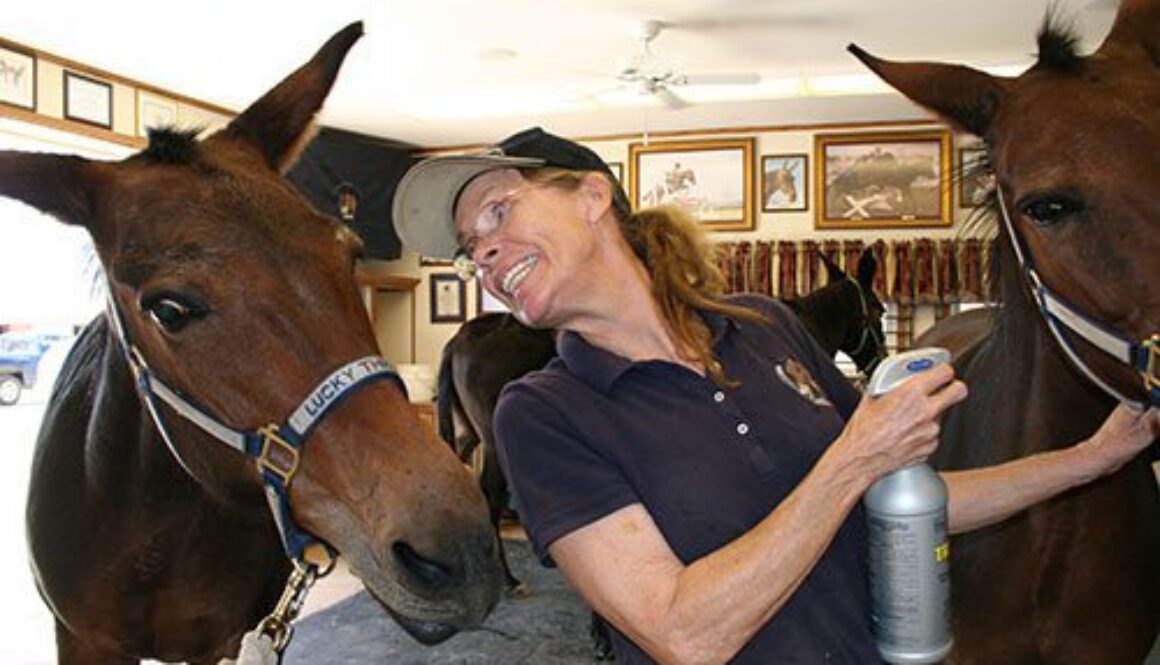

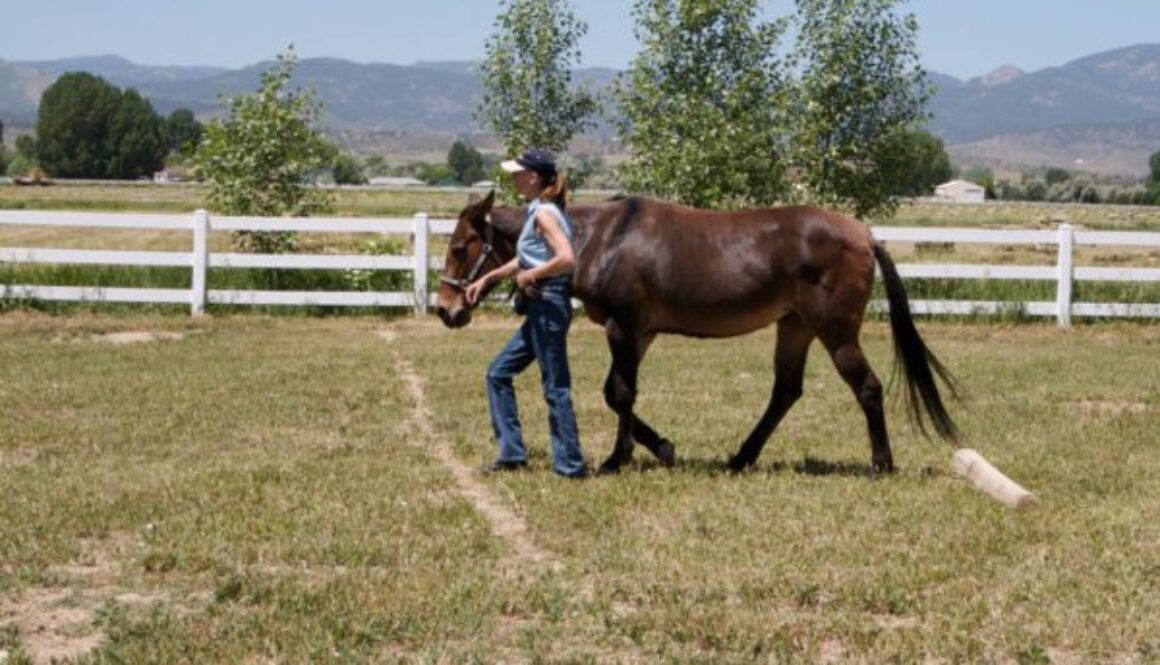




 Miniature mules and horses settle into their lunging lessons very well, but miniature donkeys (and donkeys in general) really don’t like to be lunged. They just don’t seem to see much purpose in it unless you make it fun for them. If you have a mini donkey, when teaching him to lunge it is helpful if you employ the aid of another type of equine of comparative size (such as a miniature horse or mule) to help “lead” your mini donkey through the lessons. Before I first began lunging my two mini donkeys, Augie and Spuds, I introduced them to Franklin the mini mule, Francis the mini molly mule and Mirage the mini horse by putting them altogether in the larger indoor arena space, and then I put them all in the round pen together. Before I began giving any of them specific instructions, they were all allowed some time to investigate each other and establish their pecking order. Before long all five were lunging cooperatively together, although Spuds did feel the need to kick at Mirage a few times so Mirage would allow him enough space to perform. (Mirage can be a bully sometimes and needed to be put in his place.)
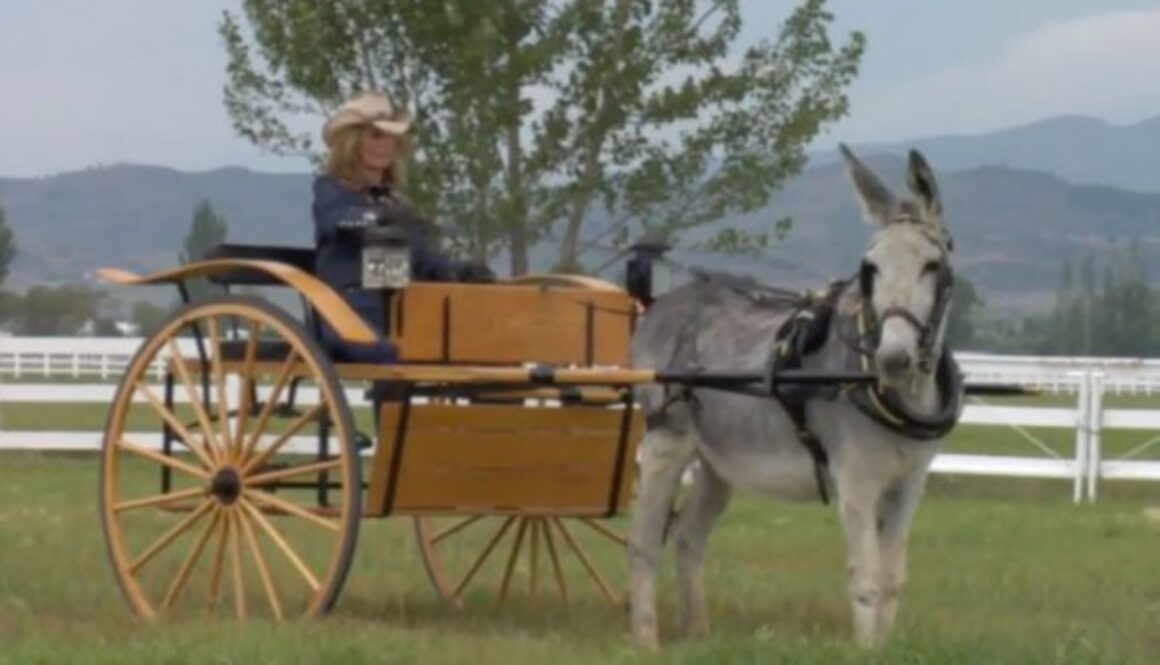
 It is important that your tack and other “mini” equipment fit well. Check the harness to make sure the bridle fits and the bit is placed correctly, and be sure to adjust the blinders on your harness bridle so they don’t rub against your mini’s eyes. Fitting miniature donkeys for harness can sometimes be difficult, but I was fortunate to find Chimacum Tack, a tack and harness manufacturing company that does a fantastic job with miniature donkey, mule and horse harness. I suggest that you make the fitting a lesson in itself—you can even introduce your mini to the cart he will be pulling without actually hitching him up to it. Just as you have with all other obstacles, first let him inspect the tack. Then, once you have put it on him, have him stand quietly in the spot in front of the cart where he will eventually stand. Don’t forget to amply reward him and he should be more than willing to comply.
 At this stage of training, lessons over obstacles can now be done with more finesse. You can begin lateral work over small rails placed in front of a fence, backing through the walk-through “L” and doing lateral work in the tractor tire. In advanced tractor tire work, if you judge it to be safe, get down on your knees so you are on your mini’s level. Now ask your mini to put all four feet inside the tractor tire, and to then make a turn on the haunches. Direct his head in the direction you choose to go first and ask him to slowly turn while all of his feet are still inside the tire. Do this by poking him in the shoulder with your index finger (just as you did when repositioning him for the farrier) and asking him to move his front end over and around the inside of the tire. Do this in one direction and then in the other direction. Stay low, maintain eye contact and don’t be too forceful in your movements.
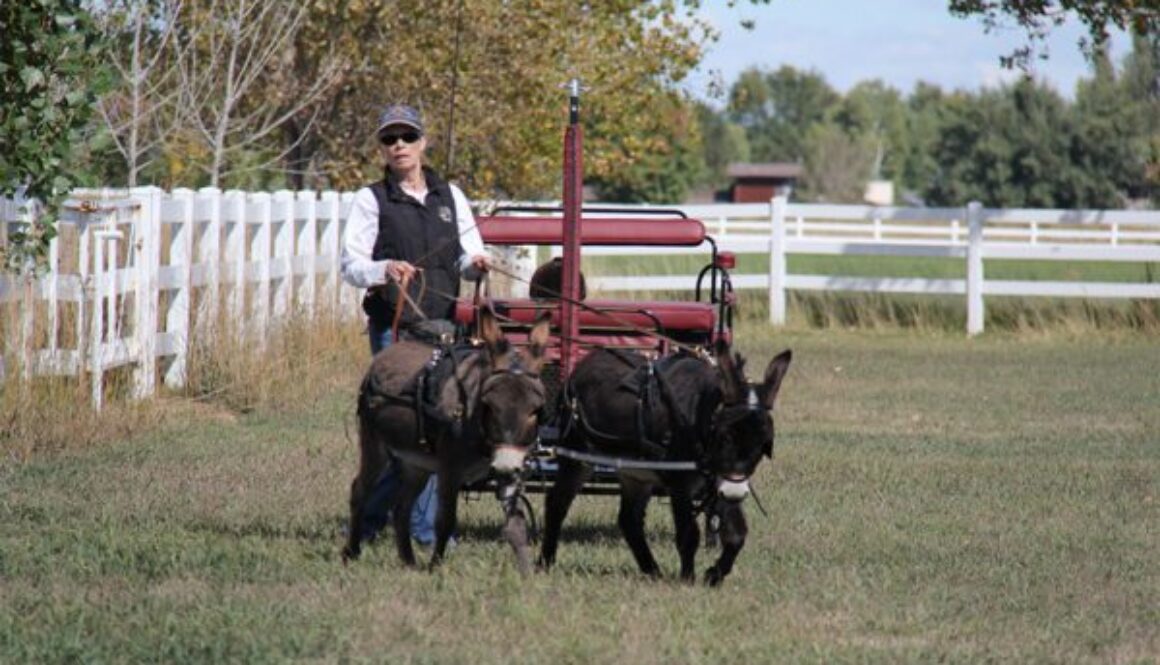
 By now you have taught your mini to follow on the lead while you both explore and have all kinds of adventures around your property, inspecting new things and having picnics everywhere imaginable. If your mini is to learn to be driven, he now needs to have the confidence to take the lead. When you begin this process, review (with your mini) leading together from the work station to the round pen. If you are training a team and dealing with two minis, tie their halters together at the side rings with about eighteen inches of 3/8-inch nylon rope with small snaps on each end between them, and use one lead rope snapped to the center of the tie rope between them. Begin by taking your position in the lead while carrying a dressage whip. Slowly work your way in beside them on the near (left) side, tap them each once gently on the hindquarters with the whip to let them know you expect them to continue forward and ahead of you (even though you are moving more slowly than they are on an angle to gradually work your way in behind them). Pretty soon, you should be directly behind them, encouraging them both forward if they do stop with a gentle tap of the dressage whip, but only one tap for each balky step.
 In subsequent lessons going forward, the next steps are to attach the drive lines and ground-drive your mini in the round pen. Ground-drive around the rail in each direction at the walk and do smaller circles from the rail and back to the rail around the larger circle. Execute an “S” turn through the middle to change directions and do the same going in the opposite direction. End each lesson with a square halt and a back. If he does not do any of these moves with ease, just be happy with what he offers and stop the lesson there. This will give your mini a lesson in communication through the bit. It is imperative that he learns this. You always have the next lesson to continue forward and you want to avoid any confrontation that will cause resistant behavior. It is easier to prevent the behavior from occurring than to have to correct it later. If you are ground-driving two minis, work each mini alone first and then follow this exact same procedure with your team.
 Moving to an open arena changes your mini’s perception of space and he will often feel like playing, so set up the cones of the hourglass pattern for him. Ground-driving through the hourglass pattern will help to maintain his attention and give him a point of focus for his lessons. Ground-drive your mini as you did in the round pen, but now he will be driven through the hourglass pattern with random halts. If you have any balking, just stop, reward for stopping, regroup and try again. Remember to go slowly and use frequent halts and backs in order to reward your mini. This helps him to stay attentive to your hands. Remember to do a full halt yourself—in good posture—before you step forward to reward him. If you pay attention to your own posture and the quality of your walk and halts, he will pay attention to his.
 There are classes at various shows (both open horse shows and miniature shows), where minis are not only driven in harness with a variety of carts and small carriages, but they also do trail courses and jumping on the lead line. Miniatures enjoy performing and have personality-plus, which audiences love! How well-trained your mini is will determine his willingness to do a multitude of fun activities, so make training fun and exciting for your mini. Enjoy the small victories along the way, use your creativity, reward lavishly and look forward to your adventures together.

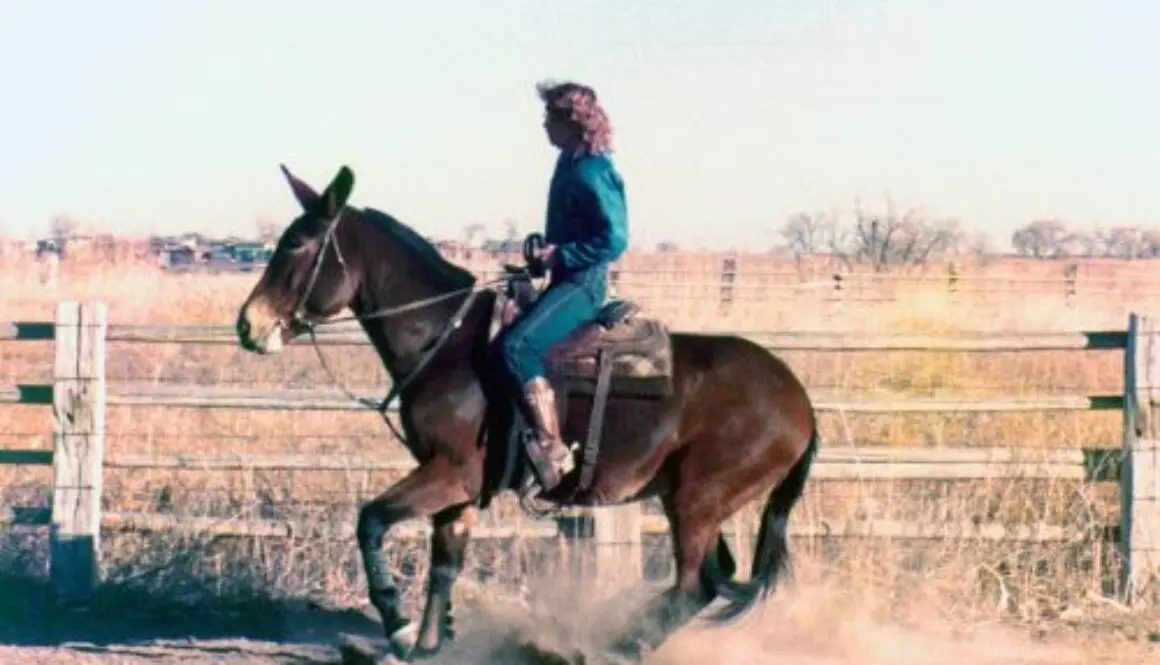
 In the early sixties, mules were among those animals quickly becoming extinct in this country. Thanks to the formation of clubs such as The American Donkey and Mule Society, founded in 1967, and the British Donkey Breed Society, founded in 1966, the trend was reversed and the animals began to get the recognition they justly deserved.
 For those of you who are unfamiliar with the breeding of a mule, he is the cross between a male donkey, called a jack, and a female horse, a mare. The reverse of that–a cross between a male horse, a stallion, and a female donkey, a jenny on jennet–is called a hinny, although many still refer to them as mules. Years ago people used low quality mares to breed to jacks to obtain mules, but today we are improving the breed by crossing better quality animals to obtain better and stronger mules.
 Many have asked about the training of mules. Training mules is much like training horses, but sophisticated trainers would probably agree that they are more like teaching young children. A mule is more likely to perform to the best of his ability if he is allowed to build trust in his trainer. This is where mules and horses differ. Horses have a forgiving nature and are able to forget a loss of temper by the trainer; mules do not forget. When a mule is nervous about a trainer, his ability to perform for the trainer is impaired. Pat Parelli, a California mule trainer, put it quite nicely: “Mules separate crude trainers from artistic trainers.” The mule handled by a crude trainer will generally epitomize the traditional belief that mules are stubborn and ornery. The mule handled by an artistic trainer will not. A technique widely used among mule trainers with great success is the psychological science of Behavior Modification, whereby the animal’s natural behaviors are modified to achieve the desired response through the use of positive reinforcement. Negative reinforcement is also used sparingly. When using negative reinforcement, one must remain calm, patient, and just to ensure the success of the temporary discipline. One must remember that negative reinforcement does not build desirable behavior. It is only used to stop a bad behavior long enough to substitute a desirable behavior. A mule trained in this manner will become a more trustworthy, willing, and predictable friend and companion. Let’s dispel the old saying that mules are “stubborn” and “ornery” and say that there are really no bad mules, only bad trainers.
 The Mule Days celebration in Bishop, California is the largest mule show in the world. Mule lovers, their friends and family enjoy four days of mule-related fun and entertainment. At this particular show there is a little something for everyone: Western cuisine, games, dancing, and conversation in addition to the mule show itself. In 1984, there were over 70 different classes and events for the competitors such as Pleasure classes, Reining classes, Trail, Musical Tires, Barrel Racing and Pole Bending. Also Jumping, Cattle Penning, Steer Stopping, Team Roping, and a Balloon Bust. For the packers: Pack Train classes, Packing contests, Box Hitch and Diamond Hitch packing contests (pro and non-pro), Team Packing and the Team Packing Scramble which you have to see to believe! There are Halter classes, Pulling, Driving classes, and for you race fans: Chariot races, Flat Track races, and yes, even a Backwards race! To highlight the events, there are featured performances by special people and mules. Almost every year, the 20-mule team makes an appearance and in 1981 Slim Pickens, Grand Marshall of the Mule Days Parade, drove his team to victory in a chariot race! In 1984, Colorado’s own Al Kaly Shrine Temple Mule Train World Champion Drill Team out of Colorado Springs gave a memorable performance on their beautifully matched, black army mules. This mule show brings together so many people with different backgrounds and interests for a perfectly glorious weekend. Each year leaves you looking forward to the next.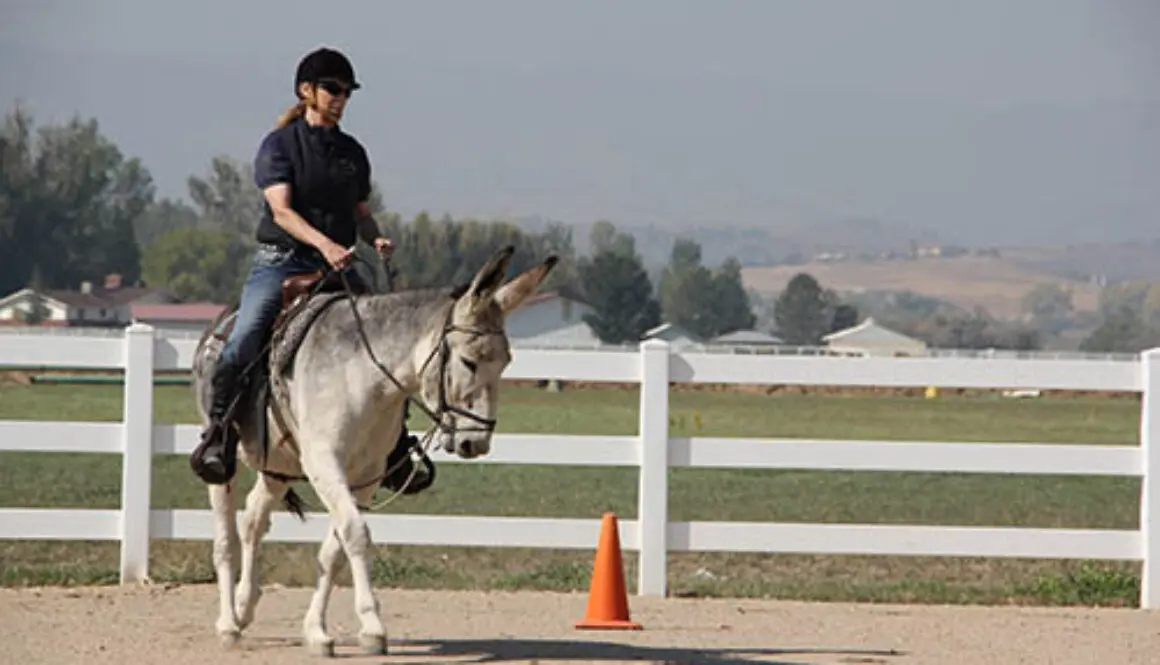


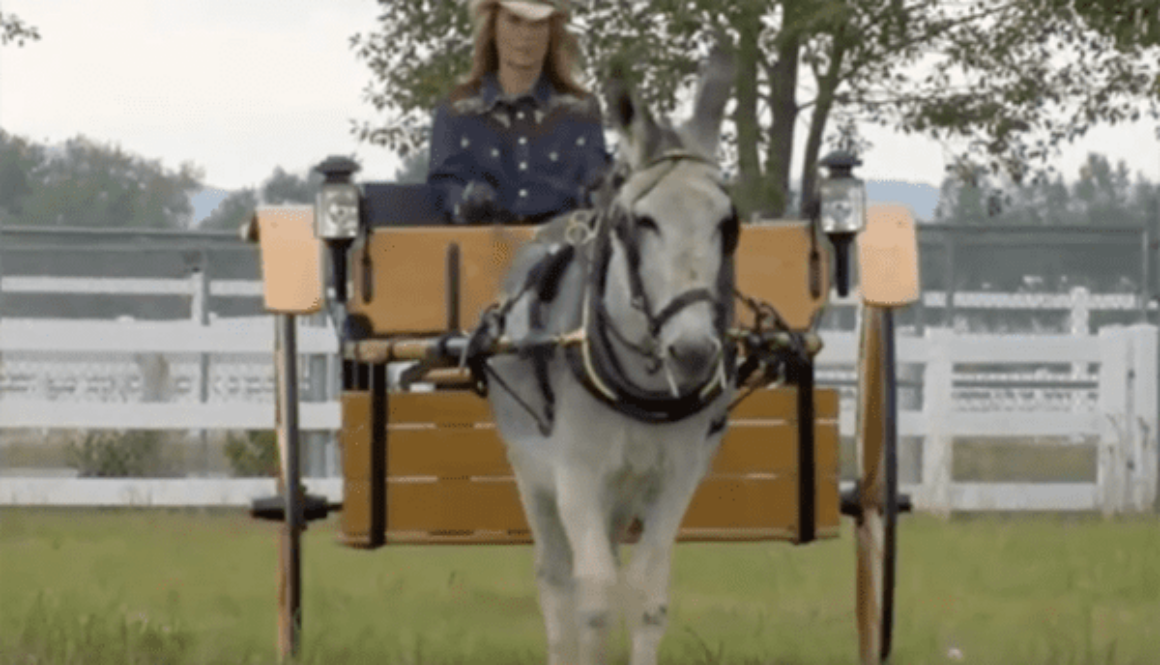


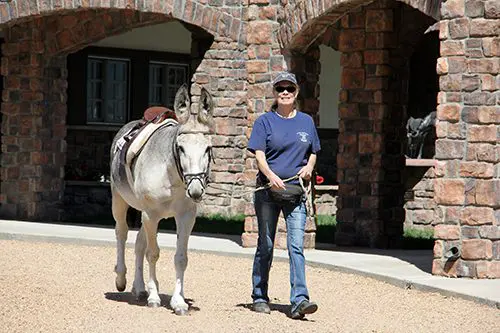


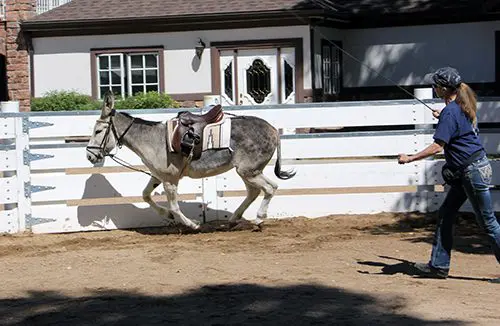
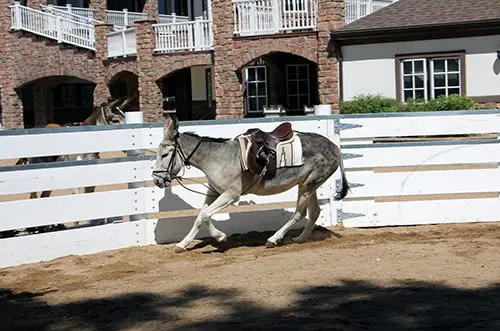
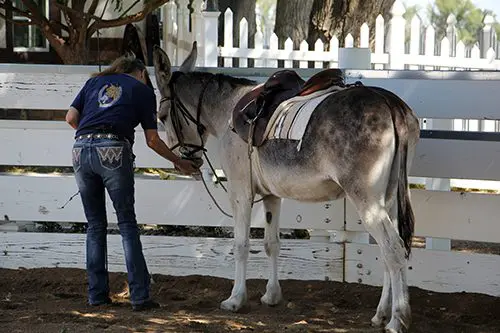
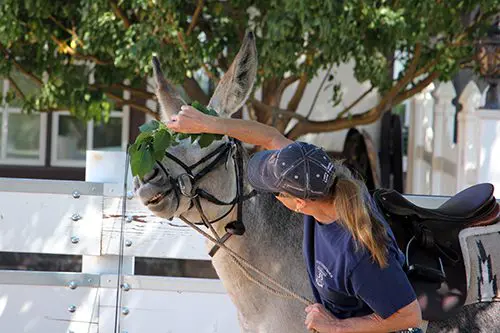


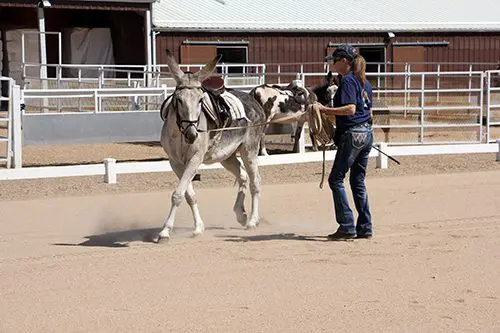


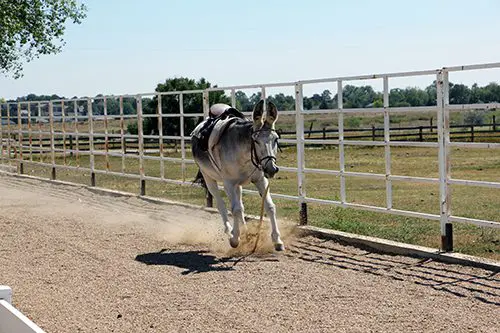

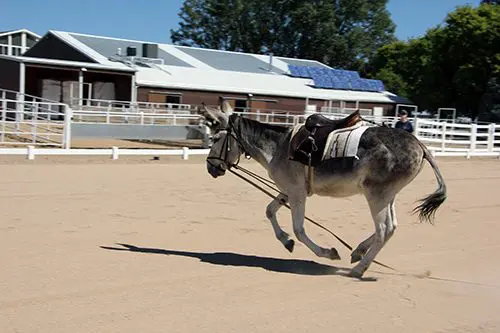
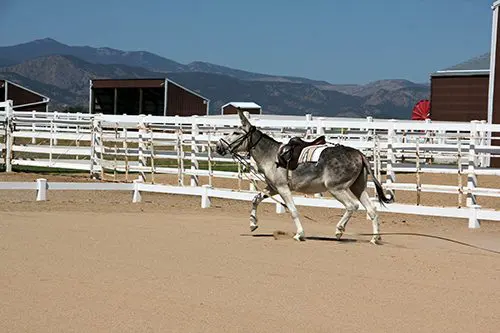

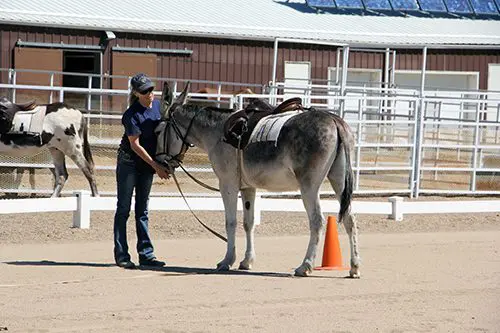
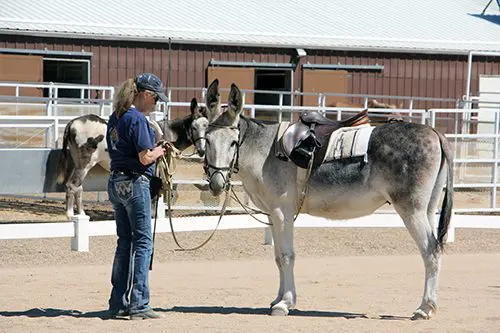
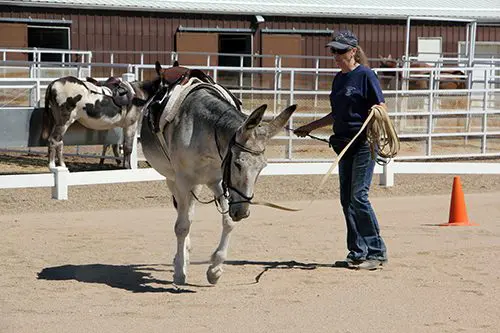

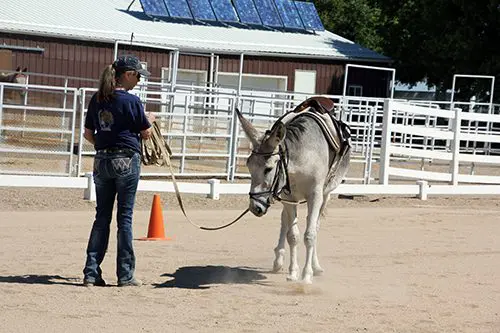
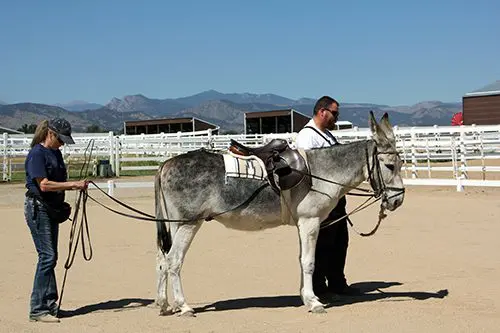
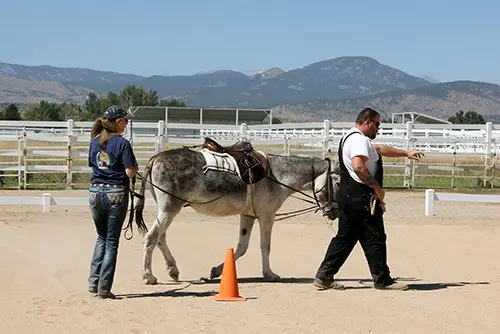

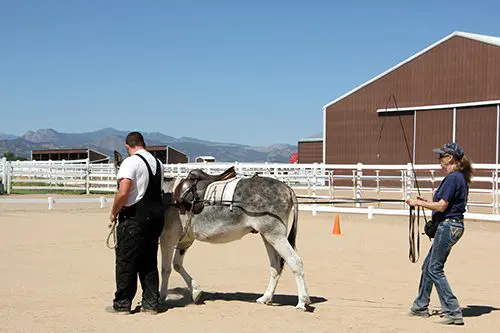


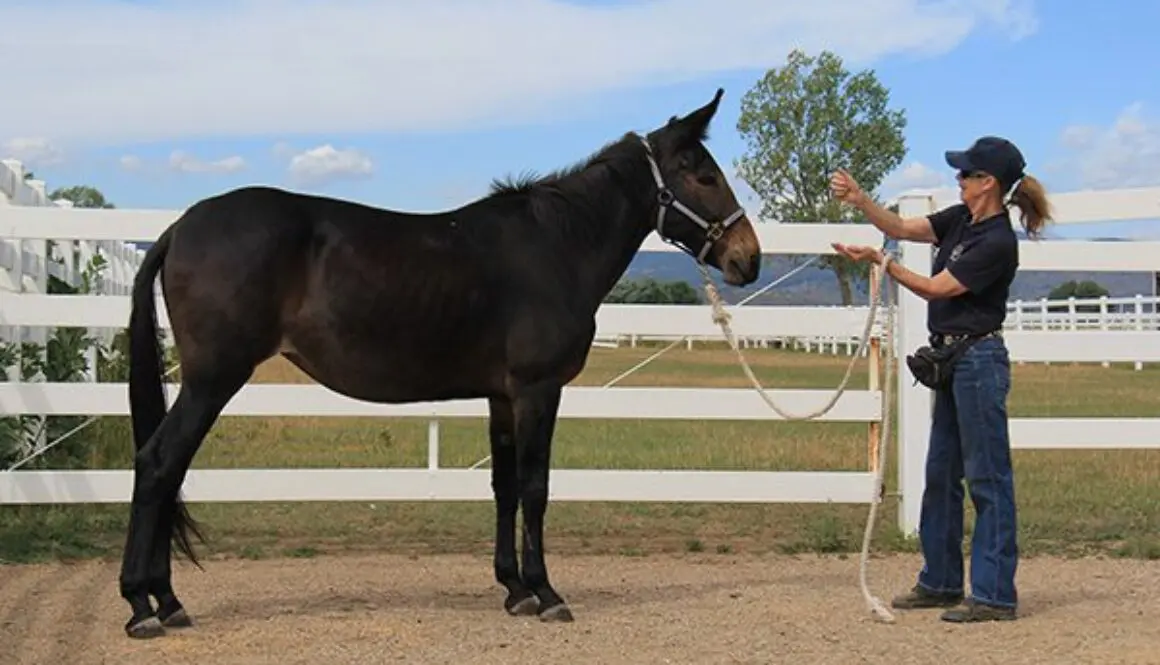

 Now that you have spent many months teaching your mule to drive and he is doing so well, you have decided that it might be fun to show him in harness. So, what are that kinds of things that a judge looks for in a driving class of mules? Well, it’s basically the same as it is with horses.
 confidently, yet promptly. He should reinback easily upon request, and stand quietly at the halt with all four legs squared. His ears will be relaxed, but attentively turned to the driver most of the time. Ears that are rapidly in motion indicate anxiety and distraction.
 30 minutes. If you condition your mule at the medium trot for 20 minutes straight, without any sweating or breathing hard, he should be able to handle the class with no problem. Another helpful hint is to condition him on uneven ground. Then, when he performs on the flat ground, it will seem a lot easier to him. Remember to condition slowly to avoid overexertion, muscle soreness or injury. If you condition your mule beyond what is expected in the class, you won’t have to worry about him being fit for class! And, as long as he is so well conditioned, be sure he is well-groomed as well.
 with good hock action, on a taut, but light rein, the position being balanced and unconstrained. The steps are
 The next consideration is the appropriateness of the animal to the vehicle he is pulling. A smaller mule should never be used to pull a large wagon, nor should the larger draft mule be used to pull a pony cart! Select a vehicle that pulls easily for your mule and one that is proportionate to his size. The overall picture should be balanced and harmonious. Fifty percent of your total class score will include your mule’s manners, his conditioning, his way of going and the appropriateness of the general turnout.
 where appropriate. Hat, gloves, coat, tie, and a lap apron are required. A whip must be held in hand at all times! Always look where you are going, check the judge for instructions periodically and pay attention to spacing in the arena! The remaining considerations for a judge are the vehicle and the harness with each carrying 15% of your total score. The vehicle should be in good repair, appropriate size and style for your mule, and should fit him properly through the shafts and tugs. The harness should fit him as well as possible and should be adjusted correctly, especially the breeching so it can do its job in the reinback.
 There is a lot to consider as a driving judge, but judges are also human beings, and basically the judge is going to select those mules for placement in the class that HE would most like to drive. If you follow the guidelines that I have described, your Longears will be one of the judge’s favorites!