LTR Training Tip #54: Setting Up for Successful Lunging
Know when your equine is ready to start working on lunging, and how to best set them up for success.

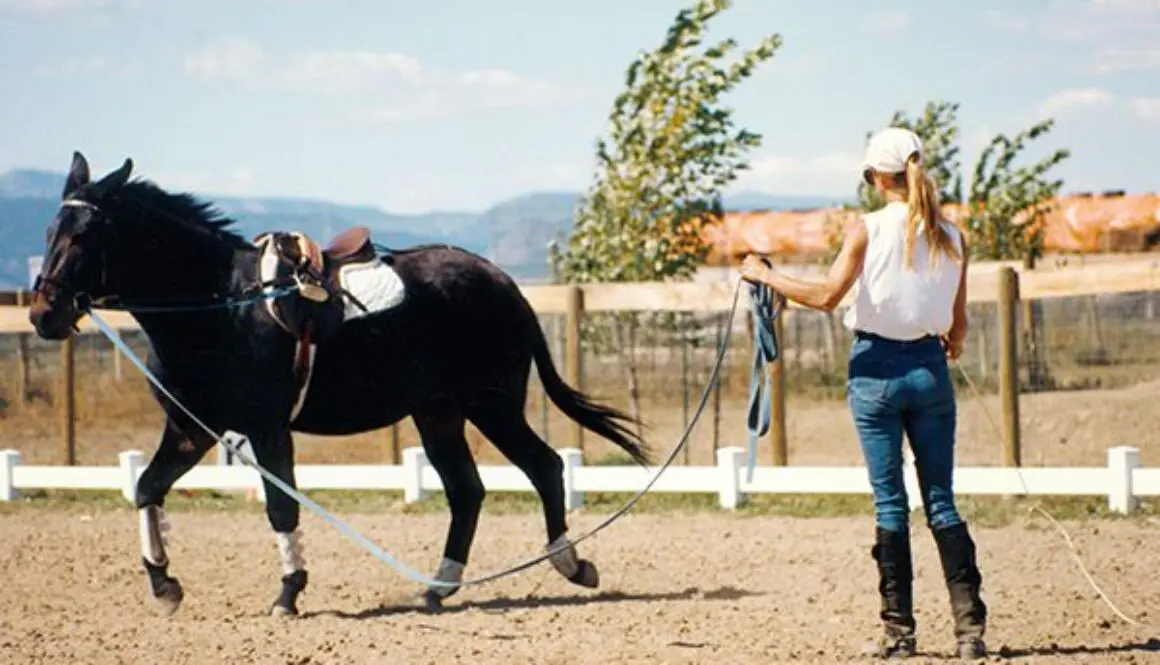
Know when your equine is ready to start working on lunging, and how to best set them up for success.


To learn more about Meredith Hodges and her comprehensive all-breed equine training program, visit LuckyThreeRanch.com or call 1-800-816-7566. Check out her children’s website at JasperTheMule.com. Also, find Meredith on Facebook, YouTube and Twitter.
© 2016, 2017 Lucky Three Ranch, Inc. All Rights Reserved.
On November 22nd, of 2021, I posted, on my MEREDITH HODGES PUBLIC FIGURE Facebook page, information about how to maintain your tack and equipment, and how to keep a neat and tidy tack room. There were a lot of comments about it and many people indicated that they thought it would be easy if you had the staff that I have.
Just for the record, when it comes to my equines and their tack and equipment, I do most of the work myself. My TWO guys do clean the stalls and runs daily, and the larger dirt pens weekly when the animals are overnighted there, and they do feed in the mornings, midday and evenings. TWO of my girls take care of the inside and external cleaning of the multiple buildings that we have, and they condition the tack and equipment as needed, but mostly every three months because we clean things as we use them.
My THIRD girl assists me in the office checking the website and Social Media connections, making Social Media posts (with the exception of Facebook that I do myself), editing articles, advertising and the newsletter, fulfilling orders and MUCH more. TWO of the girls and I film and take photos of EVERYTHING we do so we have material for our posts, articles, video Training Tips and Documentaries. We put these together with our TWO remote videographers and we have ONE remote graphics artist that also assists with publications. Our JASPER MASCOT also doubles as a website tech person. So, we have a VERY SMALL staff to cover all the work that we do. We are prompt in doing what we do because we want to provide all of you the information that you need to have the same success with your equines that we have with ours. In this post, I will address how I efficiently keep all 17 of my equines clean and healthy.


I find that when you have a regular weekly grooming routine along with good environment cleaning practices, the animals do not seem to get as dirty as they would otherwise. Spring is obviously the most intensive time of the year because of mud and shedding, but during other times of the year, grooming can go quickly. During the summer months, they have short hair coats and will only need to have bridle paths trimmed, faces, ears and nostril cleaned, Johnson’s Baby oil in the manes and tails, Neosporin for any cuts and scratches, and a quick go-over with the Dandy brush. Since I keep them barefoot with regular trims every 6-8 weeks, they rarely need their feet cleaned. I carry the grooming tools in a bucket and visit them wherever they happen to be, either in their stalls or in turnout. Because they are all taught the same manners, they come to me and line up for their turn wherever they are.
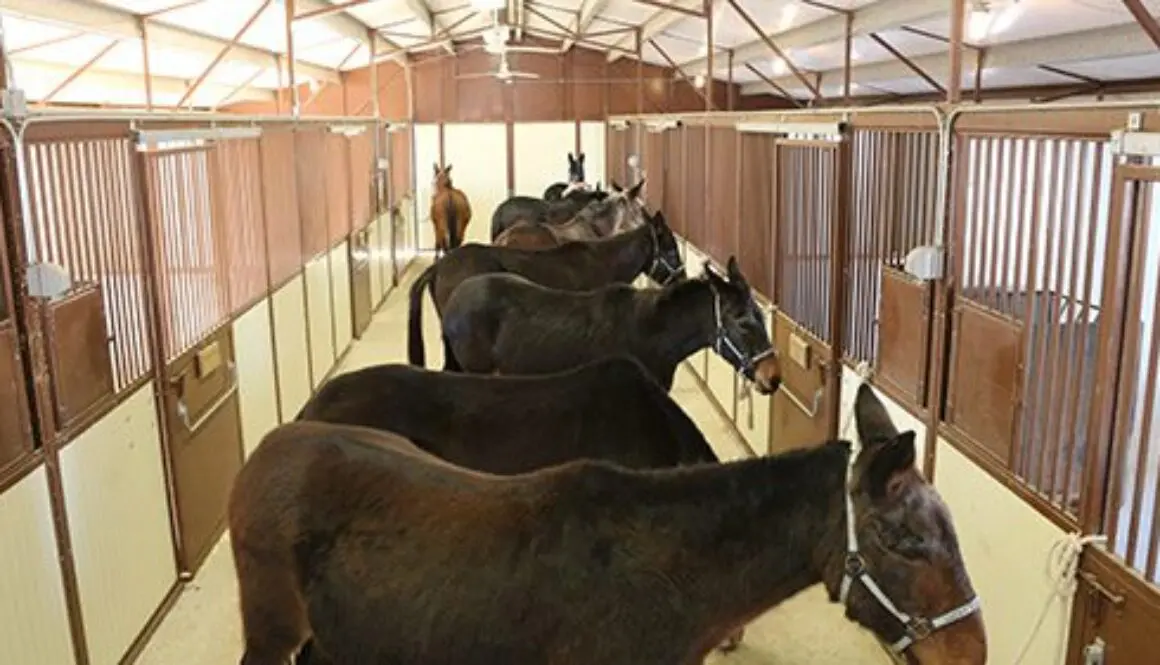
We have had good weather this fall, but with the lack of moisture, they are all pretty dusty. Since we are using my Tack Barn as an art studio and getting the BELLE, JASPER, MOXIE & KYLIE bronzes ready to be cast for their placement in our newest project, the OLDE WESTERN TOWN OF ASSPEN here at the ranch, I opted to vacuum everyone in the alleyway of the barn.
The first thing I did was to have them exit their stalls and be tied in the alleyway. I brought in Augie, Spuds and Billy from their barn and added them to the eight mules from the South Barn. As I retrieve them, I ALWAYS open the door, ask them to come to me, reward them and then put on their halter. They learn to stand quietly and will not exit the stall until I give them permission to do so.
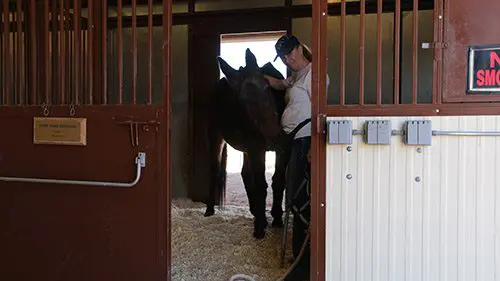

So I can be hands-free with the halter, I will often allow them to eat their reward directly from the fanny pack of crimped oats that I ALWAYS wear around my waist. If they get pushy, I will say, “NO!” and put my hand up like a stop sign and ask them to back off. If that doesn’t work, a quick slap to the side of their mouth after they have been asked does work. Consistency in MY behavior is key!


They have all been introduced to the vacuum cleaner and stand quietly while I go from one to the next. If they start picking at each other, I just holler the name of the perpetrator and say “NO!” VERY LOUDLY! They always stop because they know the next thing is a pop on the rump from me!


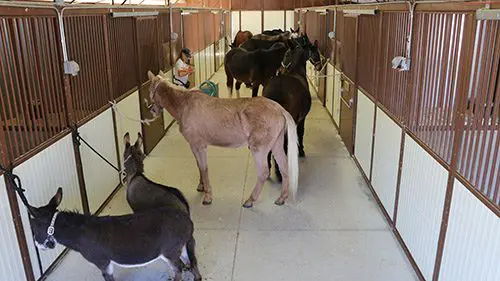
I am always aware of each animal, but I do not “move over” for them. I ask them to “move over” for ME. Then they are rewarded with crimped oats. Once they learn, for instance, that I need to return the vacuum to its spot, and that they will all get rewarded for standing quietly, they give me my space as I work around them, even during rolling up the extension cords!


Since I have so many animals, I do have to refill the fanny pack often, so I keep a full bucket available in a convenient spot for refills. Once they are all vacuumed, I ten move down the line and wipe everyone’s faces. They get their eyes, ears and noses cleaned thoroughly. They quickly learn to accept the process and then I reward them once they are all done. When I do them individually before riding, I will reward each immediately after each task. When they are all together, they will behave better when they have to wait to be rewarded when they are ALL done with each task. Then I go down the line and sprinkle Johnson’s baby oil in all their manes and tails and reward their good behavior when that is all done.


My 28 year old mule, Merlin, poked his eye on a tree branch when he was a yearling. I opted not to have his eye removed, so we have been treating it for 27 years. We keep him in a fly mask all the time to keep the dirt and debris from irritating it. Twice a day face wiping keeps it sanitary and it is easy enough to do at feeding time. We just carry a wet rag with us when we see him.
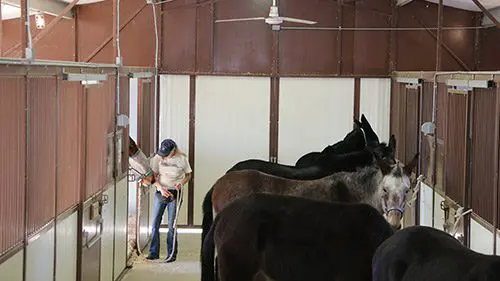

When they are all done, I lead them back to their stall, send them in while I stay at the door and ask them to turn back to me for their reward. As they chew their reward, I remove the halter and bid them a fond farewell!


With the 11 mules and mini donkeys finished in the South Barn, I next go to the North Barn to repeat the process with the remaining six animals, two Large Standard Donkeys (Wrangler & Chasity), a miniature mule (Francis), a miniature horse (Mirage) and two saddle mules (Jubilee & Brandy).

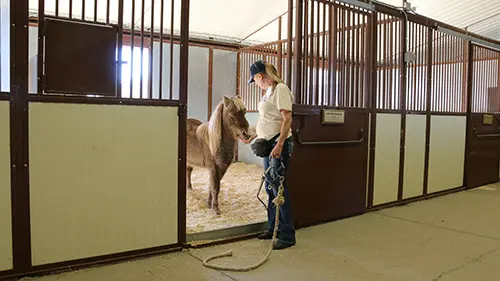
Again, I ask them to come to ME, give them their reward and then halter them as the chew. They are all happy to stand still until I tell them they can walk out the door.

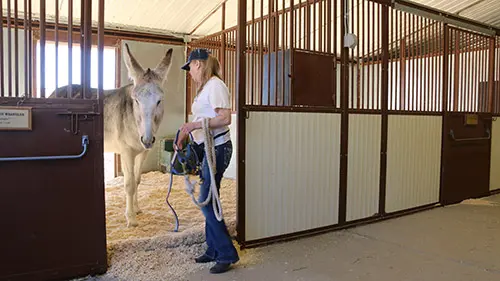


I repeat the whole process with the vacuum cleaner and again, they have all been trained to accept it, so they stand quietly and happily. I do believe that they really DO enjoy being cleaned…even if they do go back and roll almost immediately…LOL!


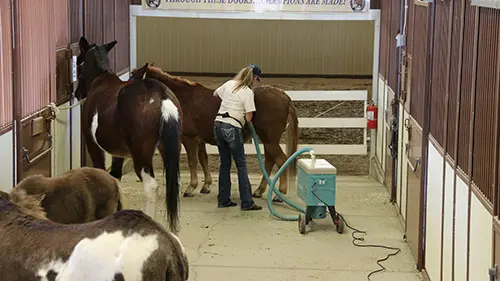


Then comes the face-wiping followed by the Johnson’s Baby oil in the manes and tails. I do not cut their bridle paths in the winter. It gets very cold here and I don’t want them to lose heat from their bodies.


Then it is time for them to be returned to their stalls. I have two rescues (re-trains) in this group and they watch intently as the old troopers enter their stalls and behave impeccably!


When Chasity was returned to her stall, I asked her to walk through the narrow space between my truck and the wall of the barn. My assistant was filming from the bed of the truck and as I said earlier, we do not move over for them! Chasity walked quietly through the narrow space, did not rush or push me, but followed obediently. She was sent into her stall, turned around and got her reward. Then, it was Wrangler’s turn.

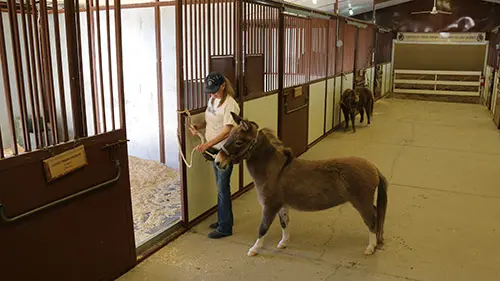
Francis is a mini mule that I got 10 years ago and to this day, she is still suspicious of humans, but is learning to trust. She can be fully groomed in her stall with no halter, but she can become quite a handful when outside the stall. Her natural reaction is to bolt and run any time she get the chance. When I return her to her stall, I set her up for success by looping the end of her lead rope around the stall bar so if she does bolt, she won’t be able to pull the lead rope from my hand and will be forced to turn around and face me. She didn’t even try to bolt this time, kept the rope loose and returned to me for her reward. Then I went and got Mirage, our 26-year-old miniature horse, and returned him to his stall. The grooming of all 17 animals only took me 2 hours! Organized practices and teaching good manners makes all the difference!


When Chasity first arrived, we needed to keep her in quarantine, away from the other animals for a minimum of two weeks. Over the past 41 years, we altered our facility to an all-steel facility. Reduced maintenance costs enabled us to proceed converting from wood and wire to steel until we completed the process. This has greatly reduced the overall maintenance costs for the entire ranch, enabling us to purchase steel panels for the barn runs. It was easy to quarantine Chasity safely and still allow her company (at a distance, of course!) and an introduction to her future stable mate, Wrangler. About every five years, we do have to spray paint the panels to keep them looking new, but this is a small price to pay for a happy donkey!


Once out of quarantine, Chasity and Wrangler were stabled next to each other. All of our runs are bedded with four inches of pea gravel. This promotes good drainage and keeps things from getting muddy. This, in turn, provides a hard surface for good hoof health and will not chip their feet because of its rounded shape. Each of our donkeys is given a soccer ball for play in the smaller areas. The ground surface is also soft and comfortable enough for them to lie down without causing shoe boils or sores. They learn to come by calling them to the end of the runs and rewarding with oats.

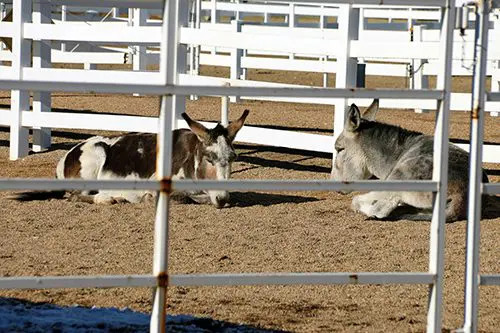
The mini donkeys’ pens are the same way, as is the road around the sandy dressage arena where they can also be turned out in the larger dirt area when it is not in use. They really enjoy a good roll in the sand.


Donkeys are desert animals and can easily become obese when exposed to green pastures. I only take my donkeys out to pasture to play with me.


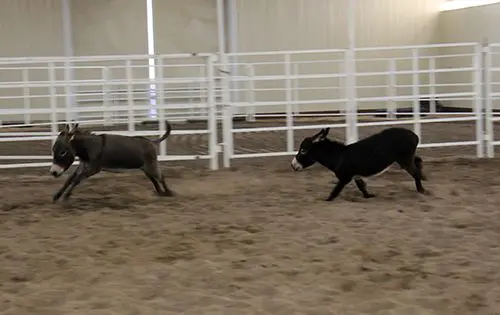
My 60’ x 180’ indoor arena is lined with steel panels. I have a 45’ Round Pen at one end with obstacles inside the side gates around the south end. The enclosed area makes for good obstacle training with minimal distractions. Round Pen work and turnout in the open area during bad weather is completely safe and NON-DESTRUCTIVE!

At first, Chasity would not come to me at the stall door, but after being chased once into the stall to be haltered, she soon gave in easily. I always halter in exactly the same way, in the same place. They love routine.


The oats reward assures that she will repeat the behavior. After only one lesson, she now comes to me every time to be haltered. For clean, dry stalls, we bore a 2’ wide x 4’ deep hole in the center, fill it with 1 ½” rock, cover it with four inches of pea gravel and put rubber mats on top. The pea gravel is held in with 2” x 6” boards bordered by angle iron.


Since we had no animals in the north stalls, we took down the panels and made a large turnout area bedded in four inches of pea gravel for Wrangler and Chasity. It was plenty large enough to romp and play…and not get muddy!


When I am out and about the barn, I reinforce Wrangler and Chasity’s will, as well as all the others, to come to me for their oats reward. We keep bulk rock, pea gravel and structural fill in bays behind the indoor arena.


When the equines are in turnout, we replenish the pea gravel as needed with the Skidsteer.


Wrangler and Chasity, our miniature donkeys Augie & Spuds, miniature mule Francis and miniature horse Mirage also have alternate access to a very large 2 ½ acre dirt pen…Large Standard donkeys one day, miniatures the next.
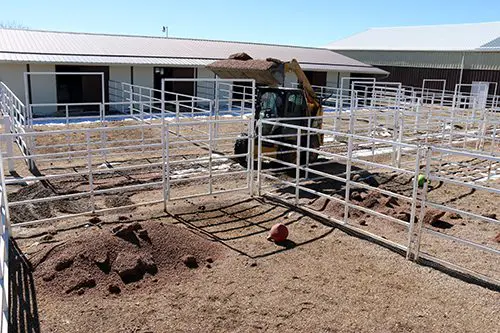

When it is dry, they can take turns on alternate days in the larger area to stretch their legs and buck to their hearts desire. They do not seem to miss being in the pasture with this kind of management and they really do stay very healthy. We have no incidence of colic, founder, abscesses, skin irritations, rashes or obesity.


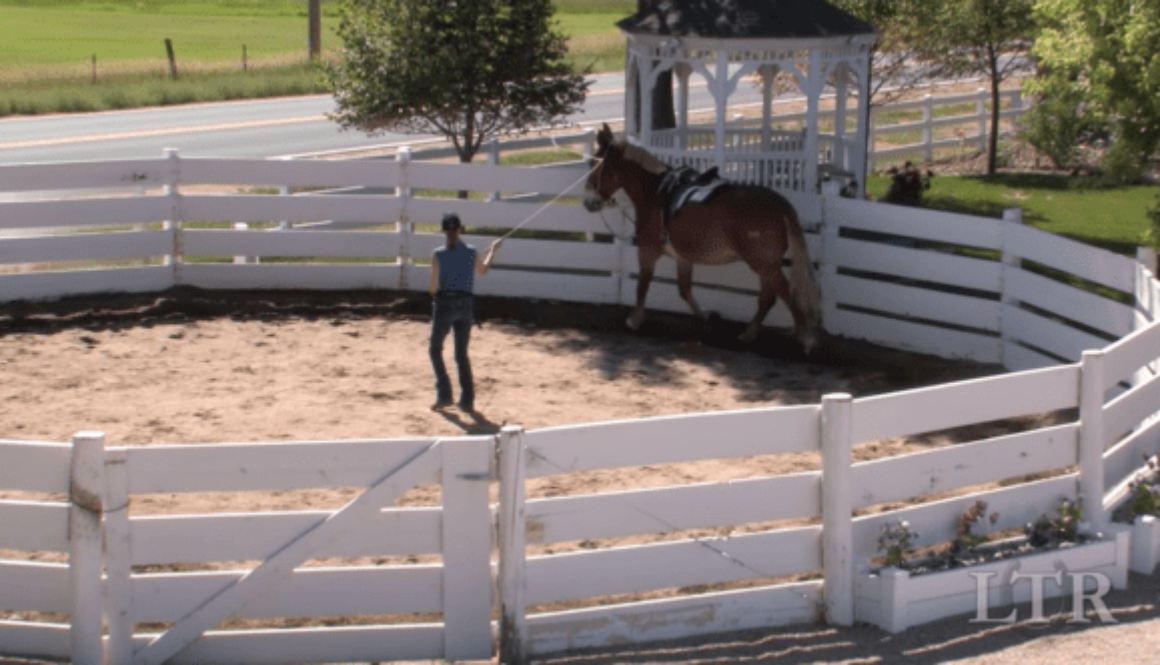
The whip is used in lunging to create movement and encourage impulsion in the equine and should never be used in an abusive manner. Learn how to use it the RIGHT way in Meredith’s latest training tip!
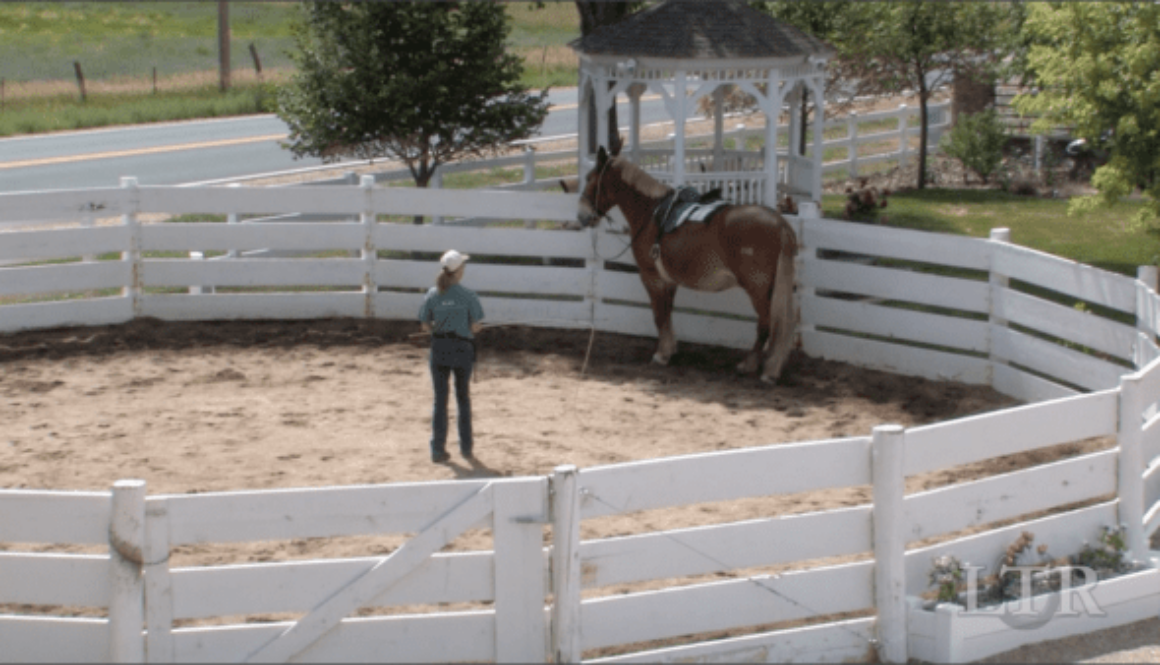
It is important to learn the elements of good communication through verbal commands and body language. You’ll find an equine who is willing to comply when he understands what you are asking!

By Meredith Hodges
 “Imprinting” is a natural process by which an animal (most typically, when young) comes to recognize another animal or a person as a parent or other object of habitual trust. Imprinting is also the way any equine is touched when he is a foal and handled throughout his entire life. It is never too late to use imprinting with your equine, and the way you do it will determine whether or not he develops a lifelong confidence and trust in you. NOTE: Imprinting should not be utilized only when your equine is a newborn, and then never utilized again. Imprinting should continue throughout his entire life.
Equine foals must be allowed to play—running, kicking and rolling. This is how they exercise so they can grow up to be healthy adults. Like any baby or toddler, a foal cannot be expected to have perfect manners, so keep lessons short (10-20 minutes every other day at the most) and use good judgment when you are with him to avoid being kicked or bitten. If he does kick or bite while you are doing things with him, use the flat of your hand and give him a quick thump on the rump for kicking or on the side of his mouth for biting, accompanied by a loud “No!” He will probably run off, but should be able to be coaxed back verbally and fairly easily with soothing language and an offer of crimped oats. When he finally does come back to you, reward him with a nice pat on the neck, and then leave him to play. By doing this, you are letting him know that it is okay to play, but not to kick or bite. He has learned that bad behavior will elicit an unpleasant touch while his good behavior will illicit kind touch and soothing words. You can resume more serious corrective lessons later.
 The most important thing to learn when training your equine is to dispense the crimped oats reward promptly and generously in the beginning of training, and only when your equine is complying (do not use anything but crimped oats for rewards). This will solidify the connection between the two of you and begin to establish a strong and mutually satisfying relationship. If, when haltered, your equine tries to pull away from you, just let go of the rope, reach in your fanny pack and offer the crimped oats to coax him to return to you. Remember not to try to progress through lessons too quickly, as this is usually what causes disobedience. Never chase your equine! Whenever at all possible, allow him to come to you of his own free will.
Before you begin your equine’s leading lessons—and during “tying” lessons—your equine should be rewarded frequently and whenever he is not pulling against the rope. This will help him to understand that he will be rewarded when the rope is loose so he is more likely to follow you when you do untie him and try to lead him. This concept is the same for each new task in each new lesson. Each time he easily complies, he should be rewarded. At this point you can move on to new lessons, but, in order to set him up for success, be sure to break down each process into small steps. Remember to always be generous with the rewards. An equine that learns to take the oats reward politely from your hand is less likely to bite you than one who has not had enough practice getting rewarded with the oats from your hand. When the correction for biting is done properly, your equine will learn not to be aggressive toward the reward and will learn to take them more delicately and gently from your hand.
If, as an adult, your equine gets too close or pushy, slap him on the side of the mouth with an open hand and a very loud “No!” Then put your hand up like a stop sign in front of his face. He should then step back or fling his head back, at which point you immediately step toward him and say, “Good Boy (or Girl),” and give him a reward for giving you your space. The next time he gets too close or pushy, simply put your hand up like a stop sign with a loud and abrupt “No!” This should be sufficient. Your equine should then be willing to back up and wait for the reward. You still need to be very consistent about when the rewards are given and when the correction is truly needed. “No” is the only negative verbal command you should ever give and should be the only word that ever denotes your displeasure so there is never any confusion (do not use any other negative verbal words or noises).
NOTE: Never leave a halter on an unsupervised equine. This is very dangerous! The halter can easily become snagged on something and can result in severe injury, a broken neck, or even death.
When thinking about the way horses, and particularly mules and donkeys learn, consider the way human children learn: They cannot accomplish many different tasks all at the same time. When tasks are not taught one by one and in a natural and logical order, confusion and failure are almost certainly guaranteed. If you want to have good results, you need to be working in a natural and logical order, with small enough steps that make sense to your equine. When training your mule or donkey, use a fanny pack filled with crimped oats, but do not offer a bucket of oats.
You should not even try to put on a halter and lead until your equine lets you touch him all over. Then you can approach with the halter. For instance, before you even halter your equine, ask him to come to you and then reward him with crimped oats when he does come. When he is consistently coming to you, the next step is to carry the halter with you without put it on him. Reward his approach toward you and his acceptance of the halter being present. Let him sniff and investigate the halter as much as he wants. Once he shows no sign of being at all bothered by the presence of the halter, you can then put the halter on him. When doing so, remember to always be polite and gentle. Reward your equine for the acceptance of the halter, and then try to loop your arm over his neck while feeding the crown strap of the halter from your left hand (from under his neck) to your right hand that is looped over his neck. This way, even if he starts to slowly move away, you can pull him back towards you with the loop around his neck and finish the process by putting his nose through the noseband of the halter. However, if he quickly jerks away, just let go of the rope. Then show him the oats and encourage him to return and try again, but do not give him any oats until he comes all the way back to your hand. Anytime he moves away, just ask him to return, but never chase him. Always make sure he comes all the way to you for his reward.
 If you find that you are having difficulty during leading training, your own body may be out of good posture, causing you to take too many steps before stopping to square up. First, make sure you are in good posture. Then give the verbal command to “walk on.” Walk a straight line, pointing to where you are going with your right hand and keeping the left hand securely on your left hip. Make sure your steps mirror his front legs. Then stop, face your equine, reward him for stopping, make him stand squarely, make sure you are still in good posture and reward him for squaring up. Now just stand still for a few minutes, giving your equine time to settle and process what has just happened. Then reward him for standing quietly for a few minutes.
Next, turn and face the next direction in which you will be going, point with your right hand, give the command to “walk on,” and repeat the exercise. If done correctly, there will be many chances to hesitate a bit or stop between actions. All of these hesitations and stops will force your equine to pay attention and be ready for your next move. If you are performing each task in these smaller increments, he will be less likely to forge ahead. It will also give you the opportunity to do things slowly enough to get it exactly “right” and through repetition, your equine will be able to transform learned behaviors into automatic behaviors. If you try to hold a move too long or, on the other hand, do things too fast, your animal may not have time to properly comply, causing him to get confused, lose interest and engage in avoidance behavior.
You should not need to tug, pull or push. Just stand still in good posture when you stop and immediately stick your hand into the fanny pack and offer the reward. If you are doing all of this correctly, your equine might turn his head into your hand and swing his hindquarters around so that he faces you instead of stopping in his tracks. Not staying straight in his tracks is a temporary problem that you can fix by simply squaring him up after he has stopped and been rewarded. If he is forging ahead, one or more things are going on; either you are not doing things in small enough steps, not rewarding promptly enough to make him turn into you, or you are not using the fanny pack. These problems can be fixed by being more attentive to your own good posture and your movements, and to the times when he does cooperate. Keep lessons in small enough steps so he can be rewarded. This is called “setting up for success.”
You need to lead your equine with your left hand and shorten the lead rope, so he carries his head next to your right shoulder and cannot slip his head behind your back. He may try to walk ahead of you, at which point you can use your right hand to push his nose back into position. This will be very awkward at first and it will take time for you both to learn to do it properly. If he knows you are carrying a fanny pack of oats, he will be more apt to go in front of you than to follow you from behind or pass you, because he will be looking for the fanny pack. Again, use your free right hand to push him back into the correct position.
Without the reward, there is no incentive for him to do a task correctly, so always remember to dispense the reward promptly and appropriately, accompanied by a verbal “Good Boy!” whenever he correctly does what you ask. Do not spend more than 15 to 20 minutes every other day on lessons, as your animal can get bored and frustrated if you drill. At first, just practice “walk” and “halt.” When he has learned to stay at your shoulder, you can progress to the next step of halting and setting him up to stand squarely. Once he does this correctly, you can move on to trotting and turns. Remember—breaking the lessons into small steps, maintaining good posture and quickly rewarding will help your equine to achieve small victories because you are setting him up for success!
To learn more about Meredith Hodges and her comprehensive all-breed equine training program, visit LuckyThreeRanch.com, MEREDITH HODGES PUBLIC FIGURE Facebook page, or call 1-800-816-7566. Check out her children’s website at JasperTheMule.com. Also, find Meredith on Pinterest, Instagram, MeWe, YouTube and Twitter.
Covered in TRAINING MULES & DONKEY: A LOGICAL APPROACH TO TRAINING, TRAINING WITHOUT RESISTANCE and A GUIDE TO RAISING & SHOWING MULES at www.luckythreeranchstore.com.
© 2016, 2017, 2019, 2024 Lucky Three Ranch, Inc. All Rights Reserved.

Once you’ve chosen the appropriate tack for your equine, make sure it is adjusted properly so your equine is comfortable and responsive.

By Meredith Hodges
 Racing, the Sport of Kings has intrigued people for hundreds of years. Perhaps it’s the beauty of running horses, or maybe the way your heart swells with excitement as they come down the home stretch, or it could just be the money. But whatever the reason, millions flock to the racetracks each year to enjoy this magnificent sport. Over the years, racing has expanded to include not only the Thoroughbreds and Standardbreds, but Appaloosas, Arabians, and Quarter Horses as well. During the past three decades, mules have emerged onto the racetrack to take their place in making racing history.
Although mule racing has just begun to take hold as a national sport, it had its beginnings in the Eastern Sierra Nevada Mountains of California in 1851, when Captain Boling’s cavalry troop was forced to halt for two months in the Yosemite Valley. Horse racing was one of the major sports used to keep up the spirits of the men during this unexpected respite. Army mules were included in these races to add to the entertainment. Much to the chagrin of some of the horse owners, the mules could actually beat some of the cavalry’s favorite mounts. Captain Boling purchased one Maltese, Kentucky-blooded mule (known as The Vining Mule). He was particularly impressed and bought him for one thousand dollars in gold from Lee Vining. He then went on to make many more thousands in match races with this mule against horses. To quote from the official racing program: “The Indian war of 1851 was the catalyst that started the first running of mules in California.”
 The first actual pari-mutuel mule meet was held in Bishop, California in July of 1978. Exacting conditions demanded discreet organization and one of the first necessities was a condition rulebook, which was put together by Paul Voorhees of Bishop, California. On completion of the condition (rule) book, the A.M.A. (American Mule Association) was designated as the official registry for all mules entered in pari-mutuel races. These pari-mutuel mules had to carry an official A.M.A. tattoo. There has been a lot of cooperation among the A.M.A., Racing Board, and mule owners over the years for the promotion of mule racing, and thus, the widespread expansion of this relatively new sport.
Match races and Western-style races included at county fairs exhibit the true versatility of the mule. With increased interest, mule racing now assumes the professionalism of horse racing with the introduction of jockeys, trainers, and starting gates. In the early eighties, purses for mule races ranged from $300 to $700 per race in such states as Colorado, Texas, New Mexico, Arizona and Wyoming with pari-mutuel racing in California and Idaho. The Stakes races averaged more per race and match races were run for as much as $5000 per race. Mules ran at such exclusive tracks as Sunland Park in El Paso, Texas and Ruidoso Downs in New Mexico, with an attendance of 300 or more mules shown over these three-day race weekends. In 1985, there was a match race in El Paso, Texas between the defending World Champion Cajun Queen, owned by J.B. Rogers, and an upcoming young mule, Loretta Lynn, owned by Butch Larson. Cajun Queen maintained her status winning the match race and a purse of $2000.
 Mules generally run races of 300 to 350 yards, although there are 220-yard, 440-yard, 660-yard and half-mile races. Like the Quarter Horses, mules tend to run better for the shorter distances. They can clip off 300 yards in 17 seconds or less. At Ruidoso Downs in New Mexico in 1984, 300 mules showed to race in a three-day meet for a total purse of $55,000. The 1985 meet was held at Sunland Park in El Paso, Texas, with the addition of a three-year-old futurity and a mule sale.
These long-eared sprinters are a breed apart from their ancestors, who were primarily beasts of burden and limited to farm and mine work. Today’s race mules are out of some the finest race-bred Quarter Horse and Thoroughbred mares, and are sired by the finest quality jacks. Because of their careful and curious nature, mules are bit more difficult to train to run straight. The mule races today prove it can be done, and done very well at that! Concerned mule owners opted for a three-year-old futurity to discourage the running of two-years-old. Mules are allowed to run as two-year-olds only after September of their second year and only if their knees have been x-rayed and approved by a veterinarian. The weight carried by a race mule must be a minimum of 140 pounds. The stoutness and sensibility of the mule has made him sounder and more economical to use for racing, with fewer leg problems than experienced with racehorses. The long-lasting durability of the mule has given cause to limit the age of participating race mules to 15 years old.
Despite sterility, race mules sold for $3000 to $10,000. The reason for this is the longevity of their racing life of 12 years and the fact that they are capable of running 2 races a day. With the price of racehorses skyrocketing, racing enthusiasts are showing more and more interest in racing mules and they are now commanding much higher prices. Executives and professionals can see the economic benefits of mule racing and appreciate the more intimate personalities of their investments. There is much to be said for racing mules. It is economically feasible, exciting and sometimes even comical, and the spectators adore them! So satisfy your own curiosity. Come to the mule races near you and see them run!
To learn more about Meredith Hodges and her comprehensive all-breed equine training program, visit LuckyThreeRanch.com, MEREDITH HODGES PUBLIC FIGURE Facebook page, or call 1-800-816-7566. Check out her children’s website at JasperTheMule.com. Also, find Meredith on Pinterest, Instagram, MeWe, YouTube and Twitter.
Covered in TRAINING MULES & DONKEY: A LOGICAL APPROACH TO TRAINING, TRAINING WITHOUT RESISTANCE and EQUUS REVISITED at www.luckythreeranchstore.com.
© 1986, 2016, 2024 Lucky Three Ranch, Inc. All Rights Reserved.

By Meredith Hodges
 Jack Copp was a very special man with a very special mule. Jack was born in Fairfax, Oklahoma, about 45 miles south of the Kansas border. His father worked with mules in the oil fields acquired
from the Osage Indians by the U.S. Government years before. Although his father was familiar with mules, Jack was enamored with horses and particularly with team roping. Jack, a congenial and responsible man, worked at his job for 27 years and roped steers in his spare time.
Then came the accident that changed his life. Jack was run over by a forklift that left him partially crippled for the rest of his life. He could no longer do the things he loved the most. In the midst of his depression, he met an old man who suggested that he get a couple of mules to mess with. “They’ll git you on your feet,” he said. Jack took the man’s advice and bought Joker, a sorrel yearling mule colt, and his sister, Sissy, a weanling molly mule in November of 1978. By May of 1979, Jack had taught Joker enough tricks to entertain the audience at Bishop Mule Days in California.
 This was where I first saw them. In six short months Jack had Joker (only two years old) stretching, sitting, laying down, carrying his feed bucket, rolling a barrel with his front legs, and walking on his hind legs. What he had done with that handsome young mule was remarkable, but what Joker had done for Jack was even more amazing. Jack’s life was given new meaning and his faith restored by this long-eared, little red mule. Sissy, Joker’s sister, was sold and put into training with famed mule trainer Pat Parelli of California, while Jack and Joker became the very best of friends.
 Joker was sired by a Spanish jack, called Red Fox, that was killed by a hunter, and out of a Thoroughbred/Quarter Horse mare. He captured the hearts of all who were fortunate enough to witness his performances. The bond between Jack and Joker was evident as spectators delighted in watching a repertoire of 30 tricks or more. As Jack is a bashful man, Joker often had to push him into the arena to get things started. They began with a good stretch to loosen up the muscles and then Joker was ready to show his stuff. In top condition, Joker showed he could walk on three legs, then on two legs. This was pretty tough for a mule, but he did it out of love for Jack. Joker had no qualms about carrying his feed bucket to remind Jack of dinnertime. But Jack was a demanding trainer and concerned parent and made Joker earn his dinner by rolling a barrel with his front feet. When rolling the barrel forward became boring, Jack taught him to roll it backwards with his hind legs. As if this weren’t tough enough, Joker later learned to roll the barrel both backwards and forwards while straddling it! All this work is sometimes tiring, so Jack thought a short nap would be in order. Joker obliged his command by lying down–his rump made a handy seat for Jack to also take a rest.
 At coffee break time, Joker took his shorter rests in a sitting position. Considerate of Jack, as a best friend should be, Joker stretched, lowering his back so that Jack could reach the stirrup easily to mount. Joker knew that tires are for traveling, but his only use for one was to plant his front feet on it, traveling around it with his back feet; or to plant his back feet on it and travel around it with his front feet. At the “End of the Trail,’ Joker placed all four feet on the tire, exhibiting his excellent balance. Jack and Joker were patriotic Americans. Joker would fly the flag while walking on his hind legs. Then Jack would take the flag while Joker bowed to the audience in appreciation for the applause!
 Not limited only to tricks, Jack removed the bridle and showed people how well trained Joker really was. Without the bridle, Joker performed pleasure, reining patterns, and trail obstacles with ease. No whips, no spurs, no bats–it’s all done with patience and love that you can feel as you watch them. They were quite remarkable! Jack believed that training a mule is like raising a child. If you slap them, bang on them, or worse, they will have no respect.
Mules will either be afraid of you or fight back. Of course, discipline is in order on occasion, but you don’t have to keep doing it. Once Jack began training Joker, Joker was not allowed to run with other animals. Jack was his only close companion. Others never distracted Joker from his best friend, Jack! Jack and Joker have performed at county fairs and shows throughout the U.S. and they were both loved and appreciated wherever they went. The fees for these shows were minimal–just enough to cover their traveling expenses. What a privilege it was to witness this incredible pair!
To learn more about Meredith Hodges and her comprehensive all-breed equine training program, visit LuckyThreeRanch.com, MEREDITH HODGES PUBLIC FIGURE Facebook page, or call 1-800-816-7566. Check out her children’s website at JasperTheMule.com. Also, find Meredith on Pinterest, Instagram, MeWe, YouTube and Twitter.
Covered in TRAINING MULES & DONKEY: A LOGICAL APPROACH TO TRAINING, TRAINING WITHOUT RESISTANCE and EQUUS REVISITED at www.luckythreeranchstore.com.
© 1986, 2016, 2024 Lucky Three Ranch, Inc. All Rights Reserved.

By Meredith Hodges
There is a lot of discussion about training mules versus training horses. There are some who say that training mules is harder than training horses, and others who say just the opposite. It has been my experience that it isn’t really that one animal is more difficult to train than the other. They each have their redeeming qualities and individual limitations. The people who are dealing with them also have their own redeeming and limiting factors. For instance, if you are leading a horse, and he does not want to follow you, because he hasn’t the strength in his head and neck as a mule, or donkey, does, he can be more easily bullied into compliance with a quick jerk on the lead rope.
 On the other hand, if you are leading a mule, or a donkey, they can easily jerk the rope right out of your hands, or jerk you right off your feet, because of the incredible strength they have in their head and neck. When you teach a mule or donkey something one day, he will ponder what he has been taught during the days between lessons. Regardless of how many days or weeks pass, he will comply more easily during the next lesson because he never forgets what has been taught. A horse will tend to forget and will need to be reminded where mules and donkeys will not necessarily need those constant reminders.
It makes sense that the handler needs to adjust his training program such that the horse has many frequent and consistent lessons to refresh his memory. Longears will only need lessons as frequently and consistently as it takes to maintain good postural conditioning. When applying lessons more frequently, the handler has the ability to make subtle adjustments to get the best from the horse. If he wants a Longears to respond properly, it is critical that he teaches the mule or donkey correctly the first time. They will learn EXACTLY what the handler teaches them the first time and will continue to repeat it. The option of changing your approach during the training sequence is limited Longears. What this all amounts to is that one is really not more easily trained than the other. Rather, it is the experience and knowledge of the handler or trainer, that makes the difference with both Longears and horses.
Mules and donkeys, sensitive creatures that they are, seem to be more concerned about the overall attitude of the trainer than are horses. With the intelligent use of negative reinforcement, a positive attitude and informed use of restraints, modification of any equine behavior becomes a lot easier.
When your mule does not comply with your wishes, first you need to get his attention and do something to temper his defensive attitude. When we are intelligent about a situation, it will minimize the animal’s negative reactive responses. Our politeness and consideration promote an overall positive attitude on both parts, and opens up the lines of communication between you.
Since these equines out-weigh us by several hundred pounds, careful and informed use of restraints can sometimes be humanely used to perpetuate and escalate the close relationship between you and your Longears (and even horses) in the training environment. Restraints should be used to help “explain” what you wish from your equine, but should not be used as a perpetual training “crutch.” Intelligence, attitude and restraints should always be used in conjunction with a pursuit of “the path of least resistance” in mind to promote successful training sessions.
If we realize that correct development of mind and body takes time, we should relax, be patient, allow the equine learn at his own pace, humanely utilize helpful restraints to minimize resistance in difficult situations and actually enjoy the training process with our animals. For example, in the case of Draw Reins, they should be used in conjunction with your regular reins, only if you have Good Steady Hands and only when necessary. In the beginning, this might mean pressure on them at every stride. As  with any restraint, they will need to be slowly phased out over time. This is pretty easy to see with Draw Reins and the response they elicit from the equine.
But what about a restraint such as the Scotch Hobble where the hind foot is tied up to make handling the feet easier? The first time you need to use the Scotch Hobble, you will probably need to secure the hind foot so that the toe cannot touch the ground when you try to pick up the hind foot. In order to tie the Scotch Hobble, you will first tie a Bowline (non-slip knot) around the neck loosely, then take the slack, hold the very end and work it between the back legs. When you get it in position, you can walk back to the front toward the loop around the neck while taking up the slack.
From the shoulder, give a quick tug on the rope to see if he will yield the hind foot. If he does, you can let him keep the toe on the ground when you run the rope through the loop around the neck and finish going around the back leg again. Then bring the rest of the slack back to the front loop and tie it off.
The Scotch Hobble can be helpful just teaching them to yield the hind leg with this method, without actually tying it off. See if he allows you to transfer the hind foot into your hand. If he does yield the foot and let you hold it for a few seconds, set the foot back down and reward him with oats immediately! If you do have to tie it off, do it looser every time you need to use it until it is so loose that you only have to put the loop around the neck and leave the rest of the slack laying on the floor between his legs. Pretty soon, you won’t have to use it at all. This is called phasing out the restraint. If he becomes fidgety at any point in the process, just back up one step and try again the next time.
 There are many kinds of restraints available in the equine industry today: Martingales, Tie-Downs, Side Reins, Draw Reins, Chambons, Hobbles, Breeding Hobbles and the list goes on. In my opinion, most of these are being used much too freely as “crutches.” They are responsible for terrible body posture and severely limit calm and compliant responsiveness among today’s equines.
A restraint should only be used as a temporary helpful tool to allow you to get a desired response from the animal…to help to show them what you expect from them. Once you get the desired response, it is your responsibility to phase out the restraint in order for the new behavior to become his new normal way of responding…correct behavior. Restraints help to reshape behaviors!
Early in a Longears life, he should \be taught to be calm in restraints which will make routine tasks much easier. Your Veterinarian and Farrier will thank you, and it might save your mule’s life if he should get caught anywhere, fall in a hole, or encounter any other potential for disaster. Your goal is to get him to stay calm and think before he begins to struggle, or bolt, and tries to run. Many Longears will stand still naturally when they are trapped, but it is always better to reinforce this pause for thought with regular lessons.
NEVER USE A FACE TIE OR ANY HARD-TIE ON A HORSE! They have a completely different reaction to being hard-tied than a mule or donkey. They will frantically fight it and throw their bodies around so wildly that they can hurt you or themselves quite easily! I do use my Elbow Pull on horses, but do not hard-tie it. Rather I tie it with loops that slip over their back when they pull against it.
 The following technique is useful when working around very young mules, although it also works well with adults. If your Longears begins to struggle, simply step back and wait for him to calm down, reward with crimped oats when he’s are calm and then resume what you were doing. The Face Tie is a very useful restraint for worming, giving shots, clipping bridle paths, clipping on the head and for teaching an ear-shy Longears how to accept the bridle over their ears. The technique is easy.
Find a good, stout hitch rail or post:
 If your mule or donkey is difficult to lead and tends to bolt and run, rather than using chains that can cause unsightly bumps on the face, you can use what I call the Quick Twist. A quick twist of your lead rope through the nose band and over his nose will provide adequate leverage. Just stand your ground and don’t move if he pulls against you. The rope will tighten around his nostrils and restrict his ability to inhale deeply. He will soon discover that if he comes toward you, it loosens and allows for free breathing again. If he becomes insistent about running off, be sure you are always leading in a confined space and just let go of the lead rope and let him run off… it’s better not to lose a pulling battle with him and let him think he can win. The coax him back by reminding him that you have the crimped oats in your fanny pack! If he still won’t come back, leave him for awhile and try again later. He’ll be back!
NEVER TIE UP YOUR EQUINE WITH THE QUICK TWIST!
 Hobbles can be helpful when clipping the legs, but I don’t recommend using them very much. Longears are truly adept at running off in them and most hobbles will cause rope burns on the pasterns that will scar permanently and never really heal. Do not use nylon hobbles for this reason unless they are lined with fleece. Leather hobbles seem to be fine for supervised use. When camping, it is better to tie them UP to a High Line, or just tie up a horse to the High Line and leave the mules free to roam loose with no halters on. They will stick near the horse.
Choosing the right restraint for a given situation takes a lot of thought and consideration. You must ask yourself which restraints are available for you to use? Which restraint will most likely bring about the correct response from your equine? Will the response come with little or no resistance, and is it humane? Will it cause other more serious problems with the animal? And finally, can the restraint be phased out easily?
 Keeping these things in mind when using restraints will help to keep the relationship with your mule from becoming a battleground. Bear in mind that whatever restraint that you use might vary from situation to situation, and from animal to animal. So, carefully weight your options! Remember, using intelligence, a good attitude and informed use of restraints can greatly enhance your training experience together!
To learn more about Meredith Hodges and her comprehensive all-breed equine training program, visit LuckyThreeRanch.com or call 1-800-816-7566. Check out her children’s website at JasperTheMule.com. Also, find Meredith on Facebook, YouTube, Pinterest, Instagram, MeWe and Twitter.
Covered in TRAINING MULES & DONKEY: A LOGICAL APPROACH TO TRAINING, TRAINING WITHOUT RESISTANCE and EQUUS REVISITED at www.luckythreeranchstore.com
© 1989, 2016, 2024 Lucky Three Ranch, Inc. All rights reserved.

Introduce your equine to lunging training with “free lunging” without tack or equipment in the round pen.

Is your equine ready to start lunging training? Ask yourself these questions before beginning.

 By Meredith Hodges
We humans tend to complicate our lives – filling them with people, things, goals and tasks until we are too busy to even think about what we are doing. For a mule or donkey (and other equines), it’s different. The equine has no “to-dos,” no “ought-to-haves” and no “ought to-dos.” He takes things as they come, considers his response in the moment and stays open to possibility. This year, why not resolve to be more like your mule or donkey. Consider your priorities and look at your relationship with him from his perspective. Stop to smell the roses, and during those inevitable challenging moments, put yourself in your Longears’ shoes. Try to think like he does and you might be surprised at the response that you will get.
No doubt, this is a tall order. After all, we humans tend to begin with the end in mind and the process is just a means to that  end. Training, for example, is a process. We attempt to train with a goal in mind. Our goal at the Lucky Three Ranch is to simply improve the equine’s performance as well as our own. Most of us train with the expectation that improvement will occur, and most of us add the self-imposed pressure to improve within a finite amount of time. The notion that training, all by itself, could be a goal is foreign to many of us. But consider it. What if we trained for the pure pleasure of spending time with our equines while using the values we hold dear like respect, kindness, consideration and consistency in our behavior? How different would the experience be for us and for our equines?
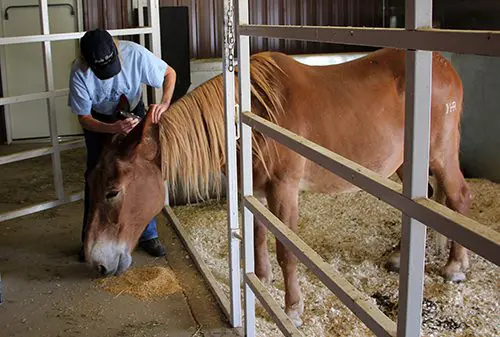 Today’s modern horse training techniques do not generally work well with mules and donkeys. Most horse training techniques that are popular will speed up the training process, so that people can ride sooner. It makes the trainer’s techniques look more attractive, but these techniques do not adequately prepare the equine physically, in a good balanced posture, for the added stress of having a rider on board. Longears have a strong sense of self-preservation and need the kind of work that builds their bodies properly, so they will feel good in their new and correct posture. Otherwise, you will not get the kind of results you expect. Forming a good relationship with your equine begins with a consistent maintenance routine and appropriate groundwork. Most equines do not get the well-structured and extended groundwork training on the lead rope that paves the way to good balance, core muscle conditioning and a willing attitude. This is essential if he is truly expected to be physically and mentally prepared for future equine activities. With Longears, this is critically important.
No matter how old or how well-trained the equine, they still need time doing the simplest of things to get to know you before  they will learn to have trust and confidence in you. The exercises that you do should build the body slowly, sequentially and in good equine posture. No human or equine is born in good posture. It is something that needs to be taught and practiced repetitively if it is to become a natural way of moving the body.
When the body is in good posture, all the internal organs can function properly and the skeletal frame will be supported correctly. Just as our children need routine, ongoing learning and the right kind of exercise to grow up into healthy and happy adults, so do equines. They need clearly set boundaries to their behaviors in order to minimize anxiety and depression in their attitude. The exercises that you do together need to build their strength and coordination in good equine posture. The time spent together during specified leading training in the Hourglass Pattern and in the Round Pen builds a solid relationship with your equine, fosters his confidence and his trust in you because you make him feel better than he ever has! A carefully planned routine and appropriate feeding program is critical to healthy development.
 It is my experience that equines, particularly Longears, bond to the person who trains them. When they go away to be trained, they do not get the benefit of this kind of bonding. When they return home, they can become resentful and resistant. Can you honestly expect someone else to go out and make a friend for you? That relationship needs to be uniquely yours. You need to be the one that is responsible for your own relationships, even with your equine!
For this reason, I decided to put my entire management and training program on my website with a lot of free information under TRAINING at www.luckythreeranch.com, my books, videos and documentaries in the STORE at www.luckythreeranchstore.com and I am always available for comments, questions and concerns via Social media (MEREDITH HODGES PUBLIC FIGURE Facebook page). I always answer my “mail” and phone calls promptly because I know it is important to YOU! I am training people how to train their own equines with a program that is so simple that anyone can do it!
I embraced this philosophy long ago with successful results. Through a painstaking process that involved a fair amount of trial and error, I determined that my ambitions as a competitor made no impression on my equines. Rather, it was the level of respect, compassion and empathy that I brought to the relationships with my Longears that served us best, both in and out of the show ring. My animals will all do anything for me, not because they had the same lofty goals that I had. It’s because we truly enjoy being with each other regardless of what we are working on or what we are doing. Really, it’s because we have become close friends, and that’s what real friends are all about. Mine are very unselfish relationships with my equines and others.
The friendships I have with my Longears are integral to their outstanding performance and versatility during their physical training. In all of my books and videos, I explain how to build that kind of relationship as you develop your equine’s foundational training. Just as he learns to move in a balanced frame day by day, moment to moment, your equine also  deepens his trust in you so you can take pleasure in your mutual effort. In fact, training for the pure pleasure of it is what your mule or donkey does naturally. He’s not thinking about the next show, the next task, or how much better he should be. He’s not even pondering what happened yesterday, or what might happen tomorrow. He’s just out there with you, in the moment, experiencing with you, good and bad…period. In that respect, he’s not so different from his ancestors that spent their days, roaming, grazing. drinking and resting. Why not assume a degree of responsibility and set realistic goals that are easy to achieve and that do not put your relationship at risk?
We love our animals, but sometimes we forget to enjoy them and respect them. My ultimate goal is to continue to learn from them. This can be a life-long pursuit with never a boring moment! Let them be who they are and give them the care they so richly deserve. That way, we both WIN!
To learn more about Meredith Hodges and her comprehensive all-breed equine training program, visit LuckyThreeRanch.com or call 1-800-816-7566. Check out her children’s website at JasperTheMule.com. Also, find Meredith on Facebook, YouTube, Pinterest, Instagram, MeWe and Twitter.
Covered in TRAINING MULES & DONKEY: A LOGICAL APPROACH TO TRAINING, TRAINING WITHOUT RESISTANCE, EQUUS REVISITED and A GUIDE TO RAISING & SHOWING MULES at www.luckythreeranchstore.com
© 2007, 2016, 2024 Lucky Three Ranch, Inc. All Rights Reserved

Side passing the “T” is an advanced move, and a good challenge for testing your equine’s lateral abilities.

By Meredith Hodges
 As the lines between suburbia and rural living continue to blur and subdivision dwellers encounter the sights, smells and sounds of farm and ranch life, lifestyles collide and questions arise about how to treat both sides fairly. There are no easy answers, but one important point to consider, as city and county councils all over the country debate these issues, is the great benefit equine centers in particular can provide for their communities.
Anyone who’s fortunate enough to have exposure to equines knows that time spent with these animals is the best antidote to the stress of today’s world. For young and old alike, the therapeutic benefit of equines is undeniable. Working with horses, mules and donkeys promotes:

Boarding and training facilities, therapeutic riding centers and other equine-related facilities are part of our national landscape both literally and figuratively. The suburban resident whose house abuts a horse, donkey or mule farm might not enjoy the animals’ early-morning vocalizations or the pungent smell of manure, but we can only hope he or she can appreciate the value of a young person learning to be a better communicator, a diligent worker and a dutiful caretaker for another being. This must be considered during discussions of ways to regulate these equine businesses so they are not constrained to the point where they cannot sustain themselves.
My Colorado-based Loveland Longears Museum and Sculpture Park at Lucky Three Ranch is located only a short distance from a rapidly increasing sub-urban community and was recently involved in this kind of discussion in my county. As a trainer, author, producer and advocate for equines and especially Longears, I know the immeasurable value of the time I’ve spent with these animals. Through my support of Hearts & Horses, Northern Colorado’s renowned therapeutic riding center, I have developed a profound appreciation for their work and the work of other facilities like them.
 These businesses and organizations don’t have big budgets. Yet, they provide an incredibly valuable service to the community, and we should be diligent about making sound decisions where they are concerned and promote sponsorships and donations on their behalf to keep these valuable services going forward into the future.
Urban growth continues to be an issue, but just as developers are increasingly called upon to give wetlands and natural habitats a wide berth, they should also give equine facilities the same consideration. Developers who bulldoze the countryside without a true understanding of the nature of the land do a disservice not only to rural inhabitants but also to the very consumers they serve. Developers know their job, but rural people know their land and animals. They know that you don’t build next to ponds and reservoirs unless you want an annual invasion of mosquitoes and possible flooding. They know that weeds don’t distinguish between one property and another and, if not managed properly, can easily jump the fence to infiltrate the neighbor’s hayfield. Rural farmers and ranchers know about water, about waste, about food production—the list goes on. It just makes sense that we should provide greater leniency in the regulation of equine business owners, not only for what they do but also for the knowledge they possess.
Because I am someone that has operated an equine training and breeding facility for more than four decades, my interest in rural education is paramount. In addition to management and training books, DVDs and television shows, I produced Walk On: Exploring Therapeutic Riding as part of my documentary series, Those Magnificent Mules. This therapeutic riding television program and DVD drew an enthusiastic response from therapeutic riding program operators and participants all over the country, thanking me for shining a positive light on these organizations. We also offer tours of my ranch to help educate a public that might not be familiar with ranch life and rural art.
 Visitors who come to meet my animals and tour the grounds invariably gain a new perspective on equine training and the facilities where it’s done. They are enamored by the life-sized bronzes of all kinds of Longears that grace the ranch. By highlighting the benefits of these kinds of facilities to our communities, we might change people’s aggravation to smiles when they hear the sound of a donkey’s bray coming through the window bright and early in the morning!
To learn more about Meredith Hodges and her comprehensive all-breed equine training program, visit LuckyThreeRanch.com, MEREDITH HODGES PUBLIC FIGURE Facebook page, or call 1-800-816-7566. Check out her children’s website at JasperTheMule.com. Also, find Meredith on Pinterest, Instagram, MeWe, YouTube and Twitter.
Covered in TRAINING MULES & DONKEY: A LOGICAL APPROACH TO TRAINING, TRAINING WITHOUT RESISTANCE, EQUUS REVISITED and A GUIDE TO RAISING & SHOWING MULES at www.luckythreeranchstore.com.
© 2014, 2016, 2024 Lucky Three Ranch, Inc. All Rights Reserved.

If leading lessons aren’t working, try asking yourself these questions to figure out what’s going wrong.

By Meredith Hodges
Whether you just want to use your equine for pleasure riding or for show, the way your equine should be managed is still the same. He still needs to be fed, managed and trained correctly for optimum health and performance in order to be a safe, happy and healthy companion. What you do with him each and every day lays the foundation for future challenges. When he is schooled in a logical and sequential way that allows muscles to be slowly and symmetrically strengthened in good equine posture, he will feel better overall than the equine that is not schooled this way. He will not only be able to do tasks safely and more easily, but will actually be happy and have fun engaging with you. The incidence of resistant behaviors becomes practically non-existent. Taking shortcuts with training will never produce the trust and confidence of an equine that is logically and sequentially schooled.

Even pleasure riding produces physical challenges.

Balance in good posture separates the winners from the rest at shows and other public events.

Encouraging good manners and offering the food reward of oats will begin positive negotiation with your equine right from the beginning. He will eagerly learn to look forward to his time with you.

The food reward assures that good behaviors will be repeated and your consistency in routine will transform the equine into one that remains calm, that will ultimately stand quietly upon request.

Being promptly rewarded for confidence and bravery during the execution of fearful tasks such as negotiating obstacles will begin to lay a foundation of trust between you.

When your equine trusts your judgment, trail loading and similar tasks are no problem at all. He will follow you anywhere, anytime…even in stormy weather!

Teaching your equine to execute gates the same way every time results in learned behavior

…the halter and lead rope become incidental.

He will always go through and turn back to you for his reward and can then be easily haltered outside of the pen or easily caught anywhere, anytime.

When you need to lead teams, they will all learn to negotiate the gate the same way.

Even multiple animals will still exit the gate, turn to you and wait for their halters and rewards.

Practicing showmanship techniques as a matter of course and not just reserving it for a show, gives leading a purpose that your equine can easily understand. It begins to develop strength in good equine posture that makes him comfortable in his body.

Standing still while mounting is never a problem when your equine is properly prepared and knows what to expect. The anxiety that causes movement is no longer present.

Carefully planned and controlled exercises in the round pen with the “Elbow Pull” gives your equine the freedom to move in good posture with a passive support system. It will help him to hold that posture for more than a few strides at a time. It gives muscles the time to be properly conditioned in good posture before the rider is ever introduced.

When the rider is finally introduced, he is strong enough in his own ideal posture to be able to sustain his balance while dealing with any shifts of balance from an inexperienced rider or variations of terrain.

When your equine has had ample leading training for good equine posture, it is easy to make the transition to ground driving in good posture, whether driving single or with teams…

…large or small, your equines will be in sync with you, and with each other. They can easily learn to pull evenly, stop squarely and stand quietly.

Learning to negotiate obstacles correctly and in good equine posture aids in symmetrical muscle development and the ability to stand balanced and comfortable in a variety of postures…

…this makes it much easier for handling by the veterinarian and farrier, and during practical applications such as taking x-rays from blocks.

Learning to stand off the end of a bridge during leading training exposes how unbalanced most equines really are until they learn how to negotiate these kinds of strengthening and balancing exercises. No mammal is automatically born in good posture. It must be taught.

When it IS taught, standing on the x-ray blocks behind is easy for your equine and will not cause anxiety and the necessity to move. If he gets stuck in a strange position he can wait and sustain the position much longer if he has core strength and is balanced in his body.

The equine that has had adequate schooling in good equine posture during leading training to promote good balance in the Round Pen with lunging and ground driving will be much stronger and better balanced overall.

This makes for a much smoother ride and a happier animal!

Practicing jumps first on the lead rope and then in the drive lines helps to build strong muscles in good posture that is essential for body control over jumps with a rider on board later. He learns to not only balance his body, but to jump only as high as needed to clear the fence.

This conservation of energy allows him to tuck his knees neatly underneath his body and clear jumps with alacrity and grace. It allows the rider a smooth ride over fences with plenty of stamina on the cross country courses. This logical and sensible approach to training will always keep you and your equine safe and happy together!
To learn more about Meredith Hodges and her comprehensive all-breed equine training program, visit LuckyThreeRanch.com, MEREDITH HODGES PUBLIC FIGURE Facebook page, or call 1-800-816-7566. Check out her children’s website at JasperTheMule.com. Also, find Meredith on Pinterest, Instagram, MeWe, YouTube and Twitter.
Covered in TRAINING MULES & DONKEY: A LOGICAL APPROACH TO TRAINING, TRAINING WITHOUT RESISTANCE, EQUUS REVISITED and A GUIDE TO RAISING & SHOWING MULES at www.luckythreeranchstore.com.
© 2014, 2016, 2024 Lucky Three Ranch, Inc. All Rights Reserved.

By Meredith Hodges
 With the hectic work schedule of spring and summer slowly tapering into fall, thoughts of relaxing mountain hunting and pack trips begin to ease their way into your mind: thoughts of cool, refreshing mountain streams, the sight of a massive bull elk, or the quiet majesty of the rugged mountain peaks. What better time to share with your mule or donkey? What better place for him to show you just what he is capable of doing? A relaxing mountain trail ride or pack trip is the perfect place for you to get to know your longears and strengthen the bond between you.
 Mules are excellent mountain partners. They are a strong and durable animal. Due to the cupped shape of their hooves, they can cover the rough mountain terrain with much more surefootedness than their cousin, the horse. Mules’ superior intelligence and strong sense of survival helps him to negotiate careful placements of his feet, ensuring the safest possible ride. This is both important and comforting when looking for a relaxing ride in the mountains. The mule’s strength and endurance is sometimes unbelievable, and always incredible. He will take you through the rough mountain terrain for days, and then pack out that “elk of your dreams” with the greatest of ease. Around the campfire, he is a wonderful companion on lonesome mountain nights. His blatant curiosity can make for the most humorous of situations and his loving way can win your heart. But more than that, he can be relied upon when the going gets tough.
In the fall of 1984, Loveland, Colorado muleskinner Buddie Stockwell and farrier, Jerry Banks, along with a few friends, decided to make a hunting trip into the Rocky Mountains. Packing in, the weather was beautiful with warm temperatures, calm breeze and nary a hint of what was to come. After setting up camp and tending to their horses and mules, the hunters went about the business of tracking elk. Hunting was good, but after a few days, one evening brought with it an unpredictable storm of incredible severity. The hunters awoke the following morning to find their camp buried in more than four feet of snow, with no chance of the storm lifting.
Quickly, the hunters packed up what they could on the horses and mules. Tents and a lot of gear had to be left behind since time was of the essence. As they left the campsite, snow deepened and the terrain underneath was steep, rocky and treacherous. They had only gone a short distance when the snow became so deep, and the terrain so hazardous that the horses refused to go one step father. The horses would not blaze the trail out! Anxiety was high and the hunters were fearful of never making if off the mountain.
 In the face of great danger, Buddie asked his trusted mule, Goliath to break trail for the others, and with slow, careful, deliberate steps, Goliathled them all safely down the mountain to their trucks and trailers, which were also buried in snow. In bitter cold, they freed the vehicles, loaded them up and made their way back to the lowlands to safety. The storms on the mountain worsened, and it was spring before Jerry and Buddie could return for the rest of their gear. But both men and their friends were grateful to Goliath for leading them down the mountain to safety.
There have been many stories such as this, where mules and donkeys have emerged the heroes in precarious situations. If you are the type who likes to take risks, it is comforting to know that your odds are better when paired with a mule. However, if you are one of those who prefer not to take such risks, there are other activities you can enjoy with your donkey or mule.
Why not take your longeared companion to the mountains for an enjoyable hike and picnic? He would thoroughly love just being able to serve you in such a beautiful surrounding. While you walk the trails enjoying the marvels of nature, your donkey or mule can carry the essentials for an elegant lunch. You can enjoy the lovely wildflowers or try your hand at fishing in the plentiful mountain streams. Your Longears would enjoy the peaceful solitude of such an excursion, and you can be confident of his ability to stay out of serious trouble.
 If you question taking excursions such as these with your Longears because of a lack of training, there are Longears-lovers nearly everywhere now who can help you. All over the world, mules and donkeys are being revived in their use. With this revival comes a vast number of mule enthusiasts with varying abilities, but they all have one thing in common. They are all willing to lend a helping hand when they can. In this country, “Mule Fever” has spread like wildfire and we are now fortunate enough to have many competent mule trainers available to beginners in all sections of this country. Rocky Mountain man Curtis Imrie made his mark as a Champion pack burro racer for more than a decade and showed the very same burros at the National Western Stock Show during the winter.
Mule and donkey trainer from Bailey, Colorado, Dick Nichols’ love for burros and mules began when he found Dusty, a three-month-old wild burro caught in a blizzard. He took her home, cared for her and later entered her in the National Western Fall Classic Donkey and Mule Show, where both he and Dusty were awarded the title of Reserve Champion Donkey of the Show. Ever since, Dick has sought to help others enjoy Longears and horses in any way he can. In addition to breaking and training wild horses at his Medicine Bow Stables, Dick included in his program free clinics for burro owners to teach them how to handle and care for them. The program was simple enough that he could generally help owners get their burros ridden and driven by the end of the first day! Getting proper training for your donkey or mule can only enhance your relationship with them and in turn, they will enrich your life. So, consider taking the time to become acquainted with these remarkable animals by allowing them to share in your fall activities whether it be hiking, hunting, packing or picnicking. The life you enhance may be your own!
To learn more about Meredith Hodges and her comprehensive all-breed equine training program, visit LuckyThreeRanch.com, MEREDITH HODGES PUBLIC FIGURE Facebook page, or call 1-800-816-7566. Check out her children’s website at JasperTheMule.com. Also, find Meredith on Pinterest, Instagram, MeWe, YouTube and Twitter.
Covered in TRAINING MULES & DONKEY: A LOGICAL APPROACH TO TRAINING, TRAINING WITHOUT RESISTANCE and EQUUS REVISITED at www.luckythreeranchstore.com.
© 1985, 2016,2024 Lucky Three Ranch, Inc. All Rights Reserved.

By Meredith Hodges
During the last 50 years, thousands of people in this country have become afflicted with a rather unique condition. The symptoms include childlike behavior coupled with loyalty, integrity, honesty, maturity, humility and moments of overwhelming humor. Those who have this condition are among the happiest people in the world, for they are fortunate enough to experience “Mule Fever.”
 “Mule Fever” begins when you gaze into the soft brown eyes of a big beautiful mule and he cocks an ear in your direction. Timidly, you request a ride, the mule complies, and the fever begins. A couple of miles down the road, a pheasant runs out of the brush and under your mule’s nose causing him to shy and unseat you. You lie in the road pained by your bruises, cussing the mule when he suddenly returns, nuzzles your face and gazes back at you with a perplexed and concerned look. Those soft brown eyes burn through to your soul, warm your heart and invite you to get up and try again. Once astride your mule again, you’d swear he is being extra-careful to avoid further mishaps. He seems sorry enough, so you forgive and forget and the bond between you strengthens and deepens. This is called “Mule Fever” and once it is contracted, one rarely recovers. Mules will remain in your heart and soul until the day you die!
The best place to witness this phenomenon is at Bishop Mule Days in Bishop, California over Memorial Day weekend each year. Thousands of mule enthusiasts gather together with their mules and donkeys to exchange stories, ideas, and even mules. The current economic troubles of the country are quickly dispelled with solutions such as: “Out of fuel, ride a mule!” and “Out of gas, ride an ass!” “And what of kicking?” asked an inquisitive bystander. A good-natured muleskinner replied, “You can’t kick while you’re working” and “You can’t work while you’re kicking!” Bishop Mule Days is a wonderful opportunity for everyone to share and enjoy a memorable weekend. Mules are the catalyst that brings people together, building new friendships and renewing old ones.
 One of the most memorable cases of “Mule Fever” broke out in the city of Ogden, Utah when three dedicated mule men decided to ride their mules 600 miles to the famed Bishop Mule Days in California. Mark Romander of Meadow Brook Mules in Ogden, originated the idea to ride to Bishop two years before, but his plans were delayed. Mark had planned to make the trip alone, but a few weeks before his departure in 1983, someone let his stock out and his mule was hit by a car and killed. This tragic event quelled Mark’s plans for 1983, but made him more determined to make this ride. In 1984, his plans were again foiled by economic troubles, but his will to make the ride was strengthened. In 1985, he was more determined than ever to make his 600 mile ride with his partners, Scott Van Leeuwen, and Jerry Tindell, a Del Monte, California, horseshoer.
Mark, Scott and Jerry left Ogden on May 1, and began their long trek south through Utah to Highway 6 and across some 400 miles of desert and mountains to Bishop, California. Spring had been good that year, and grass in the desert was plentiful. They averaged about 35 miles per day, sometimes going as far as 40 or 50 miles in a day to reach water. During the nights, they camped. They reached their destination on May 19, 1985.
 The three men agree that the best part of their long journey was all the wonderful people they met along the way who did everything they could to help them reach their destination. People extended their hospitality, allowing them to bed down at their ranches along the route. Others met them at strategic points with feed and water and other necessary supplies that would be difficult to carry along with them. Many new friendships were made on the trail to Bishop. Now that Bishop Mule Days is past, Mark, Scott and Jerry plan to go back and visit their newfound friends and extend their gratitude for helping to make their ride a tremendous success. For the future, they planned a 300-mile wagon ride to Bishop. We wished them the best of luck and supported them in their journey.
Ogden was fortunate to have Mark and Scott’s Meadow Brook Mule Ranch. They stood several jacks of all sizes and colors and had many different kinds of mules for sale. They were always more than willing to help anyone who wanted to know more about mules and they cooperated with other mule operations in the area to further the promotion of mules. These men are still doing all they can to educate the public about the versatility and  exceptionality of mules. In addition to the 300-mile wagon ride, they sponsored an All-Mule Branding in the Tonopah and Ely, Nevada area where cowboys all rode mules to brand the cattle. Also, a hundred mules were present in the Ogden Parade on July 24th, 1986 and they hoped to have the Ogden Rodeo announced from the back of a mule. There are over 70 members of the Ogden Ass Association, all of which have contracted “Mule Fever.” There is no doubt in my mind there would be many more mule enthusiasts before long.
There are as many different kinds of mules as there are individuals to care for them. In observing the social behavior in a mule or donkey herd, you can see that the rules are simple: “Do unto others as you would have them do unto you!” Each mule observes the other’s “space,” yet when closeness is needed, it’s, “You scratch my back and I’ll scratch yours.” Humans are a mule’s best-loved companion, since each mule can generally have one all to himself to train and condition. We humans would like to believe that we are the trainers, but take a moment and reflect on the qualities in ourselves that mules have been responsible for like loyalty, honesty, maturity, humility, and humor. People who think that those of us with “Mule Fever” are riding inferior animals should get off their high horse and onto a mule. False pride will tear people apart where the truest pride of mules can bring people together!
To learn more about Meredith Hodges and her comprehensive all-breed equine training program, visit LuckyThreeRanch.com, MEREDITH HODGES PUBLIC FIGURE Facebook page, or call 1-800-816-7566. Check out her children’s website at JasperTheMule.com. Also, find Meredith on Pinterest, Instagram, MeWe, YouTube and Twitter..
Covered in TRAINING MULES & DONKEY: A LOGICAL APPROACH TO TRAINING, TRAINING WITHOUT RESISTANCE and EQUUS REVISITED at www.luckythreeranchstore.com.
© 1985, 2016, 2024 Lucky Three Ranch, Inc. All Rights Reserved.
