LTR Training Tip #45: Leading Through Lateral Obstacles
After your equine has mastered moving straight through obstacles, try some of the obstacles that require lateral movement.


After your equine has mastered moving straight through obstacles, try some of the obstacles that require lateral movement.


“Hmmmm….this feels REALLY good, Spuds!”

“This looks promising…another adventure!”

“Now we are both shed out, clean and ready for our adventure, Augie!”

“Oh, look, Spuds! It’s Wrangler & Chasity! Oats around…LOL!!”

“It’s Mirage and Francis, Augie…more oats…YAY!!!”

“Francis sure is PURDY, Augie!” “Still got that crush…eh, Spuds!”

“Nice to have Robin with us this time!”
“Are we going to get a trim? It looks like Dean, Augie!”

“No, Spuds, maybe a bath at this Bath House?”
“This boardwalk is kinda tricky, Augie!”

“How about a haircut at the Barbershop, Spuds?”
“No, thank you, Augie! I had one last week!”

“Ah, what have we here, Spuds?”
“Don’t ask, Augie! I think this is the Undertaker!”

“Oh, this is easy as pie, Augie!”
“Yeah, Yeah, Spuds!”

“Oats and a pat on the head is ALWAYS good, Augie!”
“I would agree, Spuds!”

“HMMM…sheet on the boardwalk, Augie!”

“No sweat, Spuds! We’re at the WILD ASS SALOON… wanna drink, Spuds?”

“No? Well let’s just head around the corner then, Spuds!”

“Under and around a hitch rail?…that’s new, Augie!”

“Time for the oats reward again, Spuds!” “Hey, what about me, Augie?”

“Did you see the sign, Spuds? We are now leaving ASSPEN!”

“It was another GREAT ADVENTURE, Augie! So many things to see!”

“Agreed! Too bad we have to go home now, Spuds!”

“Oh, well! Jump right into the stall for more OATS, Augie!”

“Oats and a nap…sounds good, Spuds!”
To learn more about Meredith Hodges and her comprehensive all-breed equine training program, visit LuckyThreeRanch.com or call 1-800-816-7566. Check out her children’s website at JasperTheMule.com. Also, find Meredith on Facebook, YouTube and Twitter.
© 2016, 2017 Lucky Three Ranch, Inc. All Rights Reserved.

 By Meredith Hodges
George Washington imported the first jacks into the United States on October 26, 1785. The two jacks were a special gift to him from the King of Spain, although one died during the crossing. Royal Gift made it to become the sire of Washington’s mules at Mount Vernon. Two hundred years later, October 26th became Mule Appreciation Day as a result of mule’s increased popularity in modern times. George Washington was one of the very few in his time who recognized the value of breeding good mares to jacks for the best mules, at a time when most people were breeding mares that were unfit for horse production. The mule, being the hybrid cross between a male donkey called a jack, and a female horse called a mare, generally inherits the best characteristics from both parents. He is a stronger and more durable animal than the horse, requires less feed for good health, is more surefooted and is more resistant to parasites and disease than is the horse. He is smarter and less likely to injure himself than the horse, and if bred and trained properly, he possesses a disposition that is affectionate, humorous and more willing than that of the horse. In 1992, the American Donkey & Mule Society celebrated its 25th Anniversary in support of mules and donkeys. In 1967, inspired by “Platero,” a gentle donkey and friend owned by the Hutchins family, the A.D.M.S. was founded by Paul and Betsy Hutchins and has grown into an appreciative organization of over 4000 members. They have encouraged people internationally to start their own clubs and organizations in support of Longears. As a result, the mule has enjoyed more different working and recreational uses now than ever before!
 Although his primary use has been and still is as a pack animal, the mule has become a viable saddle animal, competing in all of the same types of events as horses. He has his own shows, as well as competing against horses in other types of shows. He is a curious animal and commands attention and interest wherever he goes. Mules and donkeys have been exhibited in the opening ceremonies at the Olympic Equestrian games years ago. There was an A.D.M.S. entry in the Tournament of Roses Parade in Pasadena on New Year’s Day 1992 and they have been exhibited at many horse shows and events across the United States. Special interest groups have been formed to help to preserve the integrity of these wonderful animals in an effort to educate people as to their use in the world today.
The Donkey Sanctuary in Great Britain rescues abused donkeys and allows them to live out the rest of their lives in peace, comfort and good health. Some of the donkeys are used at yet another place called the Slade Centre in Great Britain in a handicapped drive and ride program, while the Donkey Protection Trust provides experts in the field to poorer countries for healthier and more economically productive use of their donkeys where lives are actually dependent upon them. Interest in these remarkable animals has spanned many miles around the world and has brought people and cultures together for a common cause.
 Special people dedicated to the positive promotion of Longears have educated others about these valuable assets to our society, and have helped to dispel old rumors and unkind attitudes about them. The result of their work is apparent in the lives of many people who have had the opportunity to be exposed to mules and donkeys. Mules and donkeys have bridged gaps among people, cultures and religions. Their contributions can be found in many aspects of our lives.
In 1992, the Lucky Three Ranch in Loveland, Colorado, in keeping with the spirit of Longears, developed an apprenticeship program for students wishing to learn about the many aspects of the Longears industry. It originated as an effort to have a cultural exchange of ideas and attitudes worldwide. It was basically a program to teach the student how to train and manage mules and donkeys, but it also covered the economic,  commercial and social aspects as well. We were proud to accept our first student, Ruth Elkins from Great Britain, in October of 1992. It was her wish to not only learn as much as she could about Longears, but to introduce an American Dressage Mule to her country when she returned. She had hopes of inspiring a new and interesting challenge to others in her own country. How appropriate that our first student should arrive during the very month that we have designated to appreciate mules! This now online program has since been revised and is called the TMD Equine University – open to students from the U.S. and around the world who can understand English. For those who cannot, we have our website at www.luckythreeranch.com translated into French and Spanish, and three manuals that correspond with our Training Mules and Donkeys DVD series are also translated into French, Spanish and German.
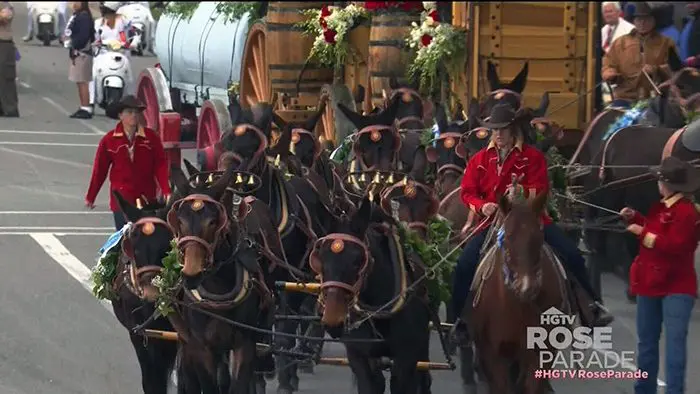 Historically, mules have been primarily responsible for helping to build this country into what it is today. They aided the cavalries in the acquisitions of land. They pulled covered wagons of settlers thousands of miles across the new frontier. They worked in the coal mines, along canals and in the Southern cotton fields, as well as other crops. Mules helped build some of our major recreational facilities, such as the Rose Bowl, and have helped provide safe access to treacherous mountain recreational areas, such as the Grand Canyon, where the use of horses is questionable… and the list goes on!
Today, the mule still makes his tangible contribution to our social growth and development. He is an animal which has evolved with the times and there seems to be no end to his capabilities and contributions. New uses are continually being discovered for this highly versatile and adaptable animal, limited only by our own imaginations. It’s only fitting that we take the time to appreciate Longears on October 26th, an animal who has contributed so much to all of our lives. Thank you, mules…and donkeys, too! Life might not be as sweet, were it not for you!
To learn more about Meredith Hodges and her comprehensive all-breed equine training program, visit LuckyThreeRanch.com, MEREDITH HODGES PUBLIC FIGURE Facebook page, or call 1-800-816-7566. Check out her children’s website at JasperTheMule.com. Also, find Meredith on Pinterest, Instagram, MeWe, YouTube and Twitter.
Covered in TRAINING MULES & DONKEY: A LOGICAL APPROACH TO TRAINING, TRAINING WITHOUT RESISTANCE, EQUUS REVISITED and A GUIDE TO RAISING & SHOWING MULES at www.luckythreeranchstore.com.
© 1992, 2016, 2024 Lucky Three Ranch, Inc. All Rights Reserved.

Learn how to lead your equine through forward obstacles in order to instill confidence and turn your equine’s fear into curiosity.

By Meredith Hodges

“Stubborn as a mule” is hardly an appropriate cliché to describe today’s mules who are sweeping the countryside with their remarkable abilities! But why now? Why haven’t mules been used successfully as saddle animals before this? My only guess is that in the past, we did not afford ourselves much leisure time out of necessity. Therefore, mules used for packing and farming had to be broke quickly to help with the work. They were generally trained by older and more experienced animals by working in teams. People did not have the time to spend training one horse, much less one mule! If an animal refused to learn under the “team” plan, he was quickly discarded for an animal that would. Today we find that to train mules successfully for a variety of uses, we must spend a lot of quality time with them to get the desired response. Mules do not profit from hasty or forced training. With this new approach to training mules, they are rapidly becoming a preferred saddle animal.
 It does not seem strange to me that this phenomenon with mules is finally taking place. A mule usually inherits his strength and intelligence from the jack and his beauty and athletic ability from the mare. Of course, both the jack and the mare can contribute more and less, of each other’s major attributes varying the looks and abilities of the offspring. Still, the offspring of a given mare will exceed the abilities of that mare after adding the jack’s incredible strength and intelligence. It is no surprise, then, in the face of this evidence, that using an athletic, sport mare will produce a sport mule, and so on.
 In Europe, the Equestrian Arts are revered and preserved on a majority basis. In the United States, equestrians are a minority, taking a back seat to baseball, football, and other sports of the “common man.” Still, there is a marked growth of equestrian skills and equine performance that CAN carry us into the future with added equestrian interest. The spectators of Equestrian Sports must be considered. It is the spectator who pays to support us and it is the nature of the spectator to want to be entertained. In order to preserve their interest, we must keep them abreast of new developments in our industry, new events, new people, and new animals that now include mules! Since mules are now successfully competing with and against horses, it only stands to reason that they can be an asset to the industry as new talent. A complete list of uses and accomplishments of the mule is still not possible since the mule has not been tested completely, but that which has been tested is positive, including testing as an embryo transplant recipient. The mule has many redeeming qualities that make him attractive to Equestrians: he is durable, intelligent, extremely surefooted and less expensive to maintain than are horses. An added bonus is the affectionate, mischievous nature of the mule when treated kindly and fairly.
 Sometimes we humans fall into the belief that one breed is better than another (with mules at the bottom, of course?!!!) when we should actually be looking at the whole picture a lot more realistically! It really isn’t that one breed is better than another. Rather, there are individuals within every breed who will excel. Whether that individual is a Warm Blood or a mule, shouldn’t he have the support of the entire equine industry and not just the support of his own breed?! If we had not integrated baseball, or football, for example, do you think it would have grown into the industry that it is today?! Probably not! Together we stand, divided we fall. Bickering over such trivialities in or own industry creates dissention and separation of resources. Better to use all the resources we have available to us in a positive and favorable manner for the support and preservation of our entire equine industry. Let’s get our priorities straight and do it for the survival of our industry, do it to improve your own skills, and do it to improve your equine’s skills! Try to keep your personal feelings in check for the sake of the whole and appreciate the art and skill of all our equestrians in the learning process. We can all learn from each other. “Mules can make a viable contribution to equestrian events… if we only give them a chance!!!!”
To learn more about Meredith Hodges and her comprehensive all-breed equine training program, visit LuckyThreeRanch.com, MEREDITH HODGES PUBLIC FIGURE Facebook page, or call 1-800-816-7566. Check out her children’s website at JasperTheMule.com. Also, find Meredith on Pinterest, Instagram, MeWe, YouTube and Twitter.
Covered in TRAINING MULES & DONKEY: A LOGICAL APPROACH TO TRAINING, TRAINING WITHOUT RESISTANCE and EQUUS REVISITED at www.luckythreeranchstore.com.
© 1989, 2016, 2024 Lucky Three Ranch, Inc. All Rights Reserved.

Wrangler is such a goof ball! Because Wrangler would lock up in front of the Tack Barn and not want to walk over the grate, I got smart and learned to take Chasity to the Tack Barn first. Then, he didn’t even notice the grate and walked right in! However, he gets pretty rambunctious about waiting his turn. I could lead them both at once, but he needs to learn to be by himself with me sometimes…and BEHAVE! When I first got Wrangler, he would get excited like this and then just try run over me when I opened the stall door. Through repetition and humane discipline, I changed his behavior with Behavior Modification, a systematic reward system of training. To be successful, one needs to target the behaviors that need to change, set up the equine for success and promptly reward the positive behaviors as they occur. AND, you need a specific, consistent and humane way to stop bad behaviors in their tracks when they occur. We work on the premise of POSITIVE REINFORCEMENT, but we also need to learn how to use NEGATIVE REINFORCEMENT if one does not want to be hurt, or even killed, by these VERY LARGE and STRONG animals!


The negative reinforcement that I use really works. When he got aggressive the first time, I raised my hand like a stop sign and when he did not stop, he got a firm slap to the side of his mouth as I said, “NO!” as loud as I could. I promptly raised my hand like a stop sign in front of his face again after which he started to turn back around. I quickly took a handful of oats from my fanny pack, took a step forward and offered him the oats. He did a double-take and came back for the oats to which I replied, “Thank you for giving me my space!” Going forward, he still occasionally gets too aggressive, but he always stops when I put my hand up like a stop sign in front of his face and takes a step back. He won’t need to be slapped again since this was done correctly the first time. He remembers!


As soon as I open the stall door now, Wrangler immediately stops his antics and becomes a gentleman that can be rewarded. He stands stock still while I put on the halter and then drops his head at my shoulder. I hold his lead rope in my left hand while pointing in the direction of travel with my right hand. I tell him to “Walk on” and look down to see what foot he is leading with and follow his front legs, step for step. We get IN SYNC with each other and I lead him that way from the time he leaves his pen to the time he returns. I do this the very same way with ALL of my equines ALL of the time. Consistency breeds familiarity and compliance.


Donkeys have issues with chronic runny eyes and noses. The way to stave off any infection is to clean their eyes, nostrils and ears with a damp towel daily. This also encourages them to accept handling around their face in general.


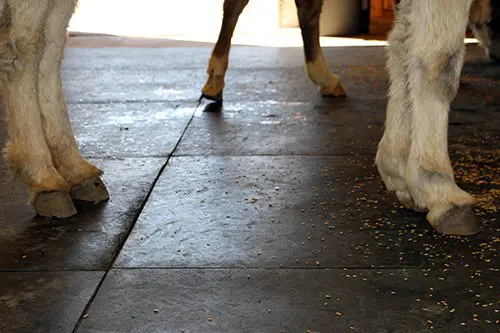
Donkeys are inherently desert animals and can severely founder or colic on lush feed. Symptoms of too rich feed will be manifested in the hooves as abscesses, crusty growth, collapsed heels and frogs, or just plain stress rings. Wrangler has abnormally small rear hooves and it is important that his core strength is developed in good postural balance to make sure the weight distribution is even so none of his hooves are carrying too much weight for his size.

Wrangler is rather flat-withered and needs a saddle that will “hug” his body, leaving ample room for his spine.


I initially tighten the girth snug, but not too tight. The crupper is adjusted so the tail lies comfortably.


I gently press on the bars of his jaw to open his mouth for the bit and carefully bring the crown of the bridle over his ears, protecting them with my hand. Being polite and considerate will get much more cooperation from your equine.


I adjust all the straps on the bridle so it is comfortable, paying special attention around the ears. The drop noseband helps him learn to hold the bit properly. I always gradually tighten the girth over several times.


The walk to the Round Pen is still IN SYNC…all three of us! Wrangler’s “Elbow Pull” postural restraint is adjusted and he is reminded how to release the tension.


Wrangler’s posture has greatly improved over three years and has given him added strength, endurance, stamina and animation to his gaits. He defies the slow and pokey characterization of donkeys in general! He’s a true athlete!


Wrangler and Chasity do a very nice reverse in sync with each other. Wrangler resumes the working walk.


Five rotations at walk, five rotations at trot, reverse and repeat in the other direction. We do 3 sets with a 3-minute break in between. Rewards are in order with every halt. With every halt, Wrangler is asked to rebalance and square up!


Then I begin riding with three rotations at trot in each direction. I carry a riding crop in case he needs a little encouragement to keep going. If he gets too tired, we call it quits and will do more another day.


I always end the sessions with a halt and rein back. Then I dismount and reward him again for a job well done!


Back in the Tack Barn at the work station, I carefully remove the bridle. I always hold the halter crown strap in my right hand while removing the bridle. I then slip the bridle onto my left arm, pick up the nose band of the halter in my left hand, bring it over his nose and buckle the halter. This way, if he pulls away, I still have my arms (and halter) around his neck to hold on to him.


We make our way back to the barn and Wrangler waits patiently while Chasity enters the stall first (Ladies first, you know!). He follows her sedately into the stall and they both turn around to me to have their halters removed and to receive their rewards. Wrangler “suggests” to me politely that I should hurry with Chasity’s halter and get to the rewards…QUICKLY! He’s still hungry!!! Silly boy!!!



By Meredith Hodges
Donkeys are indigenous to desert areas that are often extremely hot or extremely cold. They are tough, surefooted due to the unique shape of their hooves, resistant to parasites, and disease and can withstand wide variations in climate. They require very little to survive and actually prefer the wide variety of brush and weeds that occur naturally in the desert with one of their favorite foods being dandelions.
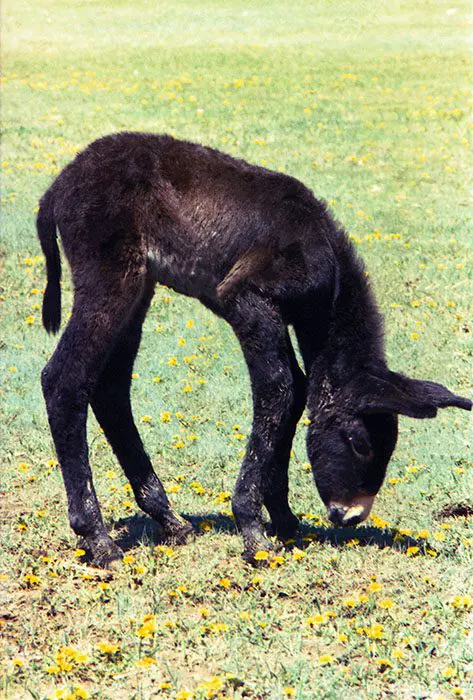
Donkeys possess an incredible hair coat that does not shed off completely like horses do in the summer months. In their first year, a young donkey will keep his thick hair coat throughout the summer and won’t lose most of the hair until August.

In August, he will not have the thick hair coat, but will retain some longer, wispy hair unlike the horse. This thick hair is meant to insulate the foal against extreme heat and cold until he is able to develop enough body fat to help regulate the temperature throughout his body. It will stay thick inside the ears and will protect the donkey foal from parasites, bugs and severe trauma.

In one short month, the young donkeys will begin to grow back their thicker, winter under-coat in September in preparation for the cold.

As the donkey ages into the prime of his life, he has a covering of body fat to help keep his temperature insulated and the thicker hair is no longer as long and shaggy. Of course, there are some breeds of donkeys that will grow more thick hair than others, but the shaggy hair as an adult is generally reserved for the French Poitou Donkeys.

As the donkey gets to be over 25 years of age, he will begin to grow thicker hair year round to compensate for his loss of body fat due to old age.

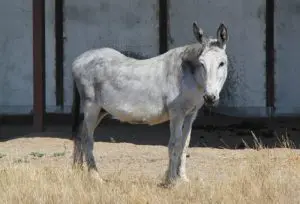

When we show our donkeys, we body clip them, but if this is done, it is imperative to blanket them if it gets too cold and provide a light sheet during the cool summer nights.
Understand that they now no longer have the PROTECTION of their unique hair coat. When traveling, donkeys will sit back in the trailer and can rub themselves raw during the ride, especially if they have been clipped. When unclipped, the hair coat will keep this kind of damage to a minimum.

If your donkey does get these kinds of sores, they can usually be healed fairly quickly with a daily application of Neosporin ointment (Photo below was taken one week later). Note that when you clip, there is also the consideration of sunburn.

If you clip your donkey for show and need to haul any distance at all, you should protect his precious rear end by using a blanket or sheet secured over the hind quarters. The best course of action is not to body clip your donkey at all if you do not show. Remember, he’s a desert animal and Mother Nature has already provided him the protection that he needs against the elements.


To learn more about Meredith Hodges and her comprehensive all-breed equine training program, visit LuckyThreeRanch.com, MEREDITH HODGES PUBLIC FIGURE Facebook page, or call 1-800-816-7566. Check out her children’s website at JasperTheMule.com. Also, find Meredith on Pinterest, Instagram, MeWe, YouTube and Twitter.
© 2017, 2018, 2021 Lucky Three Ranch, Inc. All Rights Reserved.

Whether or not your equine is calm enough to really stand still depends on all the lessons he has had and how they were executed.
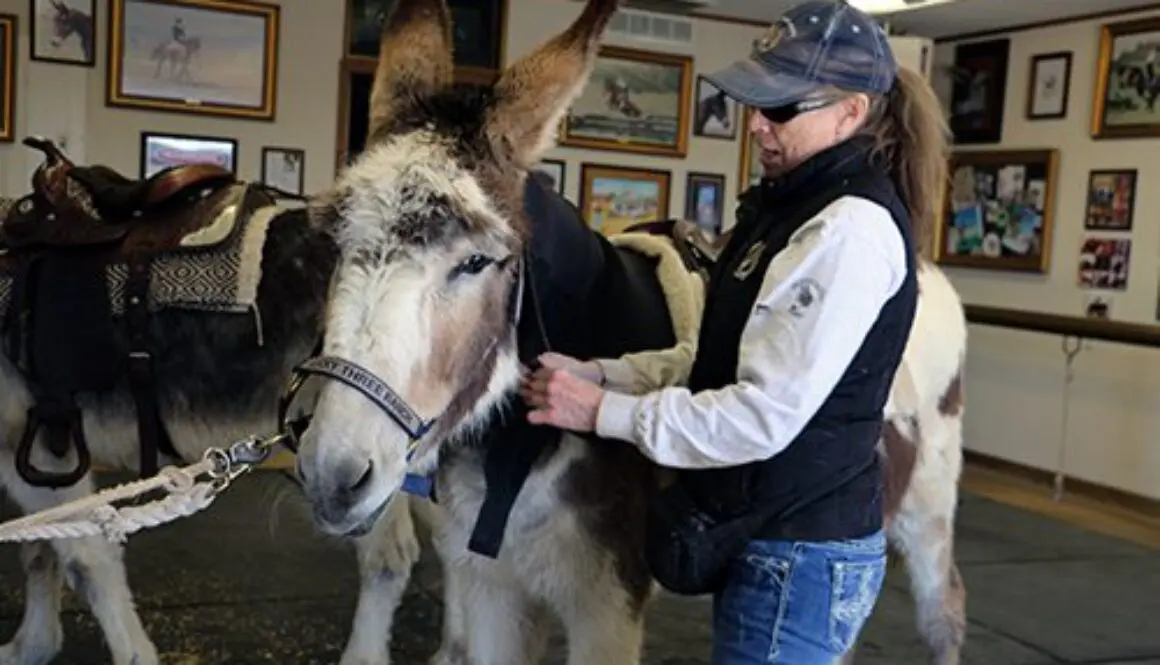
Due to the colder and more inclement weather here in Colorado, Chasity has been off her exercise program for about three months. It was time to get back to work! No matter how long it has been between lessons, when you have a specific routine, the equines seem to comply easily because they know what to expect, beginning with going to their regular work station to be groomed and tacked up. In order to keep upper respiratory disease at bay, eye infections and ear problems to a minimum, it is advisable to clean these areas with a damp towel regularly. Be polite and wipe the towel in the direction that the hair lays and clean the nostrils with a circular motion. This repetition will prevent them from getting head shy.

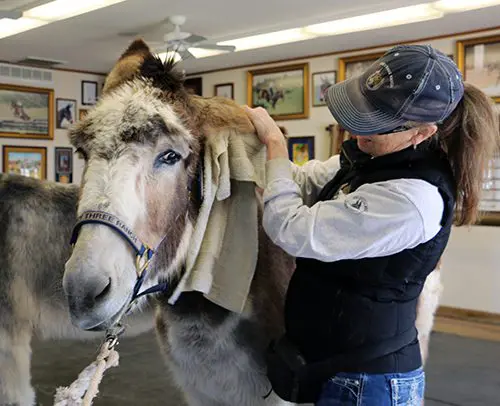
Chasity still thinks the vacuum cleaner is questionable, but she tolerates it now. Not only does it pull the dirt from the skin for healthy hair growth, it also promotes circulation better than massage and does a better job at softening her “fat roll.” I used massage in the beginning when Chasity first came here with her enlarged crest (photo below on the right).


It had become somewhat enlarged again about three weeks ago, but after two sessions with the vacuum cleaner, it has decreased substantially already.


Another valuable therapeutic grooming tool is this simple human, multi-bristled hairbrush. It is not only VERY helpful during shedding, but also works to further stimulate the hair coat and promote better circulation, as well as efficiently removing dirt from the skin. I have found it to be more helpful for healthy hair than any equine grooming tools. The long, thick hair coats of winter and spring stay soft and healthy when I use this hair brush over the entire body. I only clip bridle paths when the weather gets warmer and I leave body clipping for showing. The only other grooming tools I use are a shedding blade to remove mud and a dandy brush to finish the coat. They can have balding spots from rubbing during the shedding season and may even get sores, but I just treat those with Neosporin and they recede quickly. A healthy hair coat will insulate your equine from the heat and cold and protect them from insects better than any artificial products or practices.


Equines do like feeling clean all over and really do appreciate your efforts at keeping them this way…although, they don’t necessarily show it when the first thing they do after a good grooming is to go for a good roll in the dirt!!! Still, they do seem to realize that you care and will show their appreciation in a multitude of other ways…like being happy to leave their companions to go with YOU and stand quietly during grooming, tacking and hoof care!
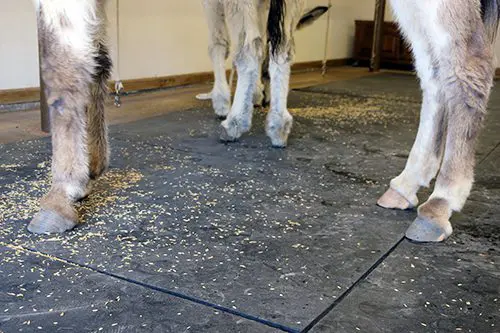
Feeding is a very important consideration for healthy hooves as are regular trims when needed, usually every 8-10 weeks. For donkeys, it can even be longer between trims when they wear their hooves in good balance. Chasity had hoof issues when she first arrived, but is now sporting healthy balanced feet! Remember that Longears will be more upright and have more heel than horses and ponies…and donkeys will typically be more upright and have more heel than mules.

Fitting saddles can be tricky. Make sure the saddle makes even contact behind the withers and over the back with relief from pressure over the spine. Many saddles sit too high and cause centralized and uneven pressure across the back. Pressure points are easily identified after a workout. The back will be sweaty, but the pressure points will be dry.


Place the saddle in the center of the back, behind the shoulder blade, the girth falling 4” behind the forearm where the skin is thicker and body begins to swell. I have successfully used cruppers with the buckles set away from the tail to hold it in place. The crupper is adjusted with just enough tension so the tail will still be able to rest comfortably.

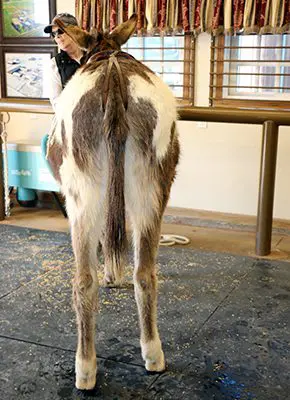
I am using the neck sweat on Chasity for lunging to promote a decrease in the crest. When bridling, I press my thumb on the bars of her mouth to get it open and protect her ears with my hands as I pull the crown piece to the poll. This promotes trust and keeps any equine from getting ear shy.


On an English saddle there is a small d-ring that I use to tie up the reins.


Then it is off to the Round Pen. I always stay in sync with their front legs when we walk and execute the gates EXACTLY the same way EVERY TIME! All movements are predictable, never abrupt. They comply due to trust.


I adjust Chasity’s postural restraint, the “Elbow Pull,” and then remind her to give to the tension to get the release with a reward of oats for flexing at the poll. Wrangler, “Mr. Curiosity” watches intently…they do learn from each other!


Chasity’s overall posture has changed dramatically as has her movement. She uses her body much more efficiently.


Chasity has strong hind quarter engagement with an uphill balance to promote enthusiasm, endurance and stamina.


A reward is always in order for a job well done. Her forward stretch has improved greatly in one short year.


The lateral stretches are also much improved. After five rotations of walk, then trot, then reverse and repeat the other direction, 3 sets with a 3 minute break in between, then stop. Done once a week is adequate to maintain conditioning.


I hold the halter crown strap in my hand and protect her ears as I remove Chasity’s bridle. Then I slip the bridle onto my left arm, bring the noseband over her nose with my left hand and fasten the halter to the strap in my right hand. This ensures that I can keep hold of her should she try to pull away. Last, I fasten the tie strap from the hitch rail.


I always unfasten the girth on the left, then tie up the girth on the right, slide the saddle back, loosen the crupper from the tail and take off the saddle on the right side. This gets the equine used to being handled from BOTH sides. I always rinse the bits and wipe any dirt from the bridles and saddles before putting them away…saves work in the long run!


I remove Chasity’s neck sweat to see how much sweat is underneath…encouraging! We are definitely making progress!


To end, we do a few more stretches in each direction. These are improving immensely, too!


Then it’s walking IN SYNC back to the barn for turnout in the larger dry lot. They enter the stall, ladies first, and then they both turn around to allow me to remove their halters and to enjoy their last reward. I keep all my donkeys off grass most of the time. I find that they stay healthier and do not run the risk of getting obese that way. They do have large dry lots for turnout on pea gravel every day and a couple of acres of dirt pen for really stretching their legs every other day. They do get some grass when we go for walks, but do not seem to miss it most of the time. They are too busy playing and resting with each other…and looking forward to our next lesson TOGETHER!


By Meredith Hodges
Longears thrive with a routine management and training program. Their performance and longevity is greatly increased. Sir Lancelot is now a 27-year-old ranch mule that has had the benefit of my management and training protocol. Done over two years when he was much younger, the result of his postural core strength leading exercises, lunging, ground driving and later riding in my postural “Elbow Pull” self-correcting restraint is apparent in his youthful enthusiastic attutude and body structure. Since, I did not show Lance, I had no need to make the transition from the Eggbutt snaffle bit to the curb bit. He was extremely responsive in the snaffle bit all these years. Today, we are going to make the transition to the curb bit and document it as an addition to our training series.

Lance executes the gate perfectly! He stands quietly while I put on the “Elbow Pull with the curb bit that conveniently has a crosspiece connecting the two ends of the shanks where I can run it through (instead of running it through the snaffl rings as I did in the snaffle bridle). Commonly, the equine will raise his head during his first introducion to the curb bit. Lunging in the “Elbow Pull” will remind him of his good posture with the addition of the new bit.
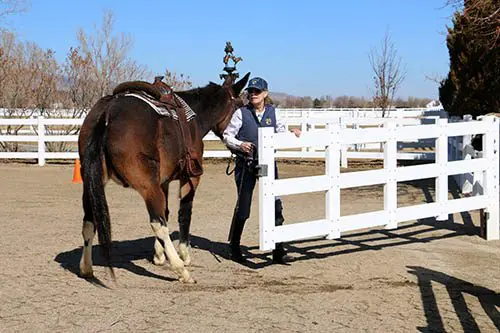

Lance starts to raise his head, but almost immediately resumes his good posture. The “Elbow Pull” goes loose and he moves out nicely at the trot.
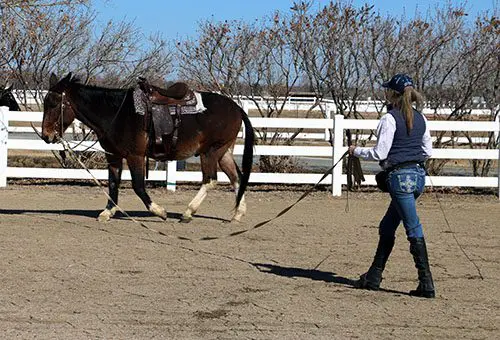

The canter poses no problem at all. Lance stands quietly after being called to halt while I change lungeline to the new side of his face.


Lance remains on the arc of the circle with a squeeze from closing my fist as his outside front leg comes into suspension, maintaining his balance and bending correctly through his rib cage as he first learned in the Round Pen.


Lance steps well underneath his body and maintains the critical upward balance intiated by hind quarter engagement.
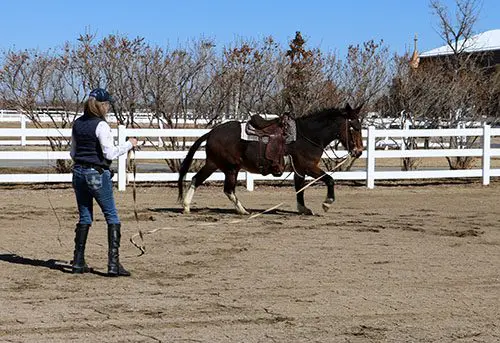

Lance waits patiently as I roll up the lunge line, remove the “Elbow Pull” and then follows me obediently to the gate.
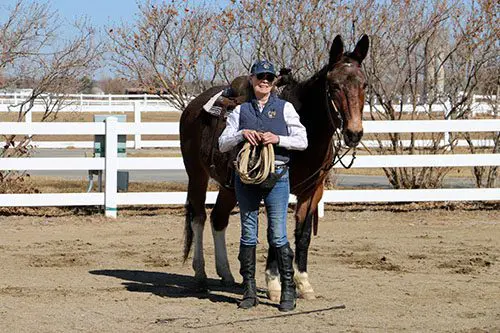

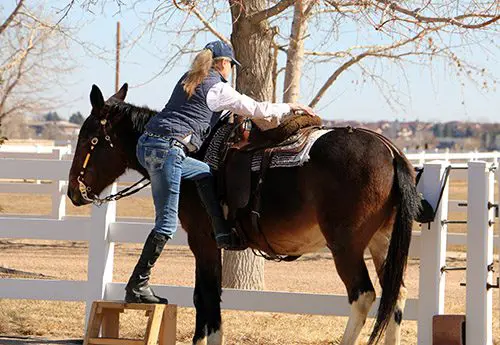
The mounting block was new, but he didn’t mind! He knows how to stand still. He followed my seat easily around the first turn, bending appropriately through his rib cage while staying erect in his posture around the cone.
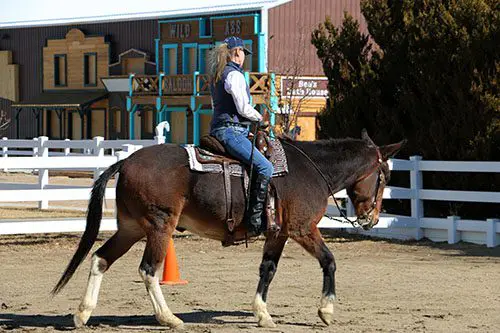
I kept my hands in front of the saddle horn. On the straight lines I alternated leg pressure from side to side. Through the turns, I lightly squeezed/released the direct rein while continuously nudging the opposite side with leg pressure from my leg. Otherwise, I kept my hands quiet. Lance remained in good equine posture.
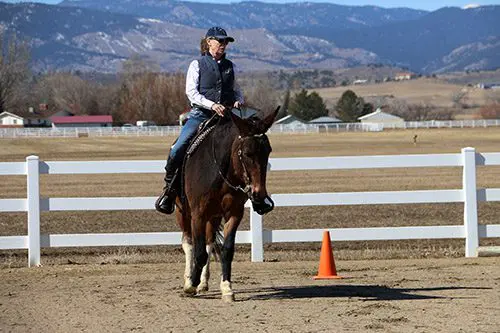

I verbally counted to Lance as he negotiated the Hourglass Pattern. On straight lines, I matched my alternate leg pressure with the verbal command, “One-Two, One-Two…” and on the turns, I matched the one-sided leg pressure with, “Two-two, Two-Two…” He halted with his hind quarters still engaged.


Lance kept his mouth quiet and responded well to my leg pressure with hardly any movement necessary on the reins. We finished with a bow (He really likes to bow!)! He then stoood quietly and waited for my next cue.


Lance was so proud of himself! When you take the time to break things down into very small steps so your intent is clear and concise to your equine, it is easy to successfully make the transition from one thing to the next during training, even when going from the snaffle bit to the curb while maintaining the same light and responsive contact with your equine’s mouth. Although it may take more time, the journey and the end result is much more relaxed and enjoyable. One learns to appreciate the “little” victories along the way. In turn, our equines appreciate US because they know in no uncertain terms that we have their best interest at heart and are the ones that keep them healthy and comfortable. This makes for a deep and abiding, everlasting partnership!

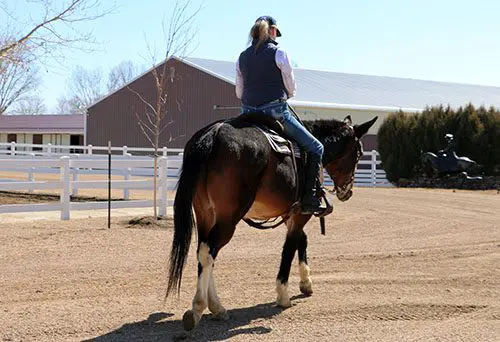

Leading with purpose will keep your equine’s responses attentive, prompt and smooth.


Meredith demonstrates how to teach your equine to execute a turn-on-the-forehand on the lead line.

The turn on the haunches can be a complicated move for your equine. Learn how to approach the move in this Training Tip.

If you are going to attend a show, it is advisable to get a copy of the rulebook that is designated by the show committee, so you know what to expect for each class you enter.

One of the most difficult things your equine will ever learn is to stand perfectly still while the show judge inspects him.


One of the most difficult things your equine will ever learn is to stand perfectly still while the show judge inspects him.
