

MULE CROSSING: LTR Training Principles and Philosophy
By Meredith Hodges
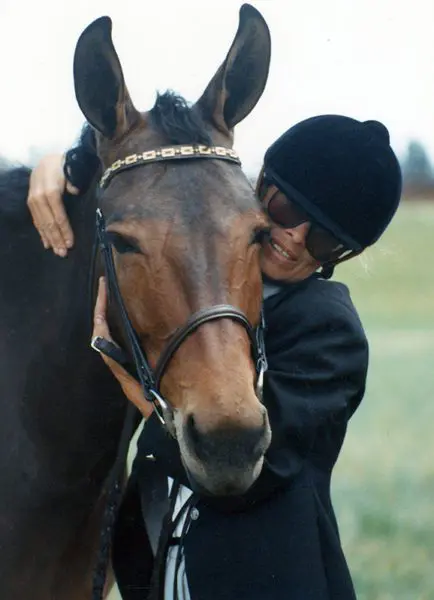 No training series would be complete without examination of the principles and philosophy behind the training techniques. The philosophy of my training techniques is based on the principle that we are not, in fact, training our equines. In fact, we are cultivating relationships with them by assigning meaning to our own body language that they can understand.
Since our own level of understanding changes and grows over time, we must assume that so does that of our animals, and we must gauge our explanations accordingly. In the beginning, the emotional needs of the young equine are quite different from that of an older animal. They need to overcome a lot of instincts that would protect them in the wild, but are inappropriate in a domestic situation. In this case, our focus must be on developing friendship and confidence in the young animal, while establishing our own dominance in a non-threatening manner.
We do this through a lot of positive reinforcement in the beginning, with gentle touch, reassuring voice, and lots of rewards for good behavior. Our expressions of disapproval are kept at a minimum. As he grows with us, the equine will realize that we do not wish to harm him, and will next develop a rather pushy attitude in an attempt to assert his own dominance – once that he is confident that his behavior is acceptable. When this occurs, we must re-evaluate our reward system and save excessive praise for the new things as he learns them and allow the learned behavior to be treated as the norm, praised more passively, yet appreciated. This is the cultivation of a delicate concept of give and take in a relationship from the emotional standpoint. As in any good relationship, we must learn to be polite, considerate and respectful of our mules, donkeys, horses, ponies and hybrids. After all, as my grandmother used to say, “You can catch more flies with sugar that you can with vinegar!”
From the physical standpoint, there are also a lot of things to consider of both mule and trainer. In the beginning, unless you are a professional trainer with years of proper schooling, you are not likely to be the most balanced and coordinated of riders, lacking absolute control over your own body language. By the same token, the untrained equine will be lacking in the muscle coordination and strength to respond correctly to your cues that guide him to perform certain movements. For these reasons, we must modify our approach to fit each new situation and modify again to perfect it, keeping in mind that our main goal is to establish a good relationship with our equine and not just to train him! It is up to the trainer to decide the cause of any resistance, and to modify techniques to temper that resistance – be it mental or physical.
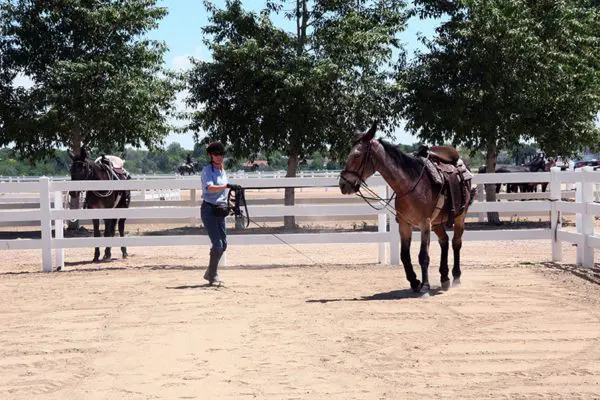 For instance, we had a 3-year-old mule learning to lunge without the benefit of the round pen. The problem was that she refused to go around you more than a couple of times without running off. Assess the situation first by brainstorming all the probable reasons she might keep doing such an annoying thing. Is she frightened? Is she bored? Is she mischievous? Has she been calm and accepting of most things until now? And most important, is my own body language causing this to occur?
Animals are all quite different, as are humans, and each individual will learn in his own way, as do humans. Once in a while, you meet an animal that is not able to learn things in a conventional manner. He perceives things just differently enough to make it extremely difficult. In the case of the mule that would not lunge independently on the line, we found that she needed additional learning aids. You can either put a round pen around the animal to “force” him to comply, or you can wait until he is broke to saddle before you try to lunge him again with just the line. If you only have an arena, you can lunge the equine in the corner and the two fenced sides will help him to stay on the circle. This certainly helped her!
I have worked with many mules that wouldn’t lunge first, but would ground-drive and accept a saddle and rider with no problem. After this they seem to lunge quite easily! Learn to be fair and flexible in your approach to problems as you would for anyone you were interested in getting to know. Be firm in your own convictions, but be sensitive to things that can change and be willing to make those changes as the occasion arises!
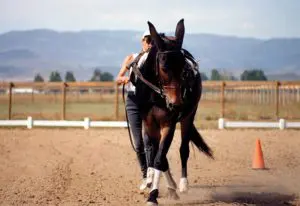 As mental changes occur, so do physical changes. As muscles develop and coordination gets better, the animal will gain confidence. As a trainer, you will need to do less and less to cause certain movements. For example, in the case of the leg yield, you may have to turn your mule’s head a little in the opposite direction to get him to step sideways and forward. As he becomes stronger, more coordinated, and understands your request, you can then begin to straighten his body more with less effort. Granted, we have begun by doing this the wrong way, yet we have put our mule “on the road” to the right way. We have assimilated an action in response to our leg that can now be perfected over time. In essence, you have simply said, “First you learn to move away from my leg, then you can learn to do it gracefully!”
The same concept works in the case of the trainer, or rider. Sometimes you must do things that are not quite right in the beginning to get your own body to assimilate correctness. As I have said, we all perceive things a little differently and it depends on how we are introduced to something whether or not we can understand or perform it. It is nearly impossible for the inexperienced horseman to perceive and control unused seat bones as a viable means of control of the equine. In the beginning, reins and legs are much easier to use to complete such a task.
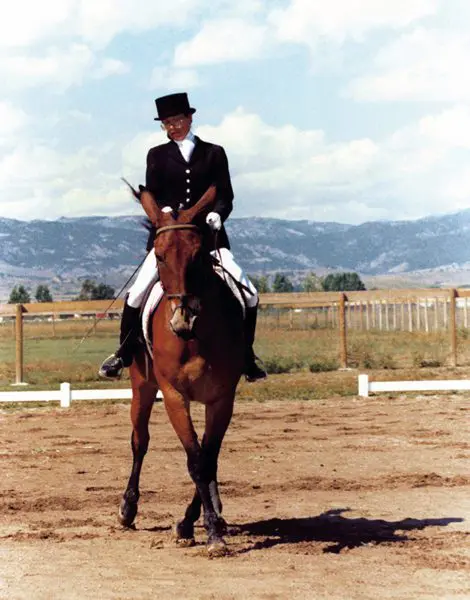 In training horses and mules, there is really little difference in one’s techniques or approach, provided we maintain patience and understanding and a good rewards system. The major difference between these two equines is their ability to tolerate negative reinforcement, or punishment. The mule, being part donkey, does not tolerate punitive action very well unless he is fully aware that the fault was his own and the punishment is fair. For instance, you ask for a canter lead and your mule keeps trotting, one good smack with the whip, or one good gig with the spurs, is negative reinforcement that will bring about the desired response, but be careful of an over-reaction from an overdone cue. More than one good smack or gig could cause either a runaway or an extremely balky animal. This kind of resistance comes from the donkey and requires a much different approach when training donkeys. The horse part of the mule allows us an easier time of overcoming this type of resistance in mules, making them different and easier to train than donkeys.
It is the innate desire of all humans to control their own lives both emotional and environmental. When we cannot, we become panicked and confused about our situation. We doubt ourselves, our abilities, and our self-worth. If we do not maintain a sense of humor about those things that we cannot control and learn to accept that which we cannot change, we are doomed to a life of depression and failure. Horses can be controlled and even some mules can be controlled for the most part, but it is my experience that donkeys are only controlled when they so desire.
Donkeys are affectionate, amicable characters, and possess such a sensitive nature that one would think punishment a real deterrent from bad behavior – but when you punish a donkey, you will be met with a tough hide and unbelievable avoidance behaviors which often cause more resistance than it’s worth! As if this isn’t enough, if you do punish your donkey for something, the next time he even comes close to the same action, he may anticipate your punishment and go straight to the avoidance behavior before he actually makes the mistake. For this reason, it is better to try to ignore the mistakes, focus on the successes and reward the equine with lots of praise. If something in your training isn’t really necessary to your final objectives and you encounter this resistance, such as I did during lunging training, then just drop it and go on to something else that they can do easily. There is plenty of time to learn it at a later date.
To learn more about Meredith Hodges and her comprehensive all-breed equine training program, visit LuckyThreeRanch.com, MEREDITH HODGES PUBLIC FIGURE Facebook page, or call 1-800-816-7566. Check out her children’s website at JasperTheMule.com. Also, find Meredith on Pinterest, Instagram, MeWe, YouTube and Twitter.
Covered in TRAINING MULES & DONKEY: A LOGICAL APPROACH TO TRAINING, TRAINING WITHOUT RESISTANCE and EQUUS REVISITED at www.luckythreeranchstore.com.
© 1989, 2016, 2024 Lucky Three Ranch, Inc. All Rights Reserved.

 Imprinting is defined as “rapid learning that occurs during a brief receptive period, typically soon after birth or hatching, and establishes a long-lasting behavioral response to a person or object as attachment to a parent or offspring.” 1 When we speak of “imprinting” in the scientific sense, it is a reference to the way the brain accepts input. The brain compartmentalizes impressions and images, and the animal reacts to the stimulus that the image produces. A collection of “imprints and images” produces memories. Imprinting training with a foal of any breed will give him a jump-start on his life with human beings.
 When imprinting your foal, think about the kind of adult you want him to be. A foal is very similar to a human baby regarding emotional needs—both need attention, love, guidance and praise to become loving, cooperative adults. Start your relationship with a positive attitude and approach your foal with love, patience, kindness and respect. Be sure to set reasonable boundaries for his behavior through the way you touch him and speak to him, the facial expressions you use, and even how you smell when you are around him so he can learn to trust and respect you and be happy at the sight of you.
 The most important sensation to which you can expose your equine is touch. If your touch is gentle and considerate, it will feel good to him and he will be interested in your attention. When you run your fingers over his body, being careful not to press too hard on sensitive areas, he will experience pleasure and begin to look forward to your visits. Learning how your equine likes to be touched will also help things go more smoothly when you begin grooming him and tacking him up and during his training lessons, when he must learn to take his cues from your hands, legs and other aids. Even how you mount and sit down in the saddle—for instance, how your seat is placed on his back—denotes your consideration of him through touch. The wrong kind of touch, no matter how slight, can be a trigger for adverse behaviors. However, the right kind of touch—done correctly—produces pleasure in your equine and instills a willingness to perform in a positive way each time you interact with him.
 To begin imprinting training, run your hands all over your equine’s body and down his legs, and put your hands in his mouth and in his ears. His reactions will help you learn how he likes to be touched. Getting your equine used to touch in this way eventually evolves into exposing him to grooming and working with tack and equipment. You are continuing to build on the initial imprinting work, but now, when you are grooming, the grooming tools will become extensions of your hands, and when you introduce various tack and equipment like clippers, they will also become an extension of your hands. Allow your equine to use his sense of touch (usually with his nose) when introducing any new object. Work toward getting your equine’s response to your touch as highly sensitive as possible, so that he can use his own body language to communicate with you. NOTE: Many owners pat their equine on the top of the head with the flat of their hand as a sign of affection, without realizing that, as a rule, most equines don’t take kindly to people patting their foreheads or faces. A pat on the forehead works if you want to distract your equine, but save it for that purpose only. It is much better to show affection by stroking your equine (always in the direction in which his hair lies), in a soothing and reassuring manner.
 The tone of your voice is another important element of imprinting. If your general tone is soothing and encouraging, he is more likely to comply. Then, when he needs to be disciplined, the change in your tone of voice will convey your disapproval before you even have to touch him to make a correction—giving him the opportunity to straighten up before you actually need to apply the physical backup of negative reinforcement. If, no matter what the situation, you always speak in low tones, he will not be able to differentiate between what’s acceptable and what is not, but if you modulate your voice to clearly express what you want to convey, your equine will be much better able to understand and react appropriately.
 The next sense to which you should appeal is your equine’s sense of taste (a no-brainer). When you dispense the oats reward for all of his new positive behaviors, he associates that wonderful taste with you and will follow you to the ends of the earth to get more oats.
 Work on evolving your own body language as a natural and truly wonderful way to “talk” with your equine. You can also use verbal language, but body language should be your primary form of communication.
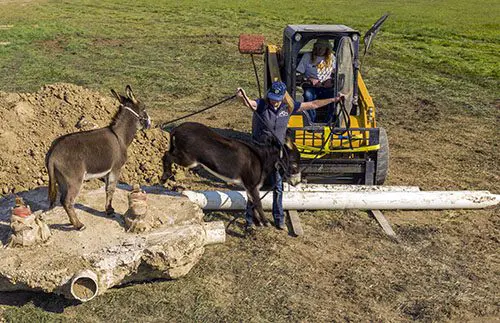
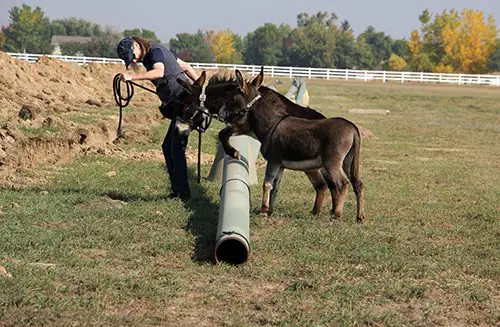
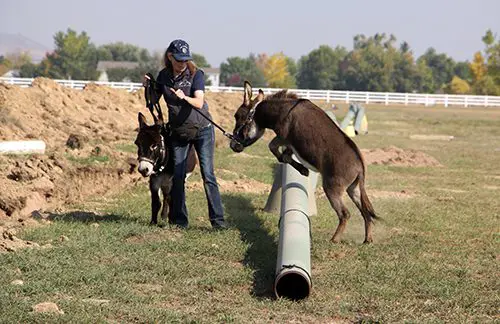
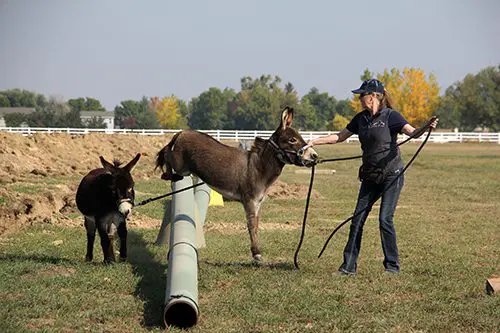
 Work with ground rails and cavalletti helps to build muscle, particularly in the hind quarters. This will help him to carry your weight more easily through lateral movements, stops and lengthening of the gaits. Proper preparation minimizes resistance and frustration. This will be apparent in how your animal carries his tail. Is it hanging in a relaxed fashion, or is he switching his tail periodically, or regularly? You might notice that after the initial introduction of lateral moves, your equine’s forward motion has become a little “shaky” again. It is now time to clarify the connection between forward motion and lateral motion with his increased understanding of your seat and legs (Not so much the reins as your connection to the bit needs to remain quiet!). By employing a few simple exercises, this can be a very simple process.
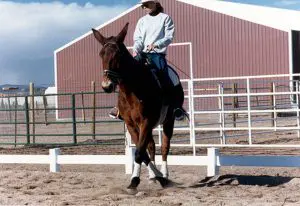
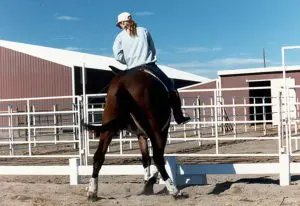 regular rhythm and cadence, proper flexion and bending through his rib cage. In rhythm, change your aids to a slight counter-bend and ask for a turn-on-the-forehand at the fence rail. Send his haunches around with pressure from your leg, well back on his barrel, until he is 180-degrees reversed. At the precise moment he is in the new position to go forward, in the opposite direction, release the pressure on your reins! Then send him forward again from your legs onto the new circle.
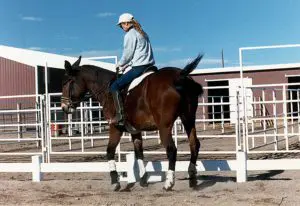 Complete the turn with a series of half-halts from your seat and a squeeze-release action with the reins. If you do this, your final release will come as a natural sequence to the turn and it will be executed in the rhythm and harmony of your equine’s movement. You can do this exercise at the walk, trot and canter, but be sure to slow down to a walk from the faster gaits in their natural sequence…canter, trot, walk and turn…trot, walk and turn. Do not be abrupt and skip the interim gaits.
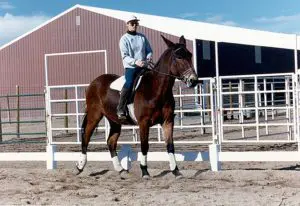 Be careful not to inhibit his forward motion. It is better that he does small circles to complete the turn at first than to fall back over his haunches and pivot on one hind foot. As in the turn-on-the-forehand, nudge his barrel on the opposite side, pushing his haunches into the turn with the squeeze-release action. Longears will tend to lean into a continuous pressure from your legs! Keep practicing this exercise, maintaining his body between your aids.
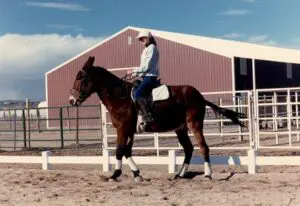 Once your equine gets his footwork figured out through these complicated movements, and has the opportunity to develop his body properly, you can begin to as for more speed and finesse on the turns, but this comes MUCH later! To attempt any more right now will most likely destroy his forward motion, cadence and rhythm. This will cause frustration and fatigue.
 soon? Wouldn’t you rather have a long-lasting and pleasant relationship with a companion that is happy with his work?


























 By Meredith Hodges
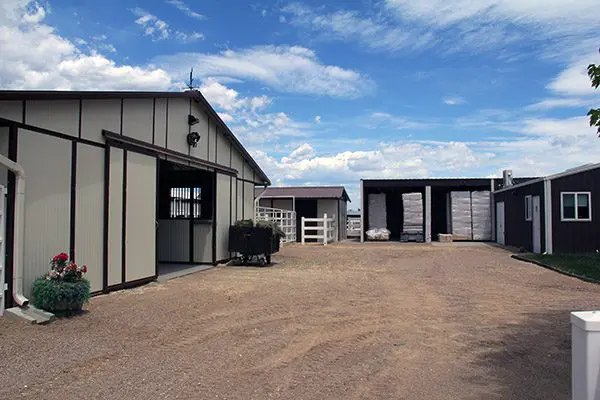 Once you have accumulated a few names, call and make appointments to visit the various trainers. The interview with the trainer is as important to you as it is to him. You will have an opportunity to discuss finance, goals and general care. An appointment will also give you the chance to see his facility and allow you to draw your own conclusions before you make a commitment. There are many good horse trainers available today, but they are not necessarily qualified to train mules. The mule trainer must be a person of extraordinary patience and be well versed in technique… and just as a precaution, you might ask if he’s ever trained a donkey. The mule trainer must know how to appeal to the donkey half of the mule as well as the horse half of the mule to be successful.
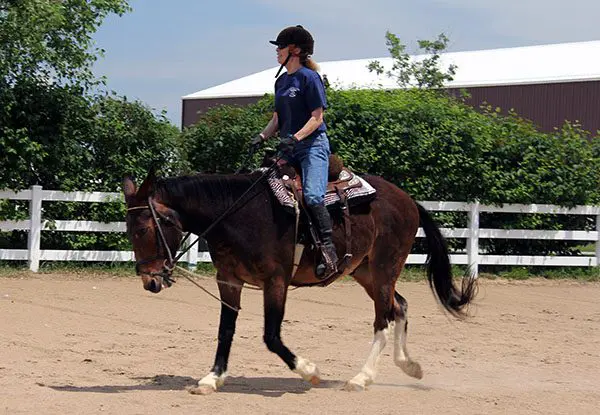 As a consideration to yourself and your mule, do not be afraid to ask the trainer if he will ride for you. You might want to mention the fact that you wish to see him ride at the time you make your appointment. The trainer can then be sure to allot the time necessary to ride for you. As he rides, watch the way he handles the animals. Are his hands light, yet firm? Does he ask for collection and cause the animal to travel smoothly and fluidly? Do his animals move away from leg pressure? Do the animals bend through their circles? Vertical flexion, impulsion, and lateral bend are all the elements of proper shape and any truly good trainer will know and practice these techniques. Beware of the person who claims to be a trainer, but only “rides” your animal. He could conceivably do immeasurable damage.


