

Uncategorized

LTR Training Tip #75: Hourglass Pattern Under Saddle at the Walk & Trot
The Hourglass Pattern helps your equine to build good postural balance and core strength with symmetrical muscle development.

LTR Training Tip #74: Always use Good Horsemanship
Whenever you ride, always practice the elements of good Horsemanship.
Imagine a wild horse in the courtroom

The following is from the American Wild Horse Campaign:
Suzanne here — I wanted to give you an update about the important work of AWHC’s legal team right now and the looming legal battles ahead to protect wild horses and burros.
From a legal perspective, the situation surrounding wild horses and burros is very unique. These equines are legally protected as living symbols of the historic and pioneer spirit of the West and as an integral part of public lands they inhabit. The Bureau of Land Management (BLM) is the agency tasked with managing most of these beloved animals, but sadly as you and I both know, Meredith, wild horses and burros are threatened by the outdated and unscientific management practices the agency implements.
For years, our legal team has worked to build a strong firewall of protection around wild horses and burros, but we’re not done yet. We have a few key upcoming legal battles that will decide the fate of thousands of wild horses and burros.
We are:
- Continuing our litigation against the implementation of the BLM’s disastrous Adoption Incentive Program (AIP) that’s sending hundreds — if not thousands — of wild horses into the slaughter pipeline;
- Taking legal action to hold the agency accountable when it fails to release critical records we request under the Freedom of Information Act (FOIA);
- Tracking the BLM’s rulemaking process to “clarify its authorities” under the Wild Free Roaming Horses and Burros Act and pursuing a rulemaking petition to strengthen the agency’s Comprehensive Animal Welfare Program Guidelines and make them enforceable.
As we take on these fights in the courts, we are gearing up for the final legal showdown in our decade-long battle to stop the BLM from removing two million acres of federally protected habitat and eradicating the beloved wild horses who live in the Checkerboard region of Wyoming. The final decision has been made by the BLM and its release is imminent, but with your help, we will be ready to go to court to defend Wyoming’s iconic Checkerboard herds.
These legal battles could not be more important — the fate of thousands of wild horses and burros are on the line. So today, I’m here to ask if you’ll make a donation to help build up our Legal Fund as we fight to protect wild horses and burros across the West. Will you make a donation today to support this important work, Meredith?
| DONATE |
Thank you for helping us to be a voice in the courtroom for these innocent animals.
Suzanne Roy
Executive Director
American Wild Horse Campaign

LTR Training Tip #73: Follow the Leader
Following a seasoned animal through the hourglass pattern for their first time in the open arena will give your equine more confidence and decrease the incidence of resistance.

LTR Training Tip #72: Riding in the Round Pen without an Assistant
After a brief session with an assistant at his head, your equine will have more confidence and will be more willing to go forward without the assistant.

LTR Training Tip# 71: Dealing with Bucking
Horses and mules will require a different kind of correction when bucking in order to get the best results from each of them. Meredith explains the difference and what to do.

LTR Training Tip #70: Teaching Your Mule to Stand Still When Mounting
Having your equine stand still during mounting is the result of a calm and sensible approach to ALL phases of the preliminary groundwork. Going forward with a logical and sequential approach will help the equine to stay calm and prevent any resistance.


LTR Training Tip #69: Begin Riding with An Assistant
Once your equine is quiet and comfortable with mounting, you’re ready to ride with an assistant at his head for safety. Just be a passenger at this stage. Stay relaxed while maintaining light pressure through your reins and legs, and let your assistant do the leading. This approach will prevent unwanted accidents.


LTR Training Tip #68: Mounting Exercises
Trouble usually begins when you get in a hurry. Be sure to take your time and progress at the speed of your equine. As you do these mounting exercises, be sure your equine is comfortable and calm before moving on, and don’t forget the oat rewards!
CHASITY’S CHALLENGES: Circles and Stretching: 5-19-20
5-19-20
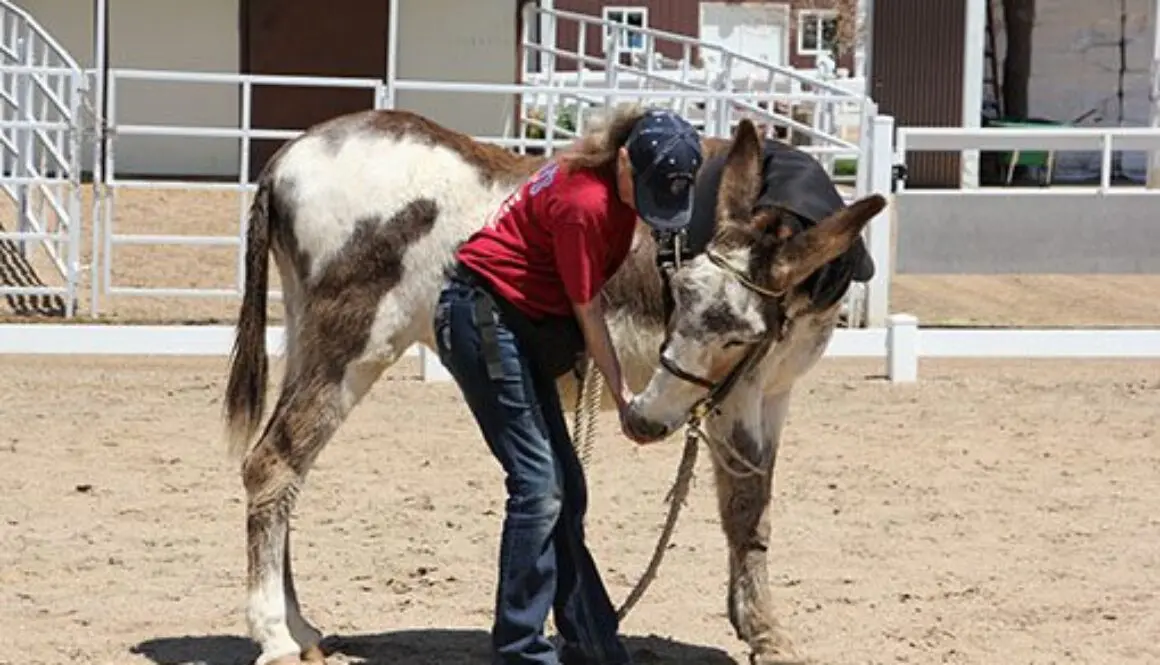
Chasity is continuing to gain core strength, balance and even has a little “prance” in her step these days. The bacterial infection is almost gone and she is eagerly waiting at the stall door for her lessons each week. She gets structured leading exercises in her proper postural “gear” and in between, she has other things happening on other days like daily “soaking” of her infection, vet appointments and the farrier. Today, we will add circles at every cone to increase the intensity of her workout. Stretching is done more frequently now.


Chasity carefully walks in sync with me, no more pulling on the lead rope or charging ahead like she did in the beginning. She is happy on her way to the outdoor dressage exercise arena. Varying the location of her postural core strength leading training keeps her fresh and engaged.


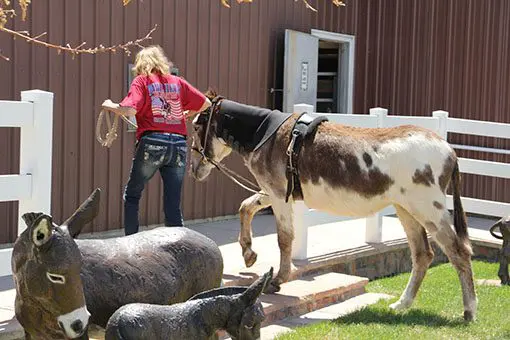
On the way to the dressage arena, we stop to visit with Augie and Spuds, our delightful little mini donkeys. Chasity is intrigued. Where she is stabled, she can only hear them. Then it’s on to the dressage arena.


Since the arena is also used as a turnout area, it is a bit bumpy and the sand is deeper than the other places where Chasity has worked. It will increase the intensity of her work. Still, she is bending nicely through her rib cage while remaining erect in her body and doing her four-square stretches very well indeed!


Chasity is bending her joints well while walking in sync with me, however, I am noticing she is a bit stiff in her left hind leg, especially around the turns to the left. We added circles at every cone in the Hourglass Pattern to help to enhance her bending technique.


She steps out nicely with her right front, but as she brings the left hip forward, her gait is stilted and limited in it’s range of motion. The abdominal muscles are only moderately engaged and she stops short of reaching underneath her body to her center of gravity.


The right hind leg moves forward into it’s correct position, but she is just lifting and swinging her left hind leg forward instead of bending adequately through her joints, particularly in her hip joint.


As she steps forward with the right hind foot, the left hind has an abnormal look to the extension of the leg. It appears stuck in the hip joint and pelvic area, and is not swinging freely. Still, she is bending fairly nicely through her spine.


Another good stretch while standing four-square was in order and Chasity let me know that it felt VERY GOOD!


On straight lines with no rails, Chasity is able to reach underneath her body to the center of gravity, but going around the turns reveals some stiffness in her pelvic area while the rest of her spine bends easily.

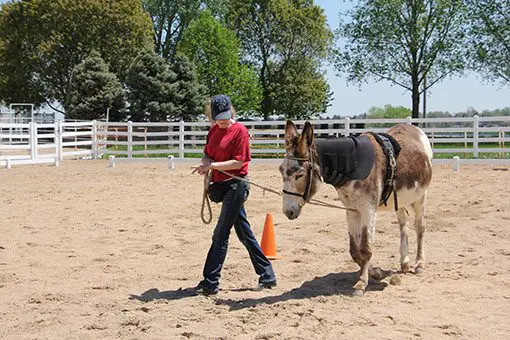
Chasity really enjoys her stretches and does them with no problem at all. Then we begin to track in the other direction and it is clear that bending to the right is particularly difficult for her.


As we proceed around the cones to the right, her bending gets a little better and the right leg moves easily under her center of gravity. But when she approaches the rails, her pelvis appears to stiffen and inhibit her movement again.


There is plenty of “reach” in her front legs, but the rear legs do not seem to be able to consistently follow her forward movement. Her abdominal muscles are engaged and she is attempting to round her back, but her stiff pelvic area is inhibiting the ability to reach well underneath her body.
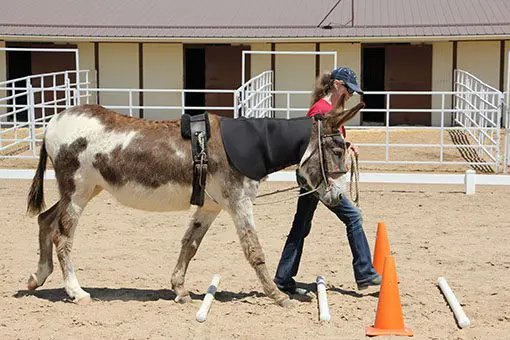

Traversing the rails is making it apparent that she should probably have a visit from our proficient equine chiropractor. Since she just arrived a short time ago, I did not think it would be prudent to expose her to chiropractic until I could loosen her stiff body a little bit and gain her trust first.


We finished traversing the rails and she had to “lean” on the “Elbow Pull” to keep her balance. She did pretty well circling to the right for the last time, but it was now clear that she would need to be adjusted with chiropractic before any further lessons could take place and be beneficial to her.


We ended the lesson with one more four-square downward stretch, then a stretch to the right…


…then she did a stretch to the left and left the arena in perfect synchonization with each other. Still, she didn’t have the “reach” behind that I thought that she should.
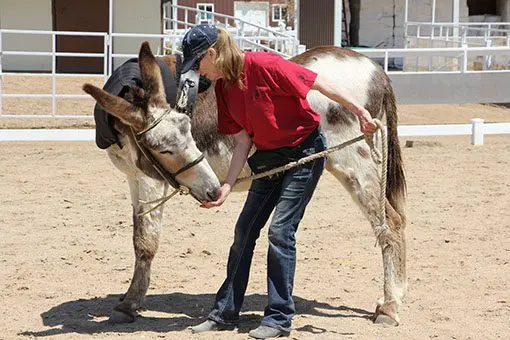

Just to make things a bit more interesting, we opted to investigate the lane to the small park to look at this new area. Chasity thought the steps looked particularly strange, but she was not fearful.


She navigated the steps like a champ and stood quietly while we took in the sights. She saw Robin Laws’ “Donkey Talk” to her left and J. Payne Lara’s “Love Me Tender to her right.This was a major accomplishment for Chasity since standing still was NOT something she wanted to do when she first arrived.


Then we went back up the steps, left the area and went to see the pack mules, “A Friend to Lean On” by Robin Laws. Chasity played “cute” for the camera. Then we went to see Bonnie Shields’ “Friends,” a bronze statue of Kylie, Moxie and Jasper from our children’s series. As you can see, her posture is greatly improved…the “Elbow Pull” is staying LOOSE most of the time now!

[one_third_last]


LTR Training Tip #67: Healthy Hooves for Healthy Riding
Soundness begins with the hooves. There is a wide variety of reasons, so learning to assess if and when your equine needs shoes, and how often hoof care is needed is critical to your equine’s overall physical postural balance and general health!

LTR Training Tip #66: Checking Your Under-Saddle Tack And Equipment
At the Lucky Three Ranch, it’s always safety first! You’re going to need the proper equipment, such as a regulation riding helmet and appropriate, fitted riding boots. Once properly prepared, it’s time for a safe and enjoyable ride.

LTR Training Tip #64: When Ground Driving Lateral Obstacles Aren’t Working
Ground driving helps your equine to understand the rein cues coming from the drive lines. When working through lateral obstacles, your equine may be unsure or fearful. Be sure to work patiently on your verbal commands and take obstacles slowly, while being willing to gently help him through. And don’t forget the reward for good behavior.

LTR Training Tip #63: Ground Driving Lateral Obstacles
This is your equine’s turn to take a leadership role in your partnership as you execute lateral obstacles on the drive lines. Navigating obstacles in this manner will instill mutual confidence and trust.

LTR Training Tip #62: Ground Driving Straight Forward Obstacles
Ground driving your equine through the straight forward obstacles is a process of turning fear into curiosity, then finesse, coordination, competence and, finally, confidence.


LTR Training Tip #61: Laterally Ground Driving the Hourglass
Lateral ground driving should be done slowly and taken in a natural sequence. Learn how to progress from lateral driving along the rail to laterally ground driving in the Hourglass Pattern.