By Meredith Hodges
Welcome to the wonderful world of mules! The mule is a product of the successful breeding of a male donkey, called a  jack, and a female horse, called a mare. Mules can either be male or female, but they are unable to reproduce because of an odd number of chromosomes in their genetic makeup. When training mules, one needs to take into account the donkey half of the mule as well as the horse half. Horses can often be trained without the benefit of a personal relationship, but mules are different. The donkey is inherently a warm, affectionate and loving creature that thrives on close relationships with their humans. When this closeness is absent, the donkey or mule can seem stubborn and uncooperative. Thus, there is the old saying, “Stubborn as a mule!”
It is important when dealing with donkeys and mules to begin by establishing a bond with your animal. Think of it as cultivating a friendship. When you and your animal are introduced, give him time to get to know you and his surroundings by keeping things simple. Close friendships are best developed when positive assets are recognized and any negativity is kept to a minimum. Cultivate good feelings with positive action.
Mules and donkeys respond best when you take the time to be considerate and understanding of their needs. Before they can launch into a training program, they need to feel comfortable about their surroundings and their trainer. Feeding time is a good time to spend with your mule. This is the beginning of a long-lasting friendship with your mule. You can stroke him all over his body, talk to him, brush him and clean his feet while he is eating provided he is in an enclosure by himself, or just with his dam.
Raising mules and donkeys is much the same as raising children. They need love, guidance and understanding, coupled with a learning program that has a natural step-by-step progression and a reward system that they can easily follow. Doing too much too soon will only lead to confusion and resistance. Be patient and willing to take the time to enjoy the day-today victories that you both will achieve to make life more fun and enjoyable.
Competition is fun and exciting but can easily become a devastating experience for both of you if the focus is winning against others. Rather, the focus should be to compete against yourself. If you are doing better than the time before, then you are doing well. You don’t need a blue ribbon to mark your improvement. When you go to a show with this attitude, you gain more open communication and friendships with others who have the same interests as you do. You are able to learn from those who are more experienced; judges and officials can help you to improve. This makes the whole showing experience more enjoyable and mutually beneficial to all.
One mule-loving family wrote to me about a show they had just attended. The mother wrote that her three boys expressed devout confidence when asked how they felt about their readiness to show. They went into the show expecting to win everything they entered. They had practiced at home until there were no flaws in their performance. The show day arrived. The eldest boy was entered in a pleasure driving class and had no reason to believe that his mule would be anything but the steady mule he was. To the boy’s horror, the mule went to the rail, put his head over the rail and froze. Needless to say, they didn’t place and the boy’s pride was crushed.
The second son was in the trail class with his mule. They, too, had practiced until their performance was flawless. Strangely enough, the gate in the trail class just didn’t appear to his mule to be like the gate at home, and the mule would go nowhere near it! He, too, was humbled and left the class with nothing.
The youngest by took his mule into his class and the mule was the same steady animal he had been at home. They finished as High-Point Champion of the show for their division.
What do you suppose was the difference in these three cases? I told the mother that I believed that a mule first needs to bond to his handler. She told me that made perfect sense. The other two boys rode and drove their mules, and practiced all the patterns and movements they would find in the show. The youngest boy spent a good part of his time just hanging out with his mule, taking him for walks, feeding carrots, doing very simple and pleasurable things with his mule, as well as practicing the exercises they needed for their classes. They were buddies, they were a team – and they won the Championship because this is how to build a friendship and what good sportsmanship is all about.
A good trainer will train himself, or herself, as well as the mule with subtle direction coming from the mule. Develop respect for your mule, responsibility in caring for your mule and self-discipline in the way you handle the mule. You will develop patience and consistency in training, neatness in you and your mule’s appearance, and pride in yourself and your mule.
Although this sounds easy enough, it really isn’t. Human nature is to be protective of ourselves and selfish about what we want and what we do. Learning to be of service to others, including our animals, requires a lot of thought and consideration. How easy it is to criticize others and blame them for the things that go awry. It’s easy to be that “Monday Morning Quarterback” and point out what’s wrong which is often followed by blame. Blame is no fun for the scapegoat and often causes severely hurt feelings. As if WE could do any better? Could you? Wouldn’t it be better if we recognized people’s assets and complimented them instead of honing in on their mistakes and criticizing them for what they do? If one ceased to criticize, wouldn’t we learn more and become more intelligent about our own choices?
When our focus becomes solely on what our Longears can do for us and when we spend hours “drilling” them to make things perfect, is that really a way to get the best from them? How about keeping the lessons short and rewarding every success along the way…AND, know when to quit and begin another day. My Grandmother used to say, “You can catch more flies with honey than you can with vinegar.” I used to think in my head, “I don’t really want to catch flies and I don’t even like honey,” but I got her point and she was right. When I got frustrated that my mules were not doing exactly what I wanted them to do, I began to ask myself, “Why not?” I thought I knew everything, until I realized how much I had yet to learn. That is when I stopped trying to force things and became grateful for everything good that happened, every day! People told me that my Longears and my other equines needed a job to be worthy of my respect and support. I thought about it for awhile. Then I realized…my equines never told me they needed a job!
At that time, I began to think about what it might be like for my mules. Yes, God gave us “dominion” over the animals, but that doesn’t make me a King (or a Queen) over them! As I opened my mind to new meaning about it all, I realized it meant that I was their “keeper.” Now, was I going to be a responsible “keeper” and do right by them? Was I going to be the same way toward others? When I opened my heart and my mind to my animals and others…that was when I really discovered how little I knew and how much I had yet to learn. I realized at that time that this would be an endless endeavor, but a lot of time to share and enjoy life!
As I began to share the experiences in my career with others instead of trying to sell everything, I was made aware of how so many others shared with me and how much smarter and compassionate I was becoming. The way I treated my Longears evolved and the responses I got from them were amazing o say the very least. Then I had an epiphany about what it really was…I was no longer USING my mules and donkeys, I appreciated what they gave to me…and the gifts they gave just kept coming. They were now true companions, partners, friends and our experiences together were quite literally becoming joyful!
The American Donkey and Mule Society was founded in 1967 at which time mules and donkeys began to make their debut in America as recreational animals instead of merely working and farm animals. Their presence in exhibitions, parades and new Longears shows made quite an impression on the general public. They added a new dimension to equine shows that people found both entertaining and exciting. It didn’t take long before children began asking their parents if they could have a mule as a 4-H Club project. Well, this set 4-H leaders back on their heels! The horse manual really did not address the differences between mules and horses (and there were distinct differences!), so in a lot of cases, the request from the kids was denied. In response to this denial from 4-H Club Leaders, I wrote my book, A GUIDE TO RAISING & SHOWING MULES…for kids and beginners. No longer could the 4-H Leaders use this excuse and mules began cropping up in equine performance throughout the country!
I knew that my approach to training was going to really annoy a lot of Old Timers that were of the persuasion that mules were stubborn, hard to handle, one had to get their attention with a two-by-four, were dangerous and other really negative ideas. I knew that my attempt to offer a better and humane way to train them would be met with skepticism and contempt. I was right. I had embarked on a journey that would define my entire career, but with my own stubbornness and conviction, I have been able to show folks a better approach.
The kids discovered an amazing and safer riding companion than they ever could have imagined! Instead of taking on people’s mules to train, I opted to teach them how to train their own equines and it has worked miracles. Lots of the Old Timers that had poo-pooed me in the past, changed their minds about a lot of the beliefs that they had. As they aged, these same Old Timers were grateful for the much safer approach to training than they had been previously offered. They found a lot of places to exhibit their extraordinary abilities with their Longears in shows, parades and on the trail with their friends. We were all able to share in their successes and smiles would abound.
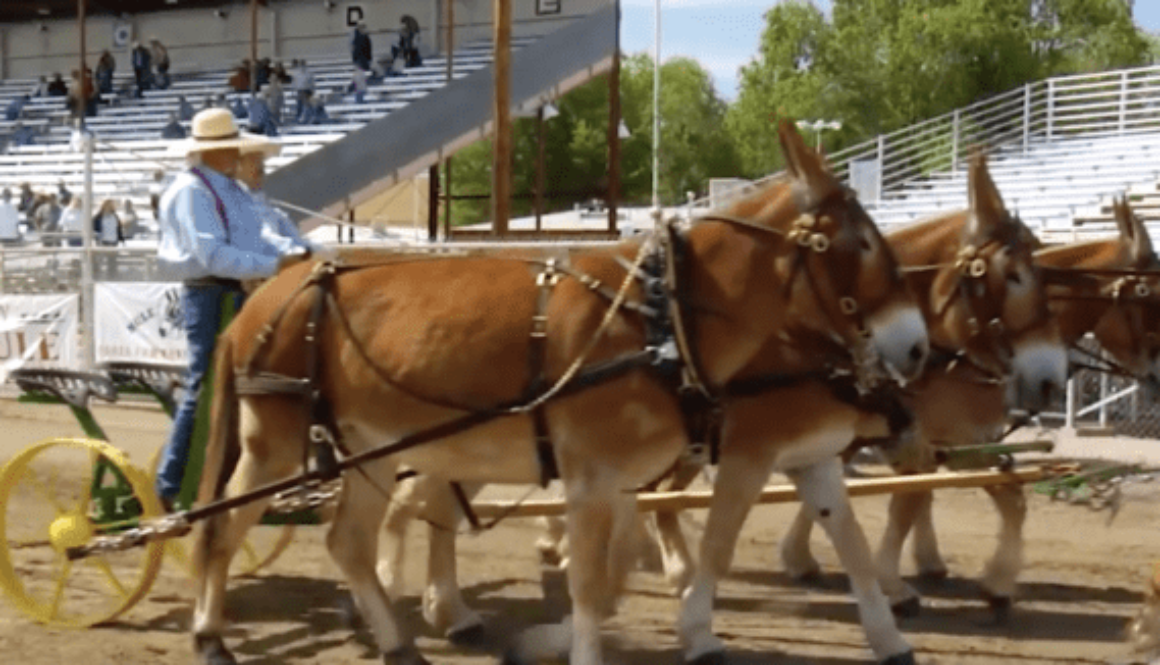
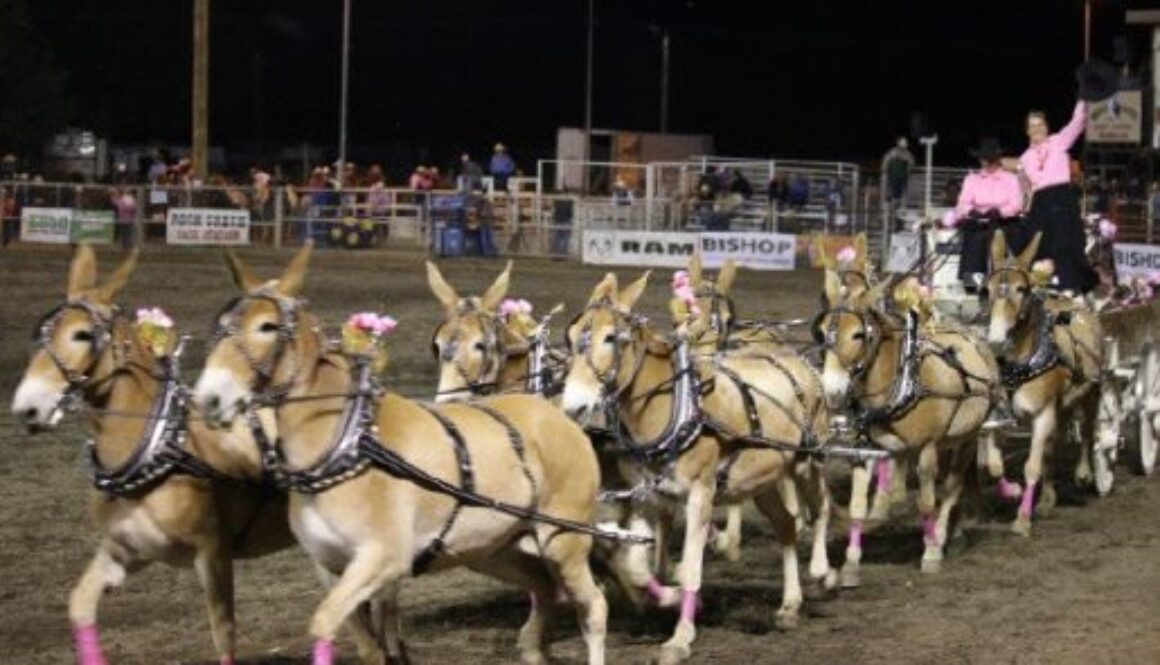
Longears have made their way into our society as yet another viable addition for the entertainment of the general population. More people than ever are taking on this challenge and making their mark as Mule Trainers. There is probably nothing as exciting as watching the drivers and their multiple hitches in shows and parades, the least of which is not the 20-Mule Team that is now being exhibited all over America. What a thrill to behold! People are now truly enjoying the affection and companionship these amazing equines have to offer! A light has been shown on the mules of the past! Those that thought mules could not be controlled, are now enjoying the companionship of their own leading celebrities of the equine community! So reject criticism, reject negativity and become a member of this new world of Longears and experience the joy that they have to offer! It’s quite simply…awesome!
To learn more about Meredith Hodges and her comprehensive all-breed equine training program, visit LuckyThreeRanch.com, MEREDITH HODGES PUBLIC FIGURE Facebook page, or call 1-800-816-7566. Check out her children’s website at JasperTheMule.com. Also, find Meredith on Pinterest, Instagram, MeWe, YouTube and Twitter.
Covered in A GUIDE TO RAISING & SHOWING MULES, TRAINING MULES & DONKEY: A LOGICAL APPROACH TO TRAINING, TRAINING WITHOUT RESISTANCE and EQUUS REVISITED at www.luckythreeranchstore.com.
© 2024 Lucky Three Ranch, Inc. All Rights Reserved.



 Cindy and I talked about the “Good Old Days” when we used to live on a ranch, had horses and could be gone all day riding with our friends! Today, our lives are so easy and require no experience to have the knowledge that you can now hold in your hand! The value of EXPERIENCE is diminished until you get hurt! There were so many things that we learned by having the full responsibility of cleaning pens, feeding, grooming, tacking up our own horses and then riding in so many different situations. One really LEARNED how to make decisions and analyze the knowledge that we gleaned. We soon learned the approaches and things that we could do SAFELY, and that kept our experiences happy and joyful! We KNEW it would cost a minimum of $5000.00/year to maintain and train our equines! Our relationships with our equines were good and they were able to teach us WELL!
 If the last resort is putting them in an auction…BEWARE! You might get stopped with your truck and trailer in the parking lot and a dealer that offers to take them off your hands right there! If you are tight for cash and looking for a convenient fix to your problem, you might think this is a great deal, but this is what KILLER BUYERS do!!!



 jack, and a female horse, called a mare. Mules can either be male or female, but they are unable to reproduce because of an odd number of chromosomes in their genetic makeup. When training mules, one needs to take into account the donkey half of the mule as well as the horse half. Horses can often be trained without the benefit of a personal relationship, but mules are different. The donkey is inherently a warm, affectionate and loving creature that thrives on close relationships with their humans. When this closeness is absent, the donkey or mule can seem stubborn and uncooperative. Thus, there is the old saying, “Stubborn as a mule!”
 enclosure by himself, or just with his dam.
 Competition is fun and exciting but can easily become a devastating experience for both of you if the focus is winning against others. Rather, the focus should be to compete against yourself. If you are doing better than the time before, then you are doing well. You don’t need a blue ribbon to mark your improvement. When you go to a show with this attitude, you gain more open communication and friendships with others who have the same interests as you do. You are able to learn from those who are more experienced; judges and officials can help you to improve. This makes the whole showing experience more enjoyable and mutually beneficial to all.
 Strangely enough, the gate in the trail class just didn’t appear to his mule to be like the gate at home, and the mule would go nowhere near it! He, too, was humbled and left the class with nothing.
 develop patience and consistency in training, neatness in you and your mule’s appearance, and pride in yourself and your mule.
 more flies with honey than you can with vinegar.” I used to think in my head, “I don’t really want to catch flies and I don’t even like honey,” but I got her point and she was right. When I got frustrated that my mules were not doing exactly what I wanted them to do, I began to ask myself, “Why not?” I thought I knew everything, until I realized how much I had yet to learn. That is when I stopped trying to force things and became grateful for everything good that happened, every day! People told me that my Longears and my other equines needed a job to be worthy of my respect and support. I thought about it for awhile. Then I realized…my equines never told me they needed a job!
 the same way toward others? When I opened my heart and my mind to my animals and others…that was when I really discovered how little I knew and how much I had yet to learn. I realized at that time that this would be an endless endeavor, but a lot of time to share and enjoy life!
 what they gave to me…and the gifts they gave just kept coming. They were now true companions, partners, friends and our experiences together were quite literally becoming joyful!
 kids was denied. In response to this denial from 4-H Club Leaders, I wrote my book, A GUIDE TO RAISING & SHOWING MULES…for kids and beginners. No longer could the 4-H Leaders use this excuse and mules began cropping up in equine performance throughout the country!
 entire career, but with my own stubbornness and conviction, I have been able to show folks a better approach.
 Longears have made their way into our society as yet another viable addition for the entertainment of the general population. More people than ever are taking on this challenge and making their mark as Mule Trainers. There is probably nothing as exciting as watching the drivers and their multiple hitches in shows and parades, the least of which is
  not the 20-Mule Team that is now being exhibited all over America. What a thrill to behold! People are now truly enjoying the affection and companionship these amazing equines have to offer! A light has been shown on the mules of the past! Those that thought mules could not be controlled, are now enjoying the companionship of their own leading celebrities of the equine community! So reject criticism, reject negativity and become a member of this new world of Longears and experience the joy that they have to offer! It’s quite simply…awesome!
 “Mules separate crude trainers from artistic trainers.” The mule handled by a crude trainer will generally epitomize the traditional belief that mules are stubborn and ornery. The mule handled by an artistic trainer will not.
 Horse training trends have evolved from Buck Branaman, Pat Parelli, Clinton Anderson, etc. and their Round Pen training techniques using ropes on the equines. Natural Horsemanship rose from these methods, using less restraint on the equine.
 This gave way to the new trend of teaching them to lie down. Equines do not lie down easily, so it wasn’t always used as an easy way to mount. It really shouldn’t be used that way because of the added stress put on the equine’s body that can cause arthritis and other problems with the hooves, and joints, as they age.
 I saw a horse being exhibited at the WEG that was forced to bow with ropes. I thought it could be beneficial to find out how long it would take for an equine to learn to bow of his accord with his own muscle strength. Lance learned to do it by himself with only slight encouragement from me in 18 months.
 If the argument is that amounting block can’t be brought along for trail riding, it makes more sense to simply acquire a shorter animal.
 If you find restraints are not sufficient to help with your equine, you may be dealing with an outlaw, in which case it is best to put him out of his misery before he injures someone. Be careful however about blaming the animal for his response to an inhumane trainer. Some can be rehabilitated, some cannot, but you will need to know what you are doing. Kindness alone is not the answer.
 Today good mule trainers apply the basic techniques of Behavior Modification (reward system training) in their programs. That is, getting the desired response through positive reinforcement and ignoring, as much as possible, the undesired behavior. Negative reinforcement, or punishment, is used sparingly, is never severe and is only used to set boundaries to behavior.



 By Meredith Hodges
 Once the heavier coat is eliminated, a weekly grooming will keep his coat nicely maintained. Daily grooming before a show, or every other day, is even better. Each time you groom him before riding, check and clip as needed the muzzle hairs, around the eyes and ears, and around the coronet bands. Leave the hairs inside the ears to prevent irritation from bugs and flies, but trim the outside edges and backs of the ears. An ounce of corn oil in his feed daily will assure a healthy sheen in his coat on show day without the use of artificial highlighters. Trimming, or shoeing, your mule on a regular six-eight week schedule will assure that his feet will not need attending at the last minute. A routine vaccination, deworming, Coggins testing and a permanent brand inspection will make sure he is ready for transport to any show anywhere at any time. Then, all that remains to be done right before the show is minor clipping, bathing, and polishing hooves.
 Then, tack up your animal, checking each piece of equipment to make sure that it is in working order. Go ahead and practice the class. Then, as you unpack your mule, set the tack aside from the rest in your tack room for cleaning later. Do this for each animal in each class. Your animals will do better at the show if they get plenty of rest before the show, so it is wise to spend the day before the show cleaning your tack, clothes, and equipment. Before you begin to clean, load all the items into your trailer that are all ready to go without cleaning. Then, as you clean the remaining items, load them directly into the trailer as you finish them.
 can be left until morning, or last minute, provided that you put them in a highly visible spot with a list of what is to be put in attached. Do not try to rely on your memory, as it will be clouded by the excitement and anticipation of the show.
 If classes are spaced fairly close together and you are using more than one animal, it is wise to tack up the other animals ahead of time so they are ready to go. If you are using only one saddle for more than one animal, the other animals can still be bridled with the halter slipped over it, so they can be tied and waiting. Be sure to tie up the reins so they will not be chewed or stepped on. If you are using the same mule throughout the show, tacking and stripping should not be too time-consuming if your equipment is well organized.
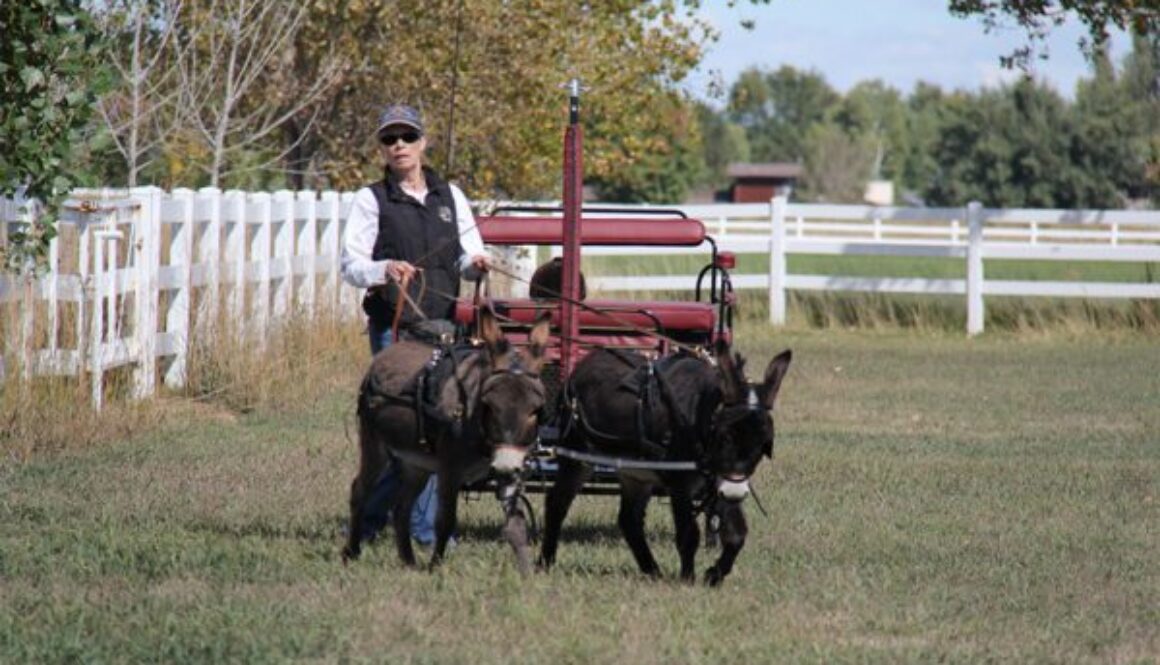
 Miniature mules and horses settle into their lunging lessons very well, but miniature donkeys (and donkeys in general) really don’t like to be lunged. They just don’t seem to see much purpose in it unless you make it fun for them. If you have a mini donkey, when teaching him to lunge it is helpful if you employ the aid of another type of equine of comparative size (such as a miniature horse or mule) to help “lead” your mini donkey through the lessons. Before I first began lunging my two mini donkeys, Augie and Spuds, I introduced them to Franklin the mini mule, Francis the mini molly mule and Mirage the mini horse by putting them altogether in the larger indoor arena space, and then I put them all in the round pen together. Before I began giving any of them specific instructions, they were all allowed some time to investigate each other and establish their pecking order. Before long all five were lunging cooperatively together, although Spuds did feel the need to kick at Mirage a few times so Mirage would allow him enough space to perform. (Mirage can be a bully sometimes and needed to be put in his place.)
 It is important that your tack and other “mini” equipment fit well. Check the harness to make sure the bridle fits and the bit is placed correctly, and be sure to adjust the blinders on your harness bridle so they don’t rub against your mini’s eyes. Fitting miniature donkeys for harness can sometimes be difficult, but I was fortunate to find Chimacum Tack, a tack and harness manufacturing company that does a fantastic job with miniature donkey, mule and horse harness. I suggest that you make the fitting a lesson in itself—you can even introduce your mini to the cart he will be pulling without actually hitching him up to it. Just as you have with all other obstacles, first let him inspect the tack. Then, once you have put it on him, have him stand quietly in the spot in front of the cart where he will eventually stand. Don’t forget to amply reward him and he should be more than willing to comply.
 At this stage of training, lessons over obstacles can now be done with more finesse. You can begin lateral work over small rails placed in front of a fence, backing through the walk-through “L” and doing lateral work in the tractor tire. In advanced tractor tire work, if you judge it to be safe, get down on your knees so you are on your mini’s level. Now ask your mini to put all four feet inside the tractor tire, and to then make a turn on the haunches. Direct his head in the direction you choose to go first and ask him to slowly turn while all of his feet are still inside the tire. Do this by poking him in the shoulder with your index finger (just as you did when repositioning him for the farrier) and asking him to move his front end over and around the inside of the tire. Do this in one direction and then in the other direction. Stay low, maintain eye contact and don’t be too forceful in your movements.
 By now you have taught your mini to follow on the lead while you both explore and have all kinds of adventures around your property, inspecting new things and having picnics everywhere imaginable. If your mini is to learn to be driven, he now needs to have the confidence to take the lead. When you begin this process, review (with your mini) leading together from the work station to the round pen. If you are training a team and dealing with two minis, tie their halters together at the side rings with about eighteen inches of 3/8-inch nylon rope with small snaps on each end between them, and use one lead rope snapped to the center of the tie rope between them. Begin by taking your position in the lead while carrying a dressage whip. Slowly work your way in beside them on the near (left) side, tap them each once gently on the hindquarters with the whip to let them know you expect them to continue forward and ahead of you (even though you are moving more slowly than they are on an angle to gradually work your way in behind them). Pretty soon, you should be directly behind them, encouraging them both forward if they do stop with a gentle tap of the dressage whip, but only one tap for each balky step.
 In subsequent lessons going forward, the next steps are to attach the drive lines and ground-drive your mini in the round pen. Ground-drive around the rail in each direction at the walk and do smaller circles from the rail and back to the rail around the larger circle. Execute an “S” turn through the middle to change directions and do the same going in the opposite direction. End each lesson with a square halt and a back. If he does not do any of these moves with ease, just be happy with what he offers and stop the lesson there. This will give your mini a lesson in communication through the bit. It is imperative that he learns this. You always have the next lesson to continue forward and you want to avoid any confrontation that will cause resistant behavior. It is easier to prevent the behavior from occurring than to have to correct it later. If you are ground-driving two minis, work each mini alone first and then follow this exact same procedure with your team.
 Moving to an open arena changes your mini’s perception of space and he will often feel like playing, so set up the cones of the hourglass pattern for him. Ground-driving through the hourglass pattern will help to maintain his attention and give him a point of focus for his lessons. Ground-drive your mini as you did in the round pen, but now he will be driven through the hourglass pattern with random halts. If you have any balking, just stop, reward for stopping, regroup and try again. Remember to go slowly and use frequent halts and backs in order to reward your mini. This helps him to stay attentive to your hands. Remember to do a full halt yourself—in good posture—before you step forward to reward him. If you pay attention to your own posture and the quality of your walk and halts, he will pay attention to his.
 There are classes at various shows (both open horse shows and miniature shows), where minis are not only driven in harness with a variety of carts and small carriages, but they also do trail courses and jumping on the lead line. Miniatures enjoy performing and have personality-plus, which audiences love! How well-trained your mini is will determine his willingness to do a multitude of fun activities, so make training fun and exciting for your mini. Enjoy the small victories along the way, use your creativity, reward lavishly and look forward to your adventures together.