Horses in all segments of the equine industry are regularly transported both intrastate and interstate for a variety of purposes, both by individuals and businesses. The ability to move horses easily for competition, breeding, sale, and recreation is of vital importance to the economic health of the industry.
In order to ensure the American Horse Council has a better understanding of how enforcement of federal motor carrier safety regulations are impacting the industry, we request all members of the horse industry take the following short survey. The survey is anonymous and the results will be used solely for informational purposes.
If you are an equine organization we ask that you please distribute this survey to your membership.
The survey will remain open until May 20th. If you have any questions, please contact the AHC.
Our sweet little one is still moving in the right direction. She has made substantial improvement in her whole 10 days of life. Her first lab results for a muscle enzyme showed her values were off the charts. Normal is 800, and upon intake she was at 120,000, the highest level the equipment could read. As of yesterday, her muscle enzyme levels and other blood levels were within normal range. She is still weak and unable to get up on her own, which is not uncommon, but once she’s helped to stand, her mobility is MUCH improved !! Thanks to her docs at Loomis Basin Equine Medical Center, her hospitalization is winding down, and she will be home soon, but she has a long rehab/recovery to come and she’s not out of the woods by far. To say her journey has been a rollercoaster ride is an understatement, but we thank you all so much for your support and assistance with this little gal.
Click here to learn more about selenium deficiency?
She still needs your help. Due to her baby steps in recovery, the cost of her care continues to climb, and we exceeded the initial guesstimate for costs of hospitalization by quite a bit. It’s hard for us to ask, but we committed to getting her this far, and we need some help to continue her hospitalization and treatment. Please share and spread the word of this sweet babies fight, and let’s get this gentle girl home!
You can also mail a check to:
All About Equine Animal Rescue, Inc.
2201 Francisco Drive #140-174
El Dorado Hills, CA 95762
Make a payment directly to:
Loomis Basin Equine Medical Center
(Please reference our AAE’s Account, ID# 23216 and Little Filly Fund)
The pain and heart break that is a part of rescue can sometimes be too much to bear, and you feel like your heart will never survive. Once again my heart was shattered into a million tiny pieces.
Matt and I had been called to pick up an orphan foal, but about 120 miles into the trip were turned around as the baby seemed to be improving. She was nursing and her mom was protective and all seemed well.
Two days later we were called on the same foal. Matt was in NV and I was in CA so he picked her up and we met and I started home. We both provided critical care, but when I stopped to treat her I opened the door to my worst heart ache. “Little Girl” had slipped from this world and was gone. I sank to the trailer floor and held her beautiful little body in my arms. Tears slid down my face as I couldn’t help but sob out the pain of losing this little one before I could even start to help her.
I drove the longest and loneliest drive home to our intern Mona and our orphans Diesel and Sapphire. (Matt was on the road delivering horses.)Wrapping my arms around them I thanked God that they at least have a chance.
CHILLY PEPPER – MIRACLE MUSTANG really needs your help once again. Diesel decided to find a 100 year old nail and step on it, putting it into his frog. Luckily, it missed the bursa sack and coffin bone by a hair, but still required veterinary care. That turned out to almost be the easiest part.
Sapphire’s mom was trying to kill her and Diesel’s mom was no where to be found when these babies were pulled in. We knew these babies had issues, even though Diesel was fever free, played and ate very well. That doesn’t always mean what folks think it does. He has an internal infection, as does Sapphire. The first vet bill was about $1000 between the two of them, with the 2nd visit $350. Diesel has to go back one more time, but of course that is not the end of it.
Last night we got another call and Matt brought me another baby who is barely hanging in there. He is the one in the top photo. Black Jack can barely move, cannot lay down by himself, and was attacked by something prior to being brought in. He was found yesterday alone, no one in sight. This is usually a pretty good indicator that the band realized he would attract predators. I am not sure but the way he moves it is almost like they beat the stuffing out of him before convincing him to not follow the herd. Again, you never really know for sure, but there are indicators to what might possibly have happened. At any rate he is hanging in there as of this post. He is eating, on medication and we are spending 24/7 with him. He is one you have to stay in the stall with. His eyes are as empty as I have ever seen, although there was a tiny spark today.
Black Jack is having severe gut issues in addition to all his other problems, but did manage to poo just enough to spray me and the blankets as I lay in my chair in the stall with him last night.
We have been hit with a lot of expenses with the horses, feed etc. and the vet bills. Matt is on his way Right Now to pick up ANOTHER baby, and possible an additional one who is injured. So we are looking at more expenses and all these kids will most likely need more vet care, hopefully with the exception of Sapphire.
With 5 babies on Foal Lac the milk powder alone will be $1500 + for a month. That is just a drop in the bucket as far as what we use to care for them. Add in Foal Lac Pellets, Kerosene for their heaters, Baby wipes, Vaseline, rubber gloves, shavings, syringes, needles, enemas, BioSponge, ProBiotics, hay, etc. etc. it just keeps adding up. So as always, the orphans are spendy, but I believe when God puts a baby in front of me we are supposed to give it every reasonable chance available.
We also just picked up another stallion (in addition to all of the other kids from the ISPMB rescue) who was ready to be loaded on the slaughter truck. We received a “hail mary call” and God whispered in my ear “say yes”.
So although we have had an amazing year placing horses, more keep coming. THANK YOU FOR MAKING IT POSSIBLE TO SAVE THESE KIDS! Together we have accomplished amazing things, but it seems like the work has just begun.
I was kind of hoping for a break after South Dakota, but God giggled at me again. I hope folks remember, we only ask for the horses so we can take care of them and give them a chance for the lives they deserve.
If you want to help You can go to You Caring – to help us keep saving lives..
The U.S. Department of Agriculture’s (USDA) National Agricultural Statistics Service (NASS) is preparing to conduct its 2017 USDA Census of Agriculture. Horses will be included in the Census. Every five years, USDA-NASS conducts an agriculture census to determine the number of U.S. farms and ranches and gather vital information about U.S agriculture, including the horse community. The census is a valuable tool to help the USDA determine land use and ownership, livestock populations, operator characteristics, production practices, farm income as well as other important information.
The announcement of the USDA-NASS census comes as the American Horse Council has initiated their 2017 Equine Industry Economic Impact Study. The AHC economic study questionnaire will be finalized this month and begin collecting data in the following weeks. These two separate, yet concurrent studies will provide both the industry and the public with a strong image of the state of the industry in 2017. The AHC strongly encourages everyone who is offered the opportunity to participate in either, or both, of these studies to do so. The economic impact and the census are critical to promoting the horse industry.
The AHC continues to promote the USDA-NASS census due to the critical need for the horse community to be properly accounted for in the federal governments agricultural findings. The information collected by the Census will be used to develop federal and state agricultural policy for the next five years. It’s vital all farms and ranches with horses participate in the census so the USDA, and the nation at large, has accurate information regarding the size and scope of the horse community.
Farm or ranch owners who participated in the last Census in 2012 will automatically be mailed a survey that can be filled in and mailed back. If a farm or ranch was not part of the 2012 Census or has not received a form in the mail, the owner can go to the USDA’s census website http://www.agcensus.usda.gov and clicking on the ‘Make Sure You Are Counted’ button through June.
According to the USDA guidelines for the Census, a farm is any place from which $1,000 or more of agricultural products, including horses, were produced and sold, or normally would have been sold, during the year.
Further information on the 2017 Census of Agriculture can be found on the USDA’s websitehttp://www.agcensus.usda.gov.
The Bureau of Land Management (BLM) is planning to authorize a 44,000-acre expansion of an open pit gold mine in Nevada. The massive expansion will negatively impact wild horses in four Herd Management Areas by significantly reducing their habitat and subjecting them to increased vehicle traffic, noise, and human activities in the project area. The mine will also consume massive amounts of water in an area where water is already scarce, and where the BLM often uses lack of water as an excuse to remove wild horses from public lands. The agency is seeking public comments on an Environmental Impact Statement for this project – get your comments in today by clicking below.
Last month marked the second anniversary of the signing of our cooperative agreement with the State of Nevada for the humane management (via PZP birth control) of the historic and beloved Virginia Range wild horses near Reno. This community-based program has been a success and exceeded our established target goals. The Virginia Range horses are challenged by habitat loss due to encroaching development in this fast-growing area of northern Nevada. The program’s goal is to reduce the removal of horses from the range by humanely slowing population growth rates and reducing population numbers over time. Read more about this exciting public/private partnership that is Keeping Wild Horses Wild in Nevada by clicking below.
Last week, we scored another major legal victory when the Ninth Circuit Court of Appeals upheld the dismissal of a lawsuit filed by the Nevada Association of Counties, the Nevada Farm Bureau and others seeking the removal of thousands of wild horses and burros from Nevada public lands. It was our third appellate court win in less than a year! The battle in federal court goes on, however, as wild horse opponents shift legal strategies in an attempt to force massive wild horse roundups. Read more about the ongoing battle and how you can help below.
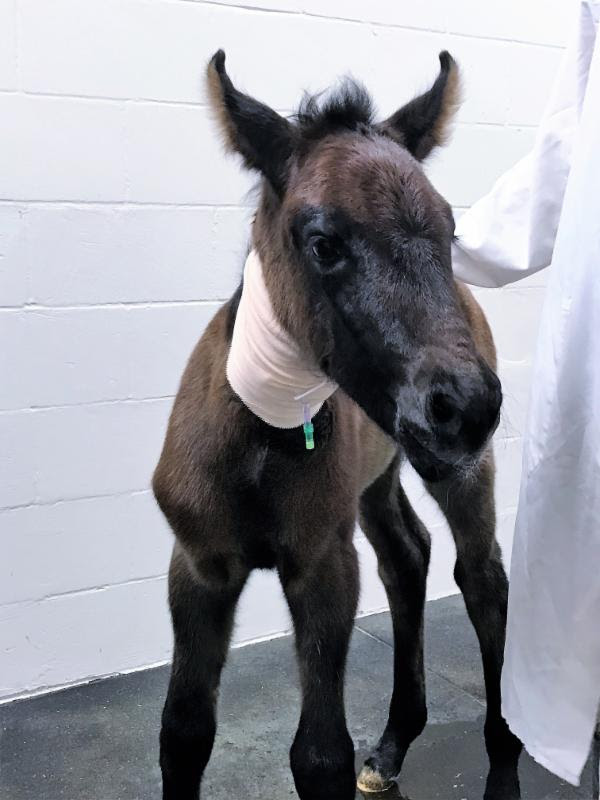
In the hustle and bustle of our busiest time of year, we have a critical case, an orphan filly that was not only rejected by mom, but reeling from the effects of mom’s rejection, malnourishment and selenium deficiency, topped of by stress of transport and dehydration. She needs your help!
We go the call yesterday (4/5), a plea for assistance with an orphaned foal who was just a few hours old. She had been rejected by mom and needed help.
So transport was arranged and off we went. She was about 4.5 hours away, but we met in the middle. Gosh, what a precious lil’ filly we met, but it’s been a really rough start! Unfortunately, she was very weak, and definitely in a fragile state. She plopped down on the ground to rest, so we layed her down in the back seat and hightailed it back to Loomis Basin Equine Medical Center (LBEMC) to check her out.
Turns out she looked better than she was. Her blood values were not good, and she was hospitalized.
Lots of attention and supportive measures were taken. A catheter was placed, blood drawn, and meds administered.
We left her looking fairly good and feeling hopeful.
But with foals, things can change quickly. A call at midnight informed us her blood values moving in wrong direction, and we were being prepared for not so good news by morning. HOWEVER, she was up and drinking milk replacer on her own, so that was good!
This morning, she was holding her own, but still quite sick. She was still getting up on her own and drinking her milk replacer with a good appetite. That offered some optimism to keep pushing forward. This afternoon, she was up, she was eating, and her blood levels were finally trending in the right direction, and the 9p update is things are still moving in the right direction.
She wants to live! She’s a FIGHTER and AAE wants to support her as she continues her battle.
Although she’s not out of the woods, the docs think she’s moving in the right direction. It likely she’s dealing with the results of being rejected by mom, and secondary effects resulting from mom’s malnourishment and selenium deficiency, as well as stressors from long transport and dehydration. It’s a lot for any young, new life to endure. Docs are hopeful that with 5 +/- days of hospitalization and supportive care, she has a good shot at a relatively normal life. However, there is a chance there will be some long lasting effects, but it’s too early to know. We need a few more days to have a better picture, but so far, the trend is good.
A BIG THANK YOU to the docs at LBEMC for their quick actions and the outstanding care provided for this little filly. We are all hoping for continued progress.
Without hospitalization, she has little chance of survival at this point. The unfortunate reality is that we are looking at a big expense for this one little life, well over $5,000 to get there. She needs your help.
If our big community can help in little bits, the hit isn’t so hard to any one, and for those that need, AAE is a 501(c)(3), so donations are tax deductible.
No donation is too small. If everyone that can will help just a little, we can give this precious girl a chance to live a full life.
Some folks may think because of the costs that euthanasia is the better choice. Fair enough, and if you feel that way, you are under no obligation to donate. But if you are like many others and believe every life counts as long as there’s a good chance for a good quality of life, please help if you can. Because this little girl has a good chance for a good quality of life, we think she deserves the opportunity. This girl wants to live!
This little girl thanks YOU for caring enough to help her live.
“By saving the life of one horse, we may not be changing the world, but we are changing the world for that one horse.” – Author Unknown
Please note, should there be excess funds, they will apply to future AAE veterinary needs.
The UHC welcomes two new members, the Retired Racehorse Project and Palmetto Carriage Works. Each will be featured in future editions of the UHC Roundup. Member organizations help make programmatic decisions in the areas of education, programs, funding, and visibility.
Registration is open for the AHC’s 2017 Annual Meeting and National Issues Forum. Registration information, along with a tentative schedule and link to make room reservations is available on the AHC website Events tab.
New this year, the AHC is offering discounted registration for those who register before April 15th– so be sure to register as soon as possible!
The theme of the National Issues Forum, sponsored by Luitpold Animal Health, will be “The Power of Unity,” and will feature keynote speaker Roger Dow of the U.S. Travel Association. The Issues Forum will feature two panels: a Research Panel and a Youth Panel.
The Research Panel will be moderated by Allyn Mann of Luitpold Animal Health and will feature researchers from AQHA, AAEP, Grayson Jockey, Horses & Humans, and Colorado State University. The panel will focus on why research is important to our industry, and some of the research they have recently completed that is transforming the industry.
The Youth Leader Panel will be moderated by Julie Broadway & Dannette McGuire of the American Youth Horse Council and will include youth leaders from Arabian Horse Youth Association, Harness Horse Youth Foundation, US Pony Club, AMHA and AQHA. They will focus on what their respective organizations are doing to engage youth and give attendees some insight as to what the industry should be doing in order to remain relevant to the younger generation.
The AHC will also provide an overview of its new Strategic Plan, and Tom Zitt of the Innovation Group will give attendees an update on the progress of the 2017 Economic Impact Study. Two members of Congress have also been invited to speak on why the horse industry means so much to them and what we can do to ensure it remains successful and thriving. Finally, in a new part to the Issues Forum, breakout group discussions will take place at the end of the presentations with various topics being discussed.
The AHC’s Annual Meeting and National Issues Forum is the only meeting where every single segment of the equine industry meets! We hope you will take advantage of the discounted registration if you register before April 15th.
On March 30, 2017, Representatives Ted Yoho (R-FL) and Kurt Schrader (D-OR) re- introduced the Prevent All Soring Tactics Act of 2015 (HR 1847) (PAST act) in the House of Representatives. The bill is intended to strengthen the Horse Protection Act (HPA) and prevent the soring of Tennessee Walking Horses, Racking Horses, and Spotted Saddle Horses. The bill is identical to the bill introduced last Congress and is supported by the American Horse Council and most national horse show organizations.
Soring is an abusive practice used by some to train Tennessee Walking Horses, Spotted Saddle Horses, and Racking Horses. It usually involves the use of action devices, chemicals, pads, wedges or other practices to cause pain in the horse’s forelegs and produce an accentuated show gait for competition. Despite the existence of a federal ban on soring for over forty years, this cruel practice continues in some segments of the walking horse industry.
The PAST act would amend the HPA to prohibit a Tennessee Walking Horse, a Racking Horse, or a Spotted Saddle Horse from being shown, exhibited, or auctioned with an “action device,” or “a weighted shoe, pad, wedge, hoof band or other device or material” if it is constructed to artificially alter the gait of the horse and is not strictly protective or therapeutic. These new prohibitions would not apply to other breeds that do not have a history of soring.
The legislation would also increase fines and penalties for violations, including the potential for a lifetime ban for repeat offenders.
The bill would create a new licensing process for horse show inspectors, eliminating the current often criticized designated qualified persons (DQPs) program. The bill would require the U.S. Department of Agriculture to train, license and appoint new independent inspectors for shows and other HPA-regulated activities that wish to hire an inspector. Licensed or accredited veterinarians would be given preference for these positions. The decision to hire and cost of an inspector would still reside with the management of a show, sale or auction.
Many national horse show organizations have endorsed the PAST Act including;
The American Horse Council
The American Quarter Horse Association
The American Association of Equine Practitioners
The American Paint Horse Association
The U.S. Equestrian Federation
The American Morgan Horse Association
The Pinto Horse Association of America
The Arabian Horse Association
The American Saddlebred Horse Association
The United Professional Horsemen’s Association
The Appaloosa Horse Club
Many state and local horse organizations also support the bill. The bill has broad bipartisan support and already has over 208 co-sponsors.
Various efforts have been made since enactment of the HPA forty years ago to stop the soring of horses and they have not worked. This bill is focused on the problem it is intended to solve and does not adversely affect other segments of the show industry that are not soring horses and have no history of soring horses.
The AHC supports the bill and urges all members of the horse industry to contact their Representative and ask them to support the bill and become a co-sponsor.
On March 30, 2017 Congressman Andy Barr (R-KY) re-introduced the Race Horse Cost Recovery Act (H.R. 1804) and theEquine Tax Parity Act (H.R. 1805) . The Race Horse Cost Recovery Act would permanently place all race horses in the three-year category for tax depreciation purposes. A 2008 provision that temporarily put race horses in the three year category expired at the end of 2016. The Equine Tax Parity Act would make horses eligible for capital gains treatment after 12 months, rather than 24, similar to other business assets. The American Horse Council supports both of these bills.
Congressman Barr also introduced the Race Horse Expensing Certainty Act (H.R. 1806), the bill would provide extra clarity that racehorses are eligible for the Section 179 business expense deduction. All horses purchased and placed in service by a business are currently eligible for the Section 179 deduction and the bill would not change this.
The 2008 Farm Bill included language that allowed all race horses to be depreciated over three years, regardless of their age when placed in service. Prior to then, race horses were depreciated over seven years if placed in service before they turned two. Horses placed in service after two (24 months from foaling date), could be depreciated over three years. A horse is generally deemed to be placed in service when it begins training, which is usually at the end of its yearling year. This change to the tax code was extended several times, but expired at the end of 2016. The Race Horse Cost Recovery Act would permanently make all race horses eligible for three year depreciation.
Depreciation is a means of recovering the cost of property, including horses, used in a business through deductions of portions of the horse’s cost over a period of years. Generally, the recovery period approximates the estimated useful life or economic life of the property. The horse industry believes a three year deprecation schedule more accurately reflects the actual time a horse will be raced and a seven year deprecation period unfairly penalizes the horse industry.
Permanently placing all race horses in the three year depreciation category would be of great benefit to the horse industry and is supported by the AHC.
Equine Tax Parity Act
The Equine Tax Parity Act (H.R. 3672) would make horses eligible for capital gains treatment after 12 months, rather than 24, similar to other business assets.
Under the current federal tax code, gains from sales by individuals of property used in a trade or business, including horses, qualify for long-term capital gains and are subject to the maximum capital gains tax rate of 15% for taxpayers earning less than $450,000 or 20% for those earning more. Since the individual income tax rate can go as high as 39.6%, the lower rate is a real advantage.
Horses held for breeding, racing, showing or draft purposes qualify for the capital gains rates only if they are held for 24 months. All other business assets (except cattle) qualify if held for 12 months.
The Equine Tax Parity Act would end this discriminatory treatment of horses under the tax code and allow horse owners to enjoy the reduced rate upon sale after holding a horse for 12 months. For most owners and breeders shortening the capital gains holding period to 12 months should be a benefit. Reducing the holding period by half would give many horse owners and breeders more flexibility to sell and market their horses. It would mean that every sale of a horse which is held for at least 12 months will qualify as a capital gain or loss unless that horse is held primarily for sale. The AHC supports this bill.
The Race Horse Expensing Certainty Act
The Section 179 business expense deduction allows any business, including any horse business, to immediately depreciate up to $500,000 of the cost of any investment in business assets, including horses. The deduction is reduced dollar-for-dollar once investment in all one’s business activities hit $2 million. The bill would provide extra clarity that racehorses are eligible for the Section 179 business expense deduction.
Today, the AHC submitted comments in support of an Internal Revenue Service (IRS) proposed rule regarding withholding requirements on pari-mutuel winnings. The proposed rule would make changes to withholding requirements that more accurately reflect
the current state of wagering in the horse racing industry. The rule, if made final, will be of great benefit to horse players and the racing industry.
Specifically, the proposed rule would define “amount of the wager” as the total amount wagered by a bettor into a specific pari-mutuel pool on a single ticket for purposes of determining whether wagering proceeds are subject to 25% withholding on winnings of $5,000 or more and are at least 300 times as large as the amount wagered.
Currently, the IRS does not recognize the total amount wagered on an exotic bet with “boxes,” “wheels,” and “keys,” when determining whether the 300:1 ratio has been met and 25% withholding is triggered, only the cost of the individual winning bet. This greatly increases the number of winning bets that are subject to withholding and does not accurately reflect the actual amount bet and the actual amount won. An example of how the current withholding requirements work and how they would work under the proposed rule can be found here: Example Under Current IRS Regulations.
In its comments, the AHC stated the current rules were written before “exotic bets” existed and do not accurately take into account the total amount wagered in many instances and the proposed changes will fix this issue. The AHC expressed its strong support for the proposed regulations and urged the IRS to finalize the rule as soon as is practical.
I know that the video below of the Bureau of Land Management’s (BLM’s) recent roundup in Utah will make you as angry as I am, and as committed to fighting for change.
Terrified wild horses stampeded by helicopters into trap pens. An innocent mare and foal chased relentlessly by the helicopter before being trapped and separated forever. The tiny foal now confined in a muddy BLM pen, never to see his mother again.
The BLM helicopters are taking a break right now for foaling season (March-June), but we aren’t.
AWC is fighting initiatives in states like Utah that want to “harvest” wild horses as “protein resources” by slaughtering them, challenging — and defeating — rancher-led lawsuits seeking the removal of tens of thousands of wild horses and burros from western public lands, and lobbying on Capitol Hill to block efforts to kill the 46,000 wild horses and burros in holding facilities either directly by lifting the slaughter ban, or through the back door, by transferring captured animals to state and local agencies.
Are you with us?
I just returned from Washington, and I cannot stress to you enough how important this work is. Both lawmakers and agency officials know that the public will not stand for the slaughter of our national icons. It’s clear that we, collectively, are the line that stands between our wild horses and burros and mass roundups and slaughter.
This Congress and Administration will make decisions in the coming months that will determine the future for wild horses and burros for decades to come. Can we count on you to sustain this fight at this very critical time?
Thank you — we could not do this work without you!
The fight over the future of America’s wild horses and burros will take place in Washington, DC this year as the Administration charts a new course for the Department of the Interior and Congress funds the government for the remainder of Fiscal Year 2017 and for Fiscal Year 2018. As an American citizen and taxpayer, YOU have both the right and ability to weigh in to influence these decisions. When it comes to your elected officials in DC, YOU – as a constituent – are the best lobbyist for protecting wild horses and burros from mass roundups and slaughter.
Click below to learn how to best wield your power and get started today!
Registration is now open for the AHC’s 2017 Annual Meeting and National Issues Forum. Registration information, along with a tentative schedule and link to make room reservations is available on the AHC website Events tab . New this year, the AHC is offering discounted registration for those who register before April 15th!
The theme of the National Issues Forum, sponsored by Luitpold Animal Health, will be “The Power of Unity,” and will feature keynote speaker Roger Dow of the U.S. Travel Association. The Issues Forum will feature two panels: a Research Panel and a Youth Panel.
The Research Panel will be moderated by Allyn Mann of Luitpold Animal Health and will feature researchers from AQHA, AAEP, Grayson Jockey, Horses & Humans, and Colorado State University. The panel will focus on why research is important to our industry, and some of the research they have recently completed that is transforming the industry.
The Youth Leader Panel will be moderated by Julie Broadway & Dannette McGuire of the American Youth Horse Council and will include youth leaders from Arabian Horse Youth Association, Harness Horse Youth Foundation, US Pony Club, AMHA and AQHA. They will focus on what their respective organizations are doing to engage youth and give attendees some insight as to what the industry should be doing in order to remain relevant to the younger generation.
The AHC will also provide an overview of its new Strategic Plan, and Tom Zitt of the Innovation Group will give attendees an update on the progress of the 2017 Economic Impact Study. Two members of Congress have also been invited to speak on why the horse industry means so much to them and what we can do to ensure it remains successful and thriving. Finally, in a new part to the Issues Forum, breakout group discussions will take place at the end of the presentations with various topics being discussed.
The AHC’s Annual Meeting and National Issues Forum is the only meeting where every single segment of the equine industry meets! We hope you will take advantage of the discounted registration if you register before April 15th.
Recently, President Trump issued several executive orders relating to increased immigration enforcement and border security. These actions will impact many employers, including those in the racing and showing segments of the horse industry, even those that rely on legal foreign workers.
For many years horse farms, horse shows, trainers and others have had difficulty recruiting American workers. This has forced many to rely on foreign workers and utilize both the H-2B non-agricultural and H-2A agricultural temporary foreign worker programs to meet their labor needs even though these programs are often extremely burdensome to use. Additionally, many of the workers employed in the industry may lack legal status.
Most foreign workers in the industry are directly responsible for the care of the horses upon which the entire horse industry is dependent. Without these workers to raise, train, and care for the industry’s horses, many other jobs held by Americans not only in the horse industry, but also supported by the horse industry will be in jeopardy.
Generally speaking, increased enforcement, increased competition for legal workers and greater demand for H-2B and H-2A workers will make it more difficult for horse industry employers to fill many positions.
Representative Scott DesJarlais (R-TN) has reintroduced the Horse Protection Amendments Act (H.R. 1338). This is the exact same bill DesJarlais introduced last year to amend the Horse Protection Act (HPA). The bill would create a single Horse Industry Organization (HIO) that would be responsible for enforcement of the HPA. This bill is opposed by the AHC.
The HPA was enacted in 1970 and prohibits the showing, sale, or transport of a horse that has been sored. Soring is an abusive practice used by some horse trainers in the Tennessee Walking Horse, Spotted Saddle Horse, and Racking Horse industry to intentionally cause pain in a horse’s forelegs and produce an accentuated show gait for competition.
The AHC opposes the DesJarlais bill because it would not reduce the prevalence of soring in the Tennessee Walking Horse, Spotted Saddle Horse, and Racking Horse industry and does not address most of the issues raised in a USDA Office of Inspector General Report on the HPA enforcement program. In fact it could exacerbate the situation by placing responsibility for enforcement of the HPA more firmly in the hands of a walking horse-controlled HIO.
The bill has 9 co-sponsors; Chuck Fleischmann (R-TN), John Duncan (R-TN), Marsh Blackburn (R-TN), Hal Rogers (R-KY), Diane Black (R-TN), Andy Barr (R-KY), David Roe(R-TN), James Comer (R-KY) and Bret Guthrie (R-KY).
The AHC continues to support the Prevent All Soring Tactics Act (PAST Act) that would strengthen the HPA and prevent the soring of Tennessee Walking Horses, Spotted Saddle Horses, and Racking Horses.
Please visit our fundraising auction page to see the directions for bidding and pictures of all the great items and services that are up for auction!
Thanks in advance for your participation. The auction generates a lot of interest (and competitive bidding!), and the proceeds allow us to carry out our mission of helping donkeys and mules in need. In 2016 we placed 40 long ears – a new record!
In 2015, the Environmental Protection Agency (EPA) and the U.S. Army Corps of Engineers’ (Corps) issued a new regulation to redefine “Waters of the U.S.” under the Clean Water Act (CWA). The Trump administration has announced it will instruct the EPA and the Corps to review and reconsider the 2015 rule known as the Waters of the United States rule or WOTUS. The rule was opposed by the American Horse Council (AHC) and other agricultural groups.
The CWA regulates discharges of pollutants into navigable rivers and lakes, collectively known as “Waters of the U.S.” The 2015 rule redefined “Waters of the U.S.,” in a manner that significantly expanded the waters subject to the requirements of the CWA. The CWA includes exemptions for agriculture, however the AHC and other agricultural groups had serious concerns regarding the 2015 rule and the AHC believed it could negatively impact horse farms, ranches and racetracks in all parts of the country.
During the original comment period, the AHC asked the EPA and Corp to withdrawal the rule in its entirety and supported Congressional efforts to block the rule. The AHC supports the decision to review and reconsider the 2015 rule.

 The following is from the American Horse Council:
 The following is from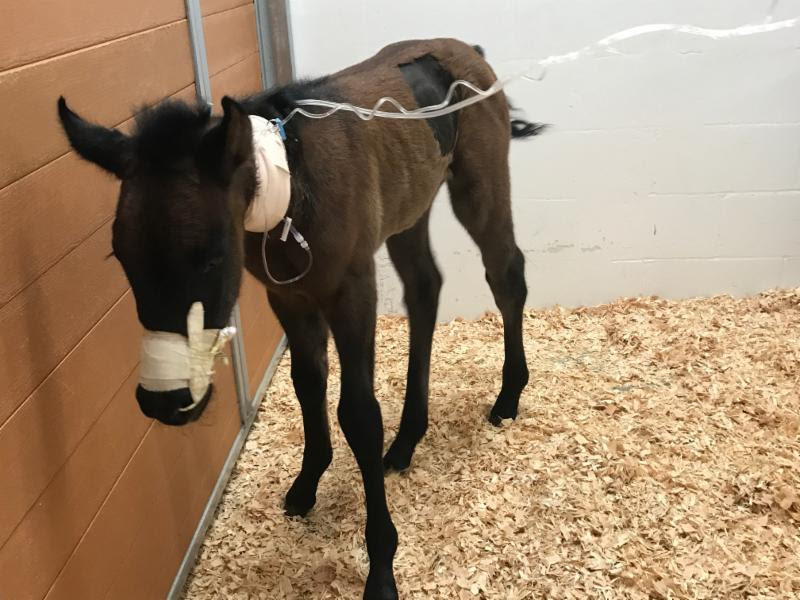
 The following is from


 Lots of attention and supportive measures were taken. A catheter was placed, blood drawn, and meds administered.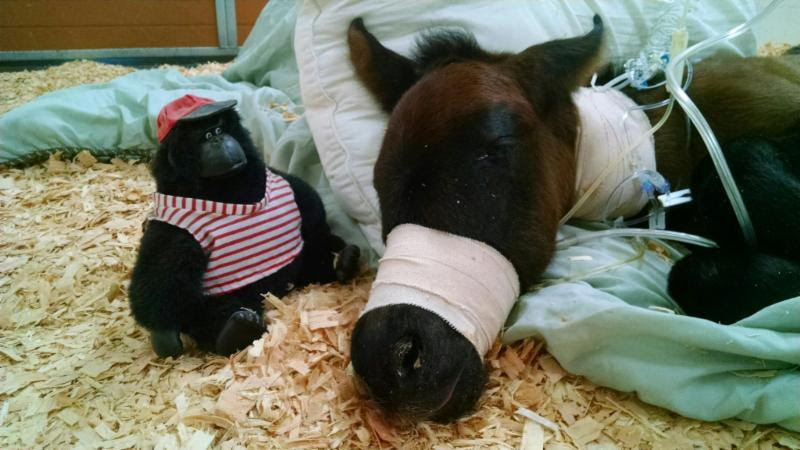
 The following is from the