MULE CROSSING: Donkey Training, Part 8
 By Meredith Hodges
Now it is time for your donkey to learn to move laterally. Lateral movements are essential to the overall balance and posture of your donkey. It will improve muscle strength throughout his body and will reduce the risk of injury or soreness while he is being ridden or driven.
You can begin his lateral work on the drivelines in the large arena. Begin by driving your donkey through the hourglass pattern (after review). As he approaches the first corner cone, ask him to circle it and then turn down the centerline instead of moving down the short side to the next cone. Let him move straight for a few steps, and then, with your assistant at his head, ask him to move forward and sideways away from your circle. The centrifugal force from the circle should send him onto the diagonal with little resistance and your assistant will be in front to keep him from just running forward. If he is to move laterally to the right, you should make a small circle to the left and drift out and onto the right diagonal. If he is to move laterally to the left, you should circle to the right and allow him to drift out and onto the left diagonal. As your donkey is on the circle, maintain the bend with a shortened inside rein. As he comes up the centerline, maintain the bend as he moves forward on the straight line, then begin to give distinct pulls and releases on the outside rein to encourage him to follow it, and back this up with a light tap of the whip on his opposite hip if he does not begin to move diagonally. As he begins to walk diagonally, so should you—step for step. Pull the outside rein in unison with his front legs, pulling back when the outside leg comes back, allowing freedom for the front leg that is to cross over. It takes a little coordination, so don’t be discouraged if things aren’t working well the first few times. Just keep practicing and you will eventually get it, and so will your donkey!
As he gets better at the lateral walk this way, you can add various patterns, which will increase his lateral response. And above all, do not forget those verbal commands: “Haw-over” for left and “Gee-over” for right. You have made it easy for him by asking him to perform the lateral response out of the circle. Another circular lateral response is the spiral. Have him walk in a large circle and spiral down to a very small circle. Then ask him to gradually work back onto the larger circle again by spiraling out in a yielding fashion. Watch his legs to make sure he is crossing over properly.
Now it is time for him to listen even more carefully to your rein and whip cues. You will begin to ask him to change his bend for you before he moves laterally. Walk the perimeter of the arena and this time, you will circle on the second corner. When he has completed the circle and his nose comes to the diagonal track, ask him to halt and move his hindquarters over until he is parallel to the long-side rail. Then give the proper cues for the direction in which you wish to travel, as designated earlier. This exercise helps promote good listening skills on the part of your donkey and more increased coordination for yourself. There are several different variations on this theme. The first time you will want to cross the long diagonal (see diagram), allowing your donkey all the time he will need to complete the lateral exercise with the least amount of angle.
As he becomes more adept, you can teach your donkey to cross the short diagonal from the corner to the middle of the long side of your arena. Then proceed straight through the next corner to the second cone and repeat (see diagram).Always be sure to stop, correct the bend, and then proceed—one step at a time if necessary. He can learn to cross two short diagonals by circling at the middle of the rail on the long side after the first short diagonal, then proceeding laterally to the corner. Two short diagonals would create a change of lateral direction, so be sure to execute your cues very concisely with pauses between your transitions. Circle, halt, move hindquarters, move laterally, halt at the center of the long side, change to the bend of the new circle, complete circle, halt, move hindquarters, move laterally. Take it one segment at a time, one step at a time.
Next you will ask him to move laterally through the hourglass pattern, with a change of direction in the center of the arena. Move into the short side of the arena, pass the first cone and go on to the second corner. Circle at the second cone and halt, move his hindquarters over until he is parallel to the long side then proceed laterally to the center cone gate. At the gate, circle around the cone nearest the rail from which you began, halt, move his hindquarters and continue laterally to the next corner, which should be on the same long side on which you started (see diagram). Continue around the cone, across the short side to the next cone, and repeat as before to complete the hourglass. Use an assistant to help direct your donkey in the beginning and fade out the assistant as your donkey understands and complies with your wishes. Do all of these exercises at the walk until he is impeccable. Then you can drive him through them at the trot with slows and halts in appropriate places.
If your donkey is large enough and seems to react better when you are in the saddle, you can begin these exercises mounted and teach him the ground-driving afterwards. Donkeys are very different in the way they each learn. The other consideration is your own skills. Handling drivelines is sometimes really tricky and you may be better with reins, legs and a crop than you are with drivelines and a whip. The important thing is that you give your donkey a clear message as to what is expected, so he can learn easily and without resistance. Just remember that, when you are riding, your cues need to be just as clear as they are when you drive him. You need to tell him verbally what is expected at each segment of the exercise and make clear pauses through transitions. Use your assistant whenever necessary to  minimize resistance at any particular stage and reward your donkey lavishly for his honest attempts.
Once he has learned to drive and ride laterally in the arena, you can take your donkey to the obstacle course to put these movements to work. Begin with your assistant aiding you first in side-passing a log placed near the fence (to discourage your donkey from going forward), then a log in the open and side-passing a “T.” Try backing through two barrels in a figure-eight pattern using turns on the forehand and haunches to negotiate the pattern. Finally, teach him to move appropriately while you are opening and closing a gate, both on the drivelines and under saddle. Once he gets the idea on each obstacle, you can eliminate the assistant and ask him to take more responsibility for himself. He should be able to do everything he learns both under saddle and on the drivelines. There is no rule as to which he needs to learn first, but he should learn both under saddle and on the drivelines to be as responsive as he can possibly be, either in harness or under saddle.
To learn more about Meredith Hodges and her comprehensive all-breed equine training program, visit LuckyThreeRanch.com, MEREDITH HODGES PUBLIC FIGURE Facebook page, or call 1-800-816-7566. Check out her children’s website at JasperTheMule.com. Also, find Meredith on Pinterest, Instagram, MeWe, YouTube and Twitter.
Covered in TRAINING MULES & DONKEY: A LOGICAL APPROACH TO TRAINING, TRAINING WITHOUT RESISTANCE and EQUUS REVISITED at www.luckythreeranchstore.com.
© 1999, 2016, 2024 Lucky Three Ranch, Inc. All rights reserved.

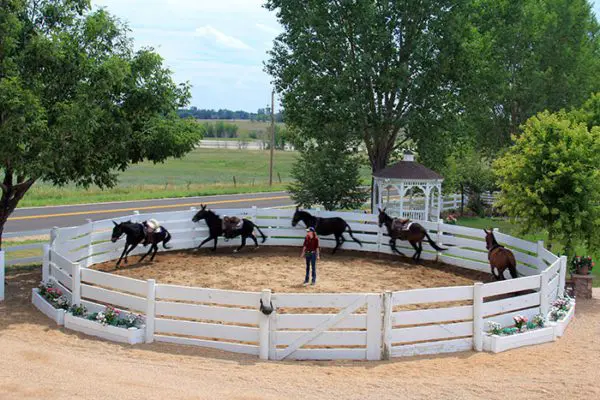
 at the walk and trot. Then dismount and try lunging, first at the trot, then ask him to “Canter.” Use the same cues you did at the walk and trot. Give the verbal command first, then shuffle your feet while raising both of your arms, one pointing in the direction in which you wish to travel, and the other one raised behind you, with the whip in-hand. If he does not comply, then lightly tap the whip to his gaskins once just above the hock, then tap it harder on the fence behind him. He should begin to canter. Even if he canters only two steps, stop him, reward him and then try again. Don’t keep asking for more right away, because he will only get frustrated and stop. If you are patient and consistent, he will canter farther each time. Once he canters fairly well while lunging, you can skip ground-driving and go straight to riding him at the canter. Have your assistant stand in the center of the round pen with the lunge whip and “lunge” him while you ride and cue from his back. Sit very quietly and with a very loose rein, allowing him to canter until you say “Whoa.” Make sure you and your assistant are exactly in unison with your verbal commands, since you do not want to confuse the donkey. If, after a few sessions, he positively refuses to canter, fear not. You can try something else first, and come back to cantering later.
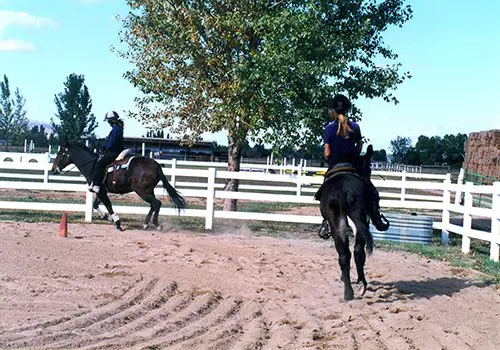 If your donkey hasn’t cantered in the round pen, go back to his lesson at the trot and allow him to succeed and be rewarded. Then take him into the large arena and allow him to follow an experienced animal through the hourglass pattern and along the perimeter of the arena at the walk and trot. Afterwards, go to the perimeter of the arena and have your assistant begin to canter out of a short side and down the long side. Encourage your donkey to follow. If he does not want to canter, slow him down through the short side and encourage him again on the next long side. If he wants to canter but is cutting the corner, let him. It is more important at this stage to get the canter than it is to stay on the rail. Be sure to call out your verbal commands repetitively as he learns to canter. You will say “Canter-Gee” for right and “Canter-Haw” for left. These are really important commands, as donkeys are more responsive to verbal commands than they are to your legs and reins. Let him canter for as long as he will, then stop and reward him. He will go longer periods of time as he gains strength and coordination. Make your circles as large as possible, at least fifty feet in diameter.
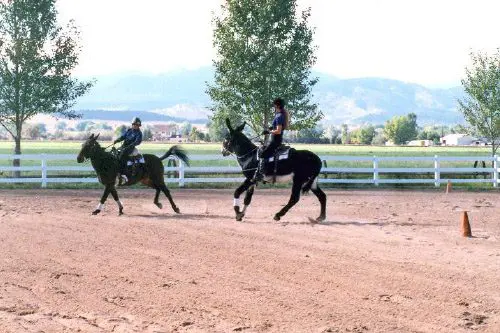 When he is cantering—or loping—easily around the arena, you can begin to facilitate control at the canter by varying your exercises. Have him trot the short sides and canter the long sides of the perimeter of the arena. Be sure he is picking up the proper lead in each direction (more on leads in discs #5 and #6 of my DVD training series, Training Mules and Donkeys). Pick up the lead in the corner each time to help him. Then you can trot the hourglass to the corner of the short side, pick up the canter and canter a circle, half of the arena, come back where you started, trot, and resume the pattern. Just be sure your circles are large enough to encourage good balance. You can ask him to trot along the rail, do a turn on the haunches and canter away on the correct lead. This will help him to learn to canter without the use of a corner. Take him out into the open on the obstacle course and let him canter for some longer distances, both in a straight line and in very large circles. If he breaks to the trot at any time during any of the aforementioned exercises, do not let him continue on at a fast trot. Slow him to the walk, then halt, regroup and begin again. You want to always maintain control.
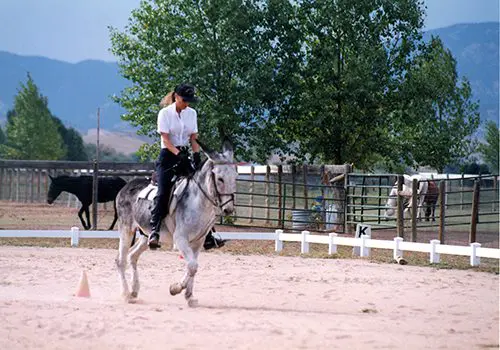 The most important thing is to reinforce the verbal commands. Donkeys can be very dead-mouthed and very dead-sided, but they have the most acute hearing you’ll ever perceive and they rarely miss a verbal command. If your donkey is well schooled in his verbal commands, you will never need to set him up for his lead changes—he will always take the one you call for, even if it is a counter-canter. The same goes for every other command. If you want to stop and he is cantering, don’t forget to speak in order: “Canter, Canter, Trot, Trot, Walk and Whoa!” If you say “Canter,” then just “Whoa,” you will produce a sloppy and resistant transition, since donkeys aren’t into sliding stops, although they can do small sliding stops (Lucky Three’s Little Jack Horner was able to slide for fifteen feet). Even professional reining trainers will tell you that an equine has only so many good stops in him, and it is not advisable to do such strenuous and abrupt movements too often. So be concise with your verbal commands and try not to leave any out when “conversing” with your donkey.

 Training your donkey is not really much different than training horses and mules, although there are differences in instinct and attitude that will determine your approach in given situations. The mechanics and techniques, however, remain the same.
 When imprinting the foal, think of the kind of attitude you want to cultivate in him—do not come at him with the idea that he must accept you. This is a forceful and intrusive attitude and can foster resistance. Come at him with love, patience and kindness and these are the things he will learn. Give him respect and ask that he respect you and he will begin to learn about behavioral limitations. If he were in a herd, the adults would demand that he respect their space with well-placed discipline. You must learn to do the same without overdoing it. If he bites or kicks, a well-placed slap on the side of the mouth for biting and on the rump for kicking and a loud, “No!” will do the trick. Rewarding his good behaviors consistently will reinforce repetition of what you desire from him and will foster understanding between you and your donkey. This is the beginning of a long-lasting bond of friendship.
 Whether your donkey is a young foal or an older animal, begin with imprinting and do the steps in sequence. Learn how to properly put on the halter. Let him wear it for a while then take it off, as he could get it caught and injure himself if it is left on. When your donkey is not bothered by you putting on and taking off the halter, you can teach him to be tied. Put the halter on him and tie him to a safe post for one hour. Come by to see him every 10 or 15 minutes, untie him and ask him to “come.” If he does not take a step toward you, just retie him and leave. Come back in 10 minutes and try again. When he takes a step toward you, reward him with a treat and lots of praise. Stroke him on the neck and shoulder or on the poll between the ears, or scratch his chest or rump—whatever he finds most pleasing. Then try a few more steps. Don’t ask for any more steps each day than he is willing to give. Save them for the next time and soon he will lead easily. When he is leading easily, you can start taking walks around the farm and you can begin to introduce him to things he may find frightening. Lead him as close as he will go at your shoulder, then step toward the obstacle as close as the lead will allow and coax him to you. Offer a reward if necessary to entice him, and be sure to reward him when he comes forward. When he is confident about investigating “things” with you, you can progress to an obstacle course.
 At your first try going over logs, a bridge, tires, or other such obstacles, you may find your donkey reluctant to pick up his feet to negotiate an obstacle. He will probably try to go around it any way he can. Stand close to his head, holding him on a shorter lead, and ask him to “come.” If he moves only one foot over a log or tire or onto a bridge, stop, hold him there and give him a reward for his effort. Next, ask for the other foot and, if he is willing, let him walk over the obstacle, then reward him again. If he moves only one foot more, reward that, and proceed—slowly! You don’t want him to just run through it. You want him to come when you say “come” and to whoa when you say “whoa.” You are beginning to establish verbal communication with your donkey, so keep it simple and consistent. Do all obstacles the same way. Donkeys like to get crooked over obstacles. When he has learned to step through or over an obstacle but is not going straight, you can step directly in front of him, holding the halter on both sides, and ask for straightness as he negotiates the obstacle.
 Once he has learned to follow you over and around obstacles, he will be ready to begin the fundamentals of showmanship. Hold your lead in your left hand, keeping your right hand free and straight out in front of you. He should learn to lead with slack in the lead and to follow your shoulder. If he gets too close, you can use your right hand to push him back into position. Once you have begun showmanship training, ALWAYS lead him this way. Teach him to stand squarely on all fours every time he stops. You are not just teaching him to set up, but to carry his body in a balanced fashion so he will develop good posture and balance. When you want to teach him to trot on the lead, give the verbal command to “trot” and slowly move your own legs into a very slow trot. If he is difficult, do not go to the whip. Try to find something toward which he wants to trot. Above all, don’t get discouraged if he won’t trot the first few times, just slow back down and do something he already knows, then quit for the day and try again the next. Eventually, he WILL get it!
 Do the same exercises (outlined in DVD #1 of my
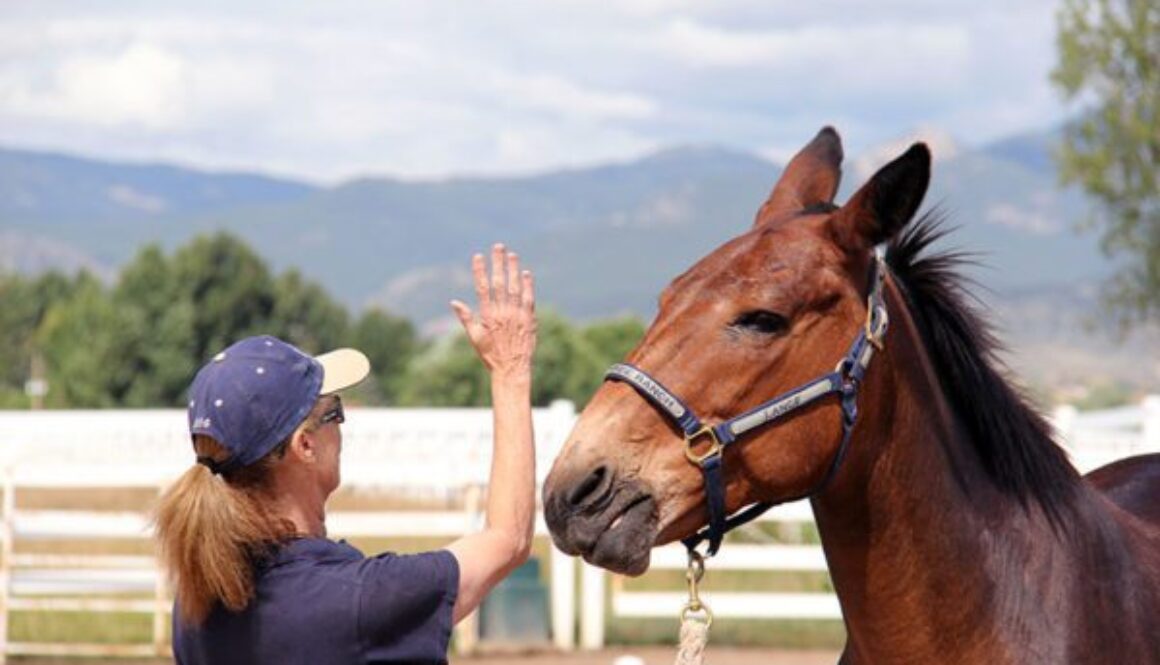

 In the past, when equines ran free, they were unencumbered by human interaction and could build and condition their muscles naturally. Today, with increased population but reduced open lands, their activity is often restricted. It then becomes our responsibility to not only train them, but to prepare them physically to perform and keep them happy in their environment. This responsibility becomes even more important when we ask them to exert more energy than normal, in activities like long trail rides, endurance events, showing and equine-related work. Proper preparation for this modern-day lifestyle will help to minimize your equine’s stress, both physically and mentally.
 Understanding the prey-predator responses can help to guide us in the training of our equines, but because of the change in the environment, it shouldn’t completely define our training methods. The prey animal that is uncomfortable with making direct eye contact with the human “predator,” for instance, is virtually trapped in a confined environment in which he has no control and can therefore become anxious and difficult to handle. We are taught not to make eye contact with him until he is willing to face us. We are taught to “chase” him in a round pen until he does.
 instance, the equine that is “trapped” on a lunge line and asked to reverse toward the handler will inadvertently be improperly set up to take the new trotting diagonal, or the new lead at canter, from a position that actually “tangles” his hind legs and causes him to fumble into the new diagonal or lead. This mistake can become painful and even detrimental to the stifles as he jumps out of the entanglement and can cause resistant behaviors which are often punished on top of the physical pain he is already experiencing.
 his body symmetrically in good equine posture. Once he has established good equine posture and balance over a long period of time doing appropriate exercises, he will then be better able to efficiently reverse towards you on the lunge line by changing direction from a position of balance rather than an awkward imbalance.
 Be a true leader and learn to set boundaries for your equine with appropriate corrections for bad behaviors (which can be found on our website and in our products). Make these corrections quickly and then immediately return to a clear definition of what you expect and make sure that it is easily doable for your equine at each step. Every animal on the planet will correct another’s misbehaving with a very clear and undeniable gesture that will stop the abuser promptly in their tracks. Take note. This is not abusive, but rather a very clear communication of what’s right and what’s clearly wrong. In fact, in the case of the mule attacking the puma that has circulated the internet for the past few years, it was clearly a case of the mule engaging in the hunt with his human “friend.” So, who is really prey and who is predator in this particular scenario? Sometimes we just need to change our perception or understanding of things and deny all-encompassing generalizations and stereotypes.
 being. In the practice of true Behavior Modification, all five senses should be employed: sight, hearing (voice), smell, touch and taste. These are all innate ways to communicate effectively. Any distractions should be eliminated when communicating with your equine—put away the electronic devices, clickers and loud whips, and avoid abrupt noises.

 Training isn’t just a way to teach your equine to do certain “movements,” but a way for you to help him to grow physically and mentally healthy, and to enable him to learn to cope with the demands that will be put on him during his lifetime—much like raising a child to grow up to be a healthy and productive adult.
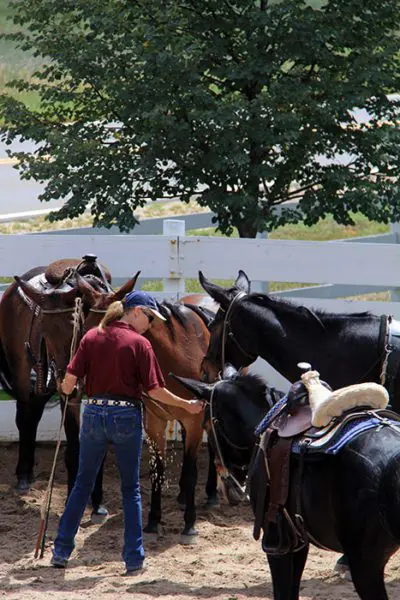 The subtleties in your attitude and approach, along with a solid knowledge base, can make all the difference in your training program. Whether your equine is a foal or an older animal that you have just obtained, whether he is trained or untrained, the process is the same and it’s never too late to get started with the right kinds of expectations in mind. You are creating a bond, developing the foundation for a healthy friendship, and setting the ground rules that will dictate the positive extent of your continuing relationship with your animal. It is important to be an active participant in your animal’s training. After all, you wouldn’t have someone else make a friend for you. You’d do it yourself—one-on-one.
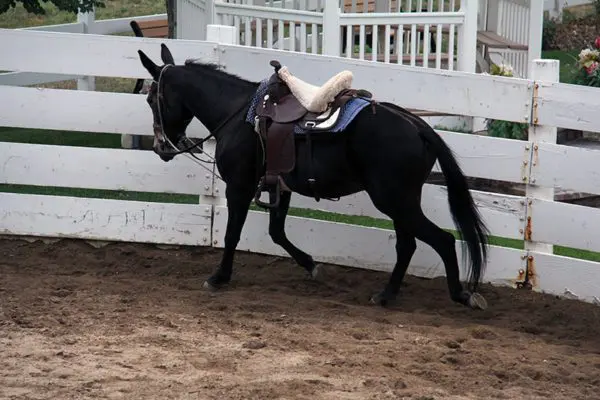 solid foundation with him before moving on to more elaborate maneuvers will yield better results. Remember to always be aware of your equine’s physical, mental and emotional responses during training. For instance, you may think that, once your mule is moving around the round pen at all three gaits with a reverse, he is ready to begin riding, but this may not necessarily be true. Considering that it takes years to really condition muscles to their maximum strength, six to eight months of doing round pen exercises is not really that long a period of time. If you don’t spend at least six months on flatwork leading training and six months on obstacle leading lessons to promote strength and balance in good posture, you can greatly hinder your equine’s ability to perform in the round pen on the circle. In turn, spending less than six to eight months in the round pen will not produce the best results in muscle development. If you move through conditioning too fast, it will affect your animal’s mental attitude toward training and he will very likely experience soreness and emotional depression. As a result, he will most likely become resistant to training.
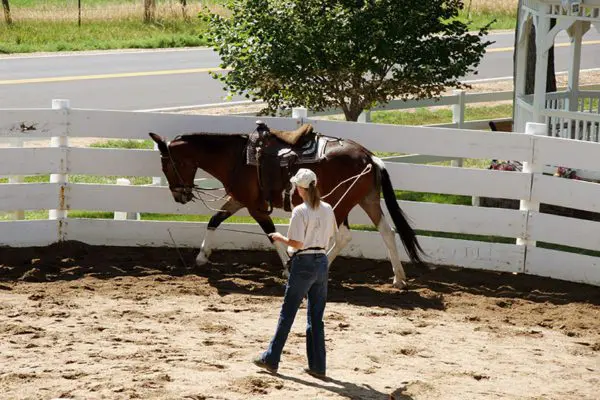 know what exercises you should begin with and which exercises should follow. Don’t let yourself get sucked into drilling on something that just isn’t working. If you run into problems and things aren’t working out properly, just go back and try something that is similar in its demand but simpler for you and/or your equine to execute. Sometimes, it is just a manner of approaching the problem differently or leaving it to another day. Like humans, equines have their own individual ways of learning and it’s up to you to figure out what works best with your particular equine on any given day. You can find my suggested approaches to this in my DVD series, Training Mules & Donkeys and Equus Revisited. Note: Don’t forget to reward your animal for positive behavior.
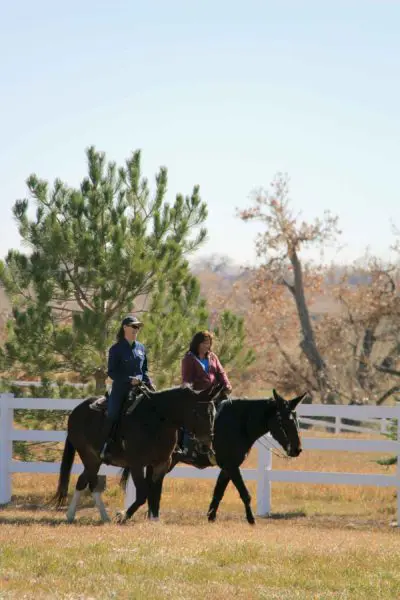
 Benefits of group lessons Equines can learn from each other, so it can be beneficial to work them together. When you are working with foals, it is helpful to take “Mom” along or have her tied nearby during training sessions. Green animals often do better on the trails during the first year if they are ridden along with well-trained trail animals. If you have multiple animals to keep conditioned, you can even lunge them together, provided your work in the round pen has been consistent with each of them separately from the beginning. In driving training, the “group lesson” idea of hitching young animals with the “old pros” has been a common practice for many years. Lunging “teams” together can also provide beneficial exercise. Speaking of “old pros,” it is to your advantage to find a local instructor/trainer with whom you can periodically take lessons. This gives you a way to check to make sure you stay on the right track and continue to improve your own skills. Lists of trainers and instructors can be obtained from the United States Equestrian Federation.
 Over the past few decades, through trial and error, we equine owners and trainers have discovered that, when communicating with our equines, harsh bits are not really necessary. Rather, it is safer and more beneficial to use milder tack and equipment, to concentrate on learning correct body language and to give clear cues with our hands, seat and legs to elicit the desired response from our equines.
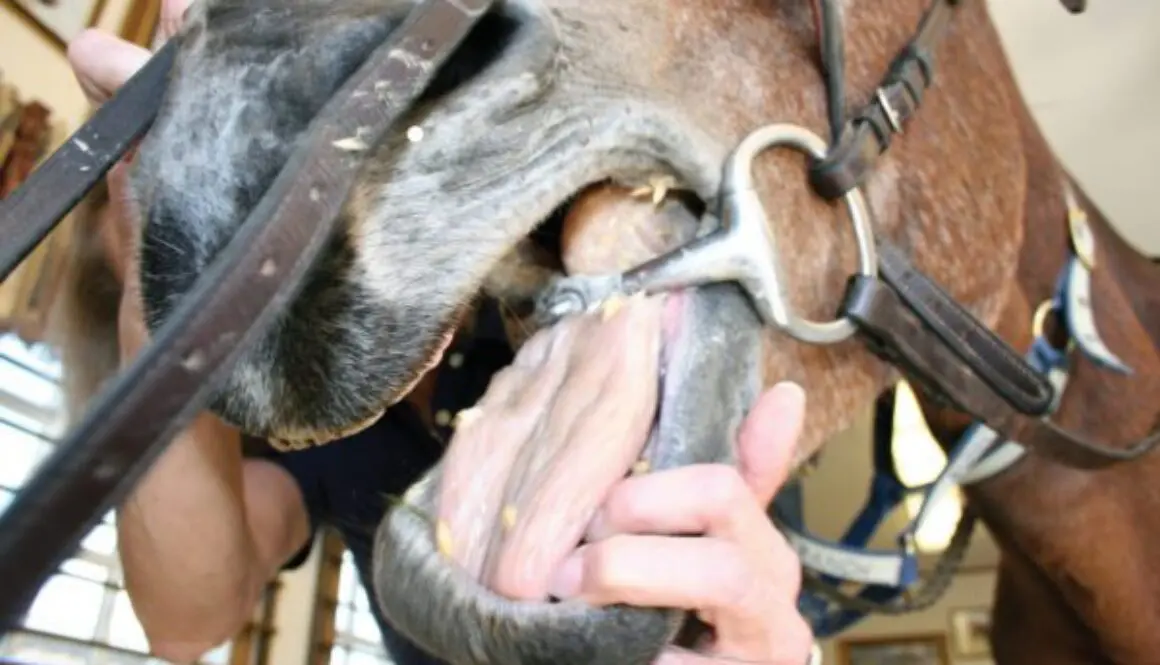
 When it comes to rider/equine communication, bitless and/or brideless techniques do not work as well as the simple, direct rein action of the snaffle bit in concert with your seat and legs.Many people are under the impression that having a bit in the mouth is painful for an equine, and the seeming “nutcracker” action of the snaffle bit when it is in your hands suggests that it might pinch your animal’s tongue when you pull on the reins. The mouthpiece of the snaffle bit actually “breaks” in the middle, allowing it to slide easily across the top of your equine’s tongue. It does not pinch his tongue, but it does put pressure on the corners of his mouth. The snaffle bit is correctly defined as a bit that promotes “direct rein action,” meaning that when you pull right, you go right and when you pull left, you go left. A snaffle bit does not have a shank. If it did have a shank, it would be considered a curb bit, regardless of how short the shank really is (as is the case with a Tom Thumb bit).
 Learning to go forward in the beginning of your equine’s training in a snaffle bridle is paramount to properly developing his body so he will learn to carry a rider in a strong and solid frame and in good equine posture. The forward training teaches him to stretch his head and neck forward, to step well underneath his body to propel himself forward, and to elongate his overall frame to keep the vertebrae in his back from becoming compressed and rigid. When he is moving correctly in a straight line, he will have more suspension and flexibility to his gait, and when he turns he will be able to bend easily through his rib cage.
 Although it would seem that a bitless bridle could achieve this same end, it has a different action on your equine’s head and neck, which inhibits proper bending through turns. The straight forward motion can be achieved with a bitless bridle. However, reins on a bosal (a type of braided rawhide noseband used with the hackamore-type headstall), bitless bridle reins, and other bitless configurations do not have the same lateral effect on the equine’s head and neck as does the snaffle bit. The equine’s head and neck form two sides of a triangle. The rope reins on a bosal, although lower on the nose of the equine than reins that come from the corners of the mouth, can cause the equine’s head to twist slightly sideways during the turn because, during any directional indication, the rawhide bosal around the nose twists through the rope reins which are both secured together underneath the jaw. The rope reins pull the underside of the bosal in the direction of the turn, but the nosepiece goes the opposite way and can cause your equine to improperly tilt his head through the turns. On bitless bridles, the reins are attached substantially higher than the corners of the equine’s mouth. When you pull on the reins attached higher on the equine’s jaw than where the bit would be as is the case with a halter or bitless bridle, the angle of pull is sharper and more abrupt, since the head side of the “triangle” is so much shorter than the length of the neck. It will cause the equine to try to turn his head too sharply from the poll, which can cause kinks and pain in his neck.
 To prove the point, try this experiment. Preferably using an untrained animal, take hold of the halter and gently but firmly pull on the halter in an attempt to make him bend his head and neck to the side. The higher position of the halter is like a bitless bridle and you will feel slight tension and resistance to this action before the animal finally complies. Next, gently insert two fingers into one corner of the equine’s mouth while standing at his shoulder and by squeezing and releasing your fingers, ask him to turn his head and neck to the side toward you. If done correctly, without yanking on him, he should give easily to your cue to submit and turn his head and neck. You will notice that he extends his head and neck slightly forward before turning it to the side.
 Now try this action on yourself. Stand in good posture and, without extending your neck, turn your head to the side. Do you feel the tension at the brainstem on the back of your neck? Now, stand in good posture, stretch your neck in an upward and forward arc and then look around the turn. Can you now feel the release from tension in the back of your neck? Your equine experiences the same feelings. The shorter angle of the side-pulls and bitless bridles will have a more abrupt pull and can cause some pain, while the longer angle coming from the snaffle bit at the corners of his mouth will allow a smoother and painless response. NOTE: Any bit can be painful to an animal when in the hands of an inexperienced rider who uses only the bit for control.
 The equine that has not had this kind of advanced training will possess neither genuinely good posture nor the knowledge of how to respond correctly in an abrupt and unpredictable situation. He will be more apt to be frightened and, as a result, may bolt and run, putting you and everyone around you at risk. However, the equine that is properly and conscientiously taught how to communicate through the snaffle bit will be a safer and more reliable animal to ride and to take into public places. He has learned to stop and wait for cues (communication through the bit) and is less likely to bolt and run if frightened because he understands and trusts the communication coming from his rider. He will now be more correct and solid in his good posture, yielding confidence in his attitude, and he will be a more reliable pleasure and show animal to ride.
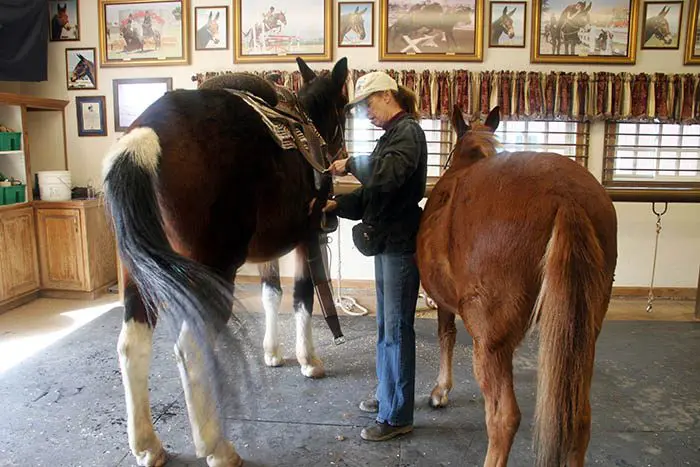 Once your equine has mastered tying and leading in the small pen, he can then move on to a designated work station where he will not only be groomed, but will also learn to accept tack in preparation for the round pen. This should be a place that has a good stout hitch rail and easy access to your tack and grooming equipment.
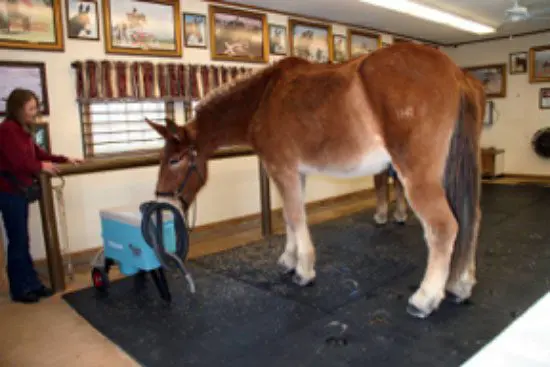 Keep an eye on the pressure you apply whenever using these various grooming tools. Different animals will have different sensitivity to these tools and will tolerate them better if they know you are not going to cause undue pressure or pain. Learn to brush the mane and tail starting at the bottom and working upward, and use a conditioner such as baby oil to keep from pulling or breaking the hair. (Baby oil will also keep other equines from chewing on the tail.) A shedding blade can be an uncomfortable grooming tool when used improperly. When using a shedding blade to remove mud around the head and ears and even on your animal’s body, be careful to minimize his discomfort by monitoring the pressure you apply to each area and working VERY slowly. When bathing him, be extra careful not to get water in his eyes or ears. These types of consideration for your equine’s comfort will help build his trust and confidence in you, and it will help make training easier and more enjoyable for both of you.
 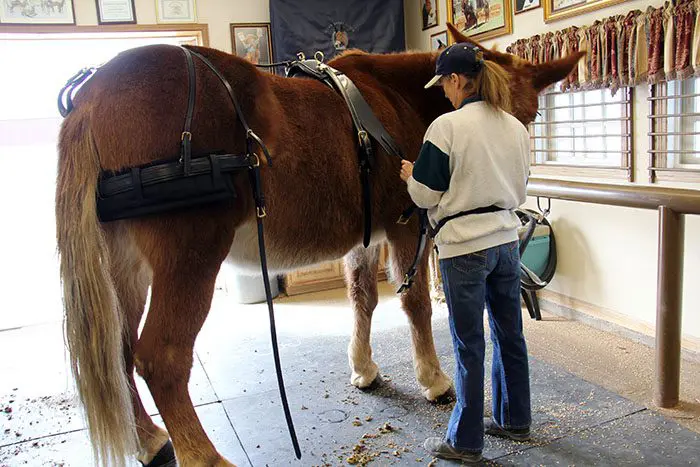 doing. If you are not sure about what tack to use when, go to the Lucky Three Ranch website for more detailed information, or ask the experts in your area. Make sure all tack and equipment fits your animal properly. If it doesn’t, it can cause adverse behaviors during training.
 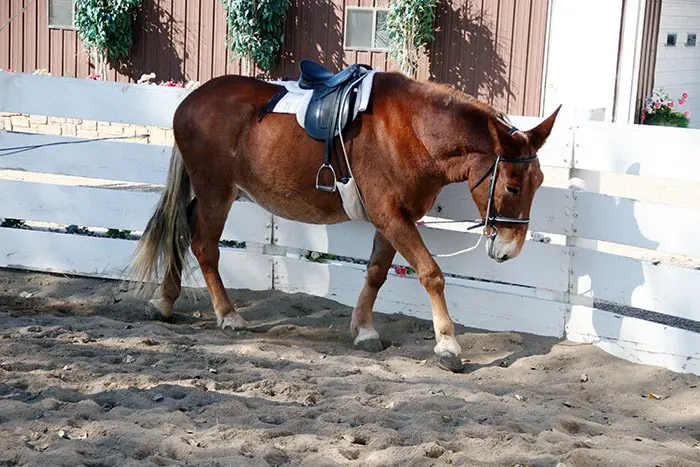 behavior you are seeing. Equines are very honest about their responses, and if they are not doing what you expect, it has to be in the way you are asking. Also, don’t hurry your equine. When asking for the walk, make sure that the walk is even in cadence, balanced and regular—not hurried. Only after your animal is correct in his execution of one gait, should you move on to the next gait. When first introduced to the Round Pen, it is not uncommon for an equine to begin work at the trot and then, as he becomes more comfortable with the new area, at the walk.
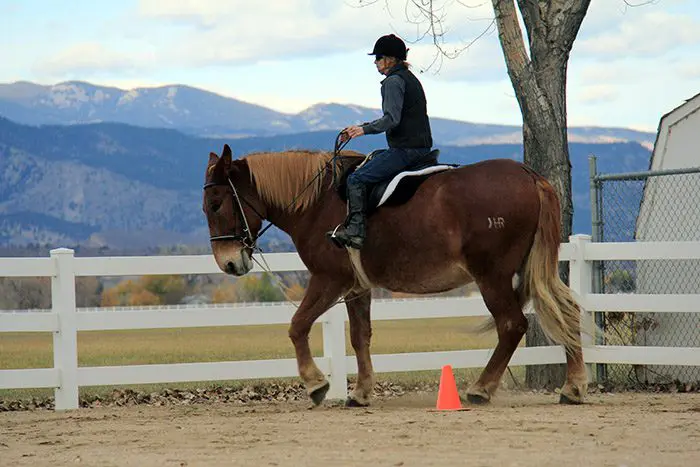 The arena is the place to really start focusing on forward motion and lateral exercises to further strengthen your equine, and it is the place to begin fine-tuning his balance, first during leading exercises, then Ground Driving and finally while he is carrying a rider. The Hourglass Pattern in the arena is also a good place for you to fine-tune your own riding skills, so that you learn to help your equine maintain good balance and cadence, on straight lines and while bending through the corners. In order for your equine to correctly go through the corners, you will be asking him to bend the muscles through his ribcage so he can remain upright and balanced. Equines are not motorcycles and should not lean around the corners. The power should always come from the hindquarters to keep the front end light, supple and responsive to cues. If his front end is heavy and sluggish, your equine is not adequately stepping underneath with his hind legs and will thus, lose forward impulsion and power and will not properly condition his muscles.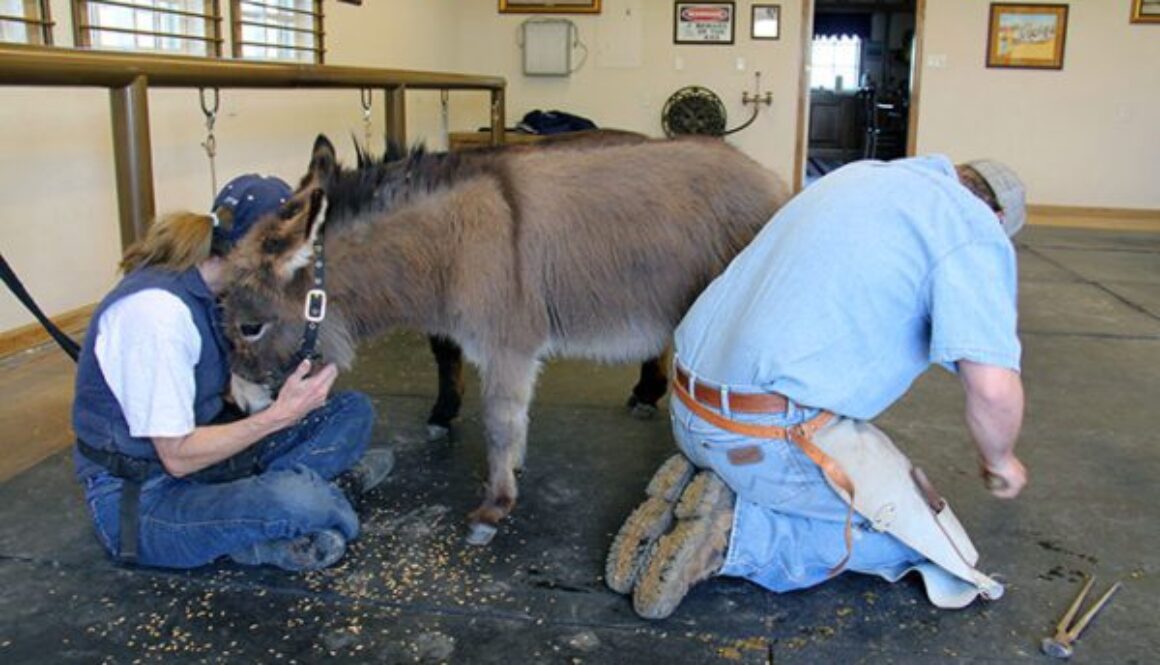




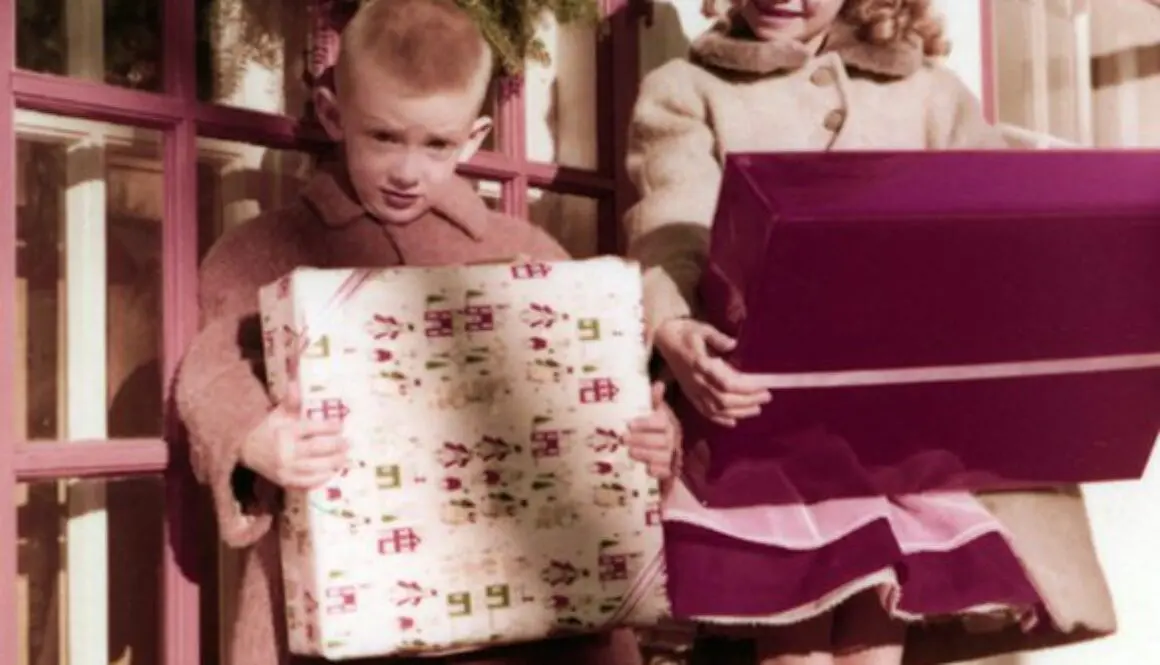
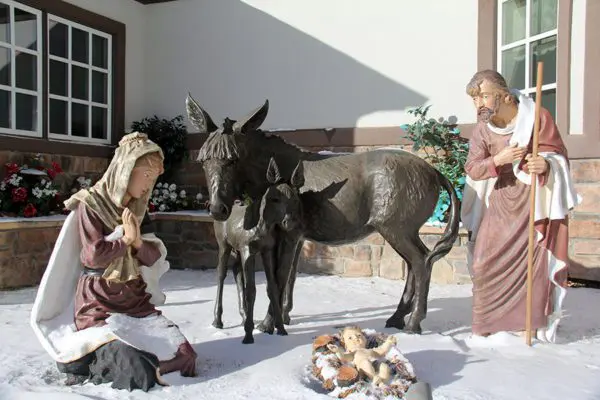 My favorite holiday of the year has always been Christmas! The sights, sounds and smells of Christmas transport me to a magical place for the whole month of December, and the excitement and joy of yesterday still ring true today. I cannot think of a more deserving holiday than one that celebrates the birth of Jesus Christ and promotes so much hope and serenity throughout the world, if only for a day. Christmas reminds us all that the spirit of sharing and giving is timeless and takes only a willing attitude and a little bit of creativity.
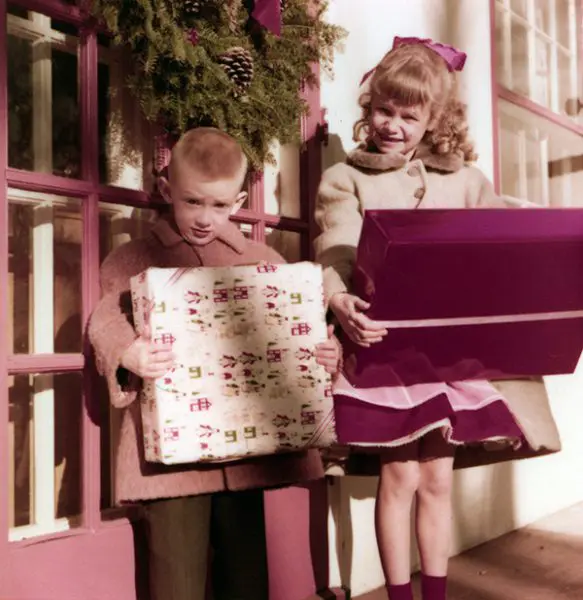 watched a 1955 film called On The Twelfth Day of Christmas. As you might guess, it was based on the old English song, “The Twelve Days of Christmas.” Every year, the film brought wild bursts of laughter, as we watched a proper Edwardian lady’s townhouse in England become filled to overflowing with gifts from her suitor. Not only did she get the gift designated for each day, but also the same gifts from prior days plus the new one. By Christmas, her little townhouse was filled with 12 partridges in pear trees, 22 turtle doves, 30 French hens, 36 calling birds, 25 gold rings, 30 geese a laying, 28 swans a swimming, 32 maids a milking, 27 ladies dancing, 30 Lords a leaping, 22 Pipers piping and 12 drummers drumming! Laughter filled our house daily from that day forward, all the way up to Christmas. Of course, as children, we were also reminded of the “naughty and nice” list.
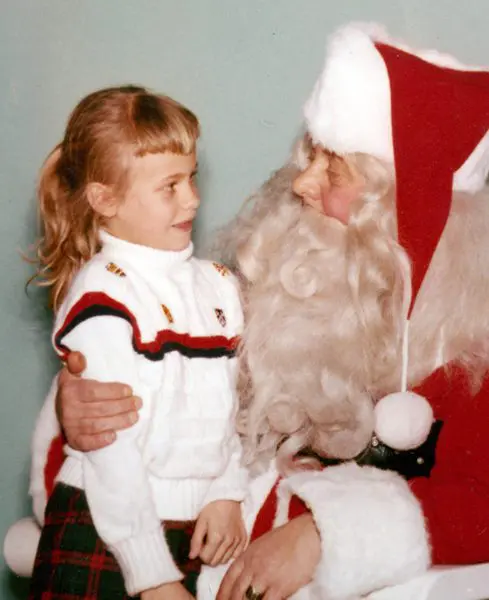 Christmas baking for days on end with my Grandma is a favorite memory. We got to bake great gifts for many friends and family members (and we all knew there would be time to exercise and take off the weight…LATER!). We children were wide-eyed and filled with wonder as we passed the evenings listening to our favorite Christmas carols and our elders’ stories of Christmases past. And we absolutely knew that Santa really could drive eight tiny reindeer across the sky, with Rudolph lighting the way with his red nose, bringing presents to little children all over the world. All of these experiences bonded our entire family together.
 We kids always awoke extremely early on Christmas Day, bouncing down the stairs to see what Santa had left us. The cookies and milk were gone and the presents from Santa were under the tree, but we were not allowed to touch them until our parents and grandparents got up. That wait was excruciating, but it was oh so much fun when the adults finally got up! After opening presents, everyone had a light breakfast, because the early afternoon would bring our traditional Christmas dinner with friends and family. My mother made the most amazing spread of perfectly roasted turkey and stuffing, mashed potatoes and gravy, an incredible salad filled with everything you can think of from the garden, sweet potatoes and a lovely cranberry sauce. The meal was always topped off by my grandmother’s unique and decadent chocolate roll, a light chocolate cake with real whipped cream and homemade chocolate sauce on top.
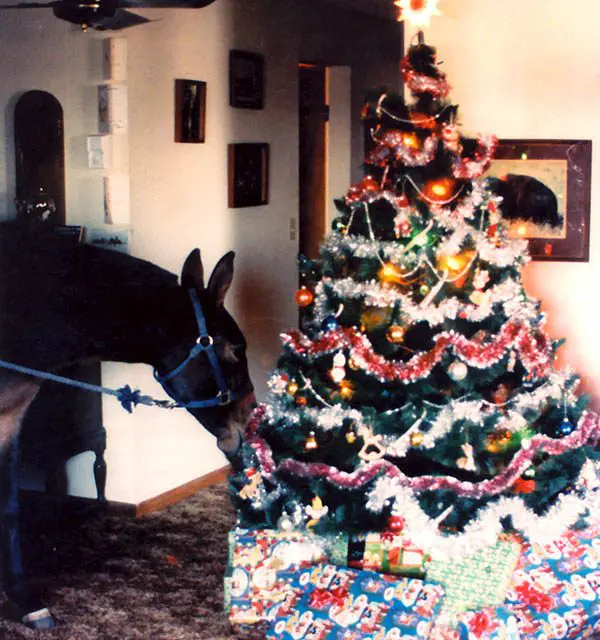
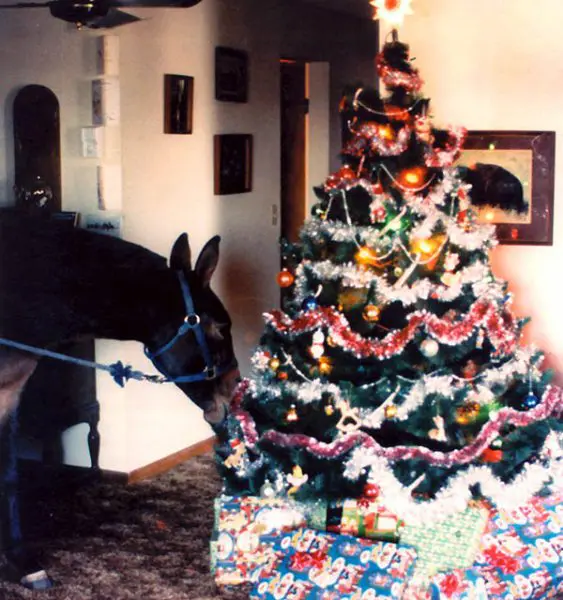
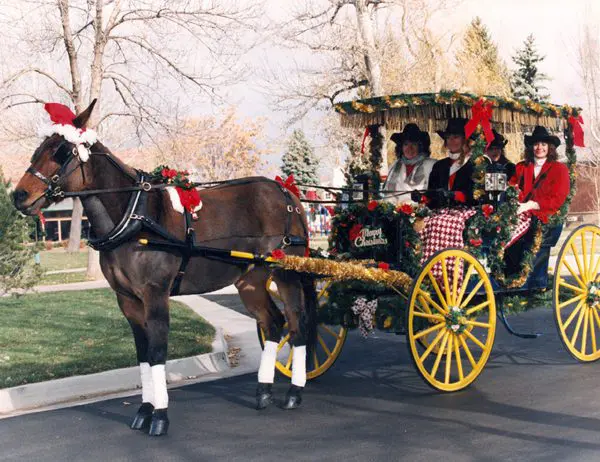 original farmhouse at Lucky Three Ranch, the old floors were sturdier than those in my present home, so the mules were actually allowed to help with the decorating of the Christmas tree!
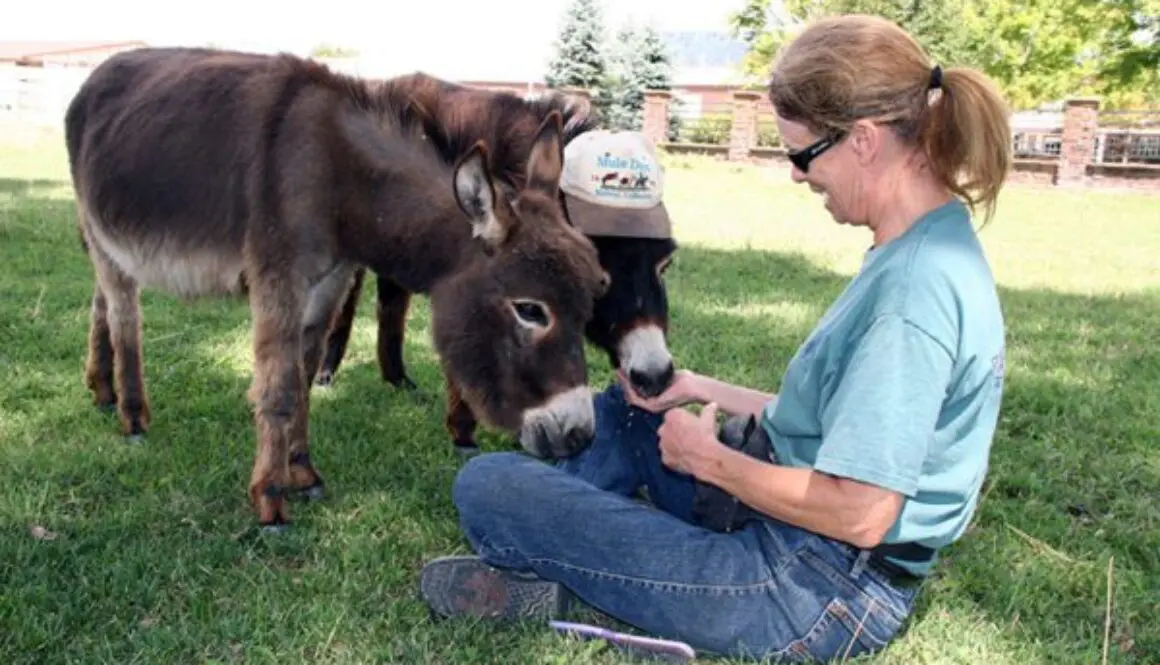
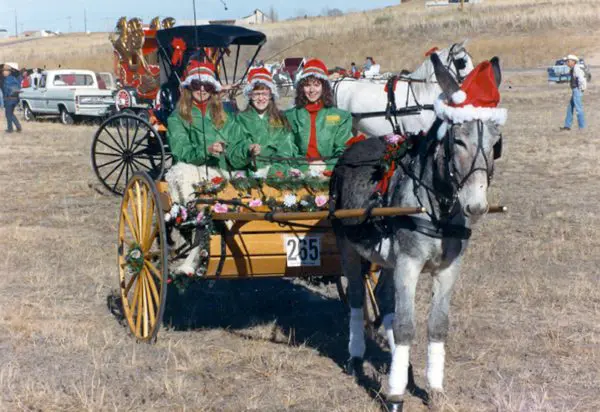 my mules, horses and donkeys became an integral part of each holiday season. My favorite tradition now is the time spent sharing a warm hug with each of my equines and giving them an extra measure of oats on that very special day that we call Christmas!