MULE CROSSING: The Road to Success with your Mule!
By Meredith Hodges
When equines are trained in a logical, consistent and respectful way beginning with detailed lead line training, even “cycling females” is not a problem. Appropriate lessons need to have a logical beginning and be taught in a sequential fashion. The logical beginning in any athletic conditioning program should be to strengthen the core muscles that support bony columns. The length of the lesson and order in which lessons are presented facilitate strength and balance at the core. Adequate length of each stage of training and the way the lessons are delivered instill a sense of security, confidence and trust in the handler that cements the relationship and become part of the equine’s automatic behavior.
 Think of it in terms of teaching children. Children have difficulty learning and paying attention when they have not been eating in a healthy way or exercising properly, when the teacher is unclear in their delivery and the material does not flow together easily, when the teacher moves along too quickly, when there is too much repetition and when they have to stay in one position too long. When the teacher is more aware of the elements of learning, delivers the information in a logical and sequential manner with attention to mental and physical health, and provides solutions, the students will thrive!
We are often in too big of a hurry to ride and do not spend enough time at the lower-level stages of training. We don’t understand the implications of moving along too fast because these animals are so much larger than we are that we can’t imagine that they would have strength, balance and coordination issues that would be counter-productive to our expectations.
How could we even know? There are multiple trainers out there who believe that an equine can be ready to ride in 60-90 days. This is highly publicized and does not afford the average person to think any further than just being able to ride. However, if you ask yourself if you could be ready for a 25-mile marathon in 60-90 days, then the picture starts to become clear…there is much more to think about and it takes much longer to be ready for such activities. You cannot strengthen muscles, balance the body and instill body awareness adequately in this short period of time, and core muscle strength might not be addressed at all!
 Leading training is not just teaching to follow and many people spend too little time on leading training. In leading training, the equine gets the benefit of isometric-type exercises that strengthen the muscles closest to the bone while you work on forward and backward straight lines, smooth arcs through the turns and square halts, all facilitating good balance and proprioception (body awareness). This promotes good core muscle strength that will enable your equine to move to the round pen stage of training and do remarkably well because he won’t be fighting his own awkwardness and lack of balance while trying to balance on the circle at all three gaits.
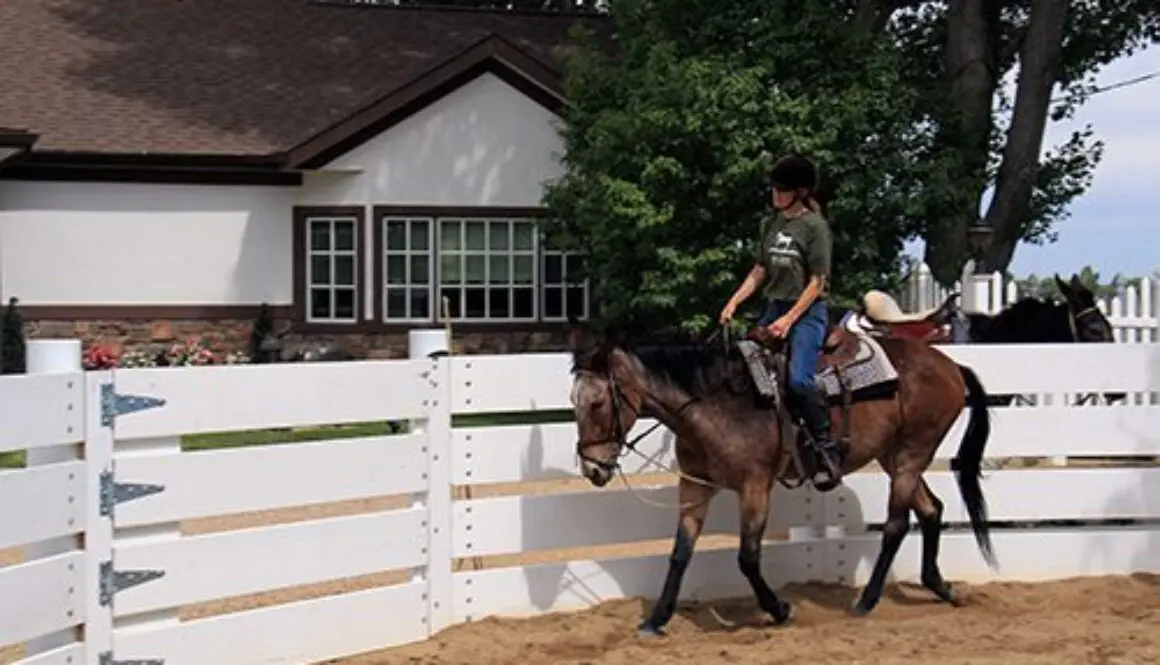
This kind of training requires that you really pay attention to your own good posture and execution of the tasks in leading training. You must be consciously aware of your own posture. Stand straight and tall, holding the lead in your left hand while using the right to keep the animal at your shoulder, not too far forward, not crowding you and not too far back. Wear your fanny pack full of crimped oats (the reward) to keep your equine interested in staying at your shoulder and not lagging behind.
 When you walk, make sure your legs are following the movement of their front legs, stepping forward with your corresponding feet and not stepping any further forward than they do. When you stop, stop with your own feet together (in a balanced fashion), turn and face the equine’s shoulder and square up his feet every single time you stop. This causes the equine to be conscious about balancing weight over all four feet evenly that will result in the balance becoming steadier as the task demands and speed increases.
You can tell your equine is ready to move from the flatwork leading training to the obstacle leading training when you can throw the lead over his neck and you receive his  compliance though all he has learned without you touching him. Next, we add the element of coordination during lead line training over obstacles. The first task of lead line obstacle training would be to introduce the obstacles and ask for reasonable negotiation of the obstacle to instill confidence in the equine and trust in you. The second stage would be to break the obstacles down into smaller steps to manipulate coordination and balance and to instill adequate self carriage through the obstacles.
Taking time to do these exercises correctly at the walk and trot on the lead line will help immensely before the equine goes to round pen training where the exercises become more active and demanding. The core base from which the animal must work will be much stronger and he will be better able to stay erect and bend through his rib cage on the circle in the round pen instead of leaning like a motorcycle.
When we finally do graduate to the round pen, it will become important to maintain good equine posture and balance. When equines are allowed to run freely in the round pen, they naturally get excited and want to hollow their neck and back. This is why we employ the self-correcting device I call the “Elbow Pull.” There are separate ways to adjust this, one is for horses and one is for mules and donkeys. More details about this and leading training can be found in my manual and DVD combo, “Equus Revisited.”
 By the time you finally do ride, your equine will not only be strong, balanced and coordinated enough to do more complicated activities, but if you are unbalanced at all, he will be better able to cope with that as well. This is particularly important with cycling females as they already have a marginal, but normal amount of aches and pains while they cycle. If they are to maintain a good attitude and good balance with a rider, they need good core muscle strength, so they can overcome the normal menstrual aches and pains and deal with the rider in a reasonable way. They will also be more mentally and emotionally tuned into you and less likely to become disengaged. It is my observation that most disobedience is due to a lack of balance whether it is mental, emotional or physical.
With good core muscle strength, even cycling females will be better able to perform to their full potential at the time when you lower your expectations. The level of their mediocre performance will still be higher than most of their competitors. Equine mares are difficult enough, but jennets and mollies that are not trained in this logical way will be distracted, tune you out when they are cycling and revert to their instinctual behaviors like squatting, peeing, clacking their teeth and they will remain “on alert!” This can cause a lot of problems for the handler.
To learn more about Meredith Hodges and her comprehensive all-breed equine training program, visit LuckyThreeRanch.com, MEREDITH HODGES PUBLIC FIGURE Facebook page, or call 1-800-816-7566. Check out her children’s website at JasperTheMule.com. Also, find Meredith on Pinterest, Instagram, MeWe, YouTube and Twitter.
Covered in TRAINING MULES & DONKEY: A LOGICAL APPROACH TO TRAINING, TRAINING WITHOUT RESISTANCE and EQUUS REVISITED at www.luckythreeranchstore.com.
© 2010, 2016, 2024 Lucky Three Ranch, Inc. All Rights Reserved.

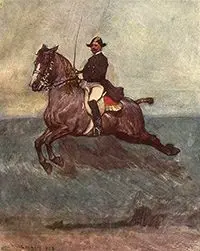 Why does Dressage training lend itself so well to training mules? In order to answer this question, we need to have a clear understanding of what Dressage really means and how it pertains to the mule’s mental and physical development in relationship to our own expectations. When most of us think of Dressage, we picture in our minds those elegant Lipizzaner stallions of the Spanish Riding School in Vienna, Austria.
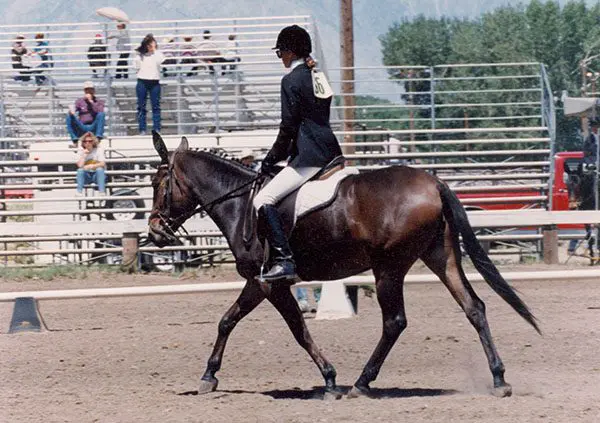 I have found that my mules will exhibit resistant behavior when they are confused or frightened, but never out of “stubbornness.” Often, we take it for granted that, since a young mule can walk, trot, canter, back up, etc. by himself, he should be able to do all these things with us astride. What many people don’t realize is that mules are born with as diverse postures as humans, and there are few mules that will exhibit good equine posture without being constantly reminded. People compensate continually for deficiencies in their own body structure, and posture will vary from person to person and situation to situation. For example, a straight-backed chair will cause most of us to sit up straight, which is healthy for the spine and neck. On the other hand, the sinking comfort of a plush couch will produce a collapsed posture, which can eventually produce sore back and neck muscles. In a similar way, a mule will have to sacrifice his good posture to accommodate an unbalanced and inexperienced rider.
 By taking the time to condition and strengthen their muscles, we allow our mules to engage in physical exercise that is not taxing and painful, thus, keeping their mental attitude fresh and happy. By conditioning your mule in a carefully sequenced pattern of exercises, you will more often avoid the possibility of throwing him off balance and into the confusion and fear that will lead to resistance and disobedience. With your own posture in mind, you can develop the rider and mule as one unit. The process is slow but thorough, and mutually satisfying.
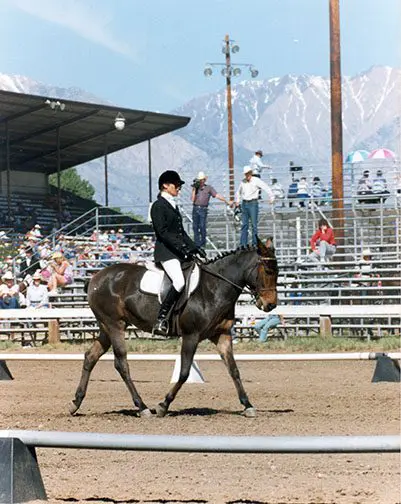 Equipment use plays an important part in the breaking saddle used, but many trainers today will agree that the less complicated equipment is used in the beginning, the better. The Western saddle may certainly be used for breaking but, from the mule’s standpoint, the Western saddle is heavier and there is quite a lot of leather between you and your mule, which can cause a certain amount of interference in communication. If the mule cannot “feel” his rider well, often times a leg or rein aid can come as a surprise and produce a response that is predisposed to resistance. For this reason, I prefer to start training in an all-purpose—or Dressage—saddle. However, I would recommend training in a Western saddle for the less-experienced rider, or if you are training a more easily excitable animal.
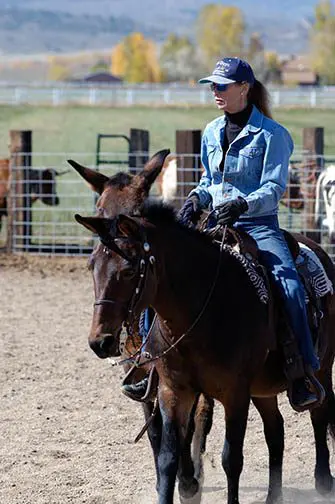 As in any exercise program, it is not advisable to drill and repeat every day. With a mule, as with any athlete, muscles need to be exercised and then allowed rest for a day or two between workouts to avoid serious injury. In between Dressage days, you can take your mule for a simple trail ride or just let him rest. The time-off and a variety of activities will keep him fresh and attentive. Three times a week is usually sufficient, with Dressage training for his proper development and conditioning, two days of simple hacking or trail riding and two days of rest. This also takes the pressure off of you. If you’re not into riding on a particular day, you won’t feel like you have to because your mule will retain his learning without the added stress of drilling day after day. Try to think of your mule’s training in terms of yourself: Would you care to be drilled to exhaustion day after day? How would you feel mentally and physically if you were? Dressage—whether it is basic or the most advanced—is a French word for training. It is thoughtful, considerate and kind, and will produce a mule that is mentally and physically capable of doing anything you might like to do with a relaxed and willing attitude. It may take a little longer, but the result speaks for itself.
 There are so many equine-related products on the market today that it is often difficult to decide which ones you really need and which ones you don’t. For instance, the subject of Splint Boots and Leg Wraps can be very confusing. How do you know when to use them? What types of Leg Wraps or Splint Boots are best? Do they really help? In what ways do they help? What kind of material should they be made from? And the list of questions goes on.
 are also used for support during training. These types of wraps are commonly used during Dressage training and typically only cover the Cannon Bones and not the fetlocks and pasterns. If you use Polo Wraps, or quilted cotton pads and wraps, learn to wrap them correctly to avoid pressure points that could cause circulation problems. Begin the wrap by placing the quilted pad or cotton pad in place around the Cannon Bone. Start the wrap at the center of the Cannon Bone, measure the tension on the wrap to make sure it does not interfere with circulation, that it is just snug and wrap down to the Fetlock joint. Then wrap upwards to just below the knee and Velcro the wrap in place. To keep the wrap from sliding down, use Duct tape just below the knee with one rotation of a tighter wrap to keep it in place. Consult with a professional to learn the proper wrapping technique. It is usually a hands-on lesson with a lot of practice! When they have lost their elasticity, it is time to throw them out.
 After his basic training, when your equine is participating in more stressful activities such as Jumping, Endurance, Reining and Racing (or in the case of an injury), it may become necessary to use a more supportive boot to lightly support already conditioned muscles and tendons. Support boots are designed to provide even support over the entire area that they cover. Be careful that they are neither too tight, nor too loose. You don’t want the boots so tight that they cut off the blood supply to the covered area, or not flexible enough to allow the joints to move freely. However, you don’t want them so loose that they ride down the legs.
 lameness if damaged, even by a small, seemingly insignificant cut or bump. If a hoof is unusually dry, severe cracks can occur. It is advisable to routinely use a hoof dressing in addition to the “Bell Boots’ to prevent traumatic cracking during repeated concussion.
 You might be asking yourself, “How can I tell a minimal support boot from a fully-functional medical support boot?” This can be quite confusing considering all the different kinds of leg wraps and splint boots that are out there. Some even look identical, but are not. Off-brand Splint Boots look a lot like Pro Choice Splint Boots, but they are made from inferior-quality materials that do not afford the degree of support and flexibility needed for successful therapy. Although these off-brands are designed for support and do cover the joints, they should be considered as more of a protective boot than a Therapeutic Boot. Splint Boots are strictly for the protection of the Cannon Bones because they do not cover the joints and offer very little support.



.jpeg)