MULE CROSSING: Owning an Equine Is Serious Business, Part 2
By Meredith Hodges
As discussed in Part 1 of this article, there are many realistic and very important steps to choosing, housing and caring for an equine. Let’s begin at the beginning … BEFORE you make a purchase.
TIP: Before you buy your equine, take the time to educate yourself with books and DVDs. Knowledge is your most powerful tool.
Here is a checklist of things to consider BEFORE you buy:
- Consult with knowledgeable professionals who can help you get started on the right foot.
- Pick your equine for not only his particular athletic potential, but for his compatibility with your own personality.
- Carefully choose your vet and farrier ahead of the time of your purchase.
- When you are ready to buy, bring along a qualified professional to look at any animals in which you may be potentially interested.
- When choosing your equine, ask the seller to demonstrate to you what the equine does, and then ask if you can ride him, doing the same moves yourself to make sure the animal will perform for more than just the seller.
- Check the animal for any unsoundness and signs of tranquilizers or other drugs.
- Ask the owner to load and unload the equine into and out of a trailer.
- Make sure registration papers and health records are in order and up to date.
- Get a pre-purchase exam from your veterinarian.
 Once your animal is home, make sure that:
- He has adequate shelter, good nutrition and a routine he can count on.
- There is a safely fenced, two-acre area per equine for turnout, along with adequate shelter from the elements.
- He is given feed that is appropriate for normal growth.
- Feeding is done at the same time each day, both in the morning and in the evening—without fail.
- You visit the barn twice every day in order to check your equine from head to tail, making sure that he has not injured himself and that he is not getting sick.
Become familiar with the first signs of possible illness:
- Is your equine eager to see you—alert and attentive, with bright eyes and ears perked in your direction—or is he sullen and lethargic?
- Does he go after his food immediately and chew with regularity?
- Does he appear to have been rolling on the ground? (If so, is he still eating well?)
- Is the manure a healthy color and consistency, and is there the usual amount of manure and urine? (If there is an abrupt change in amount or appearance, call your veterinarian.)
- Is your equine sweating? (If he is, is it just the weather, or is it an elevation in his temperature?)
- How is he moving? (Does he have regularity of gait, or is he exhibiting any lameness?)
- Check the eyes, ears and nostrils for discharge or any other irritations. (If there is any discharge, is it clear and minimal, or is it thick and yellowish or bloody?)
- Check the hooves for any cracks, stress rings or abnormalities in the foot. (How fast is the foot growing? Is the foot growing faster or slower than usual? Is he maintaining the proper angles in the feet? Prepare for farrier visits accordingly.)
- Check the water and trace mineral salt block. (Is the water clean and free from debris? Has the salt block been used? If so, how much?)
 To keep flies and other insects under control:
- Feed the right kinds of healthy feed.
- Keep water sources clean and fresh.
- Daily—clean all stalls, pens and sheds so that they are free of manure, and add fresh bedding of straw or shavings, as needed.
- Periodically—clean your barn with a disinfectant.
- Keep all tack and equipment clean.
- Each time you leave the tack room, spray for any residual flies, using a household spray made specifically for flying insects.
- Keep manure collection piles well away from the barns and your house. (I suggest having manure hauled away weekly). Putting manure on pastures will only invite weeds to take over.
- Regularly groom once a week to remove excess hair, mud, etc. This will help to eliminate places on your animal (including his legs), that may be a target for egg-laying insects.
- For sores, scabs or bumps, use Neosporin. If these are severe, use Panalog—also called Animax or Dermalone—by prescription from your vet.
- Do not clip the hair inside the ears.
- Do not clip the hair on the legs (unless you absolutely must for showing).
- Use Johnson’s baby oil on the manes and tails.This helps to keep the flies at bay and will also keep other animals from chewing on each other’s manes and tails.
- Use Farnam brand Tri-Tech 14 fly spray once a week (it lasts the longest). This helps to control bugs and insects that can pester your equine, especially during warm weather. (I have found that herbal remedies do not seem to work as well.)
- Use fly masks that have holes for the ears for those equines that have sensitive skin and/or are sentive around the facial area. The fly masks that have ears built in often do not comfortably fit donkeys and mules.
Farnam Super Masks will usually fit most equines.You can find them in most tack and vet stores.
NOTE: To further prevent the infestation of parasites, fields and pastures should be harrowed in the spring and the fall, and between hay cuttings.
 Finding a good veterinarian and farrier is paramount to the health of your equine. You will need to find out which vaccinations are needed for your area, and schedule the spring vaccinations accordingly. If you are not a skilled, experienced equine person, it is best to have your veterinarian administer these vaccines for you, as sometimes certain animals can have adverse reactions to them. (Many inexperienced owners administer shots and other medications because they want to save money, but this can often result in adverse reactions and, consequentially, higher vet bills.)
Don’t be afraid to ask questions and encourage your veterinarian to help you to learn veterinary maintenance that you can do yourself. Most good veterinarians are happy to do this, as it frees them up to tend to the more serious cases in their practice. I would be suspicious of a vet who is reluctant to discuss the health of your equine with you.
Here’s a “health support team” checklist:
- Is the vet you are using allowing you to ask questions about your equine?
- Is he or she asking you questions about your equine, as well?
- Is there open communication between you and all the members of your equine’s support team?
- Do the vet, farrier, equine chiropractor, massage therapist and any other professionals involved in the welfare of your equine communicate well with each other?
NOTE: The overall focus should always be the health of the equine patient, including a cooperative effort from his health support team.
Now that you have a good idea of what it takes, on a daily basis, to properly manage your equine and his environment, you’re well on your way to reaching your goal of being a knowledgable, responsible equine owner. In Part 3 of this article, we will cover the responsibilities associated with your equine in preparation for future athletic activities.
To learn more about Meredith Hodges and her comprehensive all-breed equine training program, visit LuckyThreeRanch.com, MEREDITH HODGES PUBLIC FIGURE Facebook page, or call 1-800-816-7566. Check out her children’s website at JasperTheMule.com. Also, find Meredith on Pinterest, Instagram, MeWe, YouTube and Twitter.
Covered in TRAINING MULES & DONKEY: A LOGICAL APPROACH TO TRAINING, TRAINING WITHOUT RESISTANCE, EQUUS REVISITED and A GUIDE TO RAISING & SHOWING MULES at www.luckythreeranchstore.com.
© 2012, 2016, 2018, 2024 Lucky Three Ranch, Inc. All Rights Reserved.

 What kind of equine handler are you? When interacting with your Longears or any equine, are you an observer or a participant? Are you fully aware of the reasons for your equine’s behaviors? Behavior in general is most often motivated by a stimulus that elicits a response, yet the early years of physiological development are most dependent on heredity. Heredity includes not only physical characteristics, but mental, emotional and instinctual behaviors as well. We are taught that if an equine’s knees are beginning to fuse, he is ready for training. Is the animal really ready for training just because his knees are beginning to fuse? Physical development is called maturation, and we often determine the equine’s capabilities by maturation alone, with no consideration for the whole animal.
 When the stallion signals danger, it is this mare that will lead the herd, while the stallion generally brings up the rear. During estrus, the mare cycles every 21 days during the warmer months of the year. The mare accepts the stallion for only seven days out of the 21-day cycle. The stallion may cover her several times during that period and will do the same with the other mares in the herd. Not all mares will accept the advances of the stallion at certain times and, because they are as different as people are in their genetic makeup, not all of them will become pregnant every time.
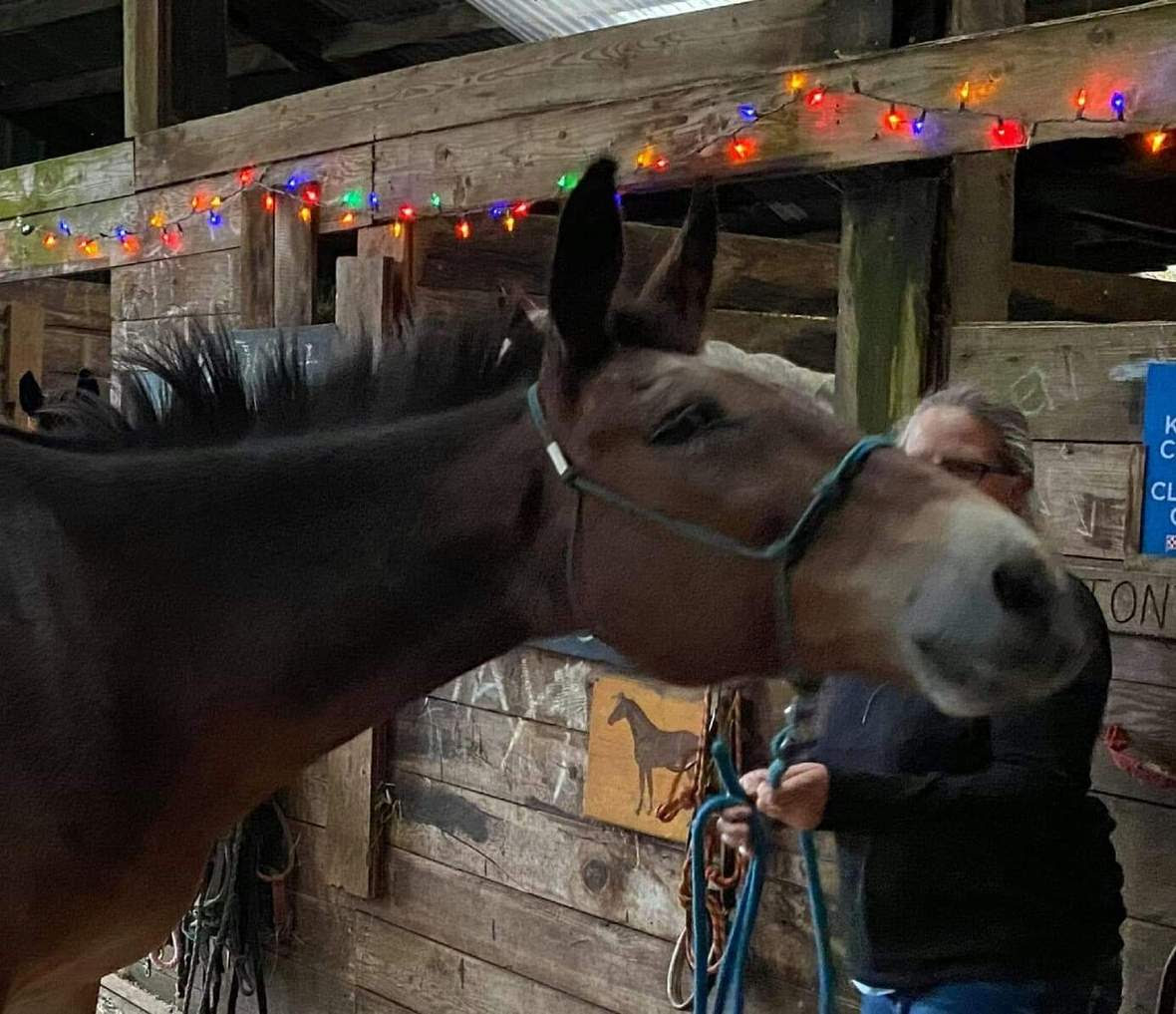
 A mule will pin its ears when it is concentrating very hard and when it is following you and wants attention. Mules and donkeys are basically very friendly and rarely lay their ears flat back in pure anger like a horse will. When they are angry, you will know it. Scratching in different areas will produce different results. If you scratch their jowls, for instance, they may perk their ears forward, but when you rub their forehead, they will lay their ears back. If you scratch the insides of the ears, some will like it and tilt the head sideways with quivering eyebrows while others will jerk away at your impolite intrusion.
 At first, Arabian horses were thought to be silly and difficult—not the ideal mount for the common man. Later, the intelligence of the Arabian was discovered and explained by saying that, because the Arabian’s eyes are set lower in the head and the forehead is broader than most other equines, there is more brain space in the skull. This is also true of most mules and, particularly, Arabian mules. Once man believed in the equine’s intelligence and had a scientific reason for it, training was modified and approached a little differently. Man was then able to learn even more about the horses he was training. It wasn’t long before man discovered that this didn’t always hold true and there had to be more to consider when assessing the whole human being and, consequently, the whole horse.



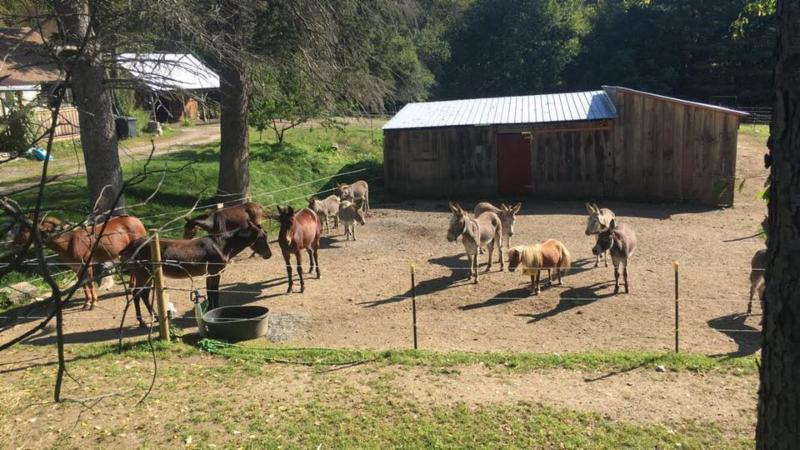 a lazy day at the rescue
 Hannah with her assistant, Daisy… sporting the shades.