Ely, Nevada (October 14, 2015). . . The American Wild Horse Preservation Campaign (AWHPC) today blasted the Bureau of Land Management (BLM) for ignoring scientific advice and environmental complaints in its decision to proceed with the use of an experimental fertility control vaccine on wild horses in the Antelope Herd Management Area (HMA) in eastern Nevada.
Last month, AWHPC filed a complaint with the White House Council on Environmental Quality (CEQ) against the BLM to stop a precedent-setting plan to use the experimental drug, known as GonaCon, for the first time ever on federally protected wild horses. The long- term effects of the vaccine on wild horses are unknown, and the National Academy of Sciences recommended that more research was needed on GonaCon’s impacts on wild horse behavior before being used in wild horse populations.
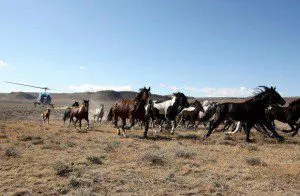
The Bureau of Land Management (BLM) is planning a mega roundup of wild horses in the Beatys Butte Herd Management Area (HMA) in southern Oregon later this month. The roundup will shatter the lives of 1,500 wild horses and cost American taxpayers as much as $76 million for the helicopter stampede and lifetime warehousing of captured mustangs in government holding facilities!
This massive roundup is being conducted to appease ranchers in the Beatys Butte Grazing Association, who graze their livestock on our public lands at taxpayer-subsidized rates. This small group of ranchers has been pressuring the BLM to remove horses so they can graze more cattle in the same public lands area.
Please take a stand today! Your signatures will be hand delivered later this month to the Oregon BLM at a joint meeting of the agency’s citizen advisory boards that oversee most of the wild horse areas in the state.
On September 24, 2015, AWHPC’s law firm, Meyer Glitzenstein & Eubanks, filed a complaint on our behalf with the White House Council on Environmental Quality (CEQ) against the BLM to stop a precedent-setting plan to use an experimental fertility control vaccine on wild horses in the Antelope HMA in eastern Nevada. Unlike the PZP fertility control vaccine, which has been studied and used for more than two decades, the vaccine in question, known as GonaCon, has never been adequately studied in horses. The National Academy of Sciences itself concluded, “Further studies of behavioral effects of [GonaCon] are needed.”
The long-term effects of GonaCon on horses are unknown, but include potential behavioral impacts that will change the social dynamics and organization of wild horse herds, and miscarriage if the vaccine is administered to mares in the early stages of pregnancy. The agency’s plan to use GonaCon for the first-time ever on wild horses under BLM management without scientific study is unjustified. As a result, AWHPC is calling upon the CEQ to prohibit the BLM from using GonaCon in wild mares in the absence of a formal scientific study that accurately collects and analyzes data on the physiological and behavioral effects of the vaccine on horses.
RENO, NEVADA (September 28, 2015) … Pershing County and six public lands ranchers today dropped their lawsuit against the Bureau of Land Management (BLM) seeking the removal of hundreds of wild horses from public lands in the area. The ranchers and the BLM entered into a private settlement agreement that does not commit the government to any action. The agreement merely creates a drawn-out schedule over several years during which time the BLM is to consider the removal of wild horses from 16 wild horse habitat areas that overlap public lands utilized by the ranchers for grazing their privately-owned livestock. This dismissal comes three months after the American Wild Horse Preservation Campaign (AWHPC) and Pershing County property owner Debra Davenport were granted intervenor status in the case.
“This agreement is not court sanctioned and is little more than a face-saving way for the ranchers and local government to drop a lawsuit that had no legal merit and was bound to be dismissed by the court,” said Deniz Bolbol, AWHPC spokesperson. “The BLM should not reward ranchers for filing meritless lawsuits by prioritizing the removal of horses from the public lands at issue. Rather, the BLM should focus on humane on-the-range management and fulfilling its legal mandate to protect all wild horses and burros on our public lands in the West. Prioritizing removal of horses in these areas will simply encourage more baseless legal actions by ranchers and their local government allies.”
The lawsuit sought to force the BLM to immediately round up hundreds of wild horses from Congressionally designated wild horse habitat on public lands in Pershing County, Nevada.
The lawsuit was part of an attempt by ranchers, who view mustangs as competition for cheap taxpayer-subsidized grazing on public lands, to use the court system to compel the BLM to remove more wild horses from the range. To date, AWHPC has intervened in five of these cases. Earlier this year, Judge Du granted AWHPC’s motion to dismiss a similar case filed by the Nevada Association of Counties against the BLM, and the U.S. District Court in Wyoming granted AWHPC’s motion to dismiss the State of Wyoming’s lawsuit against the BLM seeking the removal of thousands of wild horses from the range.
The Bureau of Land Management (BLM) is accepting public comments on an environmental analysis (EA) of a massive helicopter roundup and removal of nearly 2,000 wild horses living in Wyoming’s Red Desert Complex, which includes the Antelope Hills, Crooks Mountain, Green Mountain, Lost Creek and Stewart Creek Herd Management Areas (HMAs). The action would leave behind just 480 horses on this 700,000-acre (more than 1,000-square-mile) public lands area!
The EA ignores over 6,000 public scoping comments submitted earlier this year calling for the humane management of Red Desert wild horses on the range with PZP fertility control, and for humane capture methods, instead of using helicopters to chase horses into holding pens. Alternative 2 — the Proposed Action in the EA — calls for removal of over 1,700 wild horses from the Complex — that’s 45% of the total estimated mustang population in the entire state — and includes the token application of PZP fertility control to just 23 mares.Alternative 1, a second alternative analyzed but not proposed in the EA, would more fully utilize fertility control and return more wild horses to the range, but would still permanently remove approximately 830 wild horses from the Complex. Both alternatives call for using traumatic helicopter capture methods.
It’s time to take a stand for Wyoming’s wild horses. We must insist that the BLM stop ignoring the public andstart humanely managing the Red Desert wild horses on the range, allowing the horses within the HMAs to remain where they are on our public lands! The BLM should raise the “Appropriate” Management Levels (AMLs) for the Red Desert Complex wild horse populations. The BLM must fairly allocate range resources to ensure that wildlife — including wild horses — have a fair share of the forage on our public lands, rather than giving exorbitant resources to the privately-owned cattle and sheep operations.
The following update from is from AWHP, written by Suzanne Roy
The BLM held its second, and final, Wild Horse and Burro Advisory Board meeting of 2015 on September 2nd and 3rd in Oklahoma City, OK. Of all the board meetings I have attended since 2009, this was by far the most ominous. Emboldened by years of BLM’s crisis-creating, the pro-slaughter majority on this board is now openly endorsing slaughter as a solution to the BLM’s budget woes. These members, who overwhelmingly represent livestock interests, are also aiming to reduce wild horse numbers below the already ridiculously low allowable population levels.
The BLM Wild Horse and Burro (WH&B) program, under the leadership of Dean Bolstad, a long-time BLM bureaucrat, seems only happy to comply. In fact, after the pro-slaughter board members spoke explicitly about the need to overturn Congressional ban that prevents the BLM from selling wild horses and burros for slaughter, Bolstad commented that, of the 49 board meetings he has attended since 2003, this was the best one yet.
In 2013, the National Academy of Sciences evaluated the BLM’s WH&B Program and concluded that “continuation of ‘business as usual’ practices will be expensive and unproductive for the BLM and the public it serves.” Undaunted by this warning, the BLM is continuing down the same destructive path, announcing at the meeting:
Expansion of helicopter roundup contracts to include three companies, including Sun J Livestock, which was found previously to have engaged in “unprofessional” conduct, including the electro-shocking of wild horses.
Scaling up removals under the guise of sage grouse protection.
Spending over 70% of the budget to round up and warehouse horses, while continuing to spend less than 1% on humane fertility control to manage wild horse populations on the range.
Spending millions on research, much of which is aimed at perfecting techniques to permanently sterilize wild horses on the range.
Meeting with Congress to share its self-inflicted budget woes, with the goal of overturning the ban on selling captured wild horses and burros “without limitation” that would enable kill buyers to purchase large numbers of wild horses and burros for slaughter.
ZEROING OUT ENTIRE WILD HORSE HERD NOT VIEWED AS CONSTITUTING “IRREPARABLE HARM.”
Washington, DC (Sept. 15, 2015) – Today, Federal Judge Christopher R. Cooper denied a Preliminary Injunction to stop the Bureau of Land Management (BLM) from carrying out its decades old quest to remove the entire West Douglas wild horse herd. Tomorrow the BLM will begin a helicopter roundup and removal of wild horses in and around the herd area with the ultimate goal of zeroing out the herd (area).
The lawsuit was brought by The Cloud Foundation (TCF), Wild Horse Freedom Federation (WHFF), The Colorado Wild Horse and Burro Coalition (CWHBC), Dr. Don Moore and Toni Moore of Fruita, CO., and Barb Flores of Greeley, CO, to protect this herd and the neighboring Piceance East Douglas herd. “Sadly,” states Toni Moore, “the courts did not view the loss of an entire herd of wild horses as ‘irreparable harm.’ “
“Wiping out the West Douglas herd erases a whole distinct set of genetics, separate from nearby East Douglas horses,” states Linda Hanick, TCF Board member who testified in the Sept. 11 hearing on the case. “The roundup disregards the importance of the historic recorded documentation of these horses since Sept 1776. This roundup closes the door on an important piece of Colorado’s wild horse history.”
“We’re very disappointed of course,” states Ginger Kathrens, Executive Director of TCF. “Wild horse families that have shared a history with this rugged Colorado landscape for hundreds of years will be swept away, while the real public land destroyers, the thousands of head of welfare livestock remain. It is terribly unfair, but we continue to fight for those wild herds that remain!”
“Rangeland impact of livestock in West Douglas is greater than 10 times the impact of wild horses,” states Barb Flores, plaintiff in the case who also testified in the Sept. 11 hearing. “Both use the area year round. While cattle are moved from pasture to pasture, wild horses migrate throughout the herd area on their own.”
The Bureau of Land Management (BLM) currently is accepting public comments on a plan to expand the Bald Mountain mining operation that will affect the wild horses living in the Triple B Herd Management Area (HMA) in White Pine County, Nevada. The proposed action will permanently remove 1,210 acres of already scarce vegetation available for wild horses, temporarily remove an additional 6,879 acres of currently available forage, reduce the amount of water available for wild horse use, increase the size of the area negatively impacted by human activity and noise, and pose a risk to wild horse safety and health by either physical injury or exposure to poisonous mercury and cyanide contamination, which is a byproduct of gold mining.
ORPHAN UPDATE – Lil Bit is doing wonderfully. Her cast has been working and she is improving a little bit each day. We want to thank y’all as we have raised approximately half of her vet bills.
Cowboy is doing better. Due to the fact that he could not travel due to health issues, we were amazed and so thankful that by the time we could bring him to NV, we did not even need to do his casts on his legs. He will need some extremely delicate hoof trimming and some special supplements and meds, but his outlook seems to be much better than was expected. He is the baby that the local vet said might need to be euthanized. However our specialty is the critical foal care and we work so very hard on the “hopeless” cases that God puts in front of us. We do not search them out, but I truly believe, and our rescue is based on my belief that if God puts an injured creature in front of you, you darn well better give it the best care you can.
We spent the last couple of days transferring panels over to the new property we will be leasing for the 55 wild horses. The Let ’em Run Foundation has donated the use of all of their panels and a shelter to be used by the 55 Wild horses and the babies. There are several adoptions in the process and we will update you as soon as we have all the details. We are still needing lots of forever homes for these guys, but in the meantime we need to have the funds to support and care for them. It is an amazing property with tons of water. In this area and with the ongoing drought, the water alone is worth gold. Unfortunately, we will need to do a lot of repair on the fencing.
For the first time ever, the Bureau of Land Management (BLM) is proposing to convert a wild, free-roaming mustang population into a non-reproducing herd of sterilized horses. The BLM Idaho plan for the Saylor Creek Herd Management Area (HMA) would destroy the wild horses’ wild, free-roaming behaviors and is a recipe for managing this beautiful wild horse herd to extinction. If implemented, it would set a dangerous precedent for destroying healthy, sustainable wild horse populations into sterilized groups of horses that will die off. AWHPC’s formal protest of this destructive and devastating plan is pending, but we need the public to weigh in to help Keep the Saylor Creek Wild Horses Wild! Take action and sign the petition.
The following story is by Heidi Rucki of the Examiner.com.
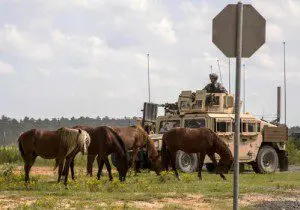
Lately it seems that horses are often in the news, and horses have become the unwary targets of the clash of human land use versus their simple animal existence. Any time horses become magnets of such attention, they frequently do not fare well. Information coming from the U.S. Army on Aug. 12 and 13 has riveted attention on about 700 “feral” horses roaming on thousands of acres in Louisiana on lands used by the army during training exercises. The horses are increasingly considered “nuisance animals” because they may pose a kicking or biting danger or leave random piles of manure.
Fort Polk spokesperson Kim Reischling says that the intense military training of troops has to pause until the horses are “shooed away.” They leave behind horse manure in the areas used by soldiers. The training area is about 90 miles northwest of Lafayette, LA, and around 20 miles from the Texas state line. Most of the horses are located on 48,000 acres of the 90,000 acres of forest land that are used for training purposes.
The Bureau of Land Management (BLM) Summer 2015 roundup season is underway. Newly captured wild horses and burros will be added to the nearly 50,000 currently stockpiled in holding facilities. Of note is the BLM removal numbers are significantly lower than those of previous years, which is largely the result of BLM’s inability to remove larger numbers of horses due to lack of holding space. This situation creates an opportunity, and should make it necessary, for the BLM to increase the use of humane fertility control as an alternative to removing massive numbers of wild horses and burros from the range. However, the agency continues to fight against making progress towards creating a humane and sustainable on-the-range management program.


 The Bureau of Land Management (BLM) is planning a mega roundup of wild horses in the Beatys Butte Herd Management Area (HMA) in southern Oregon later this month. The roundup will shatter the lives of 1,500 wild horses and cost American taxpayers as much as $76 million for the helicopter stampede and lifetime warehousing of captured mustangs in government holding facilities!


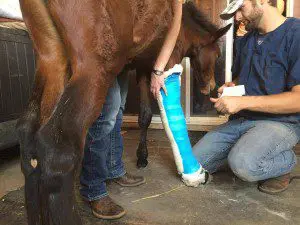 ORPHAN UPDATE – Lil Bit is doing wonderfully. Her cast has been working and she is improving a little bit each day. We want to thank y’all as we have raised approximately half of her vet bills.
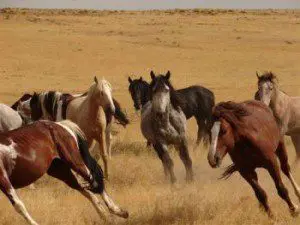 For the first time ever, the Bureau of Land Management (BLM) is proposing to convert a wild, free-roaming mustang population into a non-reproducing herd of sterilized horses. The BLM Idaho plan for the Saylor Creek Herd Management Area (HMA) would destroy the wild horses’ wild, free-roaming behaviors and is a recipe for managing this beautiful wild horse herd to extinction. If implemented, it would set a dangerous precedent for destroying healthy, sustainable wild horse populations into sterilized groups of horses that will die off. AWHPC’s formal protest of this destructive and devastating plan is pending, but we need the public to weigh in to help Keep the Saylor Creek Wild Horses Wild! Take action and sign the petition.