MULE CROSSING: Judging a Show
By Meredith Hodges
 Being asked to judge a show is both an honor and a tremendous responsibility. Just being asked to judge indicates that you have a reputation for being a knowledgeable and respected person in your field of expertise. Accepting the invitation to judge means that you are willing to share this knowledge and expertise with people who may, or may not, accept IT or you! Exhibitors can say that each show reflects only one “man’s” (judge’s) opinion, so not to worry if you don’t do well. As an exhibitor and a judge, this bothers me a little.
If the basics of Horsemanship, or Mulemanship, remain constant, then the consistency among judges should also remain fairly consistent with only a little variation from judge to judge. The variation in placements should be determined by the performance of t he exhibitors and not by the personal opinions of the judge. The judge should be a catalyst toward better learning and performance. He or she should try to make their knowledge readily available to inquiring exhibitors and be diplomatic enough about its delivery to inspire and encourage exhibitors to improve their skills. In turn, the exhibitors will be better equipped to exhibit their animals in a favorable light to the public at large and to grow into knowledgeable experts themselves with time and experience.
A good judge serves three major interests: that of his own conscience, that of his exhibitors, and that of the spectators. He must know all the rules and regulations pertaining to the classes to be judged and be willing to select the best animals for the purpose described by the conditions of the classes. He should be  objective in his decisions and be able to back them up with reasonable and knowledgeable explanations that will inspire exhibitors to work harder and learn more. He should have a congenial attitude that invites exhibitors to question and learn freely without intimidation.
Judges are human too, and for this reason judges are restricted from judging people and animals that are in some manner closely related to him. This enables the judge to maintain his objectivity and adds more 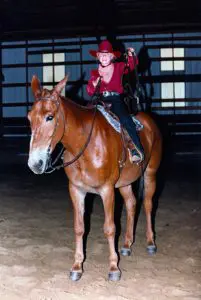 credence to his final decisions. In my opinion, judges should assist in helping exhibitors realize their full potential by helping them to improve their skills through fair, just, and educated decisions. A good judge needs to serve the idea of better learning for the sake of health, wealth, happiness, and above all, safety! A judge can be the catalyst toward learning and self-satisfaction, or he can be the catalyst toward defeat and discouragement. I prefer to be the former, encouraging exhibitors to come to me with their questions and also encouraging them to learn from each other. In our Longears industry, the ideal scenario would be to have exhibitors work at home and with each other perfecting their Mulemanship skills, bring those exhibitions of skills to a show to be judged, then return home with a feeling of accomplishment and more things to work on until the next show and the next judge. To perpetuate the learning process and to continue to learn and improve himself should be a judge’s main objective.
The Mule Skinner’s Classic held June 30-July 1 in Haines, Oregon, was a good example about what I am talking. Never before have I encountered an entire division of youth with such a thirst for knowledge and a desire for good sportsmanship, no doubt inspired by the adults. Application of good Mulemanship skills was prevalent and 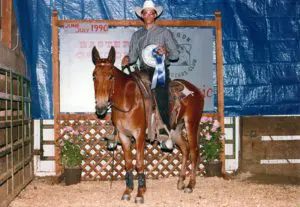 the mules and donkeys reflected this exceptional conditioning, care and handling. The show itself was obviously handled carefully and with attention to detail, leaving little margin for error or dispute. It is not really too surprising that a group such as this was able to elicit tremendous support from sponsors in their area. Their hard work and hospitality is to be appreciated and congratulated. It said a lot for the kind of people that we have in our industry – that we can all have a good time learning and showing together with our marvelous Longears, amateurs and professionals, exhibitors and judges alike! The whole idea is that each and every one of us has something to offer and something we can learn. To attend a show and to learn something new is to return home renewed and fulfilled, even though you haven’t won. To win without this mutual admiration, goodwill and learning is just another hollow victory!
There were no losers in Haines, only sixth, seventh, and eighth, etc. places! Those who weren’t doing as well as they had expected didn’t make excuses or try to assign undue blame. They realized that everyone has bad days and unforeseen disasters from time to time and it doesn’t mean you’re a lousy rider or trainer, or that you have a lousy Longears. Those who had mishaps or misfortunes were readily comforted by other friends and competitors. The ambiance of the entire weekend show was one of learning and camaraderie. If we can keep this perspective in our industry, perhaps we can avoid the politics that have nearly destroyed the horse industry and continue to enjoy the overwhelming potential of our longeared friends while improving our own skills and allowing ourselves personal growth.
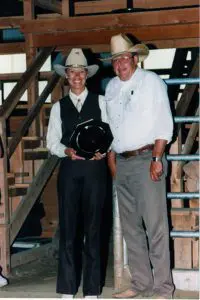 Everyone learned something at the Oregon Mr. Longears Mule Skinner Classic, including the judge! Dick and Debbie Cress and Alan and Elaine Case are to be heartily congratulated for their exceptional efforts in putting on a successful show and for taking wonderful care of this judge! Thank you to all of you who gave your time and efforts to work on the show and make it run as smoothly as it did! Thank you Larry and Fran Howe for coming with me from Colorado to help judge the packing classes and for helping to Ring Steward and to Gary Hodges for his fine photography! My deepest congratulations go to all the exhibitors for a superb effort. Keep up the good work! Thanks to our announcer Roger Harrison. And a very special congratulations to all of our Mule Skinner Classic Champions!
To learn more about Meredith Hodges and her comprehensive all-breed equine training program, visit LuckyThreeRanch.com, MEREDITH HODGES PUBLIC FIGURE Facebook page, or call 1-800-816-7566. Check out her children’s website at JasperTheMule.com. Also, find Meredith on Pinterest, Instagram, MeWe, YouTube and Twitter.
Covered in TRAINING MULES & DONKEY: A LOGICAL APPROACH TO TRAINING, TRAINING WITHOUT RESISTANCE, EQUUS REVISITED and A GUIDE TO RAISING & SHOWING MULES at www.luckythreeranchstore.com.
© 1990, 2016, 2024 Lucky Three Ranch, Inc. All Rights Reserved.

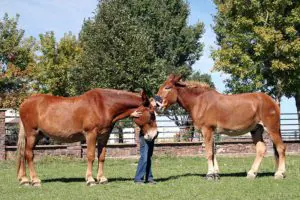 When I was growing up, my grandmother constantly reminded me of the importance of good manners. She would say, “You will never get anywhere of any consequence in this world without good manners!” And she would add, “Without good posture and proper dress, you won’t live long enough to enjoy it!” She made me read Emily Post’s Book of Etiquette from cover to cover. In retrospect, although reading the entire book was a real chore, the respect for good manners that she passed on to me has been an extremely valuable gem in my training experience with equines.
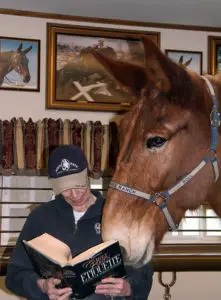 I think that the concept of combining equine training techniques with lessons in good manners is one that many people do not pay as much attention to these days as they probably should. Putting an equine in good posture with respect to his physical comfort is the most obvious form of good manners when communicating with your equine. When you apply the elements of good manners during the training process, you facilitate body and verbal language that equines really appreciate, and when you apply your own good manners and teach good manners to your equine from the very beginning of the training process, you can continue to move forward much more easily than if you do not incorporate good manners between you and your equine. When you run into resistance from your equine, take it as a red flag that you’re missing something in your communication with your animal and change your approach.
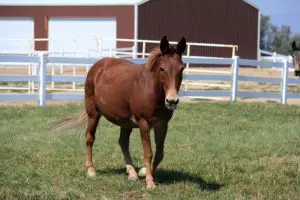 If your equine spends most of his time in the pasture, the good manners of promptness and reliability on your part are critical, as it is the only time you will have during the day to really spend time with him, and he’ll count on you to show up on time each day. What you’ll get out of being prompt at feeding times is a self-discipline that will carry over into everything that you do and will determine whether or not you are a reliable partner in the relationship with your equine. When you feed the oats mixture at night and none in the morning, it gives your equine a reason to come to you after breakfast when you offer oats to catch him, and gives him a reason to come back in off the pasture after being turned out for only a short time in the spring when pasture time needs to be limited. Doing something when it is convenient rather than considering the equine’s need for reliability in the trainer is a recipe for chaos and causes anxiety in both the equine and the trainer. However, having a predictable structure to your routine will allow both you and your equine to remain calm and clear in your communication with each other.
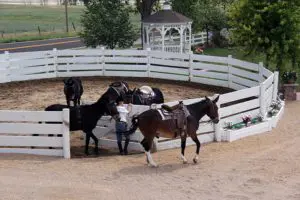 If you want your equine to come to you, rather than chasing him, simply stand at the gate or doorway and ask him to come to you, offering the oats reward when he does. If you are kind, patient and consistent, he will most likely always oblige you.
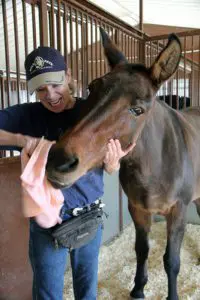 the others for standing back after you have rewarded the one you want for allowing you to halter him. This will also avoid anxiety in the one you are haltering, because he knows you will protect him and wave back the others who might otherwise crowd him or kick at him. The ones you wave back will learn that if they comply, a reward is coming.
 Being in good posture feels good to all of us and allows all the organs in the body to work correctly. When one is comfortable and amply prepared for physical activity, it is always more enjoyable. This is no different for equines. When you don’t consistently pay attention to your own good posture, neither will your equine pay attention to his. His movements will tend to be difficult and unpleasant, and the relationship between the two of you may begin to erode. But when your equine is encouraged to be in good posture during training, it feels good to him and, over time, will become his normal way of moving and resting. He will also be grateful for your kindness and consideration, and he will look forward to the activities he gets to do and the time he spends with you. When you pay attention to your own good posture right from the beginning of leading training and every time you work with your equine, he will be able to mirror your good posture. The result will be his own good posture, which will result in more comfort for him.
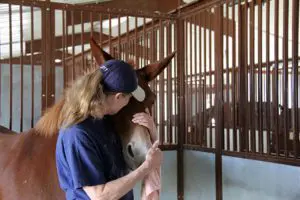 There will be times when it is necessary to employ negative reinforcement to stop bad behaviors that can escalate and become truly dangerous behaviors before they become persistent and uncontrollable. These corrections, which are covered in DVD #2 of my
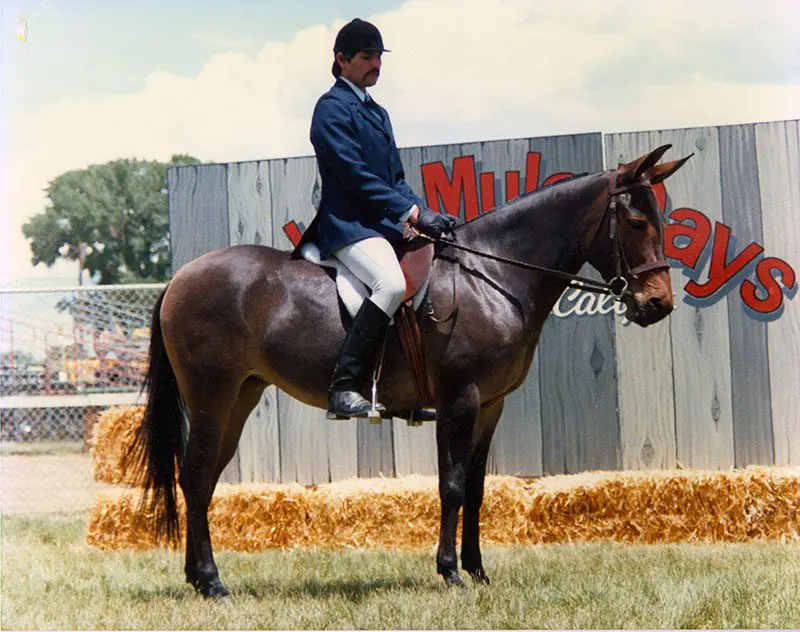 Today, we have more time to spend training our equines and cultivating our own riding skills. In most cases, the choice of tack is no longer of necessity, but of choice. Fashion, in any country, is supposed to be a statement of individuality and identity. The Western style of dress and tack suggests a hearty, rugged individual, surrounded by wide open spaces, using his equine as a partner for work. English attire paints a picture of dignity, reserve and concentrated skill. The Western image is a wonderfully romantic and picturesque way of seeing oneself, but it really doesn’t allow us the opportunity to improve our equestrian skills to the maximum. Western style riding is as limited as its uses. The smaller English saddle, made with a lot less leather, allows us to feel our equine’s body more closely (with the added stability of the stirrups) while we learn and exercise our bodies to become more harmonious with our mounts. As we can feel our equine more closely, so can he feel better the cues that we to give him. Thus, he can respond more accurately to our commands. However, most men don’t feel comfortable wearing “Sissy Pants” and riding in a “Sissy Saddle”—it just isn’t macho!
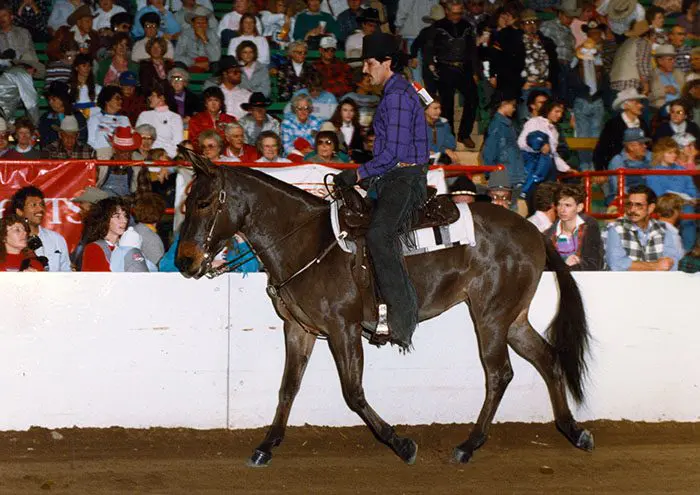 One Saturday morning, I finished a lesson with one of my students when Gary strolled into the indoor arena and announced that he was willing to give the English saddle a try, but that we would never get him into a pair of those “Sissy Pants!” “Fair enough,” I said, and brought my student’s horse around for him to ride. Getting on was a bit of a struggle, and exercises at the walk went really well, but as soon as the horse began to trot, Gary started bouncing. He was about to lose his balance, so he grabbed the rail to steady himself. The only problem was the rail stayed where it was and the horse kept going, leaving Gary dangling behind on the fence! I thought we would never stop laughing – he looked so ridiculous! Our macho man didn’t have the balance he thought he had!
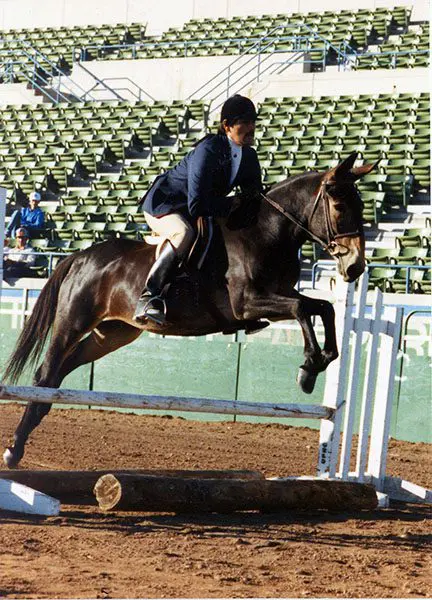 After a while Gary decided that English riding was, in fact, the best way to train. However, he still wasn’t too interested in “watching cement set” or doing Dressage tests. We decided after two years to start showing in Combined Training with the horses. We signed up for the second day of a two-phase show, not realizing that we would be asked to ride our Dressage tests the same day that we jumped. Two days before the show, Gary discovered that he would have to ride Training Level Test 1 at 9:00 A.M. the day of the show. We reviewed the test the day before the show, thinking that if all else failed I could read the test to him when he rode. Sunday morning, Gary was feeling tired, but confident. I took my place at “B” and prepared to read for him when the announcer explained that only United States Dressage Federation tests could have a reader, but not the same in Combined Training. Gary’s face turned ashen. I climbed back into the stands as he warmed up for his test… at the walk… lost in space! He stopped short below me and quietly said, “Meredith, will you please come here.” I ran down to see what the trouble was. “I can’t remember anything… I can’t do this!” he worried emphatically. I quickly explained the pattern. Gary’s first Dressage test ever in his first Combined Training show and he emerged in third place with a mule in the Elementary Division against 8 horses. Was he ever thrilled!
 We were pastured on a couple of acres that surrounded an old shed where we used to get in out of the weather. My mother was content to graze and doze day after day – she wasn’t much on excitement. I used to love it when the people came and carried on about how cute I was. Then they would scratch and massage my fuzzy little body. They even got a little playful when I followed them around, romping, playing, and bumping them with my nose. “Oh, look how cute and friendly he is,” they’d say.
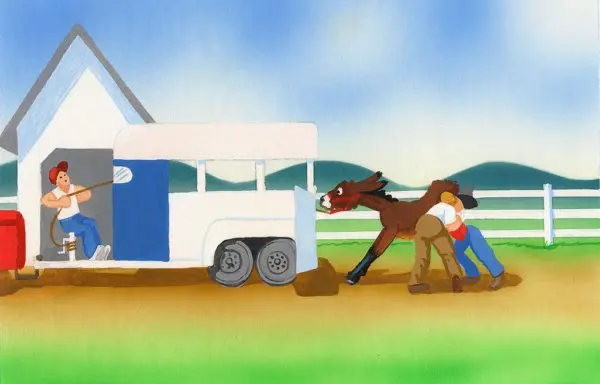 Suddenly, as soon as that “halter thing” was attached to my face, they tried to lead me away from my mother. That’s when I saw the little room on wheels parked along the pasture fence! I called to my mother to come… we were going for a ride! She took a couple of steps toward me when one of the two men shooed her off the other way. I was going alone with these two guys – but where?! Why?! I got scared! I pulled, kicked, bucked to get away, but nothing worked. They were both bigger than me and before long, I found myself locked in that little room on wheels… alone! I was frightened, but I was brave. The ride was short. When they finally opened the doors to let me out, I was an explosion of forced bravery. I came out of that trailer so fast I accidently knocked one of the men down. Whoops! Before I could show him how sorry I was, he jerked on my head and laced me about the head and neck with a long skinny stick that stung like a bee! Better stand still, I thought. Well, they didn’t like that either! They were pulling on my head and hitting me on the rear with that stinging stick! If I followed, it released the pressure from around my face and the man with the stick would stop, so I followed.
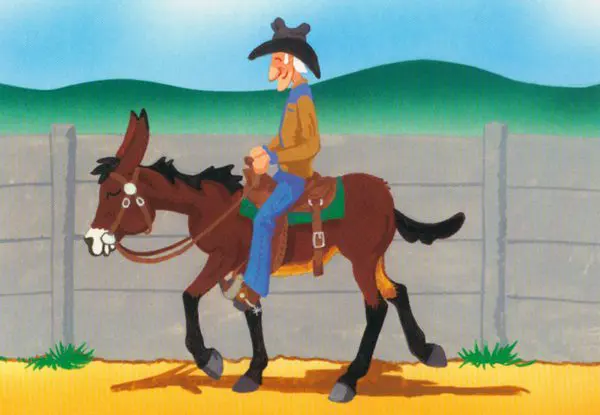 The day they put the saddle on my back when I was two was only one of many confusing times. I didn’t really mind the saddle until they fastened the belt around my middle so tight that I could hardly breathe. I bucked and ran, trying to get it off. “He’s going to be a real tough one,” the man said to my owner. I’m not really sure what he meant. I learned pretty quickly that the bucking only caused more pain as the stirrups thumped against my sensitive body. It was better to move smoothly with that saddle on my back, for sure. It took me awhile to learn to stop and turn when they pulled on that bit in my mouth, but the worst part was trying to keep my balance through all of this! Didn’t they know that I was still very young and growing and not really all that strong despite my size? They would ride me until I was stiff and sore, and then put me back in that small area with no room to stretch and exercise. They gave me rest for days at a time, with no other exercise. It seemed like I was either overworked or over-rested! My muscles never really had a chance to become stronger. They rode me either too long, or not at all. Somehow, though, I managed to learn. I guess we all do, whether it’s the hard way, or not.
 I met Mae Bea C.T. (“Peepers” from Jasper Goes to Bishop) and Ciji at Bishop Mule Days this year. They said that they have a wonderful life – equally balanced with training, pasture time, just plain fun and a lot of consideration for their feelings. Ciji said you were really mad at her for refusing all the jumps in the Hunter Under Saddle class, but that you were fair. You made her do them in the Jumping Class, rode the English Pleasure class and then let her rest for the remainder of the show since you knew she was in heat and had cramps. Ciji admitted that she can sometimes be a little stubborn and unfair herself, so she tried to make up for it by doing her best in the English Pleasure Class, which brought her fourth place.