Cliff Uber has been recognized as the 2012 PATH Intl. Independent Adult Equestrian award winner! He will be honored as a special guest at the PATH Intl. Awards Banquet held at the 2012 PATH Intl. Conference & Annual Meeting on November 2, 2012 in Bellevue, WA. Thanks to Purina Mills for providing travel schloarships for the equestrian award winners. As the Independent Adult Equestrian National Award Winner he receives scholarship reimbursement funds of up to $1500.
You may recognize Cliff from his appearance on the “Walk On, Part 1” episode of Those Magnificent Mules, and we are extremely proud of his success!
Bud (Sir Rocko) has earned the PATH Intl. Horse of the Year for Region 10 and will also be honored at the awards banquet. As a regional winner, he is a finalist for the 2012 PATH Intl. National Horse of the Year Award, which will be announced and celebrated at the awards banquet. Bud has been with Hearts & Horses since 2005 and is a most deserved recipient of this award!
As a proud representative of the American Donkey and Mule Society, Lucky Three Ranch is deeply saddened to say goodbye to our close friend, and co-founder of ADMS, Betsy Hutchins. She was one of a kind and shared our love for longears. We will miss her very much.
Betsy with Frosty
Statement from the ADMS:
It is with great sadness that the ADMS announces the loss of one of our co-founders, Elizabeth “Betsy” Hutchins. For over forty years, Betsy devoted her life and her home to the promotion of longears around the world. She and her family spent time not only in the daily operations of the ADMS (originally housed in their hundred-year-old farmhouse in Denton) but raised, trained and showed donkeys and mules as well. All four of her children were brought up with the animals and can be found in pages of the older Mr Longears and Brayer magazines.
Betsy and husband Paul converted part of their home into the operations center for ADMS. The BRAYER magazine used to be hand-typed and copy pasted up on the dining room table. Large built-in shelves all around the house were filled with donkey and mule figurines of every type. As the ADMS grew over the years, it began to encompass the sun porch of the house, gaining more equipment and taking up more time. Betsy and Paul ran it solely for many years, with the occasional volunteer for help. Betsy wrote many articles on donkey and mule care, much of it taken from her own experiences dealing with the longears living in their large acreage property.
Betsy with husband Paul
While Betsy always maintained she loved air conditioning, if animals needed care, she was outside taking care of them. If a friend came by needing a place to unload a donkey for the night, she’d make sure the gates were closed, the water tubs full and the hay brought out. She would stack hay if needed, hold heads or hooves for hoof trims, give medicines or baths to the animals, whatever was needed. She truly loved all animals, whether longears, dogs, cats, or guinea pigs, which she raised for years as a hobby.
When Paul and Betsy retired some 12 years ago, her involvement in ADMS slowed, but never stopped. She still joined the staff (by then hired on to continue to run ADMS) at shows, sitting at the information table and talking to everyone with a smile. She often handed out ribbons at shows, while husband Paul was judge or ring steward. Even though she had retired, she could still be counted on to answer questions that just couldn’t be solved, except through experience.
Betsy at a Donkey Show in the 1960s
She loved to travel the world, and went on cruises over the years, the latest just last month. With a passion for gardening, she found lovely plants and had over 160 cuttings potted at last count. A friend recounts that she heard the news of Betsy’s passing while watering cuttings from tea roses Betsy had
cultivated.
Betsy is survived by husband Paul, children Scott and wife Tammy, Melissa “Missy” and S.O. David, Melinda “Mindy” and husband Steven, Patrick and wife Katie, grandchildren Clayton and Audrey, and friends around the world too numerous to count.
Long time friend Becky perhaps has put it best in her note to ADMS: I know there is an ass or two in heaven braying in happiness that Mom has come over the Rainbow Bridge to be with them. And no, that was not thunder. It was a stampede of critters running to meet their Mom. Godspeed, Betsy.
Roll was devastated at the loss of Rock on December 27, 2011. He really didn’t know how lucky he was to be in our loving care at the time, however continuing his well established maintenance and training routine gave him some solace and in two weeks he began to reciprocate our unconditional affection for him. We moved him into Rock’s stall which also gave him a sense of security. He seemed to find comfort in Rock’s scent.
Like Rock, Roll spent many lessons on the lead rope doing his core muscle exercises and measured time in the round pen for further strengthening in hopes of re-balancing his body enough to do some light driving and riding. In March, he was doing so well I figured it was time to mount him and start doing balancing exercises from the saddle. We had our vet come out and x-ray his feet to make sure he would be sound enough for those kinds of activities. He had not exhibited any lameness in the year and a half he had been with us.
We were all surprised when we discovered that he not only had side bones in the right hind as we had palpated, but in all four feet! As if that wasn’t enough, he also had some traces of upper and lower ringbone. The vet agreed that with his core muscle and balance training he had not aggravated the conditions in his feet and that was why he never exhibited any lameness…only a slight twisting in the right hind. When I asked about riding him, my vet agreed with me that he could probably carry my weight safely at walk and trot, but that the canter could pose problems. He also agreed that light driving after his new posture had been more securely established by riding that he would be able to do some light driving while hitched to my Meadowbrook cart.
Roll had 3 weeks off after the x-rays and that turned out to be a bad decision. He lost some conditioning and got a little depressed because now the other mules were not turned out next to him anymore. So, we resumed his regular activities and allowed him turnout in the lane between the two spring turnout pens. He could have walked right through the low plastic gate, but never offered to do so. He was just happy to be near his new friends.
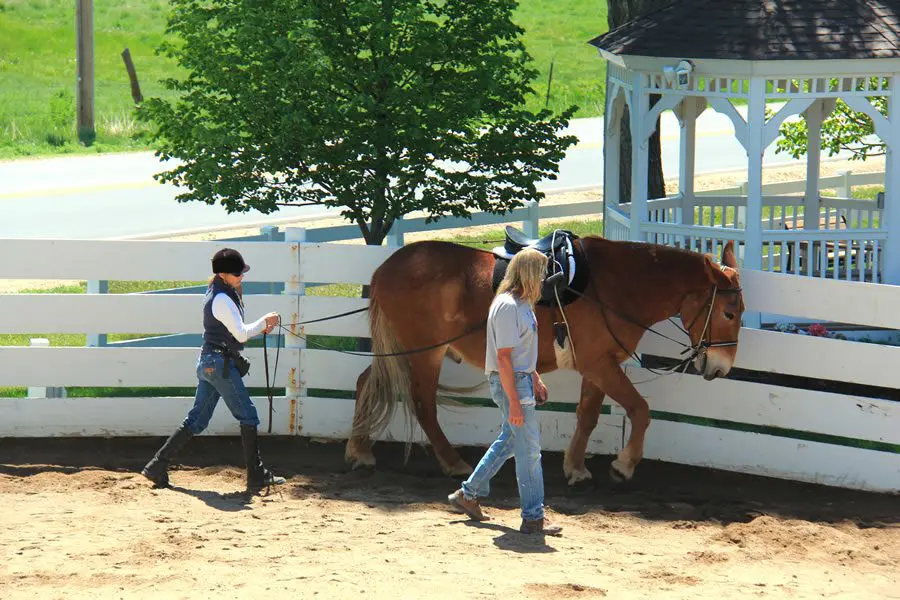
On Wednesday May 9, Roll seemed ready to be mounted and ridden for the first time. I carefully reviewed all his pre-riding lessons: grooming, tacking up while standing stock still, mounting in the tack barn, asking him to take the oats from both sides, repeated the same in the round pen after I ground drove him through the pattern I would ride with my assistant nearby mirroring his movements…
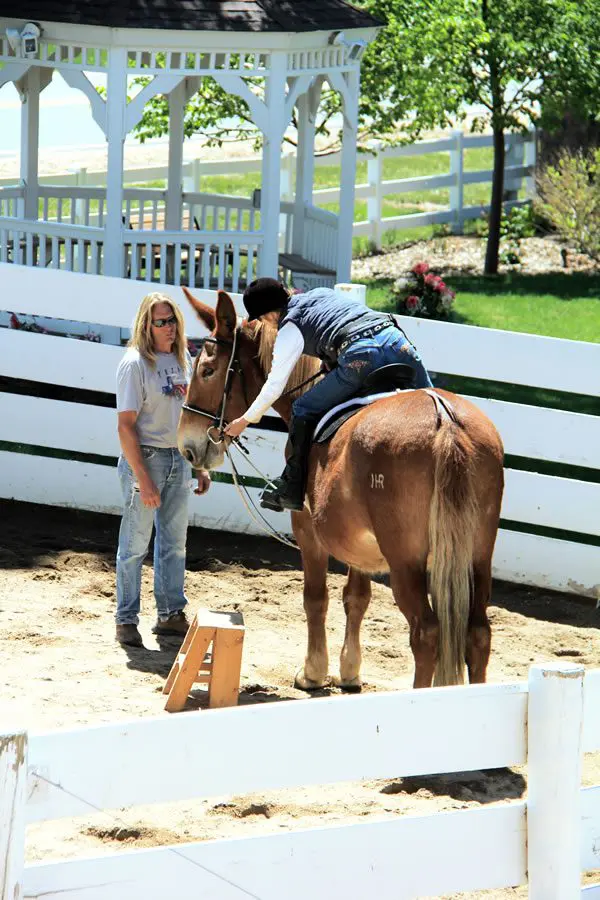
and then brought in the mounting block.
I then asked him to bring his head around to acknowledge that I was now on his back.
Roll was all business and absolutely perfect! He walked quietly tracking right for one rotation around the round pen, did a perfect reverse…
and tracked two more rotations to the left. He knew what to expect and responded accordingly right down to the rein back at the end of the lesson!
I told him it wouldn’t be long before he would be able to take treks with me around the farm fields like the other mules. He just beamed with pride and enthusiasm! It’s wonderful to see him truly happy again!
The Telly Award statuette is produced by the company that makes the Oscar and Emmy awards. They receive over 13,000 entries annually from some of the finest agencies and corporations in the world, so it is a remarkable achievement to be selected for recognition by their judging committee. The Silver Telly Council is comprised of many top industry professionals, including past winners of the Silver Telly, which is their highest honor. We previously received Silver Tellys in 2005 and 2007 for the “Lucky Three Ranch” and “Walk On” episodes from our documentary series, Those Magnificent Mules.
We’re proud of you, Jasper! Make sure that you’re part of the fun by checking out all of Jasper’s adventures On Demand!
Remember Chuchureña, the mule who gave birth to a healthy baby mule last September? Our friend Luzma Osorio sent us this update from Colombia, on the mule mama and her daughter, “La Bien Querida”:
I took some new pictures of the mule and her offspring last week, the baby is now three months old and she has grown a lot! They are gorgeous!!
Photos by Luzma Osorio, Criadero Villa Luz
What a beautiful, loving pair! Chuchureña truly proves that mules are good mothers, too!
An excerpt of an amazing story from a friend of Lucky Three Ranch, Luzma Osorio, on the birth of a new mule in Colombia–and her mule mother!
Mule mama “Chucurena” with her daughter, “La bien querida.” Photo courtesy of Criadero Villa Luz.
They say mules cannot give birth and are hostile to foals, but the mule Chucurena has proved completely the opposite. On 25 September 2011, she gave birth to a beautiful baby mule in Colombia, South America, and she is proving to be a great mother!
Chucurena is a 3 ½ year old black mule from Hacienda El Cerro in Bucaramanga. She is very affectionate, produces lots of milk and she is always looking after her baby.
This miracle was achieved thanks to the Embryo transplant technique. An eight day old embryo was extracted from a mare and implanted in the mule’s womb to develop it. Embryo transplants are a complicated process that requires synchronizing the ovulating time in both females, in this instance it was carried out by the specialized Colombian veterinarian Hector Mendez.
The embryo was from a Paso Fino Mare called La Querencia and the Paso Fino Donkey Cosaco XVI de Villa Luz. The pregnancy was 11 months and the delivery was normal with no complications. The mule knew exactly what to do and behaved as an expert mother even if it was her first time! The baby is a female and it was called “La bien querida” (The much loved).
For more information on the Criadero Villa Luz, visit their website here.
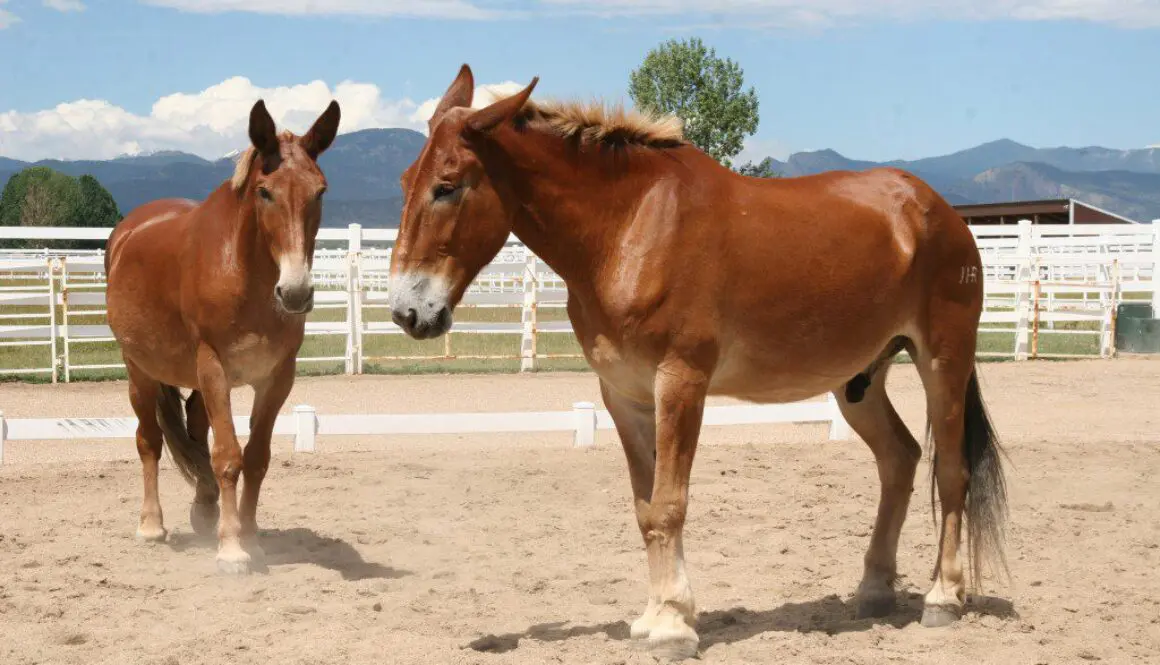
Rock and Roll, a 17 and 16-year-old draft mule team came to us on December 5, 2010. They had been rescued from an auction in Kiowa, Colorado, roughly a year before that by some friends of mine. They offered the mules to me as a last resort when their efforts to rehabilitate them failed.
Rock had an old fracture on the face of his pelvis opposite the ball joint in the right hip and had severe founder and rotation in his hind feet. Getting those shod was a real challenge since he could not stand on the bad leg. Roll had side bones in his right hind foot and it is a constant challenge to keep that foot balanced. Both mules had been seriously foundered and had muscle atrophy throughout their bodies. As therapy progressed, even more problems surfaced so we were making progress with one step forward and two steps backwards, but nevertheless, we have been gaining ground with their health.
Both mules began to develop better eating habits and better hair coats almost immediately with their change in diet. Atrophied muscles and calcified joints began to move again. Rock went through several superficial issues that were problematic. The founder began to grow out and he became three-legged lame just about the time a horsefly bit him in the sheath and caused intense swelling. Because he couldn’t move, it wouldn’t go down. We got boots for his front feet since we could not nail shoes to his foundered front feet that enabled the swelling to move from the sheath to his abdomen. We hot packed his abdomen for two weeks and it went down, but he developed a sebaceous cyst that we thought was a sarcoid on front of the withers and a wart on his chin. We got the cyst removed and treated the cyst as a sarcoid which caused the wart to drop off. Rock is now able to resume his exercises and is doing much better.
We are happy to say that both mules are doing well after 10 months of physical therapy with the core muscle leading training exercises that we do here. Roll was able to graduate to moderate round pen work in the elbow pull after about four months of leading exercises. It will be another year of groundwork before the founder is completely grown out. Their respective uses will be determined as their health improves.