Meredith Hodges
Lucky Three Ranch Christmas Card 2024
Merry Christmas from the Lucky Three Ranch. Enjoy this 2024 Christmas Card video.
Jasper: A Christmas Caper
It’s the Christmas season and Jasper and his human family are in high spirits as they travel to visit far-away friends a few towns over. When Jasper and his pal, Moxie the dog, get out of the yard and wander down a strange alley, the two friends are headed straight for one big adventure!
T’Was The Night Before Christmas
T’was late in December, the Longears remember
When Santa arrived with his sleigh!
There were too many toys for the good girls and boys
And he needed our help right away!
So we rallied our team for the sake of the dream
And at midnight they took to the air!
Santa was proud as they chorused out loud,
“Merry Christmas and Happy New Year!”
Our very best to you and yours this holiday season!
Meredith Hodges and the Lucky Three Equines!
Making the Elbow Pull
(Page 30) Although the “Elbow Pull” is a very simple and straight forward device to help keep you equine in good posture, it is also a device that needs to be custom made to fit each individual equine. Equines that are approximately the same size in the front quarters will probably be able to use the same one. First, you need to obtain a package of 3/8″ twisted nylon rope. It is generally sold on the internet in 50′ spools, but is fairly inexpensive. Do not substitute any other kind of rope or leather reins, etc. as this will have a different weight and slippage around the bridle and will not have the same effect. Make sure that when you use the “Elbow Pull” that you place it OVER the crown piece on your bridle to prevent chafing and that you adjust it by first getting them to flex at the poll (by cupping your hand at the muzzle and rocking it forward and back or just offer some oats to get him to flex) and then push UP on his muzzle until he begins to push the nose out and hollow his back. This is not a device to “tie” their heads down. It should be adjusted just tight enough to prevent them from hollowing their neck and back, but still giving them full range of motion in every other direction (Up, down and to the sides).
You will also need two snaps that are narrow, yet fairly strong that can fit easily through the rings on your surcingle, or Western saddle. English saddle D-rings are generally too small and in this situation, we do not attach to them, but rather attach the “Elbow Pull” to itself after looping it through tied up stirrups. If you make the rope a bit longer for adjustment sake, you can loop it over the withers and attach it to the small D-rings on the opposite sides. The reason for twisted rope is so you can actually go through the D-rings and snap it into the twisted rope itself for a more exact setting. You would just untwist the rope at the setting point and snap into the middle of the rope so it won’t slide. With horses, you would just twist the rope over the back as shown so the snaps are a moot point until the horse learns to give to the “Elbow Pull” and can be hard tied.
Have the equine stand at the hitch rail with the snaffle bridle on. To get a measurement for how long a piece of rope you will need for his “Elbow Pull,” take a length of rope from the coil. From the near side (left side of your equine), feed the end of the rope from the inside to the outside of the snaffle bit ring, drape it over the poll of your equine and feed it from the outside of the snaffle bit ring to the inside on the off side (right) of your equine. Pull enough slack to go down through the front legs, behind the forearm, up and over the back such that it hangs 12 inches (or a bit more, but not less) over the spine. Then, go back to the near side on where you started and pull enough rope from the spool do the same thing on that side. When you have enough rope to loop over the spine on that side, you can cut the rope at 12 inches (or a bit more, but not less).
Once you have the proper length of rope for your equine, you will need to unravel 3″-4″ of one end of the rope and loop it through the ring on your first snap. Then you will braid the rope back into itself. First, pick the loose strand that is on top as you lay the rope across your hand, bend it around the end of the snap and feed it under a twist of the rope such that it creates a loop around the end of you snap and pull it snug. Then take the next loose strand (which would be the middle of the three strands) and feed it under the next twist down from the one you just did. Then do the same with the third loose strand under the third twist in the rope. Take all three strands in your hand, hold the rope so it doesn’t twist and pull all three strands snug. They should all line up. Next, turn the rope over so you can see where the angled lines of the twisted rope begins again and feed the first strand under the first twist, the second under the second twist and the third under the third twist. Pull all three strands snug at the same time, turn the rope over, locate the first twist in the line and repeat until you have all 3″-4″ braided into the twisted rope. You will have some loose ends sticking out and nylon rope can slip, so you now need to take a lighter and burn all these ends until they are melted together and will not slip. Be sure that you burn them so they are smooth and without bumps or it will be difficult to feed the ends through the D-rings. Do the same with your second snap on the other end of the rope. Now, you have your own custom made “Elbow Pull!” If this is confusing, you can purchase our EQUUS REVISITED DVD which has a SPECIAL FEATURE that will show you how to do this at www.luckythreeranchstore.com

Driving Should Not Be Rushed
(Page 28) Before we begin, you must understand something very important: Driving a horse or mule is very different than riding. It is critically important to pay attention to detail. It’s much more difficult to learn the basics, let alone the finer points. Here’s an analogy: Just because you can drive a pickup truck, doesn’t mean you can fly an airplane. And if you want to fly a plane, you need more than just one lesson to become a pilot. The point is this—driving is fun, and it certainly looks easy, but of all the equine activities, it is the most potentially dangerous for you, for others and for your equine. If you get into trouble while riding, you might get thrown off. If you get into trouble while driving, you could end up with a runaway animal and a careening vehicle that’s crashing into everything in its path. Driving can be the most dangerous of equine activities, so be sure to spend plenty of time on prep work for both muscle conditioning and accustoming your equine to the elements of driving before actually hitching them to a vehicle.
For safety, this should take two years with multiple groundwork tasks. These exercises should not be rushed. If it can be avoided, you should NEVER drive on roads that are busy with traffic regardless of how bomb-proof your equine is. There are drivers who don’t pay attention and they are who you need to worry about. Learn more about DRIVING in the various sections under TRAINING and in the management and training products in the STORE on my website at www.luckythreeranch.com, particularly under TRAINING/TRAINING TIPS (#109 -#120).When these exercises are completed, you can safely move on to his athletic endeavors whether it be riding or driving. Whether riding or driving, the prep work is the same. The animal that is properly prepared will have far less issues with his physical mobility (less accidents and power vet bills!). The steps to training your equine to drive are simple and there are some stages where it is advisable to use an assistant, but you can learn to do this yourself.
I like to encourage people to do most of the training themselves because the equine bonds deepest with the person who trains them. You can find all kinds of helpful information about preparing your equine with postural balance and core muscles strength on my website at www.luckythreeranch.com in the various sections under TRAINING, especially under TRAINING/TRAINING TIPS #109 – #120 and at TRAINING/VIDEO ON DEMAND. You can purchase my books and videos in the STORE and I am always happy to send you a lot more detailed information if you email me at meredith@luckythreeranch.com.
DRIVING YOUR DONKEY (Page 29) Driving is loads of fun, but can be very dangerous if your equine is not prepared, and if harness and equipment is not selected and adjusted properly. Make sure the harness fits snugly and correctly so it can function as it should. Pay special attention to the weight and size of the vehicle, and to the lengths of the shafts on single hitch carts. Select the vehicle that pulls easily and is proportionate to your equine’s size. Make sure that your equine is physically prepared over a long period of time with the right kinds of groundwork exercises that will build core strength in good equine posture to avoid inadvertently straining muscles and or pulling tendons while in harness. This will greatly affect his mental attitude toward driving and keep it positive. If the equine experiences any kind of pain or distraction, he could bolt and run. Driving him in the future would be much more risky once he has been frightened. Keep driving contained to enclosed areas for the first two years of your equine’s driving experience to promote control, good communication, steadiness and safety. If you do drive on roads, always try to avoid driving along asphalt roads with heavy traffic to prevent unnecessary and potentially devastating accidents. Dirt roads are preferable. Know and obey the general driving rules of the road! Learn more about our comprehensive equine training approach in the various sections under TRAINING on my website at www.luckythreeranch.com.
MULE CROSSING: Learning to Stand Still for Mounting
Equines need clear and consistent handling practices. Teaching an equine to stand still should not just be trained as a singular task. In order to change behaviors such that they become repeated as new habitual behaviors, one needs to be logical, sequential and consistent in our own behaviors. New behaviors need to be strung together in a logical, progressive sequence and then practiced EXACTLY the same way ALL the time. Training begins with nutrition and the way your equine is fed. An equine that is fed at a specific time each day is far less stressed than those with inconsistent feeding times and will learn easier. What you feed and how is critical. The equine should ALWAYS be asked to stand still with a verbal WHOA and required to remain back when you open a door, or a gate, until they are asked to WALK ON. Read more at https://www.luckythreeranch.com/mule-crossing-learning-to-stand-still-formounting/
Profound Effects of Leading Exercises
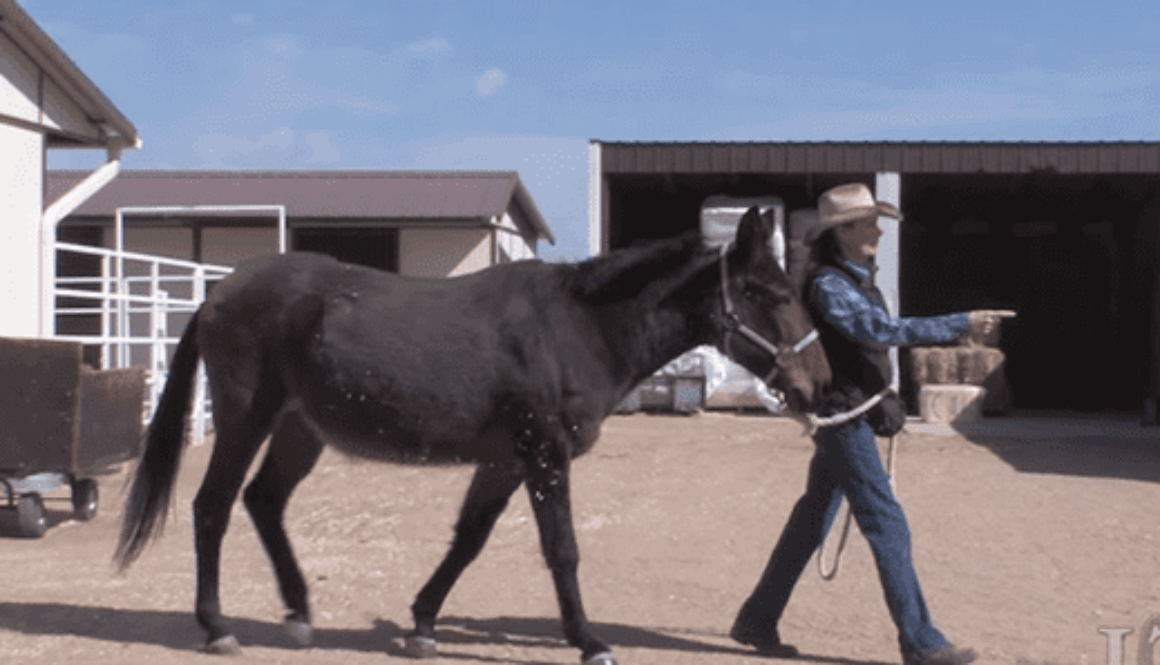
(Page 47) Leading exercises can have a profound effect on both yours and your equine’s body that will make training go much easier. Good posture is not something that living creatures are born with; it must be taught. Balanced core strength around the skeletal frame and internal organs can only be attained by moving consistently in good posture during leading training in our hourglass pattern (you will change leading sides with every new arc in the pattern). It is not the same as developing bulk muscle. Leading with the rope in your right hand does not promote good posture as it will drop your right shoulder. As you lead with your right hand, it will subtlely move the animal’s head from left to right as you walk, putting him out of balance with every step you take and will strengthen muscles asymmetrically. To develop core muscle strength correctly, stand in good posture, hold the lead in your LEFT hand so you do not interfere with his head and neck, keep his head at your shoulder, look where you are going, point in the direction of travel with your right hand (use it to keep him in line when needed) and match the steps of his front legs (Photo #1). Always walk straight lines and gradual arcs to keep his body erect as he bends through his rib cage instead of leaning into turns like a motorcycle (Photo #2). To center his balance and command his attention at every halt, always square him up so he places equal weight over all four feet (Photo #3), and always make sure he backs slowly and straight…one step at a time (Photo #4). These are the subtle exercises that will develop strength and balance in his core muscles, improve his attentiveness and will allow internal organs to function properly. This is similar to what Pilates does for humans. These leading exercises can be done with our “Elbow Pull” to rehabilitate older equines that are more permanently stuck in bad posture as shown here. Always lead your equine this way from the time you fetch him from the pen until the time you put him away. Over time, good posture will become his normal way of moving. Learn much more detail in the “Training Tips” and “MULE CROSSING” articles under TRAINING on my website at www.luckythreeranch.com, or still more in my Equus Revisited manual/DVD combo that can be purchased from our STORE.
Winter Fun With Your Equine
(Pg.6, 12-21-16) Colder temperatures and a little snow needn’t interfere with your equine activities. Your equine companion will appreciate the companionship and the creativity of the lessons no matter how simple the interaction. To keep things safe, be sure to dress warmly and avoid slipping by wearing the right boots and by keeping your equine barefoot. Use Borium shoes only if needed when riding or driving your equine and try to avoid confrontations with him that could produce resistance. The simplest of lessons like leading and lunging can afford safe and satisfying experiences between you, and will help to clarify the communication between you and keep your equine physically fit. Postural balance and core strength exercises are very passive and easy to execute in winter, but they make an incredible difference in your equine’s health and longevity. So don’t spend the winter just sitting around. Go out and have some winter fun with your equine partner! He will truly appreciate the extra time with you and you’ll both be all the healthier for it! Learn more about training for core strength and good equine posture in my comprehensive management and training program at https://www.luckythreeranch.com/mule-crossingdo- mules-need-to-be-shod/.
MULE CROSSING: Do Mules Need to be Shod?
Do mules need to be shod? Those who are familiar with mules might be tempted to say, “No,” but the answer is a little more complicated than you might think. Although the mule generally has a tougher and more durable foot than the horse, all mules do not have the same feet, nor do all mules apply the same kind of stress to those feet. Therefore, each individual animal has to be considered when answering the question, “To shoe or not to shoe?” Read more at https://www.luckythreeranch.com/mulecrossing- do-mules-need-to-be-shod/
Donkeys Can Jump
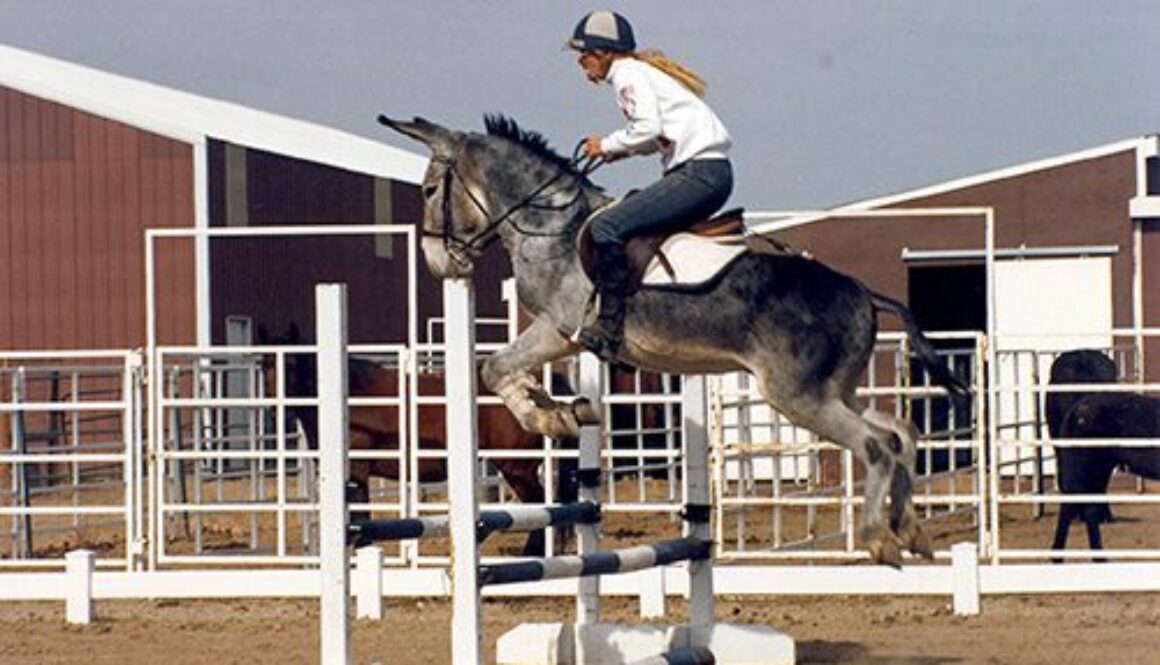
(Page 74) When one thinks of mules and donkeys, one usually doesn’t think about them being able to jump. Contrary to popular belief, not only can Longears JUMP, but they can jump from a standstill where a horse cannot. Given their jumping ability, it is important to have adequate fencing for your Longears. The fencing must be strong enough to withstand their strength, high enough to discourage jumping attempts and a hot wire to make sure! What they can’t jump, they with either dig underneath or climb over the top! In order to keep them in, what is most important is that your Longears WANTS to stay home, or you might find yourself retrieving him from the neighbor’s yard! Learn more about my special management and training practices for the ultimate in safety and enjoyment with your Longears, and even with your horses and ponies – and learn how to keep them HOME at www.luckythreeranch.com.
MULE CROSSING: Jumping Mules
In 1986, when I first began using my mules in Dressage, you would never have convinced me that I would follow it up with jumping. I was fearful of jumping because of a few bad experiences I had with horses. However, once I took the time to learn to ride and train properly with Dressage and experienced the overall stability of a mule, my fear disappeared. Read more at https://www.luckythreeranch.com/mule-crossing-jumping-mules/
Training in a Logical Sequence
(Page 69) When equine training is done in a logical and sequential way with each new stage building on the one before, it can be non-abusive, fun and easy for you and your equines! Most resistance comes when you, your equine or both of you are overwhelmed with the task at hand. Training should not just be learning to do “things.” Just as a baby learns to crawl, before he walks, walks before he runs and develops his coordination before he can play sports, your equine needs to build his body slowly and methodically if he is to perform tasks easily. Much of the time, we think we are doing this, but we forget that we need to prepare his body to carry a rider first! The equine is naturally built to carry weight BELOW the spine and not necessarily on the top of the spine. This is why it is so important to develop the core muscles and elements that support the spine FIRST through careful, specific and meticulous leading exercises done in our “Elbow Pull” through the Hourglass Pattern. This will encourage good posture and symmetrically balanced body movement.
When this has been adequately developed, the next two stages are to facilitate coordination through the negotiation of different obstacles, first by rhythmically walking straight through (Stage #1) and then by breaking them down into much smaller steps with long pauses between steps (Stage #2). All this will take place before doing any lunging in the Round Pen to solidify his good equine posture. This will keep the equine from compromising his balance by leaning like a motorcycle in the Round Pen. He will learn to lunge on a lunge line in the confined space of the Round Pen and learn the cue to keep him on the circle BEFORE he is asked to lunge on the lunge line in more open spaces. He will learn the effects of communication through the long lines (rein cues) in the Round Pen before he is asked to respond to these cues during Ground Driving in the open arena.
By the time he has gone through all these logical and sequential steps, when he is finally mounted, the only thing left for him to learn is to move away from the pressure of your legs on his sides. Get healthy and find JOY all at the same time with your equines using our comprehensive training program. Learn the details of this sequential and logical approach to training for yourself AND your equine in the various sections under TRAINING on my website. If you cannot find the answers you are seeking, email me at meredith@luckythreeranch.com and I will answer your questions promptly!
MULE CROSSING: Fitting Tack & Equipment
Whether riding or driving, the comfort and fit of your tack and equipment is an important consideration if you wish to get the best performance from your equine. Any piece of equipment that does not correctly fit your equine can cause less than optimum performance. Read more at https://www.luckythreeranch.com/mule-crossing-fitting-tack-equipment/.
MULE CROSSING: So You Think You Want a Mule?
It was bad enough before computers and cell phones when people thought they wanted a horse and could realistically have one. They thought if they had a little patch of grass and a fence around it, it would be enough to keep a horse. They never thought about shelter, feed (they could just eat the grass!), vet and farrier care, and about a dozen other things that it takes to maintain an equine. Read more at https://www.luckythreeranch.com/mule-crossing-so-you-think-youwant-a-mule/.
Longears Versatility
Many of our fans have truly enjoyed seeing LONGEARS’ incredible versatility in the musical video posts that I have done for pure FUN and entertainment! Despite the old rumors about mules and donkeys not being much use for anything but hard work (packing, farming and carrying military loads), the Lucky Three mules and donkeys have spent their lives competing against both LONGEARS and horses in various shows during their careers to prove that they too have recreational and competitive value in all types of equine events and activities. During my journey with LONGEARS, I discovered the true value of approaching training with the development of good posture and core strength in mind! Building the elements of core strength around the skeleton in a symmetrical way (the muscles, tendons, ligaments, cartilage and soft tissue) ensures them exceptional advantages in longevity in performance and optimum health. This is how my mules and donkey jack were able to pave the way for others to challenge themselves and their LONGEARS going forward, to prove that mules and donkeys are not necessarily stubborn and awkward. Just like people, they just require the correct approach to management and training to be all that they can be!
During my 48 years with LONGEARS, I learned the techniques that I still use today on ALL equines and gratefully pass them on to the public in hopes it will improve EVERYONE’S relationship with their equines. Never underestimate the intelligence, athletic ability, tractability and power of a LONGEARS…and even your horses and ponies! It makes sense when you breed the best of the horse world with the best from the donkey world. The result is the BEST OF BOTH WORLDS in the offspring! Give your equine the athletic edge! Be sure to visit and peruse all the different categories on the Task Bar on my website, and in the various sections under TRAINING, to discover all the opportunities that are available to you and your Longears.
MULE CROSSING: Look Who’s Talking — Part 3
In Part 1 of Equine Behavior: Look Who’s Talking, we discussed the evolution of man’s self discovery and how he applied this to his approach to equines. If we want to manage our equines in a healthy way and accomplish even the most basic performance with them, there is much to consider during the training process. In Part 2 of Equine Behavior: Look Who’s Talking, we learned that equines are honest in their nature, and produce quick and honest reactions to a stimulus. Therapeutic Riding provides and exemplary teaching experience for both the human and the equine. Those of us with our own equines can now derive much more from our relationships with equines than we ever thought possible. Read more at https://www.luckythreeranch.com/mule-crossing-equine-behavior-look-whostalking-part-3/.
MULE CROSSING: Look Who’s Talking — Part 2
In Part 1 of Equine Behavior: Look Who’s Talking, we discussed the evolution of man’s self discovery and how he applied this to his approach to equines. If we want to manage our equines in a healthy way and accomplish even the most basic performance with them, there is much to consider during the training process. In the not-too-distant past, the prevalent belief was that, if you had a reasonably large patch of grass with a fence around it, you could have a horse. We now know it takes much more than this! Read more at https://www.luckythreeranch.com/mule-crossing-equine-behavior-look-whostalking-part-2/
Happy Veterans Day! Mule History Video
Thank you to all of the men and women who have served and are currently serving! Today we honor you.
MULE CROSSING: Look Who’s Talking — Part 1
All of these characteristics are part of the equine whole, but they do not explain who the horse, donkey or mule is as a personality. What kind of equine handler are you? When interacting with your Longears, or any equine, are you an observer or a participant? Are you fully aware of the reasons for your equine’s behaviors? Behavior in general is most often motivated by a stimulus that elicits a certain response, yet the early years of physiological development are mostly dependent on heredity. Heredity includes not only physical characteristics, but mental, emotional and instinctive behaviors as well. We are taught that if an equine’s knees are beginning to fuse (harden), he is ready for training. Is he really ready for training just because his knees are fusing? Physical development is called maturation, and we determine the equine’s capabilities by maturation alone, with no consideration for the animal as a whole. Read more at https://www.luckythreeranch.com/mule-crossing-equine-behavior-look-whostalking-part-1/