

MULE CROSSING: The Language of Longears
By Meredith Hodges
Many of you know me as the foremost authority on the contemporary saddle mule, but what you may not know is how I earned such a title. Most of us who have become trainers began by riding and showing. Through our success, we gained recognition and subsequently clients who brought their animals to us for training. Our success with their animals posed a question for each of us at a critical stage in our careers and we had to make a decision whether we were going on the road to do clinics or something different. I opted for something different!
 Instead of going on the road to do clinics, I thought long and hard and decided to do an equestrian correspondence training course instead. I opted for this after considering that when I went to clinics as a student, I was one of 20 people and only got limited attention during those clinics. When I put into practice at home what I had learned at the clinics, I realized that I had only received the highlights of training and it was full of holes! When I tried to contact the clinicians to ask a question, I was either answered by someone in the office, or not answered at all. The clinicians were most often too busy and out of touch. The one thing I didn’t realize by making this decision was the incredible learning opportunity I had opened up for myself that I could, in turn, pass on to my clients.
I did my resistance-free video training series in as much detail as I could possibly muster. Each video represents a year’s worth of training, but as we all come to know, you can never know everything. The more you learn, the more you learn what you don’t know. I did learn fairly quickly that the relationship between equine and owner is unique to those individuals. That is, I realized it made more sense that I teach people how to train their own animals. After all, you wouldn’t ask someone to go out and make a friend for you? The relationship is truly your own and I adopted the policy that as a trainer, my responsibility would be to guide people through the process of training their own animals for the best possible results. This has proven to be true far beyond any expectations that I might have had!
This decision afforded me more time at home where I could communicate with others and help them with their animals. It also afforded me more training time with my 30 head of mules, horses and donkeys. I have always done the training of my own animals myself. I had an assistant for awhile who kept the old school masters and other broke mules exercised from time to time. However, the actual training of the mules I did solely by myself because I wanted to keep learning new things that would enhance my training program and make it better. The new things I learned I documented in the form of books, videos and television shows. What began as a quest to train and show mules in every equestrian discipline expanded beyond my wildest dreams!
 When they told me mules would not work well in a snaffle bit, I learned how to make that work. When they said they were not suitable for Dressage, I based my entire training program on those principles. When they told me not to give food rewards, I paid my mules for their efforts with a generous reward of crimped oats. When they told me not to talk to my equines, I spoke three languages to them: verbal language, body language and “touch” language. I can truthfully say that today I realize that it wasn’t the mules that were so stubborn, but rather…it was me! This positive kind of stubbornness did pay off, as I was to soon discover.
Beginning with the “A B C’s” (walk, trot, canter, whoa, back), my verbal language with them evolved over time into actual conversations. The tone of my voice indicated my pleasure or displeasure with their actions. Calling their names and then stating a command prompted their immediate attention. When working with multiple animals, phrases like “Get back on the rail!” and “Stop kicking your brother!” initiated a positive response and validated my expectations that they could indeed understand what I was saying beyond the normal commands. I watched their reactions to the tour guests we had at the ranch as they walked through the barn and met these animals. If a guest made a remark, the animals responded with an appropriate show of emotion. If it was a snide remark, they would lower their heads and splay their ears in a most dejected way. A positive remark would elicit a show of attention with ears perked toward the person who made the comment. This has shown me that they do understand English, even if they cannot speak it!
Body language is probably the most important of all the “languages.” These animals will mirror you and react to what your body is telling them. If you position yourself in front, you can turn them or stop them. If you walk up to them in an aggressive way, they will show fear. If you go to a gate or the stall door and wait with an inviting attitude, they will come to you. Of course, learning accurate body language is a responsibility that we must put upon ourselves to really be effective. I just watched the reactions of my animals to everything I did and said. If I received a negative response, I would change my approach until I got it right. When I got it right, so did they!
“Touch” language is simply how you touch your animal whether it is with your hand, a grooming tool or a whip. Touch needs to be empathetic but firm enough to do the job. Touch is a powerful tool. It can be soothing and relieve anxiety. It can be pleasurable or painful. Touch can indicate direction depending on how it is used. We begin with imprinting, or touching of the foal all over its body, but this is not the beginning and end of imprinting. Imprinting sets the stage for the kind of interaction you and your equine will have during your entire life together and can often bridge a gap of misunderstanding when the other two languages are not working. Never was this more apparent to me than just recently!
 Little Jack Horner had gone through my entire training series right along with my mules and had learned everything that I taught them. He may not have made it to Fourth Level Dressage, but he made it to Second Level Dressage with gait lengthening and lateral work. He overcame his “donkey” behaviors and gave a phenomenal performance, jumping four feet in exhibition at Bishop Mule Days. His Reining was accurate though somewhat limited by his donkey conformation. Still, he could always elicit a supportive laugh and a wide grin! He competed successfully at dressage driving shows and won world championships in driving at Bishop Mule Days.
Little Jack Horner was to star yet again in the making of my biography, our latest Those Magnificent Mules documentary project. I doubt that I had driven Little Jack Horner in fifteen years. In fact, since he turned twenty, he had not done much but take part in more sedate roles in our TV shows and videos with an occasional bareback ride around the ranch. At 30 years old, I wasn’t really sure how he would react to being hitched to the Meadowbrook cart again after so many years, so I thought I had better do a dress rehearsal.
During the dress rehearsal, I discovered that Little Jack Horner didn’t know what to do once I put on the harness. He was tied in the tack barn and when I tried to ground drive him forward, he just backed up until he was out of the building, then he went forward to the hitching area. I was rather puzzled. Still, I went ahead and hitched him to the cart and we stood there for some photos before I backed him from the hitch rail. I verbally asked him to go forward…nothing. I did not have my driving whip with me, so I used the end of the reins on his fanny to move him forward which he then did, but kept going straight until he ran into the fence and stopped.
I thought this was very strange, so I asked my ranch manager to get my driving whip. With the whip in hand, I began to talk to him with the whip. A simple tap to the side and he turned from the fence. Another tap in the middle of his spine sent him smartly forward at an animated walk. Another tap to the other side turned him the other way and we were soon doing figure eights, stopping, backing and driving as if there was never a problem at all. During the film shoot, he did all these things and even offered several hundred feet of trot before he was too tired to continue.
 It was during this experience that I realized that Little Jack Horner had become deaf and could not hear one word of what I was saying, even when I was yelling. I was sitting in the Meadowbrook cart, he had blinders on his harness bridle and could not see me, so verbal language and body language were of no help to him at all. Lucky for us, we still had the “touch” language that we had developed between us and we thoroughly enjoyed the experience of driving yet again.
It is evident to me that every detail that I had taken the time to learn in our 30-plus years together culminated in the results I see now with all of my equines. We have learned so much about each other! Now that we are all a lot older, a lot slower and a lot less coordinated, we are still afforded the luxury to continue to learn and grow together in a safe and enjoyable way. It doesn’t get any better than this!
To learn more about Meredith Hodges and her comprehensive all-breed equine training program, visit LuckyThreeRanch.com, MEREDITH HODGES PUBLIC FIGURE Facebook page, or call 1-800-816-7566. Check out her children’s website at JasperTheMule.com. Also, find Meredith on Pinterest, Instagram, MeWe, YouTube and Twitter.
Covered in TRAINING MULES & DONKEY: A LOGICAL APPROACH TO TRAINING, TRAINING WITHOUT RESISTANCE, EQUUS REVISITED and A GUIDE TO RAISING & SHOWING MULES at www.luckythreeranchstore.com.
© 2010, 2011, 2016, 2024 Lucky Three Ranch, Inc. All rights reserved.
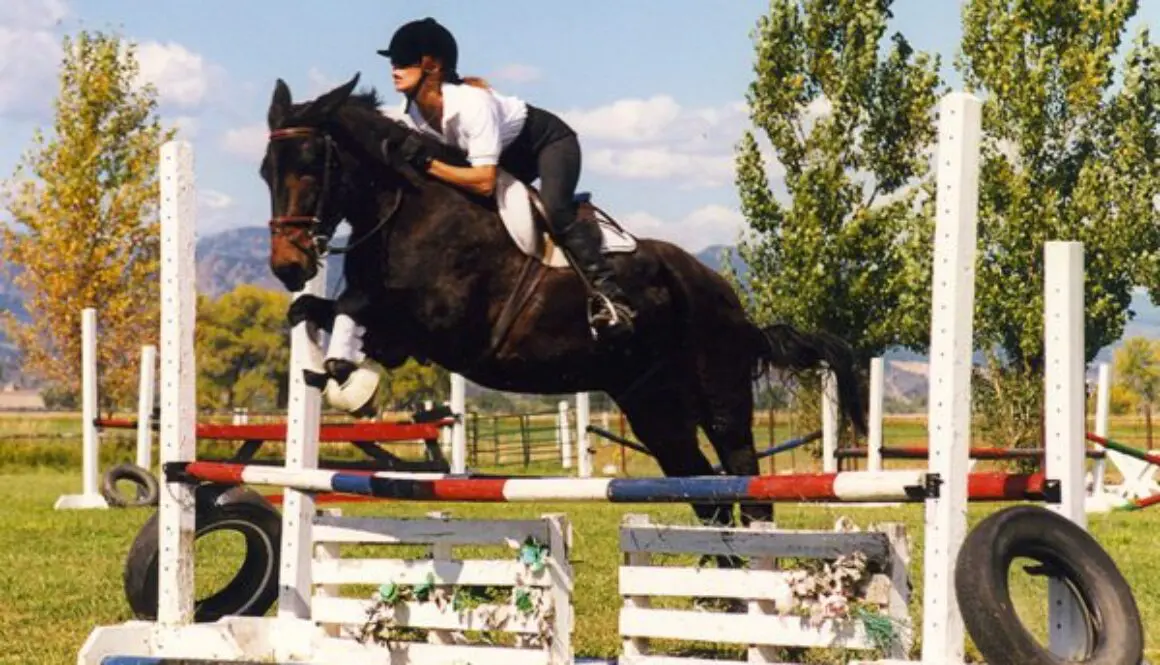

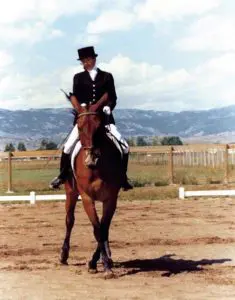 When proper attention is given to the development of balanced, postural core muscle strength from the very beginning, the equine develops strength symmetrically throughout his body as he grows. Muscles are stressed and relaxed at critical intervals, allowing for healthy mental, physical and emotional growth. When the equine feels good in his body, it clears his mind to concentrate on his performance. The result is an equine that is happy in his work and in his world.
 Dressage training has evolved from a useful tool to strengthen and balance a useful horse to just another name in Big Business. Today, equines are thought of as economic commodity, or a breeding investment, and are used in events such as Reining, Cutting, Stadium Jumping, Racing, Steeplechase, Eventing, Hunting, Dressage and just-for-pleasure riding. Monetary investment is high, and never was the old adage of “horse poor” more prevalent than now!
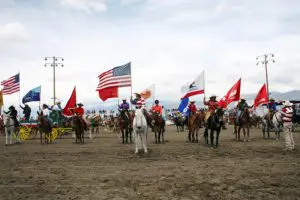 Owners can expect to spend thousands of dollars in a year for no more than a pleasure riding equine, and the cost increases with the status of the activities. The cost of supporting an equine provides economic success to a multitude of businesses such as feed stores, tack and equipment, truck and trailer sales, drug companies, motels, gas stations, county fairgrounds, breed registries, brand inspection, clothing stores, veterinarians, farriers, and the list goes on.
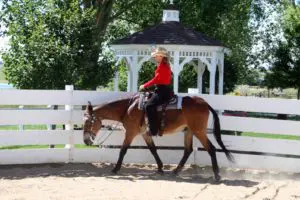 Breeding for bigger, better and faster equines, has given people the false idea that these horses perform almost solely from their heredity. This has changed how they are being trained and judged. Today, many equine competitions are no longer judged by an expert who really knows the definition of correct movement. We are inundated with terminology from the Masters that is most often misunderstood and distorted.
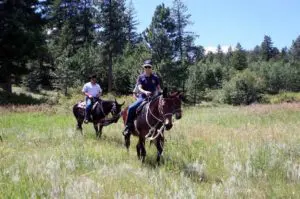 To those who are not schooled in Dressage, collection can mean a lot of things that are contrary to the actual definition, including the belief that it means to merely break at the poll and arc the head and neck. People also believe that an equine is on the bit if he arcs his head and neck and flexes at the poll. What this actually means is that the equine has taken contact with the bit, and can feel the hands of the rider through the reins, and respond lightly and obediently whether his head and neck are arched or not. Vertical flexion is the result of correct collection that involves the entire body of the equine, when the equine is flexible from head to tail with the hindquarters properly engaged. It is not the act of bringing the equine’s chin to his chest. Lateral flexion is when the equine bends his whole body through his rib cage to the arc of a circle, and is not just bending his head and neck to your knee.
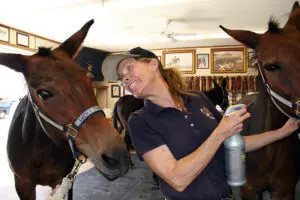 You would teach him to lunge on the lunge line in the Round Pen first with enough slack in the line so it drags on the ground as he circles. Keep a slightly open fist on the line and close your first as the outside front leg comes forward into suspension. He will feel this pressure and bring that front leg onto the circle instead of going straight forward with it. This is the cue you will use when lunging him on the line in the open arena.
 Only after you have adequately completed lead line flatwork and obstacle training is your equine truly ready to move on to the round pen and begin lunging and learning to balance on a circle at the more active gaits. At this stage, he should be complying willingly, walking with the lead rope slung over his neck and with his head at your shoulder. By now, his core muscles should be properly conditioned and strong enough to support his skeletal system during more active use and more complicated movements. Note: The equine that has not had this prior lead line balance and good posture training will have difficulty in the round pen because he has not learned to stay erect and bend his body through the rib cage when on arcs and circles.
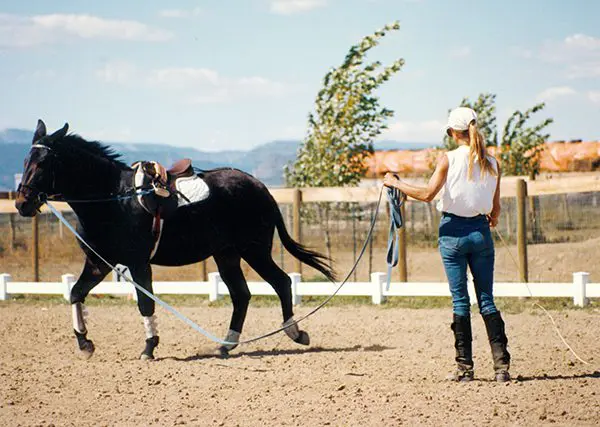 Before your equine learns to balance with a rider, he must first build muscle so he can sustain his own balance on the circle before carrying a rider. This is also true if you want your animal to learn to lunge on a lunge line. An equine that has not had enough time in the round pen establishing strength, coordination and balance on the circle will have difficulty on the lunge line, because even the slightest pressure on the line will pull him off-balance. Loss of balance will cause stress and even panic in your equine, which can result in him pulling the lunge line right out of your hands and running off. This is not disobedience but rather, fear caused by a loss of balance so do not punish him for this reaction. The animal that has had strength built on the circle before lunging and riding will not exhibit these undesirable behaviors, which are often misinterpreted as disobedience.
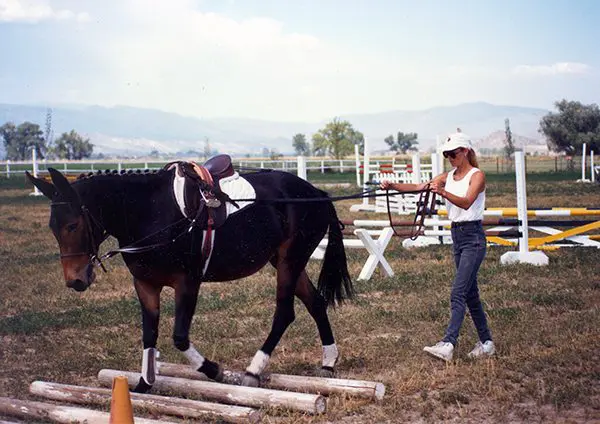 I have found that, in most cases, the larger the animal, the more docile the personality, which seems to be a general rule of thumb. I have also learned that, if a donkey or mule has a tendency to bolt and run, it’s because they don’t necessarily agree with what you are trying to do or how you are trying to do it. Even though horses usually comply fairly easily, it is important to remember that any disobedience on the part of any equine is ALWAYS the handler’s fault. Regardless of the personality type of an equine, he will always have an honest response to any stimulus. If you ask in the right way, you will get the desired response.
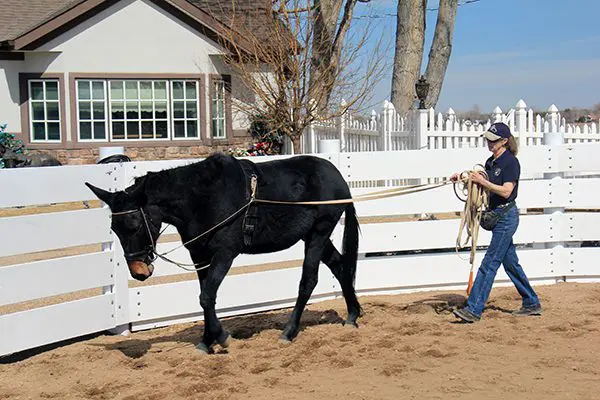 When ground driving, you should not worry about the whip while in the round pen, as the walls will help guide your animal in maintaining the correct position. What you really need to do is keep even contact on both lines (reins) when going in a straight line (or, when in the round pen, on the circle). To get your equine to begin stepping laterally, slightly tighten the outside driveline while maintaining contact on the inside driveline, so that he cannot complete the turn. Stay directly behind his haunches and urge him forward. This will cause him to begin to step sideways, with his face to the wall. Take only a couple of steps this way, and then slowly straighten him out again—you can build-in more lateral steps as he begins to understand what you want. Be sure to reward him with crimped oats every time you halt.
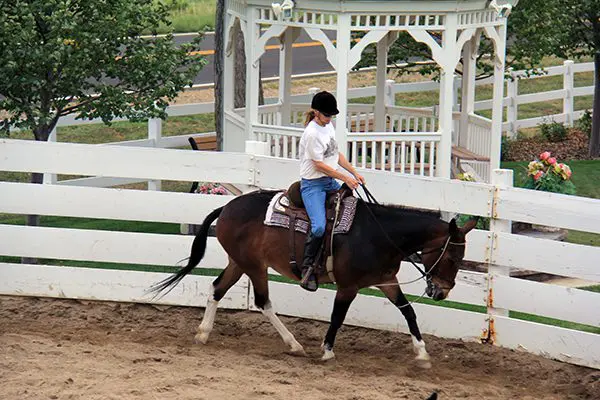 If an animal is trained with sequential, resistance-free training techniques and is given adequate time on groundwork training (a minimum of one year on the lead line and a second year on lunging and ground driving), he will warm up to other people more easily and will be more “sensible” than those animals that are not trained this way. Each new owner should take the time to review these techniques with newly acquired equines, just to create their own personal relationship with that animal and dispel the negativity of any prior relationships the animal might have had. Spending time doing simple basic groundwork training before actually riding allows your relationship with your equine to develop in a safe and healthy way. It will teach both you (the handler) and your equine how to communicate clearly and effectively. The exercises described in this article will condition your equine’s body so he can more easily carry a rider (whether the rider is balanced or not), and help your equine to be more capable of executing whatever demands the future may hold.