
MULE CROSSING: So You Think You Want a Mule?
By Meredith Hodges
It was bad enough before computers and cell phones when people thought they wanted a horse and could realistically have one. They thought if they had a little patch of grass and a fence around it, it would be enough to keep a horse. They never thought about shelter, feed (they could just eat the grass!), vet and farrier care, and about a dozen other things that it takes to maintain an equine.
Those who indulged themselves and bought a horse under those conditions soon found out that keeping an equine was a bit more than they bargained for! If they got the equine for FREE, that was even better…NOT! If they got them cheap, it was GREAT…NOT! If they got them cheap from the Kill Pens and rescued them, Oh, how compassionate they thought they were being! If they didn’t have a small patch of grass, but really wanted a horse, a Boarding Stable was the perfect option provided that the price was right! They would have the privilege of riding with their friends! Boarding Stables with limited exposure to their owners is not good for mules or donkeys, and are even worse for Boarding Stable employees that need to deal with them on a daily basis. Monitoring their feed in a healthy way at a Boarding Stable is next to impossible because they want to feed ALL the equines the same way, no matter what you write for them on a stable sign.

 Cindy and I talked about the “Good Old Days” when we used to live on a ranch, had horses and could be gone all day riding with our friends! Today, our lives are so easy and require no experience to have the knowledge that you can now hold in your hand! The value of EXPERIENCE is diminished until you get hurt! There were so many things that we learned by having the full responsibility of cleaning pens, feeding, grooming, tacking up our own horses and then riding in so many different situations. One really LEARNED how to make decisions and analyze the knowledge that we gleaned. We soon learned the approaches and things that we could do SAFELY, and that kept our experiences happy and joyful! We KNEW it would cost a minimum of $5000.00/year to maintain and train our equines! Our relationships with our equines were good and they were able to teach us WELL!
When one grows up with all things done FOR them, one loses the benefits of all those lessons that Cindy and I were able to learn. Our lives were truly filed with the love and joy we got from being with our equines, and even more, the challenges that were put before us to be BETTER. That enhanced everything we did with our animals! It made us more curious and willing to ask questions of all kinds of people that knew more than we did…and we learned so much MORE! We learned about who to trust and who we should consider suspect. We heard all about the Horse Traders and discovered the differences between them, and the differences between honest people that were also selling equines.

If you do get an animal that you are not compatible with and you want to sell him to someone else, be careful about how you do that. It is good to advertise, but know what you are talking about. If you get in a situation where you can not longer afford to take care of the animal(s) you have, be careful what you do, or it can break your heart! The first thing to do is to ask around with people you know and see if anyone can take your animal. If not, then advertise in equine publications, or on the internet, and see if there is any interest there.
 If the last resort is putting them in an auction…BEWARE! You might get stopped with your truck and trailer in the parking lot and a dealer that offers to take them off your hands right there! If you are tight for cash and looking for a convenient fix to your problem, you might think this is a great deal, but this is what KILLER BUYERS do!!!
When you are looking for an equine, don’t be afraid to talk to a lot of people, starting with people that you know are good horsemen. If they don’t have anything for sale, ask for credible references. You can usually find a lot of knowledgeable people at shows, fairs and exhibitions, but beware of what they tell you and remember that they want to SELL the animal and they know nothing about your riding ability and in most cases, they don’t care.
We learned to watch the animals at the auctions and the way they were being presented. Don’t be afraid to ask WHY they are being sold! Were they truly calm and well-trained, or were they drugged and would be quite different when they were taken home? It wasn’t hard after a while, to tell the difference among who the really good trainers were and those who “faked it” for a sale. It was even important to know the difference among trainers in case you would need help after purchasing your equine. Is the seller a true MULE PERSON?
It is important to know what kind of person YOU are (and be honest…quick temper?) before you decide what kind of equine you want to have. Research all it takes to maintain the different kinds of equines (small, large, active, docile, etc.) and whether their conformation is going to be sound enough for what you want to do with them. Ask a professional if your assumptions (and that IS what they are when you are ignorant about equines…assumptions!) are correct and sound, and will they work the way you would like them to work. Is this going to be the horse, or mule, for YOU!
The nice thing about buying a mule is that THEY will decide whether or not they like YOU! If they are not attracted to you…forget that mule! If you do find a mule that seems to be attracted to you and comes right up to you…he might be THE ONE! Then it is time to get a vet to help with a pre-purchase exam to make sure he is sound. Lots can be hidden with drugs, so take your time with this and give any drugs time to wear off. Have your vet and farrier do exams on the hooves to make sure the equine has not been “nerved.” When an equine has been “nerved,” their unsoundness can be hidden for months and years.

When you do think you have found that ideal mule, don’t be averse to asking the seller for a trial period, usually for a month to make sure things were not overlooked. This should be clearly stated in a contract between the buyer and the seller with stipulations about how things will be handled with the animal to keep him safe. You must assure the buyer that your facility would not be injurious to the animal and that he will be properly maintained. It is helpful to include acceptable surprise visits by the seller if he has any concerns at all.
If you hire a trainer and show your mule, be sure to have a clear contract with that trainer about expectations. Be sure to have a legal Power of Attorney drawn up in case of accidents that will clearly state how the animal is to be handled should something happen to you. The trainer should always be paid up in full and the animal should never be used for collateral for non-payment. As a rule, I only allow supervised youth riders on my mules for specific youth classes at shows. It is not a good idea to let anyone else ride your mule. I find that their relationships are VERY specific to the people they love! HAPPY TRAILS!
If you would like to have more information about buying and selling equines, I suggest you purchase Cindy Roberts’ book, HOW TO BUY A MULE & NOT GET SCREWED. It is an excellent resource for this kind of information. And, if you want to know as much as you can about Longears, take a look at all the books and videos that I have available both in the STORE and the FREE information under TRAINING on my website at www.luckythreeranch.com
To learn more about Meredith Hodges and her comprehensive all-breed equine training program, visit LuckyThreeRanch.com, MEREDITH HODGES PUBLIC FIGURE Facebook page, or call 1-800-816-7566. Check out her children’s website at JasperTheMule.com. Also, find Meredith on Pinterest, Instagram, MeWe, YouTube and Twitter.
Covered in TRAINING MULES & DONKEY: A LOGICAL APPROACH TO TRAINING, TRAINING WITHOUT RESISTANCE, EQUINE MANAGEMENT & DONKEY TRAINING, EQUUS REVISITED and A GUIDE TO RAISING & SHOWING MULES at www.luckythreeranchstore.com.
© 2024 Lucky Three Ranch, Inc. All Rights Reserved.

 jack, and a female horse, called a mare. Mules can either be male or female, but they are unable to reproduce because of an odd number of chromosomes in their genetic makeup. When training mules, one needs to take into account the donkey half of the mule as well as the horse half. Horses can often be trained without the benefit of a personal relationship, but mules are different. The donkey is inherently a warm, affectionate and loving creature that thrives on close relationships with their humans. When this closeness is absent, the donkey or mule can seem stubborn and uncooperative. Thus, there is the old saying, “Stubborn as a mule!”
 enclosure by himself, or just with his dam.
 Competition is fun and exciting but can easily become a devastating experience for both of you if the focus is winning against others. Rather, the focus should be to compete against yourself. If you are doing better than the time before, then you are doing well. You don’t need a blue ribbon to mark your improvement. When you go to a show with this attitude, you gain more open communication and friendships with others who have the same interests as you do. You are able to learn from those who are more experienced; judges and officials can help you to improve. This makes the whole showing experience more enjoyable and mutually beneficial to all.
 Strangely enough, the gate in the trail class just didn’t appear to his mule to be like the gate at home, and the mule would go nowhere near it! He, too, was humbled and left the class with nothing.
 develop patience and consistency in training, neatness in you and your mule’s appearance, and pride in yourself and your mule.
 more flies with honey than you can with vinegar.” I used to think in my head, “I don’t really want to catch flies and I don’t even like honey,” but I got her point and she was right. When I got frustrated that my mules were not doing exactly what I wanted them to do, I began to ask myself, “Why not?” I thought I knew everything, until I realized how much I had yet to learn. That is when I stopped trying to force things and became grateful for everything good that happened, every day! People told me that my Longears and my other equines needed a job to be worthy of my respect and support. I thought about it for awhile. Then I realized…my equines never told me they needed a job!
 the same way toward others? When I opened my heart and my mind to my animals and others…that was when I really discovered how little I knew and how much I had yet to learn. I realized at that time that this would be an endless endeavor, but a lot of time to share and enjoy life!
 what they gave to me…and the gifts they gave just kept coming. They were now true companions, partners, friends and our experiences together were quite literally becoming joyful!
 kids was denied. In response to this denial from 4-H Club Leaders, I wrote my book, A GUIDE TO RAISING & SHOWING MULES…for kids and beginners. No longer could the 4-H Leaders use this excuse and mules began cropping up in equine performance throughout the country!
 entire career, but with my own stubbornness and conviction, I have been able to show folks a better approach.
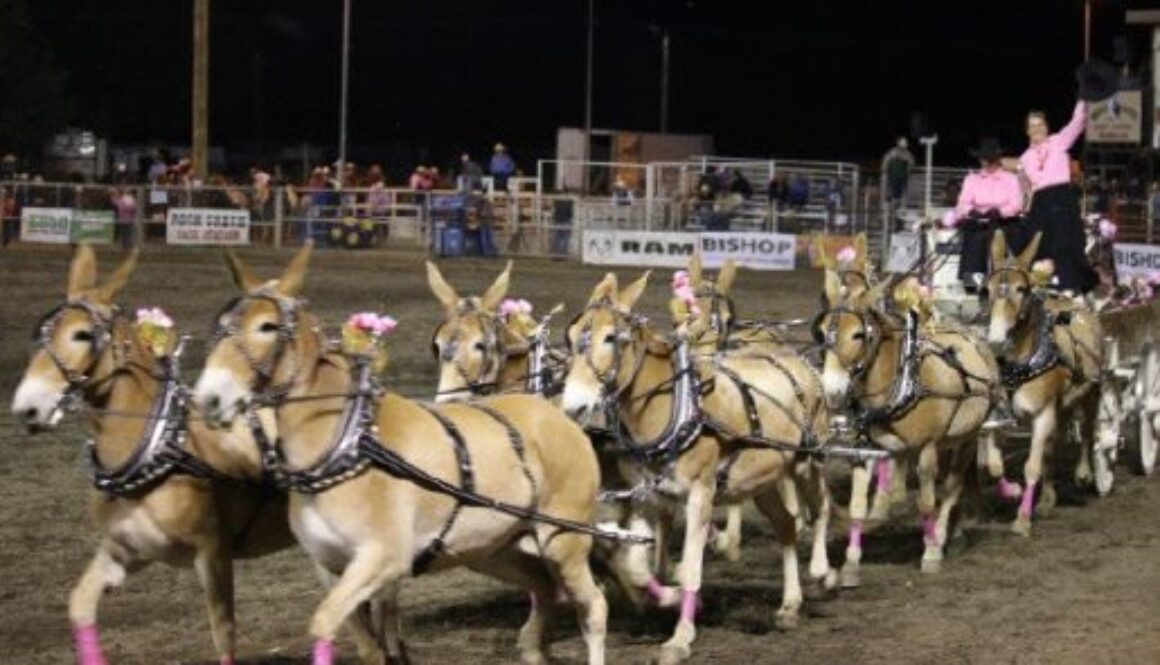
 Longears have made their way into our society as yet another viable addition for the entertainment of the general population. More people than ever are taking on this challenge and making their mark as Mule Trainers. There is probably nothing as exciting as watching the drivers and their multiple hitches in shows and parades, the least of which is
  not the 20-Mule Team that is now being exhibited all over America. What a thrill to behold! People are now truly enjoying the affection and companionship these amazing equines have to offer! A light has been shown on the mules of the past! Those that thought mules could not be controlled, are now enjoying the companionship of their own leading celebrities of the equine community! So reject criticism, reject negativity and become a member of this new world of Longears and experience the joy that they have to offer! It’s quite simply…awesome!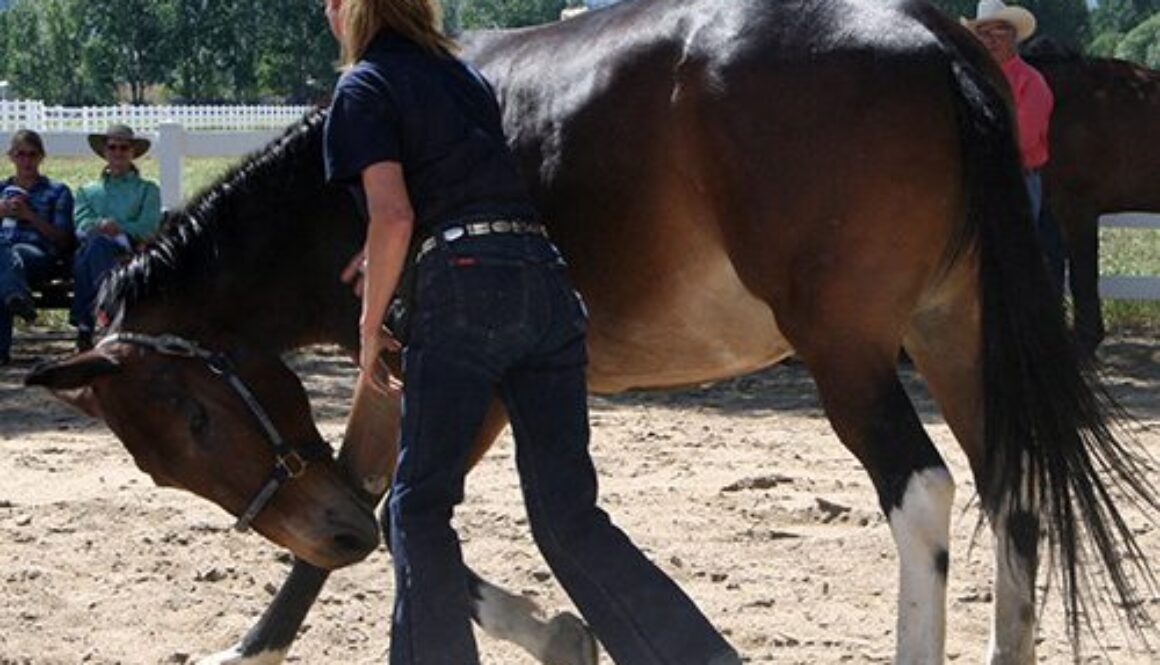
 “Mules separate crude trainers from artistic trainers.” The mule handled by a crude trainer will generally epitomize the traditional belief that mules are stubborn and ornery. The mule handled by an artistic trainer will not.
 Horse training trends have evolved from Buck Branaman, Pat Parelli, Clinton Anderson, etc. and their Round Pen training techniques using ropes on the equines. Natural Horsemanship rose from these methods, using less restraint on the equine.
 This gave way to the new trend of teaching them to lie down. Equines do not lie down easily, so it wasn’t always used as an easy way to mount. It really shouldn’t be used that way because of the added stress put on the equine’s body that can cause arthritis and other problems with the hooves, and joints, as they age.
 I saw a horse being exhibited at the WEG that was forced to bow with ropes. I thought it could be beneficial to find out how long it would take for an equine to learn to bow of his accord with his own muscle strength. Lance learned to do it by himself with only slight encouragement from me in 18 months.
 If the argument is that amounting block can’t be brought along for trail riding, it makes more sense to simply acquire a shorter animal.
 If you find restraints are not sufficient to help with your equine, you may be dealing with an outlaw, in which case it is best to put him out of his misery before he injures someone. Be careful however about blaming the animal for his response to an inhumane trainer. Some can be rehabilitated, some cannot, but you will need to know what you are doing. Kindness alone is not the answer.
 Today good mule trainers apply the basic techniques of Behavior Modification (reward system training) in their programs. That is, getting the desired response through positive reinforcement and ignoring, as much as possible, the undesired behavior. Negative reinforcement, or punishment, is used sparingly, is never severe and is only used to set boundaries to behavior.

 By Meredith Hodges
 Once the heavier coat is eliminated, a weekly grooming will keep his coat nicely maintained. Daily grooming before a show, or every other day, is even better. Each time you groom him before riding, check and clip as needed the muzzle hairs, around the eyes and ears, and around the coronet bands. Leave the hairs inside the ears to prevent irritation from bugs and flies, but trim the outside edges and backs of the ears. An ounce of corn oil in his feed daily will assure a healthy sheen in his coat on show day without the use of artificial highlighters. Trimming, or shoeing, your mule on a regular six-eight week schedule will assure that his feet will not need attending at the last minute. A routine vaccination, deworming, Coggins testing and a permanent brand inspection will make sure he is ready for transport to any show anywhere at any time. Then, all that remains to be done right before the show is minor clipping, bathing, and polishing hooves.
 Then, tack up your animal, checking each piece of equipment to make sure that it is in working order. Go ahead and practice the class. Then, as you unpack your mule, set the tack aside from the rest in your tack room for cleaning later. Do this for each animal in each class. Your animals will do better at the show if they get plenty of rest before the show, so it is wise to spend the day before the show cleaning your tack, clothes, and equipment. Before you begin to clean, load all the items into your trailer that are all ready to go without cleaning. Then, as you clean the remaining items, load them directly into the trailer as you finish them.
 can be left until morning, or last minute, provided that you put them in a highly visible spot with a list of what is to be put in attached. Do not try to rely on your memory, as it will be clouded by the excitement and anticipation of the show.
 If classes are spaced fairly close together and you are using more than one animal, it is wise to tack up the other animals ahead of time so they are ready to go. If you are using only one saddle for more than one animal, the other animals can still be bridled with the halter slipped over it, so they can be tied and waiting. Be sure to tie up the reins so they will not be chewed or stepped on. If you are using the same mule throughout the show, tacking and stripping should not be too time-consuming if your equipment is well organized.
 Miniature mules and horses settle into their lunging lessons very well, but miniature donkeys (and donkeys in general) really don’t like to be lunged. They just don’t seem to see much purpose in it unless you make it fun for them. If you have a mini donkey, when teaching him to lunge it is helpful if you employ the aid of another type of equine of comparative size (such as a miniature horse or mule) to help “lead” your mini donkey through the lessons. Before I first began lunging my two mini donkeys, Augie and Spuds, I introduced them to Franklin the mini mule, Francis the mini molly mule and Mirage the mini horse by putting them altogether in the larger indoor arena space, and then I put them all in the round pen together. Before I began giving any of them specific instructions, they were all allowed some time to investigate each other and establish their pecking order. Before long all five were lunging cooperatively together, although Spuds did feel the need to kick at Mirage a few times so Mirage would allow him enough space to perform. (Mirage can be a bully sometimes and needed to be put in his place.)
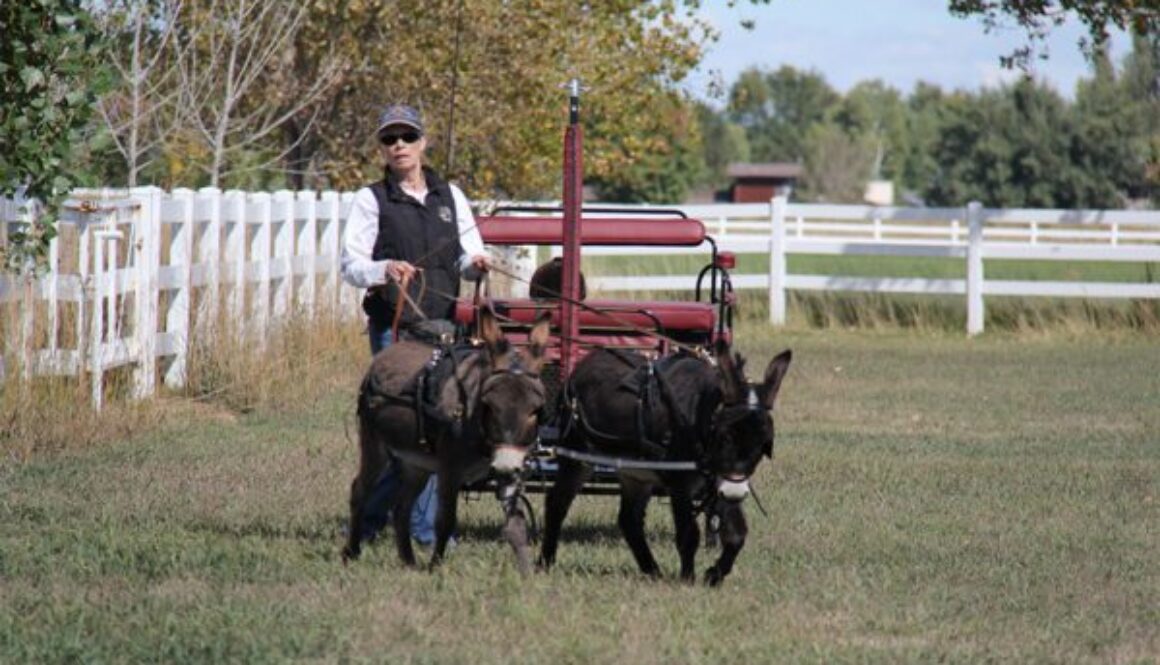
 It is important that your tack and other “mini” equipment fit well. Check the harness to make sure the bridle fits and the bit is placed correctly, and be sure to adjust the blinders on your harness bridle so they don’t rub against your mini’s eyes. Fitting miniature donkeys for harness can sometimes be difficult, but I was fortunate to find Chimacum Tack, a tack and harness manufacturing company that does a fantastic job with miniature donkey, mule and horse harness. I suggest that you make the fitting a lesson in itself—you can even introduce your mini to the cart he will be pulling without actually hitching him up to it. Just as you have with all other obstacles, first let him inspect the tack. Then, once you have put it on him, have him stand quietly in the spot in front of the cart where he will eventually stand. Don’t forget to amply reward him and he should be more than willing to comply.
 At this stage of training, lessons over obstacles can now be done with more finesse. You can begin lateral work over small rails placed in front of a fence, backing through the walk-through “L” and doing lateral work in the tractor tire. In advanced tractor tire work, if you judge it to be safe, get down on your knees so you are on your mini’s level. Now ask your mini to put all four feet inside the tractor tire, and to then make a turn on the haunches. Direct his head in the direction you choose to go first and ask him to slowly turn while all of his feet are still inside the tire. Do this by poking him in the shoulder with your index finger (just as you did when repositioning him for the farrier) and asking him to move his front end over and around the inside of the tire. Do this in one direction and then in the other direction. Stay low, maintain eye contact and don’t be too forceful in your movements.
 By now you have taught your mini to follow on the lead while you both explore and have all kinds of adventures around your property, inspecting new things and having picnics everywhere imaginable. If your mini is to learn to be driven, he now needs to have the confidence to take the lead. When you begin this process, review (with your mini) leading together from the work station to the round pen. If you are training a team and dealing with two minis, tie their halters together at the side rings with about eighteen inches of 3/8-inch nylon rope with small snaps on each end between them, and use one lead rope snapped to the center of the tie rope between them. Begin by taking your position in the lead while carrying a dressage whip. Slowly work your way in beside them on the near (left) side, tap them each once gently on the hindquarters with the whip to let them know you expect them to continue forward and ahead of you (even though you are moving more slowly than they are on an angle to gradually work your way in behind them). Pretty soon, you should be directly behind them, encouraging them both forward if they do stop with a gentle tap of the dressage whip, but only one tap for each balky step.
 In subsequent lessons going forward, the next steps are to attach the drive lines and ground-drive your mini in the round pen. Ground-drive around the rail in each direction at the walk and do smaller circles from the rail and back to the rail around the larger circle. Execute an “S” turn through the middle to change directions and do the same going in the opposite direction. End each lesson with a square halt and a back. If he does not do any of these moves with ease, just be happy with what he offers and stop the lesson there. This will give your mini a lesson in communication through the bit. It is imperative that he learns this. You always have the next lesson to continue forward and you want to avoid any confrontation that will cause resistant behavior. It is easier to prevent the behavior from occurring than to have to correct it later. If you are ground-driving two minis, work each mini alone first and then follow this exact same procedure with your team.
 Moving to an open arena changes your mini’s perception of space and he will often feel like playing, so set up the cones of the hourglass pattern for him. Ground-driving through the hourglass pattern will help to maintain his attention and give him a point of focus for his lessons. Ground-drive your mini as you did in the round pen, but now he will be driven through the hourglass pattern with random halts. If you have any balking, just stop, reward for stopping, regroup and try again. Remember to go slowly and use frequent halts and backs in order to reward your mini. This helps him to stay attentive to your hands. Remember to do a full halt yourself—in good posture—before you step forward to reward him. If you pay attention to your own posture and the quality of your walk and halts, he will pay attention to his.
 There are classes at various shows (both open horse shows and miniature shows), where minis are not only driven in harness with a variety of carts and small carriages, but they also do trail courses and jumping on the lead line. Miniatures enjoy performing and have personality-plus, which audiences love! How well-trained your mini is will determine his willingness to do a multitude of fun activities, so make training fun and exciting for your mini. Enjoy the small victories along the way, use your creativity, reward lavishly and look forward to your adventures together.








 By Meredith Hodges
 “It’s got possibilities,” I said enthusiastically. My mother scowled, then grinned and said, “Yeah, it’s got possibilities all right.”
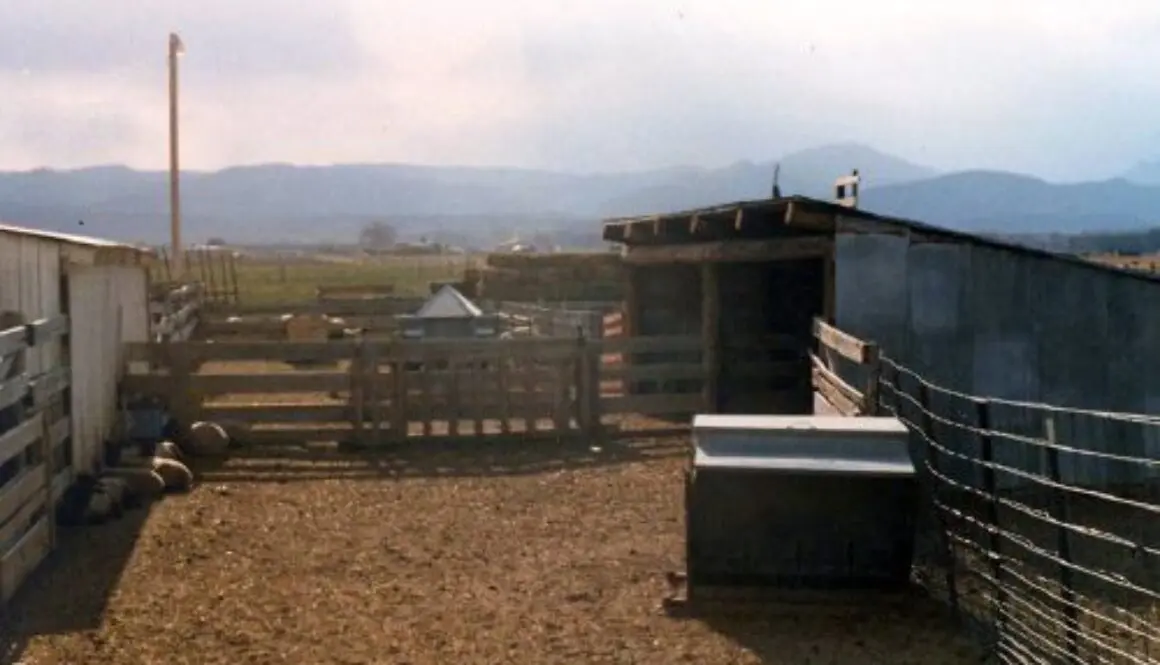
 We built fences and sheds out of discarded lumber and made do as best we could. Each day I set aside one hour to spend with the first mule that was ever totally mine!
 that trailer?” No one can ever say that Ernie Fanning doesn’t know his Longears! We introduced ourselves and sat there along the highway talking mules for about a half an hour. Afterwards, we were again on our way with our trailer full of hopes and dreams.
 Lucky Three Mae Bea C.T., a molly by Colorado Poncho and out of our Appaloosa mare, Sam’s Nickey (bred before Little Jack Horner was old enough to breed), was foaled in 1982 and had over 40 titles to her credit, including National Western Stock Show Drive & Ride Champion in 1986, Single Hitch Champion in 1987 and 1988 and Bishop Mule Days Reserve World Champion Drive & Ride and Single Hitch Mule in 1986 and 1987. Mae Bea C.T. had won numerous titles in Halter, English & Western Pleasure, Trail, Reining, and Dressage in her short career. She is the first mule I ever trained without any interference from anyone. In my opinion, she was the best mule I ever produced of the 30 or better that I had trained before. Still, there were many more Little Jack Horner offspring to come! Bea’s crowing glory was to beat 56 horses in Combined Training in 1993 at the Novice Level. Given the right start in a carefully planned training program, our mules provided us with the additional finances we needed to expand to the breeding and training operation that we had for twenty years, but it is more than just this for which we stand.
 We began as a family of three enthusiastic people, loving and living Longears and that part hasn’t changed. Good hired help is next to impossible to find, so we built up our ranch so that it would be relatively easy to care for it ourselves. In 1984, we added 70 more acres and a hay business to our operation—still managed entirely by our small family and a few friends on occasion. Experience and dedication to Longears caused us to cover a wide spectrum of training with our mules, ranging from Western to English and finally to Dressage and Combined Training. Little Jack Horner became the Sire-Supreme of mules that naturally possessed the athletic ability and conformation to accomplish a wide variety of interests. This further exhibited the true versatility of quality mules. In 1984, we bought a 14.2 HH jennet at the Segelke Dispersal sale in Denver in hopes of developing a Mammoth donkey jack with the refined
  characteristics of the Large Standard and Standard donkeys.
 Society that operated out of our ranch for more than two years. It wasn’t long ago that we were knocking on the doors of horse shows everywhere, begging for acceptance. When we formed the Colorado Donkey and Mule Society, we had horse people knocking on the doors of our learning clinics! At the same time, we had nearly six times the number of Longears shows in Colorado that we had before!
 Acceptance by the United States Dressage Federation in 1986 was the most inspiring influence we encountered in our 15 years with Longears. A tradition in equestrian arts, the United States Dressage Federation literally lives by its motto, “A Circle of Friends.” They aided us in putting our mules to the test and allowed us to test their capabilities at numerous schooling shows. We also discovered that Dressage Training (as tradition already has it) only enhances an animal’s performance. It is for this reason that we always start our young mules this way, though each individual may be suited for something different. It was our U.S.D.F. instructor, Melinda Weatherford, who inspired Gary, Dena, and I to go one step farther into Combined Training. The mule’s natural jumping ability lent itself beautifully to this avenue of training—besides, it’s just a lot of fun for both mules and riders! Our daughter, Dena, worked diligently to try to become a United States Equestrian Team rider. She said if she finally made the Olympic team, she hoped they would allow her to exhibit her three-day event mule, Lucky Three Nuggett at the Olympics. Although they never did have this opportunity, it looks like Longears will continue to prosper through a third generation in this family with my granddaughters as they love Longears, too!
 Our Longears have given us many memorable moments in our lives, most of them pleasurable and it is my desire to share this knowledge with others that keeps me going. Lucky Three Ranch only produced three to four mules per year because that is all we could handle for training. Our mules proved their quality and value many times over in the show ring.


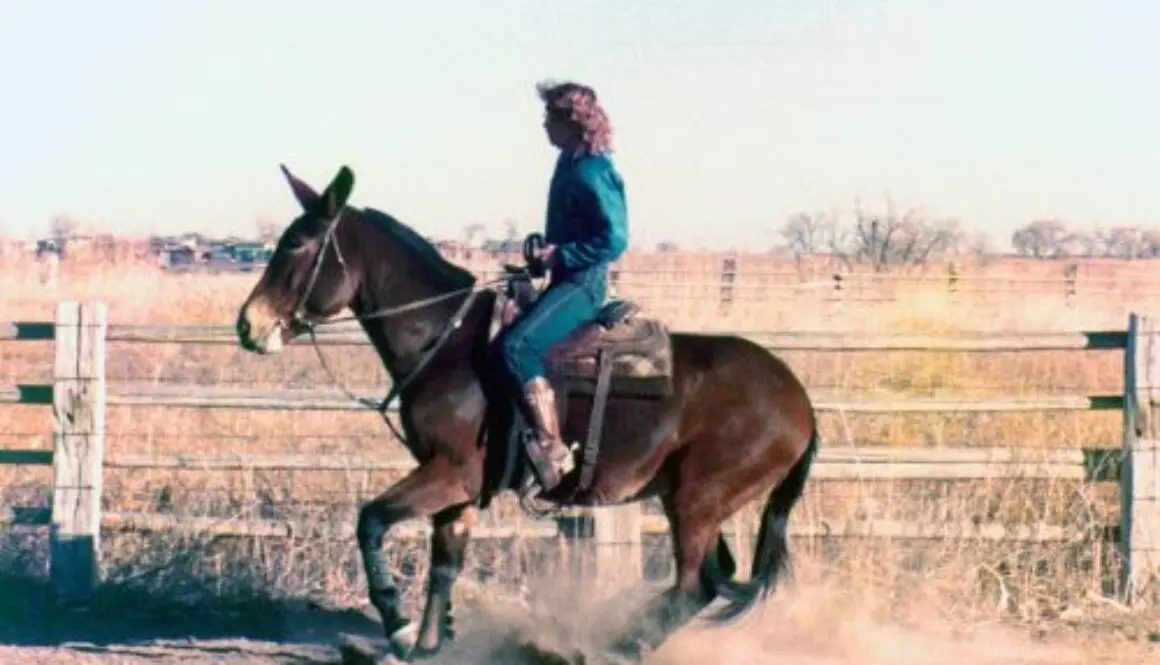
 In the early sixties, mules were among those animals quickly becoming extinct in this country. Thanks to the formation of clubs such as The American Donkey and Mule Society, founded in 1967, and the British Donkey Breed Society, founded in 1966, the trend was reversed and the animals began to get the recognition they justly deserved.
 For those of you who are unfamiliar with the breeding of a mule, he is the cross between a male donkey, called a jack, and a female horse, a mare. The reverse of that–a cross between a male horse, a stallion, and a female donkey, a jenny on jennet–is called a hinny, although many still refer to them as mules. Years ago people used low quality mares to breed to jacks to obtain mules, but today we are improving the breed by crossing better quality animals to obtain better and stronger mules.
 Many have asked about the training of mules. Training mules is much like training horses, but sophisticated trainers would probably agree that they are more like teaching young children. A mule is more likely to perform to the best of his ability if he is allowed to build trust in his trainer. This is where mules and horses differ. Horses have a forgiving nature and are able to forget a loss of temper by the trainer; mules do not forget. When a mule is nervous about a trainer, his ability to perform for the trainer is impaired. Pat Parelli, a California mule trainer, put it quite nicely: “Mules separate crude trainers from artistic trainers.” The mule handled by a crude trainer will generally epitomize the traditional belief that mules are stubborn and ornery. The mule handled by an artistic trainer will not. A technique widely used among mule trainers with great success is the psychological science of Behavior Modification, whereby the animal’s natural behaviors are modified to achieve the desired response through the use of positive reinforcement. Negative reinforcement is also used sparingly. When using negative reinforcement, one must remain calm, patient, and just to ensure the success of the temporary discipline. One must remember that negative reinforcement does not build desirable behavior. It is only used to stop a bad behavior long enough to substitute a desirable behavior. A mule trained in this manner will become a more trustworthy, willing, and predictable friend and companion. Let’s dispel the old saying that mules are “stubborn” and “ornery” and say that there are really no bad mules, only bad trainers.
 The Mule Days celebration in Bishop, California is the largest mule show in the world. Mule lovers, their friends and family enjoy four days of mule-related fun and entertainment. At this particular show there is a little something for everyone: Western cuisine, games, dancing, and conversation in addition to the mule show itself. In 1984, there were over 70 different classes and events for the competitors such as Pleasure classes, Reining classes, Trail, Musical Tires, Barrel Racing and Pole Bending. Also Jumping, Cattle Penning, Steer Stopping, Team Roping, and a Balloon Bust. For the packers: Pack Train classes, Packing contests, Box Hitch and Diamond Hitch packing contests (pro and non-pro), Team Packing and the Team Packing Scramble which you have to see to believe! There are Halter classes, Pulling, Driving classes, and for you race fans: Chariot races, Flat Track races, and yes, even a Backwards race! To highlight the events, there are featured performances by special people and mules. Almost every year, the 20-mule team makes an appearance and in 1981 Slim Pickens, Grand Marshall of the Mule Days Parade, drove his team to victory in a chariot race! In 1984, Colorado’s own Al Kaly Shrine Temple Mule Train World Champion Drill Team out of Colorado Springs gave a memorable performance on their beautifully matched, black army mules. This mule show brings together so many people with different backgrounds and interests for a perfectly glorious weekend. Each year leaves you looking forward to the next.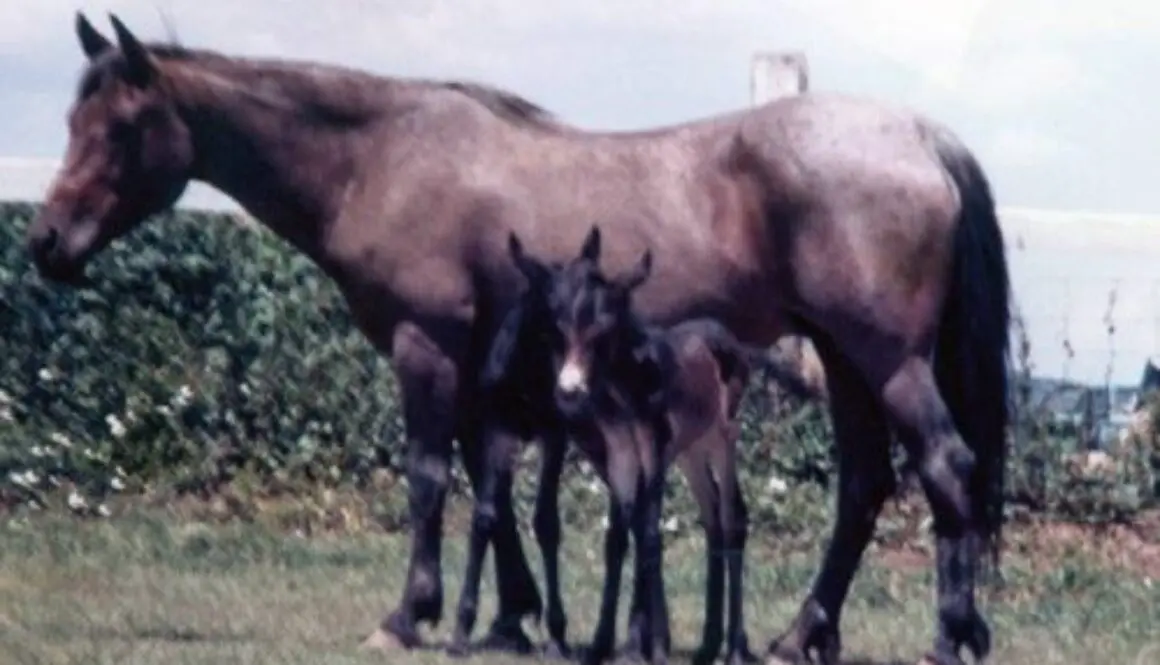
 The year before, John came down with a mild case of mule fever and decided to breed his red-road, half-Arabian mare, Missy, to Little Jack Horner here at the Lucky Three Ranch in Loveland. The breeding went smoothly and the mare was sent home. She returned 15 days later for her ultra-sound pregnancy check, at which time we discovered she had conceived twins. Since the twins posed a life-threatening situation, Kent Knebel, D.V.M., our attending veterinarian and I advised John of his options. We could abort the twins and start over or we could abort one and hope the other survived. The third and most risky choice would be to let nature run its course and hope for the best. John opted for the latter and took Missy home. She would be due to foal in August.
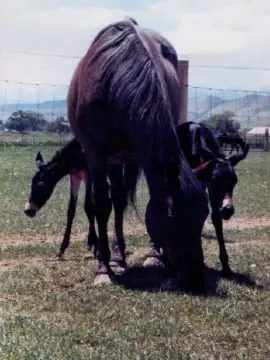 sustain two fetuses and the way the uterus contracts during the birth process. In a dog, cat, or animal given to litters, the uterus contracts in segments, giving each baby an opportunity to “line-up” for birth. In equines, the uterus contracts as a whole, often causing both babies to be pushed into the birth canal together. This usually ends in disaster. Before birth, a stronger twin may horde the larger part of the mother’s nutrients causing the second twin’s growth to be stunted. The degree of deprivation determines whether the smaller twin can survive, provided they both make it through the birth process. Either way, twins in equines are an extremely risky situation.
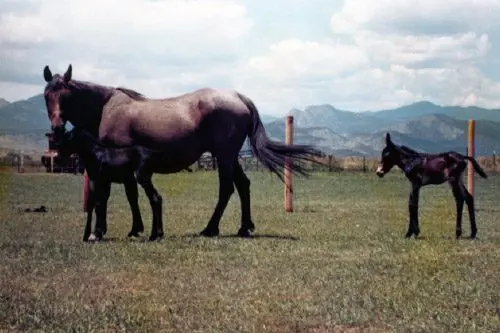 In two weeks, Missy dropped some of her weight and began to look more like a pregnant mare again. Apparently the unsupervised pasturing had allowed her to become somewhat obese. She began to wax after two weeks and we were ready for action, but she fooled us. The waxing stage came and went and she began streaming milk wherever she walked. On July 3, Dr. Knebel took another look at her while he was out at the ranch tending to another patient. “Looks like a firecracker birth to me…” he announced, “or maybe the day after.”