
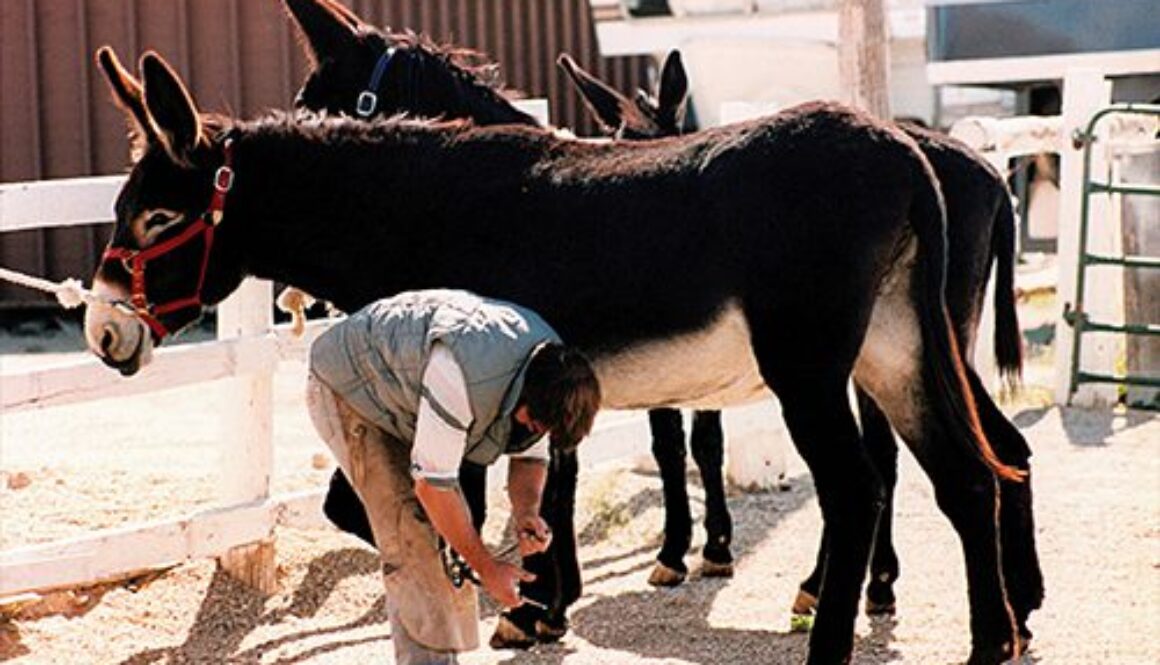
Trimming Donkeys
(Pg. 219, 6-5-15) TRIMMING DONKEYS can sometimes be a real challenge! The way that donkeys are fed makes an impact on their hoof health. Remember that they are desert animals and will not do well on rich feed. Hay alone will not provide complete nutrition, so I do give them a measured mix of crimped oats (no more than two cups once a day) mixed with the correct amount for their weight of Sho Glo vitamins for balanced nutrition, and Mazola corn oil for their coats, hoof health and digestive tract regularity (check out my detailed feeding and management recommendations under TRAINING/ASK MEREDITH/NUTRITION & DIET on my website at www.luckythreeranch.com). Sedation should only be the very last option when all else fails for trimming because Longears can “pop out” of sedation very easily. A second dose can often be too much and could kill them. It is important to employ a farrier who is a trained professional and is familiar with trimming donkeys as they are vastly different from trimming horses, and even mules. I have found that if you do your donkeys as a family, or with their “friends,” they will generally comply and things will go much easier. You can try giving a reward of crimped oats when they allow the farrier to hold the foot, and withhold the “reward” when they refuse to allow it. They will generally learn quickly that yielding the foot is more pleasurable in the long run. If that doesn’t work, just put a bucket of oats in front of each one that is being trimmed, and then pull the bucket away when the farrier is not working on them.
Give it back when he resumes working. It is always preferable to keep slack in the lead rope when they are tied. If it is tied too short, they will engage in pulling and will become distracted from the task. If your donkey allows YOU to pick up the foot, but pulls away when the farrier approaches, you should stand between the farrier and your donkey. Give the farrier a handful of oats and have him “introduce” himself to your donkey with the handful of oats. Stand quietly and wait for the donkey to finish chewing and then let the farrier try to pick up a foot. If your donkey still won’t allow the farrier to have the foot, but allows you to pick it up, just have the farrier stand next to you, pick up the foot and hand it to the farrier while he is standing beside you. Then you just back up and stand at the donkey’s head and give him his reward as the farrier works on him. If the donkey yanks a foot away, let him do it and just start again from the beginning. Do not try to hold onto the foot. He will perceive this as force and will only fight harder. We like to keep things simple and resistance-free, so we do reward-system handling of the donkeys’ whole body, hooves included, long before they are in need of a farrier. Learn more about the differences between training donkeys and training other equines in our information sections under TRAINING and in the STORE at www.luckythreeranch.com. If you do not find the answer to your questions or concerns, please feel free to contact me at meredith@luckythreeranch.com and I will answer you promptly.