
Meredith Hodges

MULE TALK! PODCAST: Getting Down with Minis, Part 2
Getting Down with Minis Part 2 –
Learn about:
- Mini group grooming – how it works to save time
- Body – clipping
- What to feed for a balanced nutrition program for minis
- Knowing body language in working around minis
- Efficient grooming practices & more
Or follow along. Read the Transcript.
Learn more on Mule Talk podcast.
For more training info: www.LuckyThreeRanch.Com and click on the Training tab.
Mule Talk is an Every Cowgirl’s Dream production – www.EveryCowgirlsDream.Com
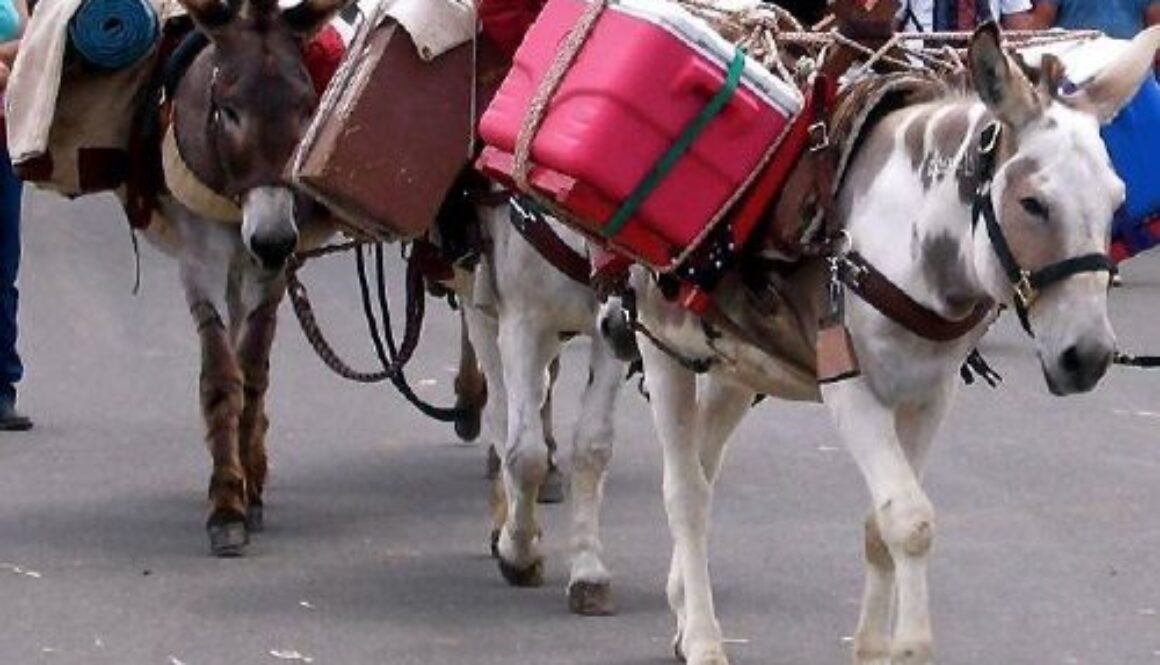
MULE CROSSING: Donkeys

Origin: Originating from the Wild Ass of Asia and Africa, donkeys are the cousin of the horse and have been domesticated for thousands of years.
Uses: Donkeys are used for riding, driving, or as pets in the United States, but as working animals in other parts of the world. They are also one-half of the equation for the production of mules, which have played a vital role in the building of human history.
Breeding: A donkey bred to a donkey produces a donkey. Donkey jacks are crossed on horse mares to produce mules, while the opposite cross (stallion x donkey jennet) gives a hinny. There are few pure breeds of donkey in the United States, where they are known by their sizes and types.
Characteristics: Miniature Donkeys are under 36″ tall at maturity. Standards can go up to 48″ and Large Standards to 56″. Mammoth Jack stock stands 56″ (14h) to over 68” (over 17h). Regardless of size, all donkeys have longer ears, a D-shaped eye socket, and a smoother, leaner body mass than horses. Many have creamy light points around eyes, muzzle, and belly. Colors range from gray-dun to dark brown, black, red, dappled roan, and Overo-type pinto spotting. Many have a dorsal stripe down the spine, with a transverse cross over the shoulders.

Donkeys have toiled for mankind though the ages. Ancient Egyptian art shows donkeys hitched to chariots alongside mules and horses. They are used not only for packing and work, but have carried many a famed person in history. The donkey is known, somewhat mistakenly, for being stubborn, but this is a misinterpretation of their self-preservation. Donkeys conserve energy until it is needed. They have great stamina and are exceptionally hearty, as well as playful and intelligent. Training a donkey is similar to training horses—with extra patience and understanding on the part of the trainer.
Today’s Miniature Donkey is popular in the show ring or as a pet. Standards can be ridden, driven or used as livestock guardians. Mammoths make exceptional riding donkeys in many disciplines, and are used to produce outstanding mules.
Donkeys of all sizes and types can be registered, with shows around the nation for longears. While many never see a show ring, they are exceptional pets and are loved by all ages. With a wide range of sizes, body types and colors, there are donkeys to suit every taste.
To learn more about Meredith Hodges and her comprehensive all-breed equine training program, visit LuckyThreeRanch.com, MEREDITH HODGES PUBLIC FIGURE Facebook page, or call 1-800-816-7566. Check out her children’s website at JasperTheMule.com. Also, find Meredith on Pinterest, Instagram, MeWe, YouTube and Twitter.
© 2010, 2016 Lucky Three Ranch, Inc. All Rights Reserved.

MULE CROSSING: Pre-Pasadena Rose Parade Press Release
By Meredith Hodges
New Year’s Day 1987 brought another first and a giant step forward for mules and donkeys when the American Donkey and Mule Society was represented by our West Coast riders in the annual Rose Bowl Parade held in Pasadena, California. Led by donkey jack, Black Bart, the mules each portrayed a different type of equestrian. Dressed to a tee,  mules once again exhibited the potential for a wide variety of uses. Spectators were awed at the beauty and grace of our modern-day saddle mules and old myths about Longears were soundly refused.
In 1988, Colorado is proud to announce the participation of four of their Longears riders and their mounts. The American Donkey and Mule Society entry in 1988 will be led by donkey jack Blue Zebulon, the 1986 World Champion Standard Jack. “Zeb” will be ridden by his owner, Fran Howe. Fran and her husband, Larry, raise “colored” mules on their 20-acre ranch, the Bitterroot Mule Company, in Bennett, Colorado, just 20 miles east of Denver, and are active directors of the Colorado Donkey and Mule Society. Though they both hold fulltime jobs, Fran and Larry spend most of their free time training, breeding, and promoting mules and donkeys. Their successes are amply portrayed by their show records, but their participation in the Rose Parade is a dream come true and a wonderful opportunity to once  again do more in support of Longears. We can be proud and thankful for the support and hard work of these dedicated folks.
Representing the Sidesaddle Equestrian will be Joan Triolo of Longmont, Colorado, riding Rambling Rose, a lovely sorrel saddle mule owned by Hal and Diane Walston, also of Longmont. Joan has ridden and driven Rose to many a victory at numerous shows, recently capturing the A.D.M.S. National Championship in “Ride & Drive” and “Trail” at the A.D.M.S. National Finals in Minnesota last July. Hal and Diane Walston run the Mountain Shadow Mule Ranch and stand their large Standard jack, Mountain Shadow Music Man, to outside mares. Trainer Joan Triolo sees to it that Rose represents her breed to perfection. Their authentic Mexican sidesaddle outfit complete with an original decorative horsehair bridle will be a sight to behold on such an auspicious occasion! Those from Mountain Shadow Mules are  active contributors to the success of our own Colorado Donkey and Mule Society.
Although the mules have always been my own primary interest, I must give my adoring husband credit for taking the time and effort to become a dedicated mule rider. Gary Hodges, riding Lucky Three Mae Bea C.T., will represent the English Equestrian, smartly dressed in a dark blue coat, gray jodhpurs, black hunt cap, and boots. Gary recently captured a well-deserved second place in the English Pleasure class at the Denver Queen City Donkey & Mule Show held the last weekend in July. Gary has shown his dedication and love of mules by building our 80-acre Lucky Three Ranch into what it is today, with barns, pens, pastures, indoor arena and even helping to farm the 58 acres of alfalfa that feeds our stock. Gary is always ready to help to support Longears and their organizations and is an active director of the  Colorado Donkey and Mule Society. His primary contributions include working on show committees and doing screens for mule and donkey clothing sales.
Lucky Three Sundowner and I will be representing the Dressage mule riders. “Sundowner” will be dressed in traditional Dressage tack. I will be wearing the black coat with white jodhpurs, black boots, and a short black top hat. The traditional “tails” and top hat are reserved for those who have achieved the upper levels of Dressage. As mules are just beginning to enter the world of Dressage, I feel it would be too presumptuous to dawn the garb of my superiors.
 We all owe a debt of gratitude to Diane Hunter of South Pasadena for putting together the ADMS entry for the Rose Parade. This woman has always worked long and difficult hours for the promotion of mules and donkeys. Her contributions as an American Donkey and Mule Society co-founder, inspector, judge and promoter cannot go unnoticed or unappreciated since they have been so numerous and so important. We thank you, Diane, for allowing us to take part in this very special event. As Diane is loaning her lovely sorrel mule, Tea Party to one of the other riders, we are bringing “Lucky Three Ciji” for Diane to ride “to the hounds!” We hope you will all tune in on New Year’s Day when mules and donkeys do the Rose Bowl Parade!
To learn more about Meredith Hodges and her comprehensive all-breed equine training program, visit LuckyThreeRanch.com, MEREDITH HODGES PUBLIC FIGURE Facebook page, or call 1-800-816-7566. Check out her children’s website at JasperTheMule.com. Also, find Meredith on Pinterest, Instagram, MeWe, YouTube and Twitter.
Covered in TRAINING MULES & DONKEY: A LOGICAL APPROACH TO TRAINING, TRAINING WITHOUT RESISTANCE and EQUUS REVISITED at www.luckythreeranchstore.com.
© 1987, 2016, 2024 Lucky Three Ranch, Inc. All Rights Reserved.

MULE CROSSING: New Year’s Rose Parade 1988
By Meredith Hodges

When we were invited in May of 1987 to represent the American Donkey and Mule Society in the 1988 New Year’s Day Rose Parade, we were thrilled—but I don’t think those of us from Colorado realized just how difficult it might be to get to Pasadena in December!
Since we had to be at the L.A. Equestrian Center on December 26th for practice for an exhibition on the 27th , we planned to leave Colorado on December 23rd—but our plans were hurried by a devastating snowstorm that eventually dumped four feet of snow, or more, all over the state and surrounding areas. Fortunately, we heeded the weatherman’s warnings and hurried out of Colorado just ahead of the storm on the evening of the 22nd. All the way across New Mexico, and as far as south of Flagstaff, Arizona, we drove relentlessly with the storm raising its ugly head at every gas stop, threatening to stop us dead in our tracks! Finally, in Phoenix, after 24 hours of driving, we were safe in the warmer southern climate.
Our dedication to our mules prevailed and we arrived safely in Los Angeles the next day… Christmas Eve. We spent Christmas Day enjoying our freedom from the gruesome trip and explored the impressive L.A. Equestrian Center aboard our mules. The mules were quite happy to finally be out of the trailer and allowed to exercise, but they were not as impressed as we were about being stabled next to Zsa Zsa Gabor’s Silver Fox; after all, he was only a horse!
 Practice for our exhibition went smoothly and the following day many visitors toured the stable area in order to meet with the stars of the afternoon’s exhibition. The mules, as always, were among their favorites. We were bombarded with interested folks asking questions and offering complimentary remarks about our Longears. Blue Zebulon, our fearless leader, handsome jack that he is, even managed to line up a photo session with a local photographer. The exhibition itself went quite smoothly. Zebulon, ridden by Fran Howe, led an entourage of mules into the arena cheered on by enthusiastic spectators. After our introduction, we lined up and watched while three demonstrations were performed. First, Gayle Gardner-Mahler gave a jumping exhibition on Diane Hunter’s Tea Party. This was followed by a “Pas de Deux” Dressage exhibition with Gayle again on Tea Party and Meredith Hodges on Lucky Three Sundowner. Vince Silverman finished the exhibition with a Reining pattern on Millie. Then we all exited behindBlue Zebulon to the sound of cheering and applause for our beloved longears. We were all so very proud!
 On December 28th, we all dressed “to the max” for a reception for all the Rose Parade equestrians held at the Tournament House in Pasadena. Celebrity guests included Iron Eyes Cody, Monty Montana, and Richard Farnsworth. Good food, good drink, and good company made for a memorable time, lifting our spirits with the promise of an exciting parade and a better new year for mules and donkeys!
On December 30th, Diane Hunter treated us to once-in-a-lifetime dinner experience at the Medieval Times restaurant in Buena Park. As we passed through the gates of the castle, we were crowned and invited by the king to take a step back in time when chivalry ruled and the Knights of the Realm fought for glory and the hands of fair maidens. We supped with the King and fellow Lords and Ladies of the Realms while watching the knights perform outstanding feats of Horsemanship and combat. We departed the castle with dreams of Camelot, whilst we made our way safely back to L.A.
 January 1st, 1988, 2:30 A.M. came early as we made preparations to make our way to the parade route. When we arrived at 3:30 A.M., the freeway was buzzing with excitement. Finally at 7:00 A.M, we were escorted to our final waiting area, where we were eventually fed into the parade. The mules and Zebulon were just great, and they seemed to know that they were representing Longears everywhere. They marched proudly in line: Fran Howe on Zebulon, Reggie Register on Tea Party, Diane Hunter on Lucky Three Ciji, Meredith Hodges on Lucky Three Sundowner, Gary Hodges on Lucky Three Mae Bea C.T., Joan Triolo onRambling Rose, Vince Silverman on Millie, Bill Wolever on Big Red Loretta, Gayle Gardner-Mahler on Frances Bess Scott, Susan Lowery on Joker B’s Jitterbug, and Janet Luke on Joker B’s Jigsaw. Despite noise makers, cheering, bands playing, helicopters, and the like, the Longears made their way proudly down the parade route while we all smiled and waved to the millions of people who decorated the street. Five miles we covered, and for five miles spectators complimented our Longears and bid us a “Happy New Year,” which we joyously returned.
After the parade, we raised a glass of champagne to celebrate ourselves and our Longears for a successful New Year. Then we bade each other farewell and those of us from Colorado hopped into the truck again, and again between storms, hoofed it back to Colorado with dreams of next year’s New Year’s Day Rose Parade!
To learn more about Meredith Hodges and her comprehensive all-breed equine training program, visit LuckyThreeRanch.com, MEREDITH HODGES PUBLIC FIGURE Facebook page, or call 1-800-816-7566. Check out her children’s website at JasperTheMule.com. Also, find Meredith on Pinterest, Instagram, MeWe, YouTube and Twitter.
Covered in TRAINING MULES & DONKEY: A LOGICAL APPROACH TO TRAINING, TRAINING WITHOUT RESISTANCE and EQUUS REVISITED at www.luckythreeranchstore.com.
© 1988, 2016, 2024 Lucky Three Ranch, Inc. All Rights Reserved.

MULE CROSSING: National Western Stock Show 1988
 By Meredith Hodges
The National Western Stock Show Donkey & Mule Show held in Denver, January 22-25, 1988, proved without a doubt, that Longears are definitely becoming more popular with equine lovers all the time. There are many new faces appearing in the classes and the caliber of the mules shown has improved considerably. The newly-added Green Western Pleasure class showed eight entries, all quite well-behaved mules!
I admit that I was somewhat concerned about mule show attendance this year, because some of our “Old Reliables” could not be present: Kimberly Nordyke of the Circle Bar N Ranch in Bennett, one of our youth riders, departed as an exchange student to Australia over the weekend of the show, but she will soon return with tales of Australian donkeys and mules to share. Kim and her family did attend the National Western Stock Show on Friday to bid us all a fond farewell. Have a wonderful time, Kim, we’ll miss you!
Although we missed the Bitterroot Mule Company’s entries this year, I would like to congratulate Larry and Fran Howe on their first grandchild… it’s a girl! Another mule lover, perhaps?! Due to our participation in the Rose Parade this year, the Lucky Three Ranch did not show “en masse” at the National Western Stock Show. We retired Little Jack Horner from the Halter classes and will only be showing him in performance henceforth. He has proven himself a superior stud already and it was nice to see a whole new crop of jacks showing. Although we did not show in any halter classes at National Western Stock Show, L.T.R. did trailer down for the performance classes each day. I apologize to those of you who spent time looking all over for us!
 If they had been giving a trophy for High Point Performance Mule, Rambling Rose would certainly have sewn it up with her spectacular series of first places in Ranch Riding, Sidesaddle, Drive & Ride, Youth Pleasure (14-17), and Youth Pleasure (13 and under). Congratulations on a splendid job of showing to all of you at Mountain Shadow Mules in Longmont! Congratulations to Bill and Evelyn Blair of Longmont for winning Grand Champion Model Mule with their lovely Two Eyed Bunny, and to Reserve Champion Model Mule, Cody owned by Gale Fortney of Colorado Springs! Congratulations to Ann Green-Rankine and Scott’s Gallant Eagle, this year’s Grand Champion Model Donkey and to Oliver Toole’s, Red Boy, Reserve Grand Champion Model Donkey! Have a successful breeding season, jack owners!
With the National Western Stock Show under our belts, we’re all heading home for a couple of month’s work, but the mules and donkeys will be back at the Denver National Western Complex in April when they will be participating in the Heart Fund Colorado Horse Show. Plan to attend and show your support of these wonderful, beautiful Longears!
To learn more about Meredith Hodges and her comprehensive all-breed equine training program, visit LuckyThreeRanch.com, MEREDITH HODGES PUBLIC FIGURE Facebook page, or call 1-800-816-7566. Check out her children’s website at JasperTheMule.com. Also, find Meredith on Pinterest, Instagram, MeWe, YouTube and Twitter.
Covered in TRAINING MULES & DONKEY: A LOGICAL APPROACH TO TRAINING, TRAINING WITHOUT RESISTANCE and EQUUS REVISITED at www.luckythreeranchstore.com.
© 1988, 2016, 2024 Lucky Three Ranch, Inc. All Rights Reserved.

MULE CROSSING: National Western Stock Show 1987
By Meredith Hodges
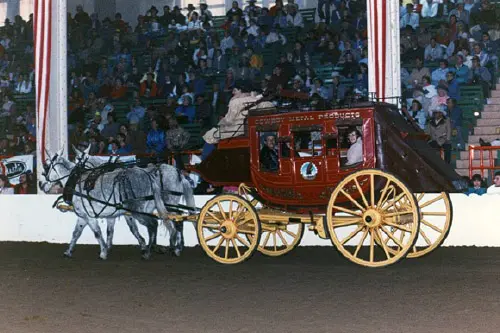 As the Denver Broncos were leaving for the Super Bowl, the mules were arriving in Denver for their debut at the National Western Stock Show held January 22-25, 1987. Mules had been absent from the Stock Show for 30 years, until 1983 when they were cordially invited by the Draft Horse Association to show between the draft horse classes. This arrangement has proven to be equally beneficial to both the draft horses and the mules. It allows for more time for tack changes between classes as well as giving the spectators a more varied show. The mules and draft horses do complement each other quite nicely and I wish to express my gratitude and appreciation to Coors and the Draft Horse Association for extending this invitation to mules. We truly appreciate your support.
 Preparing for a show such as the National Western Stock Show is probably a lot more difficult than most people realize. Preparations for next year’s show begin immediately following this year’s show. There is a lot of careful planning and time-consuming work to be done, and the efforts of those involved often goes without thanks. Thank you all who have helped make this show the success that it is! Our special thanks to Tom Mowery, a man who has worked hard in support of mules and who has almost single-handedly brought mules before the public in Colorado with his continuous willingness to do what needs to be done. Thank you, Bill Rossman for all your efforts in coordinating the mule show and for doing a great job keeping most of the exhibitors happy and contented throughout the show. This is a tough job and your gracious, diplomatic attitude was duly appreciated. And thank you so much to mule judge Ernie Fanning from Sparks, Nevada, who did a sensational job in judging our mules and more. He inspired us all to keep trying to improve!
 Still, what is a show without the exhibitors? The folks who show at National Western Stock Show are probably among the hardest working people in the country. It is a real art to be able to groom and condition an animal well enough to compete in the dead of winter, yet our hearty National Western Stock Show competitors showed that it can be done under a variety of living conditions. Mule exhibitors ranged from those with heated barns to those who must winter their animals outdoors. Collectively, they all did a great job! I would like to introduce a few of these exhibitors to you:
Grand Champion Model Mule went to our own Lucky Three Mae Bea C.T., a five year old, brown dun molly mule; she was also Grand Champion Single Hitch mule and Reserve Champion Youth Mule (13 years and under), ridden by my daughter, Dena Hodges. Lucky Three Ranch showed  eight animals this year, and although Bea was our star performer, the others did very well which was reflected in the show results. Our animals are kept in an insulated barn under lights and blankets to enhance the condition of the hair coats. They are in training every other day year round with a week or two off after each show. All the training is done by me and the riders consist of my husband, Gary, my daughter, Dena and my riding students when needed. We have a minimum staff, but those who work with us, work very hard. We wish to show the public that… Mules can do!
First place halter yearling mule went to L.J.’s Hanna, a mule sired by Lucky Three’s Little Jack Horner and out of a lovely Albino mare named Hula, owned by Donna Groh of Fort Collins, Colorado. Despite Donna’s rather serious leg injury, she saw to it that Hanna showed, even if she couldn’t show her by herself. Her efforts were duly rewarded in the class. The mother/daughter team of Zella and Cindy Brink were to be congratulated on their performances with mules Nifty and Sally, who took first and third place in the Ranch Riding class. Even with much work of her own, Zella was kind enough to take the time to help her friend Donna Groh to prepare Hanna for the show. Both women had to winter their animals outdoors, but the animals were well groomed and showed very well. Zella is a wonderful lady with mules, and her patience is further exhibited by her patient instruction of her darling daughter, Cindy. With Zella’s careful instruction, Cindy is becoming quite the mule person herself!
 More youth in the news! Fifteen-year-old Kimberly Nordyke rode her mule, Wonder Judy to a fifth place victory in the Ladies Side Saddle class against thirteen other competitors! Good going, Kim! Her younger sister, Crystal (11 years), rode to Grand Champion on Nordyke’s Tuffy in the Youth Pleasure class for those thirteen years old and under. Both girls have been taking lessons at the Lucky Three Ranch for several months and it seems their hard work and dedication is paying off! Congratulations, Crystal! Amy Wilfong riding Ramblin’ Rose for Hal and Diane Walston of Longmont, Colorado, captured Grand Champion in the Youth Pleasure (14-17) and a splendid ride it was! Good job, Amy! And “Hats Off” to all of our dedicated youth!
In addition to Grand Champion Youth Mule (14-17), Joan Triolo rode and drove Ramblin’ Rose, owned by Hal and Diane Walston, to Grand Champion in the Sidesaddle and the Drive & Ride classes. Look out world – here’s a pair to keep your eyes on! The work that has gone into this mule is apparent and a hearty “Congratulations” is definitely in order! Another plus for this year’s show was the attendance of many more draft mules. Congratulations to W.D. and Verle Hamm of Cowboy Metal Products, Inc., on their first and second places in the Draft Halter class! This was a tough class. Their team of beautiful gray draft mules, Kate and Jennie, were a real bonus to the show— thanks, guys, for bringing them!
Last, but certainly not least, congratulations to our Grand Champion Model Jack, Scott’s Gallant Eagle, owned and shown by Ann Greer-Rankine of the Thunderbolt Jack Station in Grass Creek, Wyoming; and, congratulations to the Reserve Grand Champion Model Jack, Blue Zebulon, owned and shown by Frank Howe of the Bitterroot Mule Company in Bennett, Colorado. Both these jacks exhibited the characteristics necessary in the production of high quality saddle mules. It might be of further interest to know that Scott’s Gallant Eagle was judged World Champion Model Jack and Blue Zebulon was judged World Champion Standard Jack at Bishop Mule Days in 1986. So, you see, folks, we stand “The Best Jacks in the West” right here in our part of the world. That’s really something of which to be very proud!
Thank you all…exhibitors, Stock Show personnel, and spectators for making this year’s Best of the Rockies Donkey and Mule Show the best ever!
To learn more about Meredith Hodges and her comprehensive all-breed equine training program, visit LuckyThreeRanch.com, MEREDITH HODGES PUBLIC FIGURE Facebook page, or call 1-800-816-7566. Check out her children’s website at JasperTheMule.com. Also, find Meredith on Pinterest, Instagram, MeWe, YouTube and Twitter.
Covered in TRAINING MULES & DONKEY: A LOGICAL APPROACH TO TRAINING, TRAINING WITHOUT RESISTANCE and EQUUS REVISITED at www.luckythreeranchstore.com.
© 1987, 2016, 2024 Lucky Three Ranch, Inc. All Rights Reserved.
MULE CROSSING: National Western Stock Show 1986
 By Meredith Hodges
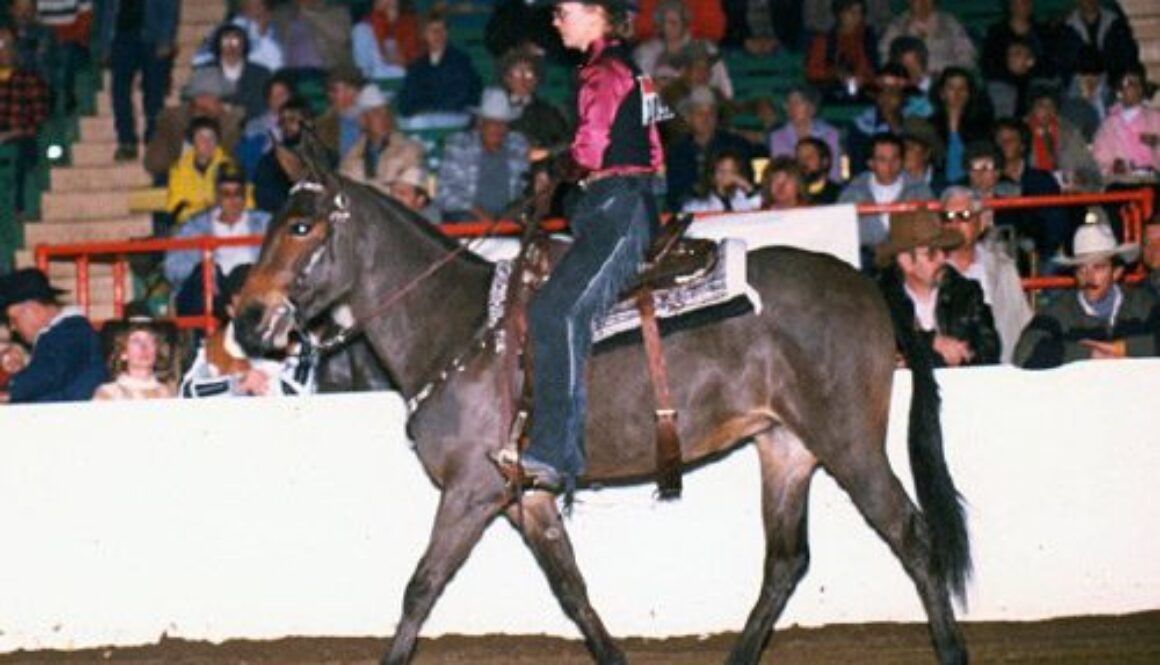
After three months of record lows and an abundance of snow, the sky opened up and the sun shone brightly with warmer temperatures for the National Western Stock Show Mule Show held in Denver, Colorado, January 16-19, 1986. Mule exhibitors worked hard the first day getting settled and prepared for the three-day mule show. Cooperation and determination got the jobs accomplished and by evening, mules and exhibitors were tired, but excited about the show to come.
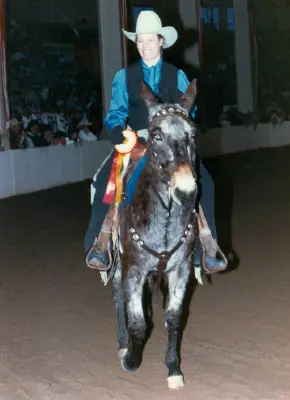 Friday morning, the stable area was thick with curious spectators and busy exhibitors, yet they all had one thing in common… that curious grin that Longears bring to one’s face. Spectators commented on the resemblance some mules had to their relatives, then laughed at their own clever jokes. In the face of all the noise and chaos, the mules themselves radiated the character and sense of humor that is a mule! Each mule was host to a multitude of mule-scratching fingers—just imagine getting a 16-hour massage! Colorado Poncho reveled in bliss, Scott’s Gallant Eagle excitedly played with his chain and Little Jack Horner brayed with enthusiasm. The barn reverberated with the musical voices of over a hundred donkeys and mules, and the spectators all made new friends!
The improvement in the quality of performance was apparent this year, including the barn exhibits. Exhibitors made signs and posters to enhance the spectator’s experience, the Rocky Mountain Longears courtesy booth was a tremendous success and the actual performances of mules and exhibitors reflected more professionalism than ever before. Tack and harness were all cleaned and shiny and the carts and buggies were all quite impressive. Despite longer coats on some mules, they were “dressed to a tee” and showed well. The audience was unconditionally supportive.
There were disputes to deal with as in any show. However, mule people welcome the improvements these disputes will bring. Learning is an important part of growing, and those of us with mules are learning all the time!
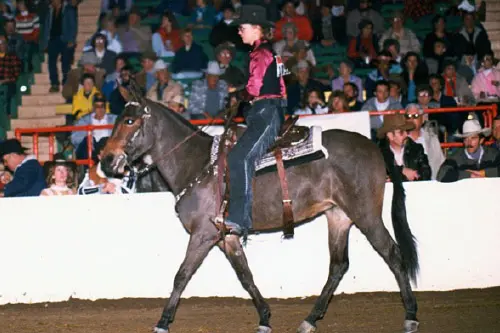 Mules and exhibitors wish to express their deepest appreciation to the sponsors and supporters of this year’s National Western Stock Show Mule Show. First, our gratitude to Coors and the National Western Stock Show for making this show possible. Also our thanks to our class sponsors for their loyal support: Adopt A Burro, Bennett Hardware & Lumber, Bennett Vet Clinic, Bitteroot Mule Co., Colorado Poncho Syndicate, Cooper’s Haulin’ Ass Ranch, HW Leasings, Jackson’s Jackasses, Lucky Three Ranch, Nordykes Circle Bar N Mules, Plumsilly Stables, Potestio Bros. Equipment, Sherer’s Auto Parts, Thunderbolt Jack Station, Ranch Supply of Evergreen, VL7 Mule Ranch, and Watkins Feed & Supply.
Congratulations to all of our winners and a special salute to our champions:
*Champion Model Mule was Lucky Three Mae Bea C.T., owned and shown by Meredith
Hodges of the Lucky Three Ranch in Loveland, Colo.
*Reserve Champion Model Mule went to Cody, owned and shown by Gale W. Fortney of
Colorado Springs, Colo.
*Our 1986 Grand Champion Jack was Blue Zebulon, owned and shown by Fran Howe of
the Bitterroot Mule Co. of Bennett, Colo.
*Reserve Champion Jack went to Scott’s Gallant Eagle, owned and shown by Ann
Greer-Rankine of the Thunderbolt Jack Station of Grass Creek, Wy.
*Youth Pleasure Champion went to Jill, shown by Krystal Nordyke and owned by Larry
Jarrett of Franktown, Colo.
*Ranch Riding Champion was JD Diamond’s Blackjack, owned and shown by Jack
Dishong of the JD Diamond Ranch in Bennett, Colo.
*Sidesaddle Champion went to Sally, owned and shown by Zell Brink of Ft. Collins,
Colo.
*Mule Pleasure Champion went to Nift,y owned and shown by Zell Brink of Ft. Collins,
Colo.
*Single Hitch Champion (48” and under) went to Sweat Pea, owned and shown by Bud
Stockwell of Loveland, Colo.
*Drive and Ride Champion was Lucky Three Mae Bea C.T., owned and shown by
Meredith Hodges of the Lucky Three Ranch in Loveland, Colo.
*Single Hitch Champion (over 48”) was Jill, shown by Boomer Navarro and owned by
Larry Jarrett of Franktown, Colo.
*Multiple Hitch Champions were Maude and Cocoa, owned and shown by Vernon and
Sandy Miller of Strasburg, Co.
*Lightweight Champions were Maggie and Jiggs, owned and shown by Larry Jackson of
Commerce City, Colo.
*Heavyweight Champions were Jerry and Kate, owned and shown by Marsh Bates of
Evergreen, Colo.
*High Point Mule went to Jill, owned by Larry Jarrett of Franktown, Colo.
I would also like to extend a special thanks to all of those in the Costume Class; everyone did an excellent job portraying mules in their various authentic uses, making this perhaps, the largest and best costume class ever!
Mule people are special! They work harder loving mules than most and are always there to lend a helping hand as was apparent at this show. Congratulations to all for helping this year’s National Western Stock Show Mule Show to be better than ever! We cordially invite you all to participate next year. The more mules, the merrier!
NATIONAL WESTERN STOCK SHOW RESULTS
M-1 Miniature Mule Halter
M-2 Sponsored by: COPPER’S , Loveland, Colorado
1 Minnie The Mule Cynthia F. Wolf Littleton, Co.
2 Bitteroot Banjo Bitteroot Mule Co. Bennett, Co.
3 Jean Gordon Nordyke Bennett, Co.
M-3 Saddle Mule Halter
Sponsored by: RANCH SUPPLY, Evergreen, Co.
1 Cody Gale W. Fortney Co. Springs, Co.
2 Lucky Three Firestorm Meredith Hodges Loveland, Co.
3 Callipoe Arthur Boyd Ft. Lupton, Co.
4 Bitteroot Super Bill Bitteroot Mule Co. Bennett, Co.
5 Jezebel Arthur Boyd Ft. Lupton, Co.
6 Bushrod Gaye Stockwell Loveland, Co.
M-4 Saddle Mule Halter
Sponsored by: COLORADO PONCHO SYNDICATE, Bennett, Co.
1 Calico Gorgon Nordyke Bennett, Co.
2 Peggy Sue Gaye Stockwell Loveland, Co.
3 Rusty Joseph Giesler Longmont, Co.
4 Chester William Rossman Longmont, Co.
5 Funnybutt Skip Jackson Aurora, Co.
6 Sally Zell Brink Ft. Collins, Co.
M-5 Saddle Mule Halter
Sponsored by: POTESTIO BROTHERS EQUIPMENT, Parker, Co.
1 Shenandoah Mimi Weeks Co. Springs, Co.
2 Lucky Three Stardust Meredith Hodges Loveland, Co.
3 Bitteroot Spider Dee Bitteroot Mule Co. Bennett, Co.
4 Prhzutah Tanka Patricia Barnard Littleton, Co.
5 Casper William L. Millard Montrose, Co.
6 Velvet Lilly Hal & Diane Walston Longmont, Co.
M-6 Saddle Mule Halter
Sponsored by: SHERERS AUTO PARTS, Bennett, Co.
1 Lucky 3 Mae Bea C.T. Meredith Hodges Loveland, Co.
2 Rambling Rose Hal & Diane Walston Longmont, Co.
3 Frijoles Dixie Belle Sharon Anthony Co. Springs, Co.
4 Lucky Three Ciji Meredith Hodges Loveland, Co.
5 Dummy Larry Jarrett Franktown, Co.
6 Pepsie Georgia Andrews Northglenn, Co.
M-7 Draft Mules Halter
NO ENTERIES
M-8 Draft Mules Halter
Sponsored by: WATKINS FEED AND SUPPLY, Watkins, Co.
1 Jewel Ray Godfrey Rapid City, SD.
2 Roy Ray Godfrey Rapid City, SD.
3 Merle Half Ass Boat Co. Wallace, KS
4 Maude Vern & Sandy Miller Strasburg, Co.
5 Cocoa Vern & Sandy Miller Strasburg, Co.
NATIONAL WESTERN STOCK SHOW RESULTS CONT’D
M-9 Standard Jack Halter
Sponsored by: HW LEASINGS, HAL WILSTON, Longmont, Co.
1 Blue Zebulon Bitteroot Mule Co. Bennett, Co.
2 Little Jack Horner Meredith Hodges Loveland, Co.
3 Colorado Poncho Co. Poncho Syndicate Bennett, Co.
4 Ed Boykin Larry D. Jackson Commerce City, Co.
M-10 Mammoth Jack Halter
Sponsored by: NORDYKES CIRCLE BAR N MULES, Bennett, Co.
1 Scott’s Gallant Eagle Ann Rankine-Greer Grass Crk. Wy.
2 Beau Bonanza Thomas G. Smidt Montrose, Co.
3 Laramie LeRoy Andrews Northglenn, Co.
CHAMPION MODEL MULE
Sponsored by: BITTEROOT MULE COMPANY, Bennett, Co.
LUCKY THREE MAE BEA C.T. MEREDITH HODGES Loveland, Co.
RESERVE CHAMPION MODEL MULE
CODY Gale W. Fortney Co. Springs, Co.
CHAMPION MODEL JACK
Sponsored by: RMLEA
BLUE ZEBULON BITTEROOT MULE CO. Bennett, Co.
RESERVE CHMAPION MODEL JACK
SCOTT GALLANT EAGLE Ann Rankine-Greer Grass Crk. Wy.
M-20 Youth Pleasure Ridng
Sponsored by: BENNETT FFA, Bennett, Co.
1 Larry Jarrett Jill Franktown, Co.
2 Ann Rankine-Greer Drifter Grass Crk, Wy.
3 JD Diamond Ranch Miriah Bennett, Co.
4 JD Diamond Ranch Black Jack Bennett, Co.
5 Gail Allen Jasper Genoa, Co.
6 Larry Jarrett Rufus Franktown, Co.
M-21 RANCH RIDING
Sponsored by: JACKSON’S JACKASSES, Commerce City, Co.
1 JD Diamond Ranch JD Black Jack Bennett, Co.
2 Zel Brink Sally Ft. Collins, Co.
3 Larry Jarrett Gin Franktown, Co.
4 JD Diamond Ranch JD Miriah Bennett, Co.
5 Lee Schweizer L.J. Larkspur, Co.
6 Larry Jarrett Babe Franktown, Co.
NATIONAL WESTERN STOCK SHOW CONT’D
M-22 SIDE SADDLE
Sponsored by: BITTEROOT MULE CO., Bennett, Co.
1 Zell Brink Sally Ft. Collins, Co.
2 Ann Rankine-Greer Drifter Grass Crk, Wy.
3 JD Diamond Ranch JD Diamond Miriah Bennett, Co.
4 Larry Jarrett Gin Franktown, Co.
5 Larry Jarrett Rufus Franktown, Co.
6 Debbie McLain Cletus Larkspur, Co.
M-23 PLEASURE RIDING
Sponsored by: BENNETT HARDWARE & LUMBER, Bennett, Co.
1 Zell Brink Nifty Ft. Collins, Co.
2 Sharon Anthony Frijoles Dixie Belle Co. Springs, Co.
3 Alan McLean Bucko Golden, Co.
4 Meredith Hodges Lucky 3 Sundowner Loveland, Co.
5 Meredith Hodges Lucky 3 Mae Bea C.T Loveland, Co.
6 Bitteroot Mule Co. Bitteroot Martha Bennett, Co.
M-24 SINGLE HITCH
Sponsored by: THUNDERBOLT JACK STATION, Grass Valley, Wy.
1 Buddy Stockwell Sweet Pea Loveland, Co.
2 Gordon Nordyke Jean Bennett, Co.
3 Garrie Bates Grubstake Evergreen, Co.
M-25 RIDE AND DRIVE
Sponsored by: NORDYKES CIRCLE BAR N MULES, Bennett, Co.
1 Meredith Hodges Lucky 3 Mae Bea C.T Loveland, Co.
2 Georgia Andrews Pepsi Northglenn, Co.
3 Luann Arney Bonnie Sandpoint, ID.
4 Larry Jarrett Jill Franktown, Co.
5 Zell Brink Sally Ft, Collins, Co.
M-26 SINGLE HITCH
Sponsored by: LUCKY THREE RANCH, Loveland, Co.
1 Larry Jarrett Jill Franktown, Co.
2 Meredith Hodges Lucky 3 Mae Bea C.T Loveland, Co.
3 Luann Arney Bonnie Sandpoint, ID.
4 Georgia Andrews Pepsi Northglenn, Co.
5 Berl Vinsonhaler Sparky Littleton, Co
6 Zell Brink Sally FT. Collins, Co.
M-27 COSTUME
Sponsored by: BENNETT VET. CLINIC, Bennett, Co.
1 Garrie Bates Grubstake Evergreen, Co.
2 Larry Jarrett Jill Franktown, Co.
3 Haulin’ Ass Acres Goliath Loveland, Co.
4 Joseph Giesler Rusty Longmont, Co.
5 Haulin’ Ass Acres Buttermilk Loveland, Co.
6 Meredith Hodges Lucky 3 Sundowner Loveland, Co.
NATIONAL WESTERN STOCK SHOW CONT’D
M-28 MULTIPLE HITCH
Sponsored by: VL7 MULE RANCH, Montrose, Co.
1 Vern & Sandy Miller Maude & Cocoa Strasburg, Co.
2 Westernaires Francis & Josle Lakewood, Co.
3 Luann Arney Bonnie & Bess Sandpoint, ID.
4 Ray Godfrey Roy & Jewel Rapid City, SD.
5 Bud Stockwell 6 & 7 Loveland, Co.
6 Shayne Copper Robin & Lou Loveland, Co.
HI POINT DONKEY
Sponsored by: ADOPT A BURRO, Evergreen, Co.
GRUBSTAKE Garrie Bates Evergreen, Co.
HI POINT MULE
Sponsored by: PLUMSILLY STABLES, Commerce City, Co.
JILL Larry Jarrett Franktown, Co.
M-30 LIGHTWEIGHT MULE PULL TEAM
Sponsored by: HAULING ASS RANCH, Loveland, Co.
1 Larry Jackson Maggie & Jiggs Commerce City, Co.
2 Freeman Hollandsworth Jack & Liz Brighton, Co.
3 Shayne Copper Robin & Lou Loveland, Co.
4 Bud Stockwell 6 & 7 Loveland, Co.
5 Rockie Stockwell 8 & 9 Loveland, Co.
6 LeRoy Andrews Socks & Sally Northglenn, Co.
M-31 HEAVEYWEIGHT MULE PULL TEAM
Sponsored by: LUCKY THREE RANCH, Loveland, Co.
1 Curtis Boswell Jerry & Kate Elizabeth, Co.
2 Ray Godfrey Roy & Jewel Rapid City, SD.
3 Joe Freund Bill & Bob Elizabeth, Co.
4 Paul Dickerson Tiny & Red Eagletown, OK.
5 W.M. Heincker Jack & Jill House Spring, Mo.
6 Stockwell Bisquits & Gravy Loveland, Co.
To learn more about Meredith Hodges and her comprehensive all-breed equine training program, visit LuckyThreeRanch.com, MEREDITH HODGES PUBLIC FIGURE Facebook page, or call 1-800-816-7566. Check out her children’s website at JasperTheMule.com. Also, find Meredith on Pinterest, Instagram, MeWe, YouTube and Twitter.
Covered in TRAINING MULES & DONKEY: A LOGICAL APPROACH TO TRAINING, TRAINING WITHOUT RESISTANCE and EQUUS REVISITED at www.luckythreeranchstore.com.
© 1986, 2016, 2024 Lucky Three Ranch, Inc. All Rights Reserved.
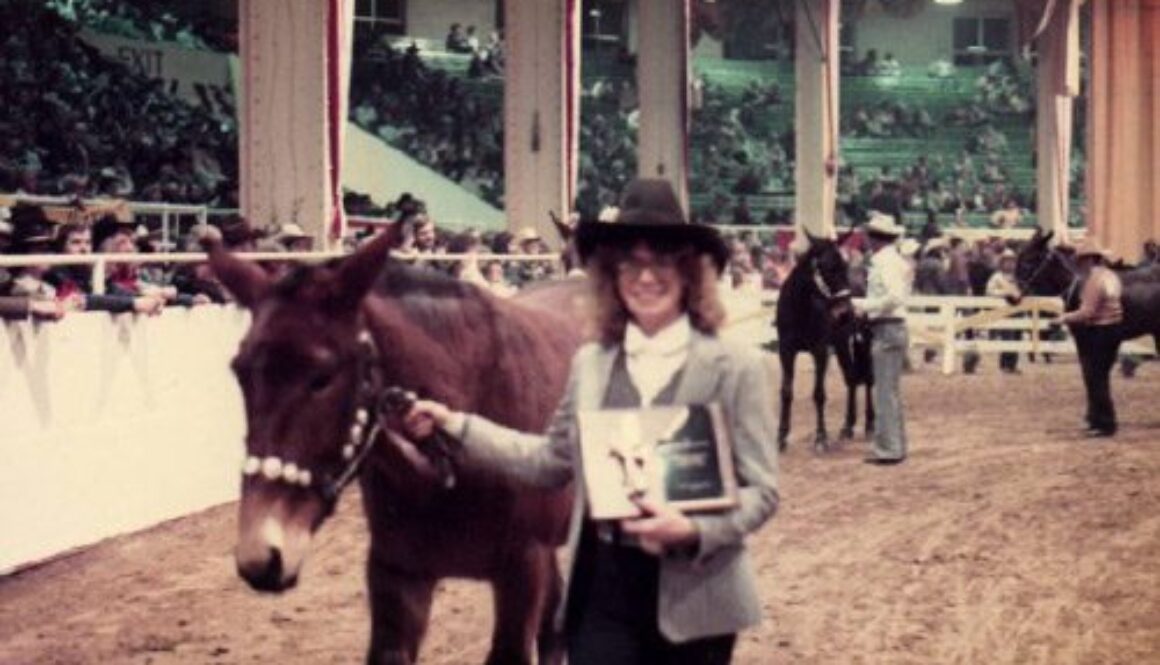
MULE CROSSING: National Western Stock Show 1984 – Mule Show and Pull
 By Meredith Hodges
A record crowd of over 44,000 people attended the National Western Stock Show Mule Show and Pull held over the weekend of January 17-20, 1984 in Denver, Colorado. The versatility of the mule was amply displayed in the performance classes as was their beauty and conformation at halter. The jacks exhibited were a wide range of sizes and colors, giving spectators an unusually good overview of breeding possibilities. Spectators held their breath as the mule teams strained against the harness with incredible strength and heart in the pulling contest, then exploded with cheers and applause after each team had managed to pull their own weight and much more!
Spectators also delighted in mule-associated trivia—conversations went something like this:
“So a mule is the cross between a female horse and a male donkey?”
“That’s right, and the male donkey is called a jack.”
“What is a female donkey called?”
“A jenny, or jennet.”
“If donkeys are jacks and jenneys, or jennets, then what are mules called?”
“Johns and mollys.”
“Aha! Then what do you call the cross between a male horse, a stallion, and a female donkey, or jenny?”
“That is called a hinny.”
“Oh my… then what do they call a mule who came out of a mule, like Blue Moon?”
“Since Blue Moon was by a jack, or donkey, they are calling him a donkule;
however, Mr. Silvester, Blue Moon’s owner, is petitioning to have it changed to jule!”
“What do they call the offspring if the mule out of a mule is by a stallion?”
“Then he is called a hule.”
“Whoo…How totally confusing!”
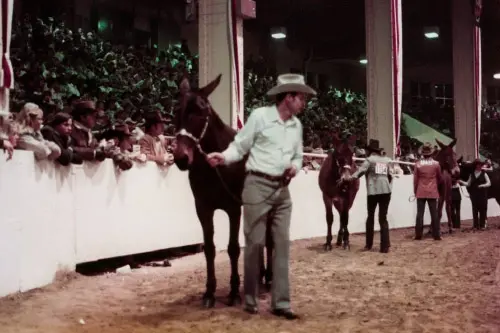 Yes, there is no doubt that all this mule stuff can be pretty confusing, but everyone seems to have such fun trying to understand it all! The Lucky Three Ranch of Loveland, Colorado, reaffirmed its reputation for the production of high quality saddle mules by placing in every class they entered, and by winning most of them. Lucky Three Sundowner took first place in Halter for mules 56” & over, three years and older, first in Western Pleasure, first in Reining, and then was named Grand Champion Model Mule of the show! In addition, Lucky Three Ciji won the halter class for mules 48” to 56”, three years and older; Lucky Three Mae Bea C.T. took sixth at halter for mules 56” & over, three years and older, then third in the Single Mule Hitch driving class. Little Jack Horner, Sire-Supreme of the Lucky Three Ranch, completed the picture by taking fourth in the Drive & Ride class against seven mules, first in Halter for Large Standard Jacks and finally named Reserve Champion Jack of the show!
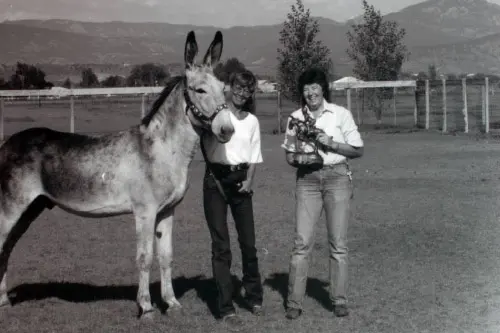 Grand Champion Jack of the show was Laramie, owned by Bud and Georgia Andrews of Northglenn, Colorado, and shown by Georgia Andrews. He was also shown under saddle in the Mule Western Pleasure class. Reserve Champion Model Mule was awarded to Jewel, owned and shown by Ray Godfrey of Rapid City, South Dakota. Jewel also took first at Halter for Draft Mules, first in the Single Mule Hitch driving class, and first in the Mule Pull with her teammate Roy in the class for mules 2001 lbs. and over. Taking first in the Mule Pull class for 1200 lbs. and under went to Six and Seven, owned and shown by Bud Stockwell of Loveland, Colorado. First in the Mule Pull class for 2101 lbs. to 2000 lbs went to Eenie and Meenie, owned and shown by Jess Johnson of Ft. Collins, Colorado.
Congratulations to all our winners! Our thanks to all who made this show the success that it turned out to be: to the exhibitors and their wonderful long-eared counterparts, without whom we would have no show; to the sponsors who continually support the efforts of the exhibitors. We would like to extend our deepest gratitude to the National Western Stock Show personnel for seeing to it that things ran as smoothly as possible. And most of all, our thanks to our “Longears fans” who continue to support us with their relentless cheering and applause! Special thanks to those from out of state for taking the time and trouble to contribute to the success of this show. And, a very special thanks to Mr. 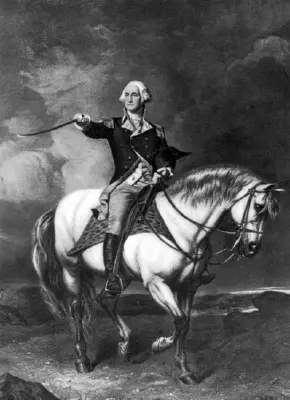 Arthur Silvester for sharing Blue Moon, the mule out of a mule, with this year’s National Western Stock Show. Everyone enjoyed meeting this extra-special celebrity!
As is apparent by the turnout at the National Western Stock Show Mule Show and Pull, mules are growing in popularity and appreciation in this country. October 26, 1985, will mark the bicentennial of the arrival of the first two jacks on American soil. They were sent here by the King of Spain, Charles III, as a gift to George Washington. It was our first president’s interest in mule breeding which helped propel the mule into its important role as the work animal that built the greatest nation on earth. The Lynchburg Mule Traders Association does not intend to let this historic milestone pass unnoticed. They are petitioning the United States congress to officially designate October 26, 1985, as Mule Appreciation Day in the U.S.A. If you wish to lend your support, you may write your congressman, or obtain information on this subject through the exhibitors at the National Western Stock Show Mule Show and Pull 1985!
To learn more about Meredith Hodges and her comprehensive all-breed equine training program, visit LuckyThreeRanch.com, MEREDITH HODGES PUBLIC FIGURE Facebook page, or call 1-800-816-7566. Check out her children’s website at JasperTheMule.com. Also, find Meredith on Pinterest, Instagram, MeWe, YouTube and Twitter.
Covered in TRAINING MULES & DONKEY: A LOGICAL APPROACH TO TRAINING, TRAINING WITHOUT RESISTANCE and EQUUS REVISITED at www.luckythreeranchstore.com.
© 1984, 2016, 2024 Lucky Three Ranch, Inc. All Rights Reserved.

MULE CROSSING: Mules and the U.S.E.F. 2007
By Meredith Hodges
 1993 was a good year for Lucky Three Mae Bea C.T.That was the year she won the Novice Division at the Abbe Ranch Horse Trials in Larkspur, Colorado. A first place finish in competition with 56 horses is a significant achievement for any equine, but this Combined Training victory was particularly noteworthy, because Mae Bea C.T. is a mule. She’s a rare mule to be sure, but not as unusual as you might think. Well-bred, well-trained saddle mules are becoming increasingly competitive in classes that were once beyond their reach. In 2007, at Bishop Mule Days, the largest mule show in the country, bridle division flat classes each boasted as many as 30 competitors, and jumping events were equally popular. Growing numbers of mule riders are looking to improve their skills through dressage training and
  competition, and the horse establishment—the United States Equestrian Federation in particular—has embraced the mule community if not with open arms, then at least with open minds.
Mae Bea C.T. and several other champion mules of mine have spent nearly four decades testing the mule’s potential as athlete and performer. I discovered what I believe to be a limitless capacity for competitive achievement, and while I don’t foresee the addition of mules to the Olympic team roster, I do insist that Dressage training is a must for every serious rider. Therefore, those with a preference for mules should have equal opportunity to participate in every aspect of that training.
 My interest in longeared equines grew from the time I went to work at my mother’s ranch in Healdsburg, California, in 1973. As proprietor of the 1,000-acre Windy Valley Ranch, Joyce Doty ran a successful business breeding and training high-quality mules. I had always been partial to horses and believed the common lore that mules were stubborn, stupid, and not only mean, but inclined to hold a grudge and seek retribution at their leisure.
Frankly, they frightened me. But I took the plunge and soon came to the revelatory realization that, in truth, mules were not stubborn or dumb or even mean. They were only cautious, with a strong instinct for self-preservation. I quickly discovered that when Itreated them with patience, kindness respect  and consideration, the mules recognized I had their best interests at heart and they would not only comply, but go the extra mile to give their very best. I was smitten with my new long-eared friends and soon had a case of “Mule Fever” I’d never kick. By 1980, I moved to Colorado and established her own mule ranch. Lucky Three Ranch grew steadily over the years as I established myself as a breeder and trainer. In 1986 my insatiable quest to take training to higher levels took me to the United States Dressage Federation Convention in Houston, Texas. I knew the key to advancement was Dressage, but before I took the leap, I wanted assurances that I would be allowed to test my skills and measure my progress at schooling shows in my area.
 With some reservation, the United States Dressage Federation grantedpermission to participate in non- sanctioned shows at the show organizers’ discretion. Armed with this qualified endorsement, I began training with my local U.S.D.F. instructor Melinda Weatherford. My partner, Lucky Three Sundowner, was a talented mule out of an AQHA-registered mare. As a four-year-old, Sundowner won a World Championship in Reining in 1984. But Dressage was something new to both of us and we had limiting habits to overcome.
For the next several years I diligently trained with both Sundowner and Mae Bea C.T., who turned out to be an enthusiastic jumper. As their training progressed, I urged the folks at Bishop Mule Days to add Dressage classes to  their established Western, English, and Jumping classes. By 1989, Sundowner and I were working at Second Level Dressage, and in 1990 we took first place in a newly established Second Level Dressage Class at Bishop Mule Days. In 1992, I asked Bishop Mule Days for a Third Level Dressage Class and they obliged, although only two mules competed. Sunny scored sixes and sevens in the class, placing first against his only competition, Dolly Barton. By 1993 Sundowner and I were working at Fourth Level Dressage. We competed at Bishop Mule Days at Third Level Dressage for a second year and easily won as the only mule in the class. For me and Sundowner, attaining Fourth Level Dressage was a great achievement.
“As a child I had a picture of Col. Alois Podhajsky above my bed, and as an adult I dreamed of dancing with Sunny through Dressage, so you can imagine how thrilled I was when we could passage and piaffe together, whether we were in competition or  just at home alone. And that is at the crux of my push to find a place for mules in the world of English riding. Of course,in the upper levels of competition, we should stick with apples to apples. But thequantity and quality of learning that takes place in the Dressage arena should be available to everyone.
 just at home alone. And that is at the crux of my push to find a place for mules in the world of English riding. Of course,in the upper levels of competition, we should stick with apples to apples. But thequantity and quality of learning that takes place in the Dressage arena should be available to everyone.
I didn’t stand alone on this issue. Fellow mule advocate Carole Sweet laid claim to one of the proudest moments in longears history when she, with the help of a few allies, persuaded the United States Equestrian Federation to amend its rules to include mules in the organization’s DressageDivision.
One day Carole Sweet’sgood friend Linda Pittman, to whom Carole had sold her own mule, called herdistraught. Linda had been in Dressage training with her mule for some time, working to qualify for the Annual Championships of the California Dressage Society.The California Dressage Society by-laws had been changed to “specificallyexclude mules from all C.D.S. competitions.” It seemed like it was disguisedintolerance for any breed that didn’t fit the model of a Classical Dressage horse. Carole saw this as a serious injustice.
 had been in Dressage training with her mule for some time, working to qualify for the Annual Championships of the California Dressage Society.The California Dressage Society by-laws had been changed to “specificallyexclude mules from all C.D.S. competitions.” It seemed like it was disguisedintolerance for any breed that didn’t fit the model of a Classical Dressage horse. Carole saw this as a serious injustice.
 Carol felt that the C.D.S. was endorsing exclusivity and discrimination in a discipline that was publicized and promoted to be suitable for every one and needed to be fixed. Carole contacted members of the C.D.S. Executive Board but got nowhere. Then she tried the United States Dressage Federation President, who told her that unless it was a rated show, organizers essentially had free rein and could include mules or not. The U.S.E.F.(U.S.A.E. at the time) said there was nothing they could do. Disheartened by the lack of response on the national level, Carole and Linda returned to the C.D.S. to request that mules at least be admitted into schooling shows. They attended the C.D.S. Annual Conference where Linda pled her case. The response was a resounding “No!”
“What bothered Carole most was how they were treated. The board members who did speak were vehemently opposed to letting mules back in. They treated them withcontempt and refused to hear them. All Carole could think was, “where’s your responsibility to your members? When you exclude the mule, you also exclude the rider.’”
 The C.D.S. Executive Board questioned her commitment to the issue and asked if she was serious enough about this to go to next week’s annual U.S.A.E. meeting Carole spent the next three days preparing a hefty packet of materials for the meeting. It included endorsements from every major mule organization, facts and figures on the industry, and information from the U.S.A.E. Endurance and Driving disciplines, which already allowed mules in competition.
Carole felt the feeling in the mule community was that mules had been discriminated against for so long and this was a chance to do something about it. She got letters of endorsement from everyone.
Carole received a personal invitation from the Dressage Committee Chair to attend a closed-door meeting to discuss the matter. Although she was unable to attend, the materials she sent and the answers she provided to some tough questions were enough to convince the committee to endorse the rule-change proposal.
That legitimized it. Now it wasn’t just Carole saying this should happen; it was the Dressage Committee. They were incredible to work with.
In January 2004, Carole, her friend Linda Pittman, American Donkey and Mule Society registrar, Leah Patton and I all traveled to Los Angeles to attend the U.S.E.F. Convention.
Carole knew I had already done so much on behalf of mules that I would want to be part of this and Leah as well. Carole said we were a huge help. We attended meetings and lobbied hard in anticipation of a vote by the Board. Carole said it was to their advantage that two of the organization’s goals that year were to build U.S.E.F. membership and reach out to the grass roots of the horse community. What could be more grass roots than mule riders? We’ve got a huge population of mule riders, which could translate into income for the organization. In the end, after three years of persistence, Carole’s and mymoment of triumph arrived. The Board voted to approve the rule change and admit mules into sanctioned competition, with the exception of high-performance qualifying and selection trials. Carole, the others and I were ecstatic. “I’m so thrilled for what we could do for all those people who love mules.” Carole said. “Now they’re in the sand box. There’s still some sand kicking going on, but they’re in!”
 Now that it’s done, the U.S.E.F. rule change hasn’t exactly launched a revolution. In fact, it’s been kind of quiet out there, and Carole wondered what effect the rule change hadactually had. She suspected it could take a while for mule riders, low on the totem pole for so long, to acquire the skills, the nerve, and the sense of possibility that will propel them to higher levels of performance, but she’s confident they will and the mules, too, will rise to the challenge.
Carole believes that riding a mule in Dressage is no different the riding a horse. Any animal’s ability is based on temperament, conformation,and heart. My television program Training Mules and Donkeys on RFD-TV reached millions of viewers every week, knowing that with proper training, care and athletic conditioning, mules can excel in any discipline. If you understand the mule’s psychology and his physical needs, you can reach truly amazing levels of performance.
One place where mules can show their stuff in ever growing numbers is Bishop Mule Days. Each Memorial Day weekend 800 mules and several thousand people congregate in Bishop, California for a competition that includes more than 180 events. Bishop Mule Days Executive Director Kim Craft says that more riders compete in the English classes than in the Western events.
Last year there were 25 to 30 competitors in the flat classes. Bishop Mule Days uses U.S.E.F. “R” rated judges and the riders come to compete in World Champion classes and win real champion points. The Mule Days competitors have raised the bar in every event. Mule Days used to be Mom and Pop and a two-horse trailer, but these competitors train much harder and compete more seriously, and these mules are incredible. It’s the knowledge and the people that have brought the mule this far. Most who take their mules into English classes don’t do so with visions of trouncing the competition at an A.Q.H.A. show. They’re simply trying to become better riders through study and practice. It’s more about learning than performing. People are passionate about their animals and want to become the best riders they can be.”
Bishop Mule days is a World Class show. The U.S.E.F. and the entire Dressage community can be proud of the competitors there and how they represent the extraordinary discipline of Dressage.
So don’t be surprised if you happen to come across a mule or two at your next horse show. They’re there now! And I will tell you, “They’ve earned it!” I am so proud of all the people who are now taking advantage of what we made available to them. Audrey Goldsmith and Heart B Porter Creek were the first, followed by Laura Hermanson and Heart B Dyna and in 2016, Behold the Desert.
To learn more about Meredith Hodges and her comprehensive all-breed equine training program, visit LuckyThreeRanch.com, MEREDITH HODGES PUBLIC FIGURE Facebook page, or call 1-800-816-7566. Check out her children’s website at JasperTheMule.com. Also, find Meredith on Pinterest, Instagram, MeWe, YouTube and Twitter.
Covered in TRAINING MULES & DONKEY: A LOGICAL APPROACH TO TRAINING, TRAINING WITHOUT RESISTANCE and EQUUS REVISITED at www.luckythreeranchstore.com.
© 2007, 2024 Lucky Three Ranch, Inc. All Rights Reserved.

MULE CROSSING: Mules and Dressage
By Meredith Hodges
 It is no secret that the popularity of mules in this country is on the rise and their uses are quite varied. Many people believed that mules were used solely for packing and pulling, but modern-day mule lovers have competed successfully with mules in all areas of equine athletics, exhibiting the mules’ true abilities and versatility. Western style riders were the first to catch on to mules, but English riders soon followed suit. Perhaps the most elite form of English riding, Dressage was avoided for many years. There could have been any number of reasons for this, however, an adventurous lady from Montana chose to train her more than 16 hand mule, Baby Huey, for Dressage and competed successfully in many shows. This opened still another door for mules.
The object of Dressage is “the harmonious development of the physique and ability of the horse. As a result, it makes the horse calm, supple, loose, and flexible, but also confident, attentive and keen, thus achieving perfect understanding with his rider.” In Dressage, one is not concerned with time in training. Rather, it is measured in progress from one step to another. Dressage requires a discipline of the mind and body. This slow and methodical way of training lends itself nicely to mules.
 One of the basic differences between training mules and training horses is the essential maintenance of a calm attitude by the trainer. Mules will not respond positively to a bad temper. The calmer and more deliberate the trainer, the more responsive the mule. Training in this manner will reveal the true abilities of the animal. His paces will be free and regular and his movements will be harmonious, light, and easy. Impulsion from the hindquarters is reflected by lightness on the forehand with quiet acceptance of the bridle with no tenseness or resistance. An animal trained in Dressage will appear to be doing of his own accord what is required with an air of confidence and always attentive. The walk is regular and free, and unconstrained. The trot is free, supple, regular, sustained and active. The canter is united, light and cadenced. These all reflect active and animation of the four quarters. He is never sluggish. He will respond to the slightest cue from the rider and thereby, give life and spirit to rest of his body. In all his work, a Dressage animal will be “on the bit” with a light, soft contact and submissiveness throughout. Many good trainers use these basic principles in turning out their best-trained animals. It just doesn’t always get labeled as “Dressage”.
 One need only try to bully a mule once to find out that it simply doesn’t work. The mule, with the strength of the jack, can crook his neck so that no amount of pull can cause him to bend and the wide opening of the mouth leaves you pulling on virtual “rubber!” Consequently, you are left doing primarily what he wants. Slow and methodical training in Dressage can unite a mule and rider in a beautiful, flawless picture. Communication between equine and rider is, after all, what Dressage is all about.
O.K., you say. So the mule lends itself well to this type of training, but what of his tendency toward possessing naturally attractive gaits and a smooth way of moving? That’s simple. A mule is always better than the horse out of which he came. Should you desire a particular kind of action, seek a mule out of a mare that possesses that particular trait. The primarily smooth muscling of the mule allows him to be somewhat of a ballet dancer among equines. His gait is generally smoother than most horses anyway, with the strength to control his movements as is exhibited by his unique ability to jump from a standstill. Certainly, he could conceivably perform the more intricate movements of advanced Dressage.
There are those who believe that mules are just not as pretty as horses, and therefore, could not be as beautiful to watch in Dressage. Naturally, there are mules that would not be suitable for this form of training for the show ring, but so there are also unsuitable horses. With selective breeding, there have emerged mules that do possess a certain beauty with their grace and agility. In some cases, it is difficult to distinguish them from fine horses.
 The mule, as anything but a packing and pulling animal, has not been tried too much in the past. This is why they have not been seen in many places of equine athletics. Mule lovers today are trying mules in all areas of equine sports and are exhibiting that mules can do it all! With the intense training and showing of more mules, more of the uneducated public is able to see that there is far more to mules than was portrayed in the past. Horsemen are continually surprised and amazed… and in some cases, even converted to mules!
As more is discovered about these marvelous animals, more people become attracted to them. Discovering mules is something like exploring unchartered territory: the possibilities are endless. As in any new venture, it takes a while for the word to get out, but it is clear that in this country the word is out and the popularity of mules is increasing with each new discovery about them. Perhaps, in the future, the public will be able to witness the first mule doing a “Capriole!”
To learn more about Meredith Hodges and her comprehensive all-breed equine training program, visit LuckyThreeRanch.com, MEREDITH HODGES PUBLIC FIGURE Facebook page, or call 1-800-816-7566. Check out her children’s website at JasperTheMule.com. Also, find Meredith on Pinterest, Instagram, MeWe, YouTube and Twitter.
Covered in TRAINING MULES & DONKEY: A LOGICAL APPROACH TO TRAINING, TRAINING WITHOUT RESISTANCE and EQUUS REVISITED at www.luckythreeranchstore.com.
© 1986, 2016, 2024 Lucky Three Ranch, Inc. All Rights Reserved.
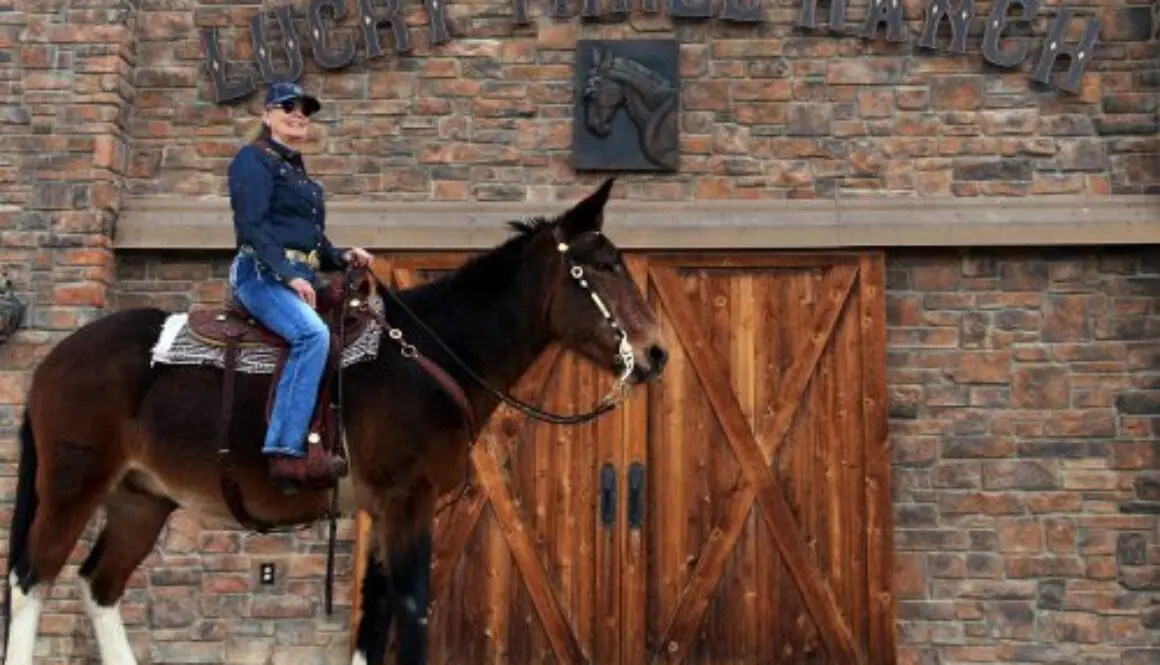
MULE CROSSING: Lucky Three Ranch – 45th Anniversary
By Meredith Hodges
It’s hard to believe that I have already spent 45 years in the business with not only mules and donkeys, but a vast array of equine related activities. I have always loved horses and began riding when I was only two years old. I was about as horsey as a girl could be and when not riding, it was still horse books, drawing horses and engaging in anything that remotely resembled a life with equines. At one point, I even designed a 100-stall barn and vowed to rescue every horse in our country that was being abused. Little did I know then, my 100-stall barn would be terribly inadequate.

I actually founded the Lucky Three Ranch in Loveland, Colorado in 1980 although I had many years with horses and six years with mules before then. I moved to Colorado with the intent of going to Colorado State University to get my veterinarian credentials, so I sought out places to live in Fort Collins. It was a fluke that a contract fell through and this tiny little 10-acre sheep ranch became available. I remember standing in the driveway, my vision crystal clear in my head, and told my mother, “This place HAS LOTS of possibilities.” She gave me a condescending nod and said, “It definitely has lots of possibilities.” I don’t think she had any idea of what was to come! But, after all, the vision was MINE!

Since, I began a journey that has led me from equine breeding and training for mules and donkeys, through showing, then judging and giving clinics. I developed the first ever equine training correspondence course with my videos. I revised them for television and was on numerous channels and RFD-TV for 11 years. After going off television, I adapted my award-winning TV Shows for VIDEO ON DEMAND from my website at www.luckythreeranch.com and expanded our presence on Social Media. I have written 3 hardbound books and 3 manuals on equine management and training that all complement each other. They overlap, but are not duplicated. There is a lot to learn and the learning never ends. The addition of the DVDs provided the most comprehensive management and training series ever to hit the equine industry. Since I have always documented EVERYTHING I learned, I produced numerous TELLY AWARD WINNING documentaries that are also in the VOD section of my website. I decided to go this route because of the lack of continuity in the management and training materials that I had to work with while I was growing up. I saw and personally experienced the therapeutic value of equines and became intimately involved with the HEARTS AND HORSES THERAPEUTIC RIDING CENTER (www.heartsandhorses.org) located just a few miles from my Lucky Three Ranch. The interaction with this program inspired me to write my children’s series of books and videos, and even a music CD, Jasper the Mule. I launched this fun and educational children’s series by writing a letter from a baby mule named JASPER to myself stating his concerns about training and his perception of trainers from the mule’s point of view.

The Lucky Three Ranch slowly became even more than the vision that had in my mind 45 years ago! My interest and influence in the equine community grew into something much more expansive than my original 100-stall barn. It grew into the LOVELAND LONGEARS MUSEUM & SCULPTURE PARK at LUCKY THREE RANCH! We opened the ranch to tours and each tour is a personalized clinic for those who attend. I can now reach hundreds of thousands of people worldwide and am now in a position to be able to teach them how to appreciate and enjoy their equines as much as I enjoy mine and share it in a multitude of different ways. It is so incredibly rewarding when I see happy animals with happy owners doing the things that they love together! This is the gift that I have been given in life by my Maker to share with others and their joy is my reward! Thank you to all of my friends and fans for your loyalty and support! I couldn’t have made 45 years without you and the magnificent equines that color my life! The ultimate gift for me is to be able to see all of you enjoying LONGEARS as much as I do, and to see you going forward to accomplish great things and become amazing ambassadors of the breed!


To learn more about Meredith Hodges and her comprehensive all-breed equine training program, visit LuckyThreeRanch.com, MEREDITH HODGES PUBLIC FIGURE Facebook page, or call 1-800-816-7566. Check out her children’s website at JasperTheMule.com. Also, find Meredith on Pinterest, Instagram, MeWe, YouTube and Twitter.
Covered in TRAINING MULES & DONKEY: A LOGICAL APPROACH TO TRAINING, TRAINING WITHOUT RESISTANCE, EQUUS REVISITED and A GUIDE TO RAISING & SHOWING MULES at www.luckythreeranchstore.com.
© 2015, 2016, 2025 Lucky Three Ranch, Inc. All Rights Reserved.
MULE CROSSING: Lucky Three Mae Bea C. T.
 By Meredith Hodges
Bea was the epitome of good manners and propriety, and is therefore allowed in the house! She has been known to help with the dusting, but she also enjoys a good game of cards or a hearty round of eight ball.
She has a little trouble with the pool cues, but her nose will sometimes suffice. She is a little leery, however. Chalk on one’s nose can be a little humiliating! Especially to a perfectionist!
Although Bea isn’t particularly fond of football, she does love the Broncos like any true Coloradoan. Nothing was more exciting than when the Broncos won the Super Bowl!
The owner of the Embassy Suites hotel in Fort Collins, Colorado made a bet with one of his employees that the Green Bay Packers would win the Super Bowl that year. If he was right, the employee would have to sit outside the hotel for a whole day on a toilet seat in his boxers. If the Broncos won, the  owner would have to paint his face orange and blue and ride a mule all the way around the hotel. Well, guess who won and, guess who the mule was?! Yes, it was our own Lucky Three MaeBea C.T.!
Bea, dressed to the nines in Bronco gear and sporting a Bronco flag, carried the humbled Green Bay Packer fan and hotel owner proudly around the hotel while reporters scrambled asking questions and taking pictures. Later that day, she was on the five o’clock news in all her glory!
Bea was a natural born movie star! The cast always loved to work with her because she was always so willing and cooperative. A day of shooting can be quite exhausting, but Bea never was one that needed more than one or two takes. You told her what to do and she just did it. She put her heart and soul into everything she did and her expressions and actions were always appropriate. She helped me to produce three hardbound books, three manuals, eleven training videos and three documentaries and over fifty half-hour programs for television. Our website is now loaded with Training Tips, Video On Demand and access to our YouTube Channel, Facebook and Twitter posts, all based on the knowledge that I gleaned from this unique and amazing partner.
 Although they never finished the movie, DIX Country Pictures chose Beaas Wadi’s understudy from hundreds of applicants.
She did a photo shoot in which she appears on the Colombian Relief poster with Juan Valdez! While we were shooting, it was hard to keep a straight face. Here we were in the middle of a grassy pasture, asking Beato put on her best sad face… without eating the grass! Of course, in true form, she did as we asked, but her facial expressions kept us in stitches!
 In 1998, we did a shoot with the Discovery Channel and Bea can be seen as the mule in their production of “The Ultimate Horse.” What a gal!
Bishop Mule Days is always fun and exciting, but one of the things Bealiked the most was to be in the Bishop Mule Days Drill Team. She spent more than 10 years on the team and worked her way into the coveted leader position. Our drill instructor, “Sarge” was tough, but so was Bea!
One year, during drill team practice at the gallop with 30 other mules, we were doing the frightening “Crossfire” when her split-ear bridle came off and fell to her chest. I hollered at “Sarge,” but she wasn’t the least bit sympathetic and said, “Just keep going!” Well, Bea finished the entire drill without her bridle and never missed a lick!
Another time, Diane Hunter was riding her in the drill team when she got into some really deep dirt and tripped and fell right on top of Diane and the flag. I saw what happened and saw Diane pinned underneath Bea’s body. Everybody stopped cold and I hollered at Bea to stay still which she did. “Sarge” and I ran over to assess the situation and once we got to Diane and figured out that it was OK for the mule to get up, we told Bea to get up and she did…very carefully. “Sarge” turned to Diane and said, “You know, you owe your life to that mule. Any other mule would have got right up and probably would have kicked your head in!”
 Everyone loves a parade and Bea was no exception! She competed in numerous costume classes and parades, but dressing up for the holidays was her favorite. She placed first in many a parade and had no problem with any theme you might want to try.
She loved to wear her Santa hat at Christmas time and she made a pretty scary wicked witch on Halloween!
Bea participated in the American Donkey & Mule Society entry in the 1988 Tournament of Roses Parade ridden by Gary Hodges in English attire along with her two stable mates, Lucky Three Sundowner ridden Dressage by me (Meredith Hodges) and Lucky Three Ciji ridden by Diane Hunter in Fox Hunting attire.
 Bea may be a perfectionist, but she was certainly not a prude. She was always willing to try anything you might ask. At home, Bea worked hard checking fences, moving cattle and much more.
Early in the fall one year, two cowboys asked me if I wanted to help them move some cattle down from the high country and asked if I thought my mule could do it. I nodded confidently and we were off. We drove those cattle up and down the rocky terrain through thickly wooded trees,  shrubs and bushes. We were headed up one hill behind the cattle and the two cowboys when we came upon a three foot diameter tree that had fallen across our path. The cattle dove into the underbrush on either side of the tree, the cowboys slid to an abrupt halt and Bea came right up the middle, jumped the tree and stayed on the heels of those cattle the entire way! No one was more surprised than those two cowboys, except maybe their horses!
The Northern Colorado Horse Trials cross-country phase was held at Lory State Park in Fort Collins, Colorado. Each year, our club is responsible for repairing and setting up new jumps on the course. The only hitch is that there are no motorized vehicles allowed in the park. We had dozens of heavy telephone poles to move in order to do our job. Of course, the event horses weren’t up to the job, but Bea certainly was! She pitched in and dragged those poles to their new locations and helped build and repair the jumps. Then, a couple of weeks later, she came back and competed to second place in the competition itself! Talk about versatility!
Bea loved to jump! It took Dressage to get her elevated in front enough to be proficient at jumping, but once we got her  there, she cleared fences without batting an eyelash. She always took the jumps right over the center and never expended any more energy than necessary to clear the fence in beautiful form.
She competed in the Bishop Mule Days jumping classes for almost a decade coming in second only to the infamous pair, Lou Moore-Jacobsen and Empress Josephine. One year, she actually took first against Empress Josephine when she was penalized for clipping a rail in the last go round. Lou and Josephine knew from then on, they could not make even the smallest error against Bea or the competition would be lost.
 Her shortened frame allowed her to make sharp turns and still clear the fences in timed classes where she would ordinarily be at a disadvantage against taller mules.
Everything Bea did with the bridle, she would do without the bridle and jumping was no exception. She did bridleless courses at home and in exhibition. In one exhibition, she did a Dressage and bridleless jumping exhibition to music performed by the Denver Symphony Orchestra as a tribute to our troops during Desert Storm.
Bea was the eternal perfectionist and only clipped two rails in her entire jumping career. She was horrified when it nicked her freshly polished hooves!
 In 1986, Bea and I began lessons with instructor/trainer Melinda Weatherford in Dressage. The same year, I went to the United States Dressage Federation Convention and introduced them to the idea of allowing mules such as Bea to compete in dressage schooling shows and competitions. There were some discrepancies in the rules, but they finally decided to allow mules in lower levels at schooling shows with the discretion of the individual show committees. This was a major breakthrough for mules in equine society!
A few years later, she was instrumental in helping to get dressage classes added to Bishop Mule Days which has in more recent years become quite popular and a wonderful showcase to demonstrate how very well trained these mules can actually be.
 She has shown dressage in all sorts of different disciplines: Dressage Shows, Dressage Schooling Shows, Two-Phase Combined Training Shows, Three-Phase Combined Training Shows and in Two-Phase Combined Driving Shows. Her scores were always high and she was always in the ribbons right from the start. The most remarkable thing about the training in Dressage was how it enhanced her driving skills so drastically that she won the first, second and the only two Two-Phase Driving Shows she had ever entered. People were always skeptical to start, and the first to applaud her performances after they saw her! The most prevalent comment during the ribbons ceremonies was, “My God! It’s a mule!”
 For a decade, Bea was shown in numerous classes by my daughter, Dena Hodges from the age of six to sixteen. They showed together in Western Pleasure, English Pleasure, Driving, Mule Jumping, and Two-Phase Combined Training shows. They were always in the ribbons and most often first or second in their class.
In later years, she served as a mount for my two stepchildren (six years and ten years) on mountain trail rides, during lessons, and over jumps at the ranch. It was almost comical to see how carefully she would go over the 18” jumps with a child on her back so as not to unseat them!
When we were in Salt Lake City, Utah showing, my nieces and nephews who lived in Alpine came to see her and were thrilled to be able to take a ride around the fairgrounds with their cousin, my daughter, Dena on Bea. As usual, Bea was infinitely careful and protective of the children.
Bea was everyone’s favorite mule to ride. She carried amateur riders into the ribbons in numerous shows as well as being a schooling mule for students during riding lessons for all ages and abilities here at the Lucky Three Ranch.
Her kind and obedient manner made her a truly safe mount. She was always aware of her riders’ abilities and helped them any way she could to stay on board and ride effectively. With her help, as an instructor, I am more easily able to assess the ability of the students and thereby, better able to teach at appropriate levels. She was truly a remarkable individual!
 Driving was always one of Bea’s strengths. I remember when I broke her to drive. I didn’t really know what I was doing. She took to the harness well, ground drove along side of the cart and didn’t seemed to be bothered by any of it, so within three days, I hitched her to the cart and proceeded to lead her out to the pasture where we would have more room. We were going around a 90-degree turn as I was leading her, hitched to the cart, when one of the wheels caught on the fence. She did a quick little scoot for a step or two which only caused the cart to flip over. She wound up with on of the shafts over her head and the other between her front legs. She stopped cold and allowed me to right the cart and get her untangled. Then we went out to the pasture and had our first drive with me in the cart with no further incidents. No big deal!
She was a driving star! She loved it and won nearly every driving class she ever entered. She competed in numerous driving related events. In breed shows, she competed in Pleasure Driving, Drive & Ride, Gambler’s Choice and Obstacle Driving. She went on to win at the only 2 Two-Phase Driving shows she’d ever entered, showing in Dressage Driving and the Cones Scurry (accumulated points) against…YES, horses again!
She schooled numerous students in driving and was so good with her verbal commands that if I let a student drive and they went dangerously to the left and I said, “Gee,” she would ignore the student and do what I asked to keep things safe. What a mule!
 Bea was always so steady that she was the perfect Side Saddle mount. She competed in Side Saddle at numerous shows and won many of those classes. She competed in Side Saddle at the National Western Stock Show with several different riders, but always placed in the top three regardless of who was riding her.
Bea gave many exhibitions in Side Saddle at various fairs and events, always impressive to the people who were fortunate enough to be there.
In the 1990s, Bea was part of the Bishop Mule Days ladies’ Side Saddle Quadrille that showed in the parade and Grand Entry. She was ridden by a total stranger of limited ability and got her safely through the event. Beahad won herself yet another devoted fan!
 In 1993, I rode her Side Saddle in the Inaugural parade in Washington D.C. It was a grueling 24 hours, standing around waiting to go in very cold weather and in the midst of more “mule eaters” than you could count. Bea seemed to take exception to the 50-foot Elvis Presley float, but otherwise handled the whole situation with her usual grace and dignity. Bea must have caught Clinton’s eye as she strolled elegantly past the viewing area because he turned away from the man he was speaking to and gave her a hearty thumbs up! We responded in kind and in her usual style, Bea smiled broadly!
Western Pleasure was fairly easy for Bea because her stride was so short, but when it came time to try her hand at English performance, this was a definite disadvantage. She had a rather short neck which made it difficult for collection, and her downhill build made it hard for her to lengthen her stride. But again, Bea gave her very best and cooperated  when we lightly weighted her front legs to encourage some reach. In nine months, she had increased her length of stride by 18 inches!
She was on her way to a career in English events. We began enhancing her English performance with Dressage in 1986. She continued to improve, winning numerous English flat classes and always placing in the top five.
She competed against horses in a few Western classes and did well, but she really began to beat them consistently in the English classes. Mule shows alone could never offer Bea enough of a challenge, so competing against horses offered her the opportunity to push herself farther. And she did, to the disgust of many a horse person!
Bea was always an impeccable trail mule both in the show and on the trail. She did not always show in a lot of Trail classes because she showed so many other classes, but her technique was careful and deliberate. She would always wait for the cues from her rider and respond accordingly.
Trail experience for her was the simple enjoyment of many rides in the treacherous Rocky Mountains. I remember a specific time we went up a trail that was particularly narrow and steep. She was leading four people on horseback, when  the trail disappeared into a rock slide. She was trapped on the narrowest part of the trail with four horses behind her. She couldn’t turn around and she couldn’t back up. After assessing the situation, I asked her to do a 180-degree turn on the haunches and swing her front legs over the 100-foot ledge to get turned around. She did as I asked and got us through that compromising situation with the finesse of a ballet dancer! The people on the horses were nothing short of amazed! When we went trail riding, or down the road, everyone wanted to ride Bea!
Bea began her show career as a Driving and Western Pleasure/Trail mule. She showed heavily in numerous Western classes over several years from 1984 to 1989 always placing in the top five.
She competed in numerous Western classes: Western Pleasure, Youth Western Pleasure, Trail, Western Riding, Reining, and a combination Trail/Reining class called Ranch Riding. She had several different riders over the years and was always willing to give her best for anyone who rode her.
Her accomplishments were so extensive that it would be impractical to list them all. In addition to showing Western,  she did Western exhibitions at various local events and was the subject of many a newspaper or magazine article throughout her career.
Bea began her show career in Colorado in 1982 showing at halter as a two year old. She then showed successfully at Bishop Mule Days at Halter in 1985 and placed second in one of their largest halter classes for adult mules. The same year, she showed her expertise in Driving by placing first in the Mule Driving class. She continued to be competitive with world class competition in driving at Bishop taking firsts and seconds for numerous consecutive years in Mule Driving and Drive & Ride.
She then went on to show in Western Pleasure, English Pleasure, Hunter hack, Hunter Under Saddle, Jumping, and Side Saddle at Bishop and in other shows across the country, winning firsts and seconds in Mule Jumping and Side Saddle classes. Her smaller stature seemed to keep her out of the ribbons in the English flat classes, but her performance was always impeccable.
She continued to compete for more than a decade in Driving, Drive & Ride, Mule Jumping, always in the top 3 places. Although these were her strongest classes, Bea was always above average in any class in which she competed. Often, she would do 13 classes a day in various shows without complaint. What a trooper! She was inducted into the Bishop Mule Days Hall of Fame in 2006 and passed away at the age of 33 years in 2015. She was one of those truly MAGNIFICENT mules
To learn more about Meredith Hodges and her comprehensive all-breed equine training program, visit LuckyThreeRanch.com, MEREDITH HODGES PUBLIC FIGURE Facebook page, or call 1-800-816-7566. Check out her children’s website at JasperTheMule.com. Also, find Meredith on Pinterest, Instagram, MeWe, YouTube and Twitter.
Covered in TRAINING MULES & DONKEY: A LOGICAL APPROACH TO TRAINING, TRAINING WITHOUT RESISTANCE and EQUUS REVISITED at www.luckythreeranchstore.com.
© 2000, 2016, 2024 Lucky Three Ranch, Inc. All Rights Reserved.
MULE CROSSING: Meredith’s Mule/Donkey Poetry — Yesterday’s Mules

Yesterday’s mules were sturdy and strong
The days in the fields were often quite long.
The men with the whips would even the score
With a jolt to the head by a stout two-by-four
“Understanding,” a word not common for slaves
Caused many good mules to go to their graves
“Stubborn and cranky are mules,” said most men
Who used and abused them when kicked or bitten.
When industry triumphed, the mules quickly faded
But the tales remained and were often quite jaded.
T’was never the man with the stout two-by-four
Who was wrong from the start to push mules too far.
But the ignorant folks knew only what’s said
And since mules couldn’t talk, any good thoughts were dead.
They’re known to be pushy, vengeful and cross
So man abandoned the mule for his exquisite horse.
With more time for leisure the mules of today
Are treated much better and perform just that way!
The love and affection the mules can now give
Makes mule-raising and training a warm way to live.
To meet them and greet them, to own one or not,
The mules of today exhibit just what they’ve got.
We’ve banned the “Old Wives Tales” and made a new rule
If you’re not too stubborn, why not ride a mule!
To learn more about Meredith Hodges and her comprehensive all-breed equine training program, visit LuckyThreeRanch.com, MEREDITH HODGES PUBLIC FIGURE Facebook page, or call 1-800-816-7566. Check out her children’s website at JasperTheMule.com. Also, find Meredith on Pinterest, Instagram, MeWe, YouTube and Twitter.
Covered in TRAINING MULES & DONKEY: A LOGICAL APPROACH TO TRAINING, TRAINING WITHOUT RESISTANCE and EQUUS REVISITED at www.luckythreeranchstore.com.
© 1985, 2016, 2024 Lucky Three Ranch, Inc. All Rights Reserved.
MULE CROSSING: Meredith’s Mule/Donkey Poetry — The Difference Between a Whinny and a Bray-Neigh
 A horse can be dominated by man
A mule can be dominated by none
A horse succumbs to aggression
A mule succumbs to affection
A horse is indifferent to man
A mule is inquisitive to man
A horse moves, then thinks
A mule thinks, then moves
A horse looks at you
A mule looks into you
A horse is trained by short punishment and small rewards
A mule is trained by long patience and great logic
To ride a horse well, one must be proud
To ride a mule well, one must be humble
The more one understands people, the more one loves animals
The more one understands animals, the more one loves mules!
To learn more about Meredith Hodges and her comprehensive all-breed equine training program, visit LuckyThreeRanch.com, MEREDITH HODGES PUBLIC FIGURE Facebook page, or call 1-800-816-7566. Check out her children’s website at JasperTheMule.com. Also, find Meredith on Pinterest, Instagram, MeWe, YouTube and Twitter.
© 1985, 2016 Lucky Three Ranch, Inc. All Rights Reserved.
MULE CROSSING: Meredith’s Mule/Donkey Poetry — Fara
 Funny, fuzzy Fara finally fanned her floppy ears for family and friends;
Fara flew farther than few fantasies foretold.
Folks followed Fara fondly, forgetting frowns and foes;
Fara focused on the frolic for fun and freedom,
Fortunately foiling foul play!
When Fara folded her floppy ears
And feet fell first in the fields…
Friends’ fantasy faces foretold
Fun, frolic and freedom
While fondling Fara’s fuzzy, fur face;
How fortunate to find frolicking, frivolous Fara!
To learn more about Meredith Hodges and her comprehensive all-breed equine training program, visit LuckyThreeRanch.com, MEREDITH HODGES PUBLIC FIGURE Facebook page, or call 1-800-816-7566. Check out her children’s website at JasperTheMule.com. Also, find Meredith on Pinterest, Instagram, MeWe, YouTube and Twitter.
Covered in TRAINING MULES & DONKEY: A LOGICAL APPROACH TO TRAINING, TRAINING WITHOUT RESISTANCE and EQUUS REVISITED at www.luckythreeranchstore.com.
© 1985, 2016 Lucky Three Ranch, Inc. All Rights Reserved.

MULE CROSSING: Meredith’s Mule/Donkey Poetry — Angel and Cyclone
 Little Jack Horner stood in the corner
Eating his oats and hay.
Along came a mare, a breed pioneer
Who wanted her baby to bray!
Said the mare a year later
To Little Jack Horner
The baby you gave me is great!
He’s loving and loyal
He’s smart and he’s strong
For another, I just cannot wait!
To learn more about Meredith Hodges and her comprehensive all-breed equine training program, visit LuckyThreeRanch.com, MEREDITH HODGES PUBLIC FIGURE Facebook page, or call 1-800-816-7566. Check out her children’s website at JasperTheMule.com. Also, find Meredith on Pinterest, Instagram, MeWe, YouTube and Twitter.
Covered in TRAINING MULES & DONKEY: A LOGICAL APPROACH TO TRAINING, TRAINING WITHOUT RESISTANCE and EQUUS REVISITED at www.luckythreeranchstore.com.
© 1985, 2016, 2024 Lucky Three Ranch, Inc. All Rights Reserved.
MULE CROSSING: Lucky Three Ranch
 By Meredith Hodges
It was a cold October morning in 1979 as we hurriedly bathed the last 12 animals to be sold at Windy Valley Ranch’s dispersal sale. After seven years of quality mule production and training, the mainstay of my life was about to come to a close. A hard sell, I had grown to love these longeared animals and could not imagine a life without them. I begged my mother to let me have at least one mule and the 18-year-old Quarter Horse gelding I had used as my ponying horse to take with me when I moved to Colorado to attend Colorado State University vet school and start building my own ranch. But, she told me all the animals had to go through the sale.
Tears welled up in my eyes as I watched my friends being sold one at a time. I could only hope that they would all go to good homes. As the killer bid $450 for my old gelding, my heart stopped. He may have been 18, but I knew there was still a lot of good years left in that old horse! And, he loved the mules! As the monies were tallied, I stood in the office, stunned by the events of the day – Windy Valley Ranch would be no more. Without a change in expression, my mother looked up at me and said, “O.K… I will give you the old gelding, one pregnant mare, and the pony for Dena. They didn’t really bring enough in the sale anyway, but you’ll have to wait to ship them until the foal is born.” I was ecstatic! It was at that moment I decided that the legacy of the Windy Valley Ranch would never die as long as I was alive to carry on and I eagerly relayed this information to my mother.
Mom had come with us for the final real estate check on our newly acquired property in Colorado. A meager ten acres with a few out buildings, it was verging on resembling a large dump with 100 head of sheep roaming about. There was no grass or fences to speak of, but the sheep manure was plentiful! It was three feet deep over the entire two-acre barn area. In fact, it was so deep that the horses couldn’t even get in under the sheds! Yet when Gary, my mother, and I stood in the drive and surveyed the property one last time before returning to California, all I could see was what could be.  “It’s got possibilities,” I said enthusiastically. My mother scowled, then grinned and said, “Yeah, it’s got possibilities all right.”
Gary and I decided to marry before moving to Colorado and one of our friends wanted to make us a sign for our ranch as a wedding gift, so we had to come up with a name. We felt so lucky to be moving to colorful and inspiring Colorado to begin a whole new life together: Gary, Dena and I. When we asked my mother for some suggestions, she came up with the Lucky Three Ranch. It couldn’t have been a more appropriate name and so it came to be! We moved in June of 1980 and a week later, Lucky Three Sundowner was born. The week after that all our animals—three horses, one pony, and one mule—were shipped to their new home in Colorado.
Though my trust fund provided enough to cover basic living costs, it could by no means provide us with an excess to spend, so the first two years we spent digging our way out of the sheep manure and garbage with nothing but shovels!  We built fences and sheds out of discarded lumber and made do as best we could. Each day I set aside one hour to spend with the first mule that was ever totally mine!
It was Lucky Three Sundowner who inspired the direction our ranch would take. That first year, he won all his halter classes and gave us more pleasure than had any animal in my life. We decided to try to save and buy a jack eventually so we could revive the quality and standards of the Windy Valley mules. It was on my birthday in 1981 that my mother presented me with the papers on the last donkey born at Windy Valley, Little Jack Horner. After showing Sundowner at Bishop Mule Days, we high-tailed it up to Healdsburg to pick up Little Jack Horner and take him back to Colorado with us. We were just outside of Sparks, Nevada, on our way home when we heard frantic honking behind us. We pulled over and were greeted by a rather large, burly, smiling gentleman who asked, “You got a Windy Valley jack in  that trailer?” No one can ever say that Ernie Fanning doesn’t know his Longears! We introduced ourselves and sat there along the highway talking mules for about a half an hour. Afterwards, we were again on our way with our trailer full of hopes and dreams.
Eight years later, the dreams were fulfilled several times over with each new direction we took with our mules. Little Jack Horner proved his value by producing some of the finest mules in the world. Every one claimed a place at Halter and the older ones took their respective places in performance. Lucky Three Sundowner won well over twenty titles to his credit, including National Western Grand Champion Model Mule in 1983 and Bishop Mule Days World Champion Bridle Reined Mule in 1984. Later, he was the first mule to make it to Fourth Level Dressage.
 Lucky Three Mae Bea C.T., a molly by Colorado Poncho and out of our Appaloosa mare, Sam’s Nickey (bred before Little Jack Horner was old enough to breed), was foaled in 1982 and had over 40 titles to her credit, including National Western Stock Show Drive & Ride Champion in 1986, Single Hitch Champion in 1987 and 1988 and Bishop Mule Days Reserve World Champion Drive & Ride and Single Hitch Mule in 1986 and 1987. Mae Bea C.T. had won numerous titles in Halter, English & Western Pleasure, Trail, Reining, and Dressage in her short career. She is the first mule I ever trained without any interference from anyone. In my opinion, she was the best mule I ever produced of the 30 or better that I had trained before. Still, there were many more Little Jack Horner offspring to come! Bea’s crowing glory was to beat 56 horses in Combined Training in 1993 at the Novice Level. Given the right start in a carefully planned training program, our mules provided us with the additional finances we needed to expand to the breeding and training operation that we had for twenty years, but it is more than just this for which we stand.
 We began as a family of three enthusiastic people, loving and living Longears and that part hasn’t changed. Good hired help is next to impossible to find, so we built up our ranch so that it would be relatively easy to care for it ourselves. In 1984, we added 70 more acres and a hay business to our operation—still managed entirely by our small family and a few friends on occasion. Experience and dedication to Longears caused us to cover a wide spectrum of training with our mules, ranging from Western to English and finally to Dressage and Combined Training. Little Jack Horner became the Sire-Supreme of mules that naturally possessed the athletic ability and conformation to accomplish a wide variety of interests. This further exhibited the true versatility of quality mules. In 1984, we bought a 14.2 HH jennet at the Segelke Dispersal sale in Denver in hopes of developing a Mammoth donkey jack with the refined
  characteristics of the Large Standard and Standard donkeys.
We had two jennets by Little Jack Horner who reflect success in this experiment: Lucky Three Pantera, a 15HH jennet and Lucky Three Serendipity, a 14HH jennet. The future provided us with more quality donkeys, particularly our three refined jacks, two Large Standard jacks and one Mammoth jack.
Our ranch was built out of love, respect and loyalty to Longears. We always enjoyed sharing our stories and experiences with others and encourage this good feeling in the industry. We have learned so much over the years and wish to share this success with others. Out of this desire for sharing grew the Colorado Donkey & Mule  Society that operated out of our ranch for more than two years. It wasn’t long ago that we were knocking on the doors of horse shows everywhere, begging for acceptance. When we formed the Colorado Donkey and Mule Society, we had horse people knocking on the doors of our learning clinics! At the same time, we had nearly six times the number of Longears shows in Colorado that we had before!
 Acceptance by the United States Dressage Federation in 1986 was the most inspiring influence we encountered in our 15 years with Longears. A tradition in equestrian arts, the United States Dressage Federation literally lives by its motto, “A Circle of Friends.” They aided us in putting our mules to the test and allowed us to test their capabilities at numerous schooling shows. We also discovered that Dressage Training (as tradition already has it) only enhances an animal’s performance. It is for this reason that we always start our young mules this way, though each individual may be suited for something different. It was our U.S.D.F. instructor, Melinda Weatherford, who inspired Gary, Dena, and I to go one step farther into Combined Training. The mule’s natural jumping ability lent itself beautifully to this avenue of training—besides, it’s just a lot of fun for both mules and riders! Our daughter, Dena, worked diligently to try to become a United States Equestrian Team rider. She said if she finally made the Olympic team, she hoped they would allow her to exhibit her three-day event mule, Lucky Three Nuggett at the Olympics. Although they never did have this opportunity, it looks like Longears will continue to prosper through a third generation in this family with my granddaughters as they love Longears, too!
I have been writing “MULE CROSSING,” a column that appeared in numerous mule and horse publications throughout the U.S. and Europe for many years. This has been my way of sharing all our wonderful experiences with Longears with others.
 Our Longears have given us many memorable moments in our lives, most of them pleasurable and it is my desire to share this knowledge with others that keeps me going. Lucky Three Ranch only produced three to four mules per year because that is all we could handle for training. Our mules proved their quality and value many times over in the show ring.
We had wonderful news from some of our L.T.R. mule owners: Lucky Three Desiree, 1988 Florida State Fair Grand Champion Model Mule at 2 1/2 years old; Lucky Three Stardust, 4th at Halter and 2nd in Green Pleasure at the 1988 Virginia State Fair, then two 1sts and a 2nd in performance and a 4th at Halter at the North Carolina State Fair at four years old! It did my heart good to hear all our clients raving about their fine offspring by Little Jack Horner and the ultimate is when they come and beat us in a show as did Donna Groh’s “L.J.’s Hanna!” Lucky Three Ranch was born of love and friendship, grew with quality and ability, and will continue to prosper with the sharing of all these good things combined!
To learn more about Meredith Hodges and her comprehensive all-breed equine training program, visit LuckyThreeRanch.com, MEREDITH HODGES PUBLIC FIGURE Facebook page, or call 1-800-816-7566. Check out her children’s website at JasperTheMule.com. Also, find Meredith on Pinterest, Instagram, MeWe, YouTube and Twitter.
Covered in TRAINING MULES & DONKEY: A LOGICAL APPROACH TO TRAINING, TRAINING WITHOUT RESISTANCE and EQUUS REVISITED at www.luckythreeranchstore.com.
© 1991, 1998, 2016, 2024 Lucky Three Ranch, Inc. All Rights Reserved.

MULE CROSSING: Press Release: The 20-Mule Team Comes to the Lucky Three Ranch

Lucky Three Ranch sponsored the replication of the old 20-Mule Team Borax Wagons just in time for the New Year’s Day Rose Parade where they made their first debut. Owner of the 20-Mule Team, Bobby Tanner has been exhibiting the 20-Mule Team at Bishop Mule Days for many years with re-makes of the old Borax wagons, but these current wagons are an actual replication done by Dave Engel, Wheelwright, Blacksmith and Carriage Restorer from Montana with help from multiple sponsors like Garon and Donna Stutzman of Maryland, including myself in partnership with the Death Valley Conservancy. Their second appearance was in the National Independence Day Parade in Washington D.C. on the Fourth of July. On the way home back to Bishop, California we had the honor and privilege of their company for two nights and a day here at the Lucky Three Ranch. We all had a wonderful time together and several people from the community were able to come here to view the 20-Mule Team and the new wagons! What fun!

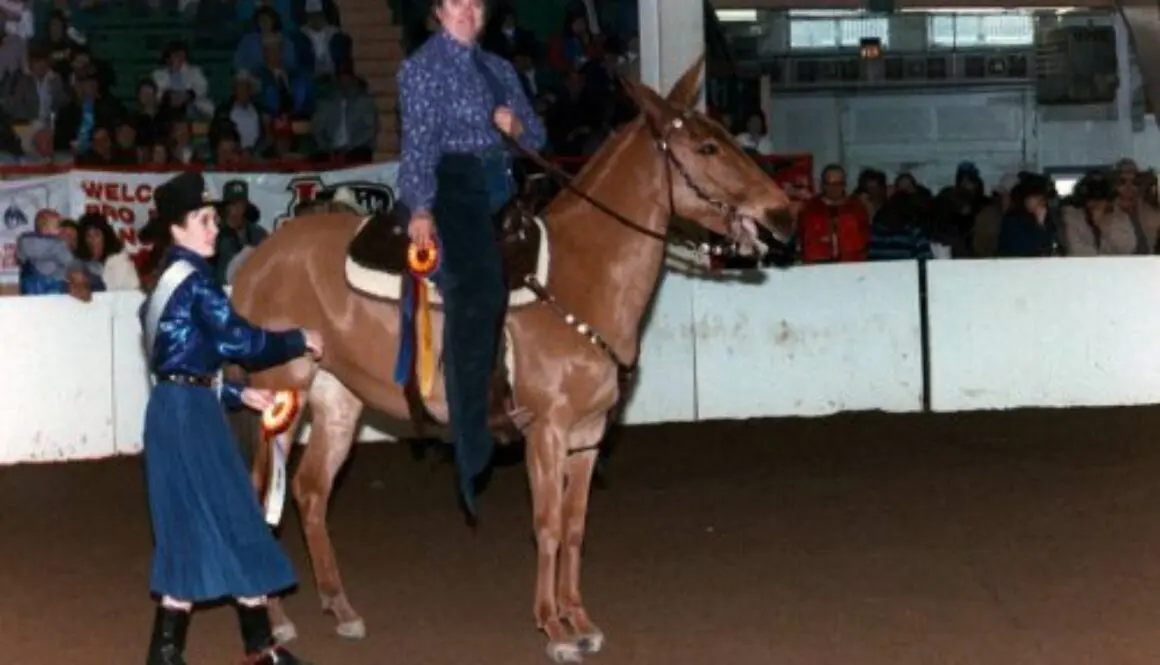
MULE CROSSING: Queen City Horse Show 1987
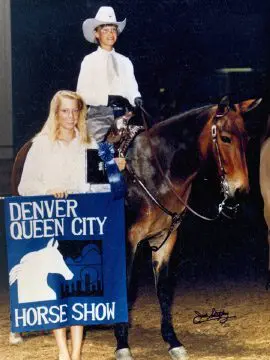 By Meredith Hodges
Only six years ago, mule and donkey shows were nearly non-existent in the state of Colorado. Enthusiastic members of the Rocky Mountain Longears Association saw a need for the promotion of Longears and the education of the public about them, and began sponsoring small shows throughout the state. As the numbers of R.M.L.E.A. members increased, so increased the demands made upon the club. We began to recognize a need for a specialized club, one that could meet the needs of those who wished to pursue the challenges of the equine performance world. Thus, the Colorado Donkey & Mule Society was born. C..D.M.S. has sponsored four shows and several clinics since January of 1987, enabling the Longears equestrians to challenge themselves and their mounts, set goals, and bask in the limelight of their accomplishments. We see what needs to be done to open the doors for mules and donkeys, evaluate our options, and then proceed with the most desirable plan of action.
Until now, mules in Colorado have been showing primarily with the draft horses or on their own, but this year we were cordially invited to put on a show with American Saddlebreds, Morgans and Tennessee Walkers. How would the mules stack up against these impressive show horses? We weren’t really sure, but C.D.M.S. met the challenge with their usual good nature and enthusiasm and put together the Queen City Donkey & Mule Show held in Denver, July 30-August 2, 1987.
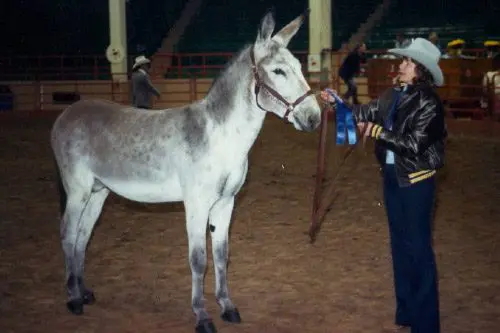 Months of preparation went into the show and like any show there were numerous things to be considered and changes to be made. Every time a change was made, people had to be notified and the mailing list for Longears was more than 400 names. We had hoped to pull in quite a few mules and donkeys, but one major glitch nearly cost us the show. Horse shows, because of their stability and increasing popularity, are able to charge much more for entries, not to mention breed and club fees. When the premium book was released, we found that the mules were charged the same fees as the horses. Two weeks before the show, management conceded to drop a lot of the superfluous fees, however by that time, it was too late to repair the damage. It is my contention that we might have had a lot more animals show up had the fees been initially reasonable, but this too, is speculation.
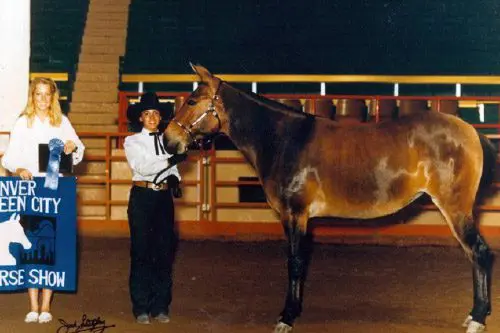 We are experiencing an economic slump in this country, and people just don’t have the extra money to spend on other than their own basic needs. Still, I would like to say that this show did not bomb out. Nineteen people and 23 mules put on a show that was well received by our American Show Horse co-exhibitors and spectators. We are also especially proud to say that every mule in the show, and donkey too, was well-conditioned, well-groomed and well-trained, making for one extraordinarily impressive show. Twenty-three mules and donkeys filled22 classes, once again reaffirming the true versatility of these incredible animals! Champion Model Donkey went to Blue Zebulon, shown by Fran Howe of the Bitterroot Mule Company in Bennett, Colorado, with Lucky Three’s Little Jack Horner taking Reserve Champion. Champion Model Mule was Lucky Three Nuggett, a two-year-old molly mule shown by the Lucky Three Ranch in Loveland, Colorado. Reserve Champion went to Mountain Shadow Mules’ Rambling Rose, shown by Diane Walston of Longmont, Colorado. Detailed results can be obtained through the Lucky Three Ranch.
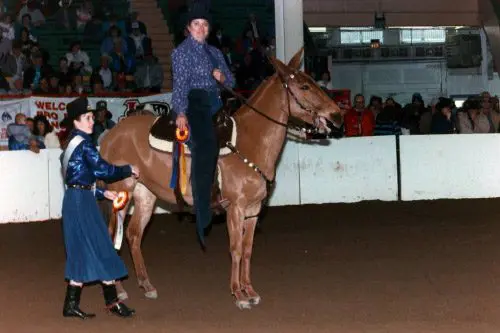 CDMS members and their friends are to be congratulated for all the hard work and dedication it took to make this show as impressive as it was. It was obvious that the several months of preparation were worthwhile. The monthly clinics sponsored by C.D.M.S. and attended with enthusiasm had indeed paid off in the show ring. It had made much better riders of us all and quiet, obedient companions of our mounts. We can be especially proud of our youth for their outstanding performances throughout the show. They have probably progressed faster than the adults! Their classes reflected an aura of concentration and determination. These “kids” are serious riders with a serious case of Mule Fever, and dreams of a bright future for Longears. They will carry mules and donkeys into new challenges and greater recognition. Keep up the good work: Justin GrandPre, Amy Wilfong, Leslie Busque, and Kim Nordyke (Youth Showmanship & Pleasure 14-17); Dena Hodges, Donnie Jo Neal, Cindy Brink, and Crystal Nordyke (Youth Showmanship & Pleasure 13 and under). A special congratulations to Leslie Busque for her first place win in the adult English Pleasure class, and to Kim Nordyke for her beautiful ride to second place in the Ladies Sidesaddle. We are very proud of all of you!
C.D.M.S. would like to express their thanks and appreciation to all those directors, managers, exhibitors, and spectators of the Queen City Horse Show committee for extending the invitation to show and for their continued friendly support throughout the show. Special thanks to Tommie Nykanon and Judy McNeish for all their hard work and dedication that resulted in a show filled with classy animals, good sportsmanship and mutual admiration among exhibitors. This show proved that it doesn’t necessarily take members to put on a good show, just dedicated, hard-working individuals and well-kept, well-trained animals. We hope the future will make the Queen City Donkey & Mule Show the crowned jewel of Colorado!
To learn more about Meredith Hodges and her comprehensive all-breed equine training program, visit LuckyThreeRanch.com or call 1-800-816-7566. Check out her children’s website at JasperTheMule.com. Also, find Meredith on Facebook, YouTube, Pinterest, Instagram, MeWe and Twitter.
Covered in TRAINING MULES & DONKEY: A LOGICAL APPROACH TO TRAINING, TRAINING WITHOUT RESISTANCE and EQUUS REVISITED at www.luckythreeranchstore.com.
© 1987, 2016, 2024 Lucky Three Ranch, Inc. All Rights Reserved.