

MULE CROSSING: Mules and the U.S.E.F. 2007
By Meredith Hodges
 1993 was a good year for Lucky Three Mae Bea C.T.That was the year she won the Novice Division at the Abbe Ranch Horse Trials in Larkspur, Colorado. A first place finish in competition with 56 horses is a significant achievement for any equine, but this Combined Training victory was particularly noteworthy, because Mae Bea C.T. is a mule. She’s a rare mule to be sure, but not as unusual as you might think. Well-bred, well-trained saddle mules are becoming increasingly competitive in classes that were once beyond their reach. In 2007, at Bishop Mule Days, the largest mule show in the country, bridle division flat classes each boasted as many as 30 competitors, and jumping events were equally popular. Growing numbers of mule riders are looking to improve their skills through dressage training and
  competition, and the horse establishment—the United States Equestrian Federation in particular—has embraced the mule community if not with open arms, then at least with open minds.
Mae Bea C.T. and several other champion mules of mine have spent nearly four decades testing the mule’s potential as athlete and performer. I discovered what I believe to be a limitless capacity for competitive achievement, and while I don’t foresee the addition of mules to the Olympic team roster, I do insist that Dressage training is a must for every serious rider. Therefore, those with a preference for mules should have equal opportunity to participate in every aspect of that training.
 My interest in longeared equines grew from the time I went to work at my mother’s ranch in Healdsburg, California, in 1973. As proprietor of the 1,000-acre Windy Valley Ranch, Joyce Doty ran a successful business breeding and training high-quality mules. I had always been partial to horses and believed the common lore that mules were stubborn, stupid, and not only mean, but inclined to hold a grudge and seek retribution at their leisure.
Frankly, they frightened me. But I took the plunge and soon came to the revelatory realization that, in truth, mules were not stubborn or dumb or even mean. They were only cautious, with a strong instinct for self-preservation. I quickly discovered that when Itreated them with patience, kindness respect  and consideration, the mules recognized I had their best interests at heart and they would not only comply, but go the extra mile to give their very best. I was smitten with my new long-eared friends and soon had a case of “Mule Fever” I’d never kick. By 1980, I moved to Colorado and established her own mule ranch. Lucky Three Ranch grew steadily over the years as I established myself as a breeder and trainer. In 1986 my insatiable quest to take training to higher levels took me to the United States Dressage Federation Convention in Houston, Texas. I knew the key to advancement was Dressage, but before I took the leap, I wanted assurances that I would be allowed to test my skills and measure my progress at schooling shows in my area.
 With some reservation, the United States Dressage Federation grantedpermission to participate in non- sanctioned shows at the show organizers’ discretion. Armed with this qualified endorsement, I began training with my local U.S.D.F. instructor Melinda Weatherford. My partner, Lucky Three Sundowner, was a talented mule out of an AQHA-registered mare. As a four-year-old, Sundowner won a World Championship in Reining in 1984. But Dressage was something new to both of us and we had limiting habits to overcome.
For the next several years I diligently trained with both Sundowner and Mae Bea C.T., who turned out to be an enthusiastic jumper. As their training progressed, I urged the folks at Bishop Mule Days to add Dressage classes to  their established Western, English, and Jumping classes. By 1989, Sundowner and I were working at Second Level Dressage, and in 1990 we took first place in a newly established Second Level Dressage Class at Bishop Mule Days. In 1992, I asked Bishop Mule Days for a Third Level Dressage Class and they obliged, although only two mules competed. Sunny scored sixes and sevens in the class, placing first against his only competition, Dolly Barton. By 1993 Sundowner and I were working at Fourth Level Dressage. We competed at Bishop Mule Days at Third Level Dressage for a second year and easily won as the only mule in the class. For me and Sundowner, attaining Fourth Level Dressage was a great achievement.
 just at home alone. And that is at the crux of my push to find a place for mules in the world of English riding. Of course,in the upper levels of competition, we should stick with apples to apples. But thequantity and quality of learning that takes place in the Dressage arena should be available to everyone.
I didn’t stand alone on this issue. Fellow mule advocate Carole Sweet laid claim to one of the proudest moments in longears history when she, with the help of a few allies, persuaded the United States Equestrian Federation to amend its rules to include mules in the organization’s DressageDivision.
 had been in Dressage training with her mule for some time, working to qualify for the Annual Championships of the California Dressage Society.The California Dressage Society by-laws had been changed to “specificallyexclude mules from all C.D.S. competitions.” It seemed like it was disguisedintolerance for any breed that didn’t fit the model of a Classical Dressage horse. Carole saw this as a serious injustice.
 Carol felt that the C.D.S. was endorsing exclusivity and discrimination in a discipline that was publicized and promoted to be suitable for every one and needed to be fixed. Carole contacted members of the C.D.S. Executive Board but got nowhere. Then she tried the United States Dressage Federation President, who told her that unless it was a rated show, organizers essentially had free rein and could include mules or not. The U.S.E.F.(U.S.A.E. at the time) said there was nothing they could do. Disheartened by the lack of response on the national level, Carole and Linda returned to the C.D.S. to request that mules at least be admitted into schooling shows. They attended the C.D.S. Annual Conference where Linda pled her case. The response was a resounding “No!”
“What bothered Carole most was how they were treated. The board members who did speak were vehemently opposed to letting mules back in. They treated them withcontempt and refused to hear them. All Carole could think was, “where’s your responsibility to your members? When you exclude the mule, you also exclude the rider.’”
 The C.D.S. Executive Board questioned her commitment to the issue and asked if she was serious enough about this to go to next week’s annual U.S.A.E. meeting Carole spent the next three days preparing a hefty packet of materials for the meeting. It included endorsements from every major mule organization, facts and figures on the industry, and information from the U.S.A.E. Endurance and Driving disciplines, which already allowed mules in competition.
Carole felt the feeling in the mule community was that mules had been discriminated against for so long and this was a chance to do something about it. She got letters of endorsement from everyone.
Carole received a personal invitation from the Dressage Committee Chair to attend a closed-door meeting to discuss the matter. Although she was unable to attend, the materials she sent and the answers she provided to some tough questions were enough to convince the committee to endorse the rule-change proposal.
That legitimized it. Now it wasn’t just Carole saying this should happen; it was the Dressage Committee. They were incredible to work with.
In January 2004, Carole, her friend Linda Pittman, American Donkey and Mule Society registrar, Leah Patton and I all traveled to Los Angeles to attend the U.S.E.F. Convention.
Carole knew I had already done so much on behalf of mules that I would want to be part of this and Leah as well. Carole said we were a huge help. We attended meetings and lobbied hard in anticipation of a vote by the Board. Carole said it was to their advantage that two of the organization’s goals that year were to build U.S.E.F. membership and reach out to the grass roots of the horse community. What could be more grass roots than mule riders? We’ve got a huge population of mule riders, which could translate into income for the organization. In the end, after three years of persistence, Carole’s and mymoment of triumph arrived. The Board voted to approve the rule change and admit mules into sanctioned competition, with the exception of high-performance qualifying and selection trials. Carole, the others and I were ecstatic. “I’m so thrilled for what we could do for all those people who love mules.” Carole said. “Now they’re in the sand box. There’s still some sand kicking going on, but they’re in!”
 Now that it’s done, the U.S.E.F. rule change hasn’t exactly launched a revolution. In fact, it’s been kind of quiet out there, and Carole wondered what effect the rule change hadactually had. She suspected it could take a while for mule riders, low on the totem pole for so long, to acquire the skills, the nerve, and the sense of possibility that will propel them to higher levels of performance, but she’s confident they will and the mules, too, will rise to the challenge.
Carole believes that riding a mule in Dressage is no different the riding a horse. Any animal’s ability is based on temperament, conformation,and heart. My television program Training Mules and Donkeys on RFD-TV reached millions of viewers every week, knowing that with proper training, care and athletic conditioning, mules can excel in any discipline. If you understand the mule’s psychology and his physical needs, you can reach truly amazing levels of performance.
One place where mules can show their stuff in ever growing numbers is Bishop Mule Days. Each Memorial Day weekend 800 mules and several thousand people congregate in Bishop, California for a competition that includes more than 180 events. Bishop Mule Days Executive Director Kim Craft says that more riders compete in the English classes than in the Western events.
Last year there were 25 to 30 competitors in the flat classes. Bishop Mule Days uses U.S.E.F. “R” rated judges and the riders come to compete in World Champion classes and win real champion points. The Mule Days competitors have raised the bar in every event. Mule Days used to be Mom and Pop and a two-horse trailer, but these competitors train much harder and compete more seriously, and these mules are incredible. It’s the knowledge and the people that have brought the mule this far. Most who take their mules into English classes don’t do so with visions of trouncing the competition at an A.Q.H.A. show. They’re simply trying to become better riders through study and practice. It’s more about learning than performing. People are passionate about their animals and want to become the best riders they can be.”
Bishop Mule days is a World Class show. The U.S.E.F. and the entire Dressage community can be proud of the competitors there and how they represent the extraordinary discipline of Dressage.
So don’t be surprised if you happen to come across a mule or two at your next horse show. They’re there now! And I will tell you, “They’ve earned it!” I am so proud of all the people who are now taking advantage of what we made available to them. Audrey Goldsmith and Heart B Porter Creek were the first, followed by Laura Hermanson and Heart B Dyna and in 2016, Behold the Desert.
To learn more about Meredith Hodges and her comprehensive all-breed equine training program, visit LuckyThreeRanch.com, MEREDITH HODGES PUBLIC FIGURE Facebook page, or call 1-800-816-7566. Check out her children’s website at JasperTheMule.com. Also, find Meredith on Pinterest, Instagram, MeWe, YouTube and Twitter.
Covered in TRAINING MULES & DONKEY: A LOGICAL APPROACH TO TRAINING, TRAINING WITHOUT RESISTANCE and EQUUS REVISITED at www.luckythreeranchstore.com.
© 2007, 2024 Lucky Three Ranch, Inc. All Rights Reserved.
 By Meredith Hodges
 owner would have to paint his face orange and blue and ride a mule all the way around the hotel. Well, guess who won and, guess who the mule was?! Yes, it was our own Lucky Three MaeBea C.T.!
 Although they never finished the movie, DIX Country Pictures chose Beaas Wadi’s understudy from hundreds of applicants.
 In 1998, we did a shoot with the Discovery Channel and Bea can be seen as the mule in their production of “The Ultimate Horse.” What a gal!
 Everyone loves a parade and Bea was no exception! She competed in numerous costume classes and parades, but dressing up for the holidays was her favorite. She placed first in many a parade and had no problem with any theme you might want to try.
 Bea may be a perfectionist, but she was certainly not a prude. She was always willing to try anything you might ask. At home, Bea worked hard checking fences, moving cattle and much more.
 shrubs and bushes. We were headed up one hill behind the cattle and the two cowboys when we came upon a three foot diameter tree that had fallen across our path. The cattle dove into the underbrush on either side of the tree, the cowboys slid to an abrupt halt and Bea came right up the middle, jumped the tree and stayed on the heels of those cattle the entire way! No one was more surprised than those two cowboys, except maybe their horses!
 there, she cleared fences without batting an eyelash. She always took the jumps right over the center and never expended any more energy than necessary to clear the fence in beautiful form.
 Her shortened frame allowed her to make sharp turns and still clear the fences in timed classes where she would ordinarily be at a disadvantage against taller mules.
 In 1986, Bea and I began lessons with instructor/trainer Melinda Weatherford in Dressage. The same year, I went to the United States Dressage Federation Convention and introduced them to the idea of allowing mules such as Bea to compete in dressage schooling shows and competitions. There were some discrepancies in the rules, but they finally decided to allow mules in lower levels at schooling shows with the discretion of the individual show committees. This was a major breakthrough for mules in equine society!
 She has shown dressage in all sorts of different disciplines: Dressage Shows, Dressage Schooling Shows, Two-Phase Combined Training Shows, Three-Phase Combined Training Shows and in Two-Phase Combined Driving Shows. Her scores were always high and she was always in the ribbons right from the start. The most remarkable thing about the training in Dressage was how it enhanced her driving skills so drastically that she won the first, second and the only two Two-Phase Driving Shows she had ever entered. People were always skeptical to start, and the first to applaud her performances after they saw her! The most prevalent comment during the ribbons ceremonies was, “My God! It’s a mule!”
 For a decade, Bea was shown in numerous classes by my daughter, Dena Hodges from the age of six to sixteen. They showed together in Western Pleasure, English Pleasure, Driving, Mule Jumping, and Two-Phase Combined Training shows. They were always in the ribbons and most often first or second in their class.
 Driving was always one of Bea’s strengths. I remember when I broke her to drive. I didn’t really know what I was doing. She took to the harness well, ground drove along side of the cart and didn’t seemed to be bothered by any of it, so within three days, I hitched her to the cart and proceeded to lead her out to the pasture where we would have more room. We were going around a 90-degree turn as I was leading her, hitched to the cart, when one of the wheels caught on the fence. She did a quick little scoot for a step or two which only caused the cart to flip over. She wound up with on of the shafts over her head and the other between her front legs. She stopped cold and allowed me to right the cart and get her untangled. Then we went out to the pasture and had our first drive with me in the cart with no further incidents. No big deal!
 Bea was always so steady that she was the perfect Side Saddle mount. She competed in Side Saddle at numerous shows and won many of those classes. She competed in Side Saddle at the National Western Stock Show with several different riders, but always placed in the top three regardless of who was riding her.
 In 1993, I rode her Side Saddle in the Inaugural parade in Washington D.C. It was a grueling 24 hours, standing around waiting to go in very cold weather and in the midst of more “mule eaters” than you could count. Bea seemed to take exception to the 50-foot Elvis Presley float, but otherwise handled the whole situation with her usual grace and dignity. Bea must have caught Clinton’s eye as she strolled elegantly past the viewing area because he turned away from the man he was speaking to and gave her a hearty thumbs up! We responded in kind and in her usual style, Bea smiled broadly!
 when we lightly weighted her front legs to encourage some reach. In nine months, she had increased her length of stride by 18 inches!
 the trail disappeared into a rock slide. She was trapped on the narrowest part of the trail with four horses behind her. She couldn’t turn around and she couldn’t back up. After assessing the situation, I asked her to do a 180-degree turn on the haunches and swing her front legs over the 100-foot ledge to get turned around. She did as I asked and got us through that compromising situation with the finesse of a ballet dancer! The people on the horses were nothing short of amazed! When we went trail riding, or down the road, everyone wanted to ride Bea!
 she did Western exhibitions at various local events and was the subject of many a newspaper or magazine article throughout her career.
 By Meredith Hodges
 Dressage is practiced in an arena marked by a low fence with letters at strategic intervals. A manual outlining the different “tests” tells you what to do and where to go in your marked arena. Once an animal is started under saddle, he begins dressage training at what is called Training Level. There are four tests at each level that increase ever so slightly in difficulty from one to the next. In each level there are certain objectives to be met. At Training Level, for instance, your mule should learn to travel in straight lines and to bend his body to the arc of large circles and in corners, and to make upward and downward transitions through his gaits while maintaining good balance, a steady rhythm and cadence throughout the test in an elongated and elastic frame. At the same time, the rider is also learning and conditioning his own body to react appropriately to the body of his animal. The objective of dressage training is to develop a harmonious balance and understanding between equine and rider physically and mentally.
 When your equine is strong, steady, rhythmic, and responsive at Training Level, he can then proceed to the next level, or First Level. At First Level, he learns to initiate more engagement of the hindquarters (collection) and begins to condition the muscles needed for lateral work through lengthening of the gaits and yielding from the leg. As he is better conditioned in his body, he is better able to perform and hold the balance and collection that is needed for Second Level, then Third Level, Fourth Level, and beyond. In order to gain true collection, he needs to possess incredible strength, such that he can step underneath himself with power from his hindquarters, round his back, and bring lightness and suppleness to the front end. This kind of posture makes the fancy upper level movements one usually associates with Dressage fluid and effortless with no apparent movement by the rider.
 Each level builds on the exercises from the previous level from Training through Intermediate to Prix St. George and Grand Prix. Combined Training is the addition of gymnastic-type exercises (aerobic equivalent) to the regular dressage routine. The jumping, or gymnastic, exercises can start in conjunction with the dressage tests as early as Training Level and can greatly enhance and improve their Dressage performances. It gives the equine a mental break from the repetition and intensity of the dressage tests. It allows the animal to develop better coordination and stronger forward movement. Jumping also enhances hindquarter development and the variety in routine keeps your equine’s mind fresh, alert, and willing to perform.
 All the Lucky Three mules will attest to the success of Dressage and Combined Training, particularly Lucky Three Mae Bea C.T., who began to do exercises at the more advanced levels. Before we began dressage training, we were training for each event. With dressage training she developed an incredible responsiveness to seat, leg and rein cues and was able to perform anything easily and willingly. She did absolutely everything you would ask of her and did it all with above average quality and enthusiasm. It has made classes in which she already excelled even better! The other Lucky Three mules exhibited this same above-average attitude and performance across the board with Dressage and Combined Training. This kind of variety keeps life interesting and challenging as we find new uses and events in which we can compete our mules. They have even made their own unique contribution to the equine industry! Volunteers to help set up shows and events are often hard to find.
 The Mountain States Combined Training Association is grateful to the Lucky Three Ranch, but particularly to Mae Bea C.T. for her help in dragging logs to help build cross country jumps at Lory State Park in Fort Collins, Colorado. Mae Bea C.T., trained in Dressage and Combined Training, not only jumps those cross-country jumps, but helps to build them as well! She is a strong, healthy and willing mule thanks to the preservation of a 100-year-old or more equestrian art called Dressage!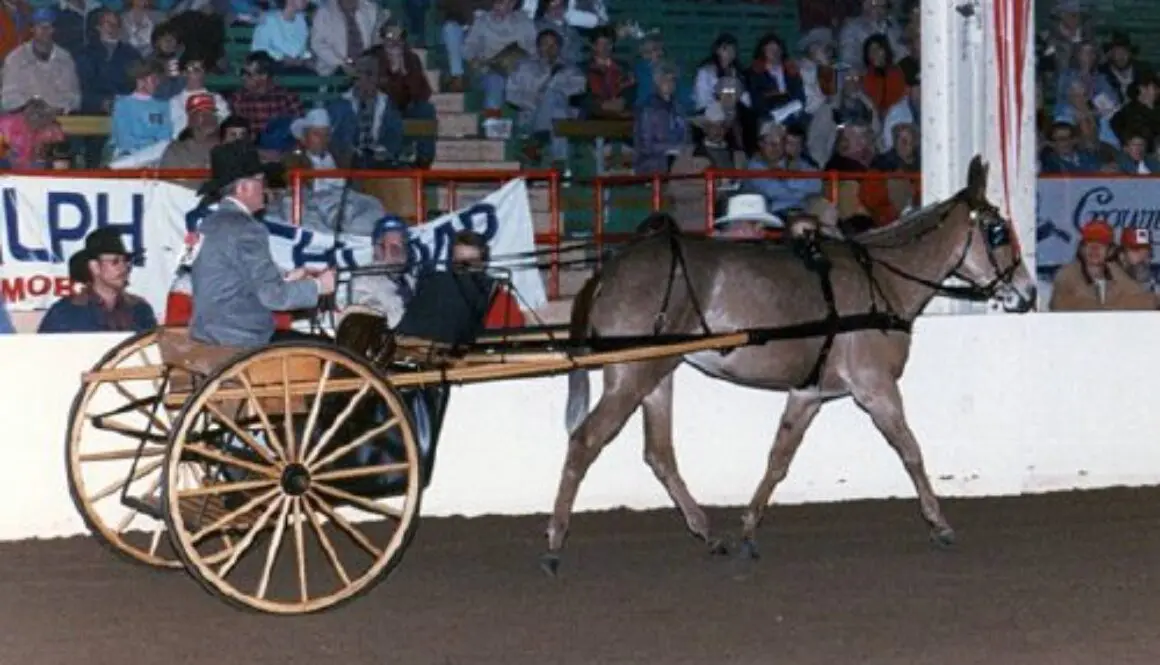
 A wonderfully new and exciting addition to the Colorado Classic Heart Fund Benefit this year was opening night’s Symphony of Champions. Riders from all divisions were given spots to ride to the music of the Denver Symphony’s Young Artists Orchestra. American Show Horses, Saddlebreds, Arabians, Half-Arabians, Morgans, National Show Horses, Tennessee Walkers and mules danced to the music of Beethoven and Broadway hits, and then came together for the grand finale to the William Tell Overture. It was an evening of beauty, an evening of humor, an evening of suspense, an evening of the deepest emotions – and the audience loved it! What an exciting way to kick off a show!
 saddle mules in the country! Performance classes began with English Pleasure, and then went on to show some of the smoothest jumping mules ever in Hunter Hack and Hunter Under Saddle classes. There was a stunning touch of class by Tammy Dishong and Dena Hodges as they emerged in the Side Saddle class.
 Back to Tammy Dishong and Dena Hodges again for Youth Pleasure, where the girls exhibited their mules in a truly professional manner, explaining why each had claimed their World Champion placements at Bishop Mule Days in California just two years before! Until recently, California mule exhibitors seemed to claim most of the world titles, but two years ago they had to start working a little harder because our own Colorado mule exhibitors began doing better than ever, giving them a run for their money!
 Drive & Ride and Ranch Riding were cancelled as the show was running late and the judge needed to catch his flight home, but in the spirit of the Colorado Classic, the otherwise refunded money was donated to the Heart Fund. Our deepest thanks to all of the mule exhibitors who took time out of their busy schedules to help support this show with their avid participation: Bitterroot Mule Company of Bennett, Colorado; JD Diamond Ranch of Bennett, Colorado; Lucky Three Ranch of Loveland, Colorado; Mountain Shadow Mules of Longmont, Colorado; Kristin Pettinger of Littleton, Colorado; and Steven White of Westminster, Colorado! Everyone did a superb job and is to be highly commended for their excellent performances! Thank you all and let’s hope that we can have even more support and participation next year! Results are as follows:
 In October of 1987, Leslie Busque will cross over into the ranks of adult riders, but she has had a youth career in mules of which any young rider would be proud. In 1983, she competed at the Texas State Fair, where she captured Reserve High Point Mule, a first from any age group in Colorado. In 1984, she again received Reserve High Point Mule at the Sandrifters All-Breed Show held in Colorado Springs and was elected Princess of the Prairie Ramblers Riding Club. In 1985, her uncle, Bob Anthony of Colorado Springs, bought a three-year-old molly mule from Judy Krol of Arizona, which he encouraged Leslie to train and show. At the Sandrifters All-Breed Show that year, Leslie rode Frijoles Dixie Belleagainst adults (there were no youth classes at this show), where she captured 1st place in English and Western Pleasure and Grand Champion High Point Mule. She went on to compete at the Colorado State Fair where she won 1st place in Green Western Pleasure (17 competitors), Open Western Pleasure, Youth Western Pleasure and Showmanship at Halter. Later that year, at the Desert Donkey and Mule Club Bicentennial Show held in Phoenix, Arizona, Leslie again competed against adults, taking 2nd in Mature Mules at Halter (3 yrs & over), 1st in Open English Pleasure, 2nd in Open Western Pleasure, and Reserve Grand Champion English Performance Mule.
 In preparation for college, Leslie moved from Colorado Springs to Loveland, where she rode as Assistant Trainer for the Lucky Three Mule Ranch. At the Denver Queen City Horse Show, she showed Lucky Three Mae Bea C.T., taking 1st place in Youth Showmanship and Youth Pleasure (14-17), then rode Lucky Three Ciji, a four year-old molly, to victory in the Adult English Pleasure.