
 Christmas is a time to stop and reflect, to give thanks for all the wonderful things that fill our lives, and to make resolutions for an even better tomorrow. The contributions that have been made by mules and donkeys today are more numerous than they have ever been before and we should give thanks that we still have these longears touching our lives and making them full!
When the age of automation arrived, many mules, donkeys, and horses were put out of work. Mechanical alternatives were taking their places in the fields, in the coal mines, along the canals, and even in the mountains. Horses made a somewhat smooth conversion of use to modern day recreation, but it was not as easy for the mules and donkeys. The history of mules and donkeys was never that well documented. Literally thousands of books have been written revering the horse for his contribution to the building of great societies and cultures, and a lot of the things attributed to the horse were actually done by mules and donkeys! It does not surprise me that by 1966, mules and donkeys were on the decline. Their uses were no longer critical to development and growth of society.
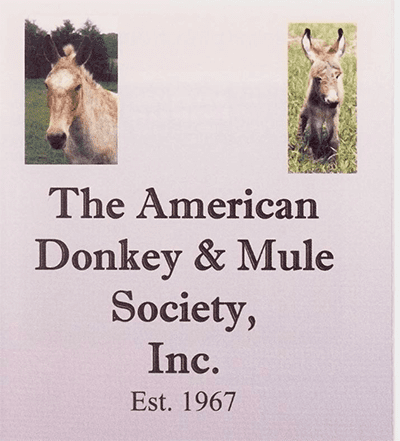
In 1967, concerned Paul and Betsy Hutchins founded the American Donkey & Mule Society, designed to respark the fires of interest in these longeared animals. The A.D.M.S. quarterly journal reminded the American public of all the extraordinary things that had been accomplished in history by donkeys and mules. They plowed the fields, pulled the covered wagons, worked in the coalmines; they pulled barges on the canals and packed munitions for the military. They built the Rose Bowl in Pasadena, California. Wild Bill Cody rode a mule named Mouse that put General Custer’s fancy Thoroughbred to shame over long distances and rough terrain. Crowned heads of Europe rode mules as a statement of class and Jesus rode into Jerusalem on the back of a small and humble donkey! Though the horse was revered and given the credit, mules and donkeys were always right there, strong, steady and humble! Thanks to Paul and Betsy Hutchins, we have been reminded of Longears’ great legacy and there are those, including myself, who would find a way to appreciate their efforts and would help to make donkeys and mules an important part of modern-day society. The American Donkey & Mule Society today offers a wide variety of programs that include longears of all sizes, breeds, types and uses. The A.D.M.S. journal is still published quarterly and is growing with the industry, keeping folks abreast of new and innovative uses for the longears of the future and it serves as a record of accomplishment. The A.D.M.S. registry ensures a more traceable ancestry than has ever before been possible. Many different A.D.M.S. award programs ensure that outstanding individuals are recognized for their diverse accomplishments and books and literature have been compiled and made available to anyone who wants to know more about these unusual animals. A.D.M.S. has inspired the formation of local clubs and groups that share in this interest and the result is evident in art, jewelry, and other longears products and events. A.D.M.S. has given our children an alternative in equestrian sport that is interesting, challenging and unique in spirit.
Mules and donkeys are becoming the equine of choice in many areas today. The California Sierra Nevada Pack Stations are populated with mules trained to take tourists on pack trips through the scenic mountain areas. The only equines safe enough to carry tourists down the steep rocky trails at the Grand Canyon and at Molokai are mules! Hunters are using mules as riding and pack animals due to their incredible strength, endurance and intelligent nature; they can handle rougher terrain and adverse weather conditions better than can the horse. Donkeys are finding new uses in guarding sheep from unwanted predators, mules and donkeys are used in handicapped riding and driving programs, molly mules are being used for embryo transplants, and third world countries are being educated in the care and feeding of their donkeys and mules to enhance economic growth. Mules and donkeys have even become viable 4-H projects for young people who enjoy the challenge. We are finding that there are actually very few things these longeared equines can’t do!
Skeptic that I am, I have always attempted to find the limitations of these incredible individuals. Here at the Lucky Three Ranch, we continually challenge our mules and donkeys with new and innovative tasks. They have continually met these challenges with success! With each new success, our mules have brought many new and wonderful friends into our lives, making life very full and very rewarding. To this day, I am still amazed when an animal has met his challenge and accomplished what I have asked. I suppose part of me would still like to believe that if they could have done all these things, then they would have already been done, but I can see now that that isn’t necessarily so. Need has a lot to do with it. No one ever NEEDED an upper level dressage mule before! Lucky Three Sundowner is currently working at 3rd Level Dressage after winning the world championship in reining in 1984. He is exhibiting play patterns that have evolved from his training that will undoubtedly contribute to his success when he gets to the level of high school dressage, commonly called the Airs Above the Ground. Lucky Three Mae Bea C.T. has clearly shown that you can do a variety of things well on a mule–whether it be against horses or other mules–with, or without the bridle! Mules give new meaning to the word VERSATILE! Not to mention that they are a loyal friend and companion as well. Then there is Little Jack Horner who defies all the laws of donkeyhood! He rides, he drives, he charges, and he jumps in formal hunter style over 3’6”. He is the sire of some of the most athletic mules in the world today. Since we have yet to find any serious limitations in these longears’ ability, at the Lucky Three Ranch we are concerning ourselves with documenting these three unique successes. Longears Training: A Logical Approach is a book documenting the training techniques we have used that has led to our mules’ and donkey’ successes. It will be released in May 1992. As far as I know, it is the only book of its kind with training from foal to adulthood. The intent is to help mule and donkey enthusiasts to get the best from their animals and to avoid the common pitfalls that would sour an otherwise stimulating and rewarding experience with longears. We have also completed our first in a series of professional mule and donkeys training videos: Seeing is Beliving! It is a 22-hour presentation outlining the remarkable results we have attained to date with our mules and donkeys. It just goes to show that MULES CAN DO, AND DONKEYS, TOO! SEEING IS BELIEVING… DREAMS CAN COME TRUE!
For more information about Meredith Hodges and her comprehensive correspondence training program, Training Mules and Donkeys, please visit www.LuckyThreeRanch.com or call 1-800-816-7566. Also, find Meredith Hodges and Lucky Three Ranch on Facebook and Twitter. And don’t forget to check out her children’s website at JasperTheMule.com.
© December 1991 Lucky Three Ranch, Inc. All Rights Reserved.
To download or print this article, please visit the LTR store.