LTR Training Tip #7: Feeding Time – Pasture Grazing
Meredith gets a lot of letters and emails from people with training questions about their equines. Here, she discusses how to best utilize pasture time for a happy and healthy equine.

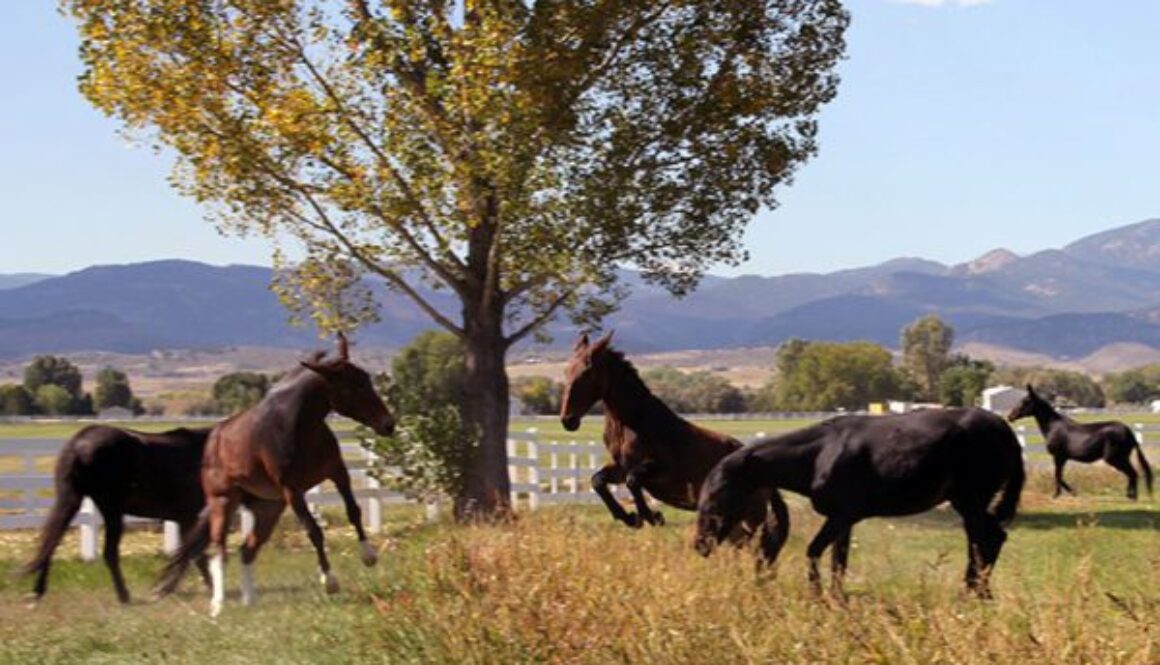
Meredith gets a lot of letters and emails from people with training questions about their equines. Here, she discusses how to best utilize pasture time for a happy and healthy equine.
We hope you enjoy Part 2 of the translated historical Longears article written by Elke Stadler, originally printed in German in the SWISS BULLETIN that comes to us from Switzerland. More articles to follow!
By Elke Stadler
Further evidence of mules in ancient times is shown by finds from various archaeological excavations. The identification of hybrids is more and more illuminated by archaeological research. The finds of mule bones on civil and military sites are scattered throughout Europe.
In Pompeii
Pompeii was an ancient city located in the modern commune of Pompei near Naples in the Campania region of Italy. https://en.wikipedia.org/wiki/Pompeii
In the stable of the house of “Casa Amanti” the remains of equine skeletons were found, five in total, including four donkeys between 4 and 9 years old and one male mule between 8 and 9 years old. The equines were probably used as pack animals for the transport of pastries. An analysis of the food remains in the stable was also taken.
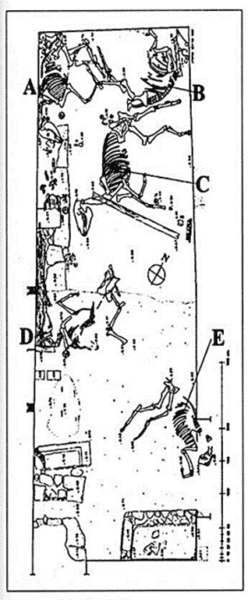

Left: Plan of a horse stable in Pompei, Anthopozoologica 31,2000, pp. 119-123.
Right: Pompeii, Casa Amanti, houses 6 and 7, Insula 12, region IX, Genovese A, Cocca T.
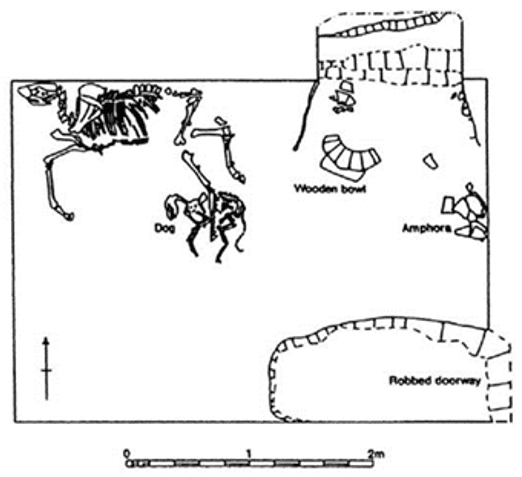
Pompeii, Insula 9, house 12, room 4, region I, (casa amarantus)
(Berry J., The conditions of domestic life in pompii in AD 79: A case study of houses 11 and 12, insula 9, region I, Papers of the British School at Rome)
In the stable on this area, probably originally a “Kubikulum” (side room), the skeletons of a mule and a dog were found. On the northern wall, remains of wood can be seen, which indicate a feeding rack. The palynological examination of the plant remains showed a variety of grasses and weeds as well as cereals, olives and nuts, indicating forage, litter and dung. Two fortified iron rings near the mule’s head suggest that it was tied up at the time of death.
The large number of amphorae in the “Impluvium” (water collection basin) of the nearby atrium (Roman dwelling house), as well as the remains of a broken amphora in the stable, indicate that the mule was intended to transport amphorae to the city. The remains of a dilapidated “Caupona” (bar, sales room) in the adjacent Insula 11 indicate commercial activity. An inscription on the western front (AMARANTUS POMPEIANUS ROG (AT) and three painted inscriptions, one on the neck (EX POMPEI AMARANTI) and two on the belly of several amphorae found in the building, indicate that Amarantus was a wine merchant, which required the keeping of a mule to transport the amphorae.
Great Britain, London
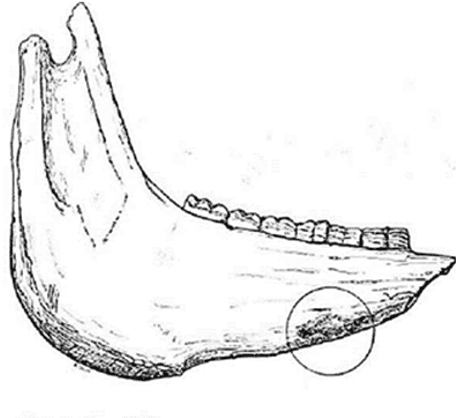
The mule jaw was found in a landfill. It dates from the Roman period (period II, phase 3) around 125-160 A.D. Age at death of the animal: more than 5 years, perhaps between 11 and 14 years.
The age determination is inaccurate, as the jaw is broken at the level of the incisors. The age can only be determined more accurately on the basis of the wear and tear of the incisors. It was also not possible to determine the sex because of the missing canines, the sex index. They are more developed in males than in females. The pronounced wear in an area of the jawbone (circle) is probably the result of the damaging pressure from a halter or muzzle.
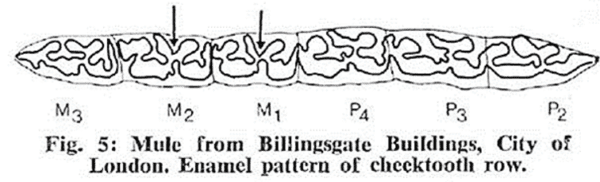
Examination of the molar profile of the jaw made it possible to determine the London jaw more reliably than mule jaws. It has a very accentuated “V” shape of the lateral cavities of the first molars (cheek teeth). The comparison with the lower jaw of another mule (Dangstetten) shows a strong similarity.
According to Armitage P, Chapman C, Roman Mules, The London Archaeologist, 3/13,1979, S. 339-359)
Kalkriese, Niedersachsen, Germany
The finding region Kalkriese is an area in northwest of Germany, where large quantities of Roman archaeological finds were made. https://en.wikipedia.org/wiki/Kalkriese
Archaeologists have identified the bones of eight horses and about thirty mules on the site of the Battle of Kalkriese, which took place in 9 A.D., including two skeletons in good condition at the trenches dug by the Germans to capture the Roman vanguard. The first mule was found in the trench, its bones (head, neck and shoulders) and its harnesses are in adequate position. The animal was therefore not completely exposed to natural decay (which explains the good osteological and anatomical preservation conditions).
The mule had an iron bridle and harness with metal elements and stones, and a bronze bell with iron clapper. The inside of the bell was stuffed with oat straw wrapped around the clapper so that the bells were not heard in enemy territory. The growth of the roots on the stems indicated late summer – early autumn, which made it possible to determine the date of the ambush around September.

In 1999 the fragmentary remains of a second 4-year-old mule were found. It carried a smaller bronze bell and an iron bridle. The animal died of a broken neck, probably while trying to climb the German wall in the general panic of the fight.
According to: Rost A, Wilbers -Rost S; Waffen auf dem Schlachtfeld von Kalkriese, Gladius XXX; 2010, pp. 117-135 and Harnecker J, Franzius G, Kalkriese 4th Catalogue of Roman Finds from the Oberesch. Die Schnitte 1 bis 22; Römisch-Germanische Forschungen vol. 66. 2008 and Wells P.S., Die Schlacht, die Rom stoppte, Kaiser Augustus, Arminius und das Abschlachten der Legionen im Teutoburger Wald, 2003)
Carnuntum, Austria
It is the most important and most extensively researched ancient excavation site in Austria 28 mi east of Vienna. https://en.wikipedia.org/wiki/Carnuntum
Horses and mule bones were discovered in the outer ditch and in pits on the edge of the first ditch of this Roman legionary camp. Four mules could be identified from the remains. The sex could be determined based on the development of the canines on the lower jaws. They were only male animals. Two of them died at the age of 6-7 years, the other two at about 15-17 years. The age is estimated on the basis of the abrasion of the teeth. Since mule teeth are harder than those of horses, the age had been underestimated and had to be reassessed.
The height at the withers was determined in relation to the length of the bones found. It was approximately between not less than 140 cm and maximum 155 cm. Apart from one mule, the other three suffered from diseases of the limbs and/or the spine caused by frequent heavy loading. A pathological change in the spinal column of a mule also indicates this. One shows a pathology (exostosis) on the jaw, which is caused by repeated rubbing of a bit or harness.
According to: Kunst G. K., Archäozoologischer Nachweis für Equidengebrauch, Geschlechtsstruktur und Mortalität in einem neuartigen Hilfskastell (Carnuntum-Petronell, Niederösterreich), Anthropozoologica 31; Ibex J. Mt. Ecol 5.2000
Weissenburg, Bavaria, Germany, Biriciana Roman Fort
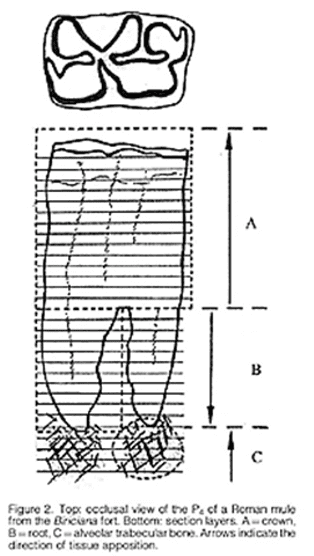 The Roman fort at Weissenburg, called Biriciana in ancient times, is a former Roman Ala castellum, which is a UNESCO World Heritage Site located near the Upper Germanic-Rhaetian Limes. https://en.wikipedia.org/wiki/Biriciana
Four skeletal remains of mules were found during an excavation in this Roman camp. The age was determined to be 160 AD after the discovery of eleven coins. They were found in a bag that was left with the mules. The authors raise the question of a possible local breeding or traditional import of mules from Mediterranean countries. When examining the teeth of an 8-year-old mule, it was found that the food in the mule’s environment must have changed until the time of its death. The animal spent part of its life at high altitude, according to the proximity of the camp, probably in the Alps. The investigations show that the animal must have been born and bred in northern Italy. It must have been used for work in the Alps for a while and later on until the end of its life near Fort Weissenburg.
According to Berger T. E., Peters J., Grupe G. Life history of a mule (ca. 160 AD) from the Roman fort Biriciana/Weissenburg (Upper Bavaria), as revealed by serial stable isotope analysis of dental tissue, International Journal of Osteoarchaeology Volume 20, Issue 2, March/April 2010, pp. 158-171.
Further Sources: https://leg8.fr/armee-romaine/mulet-du-ier-siecle-qui-es-tu
Meredith gets a lot of letters and emails from people with training questions about their equines. Here, she offers some advice on making the most of feeding time with your animals.

Meredith gets a lot of letters and emails from people with training questions about their equines. Here, she talks about how to best communicate with your equine.


Wrangler had his first sarcoid removal on 7-20-18, but we found another one just a few weeks ago starting under his right side. It looked like he had been rubbing it as it was a bit crusty. I had a mule that did that to a sarcoid and it eventually disappeared as did the other two that were on his body. He apparently built immunity against the sarcoids. So, we opted to wait and see if this one on Wrangler would also just go away. It didn’t and it was now the size of a golf ball and would need to be removed. We treated Wrangler’s prior sarcoid with Xterra because of its location in a vascular area, but this one could safely be surgically removed.

Our veterinarian, Greg Farrand, shaved the area for the IV catheter.

We opted to do the surgery in our tack and groom area where things could be kept clean. Kim handed Greg the catheter while I kept Wrangler steady. He wasn’t exactly thrilled, but he was a good boy!

In order to make sure he landed on his left side so Greg could reach the sarcoid that was on the right side, Chad and Steve took their positions on each side and guided him to the floor.

I shaved off the long, thick shaggy hair from his barrel around the sarcoid with my #10 blade and then Greg came back over the area with his closer cut blade. We put a fleece saddle pad under his head and covered his eyes with a bath towel.
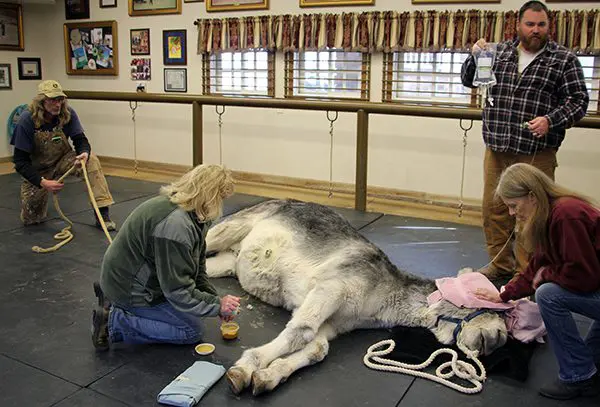
Kim prepped the area while Steve held the rope that was anchored around his hind leg to prevent any kicking if he began to wake up. Chad held the IV drip while I watched his head for unnatural breath and movement. But Wrangler just snored!

Greg carefully removed the sarcoid paying attention to getting it all. Wrangler just kept snoring!

After the sarcoid was removed, we opted not to do stitches and Greg used his Hyper Thermic machine that would trigger his immune system to fight any cells that might have not been removed. It could even cause the old sarcoid that was now dormant to drop off later if it worked to that extent. This treatment is one that replaced the old injections that used to be the follow-up treatment in sarcoid surgeries.

Kim cleaned the area afterwards and blotted the sponge onto the area to help the blood to clot.

The she removed the IV drip system from the catheter in his neck. It wasn’t long after before Wrangler began to wake up.
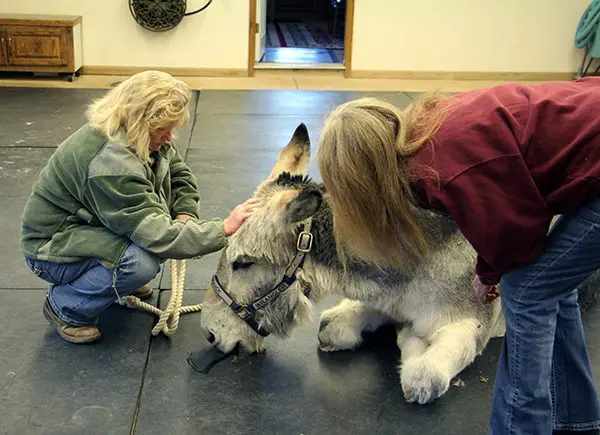
We kept him on his sternum and patiently waited until he was ready to try to get up. At first, he was a bit wobbly and stayed in a sitting position for a few seconds before rising to all four legs.
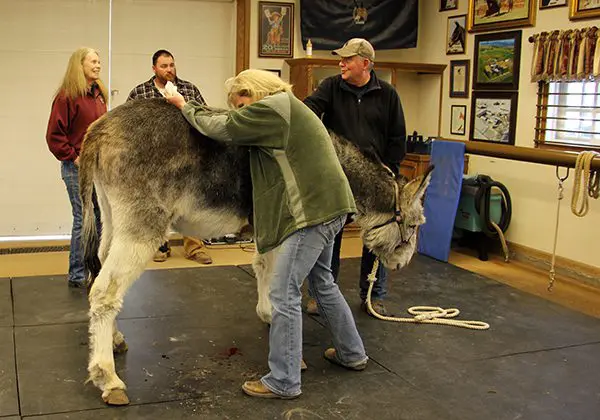
Once he was on all fours, we held the sponges up against his belly to further stop the blood until it could lot. Wrangler just “hung loose!”

When the blood finally clotted, we pulled the IV needle from his neck and then held sponges on that until it stopped bleeding. Wrangler was grateful to be awake again…well, sort of awake!

When he was showing some stability on his feet, we took a few circles around the room to get his circulation going again. We kept him walking intermittently around the room for about 30 minutes before putting him back in his stall and run. We removed all the bedding for a few days so it would not get stuck in the open wound that we would clean twice a day and treat once a day with Panalog until it is healed.

Wrangler didn’t have the where-with-all to be able to let out a full-fledged bray, but he did let out several grunts of appreciation to Dr. Greg as he left!


Getting down to your mini’s eye level so that he can make eye contact with you will foster good behavior and produce a willing relationship of trust between you. Learning how to begin the relationship with your miniature equine in a positive and natural way, and setting reasonable boundaries for behavior, discourages striking, jumping on you and other undesirable and abrupt behaviors that are common when working with miniature equines. The results of using this safe approach to miniature training have been amazing! My minis are always calm, happy to cooperate, play safely and continue to learn! Learn more about this gentle and effective way to manage and train YOUR mini on my website at www.luckythreeranch.com under TRAINING and in the STORE.
To learn more about Meredith Hodges and her comprehensive all-breed equine training program, visit LuckyThreeRanch.com or call 1-800-816-7566. Check out her children’s website at JasperTheMule.com. Also, find Meredith on Facebook, YouTube and Twitter.
© 2016, 2017 Lucky Three Ranch, Inc. All Rights Reserved.


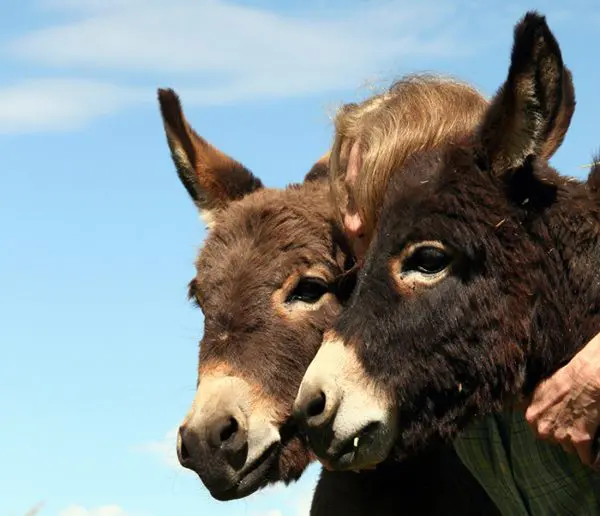
Miniature horses, donkeys and mules all have one thing in common; everyone else is taller than they are! As the saying goes, the eyes are the window to the soul so it is understandable that they would become anxious if they are unable to look into a person’s eyes to decide whether they are friend or foe. With safety always as my first priority, I work with my minis from a lower position whenever it’s safe to do so. That way, I can make eye contact with them, and I make certain they are always lavishly rewarded with an oats reward for their compliance. You can make fun of me if you want to, but another thing that is important is the way you talk to them. Baby talk INVITES their interest where a perpetually firm voice, or a clicker, does not invite the same kind of intimacy. The results of using this safe approach to miniature have been amazing! My minis are always calm and happy to cooperate and learn! Learn more about this gentle and effective way to manage and train YOUR mini on my website at www.luckythreeranch.com under TRAINING and in the STORE.
To learn more about Meredith Hodges and her comprehensive all-breed equine training program, visit LuckyThreeRanch.com or call 1-800-816-7566. Check out her children’s website at JasperTheMule.com. Also, find Meredith on Facebook, YouTube and Twitter.
© 2016, 2017 Lucky Three Ranch, Inc. All Rights Reserved.


AUGIE & SPUDS: SNOWPLAY…A FABULOUS SNOW DAY! No matter what season it is, there is always a way to turn training into fun with your equines. Usually, Augie and Spuds will just stand in their stalls when there is snow on the ground. I suppose they don’t like getting their feet wet and their stall is a nice, comfortable place with deep shavings. They do enjoy my encouragement to go exploring though, even if they have to get their feet wet! See more adventures with Augie and Spuds on my website at www.luckythreeranch.com under TRAINING/ANOTHER AUGIE & SPUDS ADVENTURE.
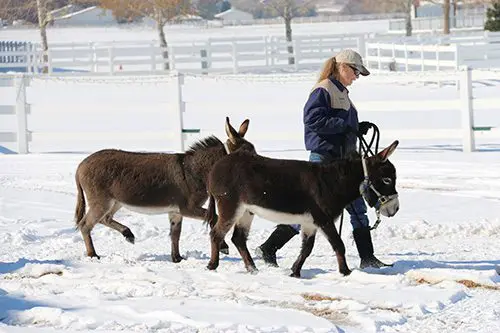
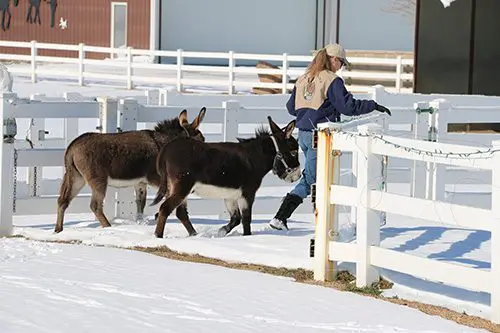
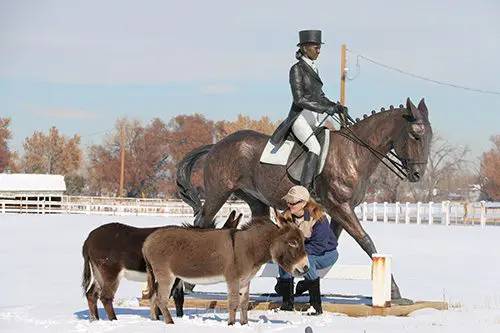

I decided to take them to the North Pasture this morning to play where the Lucky Three Sundowner bronze sculpture is situated. After going through the gate the way they were trained to do, I removed their halters and began our play session by asking them to come and see the statue. I was able to Get Down with my Minis by sitting on the base, then slid to my knees into the snow. Spuds scoped out the area while I “shook hands” with Augie. Spuds can be ornery, so he might have been saying to me, “Kiss my ass. I’m not shaking hands right now!” BUT…I just ignore the bad, or questionable, behaviors! At least he isn’t running off!
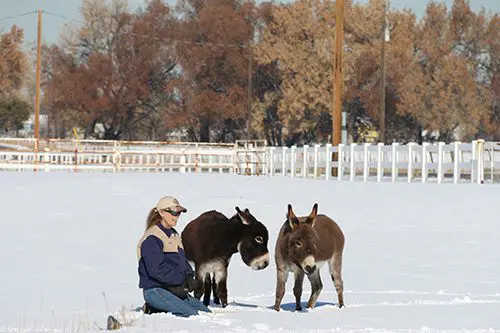
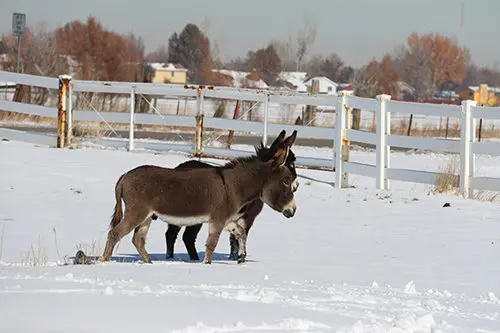
Next, I went to the middle of the pasture and dropped to my knees. Then I gave them permission to go exploring.
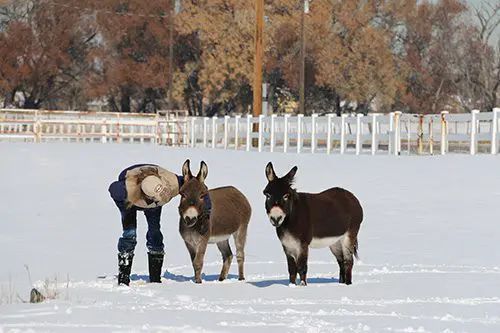
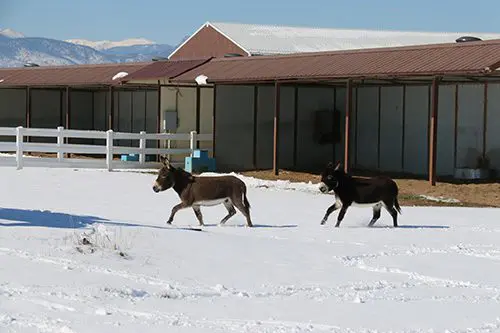
After scoping out what was on the other side of the road, they returned. I got up and quickly ran to the fence on the south side and called them to me. When they arrived, I “shook their hands” and gave them their reward of crimped oats. Although Spuds was a bit reluctant at first, he complied this time. Augie is ALWAYS willing to do what I ask!
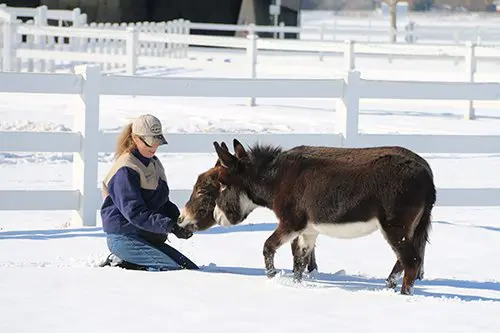
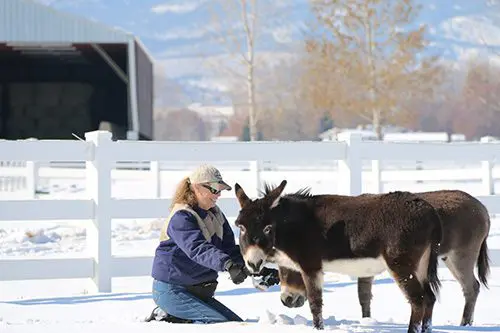
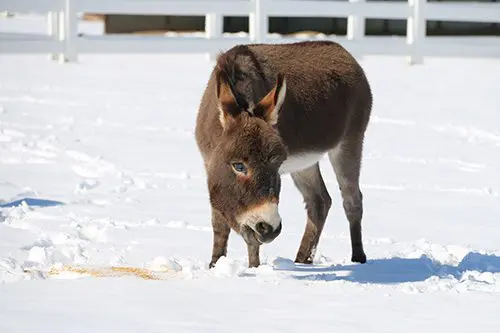
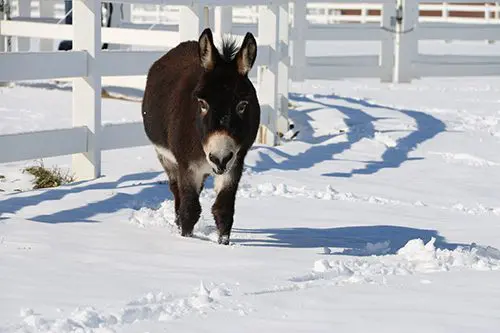
I allowed them to mosey around for a little longer. They thought the snow was pretty cool after that!
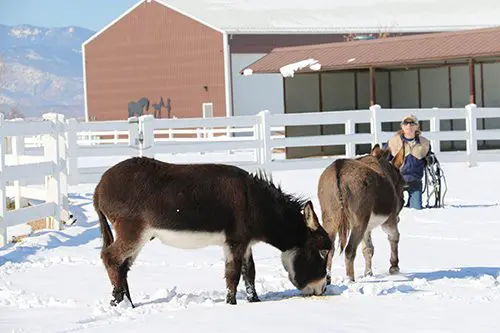
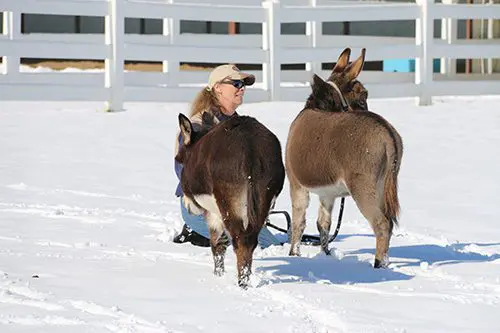
Then I dropped to my knees again near the gate, called them over and put on their halters. They were PERFECT!
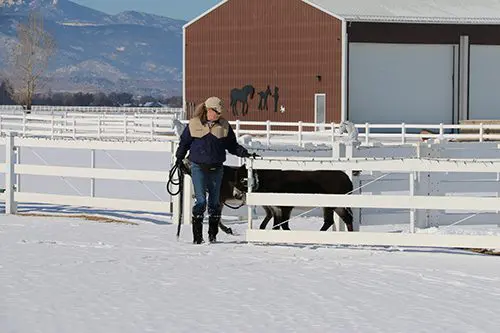
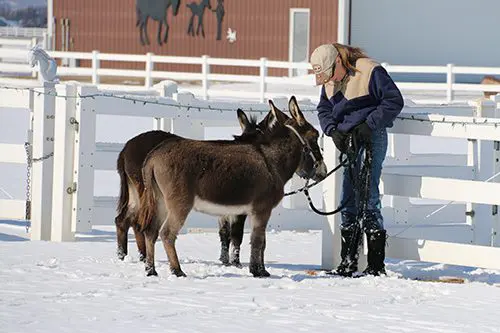
It was time to execute the gate properly again and head back to the barn…what fun on a sunny winter day!
To learn more about Meredith Hodges and her comprehensive all-breed equine training program, visit LuckyThreeRanch.com or call 1-800-816-7566. Check out her children’s website at JasperTheMule.com. Also, find Meredith on Facebook, YouTube and Twitter.
© 2016, 2017 Lucky Three Ranch, Inc. All Rights Reserved.

By Meredith Hodges
 Being asked to judge a show is both an honor and a tremendous responsibility. Just being asked to judge indicates that you have a reputation for being a knowledgeable and respected person in your field of expertise. Accepting the invitation to judge means that you are willing to share this knowledge and expertise with people who may, or may not, accept IT or you! Exhibitors can say that each show reflects only one “man’s” (judge’s) opinion, so not to worry if you don’t do well. As an exhibitor and a judge, this bothers me a little.
If the basics of Horsemanship, or Mulemanship, remain constant, then the consistency among judges should also remain fairly consistent with only a little variation from judge to judge. The variation in placements should be determined by the performance of t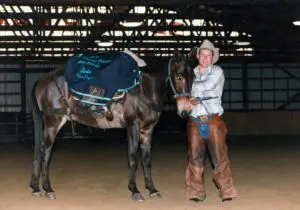 he exhibitors and not by the personal opinions of the judge. The judge should be a catalyst toward better learning and performance. He or she should try to make their knowledge readily available to inquiring exhibitors and be diplomatic enough about its delivery to inspire and encourage exhibitors to improve their skills. In turn, the exhibitors will be better equipped to exhibit their animals in a favorable light to the public at large and to grow into knowledgeable experts themselves with time and experience.
A good judge serves three major interests: that of his own conscience, that of his exhibitors, and that of the spectators. He must know all the rules and regulations pertaining to the classes to be judged and be willing to select the best animals for the purpose described by the conditions of the classes. He should be 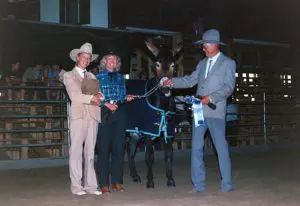 objective in his decisions and be able to back them up with reasonable and knowledgeable explanations that will inspire exhibitors to work harder and learn more. He should have a congenial attitude that invites exhibitors to question and learn freely without intimidation.
Judges are human too, and for this reason judges are restricted from judging people and animals that are in some manner closely related to him. This enables the judge to maintain his objectivity and adds more 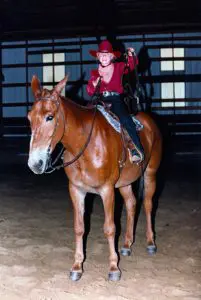 credence to his final decisions. In my opinion, judges should assist in helping exhibitors realize their full potential by helping them to improve their skills through fair, just, and educated decisions. A good judge needs to serve the idea of better learning for the sake of health, wealth, happiness, and above all, safety! A judge can be the catalyst toward learning and self-satisfaction, or he can be the catalyst toward defeat and discouragement. I prefer to be the former, encouraging exhibitors to come to me with their questions and also encouraging them to learn from each other. In our Longears industry, the ideal scenario would be to have exhibitors work at home and with each other perfecting their Mulemanship skills, bring those exhibitions of skills to a show to be judged, then return home with a feeling of accomplishment and more things to work on until the next show and the next judge. To perpetuate the learning process and to continue to learn and improve himself should be a judge’s main objective.
The Mule Skinner’s Classic held June 30-July 1 in Haines, Oregon, was a good example about what I am talking. Never before have I encountered an entire division of youth with such a thirst for knowledge and a desire for good sportsmanship, no doubt inspired by the adults. Application of good Mulemanship skills was prevalent and 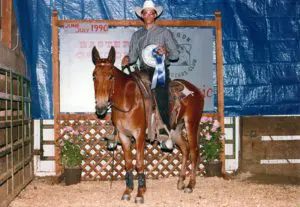 the mules and donkeys reflected this exceptional conditioning, care and handling. The show itself was obviously handled carefully and with attention to detail, leaving little margin for error or dispute. It is not really too surprising that a group such as this was able to elicit tremendous support from sponsors in their area. Their hard work and hospitality is to be appreciated and congratulated. It said a lot for the kind of people that we have in our industry – that we can all have a good time learning and showing together with our marvelous Longears, amateurs and professionals, exhibitors and judges alike! The whole idea is that each and every one of us has something to offer and something we can learn. To attend a show and to learn something new is to return home renewed and fulfilled, even though you haven’t won. To win without this mutual admiration, goodwill and learning is just another hollow victory!
There were no losers in Haines, only sixth, seventh, and eighth, etc. places! Those who weren’t doing as well as they had expected didn’t make excuses or try to assign undue blame. They realized that everyone has bad days and unforeseen disasters from time to time and it doesn’t mean you’re a lousy rider or trainer, or that you have a lousy Longears. Those who had mishaps or misfortunes were readily comforted by other friends and competitors. The ambiance of the entire weekend show was one of learning and camaraderie. If we can keep this perspective in our industry, perhaps we can avoid the politics that have nearly destroyed the horse industry and continue to enjoy the overwhelming potential of our longeared friends while improving our own skills and allowing ourselves personal growth.
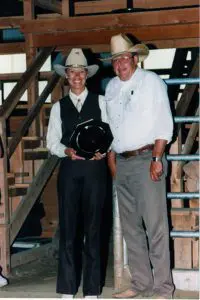 Everyone learned something at the Oregon Mr. Longears Mule Skinner Classic, including the judge! Dick and Debbie Cress and Alan and Elaine Case are to be heartily congratulated for their exceptional efforts in putting on a successful show and for taking wonderful care of this judge! Thank you to all of you who gave your time and efforts to work on the show and make it run as smoothly as it did! Thank you Larry and Fran Howe for coming with me from Colorado to help judge the packing classes and for helping to Ring Steward and to Gary Hodges for his fine photography! My deepest congratulations go to all the exhibitors for a superb effort. Keep up the good work! Thanks to our announcer Roger Harrison. And a very special congratulations to all of our Mule Skinner Classic Champions!
To learn more about Meredith Hodges and her comprehensive all-breed equine training program, visit LuckyThreeRanch.com, MEREDITH HODGES PUBLIC FIGURE Facebook page, or call 1-800-816-7566. Check out her children’s website at JasperTheMule.com. Also, find Meredith on Pinterest, Instagram, MeWe, YouTube and Twitter.
Covered in TRAINING MULES & DONKEY: A LOGICAL APPROACH TO TRAINING, TRAINING WITHOUT RESISTANCE, EQUUS REVISITED and A GUIDE TO RAISING & SHOWING MULES at www.luckythreeranchstore.com.
© 1990, 2016, 2024 Lucky Three Ranch, Inc. All Rights Reserved.
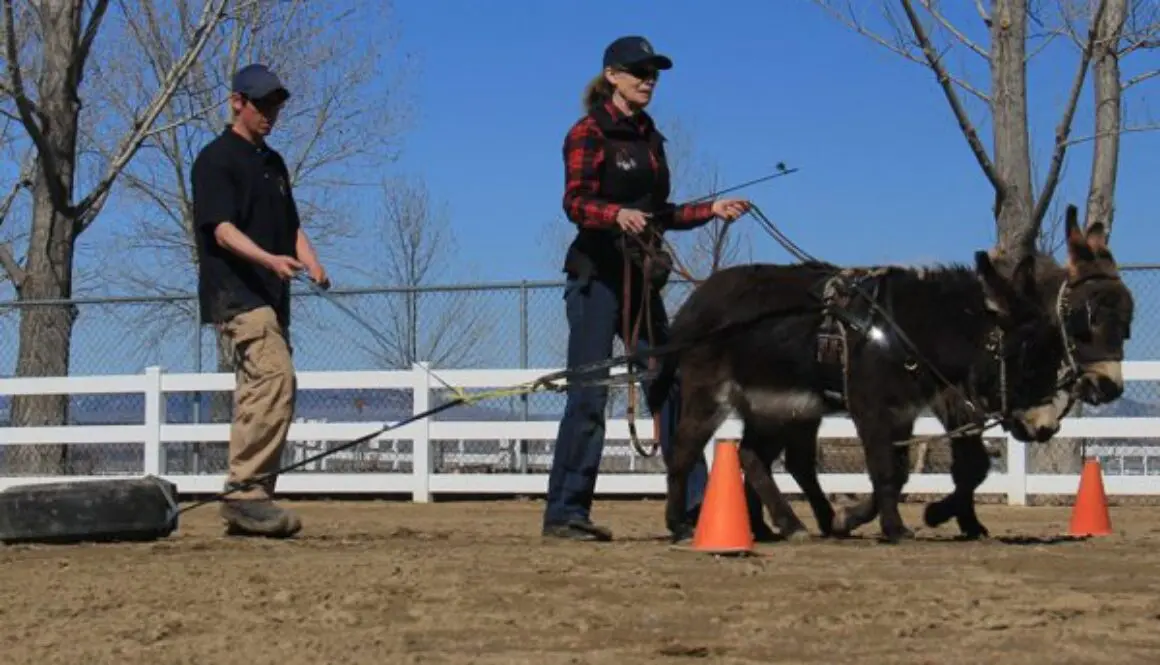


It was a perfect hot day for Wrangler’s yearly summer bath! We tried taking a “selfie” with a Canon camera and telephoto lens…not too bad for our first try!

He’s a real ham! He loves to smile for the camera and eat oats from the fanny pack.


Just tell him to and he perks his ears for the pictures! Wrangler is now an 11 year old gelding and softens my loss of Little Jack Horner in 2014!

Wrangler is so much like L.J.H. it’s crazy!


By Meredith Hodges
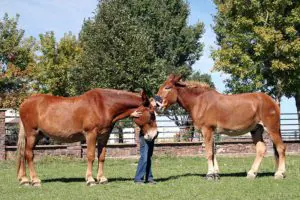 When I was growing up, my grandmother constantly reminded me of the importance of good manners. She would say, “You will never get anywhere of any consequence in this world without good manners!” And she would add, “Without good posture and proper dress, you won’t live long enough to enjoy it!” She made me read Emily Post’s Book of Etiquette from cover to cover. In retrospect, although reading the entire book was a real chore, the respect for good manners that she passed on to me has been an extremely valuable gem in my training experience with equines.
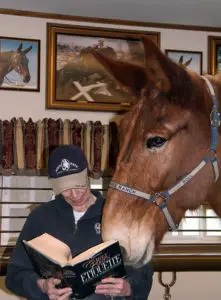 I think that the concept of combining equine training techniques with lessons in good manners is one that many people do not pay as much attention to these days as they probably should. Putting an equine in good posture with respect to his physical comfort is the most obvious form of good manners when communicating with your equine. When you apply the elements of good manners during the training process, you facilitate body and verbal language that equines really appreciate, and when you apply your own good manners and teach good manners to your equine from the very beginning of the training process, you can continue to move forward much more easily than if you do not incorporate good manners between you and your equine. When you run into resistance from your equine, take it as a red flag that you’re missing something in your communication with your animal and change your approach.
A common problem equine owners share is catching their equines. One of the elements of good manners that will help you in this task is being considerate toward your equine. When you are considerate about his need to have a routine that he can count on, he will quickly learn to look forward to seeing you at specific times during each day (at the very least, at feeding time in the morning and evening). His anticipation of your visit may appear to be only for the food value. However, when you interact with him at these times, what you say and do will lay the groundwork for your working relationship going forward, the next time you need to catch him, and during lessons. The food reward becomes less important to him over time.
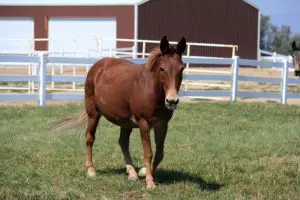 If your equine spends most of his time in the pasture, the good manners of promptness and reliability on your part are critical, as it is the only time you will have during the day to really spend time with him, and he’ll count on you to show up on time each day. What you’ll get out of being prompt at feeding times is a self-discipline that will carry over into everything that you do and will determine whether or not you are a reliable partner in the relationship with your equine. When you feed the oats mixture at night and none in the morning, it gives your equine a reason to come to you after breakfast when you offer oats to catch him, and gives him a reason to come back in off the pasture after being turned out for only a short time in the spring when pasture time needs to be limited. Doing something when it is convenient rather than considering the equine’s need for reliability in the trainer is a recipe for chaos and causes anxiety in both the equine and the trainer. However, having a predictable structure to your routine will allow both you and your equine to remain calm and clear in your communication with each other.
 If you want your equine to come to you, rather than chasing him, simply stand at the gate or doorway and ask him to come to you, offering the oats reward when he does. If you are kind, patient and consistent, he will most likely always oblige you.
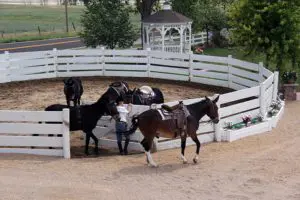
Put on the halter politely, being careful not to make any abrupt moves and always being protective of his ears. Before you exit the pen or stall, give him a reward of oats for standing still and waiting for you to finish putting on the halter. Then give him another mouthful, which will keep him busy so you can exit the pen before he does. This teaches him to always stop and wait for your invitation to exit any area. Now he is learning the good manners of allowing you to go through any gates first, and the chances of his becoming a bully will be greatly lessened. When you have multiple animals in a pen and want only one at a time through the gate, just be sure to reward 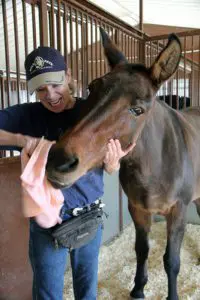 the others for standing back after you have rewarded the one you want for allowing you to halter him. This will also avoid anxiety in the one you are haltering, because he knows you will protect him and wave back the others who might otherwise crowd him or kick at him. The ones you wave back will learn that if they comply, a reward is coming.
During grooming, be polite and considerate about how you touch your animal over every part of his body. Pay special attention to sensitive areas (which is a part of imprinting), how you use your grooming tools regarding pressure over bones and around sensitive areas, and how much disciplinary pressure can be applied if your equine becomes agitated and uncooperative. This is the way to sensitize him to communicate with his trainer. When you are polite and considerate, your animal will learn to trust you and be curious rather than afraid of what is going to happen next. If he paws and shows anxious behavior, ask him to stand still only when you are directly working on him, and then allow him expression of his anxiety in between times. If you pay attention to these negative behaviors, they will only escalate, but when you don’t react to the anxious behaviors he may show at times, the behaviors will eventually subside with age and maturity.
Don’t expect to be able to control your equine’s vocal expressions. Allow him his vocal expression and feel free to engage in the “discussion” he is initiating. Eventually, his vocal expressions will become predictable (upon your approach, answering your responses, at feeding time, etc.) because you acknowledge his polite vocal requests for attention.
 Being in good posture feels good to all of us and allows all the organs in the body to work correctly. When one is comfortable and amply prepared for physical activity, it is always more enjoyable. This is no different for equines. When you don’t consistently pay attention to your own good posture, neither will your equine pay attention to his. His movements will tend to be difficult and unpleasant, and the relationship between the two of you may begin to erode. But when your equine is encouraged to be in good posture during training, it feels good to him and, over time, will become his normal way of moving and resting. He will also be grateful for your kindness and consideration, and he will look forward to the activities he gets to do and the time he spends with you. When you pay attention to your own good posture right from the beginning of leading training and every time you work with your equine, he will be able to mirror your good posture. The result will be his own good posture, which will result in more comfort for him.
Being in good posture is not a natural thing for anyone—humans or equines—it must be consciously learned. So through self-discipline, you as the trainer, become the role model for the equine. When you work together like this, you both learn to be in good posture. However, if you are not in good posture, then it will adversely affect both of you, and your equine will be unable to find his own good posture, which will in turn, negatively affect his performance. In order for training to go forward smoothly from one step to the next, both you and your equine need to learn how to walk in good posture.
 There will be times when it is necessary to employ negative reinforcement to stop bad behaviors that can escalate and become truly dangerous behaviors before they become persistent and uncontrollable. These corrections, which are covered in DVD #2 of my Training Mules and Donkeys series, are the equivalent of a firm and definite “No!” and help define the boundaries of your relationship with your equine. When boundaries are not clearly set, the result is disrespect from your animal, but when boundaries are clearly set and are consistently maintained right from the start, the incidence of bad behavior from your equine is greatly reduced.
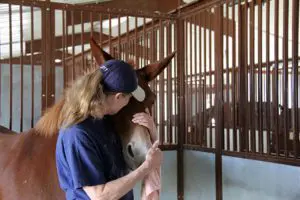
It is critical for your equine to break things down into very do-able steps for which he can be rewarded. For the best and safest results in this kind of equine training and management, it is vitally important that you use good manners yourself to teach your equine good manners, and employ both good manners and good posture throughout your entire relationship with your equine. If you always practice good manners when communicating with your equine, you might even get a “Head Hug!”
To learn more about Meredith Hodges and her comprehensive all-breed equine training program, visit LuckyThreeRanch.com, MEREDITH HODGES PUBLIC FIGURE Facebook page, or call 1-800-816-7566. Check out her children’s website at JasperTheMule.com. Also, find Meredith on Pinterest, Instagram, MeWe, YouTube and Twitter.
Covered in TRAINING MULES & DONKEY: A LOGICAL APPROACH TO TRAINING, TRAINING WITHOUT RESISTANCE, EQUUS REVISITED and A GUIDE TO RAISING & SHOWING MULES at www.luckythreeranchstore.com.
© 2013, 2015, 2016, 2024 Lucky Three Ranch, Inc. All Rights Reserved.

February 11, 2019
Unfortunately, after eight years together, Roll passed quietly from a mild colic and weakness in his hind quarters on February 11, 2019 at the age of 27 years. I rescued Rock and Roll from slaughter in December of 2010. We lost Rock in December of 2011 with a completely shattered hip joint after being rendered sound at the walk with no medications for a whole year. With ring bone and side bones in three hooves, I continued working with Roll and we met our goal of being sound enough to ride around the hay field for several years.
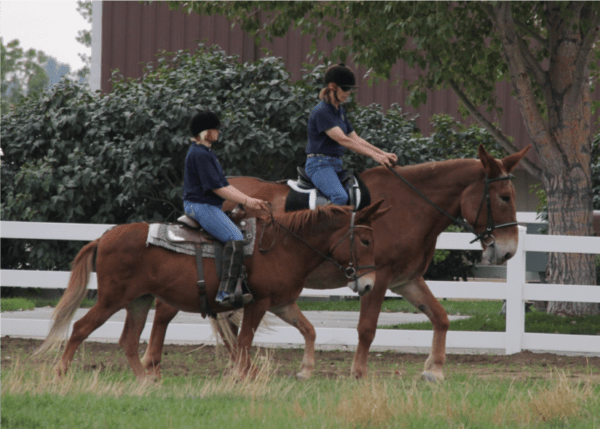
Roll survived a severe bout with White Line Disease in 2016. We had to resect 2/3 of his hoof wall and it only because of his good posture and core strength that he was able to “balance” his way through his treatments which changed weekly. It took eight months, but his left hind foot finally grew back completely (see 2016 posts).


…and afterwards, he was able to be ridden once again.

Roll began his time with me as a suspicious and spooky guy, but he studied his manners, his training lessons and we became the very best of friends. Since most drafts don’t live past 20, I feel blessed to have had him for as long as I did! Just before he died on February 11, 2019 (his hind legs were finally too weak for him to get up after his morning nap), he reached his nose from the ground to my cheek and gave me one of his soulful nuzzle kisses…a sincere thank you for a life well lived! He has crossed the Rainbow Bridge and joined his mate, Rock, that we both loved and missed so much! In my heart, I know we will eventually be together again.


By Meredith Hodges
To wear the breeches, or not to wear the breeches—that is the question. The Western training influence has been prevalent in our mule industry growth here in the United States, while other countries seem to vary with respect to their historical growth. Countries with an older equine history seem to prefer the English style of training, while newer frontiers have adopted the Western style of training out of necessity. The Western classes in breed shows reflect the varied uses of mules and horses which evolved as this country developed, and the bridles and saddles used were built out of practicality and need in a rough country atmosphere.
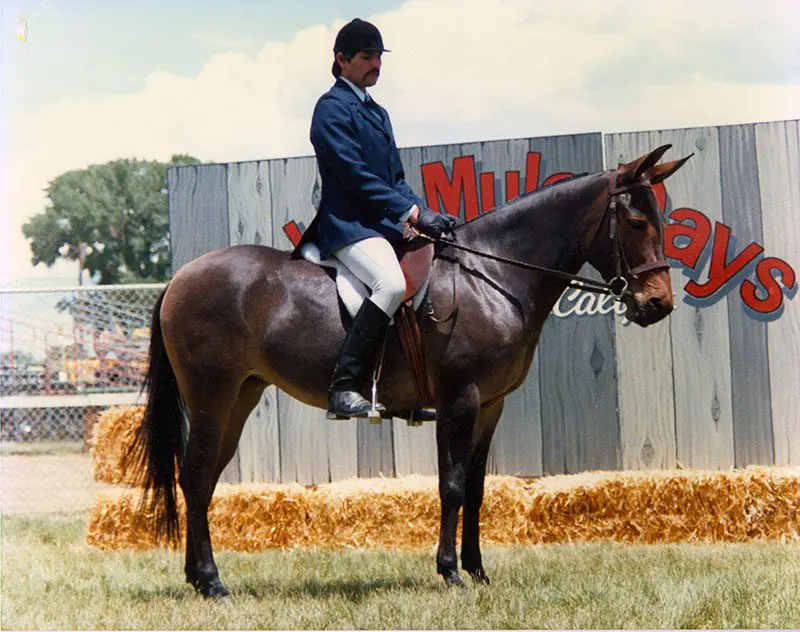 Today, we have more time to spend training our equines and cultivating our own riding skills. In most cases, the choice of tack is no longer of necessity, but of choice. Fashion, in any country, is supposed to be a statement of individuality and identity. The Western style of dress and tack suggests a hearty, rugged individual, surrounded by wide open spaces, using his equine as a partner for work. English attire paints a picture of dignity, reserve and concentrated skill. The Western image is a wonderfully romantic and picturesque way of seeing oneself, but it really doesn’t allow us the opportunity to improve our equestrian skills to the maximum. Western style riding is as limited as its uses. The smaller English saddle, made with a lot less leather, allows us to feel our equine’s body more closely (with the added stability of the stirrups) while we learn and exercise our bodies to become more harmonious with our mounts. As we can feel our equine more closely, so can he feel better the cues that we to give him. Thus, he can respond more accurately to our commands. However, most men don’t feel comfortable wearing “Sissy Pants” and riding in a “Sissy Saddle”—it just isn’t macho!
As most of you already know, Sally McLean and I got mules accepted by the United States Dressage Federation in 1986. It was a great day for mules, but it was also, almost my husband’s undoing! After a year of training our mules under English saddle in Dressage, we found them to be a lot more responsive and easier to train than they had been in the past. In addition, they were conditioned to perform well in both English and Western classes which only enhanced their versatility. With this obvious success, we decided to train exclusively under English tack. My husband, Gary admitted to this success, but let me know, in no uncertain terms, that he preferred to ride Western and that was all that he wanted to do! After all, everybody has their own preference. My only question was, had he given English a fair enough try before making his decision of preference? Since he had never ridden English, the answer was obvious. My daughter, Dena and I felt that he should at least give it a try!
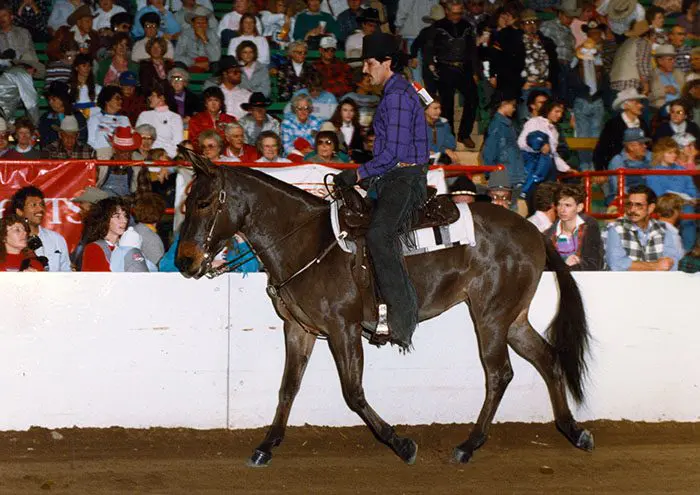 One Saturday morning, I finished a lesson with one of my students when Gary strolled into the indoor arena and announced that he was willing to give the English saddle a try, but that we would never get him into a pair of those “Sissy Pants!” “Fair enough,” I said, and brought my student’s horse around for him to ride. Getting on was a bit of a struggle, and exercises at the walk went really well, but as soon as the horse began to trot, Gary started bouncing. He was about to lose his balance, so he grabbed the rail to steady himself. The only problem was the rail stayed where it was and the horse kept going, leaving Gary dangling behind on the fence! I thought we would never stop laughing – he looked so ridiculous! Our macho man didn’t have the balance he thought he had!
Gary decided not to give up on the first try and took English lessons at our clinics for the next few months, but continued to train his feisty half-Arabian mule, Lucky Three Cyclone, with the Western saddle. About 10 shows and 35 runaways later, he thought his balance to be good enough to try Cyclone under English tack. Within a couple of months, Cyclone was actually going where Gary wanted most of the time. This was an exciting breakthrough for Gary since Cyclone was the first mule Gary had ever trained by himself. Originally, he had wanted to train him for Western Pleasure and Reining, but he couldn’t get Cyclone to complete a circle without dodging or running off. Mules were supposed to be fun, but this was rapidly becoming an unpleasant chore. Gary asked me what he could do to make the training sessions with Cyclone more fun and rewarding. I suggested that he start with some elementary cavalletti and jumping exercises to add more variety to their routine. A couple of sessions later, they were a different pair. Cyclone became much more manageable and actually seemed to enjoy his sessions. Gary, too… except… after every session he got this weird look on his face… sort of pained, yet happy. When I asked what the problem was, he said English riding was great and Cyclone was improving rapidly, but it made him very sore!
On Gary’s birthday, two weeks before his first English classes at the Colorado Classic in 1988, I decided to take him to the tack store to be outfitted in proper English attire. I didn’t tell him where we were going because I knew how he would react. I just told him we were going to get his present. When we pulled into the tack store he said, “Is this the only place we’re going for my birthday?” So as not to alarm him too much, I told him we would go to the computer store afterwards.
After 45 minutes of coaxing from the dressing room to see how the pants fit, 25 minutes of explanations about why they needed to be tight and another 15 minutes of getting him out of a pair of English boots that were too small, Gary looked the picture of the English equestrian: tall, dark and very handsome in his new sporty attire! And in the next two weeks, he discovered the intrinsic value of his “Sissy pants”—you don’t get sore when you ride! Granted, you may have to take a little flack from a few ignorant cowboys, but the equestrian skills gained and the fun that goes with it far outweighs any adversity.
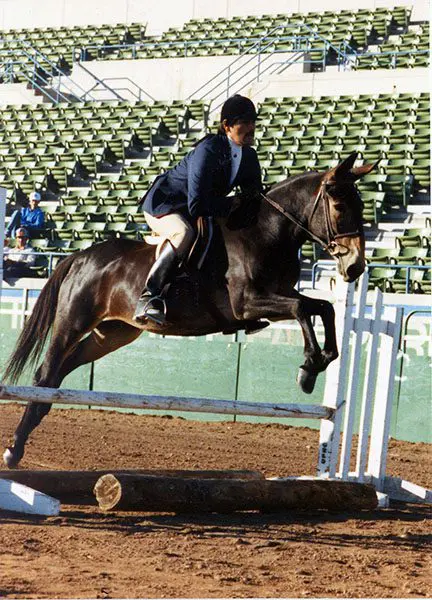 After a while Gary decided that English riding was, in fact, the best way to train. However, he still wasn’t too interested in “watching cement set” or doing Dressage tests. We decided after two years to start showing in Combined Training with the horses. We signed up for the second day of a two-phase show, not realizing that we would be asked to ride our Dressage tests the same day that we jumped. Two days before the show, Gary discovered that he would have to ride Training Level Test 1 at 9:00 A.M. the day of the show. We reviewed the test the day before the show, thinking that if all else failed I could read the test to him when he rode. Sunday morning, Gary was feeling tired, but confident. I took my place at “B” and prepared to read for him when the announcer explained that only United States Dressage Federation tests could have a reader, but not the same in Combined Training. Gary’s face turned ashen. I climbed back into the stands as he warmed up for his test… at the walk… lost in space! He stopped short below me and quietly said, “Meredith, will you please come here.” I ran down to see what the trouble was. “I can’t remember anything… I can’t do this!” he worried emphatically. I quickly explained the pattern. Gary’s first Dressage test ever in his first Combined Training show and he emerged in third place with a mule in the Elementary Division against 8 horses. Was he ever thrilled!
As my husband gazed into the adoring eyes of his numerous fans, I doubt that he felt less than “On Top of the World!” in his controversial “Sissy Pants.” A flood of compliments on his animal, his equitation and his turnout fell upon his ears, making him swell with pride and self-satisfaction. With a wink of his eye, Gary turned his mule around and walked proudly back to the trailer after the show, feeling very much a tall, dark and handsome macho man!
To learn more about Meredith Hodges and her comprehensive all-breed equine training program, visit LuckyThreeRanch.com, MEREDITH HODGES PUBLIC FIGURE Facebook page, or call 1-800-816-7566. Check out her children’s website at JasperTheMule.com. Also, find Meredith on Pinterest, Instagram, MeWe, YouTube and Twitter.
Covered in TRAINING MULES & DONKEY: A LOGICAL APPROACH TO TRAINING, TRAINING WITHOUT RESISTANCE, EQUUS REVISITED and A GUIDE TO RAISING & SHOWING MULES at www.luckythreeranchstore.com.
© 1990, 2016, 2024 Lucky Three Ranch, Inc. All Rights Reserved.

10-25-18
Roll had a good massage today! He seems to really enjoy the new Equisport massager. You can always tell when your equine enjoys his massage because he will “talk” to you along the way. Notice how Roll is pushing his hip into the massager in the first photo? That means, “Feels so good… go deeper!”

His left hind is often a bit sore from his twisting in the right hind, so he isn’t too sure about it at first, but the right hip is a different story and he relaxes. He even slid his hind leg slightly forward to allow Joanne to massage deeper.

It seemed that the left shoulder is a bit sore and he gives her a stern look of “Be careful now.”

Joanne spoke back to Roll with “I hear you! So we’ll go to the other side and move on to something else.” Roll responded with, “Oh, yes, this is a better spot!” as he relaxed his hind foot and leaned into the massager again.

Roll rounded his neck to look back to her and said, “Are you wearing a fanny pack full of oats today?”

Joanne responded with, “Nope, sorry! How about an eyeball massage?”

Roll leaned into the massager and went to town pushing his eye into the massager while Joanne just held it steady. He was in seventh heaven!


When it came to his ears, Roll went into a trance and enjoyed every minute of his full face massage!


Then she went across his back and over his rear end to finish. Roll looked at her as if to say, “Thanks for a GREAT massage…feels soooo good!”

After Rock’s death in 2011, Roll spent the last 7 years in turnout alone with only his two mini donkey friends, Spuds and Augie, across the fence from him.

The best part of the weekend following his massage was that 26-year-old Roll finally got a friend in turnout! Billy Bad Ass (age 25) came to us a month ago. We thought the two gelding boys would enjoy each other as they are pretty close in age and it proved to be true!
Roll was truly happy to have a brand new buddy!

three
