Meredith Hodges

MULE CROSSING: Mule Conformation
By Meredith Hodges
As in any breeding program, when breeding jacks to mares to obtain mules, there are many variables to be taken into consideration that are basic and pertain to both the jack and the mare. However, there are some variables that are particular to each.
 The ideal mule should have a head that is slightly longer than that of a horse, but proportionate to the size of the mule’s body. The features should be prominent and give an overall pleasant appearance. The ears should have length and be nicely shaped, and the eyes should be large, soft and kind, reflecting the mule’s health and intelligence. The forehead should be broad, tapering to a small and delicate muzzle, with a shallow mouth and well-aligned teeth, and the nostrils should be wide to allow for adequate respiration while working. Both the mare and the jack are responsible for the shaping of these characteristics, but the jack has primary responsibility where the length of the ear and the mass of bone are concerned. A jack with a longer ear will, more often than not, throw a longer ear to the mule, while the shape of the ear is determined primarily by the mare. The attractive or unattractive head of the jack can emerge in the resulting mule, so be sure to carefully consider the head on the jack to be used for breeding to produce an attractive head on your mule offspring. Standard-sized jacks and Large Standard jacks most often have a more refined head, while the head of a Mammoth jack may be less refined and possess
  thicker bone, particularly around the eyes and jaw line. In the case of saddle mule production, massive bone on an otherwise attractive head can be very unattractive, so using the smaller jacks would be better for a more refined look in your saddle mule (which is also true for the rest of the mule’s body).
The neck of the mule should have good length and come well back over the shoulders to the withers, with neither an excessive arch nor a u-shape. The withers should be apparent, but will not be as prominent as that of a horse. Many jacks have a characteristically short, thick neck. If it is passed on to the mule, this shortened and thick neck may inhibit the suppleness and agility of the resulting mule. Since donkeys tend to be rather flat over the withers, a mare with good wither development is also recommended to offset the tendency for this trait in the mule. It’s hard to keep a saddle on a mule with little or no withers, despite the use of cruppers and breeching.


The back of the mule should be slightly shorter than that of a horse and nearly straight with only a gentle slope over the top line and with strength over the loins. The croup should be nicely rounded with smooth muscling (indicative of strength and staying power), with the tail set-in neither too high nor too low. Again, the jack/mare combination must be considered in order to obtain a desirable saddle mule. Both the mare and the jack should have good body length to avoid a “boxy” appearance in the mule.
 The shoulders of the mule should be at a nearly 45-degree angle, with a broad collar surface. Most mares will have this angle, but donkeys have a tendency toward short, steep shoulders, so, to insure that the mule has good shoulders and hips, consider a jack with good length and a lower angle through the shoulders and hips.
The curved ribs of the mule should be well sprung and separated around the torso, and extended (not flat and narrow), and should range close to the hipbone. The flank should be well set down from the croup and just above the stifle with a nearly flat appearance (not as indented as that of a horse). The hip, stifle, and gaskin should all have a smooth-muscled look, not bulging, as seen in many horses. The more bulky-muscled mare is generally crossed with the smooth-muscled jack to create a more bulky, yet smooth musculature in the mule than that of the jack. The contribution of bulk muscling from the mare provides more stability to the inherent smooth muscles from the jack and will enhance athletic performance in your mule athlete.
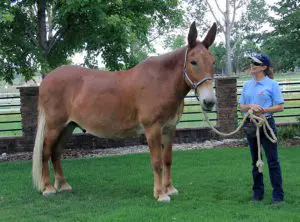 The chest of the mule should be deep and prominent, broad and well developed (it should resemble a turkey’s breast), with little or no line of separation (as is seen in a horse’s chest). Since jacks are generally narrower through the chest than are mares, the mare chosen for breeding should exhibit much width and depth through the chest to compensate for the lack of it in the jack.
The legs of the mule (as with horses) should be nearly straight, broad and clean, with adequate bone density for the size of the mule. The legs should be well braced at all four quarters and properly balanced underneath the mule’s body. The knee should be broad, deep and firmly set and the hock should be broad and muscular. Being slightly “cow hocked” in the rear quarters (with the toes pointed slightly outward) is common in mules and is actually preferred for performance (though not when showing at halter), but pay special attention to the straightness of legs in both the jack and the mare because being extremely “cow hocked” is not acceptable and should be minimized through careful breeding practices.
 If a stockier mule is desired (as in the case of breeding for pack or draft mules), a stockier mare bred to a Mammoth jack will produce the desired thickness of bone in the legs of the mule. If a more refined Thoroughbred appearance is desired, the mare should be bred to a Standard or Large Standard jack in order to reduce the mass of the bone in the legs of the mule and retain refinement throughout the body. This does not affect the height of the mule, as the mare is primarily responsible for the mule’s height, while the jack is primarily responsible for the mule’s bone thickness. The forearm and stifle in the mule should be well developed and thickly covered with smooth muscle that tapers to the knee and hock in regular, well-defined lines. Again, these muscles should be thick and smooth, but not bulging, as in horses. The mare will compensate for the limited bulk muscling in the donkey jack, and the jack will contribute and maintain the smoothness of that additional bulk muscle in the mule.
The old saying, “No Foot, no mule” is literally true, as it is in any nomadic animal. If the hooves are not trimmed and balanced properly, it will offset the balance of the equine’s entire body and can compromise longevity in the animal, because his entire internal structure will be compromised. The hooves of the mule will be smaller and more upright than that of a horse of equal size, and should be well sprung and supported, not contracted. They should have a smooth appearance and look sleek and oily. No ribbing should be apparent and the frog should be well extended, healthy and make adequate contact with the ground for good circulation to the hooves. When being trimmed, the mule should be left with more heel than the horse to maintain the more upright position that complements the shoulders and hips. The shape and condition of the hooves of the jack and the mare are both equally important when considering foot development in the mule.
 The coat and hair of the mule should be soft and shiny, covering pliable skin. The coat should be soft to the touch, denoting good skin health. Length and thickness of the coat are contributed by both jack and mare. Since donkeys have a typically thick coat of hair, a mare with a thinner coat will balance this thick hair coat in the mule, making him look sleeker and more horse-like than his donkey sire.
Although the jack plays a part in the mule’s way of going, the mare plays a larger part in the animation of the mule’s gaits. Mules out of gaited mares will generally exhibit the mare’s way of going and will also be gaited.
Probably the most important trait of the mule is his disposition. This characteristic comes primarily from the mare. Much of the mule’s attitude is formed during his first days with his dam, at which time he will observe and then assume her behavior patterns. Although much of a mule’s attitude development is environmental, there is still an inherent general disposition, so avoid breeding to mares with a negative or sour disposition, as those traits will most likely be passed on to her mule offspring.
Keeping all of these considerations and guidelines in mind when breeding for mules can definitely increase your chances of producing an attractive, usable, and enjoyable equine companion.
To learn more about Meredith Hodges and her comprehensive all-breed equine training program, visit LuckyThreeRanch.com, MEREDITH HODGES PUBLIC FIGURE Facebook page, or call 1-800-816-7566. Check out her children’s website at JasperTheMule.com. Also, find Meredith on Pinterest, Instagram, MeWe, YouTube and Twitter.
Covered in TRAINING MULES & DONKEY: A LOGICAL APPROACH TO TRAINING, TRAINING WITHOUT RESISTANCE and EQUUS REVISITED at www.luckythreeranchstore.com.
© 1986, 2016, 2018, 2024 Lucky Three Ranch, Inc. All Rights Reserved.

MULE CROSSING: Handling Your Mule’s Ears
By Meredith Hodges
Just how sensitive is a mule about having his ears touched? If a mule is handled often and properly, he should be no more sensitive about his ears than he is about any other part of his body. However, if he is rarely handled, mishandled or handled roughly, he can become quite sensitive about any part of his body and in particular, his ears. Bearing this in mind, take the time to desensitize your mule to touch and handling by paying attention to how he likes to be touched in any given area, and then by being polite about handling those more sensitive areas. This is an important part of any training program, both for general management and for safety purposes. This is the heart of imprinting.
The mule that has an aversion to having his ears handled poses a problem with management convenience, but more than that, he can be a safety hazard in many situations. Here are some examples of lack of desensitization causing inconvenience and possibly, a dangerous situation. Inconvenient: Your mule does not want his ears touched, so you have to disassemble his bridle each time you put it on him. Dangerous: Should you accidentally touch his ears while putting the bridle on him, he could possibly thrash his head around and knock you silly! Inconvenient: If you get into a difficult spot on a trail where you have to dismount and move quickly, you may be unable to take the reins over your mule’s head in order to safely lead him. Dangerous: While you try to get the reins over his head without touching his ears, your mule could inadvertently knock you down or lose his balance and fall down while trying to avoid you. The moral is this: If your mule is to be a completely safe riding animal, he must be appropriately desensitized all over his head and body—including his ears—and trust that you will not harm him.
 Desensitization should be humane and considerate—never abusive. When we say we want to desensitize an animal, it simply means that we want him to become accustomed to touch and handling all over his body, particularly in areas such as his head, legs and rear quarters, where he is apt to be the most sensitive. An animal that has not been politely desensitized will tend to react more violently to touch. When properly teaching your mule to become desensitized, your touch should be presented in a pleasurable way, so that your mule not only learns to tolerate it, but to actually enjoy it and look forward to it. An old-time method such as “sacking out” is a somewhat crude technique that is used to desensitize an animal by tying the mule in a corner where he cannot flee, and then flinging a tarp or large canvas all over his body, including the head. Often times, it creates more problems than it can solve because it is rarely done politely. A mule that has been “sacked” about the head can actually become more sensitive because this inconsiderate approach teaches him that humans cannot be trusted. He perceives that they will fling things over his head, blinding him and causing him anxiety for no apparent reason. The mule will stand still only because he cannot move, but if he is given the opportunity to flee or fight back, he will more than likely do so. Thus, the old “obstinate mule” myths are actually most often the result of some fault of the trainer, and not the mule. Sacking out more politely will eliminate these kinds of potential bad habits.
Desensitizing a mule that is sensitive about his ears is a long-term process. First, you must maintain a firm, quiet and tolerant attitude. Nothing your mule does should make you angry enough to lose your temper or your patience. Make sure your mule is tacked with a stout, non-breakable halter and rope. While stroking his nose in a polite and soothing manner, ask your mule to come forward, one step at a time, to a stout hitch rail. If he won’t come easily, just snub your lead on the hitch rail so he cannot go backwards, and keep coaxing him forward until he comes. Take up the slack with each step and then hold until he takes another step forward toward the hitch rail. Wait as long as it takes for him to gain confidence enough to come forward. Do not get into a pulling or pushing match with him—you will only create resistance in him and perpetuate avoidance behaviors—and he will win because he is stronger and he weighs more!
 When his nose is finally up to the rail, run your lead around the post and come through the noseband on his halter and around the post again. Then tie him off snugly, so that his nose is tied as closely as possible to the hitch rail, making sure there is no slack. Now begin softly stroking your mule’s nose, using gentle yet firm strokes. Next, work your way up his forehead, and finally toward his ears. NOTE: Remember to use soft, gentle yet firm strokes, going with the grain of the hair and never against it. Do not “pat” your mule—it’s too threatening.
Let the tips of your fingers find the base of your mule’s ear (away from the open side) and stroke upward, toward the tip. At this point, he will probably thrash his head back and forth to avoid your touch—just remain slow, deliberate, reassuring and gentle about your approach. When he has allowed you to stroke the ear, even if for only a couple of seconds, leave your hand resting on the ear and use your free hand to feed him an oats reward. Don’t take your hand away from the ear until he is chewing calmly and no longer worried about your hand on his ear. Do this with each ear no more than one or two times each session and then go to his shoulder and work your hand in a massaging fashion over his neck, toward his ears. While your thumb cradles an ear, let your fingers move over his poll. With your thumb, gently stroke upward on the back of his ear, while leaving the rest of your hand over his poll. If he jerks away, just keep going back to the same position of thumb cradling the ear and fingers moving over the poll.
 When he will tolerate this, you can then cradle the ear in your fingers and with your thumb, begin to gently rub upward on the inside of the edge of his ear. Do not go too deep into the ear at first. After he is calm with this, you can begin rubbing downward into the ear with your fingers, while cradling the ear in your opposite hand, being very careful not to go too deep. Watch his eyes and allow him to “tell” you how deep to go. If it feels good, his eyebrows will raise and flicker. If he doesn’t like it, he will simply jerk his head away and that is your cue to lighten up. Most mules love to have the insides of their ears rubbed, so find the areas inside your mule’s ear that actually give him pleasure. Each individual mule will be different.
 In the next step, you will be in the same position, but you will close your hand around your mule’s ear and hold it with just enough pressure that he cannot jerk your hand loose. Do not hold too tight, grab or pull the ear—just maintain a quiet, gentle hold on the ear and go with his movement. If he pulls away, just slightly tighten your grip on the ear until he stops pulling and then lighten your grip again. Tighten only when he pulls away, and then immediately release when he stops resisting—tighten and loosen your grip as needed, and be sure to follow his movement. He will soon learn that if he doesn’t fight it, there is no discomfort. Never tightly grip his ear and do not tighten your grip any more than you need to in order to hold onto the ear—you never want to induce pain. Once your mule is tolerant of you holding his ear in this fashion, you can introduce the clippers, should you desire, using the same guidelines of tightening gently yet firmly when he pulls and releasing when he submits. However, introduce the clippers only after he has completely accepted you holding his ears.

Introduce the bridle by holding your right hand flat on the poll between your mule’s ears, and by using your left hand to raise the crown piece over his nose and up to his forehead. Slide your right hand down his forehead a little to meet your left hand. When your hands meet, transfer the crown piece into your right hand, insert the bit with your left hand, and then raise the crown piece up to the base of his ears. Slowly transfer the crown strap back to your left hand. Gently cup the fingers of your right hand around the base of his right ear. Now bend the ear forward and under the crown piece and slide it over your hand (and the ear) into its position behind the ear. While keeping your palm firmly on your mule’s poll, slowly move to the left ear and repeat the same movements.
The bridle should now be in place and you can reward your mule. Do not put on and remove the bridle any more than once per session. Your mule needs to clearly know that this is not just some annoying past time you have discovered, but an act of necessity. He will soon learn that if he cooperates, it won’t take too long. Once the bridle is on, get right to the business at hand and forget the ears for a while.
 When you return with the difficult mule, tie him as before, stand directly in front of him (with the hitch rail between you) and gently remove the bridle with both hands lifting and sliding the crown piece over both of his ears simultaneously, so there is little pressure on his ears as it slides over them. If he still holds the bit in his mouth, hesitate for a minute when the bridle is off his ears and allow HIM to drop the bit. Removing the bridle this way will help to avoid chafing the ears and will avoid the bit hitting his teeth before you remove the bridle the rest of the way. Always removing the bridle in this fashion will encourage him to drop his head and will prevent bad habits such as pulling away or flinging his head.
 When your mule gets used to having his ears handled and being bridled while snubbed and haltered, you can then begin dropping the halter and loosely tying him while he is being bridled. Sometimes it takes a couple of weeks before you can drop the halter—this will vary depending on the individual mule, so just be patient. Your quiet, gentle perseverance will eventually win out and your mule’s ears will be desensitized and quite manageable. After you have mastered his outer ear and inner ear, you may find that your mule actually enjoys having his inner ear stroked or scratched, and bridling becomes easy. Integrating washing his face and cleaning his nostrils and ears during the grooming process should further help him to accept having his ears handled. Handling your mule’s ears can actually become a truly pleasurable experience for your Longears.
To learn more about Meredith Hodges and her comprehensive all-breed equine training program, visit LuckyThreeRanch.com, MEREDITH HODGES PUBLIC FIGURE Facebook page, or call 1-800-816-7566. Check out her children’s website at JasperTheMule.com. Also, find Meredith on Pinterest, Instagram, MeWe, YouTube and Twitter.
Covered in TRAINING MULES & DONKEY: A LOGICAL APPROACH TO TRAINING, TRAINING WITHOUT RESISTANCE, EQUUS REVISITED and A GUIDE TO RAISING & SHOWING MULES at www.luckythreeranchstore.com.
© 1992, 2003, 2012, 2016, 2024 Lucky Three Ranch, Inc. All Rights Reserved.


CHASITY’S CHALLENGES: After the Winter Break: 3-29-21
Due to the colder and more inclement weather here in Colorado, Chasity has been off her exercise program for about three months. It was time to get back to work! No matter how long it has been between lessons, when you have a specific routine, the equines seem to comply easily because they know what to expect, beginning with going to their regular work station to be groomed and tacked up. In order to keep upper respiratory disease at bay, eye infections and ear problems to a minimum, it is advisable to clean these areas with a damp towel regularly. Be polite and wipe the towel in the direction that the hair lays and clean the nostrils with a circular motion. This repetition will prevent them from getting head shy.

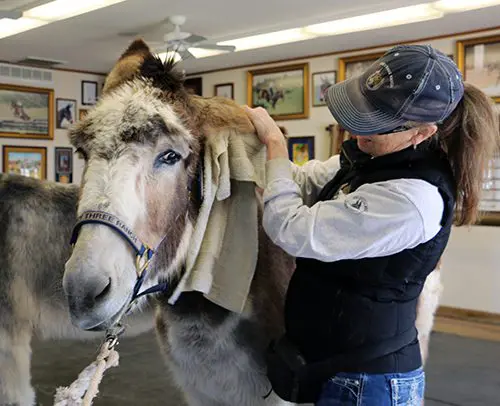
Chasity still thinks the vacuum cleaner is questionable, but she tolerates it now. Not only does it pull the dirt from the skin for healthy hair growth, it also promotes circulation better than massage and does a better job at softening her “fat roll.” I used massage in the beginning when Chasity first came here with her enlarged crest (photo below on the right).


It had become somewhat enlarged again about three weeks ago, but after two sessions with the vacuum cleaner, it has decreased substantially already.


Another valuable therapeutic grooming tool is this simple human, multi-bristled hairbrush. It is not only VERY helpful during shedding, but also works to further stimulate the hair coat and promote better circulation, as well as efficiently removing dirt from the skin. I have found it to be more helpful for healthy hair than any equine grooming tools. The long, thick hair coats of winter and spring stay soft and healthy when I use this hair brush over the entire body. I only clip bridle paths when the weather gets warmer and I leave body clipping for showing. The only other grooming tools I use are a shedding blade to remove mud and a dandy brush to finish the coat. They can have balding spots from rubbing during the shedding season and may even get sores, but I just treat those with Neosporin and they recede quickly. A healthy hair coat will insulate your equine from the heat and cold and protect them from insects better than any artificial products or practices.


Equines do like feeling clean all over and really do appreciate your efforts at keeping them this way…although, they don’t necessarily show it when the first thing they do after a good grooming is to go for a good roll in the dirt!!! Still, they do seem to realize that you care and will show their appreciation in a multitude of other ways…like being happy to leave their companions to go with YOU and stand quietly during grooming, tacking and hoof care!
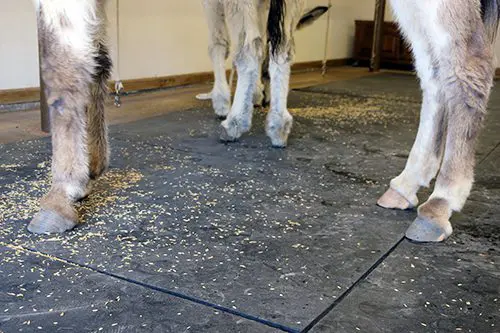
Feeding is a very important consideration for healthy hooves as are regular trims when needed, usually every 8-10 weeks. For donkeys, it can even be longer between trims when they wear their hooves in good balance. Chasity had hoof issues when she first arrived, but is now sporting healthy balanced feet! Remember that Longears will be more upright and have more heel than horses and ponies…and donkeys will typically be more upright and have more heel than mules.

Fitting saddles can be tricky. Make sure the saddle makes even contact behind the withers and over the back with relief from pressure over the spine. Many saddles sit too high and cause centralized and uneven pressure across the back. Pressure points are easily identified after a workout. The back will be sweaty, but the pressure points will be dry.


Place the saddle in the center of the back, behind the shoulder blade, the girth falling 4” behind the forearm where the skin is thicker and body begins to swell. I have successfully used cruppers with the buckles set away from the tail to hold it in place. The crupper is adjusted with just enough tension so the tail will still be able to rest comfortably.

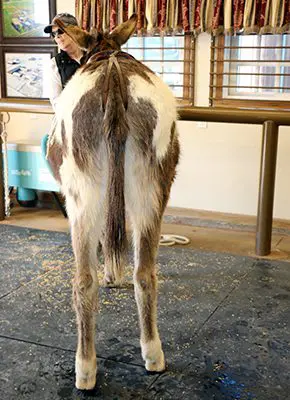
I am using the neck sweat on Chasity for lunging to promote a decrease in the crest. When bridling, I press my thumb on the bars of her mouth to get it open and protect her ears with my hands as I pull the crown piece to the poll. This promotes trust and keeps any equine from getting ear shy.


[one_third_last]

[/one_third_last]
On an English saddle there is a small d-ring that I use to tie up the reins.


Then it is off to the Round Pen. I always stay in sync with their front legs when we walk and execute the gates EXACTLY the same way EVERY TIME! All movements are predictable, never abrupt. They comply due to trust.


I adjust Chasity’s postural restraint, the “Elbow Pull,” and then remind her to give to the tension to get the release with a reward of oats for flexing at the poll. Wrangler, “Mr. Curiosity” watches intently…they do learn from each other!


Chasity’s overall posture has changed dramatically as has her movement. She uses her body much more efficiently.


Chasity has strong hind quarter engagement with an uphill balance to promote enthusiasm, endurance and stamina.


A reward is always in order for a job well done. Her forward stretch has improved greatly in one short year.


The lateral stretches are also much improved. After five rotations of walk, then trot, then reverse and repeat the other direction, 3 sets with a 3 minute break in between, then stop. Done once a week is adequate to maintain conditioning.


I hold the halter crown strap in my hand and protect her ears as I remove Chasity’s bridle. Then I slip the bridle onto my left arm, bring the noseband over her nose with my left hand and fasten the halter to the strap in my right hand. This ensures that I can keep hold of her should she try to pull away. Last, I fasten the tie strap from the hitch rail.


[one_third_last]

[/one_third_last]
I always unfasten the girth on the left, then tie up the girth on the right, slide the saddle back, loosen the crupper from the tail and take off the saddle on the right side. This gets the equine used to being handled from BOTH sides. I always rinse the bits and wipe any dirt from the bridles and saddles before putting them away…saves work in the long run!


I remove Chasity’s neck sweat to see how much sweat is underneath…encouraging! We are definitely making progress!


To end, we do a few more stretches in each direction. These are improving immensely, too!


Then it’s walking IN SYNC back to the barn for turnout in the larger dry lot. They enter the stall, ladies first, and then they both turn around to allow me to remove their halters and to enjoy their last reward. I keep all my donkeys off grass most of the time. I find that they stay healthier and do not run the risk of getting obese that way. They do have large dry lots for turnout on pea gravel every day and a couple of acres of dirt pen for really stretching their legs every other day. They do get some grass when we go for walks, but do not seem to miss it most of the time. They are too busy playing and resting with each other…and looking forward to our next lesson TOGETHER!


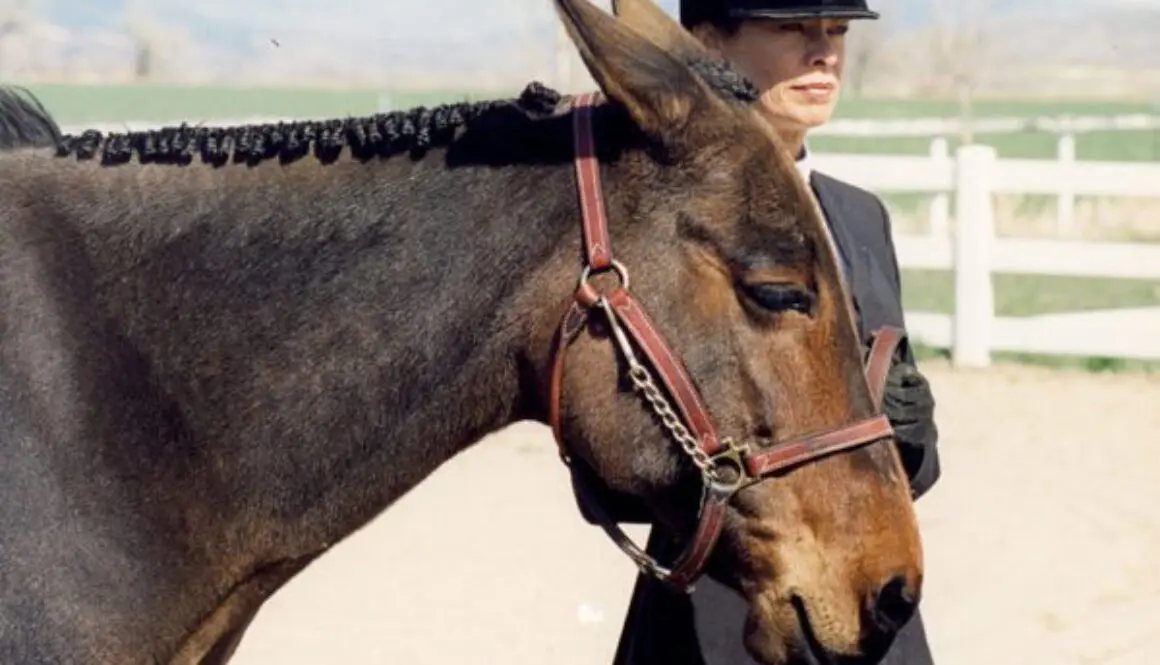
LTR Training Tip #81: Body Clipping for Show
Body clipping in a natural order with respect for your equine’s patience will help the process go much more easily.

CHASITY’S CHALLENGES: Riding in the Open Arena: 10-6-20
Chasity and Wrangler enjoy working with each other nearby and seem to learn things a lot quicker with a lot less resistance. It also affords me the ability to work more animals in less time. It’s a win-win situation. It doesn’t mean they won’t work by themselves. They will do that as well when they get to work with and without each other. This consistent routine with minimal variety greatly reduces anxiety and bad behaviors. The “Elbow Pull” is convenient for tying one while the other is working. There is no need to fuss with halters and lead ropes. I tie Wrangler while Chasity waits her turn patiently. It is a passive way to teach them to stand quietly when tied.
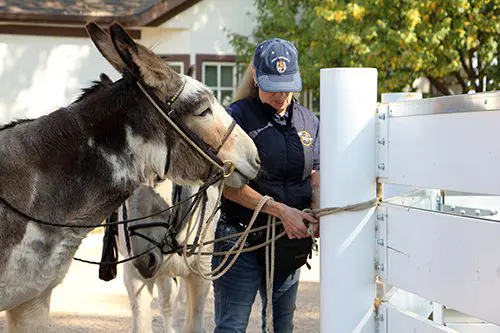

Today we will be going to the outdoor arena for riding in the Hourglass Pattern, but I opt to do some warm-up in the Round Pen first because I do not want to ask Chasity to trot in the Hourglass Pattern just yet. It is better to get her exercise done first, so we can then work on fine tuning her response to the aids: hands, seat and legs. Trotting will come later when she is consistent in her good posture, ultra-light in the bridle, moving off my legs easily and is following my seat.


Wrangler is tied outside the arena just as he has been tied outside the Round Pen. Chasity comes through the gate, stands squarely and receives her reward with no abrupt changes to the routine.

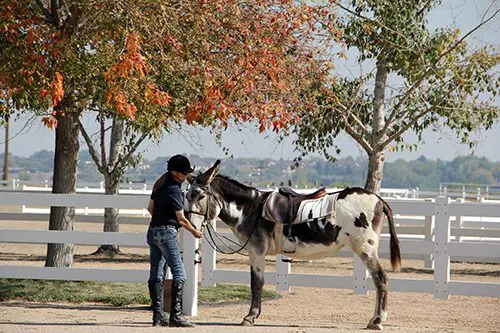
Chasity stands quietly as I mount, settle gently onto her back and politely receives her reward. She is enjoying being in a larger space, but is not anxious to walk off. She will do so only when I ask.


Chasity’s rein back is greatly improved and she is offering more steps upon request each time. She will only step one step at a time as I ask for them, and will also stop when I relax my seat and loosen the reins. I maintain a light connection to her mouth and I give the cue to move forward with my calves wrapped lightly around her belly. I maintain this contact with my legs and just nudge her on each side through the turns while I give a slight squeeze/ release with my little finger in the direction of travel.

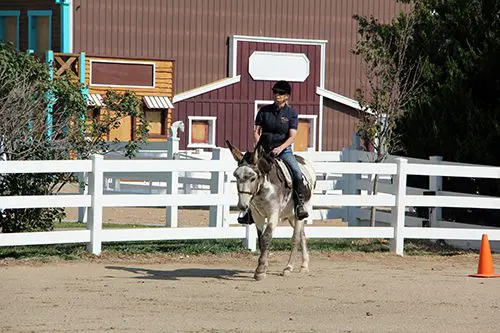
Chasity enjoys the feeling of “being hugged” by my legs with only gentle nudges from each side that push her into the direction of travel, and a nudge from both sides at once should she lose energy.


Most of the time, my legs lightly hug her sides and allow her the freedom to move while they simply support the even balance through the straight lines in the pattern. As we turn, the inside leg will move forward to the girth to keep her erect while the outside leg is back further and supports the bend to the arc of the turns.
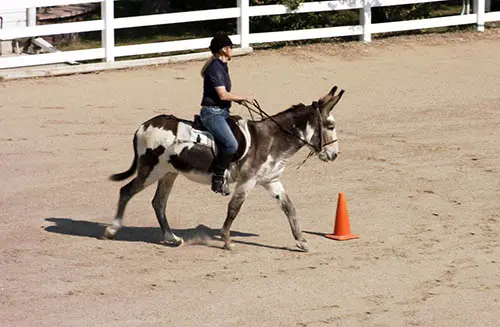
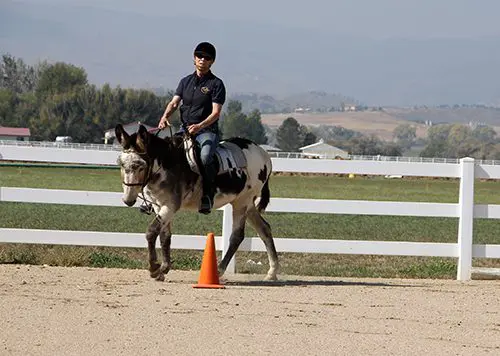
When Chasity is balanced in self-carriage, the “Elbow Pull” remains loose, she is light in the bridle and sensitive to my seat and legs. Wrangler watches her with intense interest! He knows he will soon have a turn!
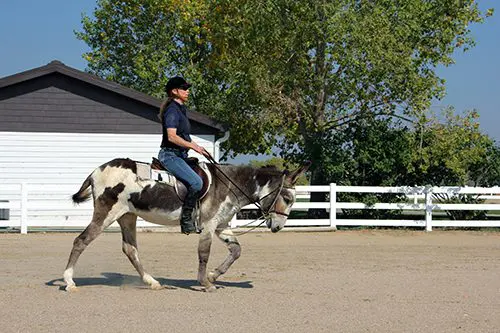

Keeping lessons short, slow and accurate will enhance Chasity’s ability to learn. We track once around the Hourglass Pattern with circles at the cones, then cross the diagonal and do the same in the opposite direction.


In the beginning, I do not use the ground rails as I did for leading exercises. It is more important for Chasity to focus on balancing my newly added, shifting weight before asking her to shift her own body weight and mine over any obstacles. I want her secure in her own balance with me aboard before we do any obstacles.
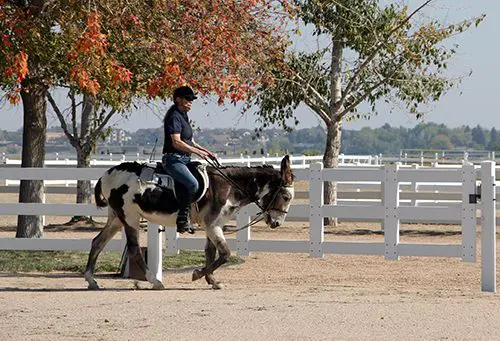

Chasity is learning to execute an energetic, forward working walk in complete postural balance. She makes a smooth turn, maintains her forward energy and tracks up the centerline of the pattern.

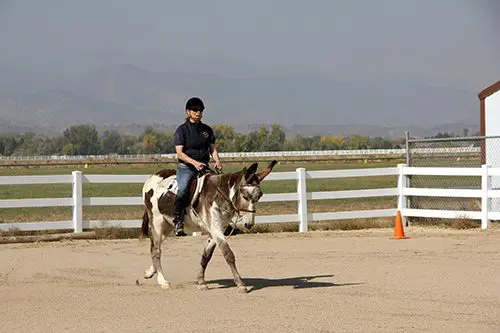
Chasity comes to a nice, balanced halt, waits patiently for a few seconds and then reins back easily upon request.


I dismount, loosen her girth and release the “Elbow Pull.” Chasity remains attentive and then stretches her neck and spine before we exit the arena. It was a relaxing and comfortable workout for us both. Maybe next time, we will be able to add the trot…if she offers it! We want to keep things controlled and accurate so she builds up the core elements in her body symmetrically. This is vital to good health and optimum performance!


MULE CROSSING: Contemporary Mules
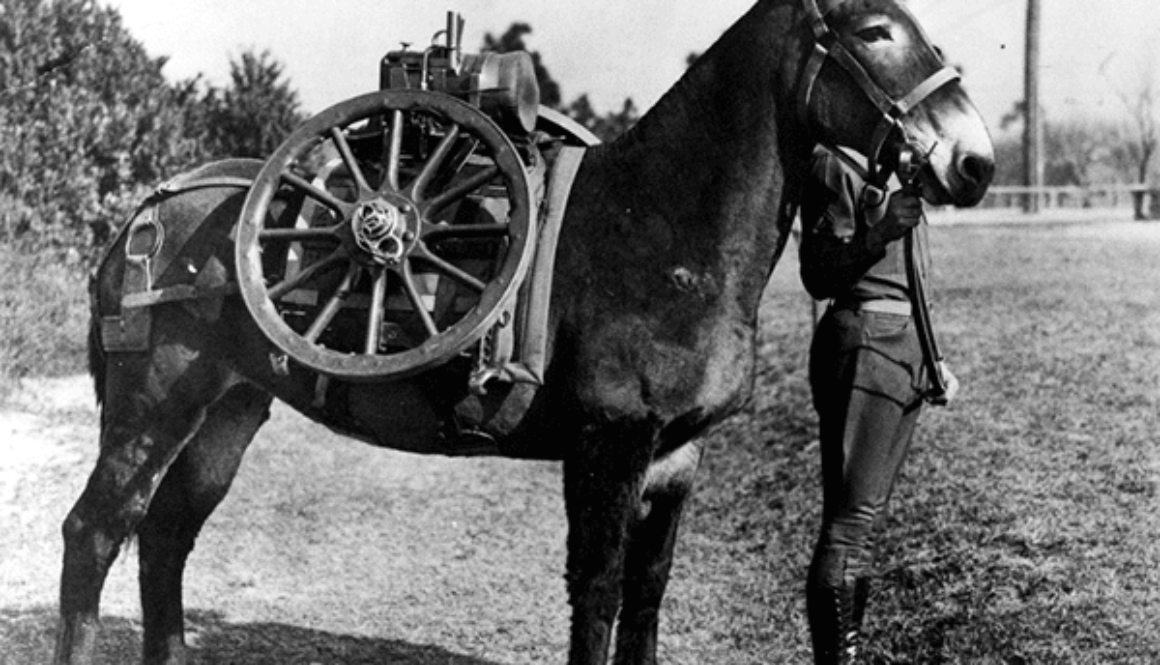
 Mules played an important role in our country during the Reconstruction Period: they patiently worked the fields, packed necessary artillery for the army, and served as a durable riding and driving animal in the westward movement. With the coming of the industrial age, their uses were minimized and they were faced with the possibility of extinction in the march of progress. Today, through the persistent determination of mule enthusiasts, mules are once again emerging as a conceivable asset to our economy and a unique form of athletic achievement and entertainment.
With new and improved training techniques, the mules of today are known for their beauty and outstanding athletic ability, their durability and their intelligence. Their uses are limited only to the imaginations of their owners. It is now commonly known that with proper training, a mule can perform better than the horse it was bred from. Subsequently, mules are not only competing in mule shows, but horse shows as well—in events from cutting to dressage. Cattle ranchers have discovered the mule to be an important asset in their business. He can go all day without tiring and can cover terrain that might discourage a horse, not to mention that the ride is much more comfortable. Hunters caught in the heavy snows of the Rocky Mountains praise their mules for carrying out heavy game and blazing trails through treacherous snowy ground, leading them and their horses to safety. Sales persons are grateful to both mules and donkeys for their humorous contributions in advertising and children appreciate the companionship and affection that mules can offer. Even the army has conceded that mules could make their contribution to the economy through their use in mountain light infantry divisions. The only problem that arises is educating people on mule psychology so that they can train them properly.
Although mules look and often act a lot like horses, there is a vast difference between the two psychologically. If a horse is given green pastures, plenty of clear water, and friends of his own kind, he is generally contented; the mule needs more. He possesses a curiosity about the world around him that requires him to participate and interact. For instance, if you were to walk out into a field where horses were grazing, chances are they would give you a glance and continue their grazing with a certain amount of indifference. Mules, on the other hand, would be compelled to approach you and check you out. 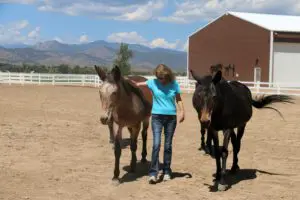 They will generally follow you around until you leave the field, begging for attention or simply observing you closely from a safe distance. Mules have a genuine desire to make friends with those other than their own species. Also, they are a very sensitive animal and can read your intentions through the tone of your voice and your body language.
Being the sensitive animal that they are, they have a low tolerance to pain. This contributes to their careful and deliberate way of going—a mule will do everything possible to keep himself safe. He is careful about his footing in treacherous terrain as well as careful about the feed he eats. Knowing this about mules can be a valuable aid in training. If a mule is not doing what you ask and you lose your temper, he will try anything and everything to escape the pain. This is where the old wives’ tales had their beginnings. Those who understand the mule’s low threshold for pain and understand his desire to please will either move on to something different if he is not giving the desired response, or introduce the lesson differently to clarify what is expected. In any case, beating a mule into submission will only cause fear and resentment, and being as intelligent as they are, they will only distrust you. Once they distrust you it is very difficult to make amends since they also possess an excellent memory!
In the early days, mules and horses had to be “broken” and trained quickly due to limited time for such matters. Trainers did not have the patience it takes to bring a mule along “right;” consequently the results were sayings such as: “Stubborn as a mule,” “Kick like a mule,” and “Get a mule’s attention with a two-by-four.” The old trainers may have succeeded in getting the mules to work, but they could never trust them… conversely, with broken spirits, the mules never trusted their trainers either.
Today good mule trainers apply the basic techniques of Behavior Modification (reward system training) in their programs. That is, getting the desired response through positive reinforcement and ignoring, as much as possible, the undesired behavior. Negative reinforcement, or punishment, is used sparingly and is never severe. Voice is an effective form of negative reinforcement. A firm “No” when he is misbehaving is generally sufficient, followed by a few minutes of ignoring him. If you have a mule that bites, a firm pinch on the nose, a “No,” then ignoring him for a bit should do the trick. If you have one who kicks, try your voice first. If he persists, quietly restrain a hind leg in a scotch tie while working on him. If he begins to kick in the scotch tie, stand back and ignore him until he has settled down. When he is settled, reward him by scratching his rear, and then resume your work. He will soon learn that he is responsible for causing his own pain and, preferring the reward, he should eventually cooperate.
Restraints are helpful in dealing with mules but must not be applied so they cause pain. Hobbles, leg straps, and scotch ties are generally all that is needed in dealing with difficult mules. Even if the mule has led a life of abuse, their ability to determine just who is responsible for their pain means that with love and kindness, they can be taught to trust again–it just takes a lot of time and patience. If you find restraints are not sufficient, you may be dealing with an outlaw, in which case it is best to put him out of his misery before he injures someone.
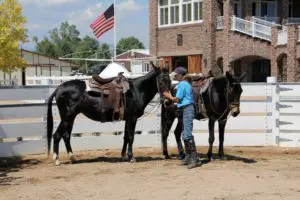 Still, the most important thing to remember is to praise the mule with caressing and scratching when he does what you desire and back it up with the food reward. Mules love this kind of attention and will do their best to get it. If they are rewarded immediately when they are behaving as desired, the desired behavior will eventually become the norm. If bad behavior is ignored or gently reprimanded, it will fade to a minimum. The result is a pleasant, affectionate, and dependable animal.
Though we are still a busy society, with the help of technology we are more able to give the mule the time and appreciation he deserves. Consequently, we are continually discovering new uses for the much maligned mule, enjoying him more, and in the process, we’re putting the old wives’ tales to rest.
Yesterday’s mules sturdy and strong
The days in the fields were often quite long
The man with the whips sometimes evened the score
With a jolt to the head by a stout two-by-four.
“Understanding” a word not common for slaves
Caused many good mules to go to their graves
“Stubborn and cranky are mules,” said most men
Who used and abused them then were kicked or bitten.
When industry triumphed, the mules quickly faded
But the tales remained and were often quite jaded
Twas never the man with the stout two-by-four
Who was wrong from the start to push mules way too far
But the folks who were ignorant knew only what’s said
And since mules cannot talk, their reputation was dead
They’re known to be pushy, vengeful, and cross
So man abandoned the mule for his exquisite horse.
With more time to our leisure the mules of today
Are treated much better and perform just that way
The love and affection the mules can now give
Makes raising and training them a warm way to live.
To meet them and greet them, to own one or not
The mules of today exhibit just what they got!
We’ve banned the “Old Wives’ Tales” and made a new rule
If you aren’t too stubborn, why not ride a mule!
To learn more about Meredith Hodges and her comprehensive all-breed equine training program, visit LuckyThreeRanch.com, MEREDITH HODGES PUBLIC FIGURE Facebook page, or call 1-800-816-7566. Check out her children’s website at JasperTheMule.com. Also, find Meredith on Pinterest, Instagram, MeWe, YouTube and Twitter.
Covered in TRAINING MULES & DONKEY: A LOGICAL APPROACH TO TRAINING, TRAINING WITHOUT RESISTANCE and EQUUS REVISITED at www.luckythreeranchstore.com.
© 1985, 2016, 2024 Lucky Three Ranch, Inc. All Rights Reserved.

CHASITY’S CHALLENGES: Riding the Hourglass Pattern: 9-29-20
After extensive work in the Round Pen getting Chasity and Wrangler light in the bridle, we are finally ready to graduate to the Hourglass Pattern in the open arena. They enjoy working together, so I just take them both together and tie one outside the working area while I work with the other. We only do these lessons weekly, but they seem to practice good posture on their own during turnout in between lessons. Their play and rest patterns are changing and their posture is improving dramatically. They can now support my weight efficiently in the saddle, so it is now time to hone their skills in a more open setting where we can work more freely. They could trot while sustaining their good postural balance in the Round Pen without my added weight, but that is a pretty restricted place to introduce the trot with my weight in the saddle. So I will tie up Wrangler with his “Elbow Pull” while I work with Chasity.


As always, she leads easily, politely negotiates the gate and stands quietly while I adjust her “Elbow Pull” and adjust her equipment. I will tighten the girth a bit more for lunging to hold the saddle in place. I always tighten the girth a little at a time and not all at once for her comfort. She appreciates my consideration.
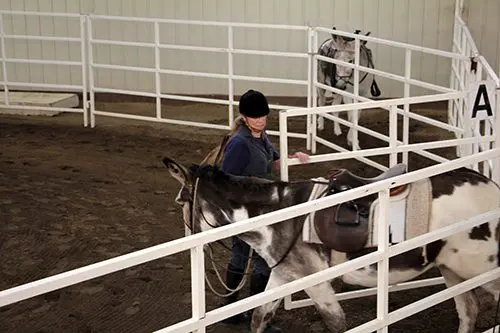

In preparation for riding, I will lunge Chasity first. When I ride her, I want her sufficiently warmed up and responsive to perfecting our communication skills. The five rotations at walk, then trot in each direction is sufficient exercise with some speed as she is now well-balanced while performing these tasks. The faster gaits under saddle will come later.

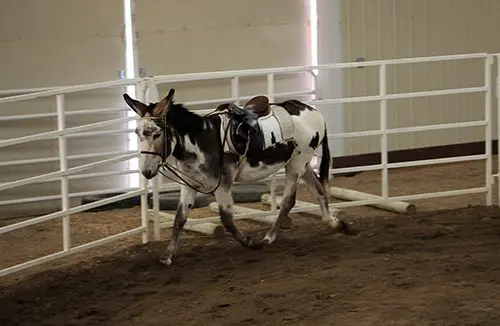
Chasity executes a very nice reverse and immediately slows to the walk, maintaining her good posture. When they are in a good equine posture, the entire length of the spine is stretched, causing space and elasticity between the vertebrae.
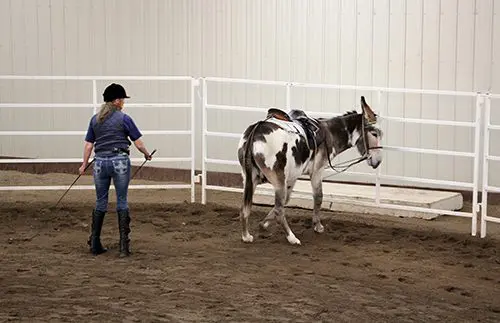
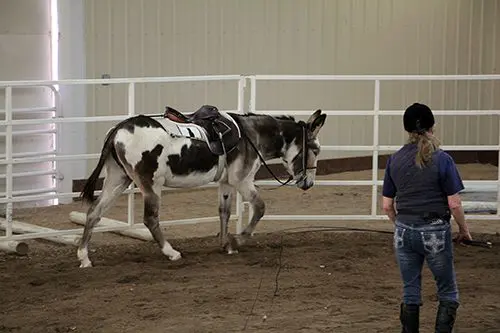
If the equine is perpetually allowed to carry their head too high, the vertebrae can become stuck and calcified too close together and over time can cause a condition called “Kissing Spine” that keeps the spine rigid and inflexible.


After a sufficient warm up with the addition of a bit of canter while tracking to the right, Chasity is ready to be ridden in the Hourglass Pattern. She obediently comes out the gate and turns to me for her reward.

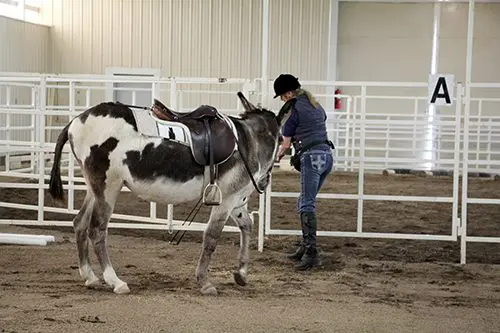
I politely mount, settle onto her back softly and offer her reward as I did in the Tack Barn and then in the Round Pen. She stands absolutely still.


Then we do a rein back before moving forward into the Hourglass Pattern. Contrary to popular belief, this “pattern training” will allow Chasity to concentrate on the details of tracking forward, bending and staying light in the bridle.


The arcs and turns in the Hourglass Pattern allow Chasity’s internal pendulum to swing from side to side and come to rest at dead center when she finally halts. She maintains straight lines and bends to the arcs through her rib cage.


When an equine is perpetually schooled on the rail or in too many circles in one direction and then another, this radical movement does not allow the internal pendulum to become centered and balanced.


There is an optical illusion that takes place when riding the rail that “pushes” the balance continuously to one side. Straight lines become difficult and bending will be stiff at best.


This swaying in the Hourglass Pattern from one arc to another keeps the internal pendulum moving freely from side to side while the equine moves freely forward. It produces fluid motion and relaxation in the equine.
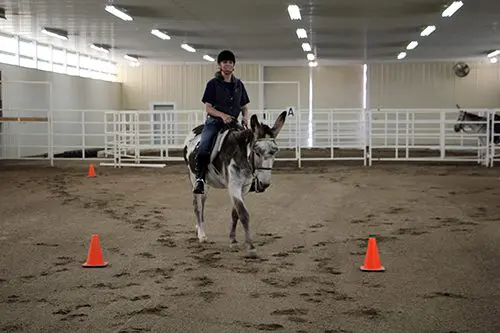

All of this keeps the animal responsive, light in the bridle and facilitates good postural movement that results in squared halts and straight rein backs. They enjoy their work because it FEELS good!


Chasity stands still while I fish in my pocket for her final reward for a job well done! Her balance is solid!


We then go back to the Round Pen area to retrieve Wrangler from his “spectator seat!” Wrangler and Chasity have been taught exactly and consistently the same way, so they are quite maneuverable and willing to do as I ask. I have not experienced a “balky” donkey or mule in years!

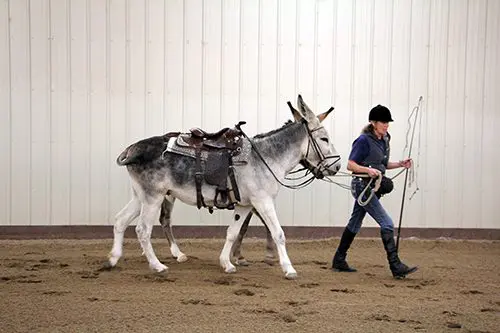


LTR Training Tip #79: Seat Leg Cues
In order for your seat and leg cues to be accurate and clear to your equine, you will need to improve stability in your own seat and balance.

MULE CROSSING: Train Your Own Mule!
By Meredith Hodges
 Mules and donkeys are wonderful animals. They’re strong, intelligent and what a sense of humor! But training a mule or donkey is different from training a horse. They require love patience, understanding and a good reward system. Negative reinforcement should be used sparingly and only to define behavioral limits. The result is an animal that is relaxed, submissive, obedient, dependable and happy with his work.
Mule and donkey owners find it difficult to find trainers for their Longears because most horse trainers are unfamiliar with the psychological needs required by Longears to invoke positive responses from them. Those trainers who are capable are few and far between, making it difficult for inexperienced owners in remote areas to get their animals trained properly. Many people attempt to train their own animals and achieve a certain level of success despite the trials and tribulations of trial and error. This can be a long and frustrating road.
We are fortunate enough today to have all kinds of books and videos available on training Longears. However, it wasn’t that  long ago when there was virtually nothing published on this subject. Those of us who were training needed to use educational resources published on horse training and modify those techniques to better suit our Longears. This still left a lot of room for trial and error…and frustration for both the trainer and the animal.
Interest in Longears has grown tremendously over the past 50 years. With this  increased interest has come an increase in the numbers of animals that need to be trained each year. The few trainers who are competent with Longears could not possibly train even most of the animals that need it, even if it were geographically possible—which it isn’t. Owners usually need to travel distances to visit an animal in training, which limits their own ability to learn with their Longears. This can also become a problem when the animal returns home.
Seminars and clinics are helpful, but they cannot replace the day to day routine that helps produce a safe, obedient and dependable animal. Mules and donkeys bond to the person or persons who train and work with them. They develop a warmth and affection for them, and a desire to please and to serve. Without this bond, mules and donkeys will often comply, but without commitment to their work. Subsequently, when the pressure is on, they may “quit” on you in an instant.
Many people have complained about sending their animal to a trainer for as long as two years, only to have the animal return  home and become a problem within as little as three months. It is important to take an active part in the training of your Longears. The more you can be a part of the training, the better for both you and your animal. Even if your mule or donkey is with a competent trainer, you need to plan on spending at least two days a week with your animal and the trainer so that your animal learns to trust you as well as the trainer. Being present and interactive with your animal at feeding time will solidify the trust he gains.
A lot of people ask me why I quit taking outside Longears for training here at the Lucky Three Ranch. In all honesty, I had developed a waiting list I could not possibly have fulfilled in a reasonable amount of time. I would, however, really like to see more people having fun and enjoying their Longears as much as I do. I considered doing clinics like so many trainers do, but I felt I could reach more people through a video and book training program with my technical support only a phone call away. Hence, I developed my training series, “Training Mules and Donkeys. Time and time again, my training  series proves that this was a great way to reach people and help them to reach new levels of communication with their animals. People who never before had the courage nor confidence to even attempt such a thing are discovering the self satisfaction and elation of training their own mules and donkeys. Most people tell me it is the best part of their day when they can work with their animals. They are quite surprised at how easy it is to establish a routine that fits with their other weekly activities…thanks to the intelligence and forgiveness of these wonderful animals.
I had been involved with training horses most of my natural life before I began training mules at my mother’s Windy Valley Ranch in Healdsburg, California almost 40 years ago. I knew nothing of Longears at the time I started there. I tried all kinds of “suggestions” from other people and by trial and error—and a lot of resistance—I somehow managed to get a lot of mules trained, but I knew there had to be an easier way. I have to applaud the forgiveness of these mules in the face of my own impatience and ignorance. They let me know when my approach to training was unrealistic and punitive, and did so in a knowing and careful way. My lessons with them were proportionate to my mistakes, so I was lucky enough not to experience anything like head injuries or broken bones. When these kinds of injuries occur, there is something grossly wrong between the animal and the person who has been injured. It could be a lot of reasons, but the one thing of which I can be sure is that the animal acted appropriately for himself, and the problem occurred because there was a lack of communication.
When we raise our children, we begin with nurturing, love, affection and play. The way we play outlines certain behavioral limits for our children and helps them to develop and learn to socialize in a positive and healthy manner. As the child grows, family interaction helps him to define for himself his place in the world. Appropriate physical activities help the child’s body to develop in a slow and healthy way. School, in its natural and logical order helps the child to understand and learn to react appropriately in society and in the world. It helps to develop the confidence on which his self image and self worth is built. Physical activities increase with intensity, strengthening the physical well being of the child. This takes longer than 18 years. How can we, in all good conscience, expect our young Longears to develop in a healthy way, both physically and mentally, if we expect them to learn the same kinds of things in so much less time?
 At first, you might think there just isn’t enough time to spend with your animal to accomplish all this, but somehow we all manage to make time for these things when we have children. We learn to experience and grow with our children, as we can also do with our animals by being realistic with our expectations at each stage of growth and training. We give ourselves the time to do this without the pressure of being hurried. There are few times in this world when we are really able to “stop and smell the roses.” Longears can afford us this very special time if you only let them. Look upon the time with your donkey or mule as you would look upon the time you spend with your child. Some days will be for learning and some for just plain fun. When there are learning days, try to make them fun and stress-free. Someday you’ll find yourself saying: “I can’t believe he has turned out to be so good. I never really felt like I was ‘training’ him!”
To learn more about Meredith Hodges and her comprehensive all-breed equine training program, visit LuckyThreeRanch.com or call 1-800-816-7566. Check out her children’s website at JasperTheMule.com. Also, find Meredith on Facebook, YouTube, Pinterest, Instagram, MeWe and Twitter.
Covered in TRAINING MULES & DONKEY: A LOGICAL APPROACH TO TRAINING, TRAINING WITHOUT RESISTANCE and EQUUS REVISITED at www.luckythreeranchstore.com
© 2000, 2011, 2012, 2016, 2024 Lucky Three Ranch, Inc. All Rights Reserved.
MULE CROSSING: The Mule Foal
 By Meredith Hodges
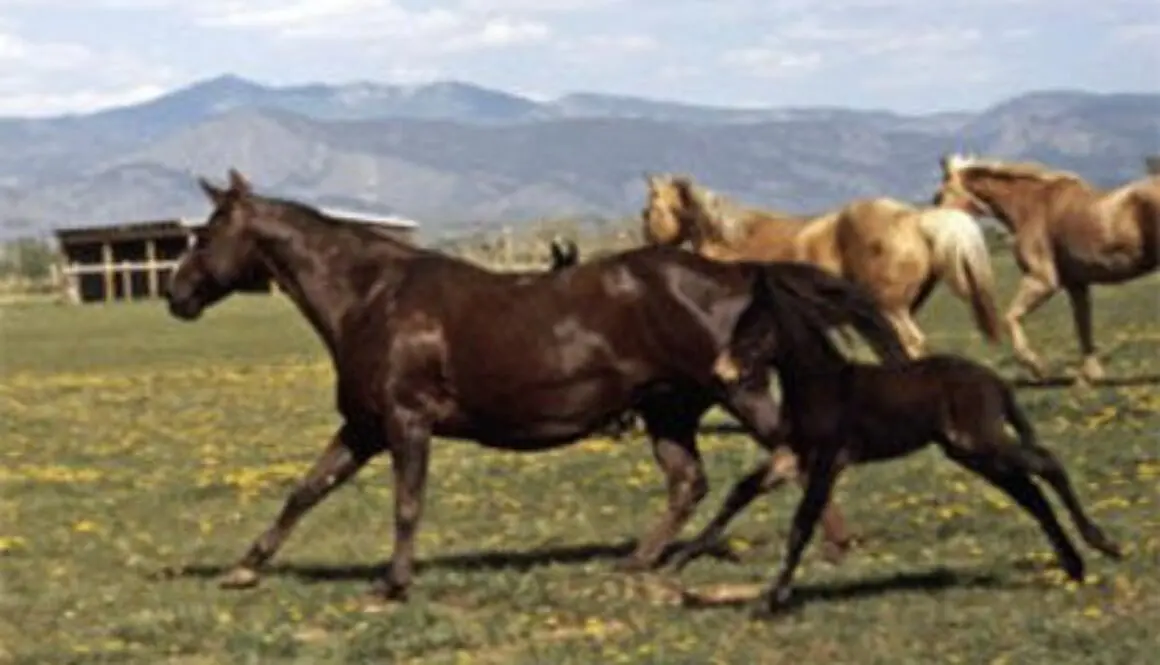
Mules and donkeys have an inborn natural affinity for human beings, so raising your mule or donkey foal to accept humans can be a relatively easy task if you remember a few simple things. First and foremost, you must learn to be a willing role model and, at all times, be polite, considerate and respectful toward your foal in what you ask and how you ask it. Second, you must remember that, from the moment your foal is born, he will learn a great deal from his dam. He will spend the first five to six months with her, so if you want your foal to be friendly and cooperative, then you should first be sure that his dam is friendly and cooperative. A mule or donkey foal from a “sour,” or uncooperative dam will, despite his deeper instinct to be amicable towards humans, eventually learn to mimic her avoidance behaviors. For instance, if your mare or jennet leaves when you approach, the foal at her side eventually learns to leave as well—whether he is truly frightened or not—and this can carry over into his adulthood. That is not to say that you cannot teach the mare and her foal to both be more amicable at the same time, but it is much less time-consuming and frustrating to train your mare to be friendly and cooperative before she gives birth.
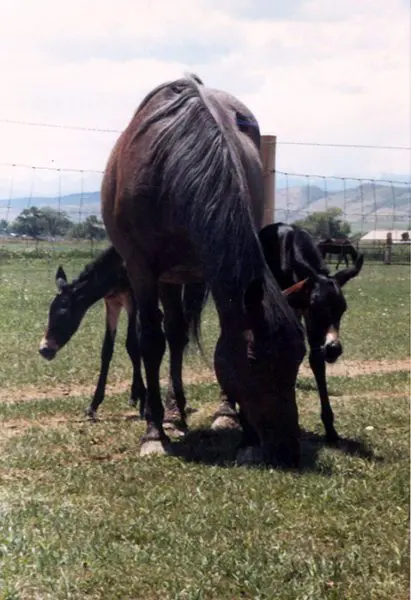 Mule foals are not too much different than human infants in their emotional needs. They require lots of attention, love, guidance and praise if they are to evolve into loving, cooperative and confident adults. In your efforts to get your young foal trained, bear in mind that he is still a child. If he is expected to fulfill too many adult responsibilities too quickly, he can become overwhelmed, frustrated and resistant. This is why it is important to allow your foal to have a childhood. You can turn this time into a learning experience by playing games with your foal that will help him to prepare for adulthood without imposing adult expectations on him when he is too young.
Mule foals love to play games and they have a tremendous sense of humor, so don’t be afraid to use your imagination in thinking up fun and interesting games to play with your foal. Once he figures out that you mean him no harm and you want to have fun, he will probably begin to follow you, even butting his nose against you to get your attention! One of my mules’ favorite games is tag. To teach your mule foal to play tag, just pet him a couple of strokes, then turn and trot away a few steps, then turn and encourage him to follow. It won’t take him long for him to figure out the game. This is especially fun for foals that do not have other foals with which to play. If your foal gets a little carried away and jumps at you, or on you, a firm tap of your palm on his nose, and a loud “No!” will define for him the limitations of the game and bad habits should not result. Directly after he has been disciplined, be sure to let him know his infraction has been corrected and forgotten, and encourage more play.
 The first component of developing a well-adjusted adult mule is to establish a routine that will give your mule foal a sense of security and trust in you. Having a definite feeding schedule can help a lot. If you take a few minutes each morning and evening to scratch and pet your foal while your foal’s dam is eating and after he has finished nursing, he will associate you with a very pleasurable experience. If his dam is busy eating, she will be less likely to think about running off with him. If your animals are on pasture, a short visit once or twice a day with a ration of oats and plenty of petting while paying special attention to the intensity of your touch on his body will accomplish the same thing.
Once you have developed a routine, always pay close attention to your foal’s likes and dislikes. Each foal is different and has definite ways he likes to be touched and definite places on his body from where he derives pleasure. By touching, stroking and scratching him all over his body, you can easily discover his preferences. If he expresses a dislike for any particular touch, either modify it or discontinue it. Usually, once a foal has experienced the pleasurable sensation of your hands on his upper body, moving down to his legs should pose little or no problem. When he has grown accustomed to your touch on his legs, he will, as a rule, allow you to pick up his feet for short periods of time. All that I have mentioned thus far should be done while your foal is free and unconstrained because it should be his choice to stay with you. If he is tied or constrained in any manner while you touch him, he could become distracted, tense and frightened, and you could be perceived as a threat, which will produce resistant behavior.
Mules are usually about one or more years behind horses in their overall development. For this reason, it is unadvisable to begin formal driving or under-saddle groundwork training in a mule’s second year. During his first year, for good posture and balance, spend plenty of time on leading training, both on the flat ground and over obstacles. Don’t get in too much of a hurry to ride and drive him. At two years of age, your young mule is still a rambunctious child and will not necessarily take too kindly to being restrained or overwhelmed with adult tasks. Mules often seem like they are able and willing at two years old, but, because he is not yet fully physically developed, his resistance could prove to be injurious to him in the long run (not only mentally, but physically as well). It is better to teach only the simplest lessons at this age. Teach lessons that naturally follow the first year’s leading training exercises (lunging and ground-driving first in the round pen, and then in the open arena).
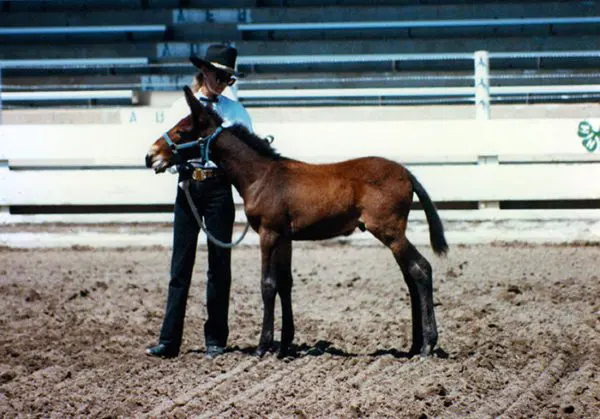 When your mule gets a little older and is ready to be halter broken, you can use your pleasurable status with him to your advantage. First, halter him and tie him to a fence with a safety knot (see DVD #1 n my Training Mules and Donkeys series). Leave him like this each day after breakfast for about half an hour, making sure to return to him every ten minutes. Each time you return, if he doesn’t become tense and struggle, untie him and ask him to follow you. If he refuses, just tie him up again and come back again ten minutes later and try again. If he comes with you, even if it is only one step the first time, take his halter off and play with him for a little while and then end the lesson. This will maintain your pleasurable status with your foal while he learns the things he will need to know as a young adult. In the next lesson you can ask for more steps before playing and ending the lesson
Once he leads fairly well, you can add the game of obstacles to begin to change his fear to curiosity (you can work on perfecting his technique over obstacles later in the year). Any chance you get, take your foal with you and discover things together while he’s on the lead line. If he becomes frightened, put yourself between him and the obstacle and allow him plenty of time to investigate the situation. When he does show curiosity rather than fear, encourage him to come forward and investigate further, then pet and praise him when he touches the obstacle with his nose. If he has been weaned and is now eating solid food, offer the oats reward. If he learns to stop and investigate potentially scary obstacles in this way as a youngster, he will be more apt to trust your judgment as an adult and will be a curious rather than a frightened animal. Just be sure to always let him know that everything is all right and that you are there to protect him whenever necessary.
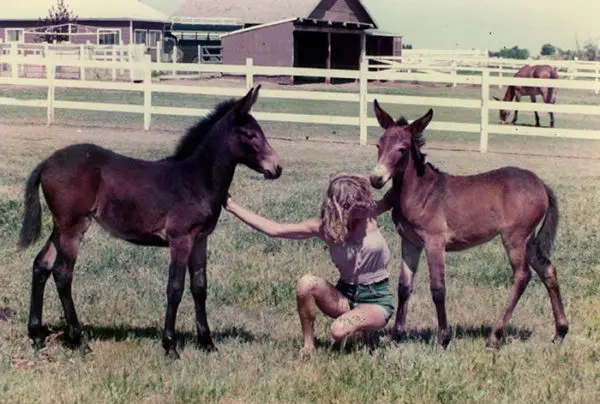 When handling your mule foal, always be sure to give him time to relax and accept a situation…and he probably will. Never get in a hurry and do not try to force anything—or your foal will be happy to oblige you with more resistance than you ever imagined possible! And remember, you can catch more flies with sugar than you can with vinegar, so go out there and have a good time with your little longeared pal. He’ll be glad to be your best friend if you learn how to be his best friend.
To learn more about Meredith Hodges and her comprehensive all-breed equine training program, visit LuckyThreeRanch.com, MEREDITH HODGES PUBLIC FIGURE Facebook page, or call 1-800-816-7566. Check out her children’s website at JasperTheMule.com. Also, find Meredith on Pinterest, Instagram, MeWe, YouTube and Twitter.
Covered in TRAINING MULES & DONKEY: A LOGICAL APPROACH TO TRAINING, TRAINING WITHOUT RESISTANCE, EQUUS REVISITED and A GUIDE TO RAISING & SHOWING MULES at www.luckythreeranchstore.com.
© 1991, 2016, 2018, 2024 Lucky Three Ranch, Inc. All Rights Reserved.

LTR Training Tip #78: Transitions
Transitions in your equine’s gait, speed or direction should always be smooth and fluid and not bouncy.

MULE CROSSING: Achieving Balance and Harmony
By Meredith Hodges
Achieving balance and harmony with your equine requires more than just balancing and conditioning his body. As you begin finishing training on your equine, your awareness must now be shifted more toward your own body. Your equine should already be moving steadily forward in a longer frame and be basically obedient to your “aids” (your seat, legs and hands). The object in finishing training is to build the muscles in your own body so that your aids become more clearly defined and effective. This involves the shedding of old habits and the building of new ones. This takes a lot of time and should not be approached with impatience. There are no shortcuts!
In order to stabilize your hands and upper body, you need to establish a firm base in your seat and legs. Ideally, you should be able to drop an imaginary plumb line from your shoulder through your hips, through your heels and to the ground. To maintain this plumb line, you must work to make the joints and muscles in your body more supple and flexible through correct use, so that this line becomes your automatic posture.
 As you ride your equine through walking exercises, try to stay soft, relaxed and following forward in your inner thighs and seat bones. Get the sensation that your legs are cut off at the knees and let your seat bones walk along with your animal—lightly, and in rhythm with him. If he slows down, just bend your knees and nudge him alternately with your legs below your knees, while keeping your seat and upper legs stable and moving forward. While your legs are still, they should rest gently on his sides in a “hug.” Do not push forward in your seat, but allow him to carry you forward. When collecting the walk on the short side, just bend both knees at the same time, nudging your equine simultaneously on both sides, while you squeeze the reins at the same time.
In order to help you stay over the middle of your animal’s back on the large circle, keep your eyes up and ahead, shift your weight slightly to the outside stirrup, and “feel the movement.” Bend your knee and set your inside leg snugly against your equine at his girth. As you do this, be sure that your outside leg (the leg on the outside of the arc) stays in close contact with his body, well behind the girth. He will begin to bend his body through contact with your legs in this position. Your inside leg (the leg on the inside of the arc) will support the bend and help to keep him upright, and the outside leg will drive him forward through the arc of the turn, or circle. On straight lines, keep your legs even, slightly behind the girth and look straight ahead. To keep his shoulders from “dropping” while executing a turn, look up and a little to the outside of the circle. This will bring your inside seat bone slightly forward and your outside seat bone slightly back, allowing your legs to easily be in the correct position for the circle. Your weight should be shifted to the outside leg. This is particularly helpful during canter transitions.
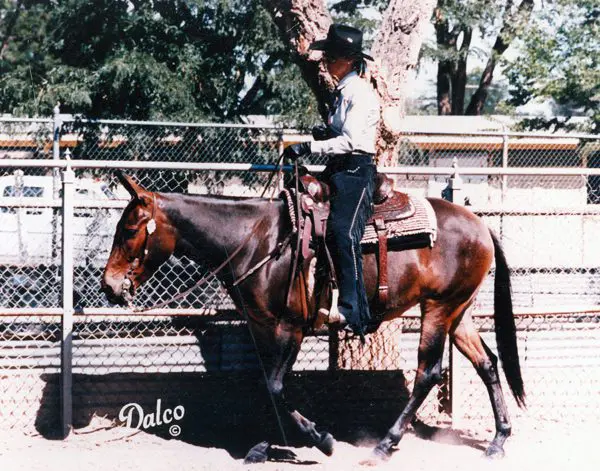 Most of us feel that we do not balance on our reins as much as we actually do. If there is any balancing on the reins at all by the rider, your equine will be unable to achieve proper hindquarter engagement and ultimate self-carriage. Here is a simple exercise you can do to help shift the weight from your hands and upper body to your seat and legs. Begin by putting your equine on the rail at an active working walk. On the long side, drop your reins on his neck and feel your lower-body connection with him as you move along. In order to maintain your shoulder-to-hip plumb line, you will find that you need to tip your pelvis forward and stretch your abdominal muscles with each step. If your lower leg remains in the correct position, this will also stretch the thigh muscles on the front of your leg from hip to knee. There is also a slight side-to-side motion as your animal moves forward that will cause your seat bones to move independently and alternately forward. There is no doubt that you can probably do this fairly easily right from the start, but to maintain this rhythm and body position without thinking about it takes time and repetition.
When you are fairly comfortable at the walk, you can add some variation at the trot. Begin with the posting trot on the rail. Always post down in your seat to meet the equine’s front leg that comes back and underneath your outside leg. Post upwards as the equine’s front leg goes forward. Once your equine’s hindquarters are adequately engaged, you will begin to feel his hind legs coming under your seat. However, when starting out, it is easier to learn to post using a visual of the front legs, and rely on the physical sensation of the hind legs coming under your seat later. When your mule is going along the rail in a fairly steady fashion, drop your reins on his neck and continue to post. As you post down the long side, remember to keep your upper body erect, your pelvis rocking forward from your seat, your knees bent such that your legs are gently hugging the barrel of your equine, and your arms raised and straight out in front of you, parallel to your shoulders.
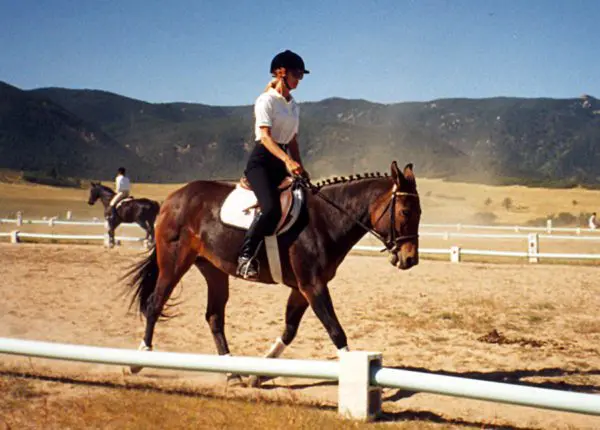 If your animal drifts away from the rail, you will need to post with a little more weight in your outside stirrup. As you go around the corners, be sure to turn your eyes a little to the outside of the circle to help your positioning. As you approach the short side of the arena, bring your arms backwards and straight out from your shoulders in a “T” formation, while keeping your upper body erect. As you go through the corners, just rotate your arms and upper body slightly toward the outside of your circle. When you come to the next long sides, bring your arms, once again, in front and parallel to your shoulders and repeat the exercise.
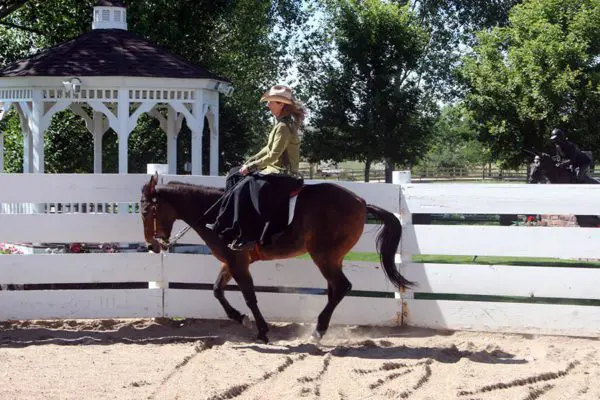 Notice the different pressure on your seat bones as you change your arm position. The forward arms will somewhat lighten your seat, while your arms to the side tend to exert a little more pressure. Consequently, you can send your animal more forward by using your seat as you go down the long sides, shortening that stride with a little added pressure from the seat bones on the short sides. When you wish to halt, put your arms behind you at the small of your back to support an erect upper body, and let your weight drop down through your seat bones and legs. Also, remember to use your verbal commands often in the beginning to clarify your aids (effect of the seat, legs and hands) to your equine. If your equine doesn’t stop, just reach down and give a gentle squeeze/release on the reins until he stops, but be sure to remain relaxed and continue to drop your weight into your seat and legs. Keep your inner thighs relaxed and flexible. Do NOT squeeze! Think DOWN through your legs on both sides. Before long, he will begin to make the connection between the weight of your seat and your command to “Whoa,” and your seat will take precedence over your reins.
When you and your equine have become adept at the walk and the trot, you can add the canter. At the canter, however, keep your arms out to the side and rotate them in small circles in rhythm with the canter. Be sure to sit back and allow only your pelvis, seat and thighs to stretch forward with the canter stride. Keep your upper body erect and your lower legs stable in the gentle “hugging” position. Once your equine has learned to differentiate seat and leg aids during each gait and throughout all transitions on the large circle, you can begin to work on directional changes through cones.
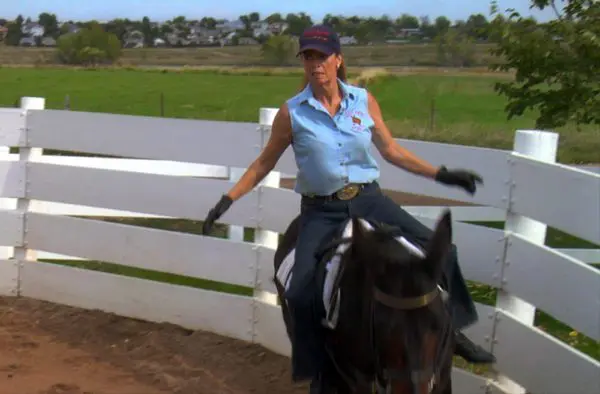
As you practice these exercises, you will soon discover how even the slightest shift of balance can affect your animal’s performance. By riding without your reins and making the necessary adjustments in your body, you will begin to condition your own muscles to work in harmony with those of your equine. As your muscles get stronger and more responsive, you will cultivate more harmony and balance with your animal. As you learn to ride more “by the seat of your pants,” you will encounter less resistance in your equine, as most resistance is initiated by tension in the seat and legs and by “bad hands,” an ineffective and uncommunicative dragging on the reins. Your hands should remain quiet and supportive in contact with the bit. Keeping your legs close to the sides of your equine’s body in a sort of hug will clarify the “track” he is to follow (much in the same way a train is confined to its tracks). As you learn to vary the pressure in your seat accordingly, so will you encounter less resistance in your animal through his back, and the stability in your lower legs will give him a clearer path to follow between your aids.
To learn more about Meredith Hodges and her comprehensive all-breed equine training program, visit LuckyThreeRanch.com, MEREDITH HODGES PUBLIC FIGURE Facebook page, or call 1-800-816-7566. Check out her children’s website at JasperTheMule.com. Also, find Meredith on Pinterest, Instagram, MeWe, YouTube and Twitter.
Covered in TRAINING MULES & DONKEY: A LOGICAL APPROACH TO TRAINING, TRAINING WITHOUT RESISTANCE, EQUUS REVISITED and A GUIDE TO RAISING & SHOWING MULES at www.luckythreeranchstore.com.
© 1992, 2016, 2017, 2024 Lucky Three Ranch, Inc. All Rights Reserved.

CHASITY’S CHALLENGES: Fun with Friends: 8-4-20
Donkeys love it when you keep things easy, fresh and interesting! Chasity has been doing so well with her lessons with Wrangler lately that I thought we could change things up a bit and add a LITTLE excitement to their routine by adding the mini donkeys, Augie and Spuds! If this is to be a safe endeavor, I will have to break things down into small introductory steps and make frequent evaluations as to what is safe to do and what might not be safe. I want them all to enjoy this time together with me! Seeing the mini donkeys in the Tack barn work station, Chasity is getting already started with a smile on her face!
First, I lunged Chasity by herself to see how she would respond in her “Elbow Pull” and to see whether she would maintain her good postural balance during this lesson. She did lovely at an energized and forward working walk! I was very pleased.
Chasity then bucked up her working trot and although she raised her head just a bit, she kept the “Elbow Pull” loose almost all the time…she is truly improving rapidly!
Next, I ground drove her and again, she did everything just right and maintained her good posture and balance…through the reverses and in both directions!
Chasity’s contact with my hands was steady and light, and she easily did her “S” turns through the middle of the Round Pen gracefully and accurately.
Chasity did a square halt and did the rein back much more easily that she had in prior lessons. She is making marked improvement every week! Yes, we only do these lessons once a week for about 20-30 minutes to get these amazing results!
Chasity and Wrangler always enjoy lunging together, but sometimes he will get a bit slow and cause her to raise her head behind him and put more tension on the “Elbow Pull” than she would do if he was not there. Wrangler spotted Augie and Spuds tied outside and did not want Chasity anywhere near them! That was when I made the decision that now would not be the right time to lunge FOUR donkeys together!
Instead, I tied Wrangler outside and introduced Chasity to Augie and Spuds…they liked each other, so I began lunging them all together! Chasity loved it!
The donkeys, large and small, tracked left and then did a perfect halt…all three of them! As they stood stock still, I rewarded them each one for a job well done!
Chasity surprised me by doing a perfect reverse and then walked behind Augie and Spuds to show them the new direction. Then they too, reversed and followed her obediently! I had to chuckle…who’s in charge here?! Wrangler just hid his face behind the post outside of the Round Pen, hoping no one would notice how left out he felt! Even though Wrangler was a bit miffed, they all had a very good time! At least he was not completely left out! Friends really LIKE to work together!

LTR Training Tip #77: Simple and Flying Lead Changes
Correctly done Flying Lead Changes should take place simultaneously, so it is important to build strength and balance through Simple Lead Changes before even attempting Flying Lead Changes.
MULE CROSSING: Showing Equines
 By Meredith Hodges
Many years ago mules and donkeys were numerous in America. Their strength and endurance made them ideal pack and work animals. Their contributions to the building of this great nation were unmatched, yet in 1966 their numbers had declined to the point of near extinction. With the coming of the Industrial Revolution, their services were no longer in demand. In 1987, the American Donkey & Mule Society celebrated its 20th Anniversary. The society was formed by Paul and Betsy Hutchins of Denton, Texas in 1967 in response to a need to appreciate the work of these fine, Longeared animals and to find new uses for them. Over the past 40 years, appreciation for these wonderful animals has gained momentum and with each new experiment, we find that these Longears are capable of a wide variety of uses in today’s world.
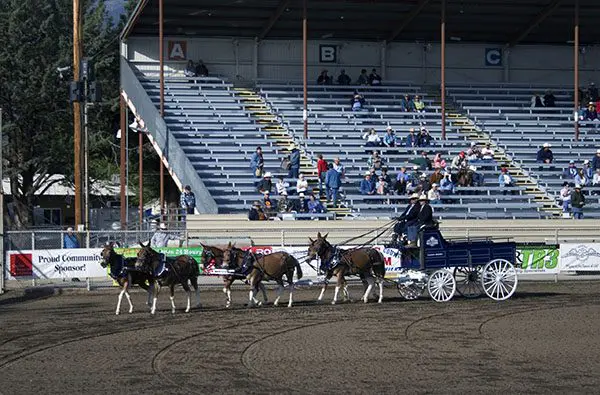 They are limited only by the imagination of The gift we have found with Longears is one that needs to be shared with others so that they might also experience the joy and pleasure these animals have to offer. In this hustle-and-bustle world, it is easy to take for granted the importance of love, sharing and simple pleasures derived from personal growth. Mule and donkey shows are a vehicle we can use to bring these things to light and revitalize the appreciation of Longears. The show ring is a place where mules and donkeys can exhibit the results of experiments with their owners and trainers, in exceptional horsemanship and performance, where challenges are met with both humor and enthusiasm. They can be pets, performers, pleasure mounts, or just plain hard workers.
However, many people are intimidated by the show ring for many reasons: a lack of show-quality animals and training time, a lack of available transportation, inopportune geographical locations and the fear of equine politics. We must remember that this intimidation was born of the horse show formats and the involvement of large amounts of money. There are literally millions of horses in this equine industry that are being shown all over the world. Out of necessity, the shows are divided and specialized according to ability and breeding.
This is the only fair way to progress and accommodate the growing numbers of horses and horse owners. In the midst of this overwhelming competitive spirit, we sometimes lose sight of the true benefits of showing. Showing can be an opportunity to test your equestrian skills and to share new ideas and concepts with others. It should be fun as well as enlightening.
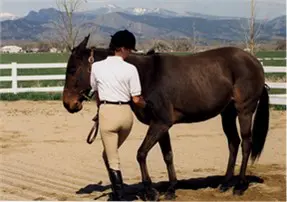 Because showing mules and donkeys is relatively new, there is much to be gained by participation. Those who feel that their animal is not of show quality can still attend shows and learn a lot about Showmanship, grooming and training skills. This development of new skills can make the difference between show quality or not, particularly in performance events. Newcomers to showing also give the audience something extra-special. The enthusiasm of the newcomer is often very contagious and the audience always finds Longears shows incredibly entertaining. They feel that this is something that they too could manage to do and enjoy. Those who feel they just cannot put in enough training time can still participate in a lot of the plain old fun classes that the show rosters include. There are enough mule and donkey clubs today that sponsor all kinds of shows and all one needs to do is contact any one of them to acquire the information that you need.
Probably the most intimidating fear of all is the fear of making some awful mistake in the show ring…in front of “God” and EVERYONE! I doubt that there is anyone showing who hasn’t experienced that awful mistake at least once in the course of learning. It’s all part of the process! “To err is human…” and err we do! I remember riding my mule in a Green Western Pleasure Class several years ago. When they asked us to trot in and line up, my mule tripped and fell flat on his face! Was my face red! Another time in a Trail Class at the World Mule Show, I picked up a plastic bag full of tin cans that rattled loudly and scared the tar out of my mule. He took off, lickety-split, out of the Trail Class and down the racetrack in front of more than 20,000 spectators! If I could have died at that moment, I would have, but I DID survive and the embarrassment of the moment subsided. The disaster of yesterday has become the source of a humorous story to tell others for years to come! So, let’s not allow too much seriousness and false pride to spoil an otherwise REALLY good time with friends! Learn from your mistakes, but don’t let them cripple you.
Time and money can be a hindrance to showing today. Economic issues are quite prevalent today, but as they say…”Where there’s a will, there’s a way!” With careful planning and the conscientious setting of priorities, one can determine the number of shows one can easily attend in a season. Those who sponsor and work on shows are sensitive to the needs of the exhibitors and are willing to help in every way they possibly can. Most donkey and mule shows are not all that expensive and can be managed quite easily.
At most of the larger one-day shows, those who wish to do so are allowed to tie to their trailers to save on stall fees. This is true in a lot of regions. Entering fewer classes will also save money and still provide you with the important learning and social benefits of showing. There are so many different sizes, colors and abilities in mules and donkeys today. Show committees encourage as many participants as possible in order to have the Longears breeds adequately represented. Schooling Horse Shows welcome the novelty of the Longears animals!
 Geographical locations and transportation can also restrict showing opportunities. With a little help and a lot of ingenuity, these issues can be resolved. One just needs to decide which shows would benefit them the most and then plan accordingly. If the show is some distance away, families, or groups, can pool their efforts and cut expenses dramatically. The growth of the mule and donkey industry has increased the number of shows throughout the country. They are now more numerous in remote areas and easy to reach. If you live in a really remote area, you might want to start a Longears Group and host your own schooling shows, or you can always request permission to ride in the Open Classes at Horse Shows in your area. Either way, you are doing important work in the promotion of Longears!
Last, but certainly not least, a word about politics. In the mules and donkey industry, we are not campaigning, not competing ruthlessly against horses and ponies. We are simply promoting our beloved mules and donkeys and their incredibly versatile abilities and looking to improve our own Mulemanship ability. As individual riders and owners meet their challenges and succeed, we should all feel warmth and joy for their accomplishments. Those individuals and their Longears have worked long and hard. They stand as representatives and heroes for us all. We can all learn to be proud and supportive of the greater cause.
When in competition, compete against yourself and learn to derive joy and pleasure from your own improvements and the improvement of others. There is a lot that showing has to offer besides ribbons and trophies. Showing gives you the opportunity to test your skills and measure your success. It helps to assess different skills and make personal choices, expand your social interaction and share knowledge gained with those that have similar interests. Most of all, showing gives each of us the opportunity to exhibit good sportsmanship and do our part in support of our beloved Longears!
To learn more about Meredith Hodges and her comprehensive all-breed equine training program, visit LuckyThreeRanch.com or call 1-800-816-7566. Check out her children’s website at JasperTheMule.com. Also, find Meredith on Facebook, YouTube, Pinterest, Instagram, MeWe and Twitter.
Covered in TRAINING MULES & DONKEY: A LOGICAL APPROACH TO TRAINING, TRAINING WITHOUT RESISTANCE and EQUUS REVISITED at www.luckythreeranchstore.com
© 1987, 2016, 2024 Lucky Three Ranch, Inc. All Rights Reserved.

CHASITY’S CHALLENGES: Yearly Baths: 7-14-20
Each year, I try to pick the hottest week in July to do the equine’s yearly baths. The mules and horses have shed out their winter coats, except for a strip of hair on the mules’ bellies, and the donkeys are getting closer to being completely shed out. This makes a difference when you are trying to get them dry after their baths. They all begin to grow their winter coats in September.
Their natural hair coats will insulate them from the heat and cold and will protect them from insects, so I do not advise clipping them unless you are showing. Even then, it is not advisable to clip the hair inside of the ears! I bath as many as four at a time and in smaller friendly groups like Wrangler and his “Lady Love,” Chasity! I am polite, considerate and respectful, so it is always an enjoyable experience for all! I begin with the introduction to the hose on their front legs.
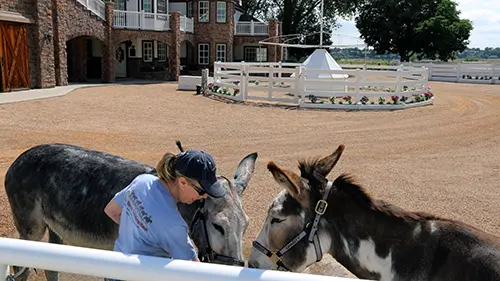

Wrangler and Chasity enjoy their yearly baths to get off the dirt that has built up during the year. I offer a drink to their lips and afterwards move to their foreheads, being careful not to get water in their eyes or ears. I spray the water gently into their mouths and we “water pick” the teeth! Playful antics like this teach them to always remain calm and keep things safe between us. This keeps interest to a maximum and intimidation to a minimum.
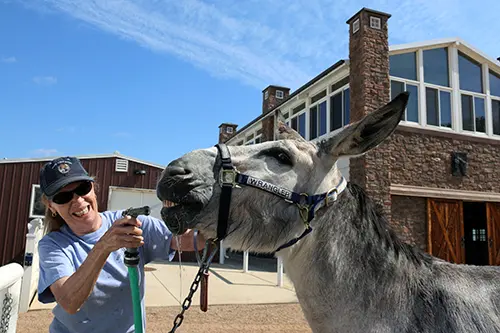

When they are approached in this manner, Chasity and Wrangler can enjoy the cool water on a hot day! Chasity knows I am being careful and doesn’t pull away, then takes a sip from the hose.


I reward Chasity with crimped oats from my fanny pack for being such a good girl. Then I rinse off the oats that were stuck to her whiskers as she gazes at the other equines in the pens nearby who are anxiously awaiting their turns.


Her attention returns to me and I work my way up her forehead to her forelock and ears. I make sure the spray is light and doesn’t sting so she will keep her ears laid back for the rinsing. I would hate to get water in Chasity’s ears, but if by accident I do, I just back off and allow her to shake her head to get the water out before I resume.


We use Tres Semme (Breakage Defense) shampoo and Aussie 3X Conditioner on the manes and tails only, and just water on their bodies to keep their hair coats from drying out. In the case of Chasity’s white legs, I will use the shampoo and conditioner there, too. The result is a healthy and shiny hair coat year round.


I spray the water over their bodies and then follow up with the serrated side of the shedding blade to scrape the dirt from their body. I keep going over each spot until the water runs clear. I pay special attention to the legs and any places that flies might have laid eggs. I will scrape these places with a stiff brush or with my fingernails and apply Neosporin to these spots, and any sores, after they are dry. I scrape off the excess water with the smooth side of the shedding blade. Then Chasity and Wrangler are put on the hot walker to dry.

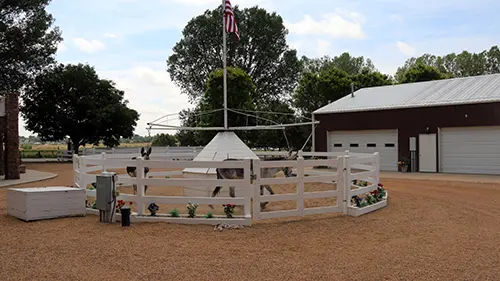
When Wrangler and Chasity are dry, I sprinkle Johnson’s Baby oil in the manes and tails and spray for flies with Farnam Tri-Tech 14. The baby oil will keep them from chewing on each other’s manes and tails. Those who have sensitive skin around their eyes will receive fly masks. Chasity and Wrangler do not need them. When entering or leaving an area, we ALWAYS execute gates exactly the same way! That way, there is no confusion and chaos that could result in resistant behaviors.
Chasity and all my equines always know exactly what is expected and know exactly what they need to do.
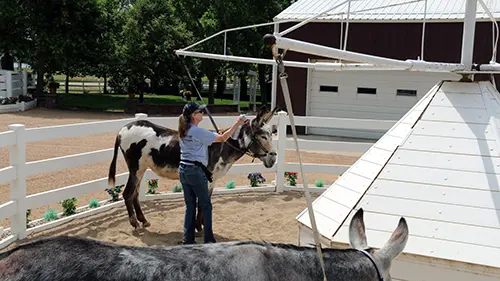

Chasity will be rewarded with her favorite crimped oats for her cooperative behavior. Good manners, and being polite and respectful are paramount to getting your equine’s full cooperation! Even if Chasity does go right out into her pen and roll afterwards, she always seems to enjoy having clean, healthy skin and hair. And, most of all, she enjoys her time with me and looks forward to the next time!